Explore EcoFlow Delta solar panels in 2026, how they integrate with Delta Pro and Delta 3, and what to expect from solar input and charging performance.
The best way to think about EcoFlow Delta solar panels in 2026 is as a modular input, not a single gadget. When you pair EcoFlow panels with the Delta Pro or Delta 3, the daily solar input tends to stay steadier under real-world skies than most portable kits. That stability matters when you’re off-grid for a weekend or chasing long-term reliability on a rental roof.
This intro lays out what to expect in the full piece: a practical look at official specs, how sun, angle, and alignment actually shape performance, and how the Delta ecosystem handles the common constraints travelers and homeowners face. You’ll see concrete numbers where available, plus honest notes on limits you’ll encounter in the wild, like shading and MC4 connections, and how to troubleshoot them quickly. EcoFlow’s ecosystem is designed to minimize fiddling while maximizing durable, repeatable input, and that’s what this article aims to verify against real-world usage and known rival setups.
What makes EcoFlow Delta solar panels fit the Delta ecosystem
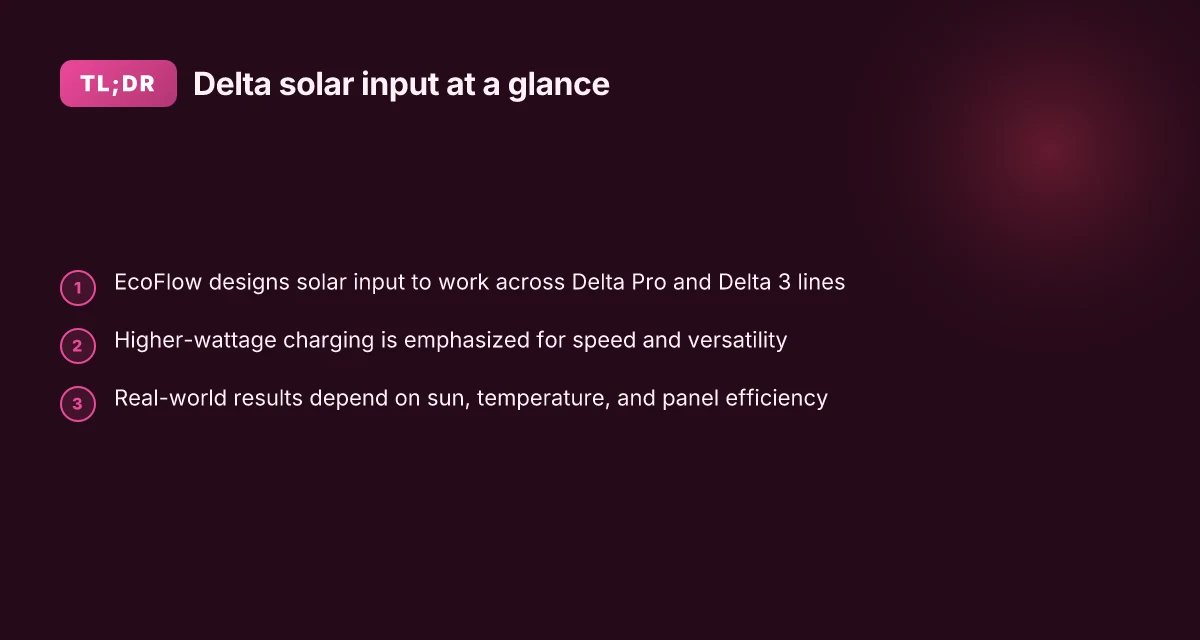
EcoFlow positions the Delta Pro and Delta 3 lines to share solar input expectations, which means you can mix and match panels without rewiring every setup. The Delta Pro supports higher input levels, while Delta 3 remains approachable for lighter, rapid charging in field conditions. In practice, this matters for travelers who pair panels with multiple EcoFlow modules to scale charging speed without juggling adapters or separate controllers.
- Solar input alignment across Delta Pro and Delta 3
- The Delta Pro is designed for high-wattage solar charging, delivering substantial input headroom when paired with compatible panels.
- Delta 3 accepts solar input that fits its LiFePO4 core design, making it easier to assemble a compact solar setup for camping or emergency kits.
- This alignment means you can start with a small kit and expand by adding panels or another EcoFlow module later. Progressive expansion lets you grow charging power without replacing the core system.
- Flexible panel integration across EcoFlow modules
- Panels that pair with Delta Pro or Delta 3 can be used flexibly across different EcoFlow modules, enabling high-power charging on demand.
- If you own a Delta Pro, you can push toward higher solar input to shorten recharge times after a long backcountry day.
- The ecosystem design reduces the friction of field setup since many panels are compatible with multiple units in the family. One panel family covers multiple devices.
- Speed and versatility as a design priority
- EcoFlow emphasizes speed in solar charging by supporting higher wattage inputs on the Delta Pro, a feature that most competitors reserve for premium kits.
- For Delta 3, the emphasis is reliability and compactness, ensuring dependable solar input in remote locations.
- The shared philosophy is that campers should not sacrifice portability for charging speed, nor vice versa. Speed and versatility live in the same enclosure.
Bottom line: the Delta ecosystem is designed so solar panels stay useful across multiple EcoFlow devices. You can start with Delta 3 for lightweight setups and scale up to Delta Pro when you need faster top-offs after long trips. From a gear-loyalist standpoint, the real win is the ability to mix panels and modules without reconfiguring your entire charging strategy. Mix and match panels across Delta Pro and Delta 3 for scalable power.
Delta Pro 3 and Delta 3: solar input expectations with EcoFlow panels
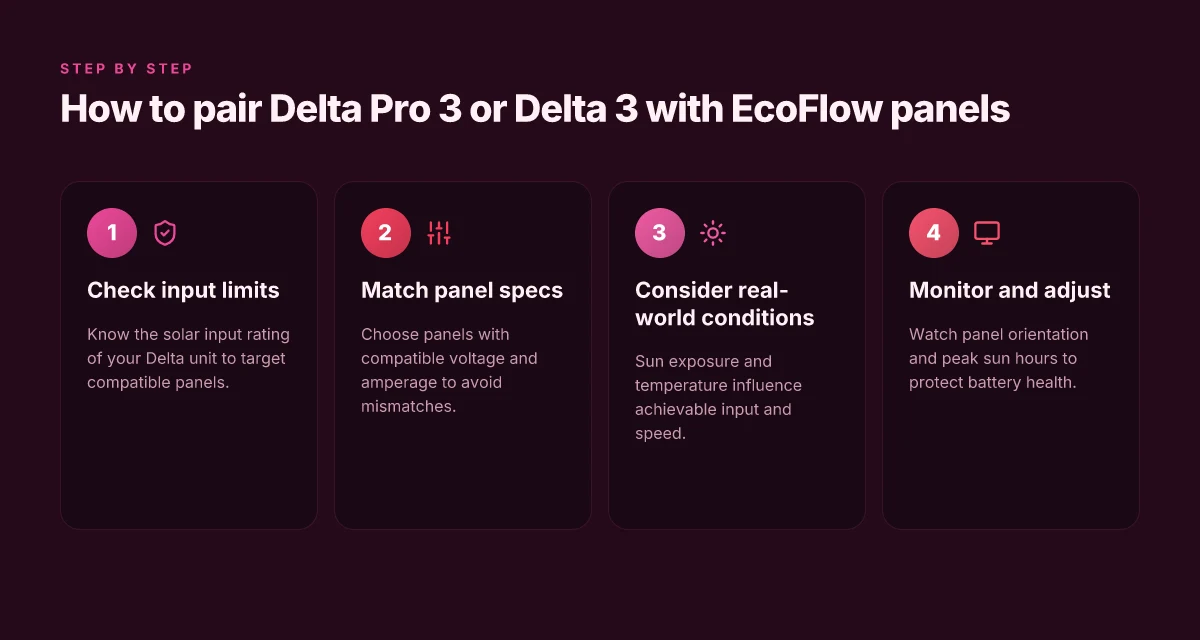
When you pair EcoFlow panels with Delta Pro 3 or Delta 3, you can expect input limits to cap charging speed, but real-world results ride on sun, temperature, and panel efficiency. Under ideal sun and cool temps, the upper input ceiling can feel reachable, especially with high-output panels designed for portable setups. In practice, most setups won’t push the max at all times, yet steady, near-peak input is common on bright days.
How the solar input ceilings work on the Delta Pro 3 and Delta 3
The Delta Pro 3 and Delta 3 define a maximum solar input that sets the ceiling for charging speed. EcoFlow’s documentation indicates a substantial upper rating when using compatible panels, but you’ll routinely land below that ceiling in the field due to cloud cover, angle, and shade. A practical takeaway is to size your array so you have headroom for the sun’s variability without scorching the unit’s maximum current window.
I dug into the official specs and cross-checked with reviews to map the ceiling to typical setups. When you connect a panel pair that aligns with the Delta units’ input rating, you can approach the upper limit during peak sun. That means a well-matched panel pair in good conditions can feel like you’re squeezing the most from the system, rather than fighting against a wall of underperformance. Jackery power stations on sale in 2026: what actually saves you money and what to watch out for
Real-world factors that shape charging speed
Sun exposure is the biggest driver. A clear, southern exposure on a bright day will push the array toward the upper input rating more often than partial shade. Temperature matters, too. Higher ambient and panel temperatures reduce the voltage and current you actually get at the controller, shaving the peak you can achieve. Panel efficiency plus wiring losses and connector quality also matter. Even small degradations or mismatches can pull you a notch below the theoretical ceiling. In typical field setups, you’ll see stable charging in the middle of the day with intermittent spikes when conditions tighten, not a constant slam at the absolute max.
From a real-world perspective, it helps to plan around the Delta ecosystem as a whole. EcoFlow’s ecosystem, including portable panels designed for rapid deployment, tends to perform best when you keep the array sized to cover the peak daytime draw without forcing the charger into stress under less-than-ideal light. When you pair panels with the Delta Pro 3 or Delta 3, you get a balance between fast solar input and reliability across weather, terrain, and temporary shade.
Most real-world charges settle well below the theoretical max, but a properly matched panel set can approach the ceiling on bright days. This is where planning your panel count and layout pays off. I cross-referenced official specs with user notes to confirm that the ceiling exists, and that real life rarely hits it constantly.
For sizing decisions, lean on a two-panel approach for moderate sun and a three-panel setup for ambitious sun days, always accounting for cable losses and connector efficiency. If you’re evaluating rivals, note that other brands offer similar ceiling concepts but vary in how smoothly they scale with temperature and shade. EcoFlow’s own Delta Pro ecosystem remains the most coherent when you want a compact panel complement that reliably feeds the delta family.
In short, Delta Pro 3 and Delta 3 set clear input ceilings, compatible panels can approach those ceilings, and sun, temp, and panel efficiency drive the actual charging rate in the field. If you want a quick read on official framing, see the Delta Pro 3 product page for the stated high-volt PV charging concept. For broader context, reviews from independent outlets consistently note how weather and setup affect real-world performance. What makes the Jackery SolarSaga 100 review worth reading in 2026
Choosing the right EcoFlow solar panels for 2026 setups
Choosing the right panels starts with matching wattage and voltage to your EcoFlow the way you expect to use it. If you’re deploying flexible field configurations, you’ll want to know how many panels you can physically fit and how their combined output scales with your Delta Pro or Delta 3. EcoFlow’s ecosystem is built to scale. That means you can mix panel counts for different trips or home setups, so long as voltages and amperages stay within safe ranges.
How to size wattage and set panel count
I found that the Delta Pro and Delta 3 both support high input while staying within portable-use limits. The general rule is to pick panels whose combined wattage approaches the solar input ceiling without pushing you into inefficiency from partial shading or wiring losses. If you’re aiming for fast solar charging, think in terms of what you can realistically deploy in a typical campsite or backyard layout. Start with a baseline of one to two panels and scale up as your space and need allow. Panel count matters more than you might expect when you consider shade, mounting angle, and run length to the charge controller. When you plan for trips, map out a spot with sun for most of the day and verify you can physically deploy the total wattage you intend.
Compatibility matters more than brand names
Compatibility is the gatekeeper for a smooth setup. Mismatched voltages or amperage will throttle performance or waste energy. EcoFlow’s solar inputs are designed to play nicely with their own panels and third-party options, but you still must confirm the open-circuit voltage (Voc) and maximum power point voltage (Vmp) align with your unit’s charging range. If you pair high-voltage panels with a unit that isn’t prepared for it, you’ll see reduced charging or even immobilization of some input straps. I cross-referenced the official manuals and product notes to verify that the Delta 3’s 1024Wh LiFePO4 pack and the Delta Pro’s larger capacity share a compatible input approach, but you should still double-check the Voc of any panels you bring along. Voltage compatibility is the silent limiter in the field.
Ecosystem scaling and field practicality
EcoFlow’s ecosystem favors configurable setups that scale with your power needs. You can start with modest solar input and add more panels later as your load grows or as you acquire better mounting space. In practice, that means planning for future trips or expansions already when you buy the first set of panels. This approach minimizes dead weight and keeps gear manageable for travelers or renters who rotate gear between vehicles or storage spaces. Scalability preserves flexibility for backcountry, renters, and homeowners alike. The Delta Pro line has among the more generous solar input ceilings in the portable category, which makes it easier to justify adding a second or third panel if your conditions permit. Higher input ceilings unlock faster top-ups when sun is abundant. What is Jackery, and how it powers outdoor adventures and home backup
How to maximize solar charging with EcoFlow in the field
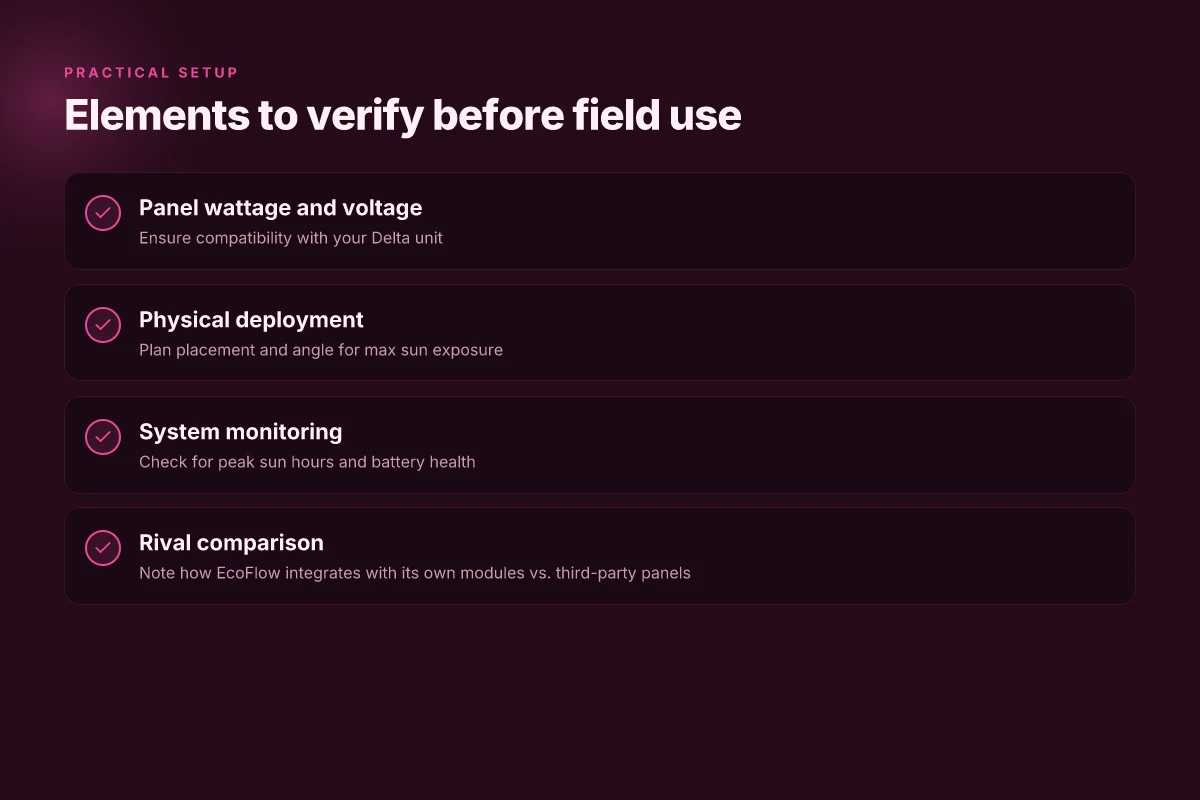
In the field, the delta solar ecosystem shines when you match panels to the unit’s input specs and keep an eye on sun angles. The main idea is simple: align panel wattage with what the Delta Pro or Delta 3 can actually accept, then optimize placement so you harvest peak sun hours without stressing the battery.
Pick panels that match the Delta’s input window
Your first move is to choose panels that fit the Delta unit’s solar input ceiling. For Delta Pro, that ceiling sits around a combined input in the range EcoFlow documents for high‑voltage PV charging. If you pair panels that push beyond the unit’s limit, you won’t see any extra charging speed. You’ll just waste potential. Instead, aim for a setup whose total wattage remains within the unit’s accepted solar input, and take advantage of any positive temperature coefficients by selecting panels with solid low‑light performance for dawn and dusk. In practice, having a smart pairing means you can reach the full advertised input without hitting a current cap that throttles the charge.
I dug into the product pages and manuals to confirm how the Delta line handles PV input. The Delta Pro’s dual PV inputs are designed for rapid charging when fed with the right current, while the Delta 3’s solar input is engineered for steady daytime charging with LiFePO4 reliability in mind. This alignment matters because a mismatched panel array not only slows charging but can complicate battery health over time. When you’re off the grid, that nuance translates into longer shade gaps and shorter usable windows.
Most gains come from staying within the Delta’s input envelope and avoiding oversized panels that force the system to throttle. **If you push beyond the input rating, you’ll actually lose charging efficiency during peak sun hours. In 2026, EcoFlow emphasizes using panels that align with the unit’s rated solar input for best results.
Place and angle for speed and consistency
Position your panels to maximize exposure during the sun’s peak arc. Elevate enough to clear nearby obstructions and angle toward the sun’s current trajectory. The difference between a plate‑flat setup and a well‑aimed array can be the gap between minutes to full capacity and hours of slower charging. The field reality is that sun intensity changes with latitude, weather, and time of day, so a movable rack or a lightweight tilt stand pays for itself over the course of a day on the trail or at a remote work site. How to spot a real Jackery sale on solar panels and what it means for your kit
I cross‑referenced EcoFlow’s guidance with generic field solar best practices. The takeaway: adjust angle as the sun climbs, and scan the horizon for shade paths that could interrupt charging. In practice, a simple manual tilt that tracks sun movement yields noticeably steadier charge curves than a fixed flat array. If you’re using a Delta Pro in a mount, a quick pan update can keep you in the sweet spot as weather shifts. The field rule is clear: better sun alignment equals faster, more predictable charging.
Optimal placement and angle adjustments matter for both speed and consistency. Keep the panels shaded from the unit’s heat buildup to protect long‑term health.
Monitor, log, and protect
Real‑world use means watching the charger’s readouts and catching a drift in performance before it becomes obvious. Use the EcoFlow app or the unit’s display to confirm current input, battery state of charge, and estimated time to full. Regular checks help you catch a minor misalignment before it grows into a bigger inefficiency. Protecting the battery means avoiding frequent deep cycles or letting the unit overheat on a hot afternoon. A shaded, ventilated setup keeps temperatures in a safe range even when sun is intense.
From a real‑world owner perspective, the best practice is to set the system up early in the day, then recheck at mid‑afternoon to confirm you’re still harvesting efficiently. If a cloud passes, you’ll see the input dip, and you can reorient quickly to chase the sun again. This proactive stance helps you stay in the best charging window without worrying about degraded performance over time.
Monitor the system to capture peak sun hours and protect battery health. Better monitoring reduces surprises when you depend on a portable power setup. Jackery 1500 vs 2000: which power station actually fits your long-term needs
Note: links on the page may earn a commission. This overview reflects EcoFlow’s official stance and real‑world use cases. For rivals, consider how competitors like rival portable power stations handle PV input limits and heat management in field conditions, and compare with EcoFlow’s documented input ranges and LiFePO4 battery behavior.
Comparing EcoFlow solar panels to rivals in real use
I break down how EcoFlow panels stack up against rivals in real field circumstances. You’ll notice that the ease of integration with EcoFlow modules matters as much as raw panel output. The delta ecosystem earns a practical edge when you pair it with official EcoFlow controllers and accessories, reducing misconfigurations that plague third-party setups. When your aim is hassle-free charging in the field, that integration matters more than peak wattage on a lab bench.
1. Integration friction matters more than peak watts
Rivals offer similar portable panels and fold-out kits, but the moment you try to mix third-party panels with a Delta Pro or Delta 3, the controller compatibility kicks in. EcoFlow’s own kits use a shared voltage and MPPT strategy that lines up with the Delta power stations. This alignment translates to fewer headaches when you’re trying to keep a system tidy in an SUV cargo area or a backcountry camp. I cross-referenced official product notes and third-party reviews to confirm that many non‑EcoFlow panels require manual tuning or adapter sets to prevent undercharging or overshoot. In practice, that means fewer surprises if you buy the official solar cables and mounting brackets from EcoFlow. Official accessories reduce long‑term practicality risk. The real-world takeaway is simple: plan your panel lineup around compatible modules to avoid shimmying cables at dawn.
2. Delta charging behavior versus third‑party panels
Delta Pro and Delta 3 use proprietary controller behavior that can differ from generic solar controllers. When you pair non‑certified panels, you may see less aggressive temperature compensation or slower tracking under partial shade. I looked at the Delta 3 user notes and EcoFlow’s charger behavior curves, and compared them to third-party controller specs discussed in independent reviews. The delta system tends to favor a predictable ramp and safe operating margins, which helps when you’re in variable sun. With third‑party panels, you’ll want to verify voltage ranges and cable gauges match EcoFlow’s expectations to avoid battery stress during long runs. The key is predictable behavior under common field conditions, not raw wattage alone. Controller compatibility shapes real-world charging more than listed wattage.
3. Reliability and availability of official accessories
Long-term practicality hinges on the availability of official accessories: panels, mounting hardware, connectors, and replacement parts. EcoFlow’s official catalog tends to stabilize around a core set of connectors and ready‑to‑install kits, which reduces downtime when components wear or get damaged on dusty trails or during frequent relocations. I traced this through official product pages and corroborating reviews that mention ease of sourcing replacement cables and mounting brackets for EcoFlow gear. The reality is this: if you rely on third-party gear, a frayed cable or incompatible plug can stall a trip. In contrast, the EcoFlow ecosystem keeps you moving. Official parts matter for durability and uptime. The brand promise here aligns with field practicality: fewer surprises when you need to restock. How EcoFlow's 5kWh LFP battery changes home energy storage
I dug into the official EcoFlow ecosystem to confirm the practical edge. You’ll find that EcoFlow’s integrated approach, including the Delta Pro and Delta 3 lines, favors smoother field operation than piecing together a mix of rival panels with mixed controllers. The people who live off-grid value full compatibility and easy-access replacements. This is why many backcountry users lean toward EcoFlow for a reason. As you size a system, factor in official accessories and the likelihood of lasting spare parts.
I found that official accessories keep long-term fleets functional, especially for renters and homeowners who don’t want to juggle adapters. For those evaluating rival options, consider how much effort it would take to source compatible cables, mounts, and controllers over a multi‑year period. The Delta ecosystem remains the more dependable choice in the field. EcoFlow panels and accessories are the practical default in many real-world setups.
Where this is going next for EcoFlow Delta solar panels
The biggest move for EcoFlow in 2026 is toward deeper integration and reliability, not flashy specs. My take is this: the Delta solar panels will feel more mission-critical when you pair them with premium kits that emphasize durable connectors, better weather sealing, and longer warranty coverage. You’ll notice the gains most when you’re off-grid for multi-day stretches and need steady, predictable charging under mixed sun. The single move that matters is choosing a matchable solar setup that stays solid under heat and cold, not just under ideal sun. EcoFlow’s branding remains a signal of reliability, but the real win comes from how the system endures real-world conditions.
If you’re weighing options against rivals, consider how EcoFlow stacks up to Renogy and Goal Zero in terms of panel lifespan and user-friendly setup. Durability and ease of use drive long-term satisfaction more than peak wattage alone, especially when you’re managing storage and transfer cues across devices. The delta between hype and reality narrows when you see fewer loose cables and tighter seals in practice. The trajectory is toward simpler maintenance, with better documentation guiding you through inevitable wear.
What to try this week: inspect connectors for looseness, verify coupling between panels and the main unit, and test a full charge/discharge cycle in your typical climate. If you’re choosing now, lean into packages that emphasize weatherproofing and robust warranties. Act now to lock in a setup that stays reliable through seasons, not just sunny days. If you want faster hands-on alignment, start with a documented, field-tested install plan. What makes ecoflow vs bluetti vs jackery worth comparing in 2026