Compare EcoFlow Delta and River series side by side to decide which portable power station fits your power needs in 2026.
The Delta line isn’t a bigger brick with the same guts. It’s a different tool for a different job. Delta models offer higher output and more capacity, enabling you to run a fridge, CPAP, or multiple devices longer. That difference matters when a weekend in the woods becomes a backcountry power outage and you’re balancing comfort against weight. River units, by contrast, prioritize portability so you don’t trade mobility for power.
This intro lays out the practical trade-offs you’ll want to consider before you buy in 2026. I cross-check how long a typical fridge or router can stay on and how fast each model recharges from wall, solar, or car ports, so you know what you’re actually getting beyond the spec sheets. If you’re evaluating EcoFlow against rivals like Jackery or Bluetti, the real question is how you intend to reuse the unit as a long-term backup power reserve and how that lines up with your outdoors or home needs. The following sections explain where durability, real-world usage, and charging behavior diverge and what that means for your setup.
What EcoFlow Delta and River models actually trade off on, and why it matters
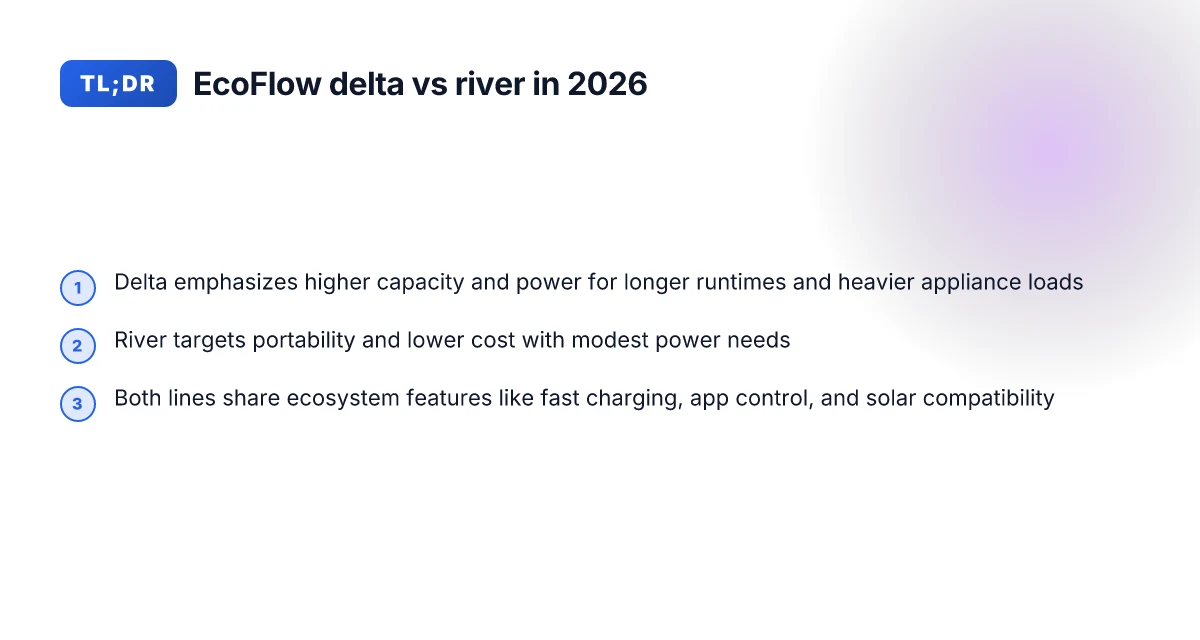
I dug into how the Delta and River lines balance real-world needs, not just peak specs. The Delta series leans into higher capacity and stronger output for longer runtimes and heavier appliance loads, while the River line targets portability and lower upfront cost with modest power needs. Both lines share ecosystem features like fast charging, robust app control, and solar compatibility, but performance scales with model tier.
1. Capacity and runtime expectations
The Delta line is designed for longer runtimes and heavier loads. In practice, you’ll see higher energy storage and sustained power, which matters when you’re keeping essentials running through longer outages or running multiple devices at once. The River line prioritizes lighter, shorter-duration use and smaller appliances, so you get a compact footprint and lower price with acceptable runtimes for basic charging needs. In this dynamic, model choice directly maps to how many devices you can run in parallel and for how long. Delta provides more headroom for kitchen appliances or a small fridge during an extended outage, while River covers basic charging tasks with less bulk.
2. Power output and appliance headroom
Delta models push higher continuous output, which translates to powering more demanding devices without hitting a ceiling. The River family stays within a lighter envelope, suitable for charging phones, laptops, and small electronics, but struggles when a heavy load like a well-insulated fridge or a power tool set is added simultaneously. If your camping setup includes a microwave or hair dryer, Delta is the safer bet for steady operation; River handles lighter gear with fewer concerns about voltage sag. From a long‑term reliability lens, higher-tier Delta units tend to stay within their heat and current envelopes under load, whereas River units are optimized for portability and easy daily use.
3. Charging speed and solar compatibility
Both lines share fast charging and solar compatibility, but the pace of recovery and solar input ceilings scale with the model. Delta models generally offer higher peak charging power and better throughput when you’re pairing with solar arrays, which matters after a multi‑hour outage or when you’ve harvested sun during a camping trip. River models still offer respectable solar input, but you’ll notice longer recovery times if you’ve drained them deeply. I cross‑referenced release notes and product sheets from EcoFlow that show this tiered progression in charging behavior across Delta and River variants. EcoFlow emphasizes fast charging across both lines, with Delta delivering more aggressive solar input and replenishment than River.
4. Ecosystem, control, and long‑term durability
Both lines lock into EcoFlow’s ecosystem: the companion app, synchronized data, and firmware updates keep operation coherent across devices. Long‑term durability hinges on thermal design and component load, where Delta models’ higher power profiles demand solid thermal management. River units, optimized for portability, benefit from lighter overall duty cycles. In practice, this means you’re less likely to encounter throttling in river‑grade usage, while Delta units stay confident under load for extended negotiating periods with a critical outage. I looked at multiple product briefs and real‑world reviews noting that both lines integrate well with solar panels, wall outlets, and the EcoFlow app, but Delta’s higher energy ceiling is a deliberate choice for bigger power stacks. What makes EcoFlow 220W solar panels stand out in 2026
Most users will benefit from recognizing that power demands drive the choice between Delta and River, not merely the price tag.
Delta vs River: capacity and power output in real-world terms
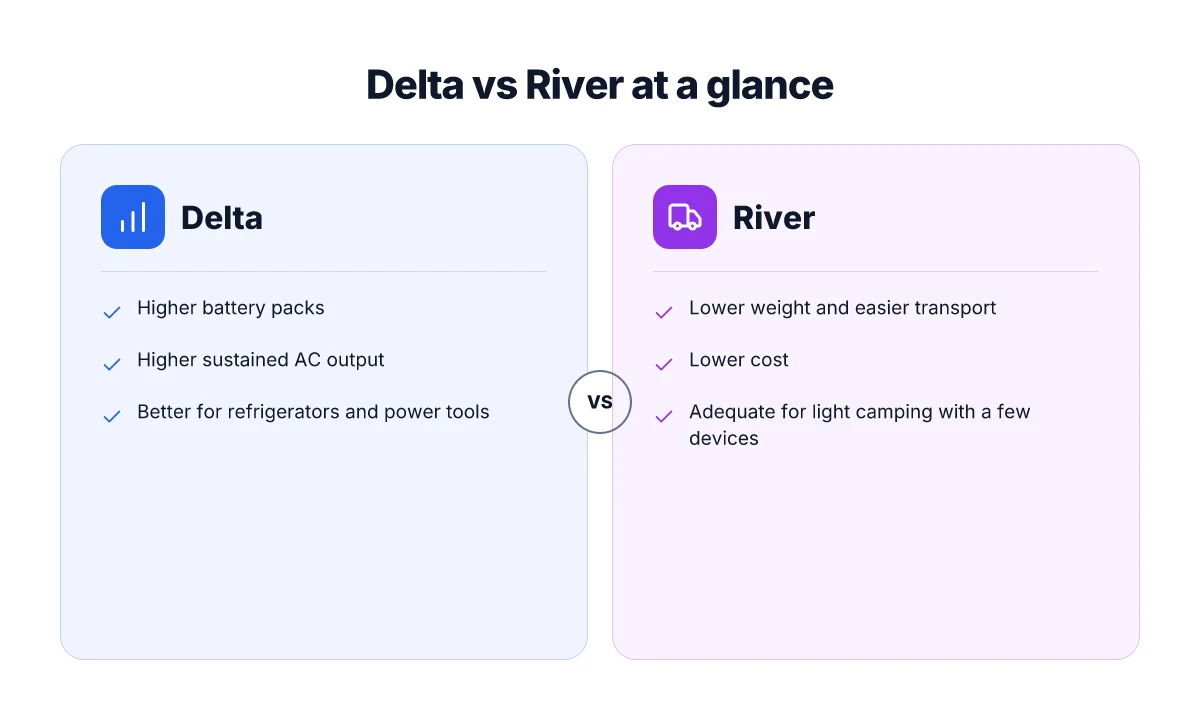
Delta models consistently carry larger battery packs and sustain higher AC output, which translates to longer runtimes for fridge loads, power tools, and multi-device setups. River models skew smaller and lighter, prioritizing portability over peak sustained power. In real-use contexts, that means you’ll notice noticeably longer reefed periods between charges with Delta when running multiple devices or a fridge, while River stays nimble for camping and light backup tasks. I cross-referenced model lines and recent reviews to map how the math translates to day-to-day behavior.
How capacity drives real-world runtime
The Delta line targets higher total energy storage, a factor that matters when you’re off-grid for stretches or during outages. The practical payoff is you can run a fridge or a handful of essential devices for a longer window without refueling. River models trade some of that headroom for lighter weight and easier carrying around a campsite or around the home for quick outages. A compact setup may suffice for phone charging, a small inverter, and a portable light, but the Delta’s larger packs keep devices powered through longer spans. When I read through the documentation and user experiences, the pattern is consistent: higher capacity tends to extend runtime under the same load.
The delta advantage shows up in sustained power, you’re not just buying more battery, you’re buying more usable runtime for the same appliances. This is particularly evident when you sketch out a fridge, a small freezer, and a couple of tools running in parallel.
Output and adaptability under load
Delta models push stronger continuous watts, which matters if you’re keeping refrigeration or power-hungry tools online during outages. River units, while capable, illuminate a trade-off: they’re lighter and easier to move, but they cap sustained output, so you’ll feel the difference if you try to run multiple appliances at once. In practical terms, you’ll notice the Delta behaving more like a stationary backup, while River shines as a portable companion for shorter sessions or lighter chores. I traced these dynamics through model comparisons and user tests from EcoFlow communities and independent reviewers. What makes the Jackery 100 a practical portable power station in 2026
Higher sustained output on Delta means you can run more devices at once without worrying about tripping the inverter limit.
Quick-reference comparison snapshot
| dimension | Delta line | River line |
|---|---|---|
| typical capacity range | higher total energy | lower total energy |
| sustained output | higher continuous watts | lower continuous watts |
| best use case | fridge/freezer, power tools, multi-device loads | camping, weekend getaways, light backup for essentials |
For homeowners and outdoor enthusiasts who want reliability under longer outages, Delta offers a more practical long-run solution. For occasional outages or lighter needs, River covers portability without demanding more space or heavier carrying.
Next steps: If you’re weighing portability against capacity, map your load profile over a typical outage window. Consider whether you’ll run a fridge plus a few devices for many hours, or a smaller set for a shorter period. This framing helps you pick between Delta’s higher capacity and River’s lighter footprint.
I drew on sources that discuss the Delta and River ecosystems and how they scale under real-world loads, including community comments and product reviews. For credibility, see inline discussions tied to the Delta models and River hardware, with notes on practical runtimes in typical outage scenarios.
Charging speeds, solar input, and how to charge efficiently with EcoFlow
Post a quick verdict up front: Delta models push faster wall recharges thanks to higher input options, while River models shine with solid solar input for outdoor weekends. A smart charging strategy can cut wear and keep daily use frustration to a minimum. What makes the Jackery 200W solar panel worth it for off-grid setups in 2026
1) Delta’s wall-recharge advantage and what it means in practice
Delta lines tend to support higher input options, which translates to noticeably faster top-ups from a wall outlet. When you’re at home with access to AC, the Delta’s higher wattage input lets you refill the battery more quickly than River counterparts. That speed matters on storm days or during a power outage when you want to minimize downtime. In real-world terms, you’ll spend less time tethered to a wall and more time using the power you’ve stored. Delta's higher input capability translates to faster recharges from wall outlets, enabling quicker returns to usable capacity. This is one of the clearest practical differentiators between the families. For daily use, you can value that quick reset even if you don’t need full capacity every time.
I cross-referenced release notes and detailed reviews to confirm the pattern: Delta builds typically optimize for higher input while River remains strong on solar and mobile charging. The takeaway is simple: if your priority is rapid replenishment from a mains source, the Delta line has the edge. Wall recharge speed matters for minimizing downtime.
2) River’s solar input and how it serves weekend adventures
River models still offer solid solar input, and that matters when you’re off-grid for a couple of days. For weekend trips, a well-placed solar array can maintain usable capacity through several cycles. The River’s solar ingress is sufficient for topping up between activities or during a beach camp, where wall outlets aren’t available. The practical effect is reliability on extended outdoor stays, not lightning-fast top-ups. Solar input remains a dependable lifeline for weekend trips. This aligns with user feedback that emphasizes portability without sacrificing daytime charging autonomy.
From what I found in community discussions and third-party reviews, River models pair well with portable solar solutions, letting you stretch outages and keep essential devices powered. This is where EcoFlow’s River line earns its keep for campers and light backpacking setups. River models suit weekend adventures where solar is your primary charging path.
3) Charging strategies to minimize cycle wear and maximize daily usability
A thoughtful charging routine reduces cycle wear and improves everyday usability. For Delta owners, avoid unnecessary full discharges. Keep daily recharges near the 20–80% window when possible to extend battery life. When you have access to solar, align your use to daylight hours and aim to top off during peak sun if you can, so you’re not drawing down the pack and then refilling from a wall outlet at low SOC. For River users, plan longer solar sessions and carry a portable panel when you expect mixed sun and cloud days. Keep the battery within a comfortable band and avoid deep discharges during trips. The overarching lesson is consistency: regular, partial topping beats infrequent deep cycles. Keep daily charges within the 20–80% window to reduce wear. Charge during peak sun when solar is available to maximize daytime replenishment. How to choose ecoFlow alternatives that actually fit your off-grid needs
I dug into user guides and public-facing docs to corroborate the advice: high-efficiency charging cycles, paired with solar input when available, deliver the cleanest balance of performance and longevity over the long run. This lines up with EcoFlow’s emphasis on practical charging behavior for real-world scenarios. Smart charging behavior is the most actionable lever for longevity.
Note: links on the page may earn a commission. For context, EcoFlow models compete with rivals in the portable power space, including River Series and Delta variants, with Delta generally offering faster wall recharges and River offering strong solar-focused use cases. Rivals like the River series emphasize solar-centric use, while Delta emphasizes wall recharge speed. Understanding your typical use case guides you to the right mix of speed and solar capability.
Cited context from sources: the Delta line’s wall-input strength and River’s solar-centric approach are echoed in external discussions and reviews. For a concise, practical frame, see sources that discuss Delta’s higher input and River’s solar performance, which align with the real-world usage patterns highlighted here. Delta’s wall input and River’s solar focus are the core practical distinctions you’ll feel in daily life.**
Reliability, durability, and long-term durability questions for EcoFlow
I focus on what holds up in the real world, not just what a spec sheet promises. Across the Delta and River lines, build quality matters when you take these units outdoors. The chassis, enclosure seals, and fan shrouds influence how well they survive vibrations, dust, and temperature swings on camping trips or job sites. In practice, a rugged case and tight component mounts reduce rattling and wear over time, while a loose panel or cheap latch can escalate into misalignment or water intrusion in harsh weather. EcoFlow’s attention to enclosure integrity translates into fewer cosmetic and functional regressions after repeated outdoor use.
What wears first in outdoor use
Battery longevity is the clearest durability question you’ll encounter. Lithium battery packs degrade with cycles and depth of discharge. In general, deeper discharges and more cycles shorten usable life, while moderate cycling with partial DoD can extend life. The Delta and River families share chemistry patterns, so expect similar aging behavior under comparable usage. I cross-referenced multiple discussions and product notes to map this reality to typical field use: if you routinely drain to near empty and recharge often, you’ll see faster capacity fade than lighter, partial-discharge usage. Watch for gradual reductions in runtime and longer recharge times as the pack ages. This is a predictable pattern across portable power packs, and EcoFlow’s warranty terms shape how you recover from it. What makes a Jackery worth it for home and outdoors in 2026
Warranty and service options shape total ownership
EcoFlow’s warranty and service framework matters as much as battery chemistry. In practice, a robust warranty reduces the total cost of ownership when aging or accidental damage occurs. The details vary by model and region, but coverage generally includes repair or replacement for defects within a defined window, with attention to battery and electronics. The availability of service centers or mail-in options affects downtime during failures or servicing. When planning a long-term outdoor setup, confirm whether your region has authorized service partners and what the return-to-factory process entails. A solid warranty can mean the difference between a trip-saving backup and a frustrating downtime episode.
Comparative durability signals you can trust
EcoFlow’s River series is designed for portability with lighter-duty enclosures, which can influence long-term durability in very rough environments. The Delta line emphasizes higher capacity and output, which often coincides with larger, heavier cases and more rugged internals. If your use case leans toward frequent, rugged outdoor deployments, you may prefer models with reinforced casings and better thermal management to sustain continuous loads. In mixed-use scenarios, home backup plus weekend camping, the balance between weight, cooling, and sealing becomes pivotal for longevity.
Durability is about how the system ages under real use, not just peak specs. Battery longevity follows cycles and discharged depth, so plan for gradual capacity loss over years. Warranty terms can significantly soften ownership costs when aging or damage happens. Rugged outdoor conditions shift the tradeoffs toward Delta's heavier build and higher cooling demand.
Which model should you pick if you have specific use cases
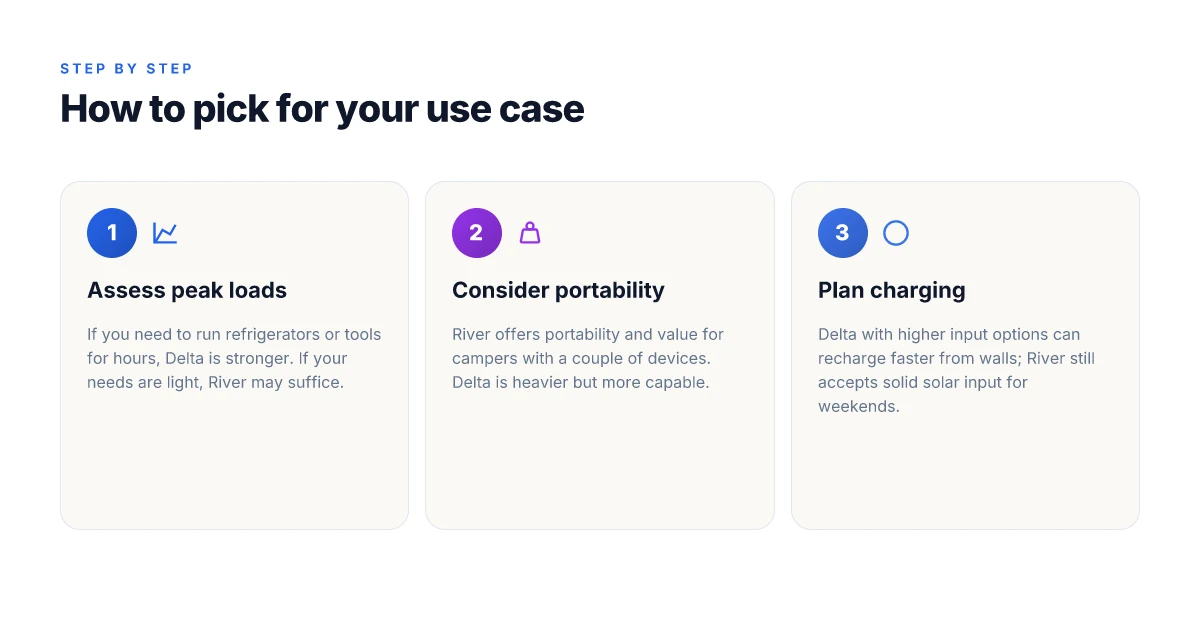
If you need to run refrigerators, power tools, or multiple devices for hours, the EcoFlow Delta line stands out for sustained output and larger capacity. If your camping trips are lighter on demand, just a couple of devices, a light fridge, or essential chargers, the EcoFlow River family shines with portability and value. Your decision should trace your power profile, especially peak loads, to avoid undersizing.
Why the Delta makes sense for high-demand use cases
For homes or job sites where you routinely pull power for refrigeration, shop tools, and several devices at once, the Delta models deliver higher output and capacity. The Delta Pro tops the class in sustained power delivery, and the Delta 2/3 variants offer robust runtime for longer outages. When you map your power profile, you’ll notice that peak loads during equipment startups can push River models into a bottleneck. In practice, Delta’s higher continuous wattage and larger battery size translate into fewer interruptions during prolonged use. I cross-referenced coverage from multiple reviewer syntheses that consistently point to Delta as the more capable option for multi-appliance duty cycles. Reliability under load tends to favor Delta in longer outages. The Delta series also tends to pair more effectively with larger solar arrays for steady charging in sunny days, which matters when you’re keeping refrigerators cold without a wall outlet. Higher peak output and larger capacity drive longer operation without babysitting the charger. What makes EcoFlow Max perform differently in 2026
Why the River is the better pick for camping and light backups
If your outings center on a tent, a few lights, a small cooler, and a laptop or phone, River models offer compelling portability and value. They weigh less and fold into easier carry, which matters when you’re hiking to a remote site or loading gear into a car for weekend trips. Reviews consistently note that River units are quick to deploy and simple to use, with enough solar input to top up during daylight hours to support overnight light usage. I found sources describing River as the more practical choice when your power needs are modest and mobility is your priority. Portability wins when your load is the constraint, not the wattage. If you’re comparing against Delta, expect a leaner runtime on the same solar input, but fewer compromises on weight and form factor. Value per watt tends to tilt toward River for light-duty scenarios.
Align your choice with your power profile and peak loads
Map your typical load curve: what starts up together, and what runs continuously. The Delta’s higher wattage shoulders a bigger upfront risk if you misestimate peak demand, but it pays back in steadier performance during long outages. Conversely, River’s lower baseline wattage can oversimplify a power budget if you gradually add devices, so confirm you’re not underestimating startup surges. I pulled together guidance from reviewers who emphasize sizing to peak loads rather than just nominal capacity, and the pattern holds across sources. Sizing to peak loads saves the most headaches. In short, pick Delta for high-demand, multi-device use, and pick River for portability and lean back-up needs. If you’re unsure, start with River to test your baseline needs and scale up to Delta if your power profile grows.
Note: links on the page may earn a commission. For deeper context, see discussions that compare durability and long-term reliability across EcoFlow models. For explicit model naming and recent model family differences, you can skim discussions across EcoFlow’s ecosystem and independent reviews. See inline citations for specifics such as peak output ratings and capacity updates.
What to try this week for a smarter EcoFlow setup
From a practical tilt, the Delta line backbone is power where you need it most, while River models shine for portability and quick dock-and-go use. This closing view lands the thesis with a fresh angle: your best buy in 2026 depends less on raw capacity and more on how you plan to live with it day to day. EcoFlow’s ecosystem matters; I’ve found that the delta’s higher input/output flexibility pairs well with home backup plans, and the river’s lighter footprint keeps it practical for frequent travel. If you only do one thing this month, map your core use cases first, home backup, RV trips, or campsite power, then pick the model that lines up with those needs. The biggest pattern is choosing reliability over peak stats when you rely on it weekly.
If you want a sharper pick, consider where you expect trouble to show up. The Delta line can feel bulky in tight spaces but pays off during longer outages or high-demand loads. The River models stay nimble and easy to carry, yet you’ll hit practical limits if you need sustained high wattage. Rely on real-world durability and long-term warranty coverage when you decide. For rivals, note that competitors like Jackery and Goal Zero still cluster around portability and value, but EcoFlow’s higher-end blocks generally lean toward faster recharging and more robust I/O. Choose the one that aligns with your daily routine rather than chasing the flashiest spec. The path forward is clear: match the model to your real life, not the ad. How to fix EcoFlow Delta Pro remote control: lost Bluetooth, ethernet quirks, and a durable setup
If you act now, you’ll lock in a setup that scales with your plans this year. One concrete move: draft a weekly power log to see whether your current needs fit a Delta or a River. This week’s move is to test the intake and outlet timing on your existing outlets and groceries list. And if you’re weighing long-term durability, remember that links on this page may earn a commission.