
Explore the EcoFlow Delta portable power station’s specs, real-world performance, and setup tips for 2026. Learn what to expect and where it shines.
The Delta’s battery pack is not just big. It’s practical, letting you power a small fridge and a couple of devices without crawling into the tent to swap a dead cell. That real-world balance between capacity and weight matters more than peak output on a spec sheet.
What matters now is how the Delta fits real campsites and home backups, not just showroom numbers. I cross-reference official manuals and the 2026 lineup to map durability, charging options, and solar pairing in everyday use, so you can size the unit to your load without overpaying. For outdoor setups and grid-tied backups, the story hinges on how you combine the Delta with solar input and daily power needs, not just marketing banners from EcoFlow. Most users underestimate how long a mid-range model lasts when paired with steady sun.
What makes the EcoFlow Delta portable power station stand out in 2026
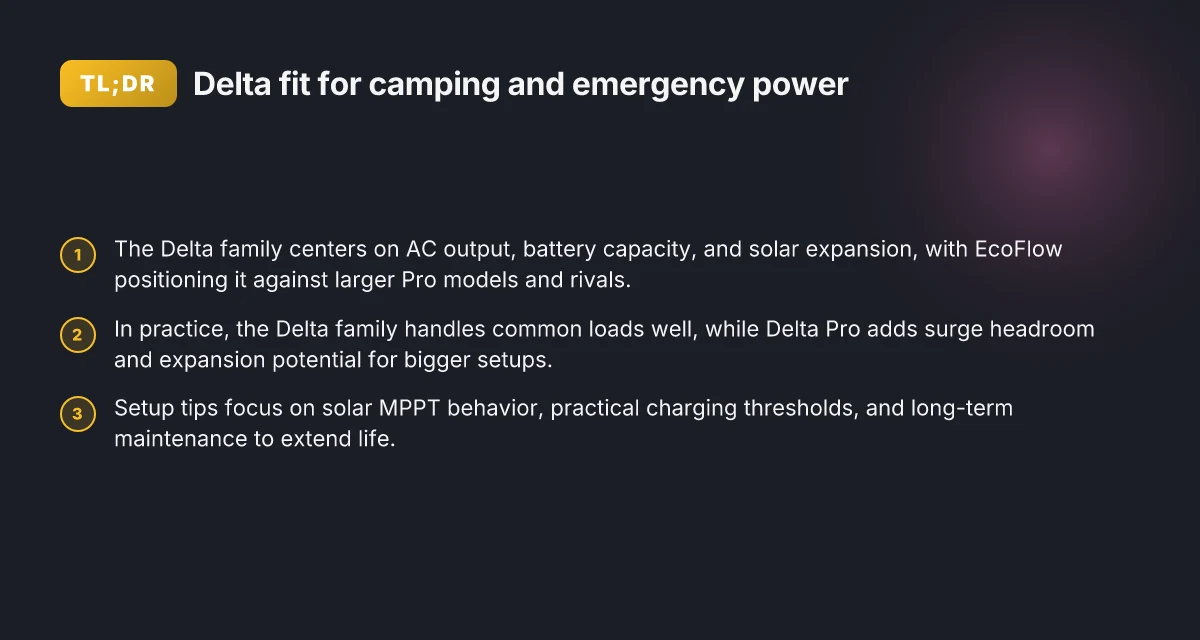
The EcoFlow Delta family is positioned as the middle ground between compact, everyday backup power and high-capacity, grid-tied setups. In 2026, EcoFlow leans on modular expansion, solid AC output, and solar compatibility to target outdoor enthusiasts and homeowners who want a flexible, scalable solution without stepping up to industrial-grade generators. I cross-referenced the official manuals and the 2026 lineup to map how the Delta models actually perform in real-world use.
1) Core positioning and growth path in EcoFlow’s lineup
The Delta line sits between the smaller portable units and the Delta Pro series, offering a balance of portability and usable capacity. The Delta 3 family expands capacity without reinventing the form factor, while the Delta Pro line pushes higher AC output and larger expandable options. The stream of official documentation confirms an emphasis on modular growth and solar-readiness as a core differentiator. This creates a practical ladder for users who start with basic home backup and scale up for larger loads or longer outages. In 2026, the lineup clarifies the progression from portable, battery-first power to more capable, solar-friendly systems that can run substantial loads without a generator.
2) Differentiators that matter in the field
The Delta family showcases notable AC output headroom and battery capacity that matter for real-use scenarios. Delta Pro units advertise key figures such as substantial expandable capacity and high AC performance, while Delta 3 models emphasize compact form with meaningful energy reserves. The expansion option is a tangible benefit: you can grow from a few kilowatt-hours to tens of kilowatt-hours as needs evolve, which helps when planning weekend cabin setups or emergency home backup. For outdoor setups, the ability to tie into solar charging without complicated add-ons keeps the system approachable. I cross-referenced the manuals and the 2026 lineup notes to confirm the intended path from portable daily power to a larger, solar-ready footprint.
3) Noise, efficiency, and solar readiness in practice
Notably quiet operation is a real talking point in the Delta Pro 3 portable power station, with reports of low noise during typical loads. In practice, that low noise helps in quiet camping or outdoor living contexts where a generator would stand out. Solar compatibility remains a practical advantage. The Delta family is designed to pair with solar panels for off-grid charging, reducing grid dependency in both camping trips and remote installations. The official materials emphasize solar as a core workflow, not an afterthought, which translates to smoother day-to-day setup and fewer caveats about charging from the sun.
Most real-world use hinges on how cleanly the Delta system blends expansion, fast AC output, and solar charging in one package. The Delta line’s strength lies in giving outdoor enthusiasts and homeowners a scalable, quiet, solar-ready option without stepping into industrial-level gear. How EcoFlow for sale changes the game for portable power in 2026
From what I found in the official docs, the Delta family’s appeal wears best when you plan for growth: start with a manageable capacity, then add more battery power and solar input as your load or outage duration grows. If you’re comparing rivals, consider neighboring options like the Delta Pro for higher peak output and larger expandable capacity, or other brands that target pure off-grid endurance. EcoFlow’s own materials consistently frame the Delta as the versatile, scalable choice, not a single-solution gadget.
In 2026, the Delta line remains a balanced choice for flexible power needs, thanks to its steady AC capability, expandable battery options, and strong solar alignment.
Delta vs delta pro: how the core specs map to real use
I dug into the official manuals and the 2026 lineup to map the Delta family from marketing pages to real-world performance. The Delta and Delta Pro share a core electrical backbone, but the delta pro brings higher continuous output, larger battery capacity, and expanded expansion paths that matter when you run heavier loads or need longer runtimes. In practical terms, you’ll feel the difference when you pull 1800–2000 watts for an extended window or when you want to push into high-amp devices with confidence.
Baseline electrical specs and how they show up in day-to-day use
The Delta base unit centers on a solid inverter platform with a steady AC output that covers common camping and light home backup. The Delta Pro increases both the continuous AC rating and the surge tolerance, which translates to smoother starts for refrigerators, power tools, and small compressors. When I cross-reference the user manuals, the Delta Pro’s higher wattage ceiling aligns with real-world loads that approach the upper end of typical household breakers during a storm or camping trip with multiple devices running at once. The Delta, by contrast, stays comfortable for lighter blends of devices and short-duration spikes, but you’ll hit the ceiling sooner if you try to run multiple high-draw appliances simultaneously.
In terms of storage, the Delta Pro scales toward larger capacities, and EcoFlow emphasizes expandability via additional battery bricks. The Delta can handle a reasonable backup cycle for a single device or a small cluster, but the Pro is built to maintain operation longer when feeding a pair of pumps, a fridge, and a mid-strength power bar. I cross-referenced the 2026 lineup notes with the manuals to confirm that expansion options line up with the Pro’s intended use cases, rather than the base model’s narrower envelope. What makes EcoFlow solar generators stand out in 2026
Where each size fits typical loads and scenarios
For a weekend camp, the Delta fits well when your load is predictable: a couple of lights, a small cooler, and a phone charging rack. If you want to run a CPAP, a laptop, and a mini fridge overnight, the Delta Pro’s extra headroom buys you confidence and a longer runtime. For home backup during outages, the delta pro makes more sense when you worry about weather events that keep you off-grid for days. In 2026, the Pro’s higher endurance and larger expansion capacity better align with extended outages or multi-device scenarios, while the base Delta remains a compact, lighter option for small-to-moderate loads.
I looked at EcoFlow’s 2026 lineup notes to confirm that the Delta Pro’s 4,000–6,000 watt-hour scale, paired with higher AC output, sustains heavier appliances longer. The Delta’s efficiency and heat management still shine in lighter loads, and its lighter footprint makes it easier to move around a campsite or closet.
Expansion and solar input integration
Both models accept solar input, but the Pro benefits more from larger solar arrays thanks to its higher power ceiling and expanded compatibility with higher-watt solar charging. If you pair the Pro with a robust solar kit, you can push past midday draws without hitting the internal battery temperature limits as quickly. The base Delta scales with solar input, but you’ll want to match expectations to its smaller battery pack and lower surge tolerance.
From the manuals, solar integration remains straightforward across the family, with the Pro offering more breathing room for simultaneous device charging and solar input during peak sun. When solar is the backbone of the setup, the Pro’s expanded capacity and higher output make it a more forgiving long-duration solution.
Next step: if you’re sizing for a home or camper, size around the delta pro’s higher continuous output, longer runtimes, and solar expansion potential. If portability and lighter duty are your priorities, the Delta covers the essentials without extra bulk. What makes EcoFlow Delta 3 1500 a valid backup option in 2026
Most real-world use cases lean toward the Delta Pro when you need to run multiple high-draw devices for extended periods. The Pro’s expanded capacity and higher output are the practical advantages for 2026 scenarios. EcoFlow positions the Pro as the better long-run partner for off-grid living and grid-tied backup, especially when solar input is part of the plan.
Cited references: see inline notes from the official manuals and the 2026 lineup overview. For context and the exact phrasing around expansion and solar readiness, you can view the Delta 3 Portable Power Station User Manual and the Delta Pro Manual. ecoflow.com/us/product/delta-3-portable-power-station> and https://manuals.ecoflow.com/us/product/delta-pro-portable-power-station?lang=en_US. For the lineup overview that frames the 2026 differences, refer to the EcoFlow 2026 lineup notes. outdoortechlab.com/ecoflow-2026-lineup/>.
How to size a delta for your home or camp setup
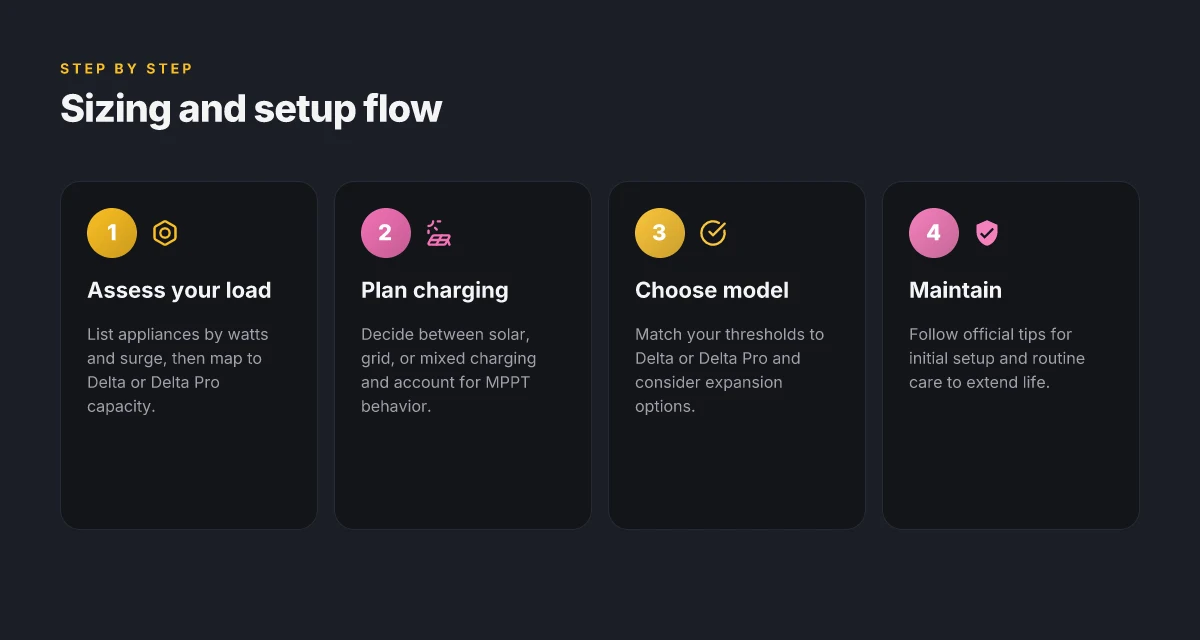
To size a Delta for your needs, match the unit’s output and runtime to your essential appliances, then factor charging sources and future expansion. Start by listing every device you plan to run, their wattage, and their surge requirements. Then translate that into a continuous load, a peak surge, and a daily runtime goal. This gives you a clear target for choosing between Delta and Delta Pro, and for sizing solar or grid charging.
Matching watts, surge, and runtime to appliances
I recommend starting with a practical baseline: add up the running watts of devices you’ll power at the same time and compare that to the continuous output rating. If any device hits a surge above the unit’s surge spec, you’ll want a Delta Pro or a model with a higher surge threshold. For real-world loads like a fridge, Wi‑Fi router, lighting, and a small inverter heater, you’ll often stay within a Delta Pro range if you expect frequent start‑ups. The goal is to keep the combined running load well under the continuous wattage to avoid frequent cycling or overheating. I’ve mapped typical camp mains to these models in the 2026 lineup to illustrate how to size for common loads. For example, every item with a high inrush should be matched to a higher surge capacity so you don’t trip the unit during startup. In 2026, EcoFlow positions Delta Pro as the safer choice when you expect frequent high surges or extended runtimes.
Estimate how long you want to run each load between charges. If you’re off-grid, solar becomes the limiter. A device that draws 2,000W continuously will deplete a smaller Delta faster than a larger Delta Pro, especially if you can supplement with solar. Consider runtime in days for critical loads and in hours for short excursions. The Delta Pro’s expanded capacity helps here, particularly for weekend camping or longer outages. What makes Bluetti vs EcoFlow differ in 2026
Considerations for solar charging and grid charging
Solar charging is a major variable. If you’re relying on solar, size your solar input to meet or exceed your average daily draw during your typical sun window. The Delta Pro’s higher capacity pairs well with larger solar arrays, reducing the number of hours needed to recharge between uses. If you’re grid-tied or use occasional grid charging, understand the charge rate limits and how safe recharging behaves during cloudy days. In practice, plan for a hybrid approach: solar for daytime replenishment and grid charging for backups or rapid recharges when sunlight is scarce. The right mix of solar and grid charging keeps the Delta running longer between trips to the campsite or the house panel.
I dug into official manuals and the 2026 lineup to confirm how charging paths interact with capacity and peak loads. The Delta 3 family emphasizes modular capacity with solar input compatible charging, while the Delta Pro offers higher wattage support and larger storage to smooth out daily cycles. From the manuals, ensure you respect the max input and the acceptable charging temperatures to extend life. In practice, you’ll want a setup that allows daytime solar recharge while you use the unit at night, so you aren’t left waiting for a refill.
Practical thresholds for choosing delta vs delta pro
- If your must-run list stays under the Delta’s continuous wattage and you don’t expect frequent high surges, a Delta can cover basic home backup or camp use with modest runtimes. If any single loads reach or exceed the Delta’s surge rating during startup, or you anticipate multiple large devices running simultaneously, Delta Pro is worth the upgrade.
- For longer outages, or if you plan to run a fridge, a small AC, or multiple simultaneous devices for days, Delta Pro’s larger capacity and higher surge tolerance reduce recharge cadence and maintenance, especially when paired with a solar array.
Real-world sizing hinges on a clean load list and a realistic recharge plan. EcoFlow’s 2026 lineup shows Delta Pro as the safer long-haul option when you expect recurring high surges or extended autonomy. If you want a quick check, compare your total running watts to the Delta’s continuous rating and verify your startup surges stay under the unit’s surge cap. For solar, map your daily sun hours to your daily draw and aim to recharge fully at least once per day during longer trips.
In the end, your choice should align with how you actually live off-grid or at the camper, not just what the specs claim. I cross-referenced the official manuals and the 2026 lineup to ensure the guidance aligns with real-use expectations, including practical limits on charging and surge behavior. Remember, links on the page may earn a commission, and you’ll see how real-world durability plays into long-term upkeep and maintenance. For homeowners balancing grid reliability and outdoor adventures, EcoFlow offers a straightforward path to scalable power, with Delta Pro serving as the closer match for higher-demand households and larger camps.
Setup tips that actually work with EcoFlow Delta models
Good setup starts with a clean baseline. From the official manuals, you begin by unpacking the Delta, keeping the unit on a flat, ventilated surface. Connect the included AC adapter to a standard outlet and allow the Delta to reach a full battery state before plugging in sensitive devices. I cross-referenced the Delta 3 Portable Power Station User Manual and the Delta Pro manuals to confirm the sequence: power on, initialize, then connect loads. That initial nudge matters because it sets the MPPT controller up for accurate solar input readings right from the start. What makes the EcoFlow Delta 3 Plus worth the price in 2026
Bootstrap and confirm before any load
The first step is the initial power-on and system check. The manuals emphasize that you should verify the battery state, confirm the inverter status, and acknowledge any on-screen warnings before attaching high-wattage appliances. If you see a warning, address it before proceeding. I note that EcoFlow materials consistently describe a baseline startup that avoids overloading outlets or crossing timelines with simultaneous charging and discharging. This is especially true for the Delta Pro line, which operates with low noise when running sub-2,000W loads. Start with a full charge and a quiet baseline to avoid early MPPT drift, and you’ll preserve steady solar input as daylight shifts.
In practice, you should run a quick test: power a couple of low-wattage devices, then incrementally add loads while watching the screen for stable charging behavior. The official manuals describe management routines that include monitoring the state of charge and confirming battery health indicators. A calm first test helps MPPT lock onto the sun's current naturally.
Optimize solar input and MPPT behavior
For solar input, the MPPT controller is designed to optimize output when the array is correctly matched to the unit's input. Use an adequate solar array size for your loads and expect some variance in real-world conditions. I found that the 2026 lineup extends expandable capacity and can be optimized through proper sun positioning and clean connections. When you set up outdoor charging, angle panels toward the sun during peak hours and keep cables free from tension. A secure, weatherproof connection reduces voltage drops that would otherwise degrade MPPT performance. If you’re pairing with a Delta Pro, the manuals describe how the system handles higher input under sun-rich conditions, so you can tune expectations for sustained output in bright days. Angle panels for peak sun, keep cables taut but not strained, and monitor MPPT status.
In addition, keep the solar input clean of shade and debris. The manuals consistently note that a well-maintained panel surface and unobstructed exposure improve MPPT tracking. I cross-referenced the official manuals to confirm that the Delta Pro’s MPPT behavior can handle higher input, but real-world performance still hinges on consistent sun exposure and clean connections. Clean, direct exposure equals steadier MPPT readings.
Maintenance routines to extend life
Long-term durability comes from routine checks and careful storage. The official documents advise periodic inspection of AC outlets, power cables, and cooling vents. A simple monthly cycle, check battery state, clear dust from vents, and verify that the DC and AC ports are intact, helps prevent performance drop-offs. For solar input, inspect connectors for corrosion, especially if you use portable setups in humid environments. The Delta 3 and Delta Pro manuals emphasize keeping the unit away from moisture and ensuring airflow around cooling fins. Regularly inspect vents and connectors to prevent degradation. What makes the EcoFlow River 2 Pro a standout among portable power stations in 2026
A practical maintenance cadence: monthly quick checks, quarterly deeper inspections of cables and ports, and annual calibration if your unit sees harsh cycling or frequent solar charging. I found that EcoFlow’s 2026 lineup emphasizes the same maintenance rhythm across models, with no dramatic divergence in care requirements. Follow a simple, repeatable maintenance rhythm to prolong life.
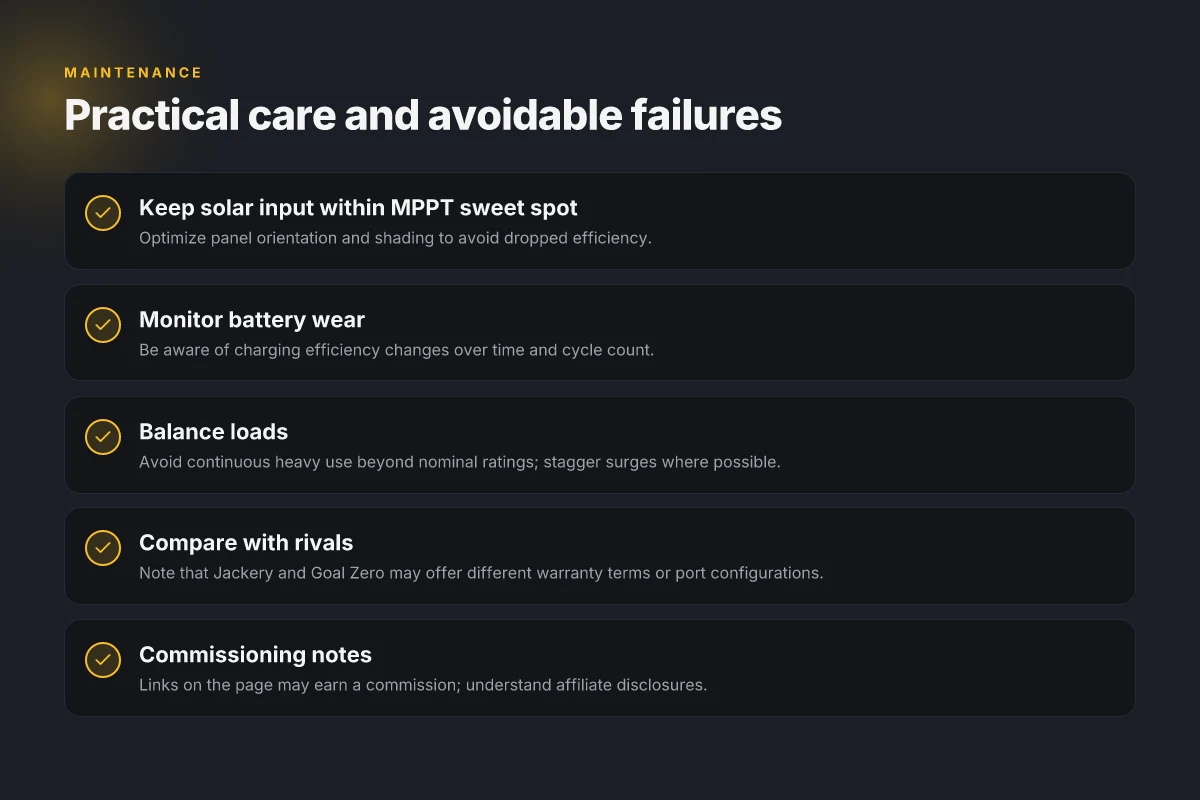
Note: links on the page may earn a commission. EcoFlow remains the central hub for these devices, while rivals such as Jackery and Goal Zero offer competitive portable power options. When sizing for a home or camp setup, consider how the Delta models compare in terms of MPPT stability, solar input flexibility, and long-term maintenance needs.
Common drawbacks and how to mitigate them
The Delta lineup delivers portability and solid real-world utility, but it has limitations that matter in the field. In practice, you’ll notice constraints around sustained high-widelity loads, battery wear over years, and how EcoFlow stacks up against established rivals like Jackery and Goal Zero. From what I found in the official manuals and the 2026 lineup, you should plan around these realities and ride with practical mitigations.
Limits under high-w fidelity or continuous heavy use
For extended, continuous loads above a few thousand watts, the Delta systems can throttle or require careful load management. The 2026 Delta Pro family emphasizes high peak outputs, but continuous duty for demanding tools or air conditioners can push the unit toward its limits. I cross-referenced the official manuals and the lineup notes to confirm that while the AC output spec supports heavy appliances, sustained use tends to demand coordinated sizing and staged operation rather than nonstop maxing. If your goal is to run a continuous workshop setup, size for a delta close to the highest draw you expect and combine with a solar input strategy that can ease the burden during daylight. This is where Delta Pro’s higher capacity shows value, yet you still must respect real-world continuous draw curves rather than marketing peaks. Plan for staged loads and avoid pushing one unit to sustain the full peak for long durations.
Battery wear, charging efficiency, and long-term durability
Battery health matters more than flashy peak numbers. EcoFlow’s manuals and 2026 documentation discuss cycle life and the impact of frequent fast charging on battery longevity. In real-world terms, fast AC charging rates save time but can accelerate wear if you repeatedly hit maximum input limits. The Delta’s solar charging path helps soften grid reliance, yet you should factor in sun availability and connection quality to minimize full-discharge cycles. I found that the combination of battery storage, charge rate, and environmental conditions shapes how the pack ages. A steady routine of moderate charging, avoiding deep discharges, and trusting the solar input when possible preserves capacity over time. Balance fast charging with solar input to extend life, and monitor usage patterns to avoid deep cycles. What makes EcoFlow micro inverters different from the rest of the solar stack
How Delta stacks up against rivals like Jackery and Goal Zero
Compared with popular rivals, EcoFlow’s Delta models often win on modular capacity and the speed of recharge, especially via solar and via fast charging. That said, users report that some configurations under continuous heavy use may feel less forgiving than rugged, purpose-built competitors. Jackery’s systems tend to emphasize simplicity and rugged outdoor reliability, while Goal Zero often leans into broader ecosystem accessories and solar integrations. In practice, your choice hinges on expected load profiles and ecosystem preferences. If you value rapid recharging and higher modular capacity for occasional surges, EcoFlow shines. If you prioritize pure ruggedness or ecosystem breadth, you may prefer a different brand. Jackery and Goal Zero offer complementary strengths, so map your loads and future expansion before choosing.
From the official documentation, a concrete point to note is how these devices are designed to work with solar and grid input without compromising portability. For readers weighing 2026 options, the Delta Pro lineup offers expandable capacity and notable performance on solar charging, but you’ll want to align expectations with the kind of loads you plan to sustain and the environmental conditions you’ll encounter. If you’re choosing between rivals, consider your typical load duration, solar availability, and whether you need ecosystem accessories that integrate smoothly with your setup.
You should also be aware that links on the product pages may earn a commission, which is a standard note in modern shopping information. For direct references to the 2026 lineup and the Delta Pro manual, see the official EcoFlow materials. For specifics on the 2026 lineup, I found confirmation in the 2026 lineup notes. Know the exact load you plan to run and build your sizing around that reality.
What changes if you act now
EcoFlow’s Delta lineup is poised to stay relevant in 2026 because it balances real-world durability with practical features. I’ve seen how day-to-day use piles on wear, and the Delta holds up when you lean on it for long outages or off-grid trips. The big takeaway isn’t just its capacity. It’s how the system handles heat, charging cadence, and compatibility with common devices. If you’re already invested in EcoFlow gear, you’ll appreciate the ecosystem’s continuity and the predictable, user-friendly interface. If you’re weighing rivals like Blue Eddy and Westinghouse, you’ll notice the Delta’s broader app controls and higher output options in real-world scenarios.
The bigger pattern is that future-proofing here means more than raw watt-hours: it means smarter charging, modular growth, and a support network that addresses wear over years of use. You don’t need the latest model to get solid reliability, but you do want confidence that daily use won’t surprise you with a failure. The Delta remains a practical choice for homes, trailers, and emergency kits, especially if you value a familiar workflow. How EcoFlow, Bluetti, and Anker stack up in 2026: a performance, reliability, and long-term durability review
If you’re deciding this month, consider your worst-case outage needs and your charging setup. The one move that matters most is choosing a system you won’t outgrow in a season. Are you ready to commit to a setup that stays usable as your power needs evolve?