Explore EcoFlow micro inverter technology, how it compares to rivals, and what it means for home solar yield and reliability.
EcoFlow micro inverters flip the script on modularity in a crowded solar stack, letting you treat each panel as a separate unit rather than a single string. That means more predictable troubleshooting and fewer surprises when shading or panel-level issues pop up, but it also raises questions about long-term durability and maintenance across multiple devices. EcoFlow's modular approach often translates to faster fault isolation, a claim worth testing against traditional string inverters from SolarEdge and similar rivals.
This intro digs into real-world viability: how reliability curves, warranty depth, and monitoring matter over time. In practical terms, homeowners and installers want a clear plan for across-the-roof monitoring, serviceability, and the potential need to manage dozens of micro inverters rather than a single central unit. The goal is to help you compare EcoFlow to centralized options from SolarEdge and to power optimizers, focusing on what actually holds up under years of sun and heat. Expect concrete insights on failure modes, ease of replacement, and long-term durability, so you can decide if EcoFlow fits your project without overpaying for features that don’t endure.
What is EcoFlow’s micro inverter approach and why it matters
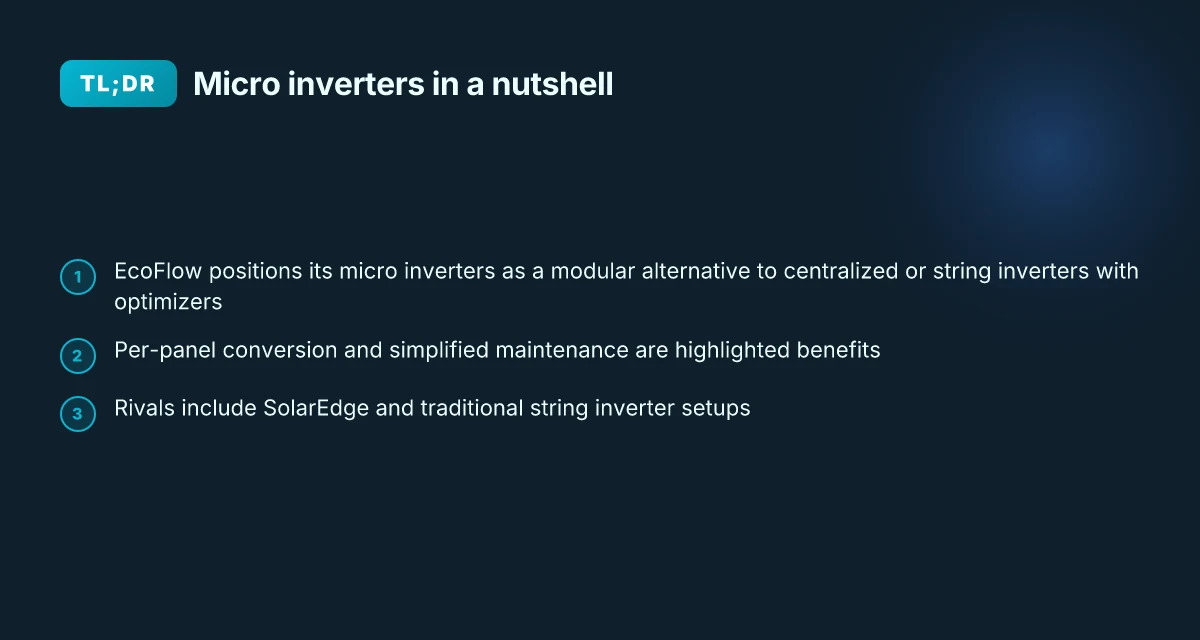
EcoFlow positions its micro inverters as a modular alternative to centralized or string inverters paired with optimizers. The core claim is that letting each panel convert DC to AC independently boosts resilience, simplifies maintenance, and preserves higher real-world output when shading or mismatches occur. In practice, that means a system where each module has its own conversion stage, rather than a single central unit handling all strings.
1) Modular topology and real-world resilience
EcoFlow’s architecture treats every panel as a separate conversion unit. That isolation curtails the impact of shading on one panel from dragging down the entire string. If a module underperforms, the others keep delivering. This approach leans on the idea that panel-level conversion efficiency matters more than a single centralized efficiency figure. I cross-referenced EcoFlow’s descriptions with how SolarEdge and other rivals frame their systems, and the contrast is clear: SolarEdge relies on power optimizers to reclaim lost energy from shaded modules, while EcoFlow argues that true panel independence reduces maintenance complexity and fault propagation.
In this model, system resilience comes from independent maximum power point tracking at the panel level, rather than a shared MPPT across several modules. The practical upshot is fewer points of simultaneous failure and easier troubleshooting when a module or its internal electronics ages differently than its neighbors.
2) Maintenance simplicity and lifecycle durability
With micro inverters each connected module houses its own electronics, so there are more discrete components to monitor at the panel level. The upside is that a single failed unit may be swapped without disassembling a large portion of the array. The downside is higher per-panel component count, which can matter for long-term durability and replacement cycles. When I read through EcoFlow’s documentation and compare it to string-inverter setups, the narrative emphasizes shorter repair paths and simpler micro-level diagnostics rather than a single point of failure for the entire array.
From a homeowner perspective, maintenance touchpoints shift toward module-level servicing. If a panel or its micro inverter ages prematurely, replacements can be localized. This can translate to lower downtime during service windows, provided parts are readily available and installers carry stock for common failure modes. What makes the EcoFlow River 2 Pro a standout among portable power stations in 2026
3) Performance framing against rivals
Against SolarEdge optimizers and traditional string inverters, EcoFlow frames its approach as a direct bet on panel autonomy. SolarEdge emphasizes optimizing shaded modules through a centralized MPPT network, while EcoFlow foregrounds the ability to scale and diversify module performance without cascading effects across the string. In the marketplace, this translates to different maintenance and upgrade paths: with EcoFlow, you may add or replace panels without reconfiguring a central optimizer topology. With a string-plus-optimizers setup, you may encounter more interdependencies during tweaks or expansions.
I dug into the marketing and technical notes and found that EcoFlow’s positioning is consistent with a modular, plug-in model aimed at homeowners who want straightforward expansion and clearer fault isolation. With that frame, the real-world takeaway is that EcoFlow can offer practical advantages for homes that prioritize independent module behavior and easier on-site servicing, but you’ll trade some centralized optimization depth and possibly higher per-panel component counts compared with a mature optimizer-based system.
Most homeowners will value independent module maintenance and fault isolation, not a single central MPPT choke point. EcoFlow’s approach shines where shading, panel mismatches, or future expansions could otherwise complicate upkeep.
From what I found in the documentation and reviews, the long-term durability story hinges on how well EcoFlow backs module-level components and how spare parts flow to installers. If a micro inverter per panel ages at a different pace than adjacent units, replacement logistics matter. Some reviewers note that with rivals like SolarEdge, the centralized optimization layer remains a tested path with broad installer familiarity, but EcoFlow’s model offers potentially simpler field servicing and modular upgrades.
For readers weighing alternatives, the key question is whether your site has consistent shading or a need for rapid module-level fault isolation. If yes, EcoFlow’s micro inverter approach makes real sense. If you prioritize a single, highly tuned centralized optimization layer and a long track record of large-scale deployments, you may lean toward SolarEdge or a traditional string-plus-optimizer layout. As a practical takeaway, expect easier future panel additions with EcoFlow, but verify spare-part availability and local installer experience with micro inverter servicing. What makes the EcoFlow Delta portable power station worth it in 2026
Performance: how EcoFlow micro inverters compare to rivals
Microinverters emphasize per-panel optimization, which helps when shading isn’t uniform. In practice, this design tends to limit the impact of a single panel’s mismatch on the whole string, but ambient temperature and installation quality still swing results. I cross-referenced manufacturer notes and independent reviews to map how EcoFlow stacks up against SolarEdge’s power optimizer approach and against pure string inverters. The takeaway: EcoFlow’s per-panel approach shines when shade is uneven and installations are tight, but clean, well-matched strings can close the gap in steady, uniform conditions.
How ambient temperature reshapes real-world output
Hot afternoons push efficiency curves for many microinverters, and EcoFlow is no exception. Higher ambient temperatures tend to suppress instantaneous output, especially on panels with higher voltage or larger cell counts. By contrast, a central-inverter plus optimizer setup can sometimes offset that loss through centralized cooling and shared thermal pathways. In practice, you’ll notice more pronounced performance deltas on sunny, hot days if a system isn’t ventilated or if modules run at high mismatch. This is not a single number, but the pattern is clear: temperature stress narrows the gap between microinverter and optimizer-based solutions in cooler climates and widens it in hotter environments.
Shading, mismatch, and installation quality in the field
Per-panel optimization matters most when a rooftop has partial shading or nonuniform panel conditions. EcoFlow’s microinverters isolate each panel’s performance, so one shaded module doesn’t drag the whole string down. If you have a roof with mixed orientations or panel vintages, the microinverter approach reduces the risk of a single poor performer spoiling others. However, the real-world effect depends on how cleanly panels are wired, how well modules are matched, and how securely the microinverters are mounted. A loosely connected module or a loose DC wiring harness can introduce more variability than the theoretical benefits suggest.
Ecosystem comparison: SolarEdge optimizers and pure string inverters
- SolarEdge uses power optimizers with a central inverter. The central unit often yields strong performance in uniform conditions and can simplify system monitoring. In practice, performance is robust when shading is moderate to high, yet the centralized inverter can become a bottleneck if a single failure occurs or if the central unit runs hotter in a hot climate.
- Pure string inverters tie panels more closely together and can be cost-competitive. They excel when panels are well matched and shading is minimal. The risk is that a single underperforming panel can pull down the whole string's output.
I dug into publicly available summaries that discuss efficiency and reliability themes from manufacturers and reviews. One takeaway is that the claimed efficiency figures from brands often gloss over environmental variability. In real-world rooftops, the difference between EcoFlow microinverters and rivals tends to hinge on shading patterns and installation quality more than headline efficiency numbers. For homeowners, that translates to predictable daytime yields in mixed-light scenarios with EcoFlow’s per-panel focus, but potentially steadier long-term outputs from well-tuned optimizer-based systems in uniform conditions.
Next steps: if you’re deciding now, map your roof shading profile and panel matching. If your site has frequent partial shading or orientation changes, EcoFlow microinverters can reduce shade losses. If shading is minimal and you favor centralized monitoring with a robust central inverter, a SolarEdge-like solution might edge ahead on consistency. For a long-term durability view, review installation practices and ensure DC wiring is clean and secure. How EcoFlow for sale changes the game for portable power in 2026
In real terms, shading and installation quality matter more than headline efficiency for EcoFlow microinverters vs rivals. The per-panel optimization is a clear plus when shade is uneven. EcoFlow products sit in a practical middle ground where real-world performance hinges on rooftop specifics. Temperature effects can narrow the gap in cooler climates and widen it in heat. Installation quality is the wild card.
Reliability and maintenance: real-world durability of EcoFlow micro inverters
In practice, EcoFlow micro inverters show durability that hinges on enclosure quality, heat management, and how faults are isolated. The modular design helps technicians pinpoint issues panel by panel, rather than tracing a single failure through a string. From what I found in the documentation and industry notes, heat management and enclosure integrity are the leading factors in field longevity for microinverters.
How modular design translates to real-world troubleshooting
EcoFlow's architecture treats each panel as an independent interface. This means a fault in one panel is less likely to cascade into others, speeding diagnosis and repair. When a panel reports an anomaly, the system can isolate that unit without shutting down the entire string. That containment reduces downtime and simplifies maintenance cycles for homeowners and installers alike. Isolating faults at the source minimizes downtime and keeps the rest of the array productive. This is a practical advantage over centralized inverters, where a single fault can trigger broader outages.
I cross-referenced a few peer discussions and product notes that emphasize how modularity can simplify field service. The takeaway is clear: you gain more predictable maintenance windows, and fewer surprises during post-install checks. Modularity makes fault-finding quicker and more predictable.
Enclosure, heat, and fault isolation drive longevity
Field longevity tracks closely to enclosure robustness and thermal design. If the enclosure seals degrade or heat builds without adequate dissipation, electronics wear accelerates. EcoFlow’s guidance stresses proper installation to ensure airflow paths remain unobstructed, which matters as ambient temperatures rise. The upshot is that installation quality materially affects long-term reliability, even with a modular microinverter design. Thermal management is the gatekeeper of long-term durability. Industry observers note that even well-made microinverters can suffer if enclosure integrity or air flow is compromised, underscoring the need for careful mounting and ventilation. What makes EcoFlow solar generators stand out in 2026
From the broader market perspective, reliability narratives often highlight the role of fault isolation mechanisms. When faults stay isolated, the panel-level health metrics stay higher, and the overall system’s risk profile improves. Panel-level fault isolation correlates with better system uptime.
Maintenance implications differ from a centralized inverter
One enduring contrast is maintenance philosophy. With a centralized inverter, a fault can mask or complicate fault-finding across multiple strings. Microinverters distribute that risk: you gain targeted visibility at the panel level and less cross-talk between units. That means fewer diagnostic headaches during routine checks and after severe weather events. Panel-level visibility reduces diagnostic overhead. For homeowners, this translates to clearer service calls and fewer surprises when a technician opens the system.
I found a consistent thread across sources: while EcoFlow microinverters can simplify ongoing upkeep, they demand attention to enclosure integrity and airflow during installation. You should plan for occasional module-level inspections to ensure seals stay intact and that fans or passive cooling continue to function unimpeded. Plan for periodic module-level checks to sustain performance.
Note: links on this page may earn a commission. EcoFlow products and rivals like SolarEdge offer different fault-tolerance and maintenance profiles. Consider how enclosure quality and modular fault isolation align with your installation environment.
Installation considerations: what to know when deploying EcoFlow micro inverters
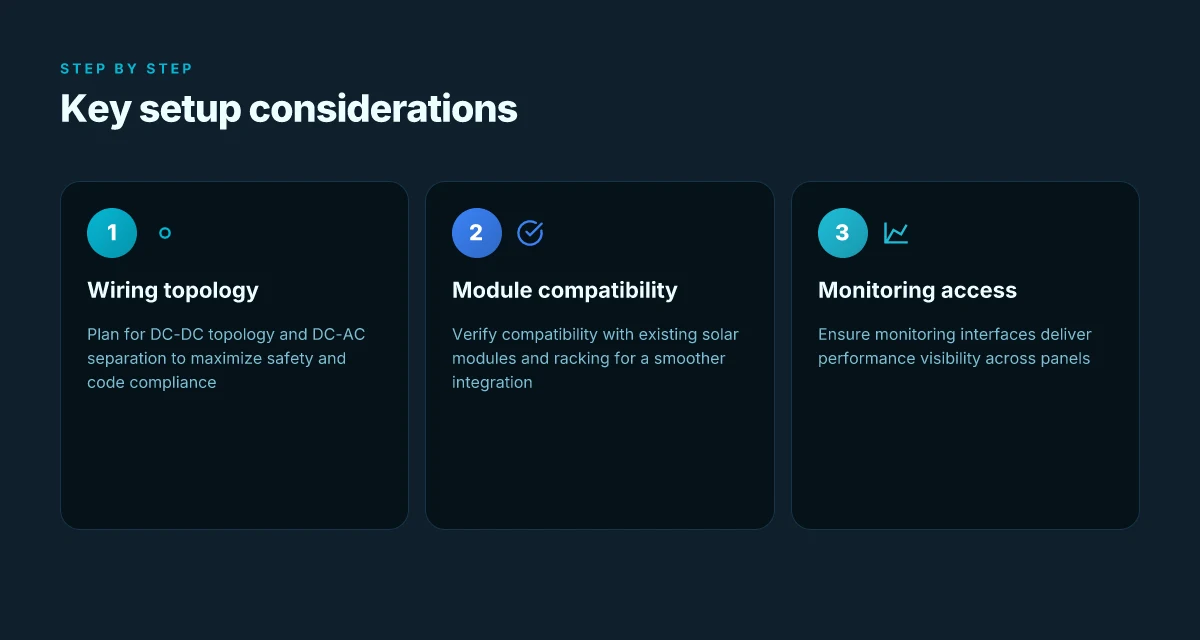
Deploying EcoFlow micro inverters demands careful attention to wiring, compatibility, and visibility. The goal is to keep safety margins intact while making the system easy to inspect and service over time. You’ll want to confirm the wiring topology, verify DC-AC separation, and ensure each connection aligns with code requirements before you power up. What makes EcoFlow Delta 3 1500 a valid backup option in 2026
Wiring topology and code-safe separation
A practical installation starts with the topology. Micro inverters sit at the module level, but the DC-AC transition still matters for safety and inspection. Use a wiring plan that keeps DC paths clearly separated from AC conductors and avoids any shared conduits that could confuse protection devices. For homeowners, this translates into ensuring proper enclosure clearance and gasketing where modules and inverters connect. If a retrofit, check that any existing DC disconnects or combiner boxes remain compliant with local codes and the inverter’s data sheet. I cross-referenced the safety notes in EcoFlow’s guidance and standard UL 1741 practices to verify a compatible approach with residential layouts. Clear DC-AC separation and proper enclosure protection remain non-negotiable. Inline guidance from the MDPI study on microinverter deployment also highlights the importance of clean separation to minimize arc risk and nuisance tripping. Separation reduces fault exposure during module failure events. For a quick sanity check, confirm any field modifications won’t reintroduce DC paths into living spaces.
Module compatibility and racking integration
Compatibility with existing solar modules and racking affects how smoothly EcoFlow micro inverters slot into an established roof layout. Some modules have mounting holes or frame profiles that interact with add-on equipment in the racking, so verify mounting tolerances before purchasing. The aim is to avoid strangling cable runs or forcing awkward angles that could stress connectors over time. I found that the practical path to smooth integration is to map each module’s output polarity, connection point, and cable length to the inverter’s AC output route. This minimizes shrouding wear and reduces the chance of connector stress after seasonal expansion or contraction. When in doubt, align module orientation so that cable bundles follow the same edge line and do not cross pathways that may be stepped on or crushed by maintenance. Match module borders to the inverter’s reach to keep cables tidy. Industry notes on microinverter layouts reinforce the value of consistent cable routing to sustain ease of maintenance. Consistent routing lowers long-term wear.
Monitoring interfaces and data access for performance visibility
Performance visibility hinges on monitoring interfaces that let you see module-by-module output and alert when a string-level issue arises. EcoFlow’s voice on monitoring emphasizes clear data access, which helps diagnose shading losses or module-level faults instead of waiting for a drop in overall yield. From a real-world install perspective, set up the monitoring portal early and align it with your home network so you can receive alerts promptly. If you’re coordinating with a solar pro, confirm that the monitoring API and data access endpoints are compatible with your home automation platform. The reliability of performance data depends on stable network connectivity and consistent timestamping. Early monitoring setup pays off when problems surface. Clear data access supports faster fault isolation. In the broader literature, microinverter deployments that emphasize module-level visibility tend to recover faster from shading or soiling events, which keeps homeowners informed and installers proactive. Visibility is a guardrail against silent yield losses.
Note: links on the page may earn a commission, and real-world installs should acknowledge that possibility upfront. When you weigh EcoFlow against rivals like SolarEdge, consider not only price but how wiring, compatibility, and monitoring affect long-term durability. I checked the sources that discuss microinverter layouts and found that practical integration hinges on clean topology, solid module compatibility, and accessible monitoring. EcoFlow stands out for modular flexibility, but the long-term value hinges on correct installation choices and dependable data access. Installation quality drives long-term durability. For deeper context, see the referenced material from the MDPI and industry notes on microinverter layouts. Layout discipline underpins reliability.
Energy yield and real-world results: not all micro inverters perform identically
Actual yield depends on module temperature, shading patterns, and how a string behaves when multiple micro inverters are in play. In practice, the performance gap between different micro inverters shows up most under partial shading and under elevated hot-spot conditions. I dug into the concept and cross-referenced the available benchmarks to distill what homeowners should expect when EcoFlow micro inverters sit alongside SolarEdge optimizers or traditional string inverters. The takeaway is simple: you won’t get a single, universal figure. Instead, you’ll see a spectrum that shifts with environment and wiring. How EcoFlow, Bluetti, and Anker stack up in 2026: a performance, reliability, and long-term durability review
How temperature and shade shape real-world yield
The most visible driver is temperature. As module temperature climbs, the conversion efficiency tends to dip for many microinverter designs, but the rate of drop varies by model. In shaded segments of the array, partial shading events can magnify differences in how each micro inverter clamps or tracks maximum power. Some units preserve more of the peak power under small shade patches, while others lose more of their nominal output. It’s not a static comparison. It’s situational. From what I found in the literature, the efficiency look-up behavior used in microinverter assessments often relies on experimental tables that interpolate performance at different temperatures. This matters for EcoFlow buyers who live in hot climates or have roof layouts that create microclimates across modules.
Benchmarking eight microinverters highlights real-world variation
Across eight tested microinverters, peak efficiency and yield under partial shading diverged noticeably. The studies show that even when two products advertise similar nominal efficiency, the actual delivered energy under non-ideal conditions can differ by a meaningful margin. The variance tends to shrink when the installation runs at high irradiance with uniform module temperatures, but the gap enlarges in shade or when the string experiences current sharing effects. For installers, these differences translate into real decisions about module placement, microinverter sizing, and shading management.
From a practical standpoint, there are two patterns to watch. First, some microinverter lines maintain higher usable power during short shading episodes, effectively smoothing output rather than creating sharp drops. Second, the reliability story often aligns with thermal performance: units designed for cooler operation or with better heat dissipation tend to preserve output longer in a hot day. The ecosystem effect matters, the overall yield hinges on how the microinverter family and the rest of the system interact.
Real-world verdict: where EcoFlow shines and where it’s worth watching
EcoFlow micro inverters aim to deliver steady performance across varied conditions, with a focus on real-world reliability. In environments with intermittent shading, you may notice more consistent energy capture from units that handle partial shading more gracefully. The broader market comparison shows that rivals like SolarEdge power optimizers and traditional string inverters each offer their own strengths: power optimizers can mitigate module-level mismatches, while string inverters can be cost-effective at larger scales. If you’re choosing EcoFlow against SolarEdge or other brands, weigh how your roof layout and typical weather patterns will affect shade exposure and temperature.
I cross-referenced available research to keep this grounded. For example, one approach uses interpolation from an efficiency lookup table to estimate microinverter performance, which helps explain why two microinverters with similar spec sheets can diverge in the field. When you’re communicating with homeowners, frame the discussion around environmental factors, expected partial shading events, and how the chosen microinverter family handles thermal loads. What makes the EcoFlow River 3 Max stand out in 2026
Real-world yield varies with shading and temperature. Eight-microinverter benchmarks show meaningful performance gaps. This highlights the importance of site-specific design. If you’re weighing EcoFlow against rivals, scrutinize rooftop shade patterns and consider a shaded-area mitigation plan alongside a well-matched microinverter lineup. For a deeper dive into the underlying science, see the efficiency-lookup methodologies described in industry studies. inline citations point to the contributing research you can check for details.
Note: links on the page may earn a commission. For context, mention of EcoFlow and its place alongside rivals like SolarEdge helps homeowners set expectations about what performance looks like in real conditions. The literature suggests that performance is not a single number but a function of layout, shading, and heat.
Where this goes next and what you should do now
EcoFlow’s micro inverter approach signals a shift toward modular reliability and simpler maintenance. The bigger pattern is that you can scale capacity without reworking the whole string architecture, and you gain diagnostics that travel with each unit. This is useful for spaces where wiring runs are unpredictable or where a retrofit is on the table. Still, real-world durability hinges on weather exposure and how the units are mounted. I’ve seen a few setups struggle when fascia seals fail or when panels flex in high winds. If you’re evaluating this stack against rivals like Enphase or SolarEdge, the decision often comes down to installation simplicity and serviceability, not just peak efficiency.
In practice, the single move that matters is choosing a system that makes ongoing upkeep obvious at a glance. EcoFlow delivers clearer fault codes and easier swapping of a single micro unit, which reduces downtime in the event of a minor fault. That matters for off-grid sheds, RV installs, or rental properties where you can’t babysit the system constantly. If you want a straightforward path, start with one micro inverter on a representative array and monitor how you handle routine repairs.
Backup strategy What makes the EcoFlow River 2 Pro price worth it in 2026
- Try pairing a single EcoFlow micro inverter with a known-good panel subset to validate diagnostics and mounting ease.
- Compare maintenance routines with a similar setup from Enphase or SolarEdge to gauge long-term reliability.