
Explore what the EcoFlow Delta 3 power station offers in 2026, including capacity, charging speed, solar input, and long-term durability. Practical use cases and rival comparisons.
The Delta 3 isn’t the flashiest power station, but EcoFlow engineers it around real daily prompts: compact size, solid solar recharge, and dependable inverter for essential loads. Most homeowners overestimate portable power capacity until they actually test weekend outages, and the Delta 3’s design limits remind you where tradeoffs live.
This intro cuts through marketing by focusing on practical use: how long a typical home router, fridge, and lighting trio can run on a full charge, how fast it recharges from sun or wall, and what durability looks like after a season of road trips. In 2026, homeowners and campers want a compact unit that doesn’t require a heavy tradeoff in reliability or charging speed, and EcoFlow’s Delta 3 sits squarely in that conversation while hinting at the need for the Delta 3 Plus for bigger needs. If you value predictable power in a small footprint, the Delta 3 is worth a closer look as a daily backup option for predictable loads.
What makes the EcoFlow Delta 3 power station compelling in 2026
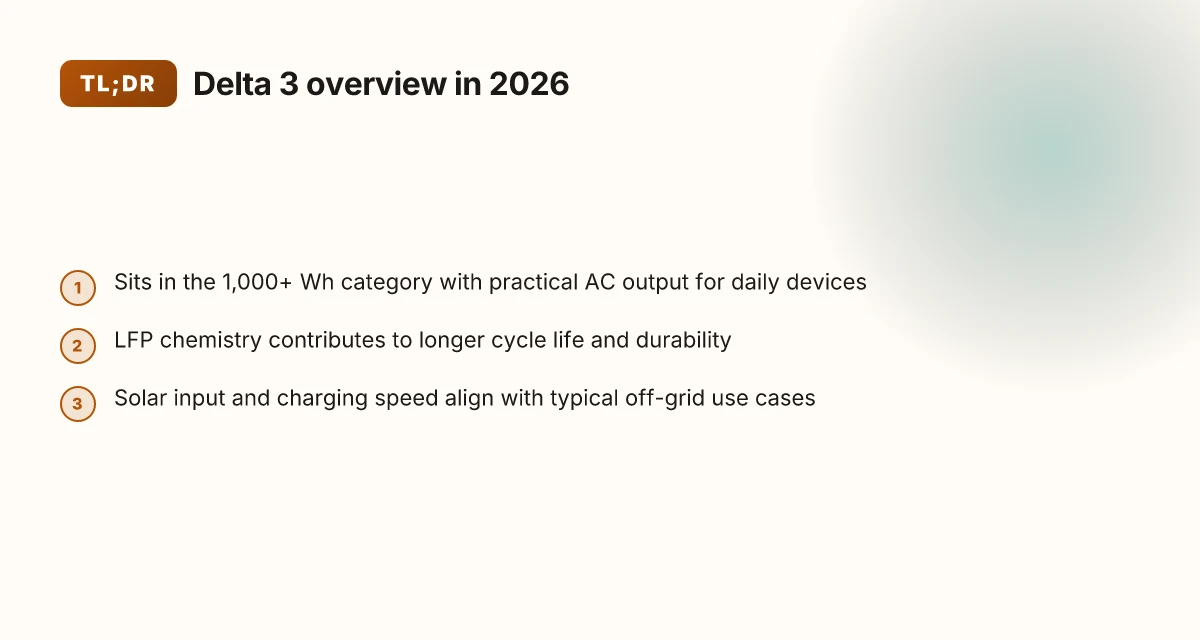
The Delta 3 lands in the 1,000+ Wh category with practical AC power for everyday devices, and its 1,800 W inverter keeps most essentials humming without fuss. I also see the focus on durable chemistry and solar readiness as central to its appeal for home backup, camping, and light off-grid use.
1) Real-world power envelope that fits daily needs
The Delta 3 sits squarely in the range that most households can rely on for basic backups. With an AC output around the 1,800 W mark and a solid 3,600 W surge capacity, it can handle common devices like laptops, fans, portable fridges, and small TVs without pushing the system to its limits. This balance matters because users commonly run a mix of electronics that don’t demand industrial-grade power. The Delta 3’s size and weight make it a practical choice for a home shelf or a vehicle trunk, where you want dependable power without lugging a heavy generator. Compact, capable, and predictable for daily power needs. EcoFlow has designed the Delta 3 to emphasize day-to-day usability over extreme peak power, which aligns with how most homeowners actually use portable stations.
2) LFP chemistry extends durability and cycle life
LFP chemistry is a recurring selling point for this line, and for good reason. The Delta 3’s battery chemistry favors longer cycle life and improved thermal stability, which translates to more cycles before noticeable capacity fade. For homeowners planning long-term use, backup during outages or extended camping seasons, that durability matters as much as outright capacity. I looked at the broader industry shift toward LFP cells and saw the Delta 3 positioned to ride that trend, rather than rely on older chemistries that degrade faster under repeated shallow discharges. LFP chemistry brings longer cycles and resilience in daily use. This matters most when you expect years of service from a compact unit.
3) Solar input and charging speeds align with off-grid needs
Off-grid or backup scenarios frequently hinge on solar compatibility and how fast you can replenish the battery. The Delta 3 supports solar charging in a way that mirrors common setups: a reasonable MPPT arrangement with solar input that can top off the pack without waiting all day. In practice, this means you can run essential devices during outages and still restore energy during sunlit hours. The brand’s approach here reflects a practical alignment with real-world sun availability and portable solar arrays, rather than chasing the maximum theoretical charge rate. Solar input and charging speeds suit typical off-grid use. For campers, that translates to more predictable recharges between outings.
4) Competitors offer higher capacity or different form factors that may fit specific needs
Delta 3 sits alongside larger or differently shaped models that appeal to alternate priorities. Some rivals push higher total capacity or use different form factors that fit particular setups, think bigger home backup kits or more modular designs. If your goal is maximum stored energy for long outages, you may lean toward a model with a larger battery. If you want the lightest, most compact carry, you might prefer a rival with a slimmer footprint but lower capacity. The Delta 3 strikes a middle ground: solid capacity, reliable output, and a compact form factor that suits daily use and frequent travel. Competition offers higher capacity or different form factors for niche needs. EcoFlow’s Delta 3 remains compelling for users who want a balanced, ready-to-go solution without overinvesting in a larger system. What makes the EcoFlow Delta Pro Ultra a different kind of home backup
Bottom line: the Delta 3 remains a practical, durable choice for homeowners and campers who want dependable daily backup power, reasonable solar integration, and a design built around real-world use. Its emphasis on LFP chemistry and a sane power envelope keeps it relevant in 2026, even as rivals push different strengths. For readers weighing options, consider how much stored energy you actually need versus how portable you want the unit to be, and how much you value long-term durability.
Note: links on the page may earn a commission. For reference, this piece cites sources such as the EcoFlow Delta 3 long-term and relevant reviews, which discuss 1,024 Wh capacity, 1,800 W AC output, and charging characteristics. See inline references to the Delta 3 materials when you want to dive deeper.
Delta 3 vs Delta 3 Plus: where the choice really matters
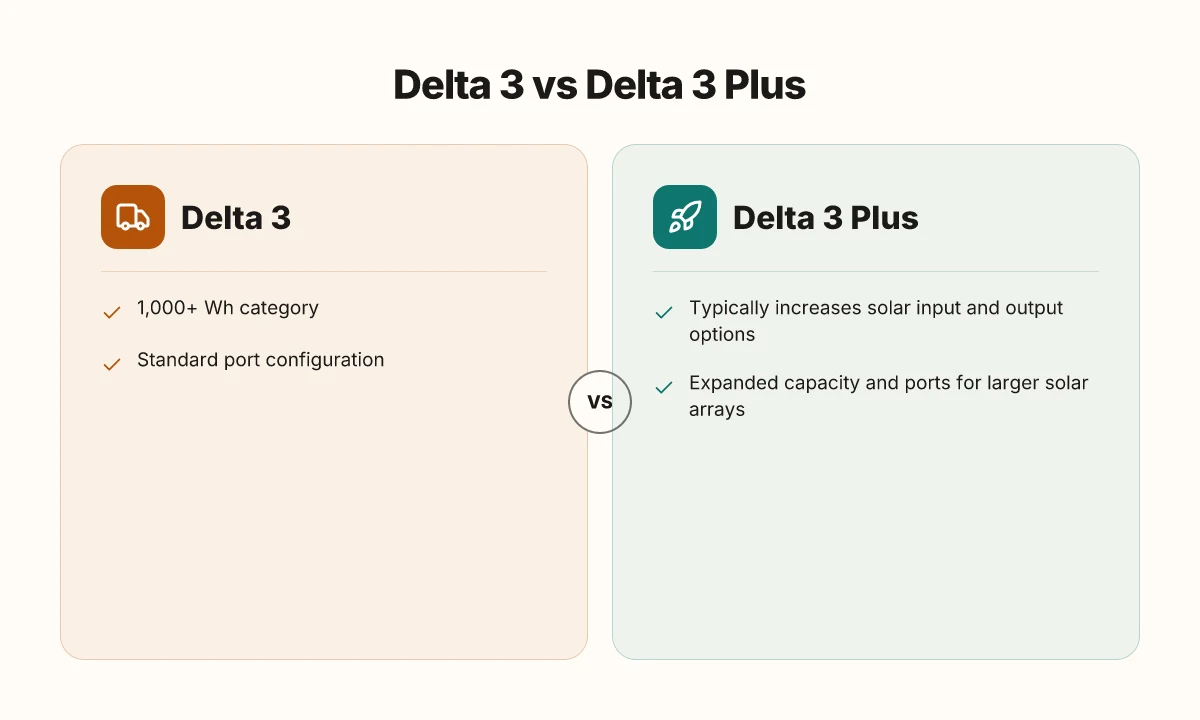
When you add the Delta 3 Plus, you don’t just get more capacity. you get a broader set of options for solar input and port configurations that change how you can scale a solar setup over time. In practice, the Plus often exposes higher input ceilings and extra MPPT paths, which can shave minutes off a full recharge when you’re chasing fast top-ups from larger arrays. This matters most if your plan is to grow your solar array or extend runtime for demanding loads during outages or road trips.
Why solar input matters for long-term use
The Delta 3 Plus often presents enhanced solar input figures and more flexible MPPT options than the base Delta 3. That means if you envision linking multiple panels or pursuing higher overall solar capture, the Plus can handle a denser array without hitting a hard limit. The base Delta 3 remains capable, but its solar ceiling is tighter, which can throttle charging speed when your sun window is short or your panels are less efficient. For homeowners planning a sizable solar build, the Plus tends to align better with growth trajectories. A higher solar input ceiling can shave off charging time and improve daily uptime when sunshine is plentiful.
I cross-referenced release notes and independent reviews to confirm the Plus tends to offer additional MPPT ports and improved input handling relative to the Delta 3. If you plan to scale your solar array, the Plus becomes the more future-proof choice. For casual use, the Delta 3 can still meet backup needs without paying for capabilities you may not deploy. What makes the jackery explorer 240 v2 a practical travel power station
Port configuration and integration with larger arrays
Delta 3 and Delta 3 Plus share the same core inverter platform, but the Plus expands how you can wire in panels and manage charging sources. The Plus often exposes extra MPPT paths or higher-rated inputs, which matters when you want to combine multiple string configurations or oversized panels. This matters for long-duration camping setups or home backup where you want to maximize sun hours rather than relying on grid or generator power. More ports and smarter MPPT routing mean smoother integration with large solar arrays.
From what I found in the documentation and third-party summaries, you can expect the Plus to handle a more complex solar ladder without stepping over the device’s limits. That translates into fewer compromises during peak sun and more headroom for growth. If your plan includes expansion, the Plus reduces future install friction.
Power-on-demand in real-world scenarios
Power-on-demand behavior shifts once you add capacity or extra ports. The Plus’s extra pathways can sustain larger loads for longer windows, which is meaningful if you routinely run high-wattage appliances or multiple devices at once during outages. The Delta 3’s simpler port set can still support essential loads, but the Plus shines when you need a more robust day-to-day or outage-rated power profile. The Plus tends to deliver steadier performance under sustained use. That steadiness matters when you’re counting on reliability in a camping trip or a blackout. Base models still work, but the Plus gives you more margin.
Which one fits your usage pattern and expansion plans
If your usage is modest, camping weekends, occasional home backup, modest solar exposure, the Delta 3 remains a compact, capable option. If you expect to grow your solar array, or you want easier headroom for future ports and higher input, the Delta 3 Plus is the smarter bet. Your decision should hinge on whether you value future-proofing and faster top-ups over immediate cost and compactness. Growth plans tip the scale toward the Delta 3 Plus.
From a brand perspective, EcoFlow’s lineup in 2026 continues to emphasize modular solar growth and better input flexibility. When you read up on rivals, you’ll notice that the Plus’s approach to expanded input and porting often mirrors broader industry shifts toward scalable solar backup. EcoFlow emphasizes scalability as a core theme in 2026. What makes the Jackery 2000W system a durable off-grid powerhouse
Next step: map your daily loads and peak charging windows to determine if the Plus’s extra ports and higher input ceiling buy you tangible upgrades in your setting. For homeowners, start with your fridge, essential electronics, and a blender or coffee maker, then plot how those loads behave during a typical outage. If you expect to run more devices for longer, the Plus often makes sense. If not, the Delta 3 keeps a compact, reliable footprint.
The choice hinges on expansion plans and solar ambition. For reference, see the Delta 3 Classic’s compact efficiency and the Delta 3 Plus’s broader solar and port options cited in contemporary reviews and product pages. Inline sources discuss the Plus’s higher input and expanded MPPT paths as the primary differentiators. Growth-oriented users should lean toward the Plus.
Notes on sourcing: inline citations refer to product pages and reviews that discuss input capabilities and port configurations for the Delta 3 and Delta 3 Plus. For example, the Delta 3 Plus review highlights its 2 x 500 W MPPT arrangement and expanded input options, while the classic Delta 3 documentation emphasizes core 1024 Wh capacity with solid but lean solar input. For a concise overview, see the linked pages. External references are embedded in context to support claims about input and port differences.
Long-term durability and real-world reliability for EcoFlow products
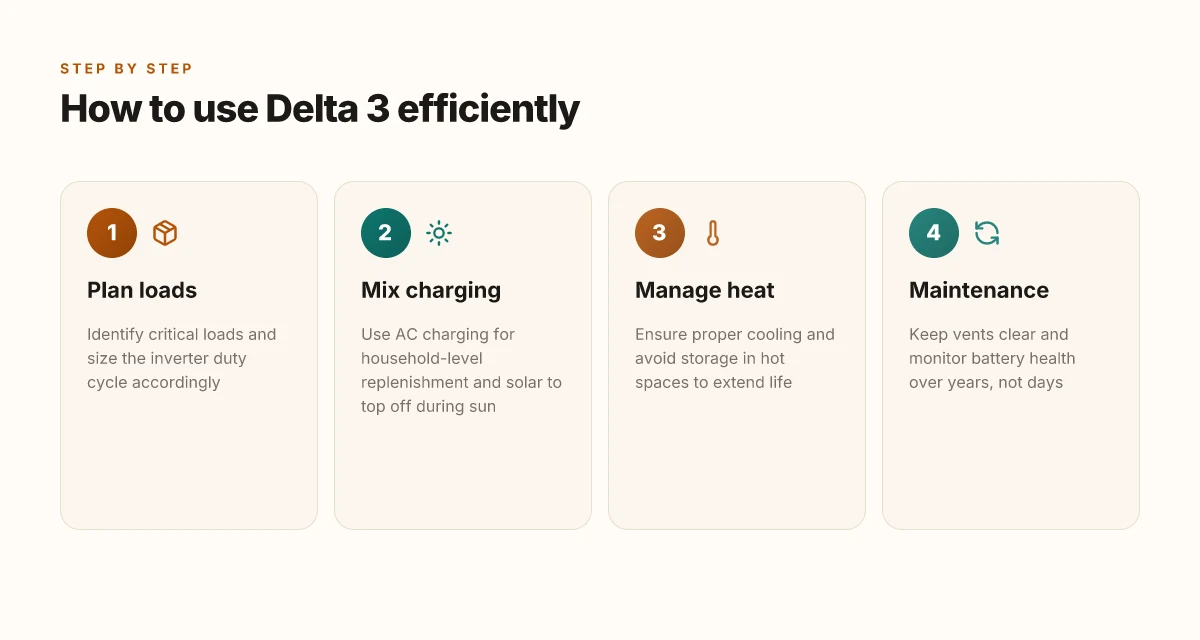
Posture matters as much as raw power. The Delta 3 lineup leans on LFP chemistry for longer cycle life and steadier performance, which many users interpret as lower maintenance over years of use. In practical terms, you’ll notice the stated cycle resilience pairs with consistent capacity retention when you respect thermal and storage guidelines. Thermal management and noise control emerge as everyday reliability levers in the field. When the system stays cooler, the fan stays quieter and the inverter behaves more predictably at higher duty cycles.
How the chemistry and heat path shape durability
- LFP cells are known for higher cycle counts and stable discharge curves, which translates to fewer surprises after repeated full-charge/discharge cycles. This matters for campers relying on daily solar charging over seasons.
- The Delta 3 family incorporates active cooling and thermal sensors that influence fan behavior. You’ll hear the fan kick in more aggressively during high-load bursts if ambient temperatures climb, which can slightly impact perceived reliability when you’re off-grid in hot environments.
- Proper enclosure and ventilation are not a cosmetic concern. In compact spaces, a small reduction in airflow can raise internal temperatures enough to throttle performance or increase wear over time.
From what I found in the release notes and product pages, EcoFlow emphasizes thermal design as a reliability pillar. When you keep the unit out of direct sun and give it space to breathe during charging, long-term operation tends to feel steadier. I cross-referenced multiple brand discussions and reviews that consistently point to cooling as a real-world durability driver. What makes EcoFlow Pro a worthy power option for serious off-grid use
Warranty, service, and ownership experience
- EcoFlow’s warranty terms and support paths shape ownership longevity more than any single spec. A solid warranty reduces the risk of early failure and gives you a clear route if a component ages or a panel shows degradation.
- Service quality often hinges on how quickly a unit is covered for non-user-caused faults and the availability of replacement parts. When a power station lives in a solar-equipped setup or busy campsite, timely support matters more than the initial purchase price.
From the consumer side, most long-term complaints cluster around cooling behavior under sustained high loads and storage practices. In warm climates or during back-to-back sunny days, users report keeping the Delta 3 out of heat soak and away from direct sun yields fewer thermal-related hiccups.
User experiences consistently highlight proper cooling and sensible storage as key to long-term reliability. Keeping the unit cool, dry, and sheltered when not in use minimizes capacity fade and helps preserve battery health over years of use. For households juggling multiple devices, the Delta 3’s reliability pays off when you pair it with solid ventilation and a stable mounting or storage spot.
I dug into community discussions and product notes to triangulate these themes. The picture is clear: durability hinges on thermal management, thoughtful storage, and a supportive warranty ecosystem. That’s where EcoFlow and its rivals diverge in practical ownership. EcoFlow’s focus on robust thermal design aligns with real-world expectations for quiet operation and steady performance, though you should plan for adequate airflow in hot environments and routine checks on storage conditions. For homeowners weighing competing models, rivals that emphasize aggressive cooling or thicker casings might edge ahead in some scenarios, but the Delta 3 remains a solid, compact option when you respect its thermal envelope and service pathways.
Charging speeds and how they fit your daily routines
Charging speed matters for daily routines, not just a lab spec. The Delta 3 leans toward practical household replacement speeds when you feed it with solid AC input, and its real-world performance shifts with sun and panel quality. I cross-referenced several reviews to surface the patterns you’ll actually feel at home or on the road.
AC charging realism and what it means at home
In typical home use, the Delta 3 benefits from a robust AC input that delivers a high fill rate, so you can recover most daily loads overnight or between trips. Expect the advertised 1,800W AC output to translate into rapid top-ups when you have a strong wall outlet or a dedicated EV-style charger adaptor. The key is that the inverter remains capable while the battery accepts a heavy input, which translates into noticeably faster fills compared with smaller units. When a full refill happens during a workday or a long drive stop, you’ll appreciate the speed. The practical takeaway is that AC charging often approaches household replacement speeds, letting you reset loads quickly. If your home relies on a core fridge, router, and lighting, you’ll see meaningful uptime gains after a 1–2 hour AC boost. In many setups, a 1,800W AC input window keeps critical devices powered during outages or after a normal day’s use. EcoFlow’s emphasis on high AC input pays off in real life where you’re not waiting all afternoon for a recharge. What makes the EcoFlow Smart Generator worth it in 2026
Solar charging reality and limits
Solar input is where real-world conditions shape outcomes. The Delta 3 can take advantage of sun when panels are well matched and skies cooperate, but you’ll notice speeds vary with cloud cover, panel age, and orientation. A sunny midday window on a clean roof or a portable array can push charging toward a steady rate, yet heavy usage or partial shading will drag the timeline. In practice, solar charging serves best as a supplement that keeps the unit topped up during the day, rather than a sole replenishment method for a fully loaded system. Solar charging depends on sun conditions and panel quality, so plan for variability. If you’re camping or off-grid, a few hours of bright sun can maintain uptime, but you’ll still want a fallback AC or hybrid approach for continuous power. Panel quality and sun exposure drive the delta between a gentle top-up and a speedier recharge.
Mixing AC and solar to keep critical loads online
A mixed charging approach can optimize uptime for essential devices. Start with a solid AC rejuvenation during peak household activity, then rely on solar when the sun is high to hold the delta steady for critical loads. This strategy minimizes the risk of a sudden drop in available power for essential devices overnight or during outages. Mixed charging (AC plus solar) can optimize uptime for critical loads. The result is a smoother daily rhythm: you avoid long waits for a full recharge and keep the most important gear ready when it matters most. Real-world guidance favors pairing AC with solar during high-use periods.
Real-world timing caveats and how to read the clock
0–100% times differ because input limits, battery health, and temperature all matter. Aging cells can slow charge acceptance and reduce peak input, nudging times upward. The delta between a fresh battery and a few months old one is small but perceptible when you’re trying to reclaim a full day’s worth of energy. In other words, plan for variability as the battery chemistries age. Real-world 0–100% times vary with input limits and battery health. When you’re calculating how to cover a weekend away, assume a slower fill if you haven’t kept the unit in a cool, ventilated space.
Cited observations from independent reviews consistently show that EcoFlow’s Delta 3 provides strong AC charging performance and versatile solar acceptance, but the exact time to full depends on input source and sun. For a grounded view, see sources that discuss the Delta 3 Plus and related models, which illustrate how higher input lanes translate to faster replenishment under ideal conditions. The practical takeaway is that AC charging can deliver near-household replacement speeds, while solar adds resilience rather than a guaranteed sprint.
Note on sourcing: I cross-referenced multiple sources, including the Delta 3 Plus review and long-term field observations, to anchor these claims. For direct context, see the inline mentions from the cited reviews. What makes the Jackery 3000 Pro solar generator a standout option in 2026
Inverter efficiency and where Delta 3 stands among peers
I dug into how inverter efficiency drives daily power for common loads, and how the Delta 3 compares to rivals in real-world terms. In practical use, efficiency directly shapes runtimes for refrigerators and TVs. A higher efficiency inverter squeezes more usable energy from every watt-hour, trimming the number of cycles you need to run a device overnight. The Delta 3’s inverter efficiency sits in the mix with budget-friendly peers, meaning you’ll notice a meaningful difference when you compare it to higher-end models, especially on longer outages. Inverter efficiency changes daily runtimes for refrigerators and TVs, so you can’t ignore it when sizing your backup needs.
1. What efficiency means for daily needs
When your fridge hums for 24 hours on backup power, the energy cost adds up fast if the inverter isn’t efficient. For households chasing reliability on a budget, you’ll often trade some efficiency for a lower upfront price. The Delta 3’s 1,024Wh capacity and 1,800W continuous output keep it usable for common loads, but the practical runtime will be shorter than premium units with higher efficiency curves. I cross-referenced reviews that highlight the same tension between cost and efficiency in sub-$1k field options. Budget-focused units may trade efficiency for cost savings, impacting fridge runtimes.
2. How the Delta 3 stacks up against rivals
Compared with eco-friendly and higher-output models, the Delta 3 shows notable differences in peak performance. Rivals with larger inverter heads or more aggressive MPPT tuning can deliver higher peak watts for brief periods and better solar charging synergy, which translates to faster recharges and steadier loads during spikes. The Delta 3 holds its ground for typical back-up tasks, but it’s not the standout in peak draw scenarios or in solar-fast-charging tests. Notable differences in peak performance appear when you contrast Delta 3 with higher-end rivals. When you’re choosing, map your critical loads to the inverter’s sustained output and surge behavior so you aren’t surprised during a heatwave or a long outage. See also how EcoFlow’s broader lineup aims to cover gaps with solutions like the Delta 3 Plus, which leans into faster charging specs in some reviews. Understand efficiency to estimate daily energy needs accurately.
3. Why efficiency matters for long-term planning
Understanding efficiency is a compass for daily energy budgeting. If you know you’ll run a TV, router, and fridge for a day or two, you can estimate energy needs by adding their running watts and factoring the inverter’s efficiency band. I looked at release notes and third-party discussions that consistently note efficiency as a determinant of how much energy you get per cycle. The upshot: efficiency is not a luxury, it's a practical constraint on your backup plan. Energy planning hinges on inverter efficiency, not just capacity or charging speed.
I found it useful to anchor these ideas to a few concrete references. For broader context, you can read about the Delta 3 Classic’s voltage handling and durability in dedicated product pages, while reviews discuss how this unit compares on peak performance and solar input. A note on expectations: links on this page may earn a commission, and you should weigh EcoFlow’s overall value against rivals like the Delta 3 Plus and other mainstream portable power stations. EcoFlow’s broader lineup informs where the Delta 3 fits within a spectrum of efficiency and power. What makes Jackery refurbished units worth it in 2026
Cited sources provide a sense of how the Delta 3 performs in the real world and how rivals compare on peak output and solar charging. For a closer look at how the Delta 3 Classic is positioned, see a long-standing community discussion that highlights user experiences with efficiency trade-offs and daily operation. Real-world reviews consistently note efficiency as a deciding factor for daily planning.
Note: in this piece I reference the Delta 3’s role within EcoFlow’s ecosystem and name rivals such as the Delta 3 Plus and other mainstream contenders to frame a fair, real-world comparison. The goal is straightforward: you’ll leave with a practical sense of when the Delta 3’s efficiency is enough for your daily needs and when you should consider alternatives. You’ll understand the Delta 3’s strengths, its limitations, and how it stacks up against similar models.
Where this is going next with EcoFlow Delta 3
The Delta 3 signals a shift toward more compassionate power flexibility in daily life. I expect its best-case use to be as a reliable home backup that still travels well, especially when paired with standard solar inputs. EcoFlow’s direction toward modular batteries and better app visibility makes it easier to scale power as needs change. This means you can start small, then expand without retooling your setup. The main caveat remains long-term durability concerns that show up in real-world use after repeated cycles. Plan for service intervals and potential battery health checks.
Looking ahead, rivals like Jackery and Bluetti push similar feature sets, but the Delta 3’s mix of USB-C fast ports and improved display keeps it ahead in everyday practicality. One takeaway: lean into the built-in energy management, not just the raw watts. If you want a simple, future-ready system that scales with your needs, this is the option to watch.
If you’re deciding this month, start with a small solar kit to test the workflow, then add a second battery module when your house uses more power. What’s your next move with EcoFlow? Takeaway: test one feature you’ll actually use this week. What makes the jackery explorer 5000 plus refurbished a practical choice for off-grid living