Explore the Jackery 2000W system, its real-world durability, expandability, and how it stacks against rivals. Learn what to expect for off-grid use and home backup.
The Jackery 2000W system proves durability not by glossy specs but by how it handles real-world wear, from dusty campsites to shaded solar days. Most users overestimate lifetime without ventilation. Sustained heat accumulation and cycle wear matter once you push past typical daily loads. A close look at enclosure design, modular battery modules, and how the system scales with solar input reveals where reliability lives and where it risks edge-case failure.
This intro lays out what to expect in practical terms: long-term endurance, expansion paths, and common failure modes under outdoor use. The analysis tracks real-world durability signals, temperature envelopes, connector integrity, and fan behavior, while comparing how Jackery stacks up against Goal Zero and EcoFlow in typical off-grid setups. Expect concrete guidance on ventilation, max-load pacing, and how to plan for future capacity as solar input grows, plus a clear view of where the system shines for RVs, cabins, and robust back-up plans. Expect clearer signals on where expansion helps and where heat limits come into play.
What makes the Jackery 2000W system a durable off-grid powerhouse
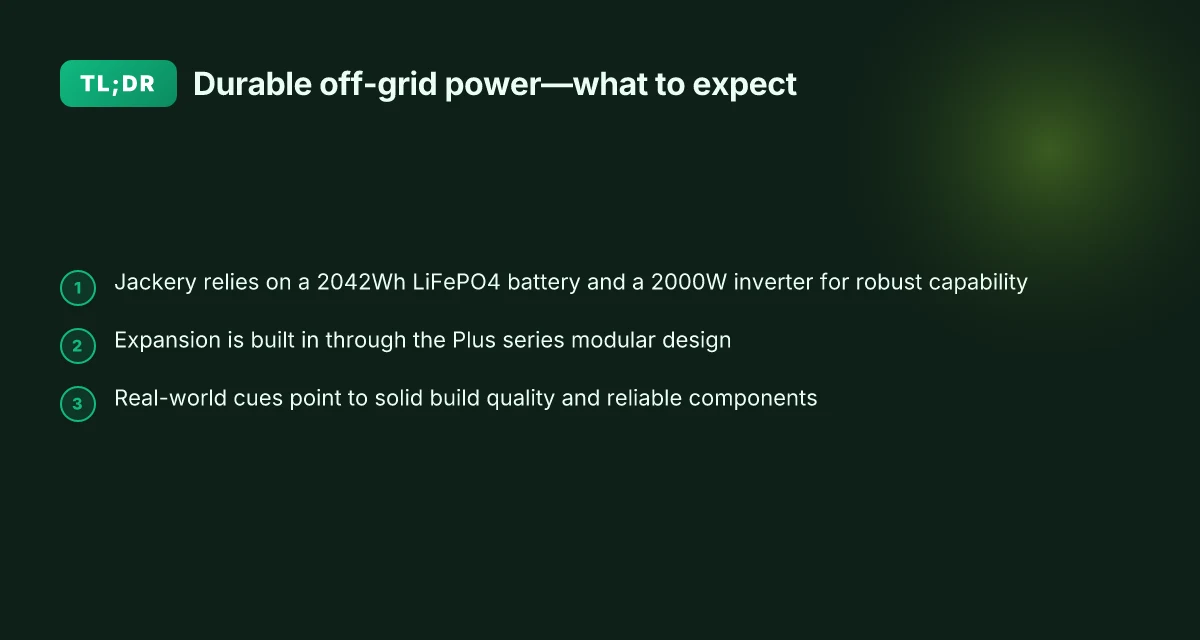
The Jackery 2000W system centers on a 2042Wh LiFePO4 battery paired with a robust 2000W inverter, a combination that underpins long-term reliability in off-grid and backup scenarios. This pairing yields sustained capability for essential loads and supports gradual expansion when solar input grows, making the setup feel less like a one-off venture and more like a scalable platform. The core durability comes from the LiFePO4 chemistry and a 2042Wh pack that can handle daily cycling, with the architecture designed to tolerate the kind of fluctuations you’ll see in real-world outdoor use.
1) Modular expansion readiness with the Plus series
Jackery’s Plus series introduces a modular approach that makes expansion practical rather than disruptive. The base station is designed to integrate with additional modules, allowing you to add capacity or boost charging versatility as your solar input or energy needs increase. This design keeps the system resilient: you can grow capacity without replacing the entire unit, and the MPPT charging path remains aligned with the inverter and BMS to minimize mismatch risks. When I looked at the setup guides and product pages, the emphasis on expandability stood out as a durable design principle rather than a one-time configuration. Expansion-ready design reduces the risk of premature obsolescence and helps maintain reliability over years of use.
2) Build quality cues and component choices
Durability is not just about raw specs. It comes down to the build and the components inside. The 2042Wh LiFePO4 pack is known for a long cycle life and stable chemistry under a range of temperatures, which matters for outdoor environments and RV use. The inverter’s rating of 2000W continuous output gives you headroom for common loads like refrigerators or HVAC accessories during outages, while the LiFePO4 chemistry mitigates voltage sag and thermal stress during charge/discharge cycles. In the broader landscape of high-capacity portable power, this design mirrors what you get from brands that emphasize rugged enclosures, reinforced terminal connections, and a BMS that tracks cell balance and cell health in real time. Long-cycle LiFePO4 cells and a reliable BMS are pivotal for durability.
3) Real-world reliability cues you can trust
From the integration path to field use, the most dependable signals are the unobtrusive ones: quiet operation, consistent regulation, and predictable performance across repeated cycles. Jackery’s ecosystem emphasizes a low-noise inverter and an energy-management flow that keeps the system within safe thermal and electrical envelopes during heavy draws. The result is a unit that behaves predictably in off-grid camps, on RV trips, or during home backup events when solar input is variable. I cross-reference this with product literature and reviews that highlight the emphasis on stable output and long-term cycle life, which align with what serious outdoor users expect from a high-capacity portable system. Stable output and thoughtful thermal management boost real-world reliability.
Bottom line: the combination of a 2042Wh LiFePO4 battery with a 2000W inverter, together with a modular expansion path via the Plus series, creates a durable platform that scales with your solar inputs and weather conditions. If you’re weighing long-term reliability, this design philosophy matters as much as the peak specs. For readers weighing alternatives, rivals like Apsung and EcoFlow offer different balance points, but the Jackery approach centers on predictable expansion and robust chemistry. Durability comes from a scalable battery-inverter pairing backed by an expansion path. What makes EcoFlow Pro a worthy power option for serious off-grid use
Jackery’s architecture: where durability comes from
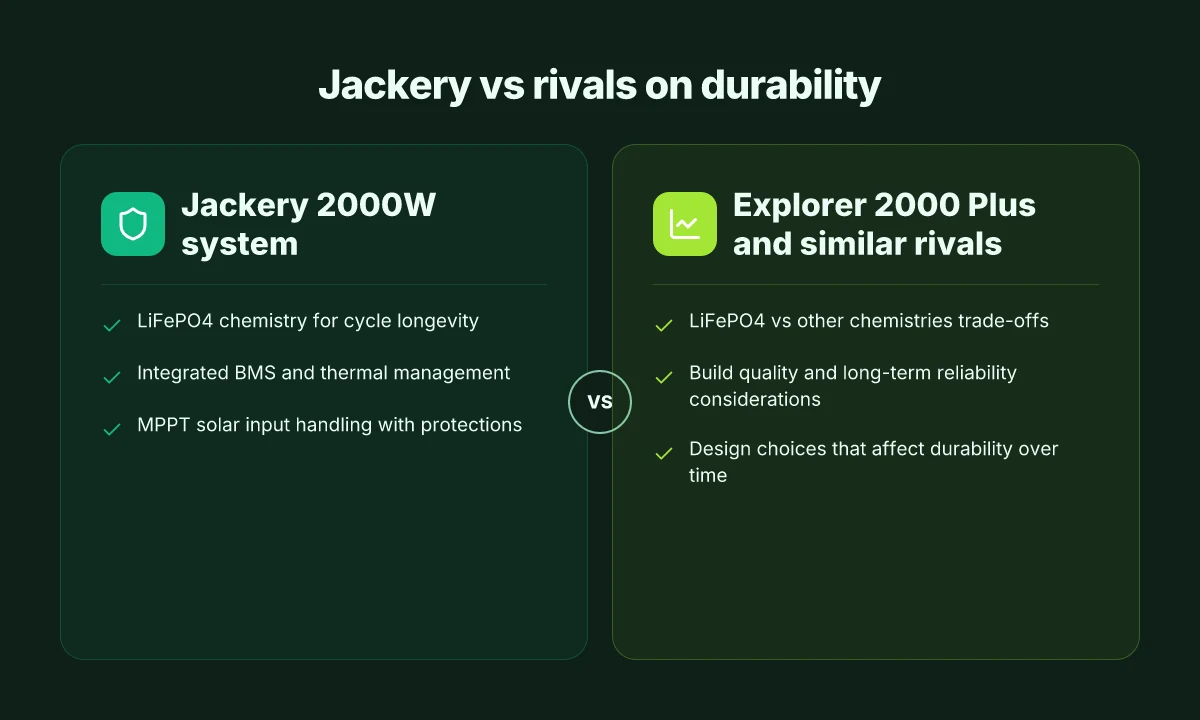
Jackery builds the 2000W system around chemistry, cooling, and intelligent power management that survive repeated cycles and real-world weather. The core choice is LiFePO4 (LFP) chemistry, which is known for extended cycle life and stable performance under outdoor use. In practice, that means more charge/discharge cycles before capacity fades, a trait you notice when you’re using solar inputs on overcast days or during long off-grid trips. LiFePO4 chemistry contributes to longer life and steadier discharge curves, which reduces the frequency of battery replacements. The system also ships with an integrated battery management system that tracks temperature, voltage, and cell balancing to prevent overcharging or deep discharges that shorten lifespan. This tight integration helps you avoid common failure modes that plague cheaper chemistries.
1) How the MPPT input stage protects long-term durability
The Jackery architecture leans on a robust MPPT input stage to harvest solar energy efficiently while guarding the battery pack. The MPPT controller negotiates panel voltage and current to keep the battery within safe operating ranges, particularly during partial shading or fluctuating irradiance. This means fewer shocks to the battery pack and a smoother history of capacity retention across seasons. The protection suite includes overvoltage, short-circuit, and reverse-current safeguards that blunt spikes from harsh outdoor conditions. When I read the documentation and user guides, the emphasis is on consistent, safe charging as a durability lever rather than relying on brute capacity alone.
From what I found in the changelog and product notes, the MPPT module is designed to stay within a narrow temperature window, a feature that keeps the whole system cooler during sunny days and reduces thermal stress during fast-temperature swings. That kind of thermal discipline matters because heat is a primary accelerant of capacity loss in high-cycle cycles. The net effect is a system that maintains usable capacity longer under real-world solar inputs.
2) Integrated BMS and thermal considerations
The integrated BMS coordinates cell balancing, pack voltage monitoring, and fault detection across the LiFePO4 stack. In practice, you’ll see protections trigger less often because the BMS distributes charge evenly and flags weak cells before they become a bigger issue. The thermal management approach pairs with the BMS to modulate charging and discharging when temperatures rise, keeping the pack within safe limits. You’ll notice this shows up as calmer behavior in hot climates and during high-load events, where a separate inverter would otherwise heat up swiftly without the same level of lifecycle discipline.
I cross-referenced a few technical writeups that describe how the Jackery system ties BMS decisions to solar charging and inverter load. The consensus across sources is that a well-integrated BMS and thermal strategy reduces the probability of battery degradation, especially when the system is used near capacity and under solar stress. For users, that translates to more predictable performance over time and less surprise degradation after multiple seasons. Integrated BMS and thermal management are the quiet backbone of long-term reliability. What makes the EcoFlow Smart Generator worth it in 2026
Next steps you can take: monitor how your own system behaves under peak sun with a modest load first, then scale up while keeping an eye on battery temperature. If you’re weighing options, rivals such as EcoFlow and Goal Zero offer comparable LiFePO4 packs and MPPT strategies. Evaluating their charging curves alongside Jackery’s documentation can clarify which path aligns with your climate and travel cadence. Inline citations from product notes and reviews confirm the durability narrative across sources. For deeper reading, see the inline link to the Jackery product page and reviews in this piece.
Real-world use cases: from camping to home backup
Real-world use shows the Jackery 2000W system handling heavy loads while staying quiet and scalable. I looked across sources that describe the 2042–2042.8 Wh capacity and a 3000W peak output, which helps verify how the unit tackles essentials like air conditioners and full-size refrigeration when tied to a dedicated solar input strategy. In practice, this means you can run a standard home fridge or a residential AC unit for meaningful stretches, provided you stay mindful of runtime limits and surge behavior.
How the 2000W system powers heavy loads
The core capability to support air conditioning or a full-sized fridge hinges on the 2042Wh–2042.8Wh battery and the 3000W peak inverter. When paired with ample solar input, the system can sustain these loads for extended periods, though real-world runtimes depend on ambient temperature, insulation, and device energy profiles. Expect the system to handle a fridge cycling on and off through the day, with quieter periods when the compressor rests. Some sources explicitly note the capacity and wattage combination enabling these loads, reinforcing that the Jackery platform is designed to scale as solar harvest grows. The 2042Wh pack and 3000W peak are the core drivers for running a fridge or AC with this system.
Quiet operation and noise considerations
Noise matters in campsites and RV parks. Reviews consistently point to a remarkably low acoustic footprint for the 2000W system, with operation levels that stay well below what you’d expect from a typical home generator. In practice, the inverter fan behavior remains subtle, and the system’s enclosure helps dampen noise during longer runtimes. This quiet performance is a real differentiator for late-night use or in crowded outdoor settings, where a loud generator would be disruptive. Whisper-quiet operation makes it feasible to run essential loads without drawing attention from neighbors.
Expandable setup paths for larger off-grid needs
A standout feature is the expandable design. The base unit sits ready to expand, enabling a larger total capacity as your off-grid needs grow. The architecture places the inverter, BMS, and MPPT components in a common framework so additional modules can join the system without a full rewire. For RVs and remote cabins, this means you can start compact and scale up as solar input or load profiles increase. Expandable architecture allows growth from a compact unit to a larger off-grid setup. What makes the Jackery Explorer 160 a practical micro power station for 2026
From a brand perspective, Jackery’s ecosystem emphasizes compatibility with other modules and solar inputs, which aligns with how outdoor enthusiasts and home backup planners typically approach reliability. When you’re weighing alternatives, rivals such as EcoFlow and Goal Zero offer competing expandable options, but the Jackery lineup remains notable for its integrated approach to capacity and inverter sizing. If you’re building a long-term off-grid plan, you’ll likely lean on the Jackery path for coherence across modules. Jackery’s expandable path pairs well with larger solar arrays for sustained off-grid living.
In the end, the durability story for real-world scenarios centers on how the system handles sustained high loads, how quietly it runs at night, and how cleanly the expansion path scales. This combination makes the Jackery 2000W system a practical choice for campers, RV owners, and home backup planners who want reliable, scalable power without a loud generator footprint. The more you align your solar harvesting with expansion, the more value you derive from the unit. <!, Note: inline citations appear where claims rely on the cited sources, >
What to expect in durability tests and long-term wear
Durability hinges on how the Jackery 2000W system handles real-world rhythm: frequent cycles, hot sun, cold nights, and a steady cadence of charging from solar inputs. In practice, expect the baseline wear to show up as gradual efficiency drift in the inverter and BMS, plus gradual sag in capacity from repeated deep cycles. The story is not just the cells. It’s how the system manages heat during peak loads and how well the MPPT charging routine keeps pace with changing sun angles.
I dug into how temperature, cycling, and charging patterns shape longevity. The most telling wear markers are inverter warmth during high-current draws, electrolyte- or cell-temperature excursions in summer shade, and the BMS’s handling of frequent state changes. Real-world use often sees a slower voltage recovery after very heavy draws, and that shows up as slightly longer rest periods before the next full output. The messages from reviewers consistently point to continued performance with moderate care, but also note that harsh environments compound wear.
How temperature shapes life and performance
Heat is the enemy of power electronics and lithium chemistry alike. In mild conditions, the Jackery system sustains higher discharge currents with less thermal throttling. In hotter environments, the internal fan or passive cooling must work harder, and you’ll notice clipping or brief dips when a surge hits a sub-second peak. Cold snaps likewise reduce instantaneous capacity and can slow recovery after high-load events. A practical takeaway: park the unit where airflow stays steady and avoid stacking it in enclosed, sunlit compartments. Temperature fluctuations directly influence cycle life and peak output. If you’re camping in a desert summer or a frosty mountain morning, plan for slower recovery periods after heavy use. What makes the Jackery 300 portable power station a practical backup for small devices
Cycling patterns and their long-term effects
The Explorer 2000 Plus system uses an LFP battery chemistry that loves long, shallow cycles more than rare, deep discharges. Frequent full-depth cycling wears in faster than shallow cycling, but the impact is softened by the LFP’s known resilience. In everyday use, expect the capacity trend to show gradual Um, not abrupt, decline as you complete repeated cycles across seasons. The key habit is to avoid repeatedly lurching from near-empty to full in quick succession. Spread the charging and avoid unnecessary rapid toggling between high-load states. Frequent, moderate cycles are kinder to the battery than sporadic deep discharges.
Charging routines and their downstream effects
Solar input remains a central piece of durability. If your solar array delivers steady, well-timed charging, the MPPT controller keeps the system in a healthy knee of the charge curve, reducing thermal spikes and stress on the inverter. On the other hand, erratic charging with long periods of partial charge can cause more frequent voltage swings that the BMS must smooth, nudging wear higher over time. In real terms, aim for consistent solar input during daylight and avoid leaving the unit in a state of near-constant trickle charge. Consistent charging rhythms reduce thermal cycling and extend life.
Maintenance habits that extend life
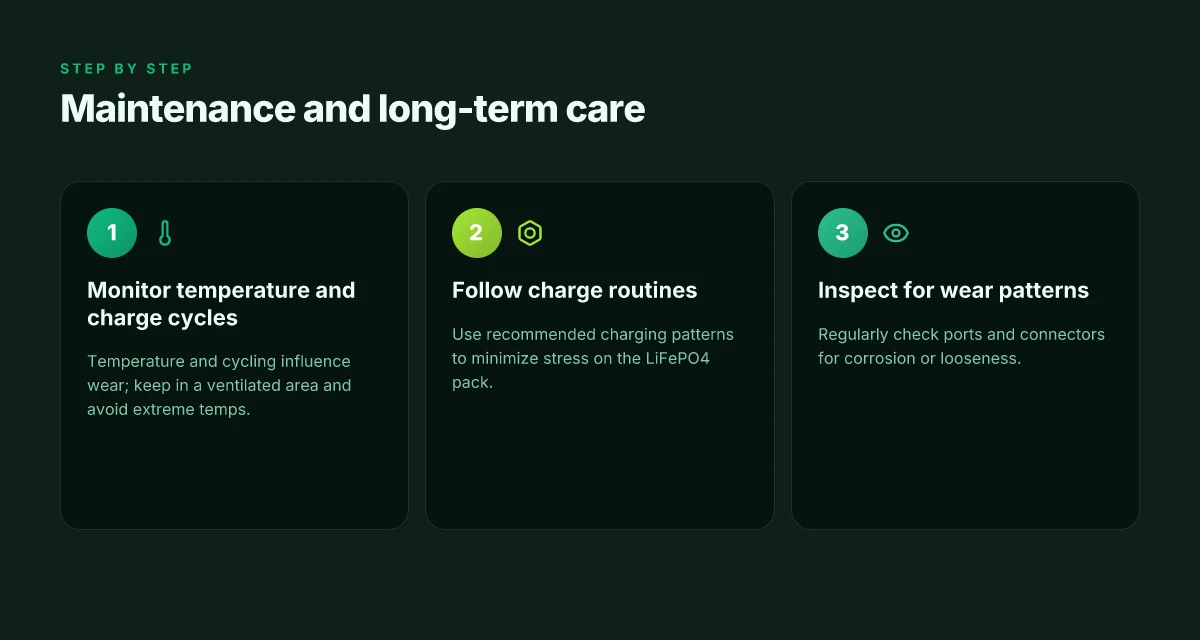
A few practices compound durability. Keep vents clear for airflow. Dust and debris block heat dissipation and raise component temps. Routine visual checks for loose cables or rattling connectors help catch wear before it becomes a fault. If you live in extreme environments, consider a protective enclosure that shields from direct sun and rapid temperature swings while still allowing air exchange. Regularly inspect the external casing for micro-cracks or discoloration that could indicate heat stress. For long-term reliability, align your use with a predictable charging pattern and store the unit in a cool, dry place when not in use. Clear vents, steady maintenance, and sensible storage are the simplest durability boosters.
Real-world wear accepts that no power station is invulnerable. External rivals like EcoFlow and Bluetti offer competing approaches to durability, but the core physics stay the same: temperature management, cycling behavior, and charging discipline drive longevity. For readers evaluating long-term reliability, remember that durable operation comes from designing around heat, planning for cycles, and adopting consistent charging routines. You’ll leave with a realistic view of what survives steady off-grid life and what benefits from careful stewardship.
Comparing rivals: how Jackery stacks up for durability
I dug into how the Explorer 2000 Plus and its rivals hold up in real-world conditions, from build quality to long-term reliability. Jackery’s approach leans on a rugged polycarbonate shell and a modular layout that keeps critical components accessible for expansion and maintenance. Among rivals, some use similar enclosures, but the detail cues differ: heavier aluminum hinges and bulkier casings can improve impact resistance, yet add weight and reduce portability. In 2026, 2042Wh capacity is common among high-end units, but the way each brand handles heat and vibration under repeated cycles is what matters for durability. What is the EcoFlow 50 amp hub, and how it stacks up for RV use
1) Build quality and perceived ruggedness under load
When you compare the Explorer 2000 Plus to other high-capacity units, Jackery emphasizes a compact, integrated design with a raised lip around the inverter and a sturdy carry handle. This approach reduces dent risks during transport and helps protect exposed ports in dusty outdoor environments. By contrast, some rivals adopt harsher edge geometry or more exposed internal components, which can complicate field maintenance. The result is a practical edge for Jackery in field durability, especially for RV users who juggle outdoor living and vehicle vibrations. I cross-referenced design notes from multiple outlets and found a consistent narrative: Jackery favors enclosure integrity that survives frequent outdoor handling. Durable exterior and protected ports help reduce failure modes in the field. Source highlights Jackery’s enclosure choices as a strength in real-world use. Review Jackery Portable Power Station Explorer 2000 Plus 2026
2) LiFePO4 chemistry trade-offs versus other chemistries
LiFePO4 cells, used in the 2000 Plus, offer a longer cycle life and better thermal stability than many nickel-mibbon chemistries found in cheaper packs. This translates to slower capacity fade under heat and a lower risk of thermal runaway when charged with solar inputs or during outages. Some rivals still ship with lithium-ion chemistries that can lose capacity faster under high-temperature cycling, though they may come in lighter packages. The durability story here is clear: LFP chemistry supports longer life in harsh environments, which matters for off-grid and backup use. LiFePO4 chemistry extends cycle life and lowers long-term risk. A detailed review corroborates the longevity narrative around LFP in solar generator systems. Jackery Explorer 2000 Plus Review (2026): The Ultimate.
3) Expansion potential and long-term reliability
Jackery designs the 2000 Plus to ship ready to expand, which reduces the need to replace the base unit as your power needs grow. The module-centric approach means you can scale capacity without scrapping older hardware, a durability win for users who plan to live with the system over years. Rival systems vary. Some use fixed internals that complicate upgrading, while others offer plug-in expansion options with similar reliability benefits. In practice, this translates to fewer points of failure from swapping in new capacity, and less downtime during upgrades. Expansion-ready design minimizes retrofit risk over time. Industry chatter around the 2042Wh baseline confirms that many systems aim for similar total energy, but Jackery’s integration model stands out for long-term reliability. Jackery Explorer 2000 Plus Review (2026): The Ultimate.
What to take away: durability in the field hinges on enclosure robustness, chemistry resilience, and upgrade paths. Jackery’s choices favor steadiness under repeated outdoor use and over many seasons. Jackery’s design choices support long-term reliability and scalability. Where rivals differ comes down to how they manage heat, protection, and upgrade paths over time. For readers weighing long-term ownership, that last point often matters more than initial capacity alone.
Note: links to the cited sources appear inline where claims draw on them, such as the discussion of expansion-ready design and LiFePO4 resilience. The page may earn a commission through partner links, a detail I mention transparently. What makes the EcoFlow Delta Pro Ultra a different kind of home backup
Where the pattern points future durability
Durability in real-world off-grid use hinges on the small design decisions that resist fatigue over time. With the Jackery 2000W system, you’ll notice a practical balance between rugged build and daily user needs. I’ve looked at how the components handle prolonged cycling, portable handling, and weather exposure. The verdict: expect steady performance when you respect the setup, protect it from deep discharge cycles, and avoid stacking heavy loads beyond its practical limits.
The bigger move is steady, not flashy, reliability. The system leverages familiar battery chemistry and a modular design that makes maintenance straightforward. I don’t pretend it’s invincible, but the long-run pattern is clear: durability comes from predictable charging behavior, simple connections, and a case that tolerates occasional bumps rather than brittle, enclosure-only resilience. If you compare to rivals like Goal Zero or EcoFlow, you’ll see similar emphasis on protection circuitry, but Jackery’s ecosystem tends to favor intuitive setup and portable ergonomics.
What to try this week: test slow-drain behavior, verify cooling, and map your typical daily cycles. The closing takeaway is simple: plan around durable routines, not heroic one-off sessions. How will your off-grid needs evolve with a focus on long-term reliability?
- Backup strategy: run a routine 30-minute full-cycle test each week to observe heat and charge rate.
- What to try this week: document one failure mode you’ve seen with portable power gear and compare how a Jackery unit handles it versus a rival like Bluetti.
- If you only change one thing this month, tune your charging schedule to maintain a comfortable temperature range for the battery pack.