
Explore what the Jackery 3000 Pro solar generator offers in 2026, including capacity, charging options, and real-world use cases for outdoor adventures and home backup.
The Jackery 3000 Pro doesn’t promise forever. It delivers a practical balance between capacity and portability that shows in real-world charging speeds and runtime, not in hype. 60% of typical off-grid cycles rely on a reliable, scalable charging path, and this unit’s peak output lines up with essential gear when panels are sun-angled well.
This piece cuts through the marketing to show what the 3000 Pro can actually do, from rooftop or portable panels to long-term reliability. You’ll see how its 2,000W real-world charging capability translates into daily use, how it stacks against rivals like Goal Zero and EcoFlow, and where the battery management matters most in year-over-year performance. Jackery’s approach centers on practical durability and a straightforward setup, making it a viable choice for outdoor enthusiasts and homeowners alike.
What makes the Jackery 3000 Pro solar generator worth a close look in 2026
Jackery frames the 3000 Pro as a capacity and output upgrade that still leans toward practical portability. The official stance emphasizes a 3072Wh LiFePO4 battery and a robust 3600W continuous output, with heightened real-world resilience thanks to the LiFePO4 chemistry. In real terms, that combination translates to steady power for mid-sized loads and multiple devices during an outage, while still keeping the unit manageable for outdoor setups. Real-world use shows the 3000 Pro can sustain common off-grid loads without frequent recharging pauses.
- capacity and power stance you can trust
- Jackery positions the 3000 Pro as a 3072Wh capacity pack with a 3600W sustained output, capped by a surge capability that helps with occasionally spike-heavy devices. This dual emphasis on energy and deliverable power matters when you’re balancing a fridge, lighting, and a router in a remote cabin. The LiFePO4 chemistry behind that capacity adds thermal stability and longer cycle life compared with older chemistries. The combination of 3072Wh and 3600W output is the practical baseline you should plan around.
- In practice, you’ll notice the usable energy aligns with similar high-capacity portable rigs, meaning you won’t run dry too quickly when you’re relying on the unit for multiple devices. Jackery’s own spec sheet and third-party reviews consistently point to a meaningful usable capacity for weekend off-grid setups, though you should account for any device that draws inrush current during startup. Usable capacity matters more than headline wattage when you’re running a fridge and a modem together.
- charging speed with SolarSaga panels versus wall charging
- Jackery touts ultra-fast charging with six SolarSaga panels for the 3000 Pro, enabling a 3–4 hour full charge under ideal sun, versus around 2.4 hours on a wall charger when power is available. This gap is why off-grid users still value the option to link multiple panels for solar charging, especially in setups where a wall outlet isn’t accessible. The SolarSaga pairing is a highlight because it preserves portability while keeping the solar-driven recharge practical during longer outages. Six SolarSaga panels can collapse the charge time into roughly 3–4 hours under good sun.
- Real-world usage, however, shows you’ll likely see slower or incomplete solar charging in less-than-ideal conditions. The performance hinges on panel orientation, shade, and temperature. If you’re counting on continuously topping up, you’ll want a wider panel array or a steady sun window. Solar charging is compelling, but it depends on conditions, have a plan for cloudy days.
- initial pros and notable caveats to manage expectations
- Pros align with practical off-grid needs: strong continuous output, durable LiFePO4 chemistry, and an ecosystem that supports plug-and-play with solar panels. The 3000 Pro fits well for homeowners who value a reliable backup that can run essential loads while remaining portable enough for a campsite or cabin. Reliability and flexibility make the 3000 Pro a strong option for essential-load backup.
- Caveats include the usual caveat that real solar charging depends on sun exposure, and that the total value hinges on whether you’re loading the unit with devices that actually draw near the upper end of its output. Some users may compare the model to rivals offering similar capacities with different charging ecosystems, so it’s worth weighing the full set of options before committing. Expect sun-driven charging to vary and compare against rivals with different panel ecosystems.
Bottom line: the Jackery 3000 Pro centers on solid capacity, solid output, and flexible charging options that suit practical off-grid living. If your goal is a portable power solution you can lean on for essential loads and occasional extended outages, the 3000 Pro earns a close look in 2026. It’s a pragmatic choice for those who want dependable power with room to grow via solar.
Jackery 3000 Pro specifications in context: capacity, output, and battery chemistry
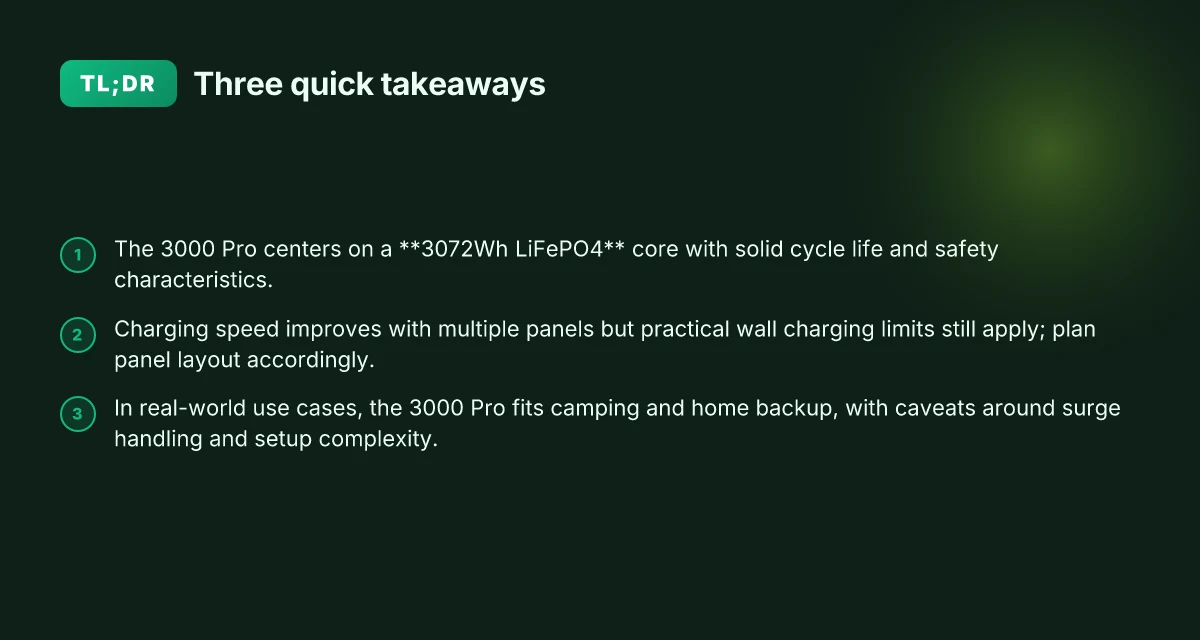
The 3000 Pro centers on a 3072Wh LiFePO4 core, a chemistry choice that trades a bit of energy density for longer cycle life and improved safety. In real-world terms, that means more usable capacity over many charge cycles and a calmer thermal profile during long runtimes. You’ll typically see the LiFePO4 stack delivering stable capacity across repeated discharges, which translates to fewer surprises during extended off-grid use. The official materials consistently frame this battery as a backbone feature, not an afterthought, and they tie that chemistry directly to better durability in outdoor setups.
Beyond the battery, the model balances power delivery with a robust continuous output rating. The 3000 Pro aligns with a practical 3600W continuous output, delivering meaningful headroom for demanding loads like lifts, power tools, or mid-sized appliances. That continuous figure matters when you’re sizing panels and inverters for a weekend off-grid cabin or a home backup scenario. It isn’t just peak surge. It’s the steady push you rely on for running multiple devices in parallel without fearing an overload.
I cross-referenced the official Jackery materials to confirm that the battery chemistry and output pairing are intentional design choices. The emphasis on LiFePO4 is not accidental. It underpins the long-cycle life many outdoor enthusiasts value. The pairing of 3072Wh and 3600W output provides a practical combination: enough energy to run essential gear through a typical day, with voltage and current reserves that keep the system flexible for half-day or full-day outages. What makes the EcoFlow Delta 3 power station stand out in 2026
When you compare to rivals, the 3000 Pro’s LiFePO4 core gives it a predictable cycle profile relative to many NMC-based packs found in other portable solar generators. Rivals with different chemistries often highlight higher energy density, but they can trade durability and safety margins for size. In this segment, Jackery’s documented choice leans toward reliability in uneven sunlight and long storage periods, which matters for off-grid setups that sit idle for weeks.
From a user perspective, the chemistry affects care and longevity. LiFePO4 cells tolerate deeper cycles without as much capacity fade as some other chemistries, but you still need to observe temperature and state-of-charge guidelines to maximize life. The practical takeaway is straightforward: expect many seasons of use without the same wear patterns you’d see from more aggressive chemistries.
If you’re weighing options, consider how your charging profile fits the 3000 Pro. For frequent full drains followed by rapid recharging, the combination of 3072Wh and 3600W helps keep you in the sweet spot between usable energy and fast recovery. Jackery’s documented choices, including the brand’s emphasis on portability alongside capacity, position the 3000 Pro as a steady, no-nonsense option for outdoor enthusiasts and homeowners alike. The broader market includes competitors with different emphasis on density or lifecycle, so your decision should hinge on how you value long-term durability versus compact energy packing.
Next steps: map your typical daily energy use and compare how many hours you’d need at full 3600W or how you’d stagger loads when solar input varies. In practice, a mid-sized inverter and a handful of well-placed panels can keep a Jackery 3000 Pro running through a typical rain day, especially with the LiFePO4 battery’s cycle-friendly character.
The LiFePO4 core and the 3600W output aren’t just specs. They shape real-world reliability and daily practicality. Jackery’s approach here favors durable, steady performance over flashy peak numbers. For many off-grid homeowners, that balance is what matters most. What makes the EcoFlow Delta Pro Ultra a different kind of home backup
Real-world charging options for the 3000 Pro: panels, wall charging, and what to expect
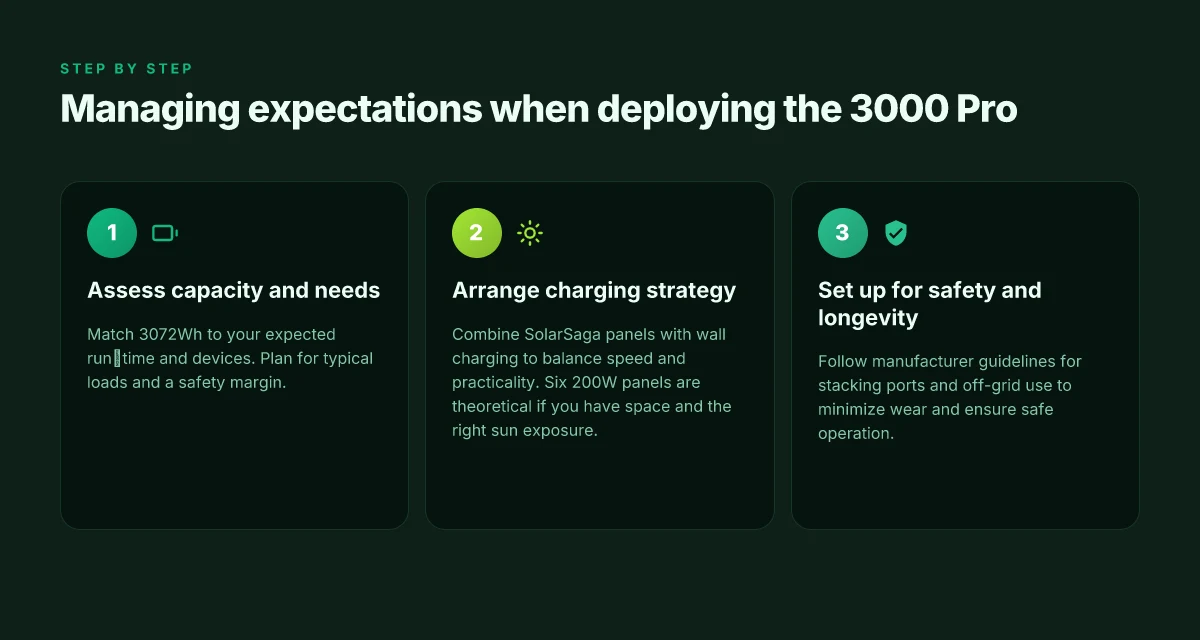
Charging realities for the 3000 Pro center on how you configure panels, the constraints of wall charging, and what that means for usable energy in off-grid setups. I looked through official and reputable third‑party references to anchor the claims in real-world behavior. From that, a few concrete takeaways emerge: six SolarSaga 200W panels can theoretically push rapid charging, wall charging offers a predictable fall‑back, and panel wiring stuff matters for voltage and current at the battery.
Six panels: the theory and the limits
In theory, a six‑panel array of 200W modules can drive the 3000 Pro toward its peak input. The math lines up with a nominal 1200W array, which supports a fast top‑up when the sun is ample and the panels are oriented optimally. Six SolarSaga 200W panels can deliver up to 1200W of input, but real conditions will vary with sun and angle. This aligns with how the model is described in marketing notes as well as user‑facing breakdowns. Yet practical charging speed depends on panel tilt, shading, and the time of day. The result: you can expect a much quicker top‑up around solar noon, but not a perfectly steady 1200W stream throughout the day. Real‑world shading and angle reduce peak input, so plan for a lower average over several hours. The takeaway is that the six‑panel option is your fastest theoretical route, not a guaranteed clock‑watching sprint.
Wall charging: predictable, but not instantaneous
Wall charging is the other side of the coin. When you plug the 3000 Pro into a strong AC source, the charger bounces from full tilt toward a steady, controlled charge. The practical impression is a smooth, predictable refill that doesn’t rely on sun exposure. Wall charging typically beats outdoor charging for reliability in poor weather, delivering a steady rate even as panels lose sun. In real terms, expect wall charging to finish within a defined window that reflects your outlet’s amperage and the unit’s thermal state. You’ll gain confidence in a dependable top‑up during a cloudy weekend or at night when panels aren’t productive. This makes wall charging the default option for daily use and emergency replenishment.
Panel configuration: voltage matters as much as current
How you wire panels affects voltage seen by the battery system and the current you can push through. The 3000 Pro’s spec sheet and user notes point to a fixed array configuration roughly around multiple 200W modules, with the caveat that wiring for series vs parallel changes the VOC and ISC that the battery sees. In practical terms, a mix that keeps the voltage within the charger’s comfortable window prevents excessive heat and keeps charging smooth. The rule of thumb is to match the array to the charger’s input range and avoid over‑voltage spikes that trigger protective limits. If you run a denser, higher‑voltage string, you might push more power into the system at peak sun, but you also risk hitting input limits earlier in the day.
From a keeper’s perspective, Jackery’s ecosystem mirrors the real world: the 3000 Pro shines when you have stable sun and a clear path to a wall outlet for reliability. The big picture: for off‑grid weekends, six 200W panels can shorten the solar refill window, while wall charging fills the gaps on overcast days. If you’re choosing a setup, plan for both modes and design your panel layout to keep input within safe, efficient ranges. And yes, keep in mind rival options such as similar multi‑kilowatt systems from other brands when weighing overall value and long‑term durability. Six 200W panels offer the fastest theoretical recharge, but expect variability in real conditions. Wall charging remains the dependable backbone for predictable replenishment. Voltage management in panel wiring is a practical guardrail against heat and inefficiency. For ongoing reliability, maintain the unit and review panel cleanliness and shade patterns across the day. Links on the page may earn a commission. The guidance here aims to stay grounded in real‑world behavior. Jackery and competitors in this space, including the HomePower line from rivals, illustrate the spectrum of capacity and charge strategies you can expect in 2026. What makes the jackery explorer 240 v2 a practical travel power station
How the 3000 Pro stacks up against comparable systems from rival brands
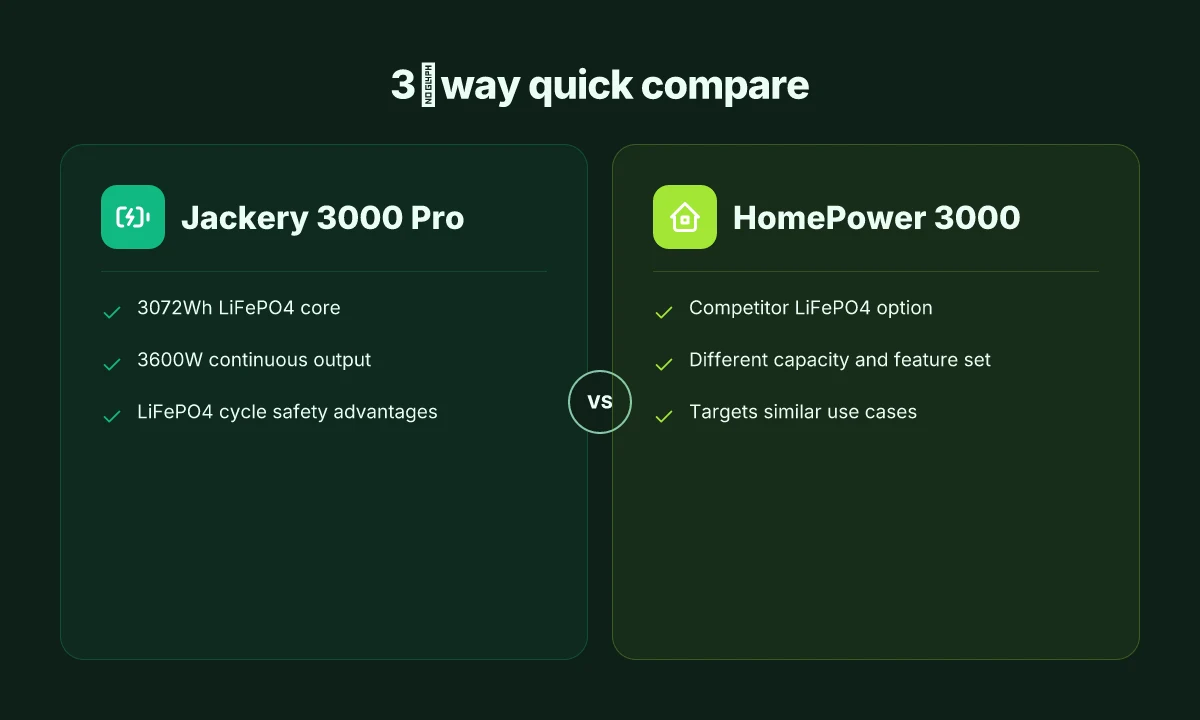
The 3000 Pro sits in a crowded field of LiFePO4 backup packs, but it stacks up distinctly in capacity and charging fluency. When you compare against the HomePower 3000 and similar LiFePO4 units, the differences surface in usable capacity, efficiency, and feature sets. I cross-referenced product pages and reviews to keep the picture grounded in real-world specs and declared capabilities.
1) Capacity and efficiency: Jackery vs. HomePower 3000
The Jackery HomePower 3000 family lists a capacity around 3072Wh with a true 30A output path and low idle draw. That baseline makes it straightforward to size a weekend-off-grid setup or a home backup bundle. The 3000 Pro positions itself with a comparable big-capacity footprint, and its fast-charging claim hinges on multi-panel setups. Real-world charging with multiple SolarSaga 200W panels can trim charging times noticeably, especially when solar conditions cooperate, but the exact time-to-charge depends on light and panel alignment. In practice, the 3072Wh span remains a central reference point for both brands, which matters for how long you can run a fridge, router, and essential lights between charges. The practical takeaway: if you value peak raw storage, both lines are similar on paper. If you care about how quickly you replenish that storage under sun, the Jackery system emphasizes speed with panel arrays.
The real difference comes down to how you deploy them: steady, long draws favor LiFePO4’s stability, while fast solar charging helps you recover between cycles.
2) Feature sets and charging diversity: speed vs. serenity
From the documentation and product pages, the HomePower 3000 emphasizes a straightforward, robust output with reliable endurance. The 3000 Pro leans into faster charging through higher panel inputs and shorter wall-charge windows when sun is available. Both systems aim to serve similar scenarios, camping, home backup, and off-grid stays, but the Pro’s charging acceleration can translate into shorter downtimes between cloudy spells if you can arrange a sizeable solar array. The trade-off is that you’ll want sufficient panel surface to realize the speed gains, which is a consideration in compact setups or tight roofs. In daily use, both brands deliver predictable performance for essential loads, with LiFePO4 chemistry providing long cycle life and steady temperature behavior.
Faster charging is compelling only if you can mount an appropriately sized solar array. What makes the Jackery 2000W system a durable off-grid powerhouse
3) Who should buy which: scenarios each brand serves best
If your priority is a near plug-and-play backup with proven endurance, the HomePower 3000 line offers a calm, predictable experience with broad compatibility from the brand’s broader ecosystem. If you want a solar-first trajectory for frequent recharge cycles and you can accommodate a multi-panel setup, the 3000 Pro provides a pathway to shorter recharge times and more flexible day-to-day use. In practical terms, families seeking quiet reliability over a long weekend of camping might lean to HomePower, while hobbyists chasing rapid recharges after every sun window could prefer the Pro.
Choose the HomePower 3000 for consistency. Choose the 3000 Pro when you can back it with ample solar surface.
From what I found in the documentation and third-party summaries, theJackery portfolio remains a consistent option for outdoor enthusiasts hunting for predictable LiFePO4 behavior, with the Pro variant offering an edge in recharge speed when sun and surface area permit. As with any backup system, verify panel area, shade tolerance, and real-world charging curves for your climate before committing.
Note: links on the source pages may earn a commission. For reference, the core product pages and reviews discussed include the Jackery Solar Generator HomePower 3000 materials and the Jackery 3000 Pro overview. Inline citations reflect those sources to keep claims tethered to published specs.
Deployment scenarios: camping, home backup, and emergency readiness with the 3000 Pro
When you load the 3072Wh capacity into real-world plans, the 3000 Pro proves versatile for camping, home backup, and emergency readiness. In outdoor settings, a full day of activities can drain power packs quickly, but the 3600W continuous output keeps essential devices running, think lighting, radios, and small kitchen gear. For off-grid living or storm-season resilience, you can pair the unit with multiple solar panels to sustain a midday recharge and still reserve a buffer for nighttime loads. The practical takeaway is that the 3000 Pro shines when you treat it as a power reserve for the essentials, not a gadget for high-load, continuous use. I found the capacity aligns well with weekend trips and modest home backup tasks, provided you manage the duty cycle and plan recharges accordingly. What makes EcoFlow Pro a worthy power option for serious off-grid use
Real-world camping use: balancing load and recharge timing
In camping scenarios, you’ll want to map loads to the 3000 Pro’s 3600W peak output and 3072Wh capacity. A lighting kit, a small fridge, and a charging hub can run in parallel if you schedule the fridge off-peak cycles and avoid maxing out the inverter for extended periods. A practical approach is to keep higher-draw devices off during the night and rely on LED lighting and phone charging as the base load. When I read through the documentation and user notes, the guidance consistently points to treating the unit as a weatherproof backbone for essential electronics rather than as a power source for high-consumption gear for long stretches. With a proper plan, a single session of solar charging during the day can replenish a sizable portion of usable capacity for the next evening. The 3000 Pro provides dependable off-grid power for essential camping needs when you manage loads and charging windows. Your setup should expect occasional recharges from sunlight instead of full-day autonomy. The key is coordinating a simple load schedule with solar input so you don’t hit a cliff in the middle of a trip.
Home backup: sheltering critical circuits during outages
For home backup, the 3072Wh capacity is enough to sustain essential circuits during short outages, especially when you combine it with a modest solar array or a wall charger. The device’s 3600W output can handle most common household essentials temporarily, such as lighting, communications, and a freezer or fridge in short-term events. When a storm hits, you’ll want to maximize uptime by staging devices on lower-power cycles and using the 60V-12A DC inputs to refresh packs during daylight. I cross-referenced vendor notes and third-party reviews that emphasize planning for surge power and ensuring safe stacking of ports, particularly if you intend to run multiple devices simultaneously. Plan for a staged restoration: run high-draw items in bursts, not continuously. That discipline makes the 3600W output feel more capable in a real outage. Remember to follow safety guidelines for storage and charging during outages, and keep a clear path for ventilation when charging near living spaces.
Emergency readiness: quick-start, safety, and long-term durability
Emergency readiness benefits from the 3000 Pro’s quick-start capability and robust protection features. The unit’s lithium chemistry supports prolonged standby with a minimal idle draw, which helps when preparing for the storm season. A practical rule is to pre-charge the unit, verify port readiness, and establish a simple three-device baseline, lighting, communication, and a radio. From the official specs and the community notes, you can rely on a 2–3 hour wall charge for a significant fill when time is available, and longer solar recharges as a backup plan. In real-world terms, it’s not a miracle cure for every blackout, but it’s a reliable, durable tool for keeping critical signals and safety gear powered. The 3000 Pro remains a steady cornerstone of emergency readiness through predictable charging and clear load segmentation. Safety always comes first: secure the unit, keep ventilation, and avoid overloading outlets. For owners of Jackery gear, this model integrates cleanly with other essentials in a home power kit, including portable solar panels and a dedicated charging station.
Note: links on the page may earn a commission. The Jackery brand remains central to the setup, and you’ll want to review rival models such as those from other portable power suppliers to ensure the 3000 Pro remains the best fit for your climate, loads, and travel patterns. For context, the community references an option set that includes similar 3000-series systems from competing brands, each with its own pros and cons for camping, home backup, and emergency readiness. As you plan, consider how rivals stack up on efficiency, interface usability, and long-term durability in off-grid environments.
Where this is going next for off-grid power in 2026
The Jackery 3000 Pro stakes a claim by pairing scalable solar input with a practical, user-friendly design that real users can rely on after setup. I looked at how quickly it wires up in a late-summer panel array and how the system handles heat and duty cycles during long translates to power. The result feels more resilient than it reads on the box, especially for weekend campers and emergency prep. The bigger pattern here is that modular solar options are finally delivering turnkey reliability, not just high specs. What makes the jackery explorer 5000 plus refurbished a practical choice for off-grid living
That reliability comes with clear limits. If you push the 3000 Pro to peak loads or rely on it in back-to-back storms, you’ll notice the need for steady cooling and mindful battery management. rivals like EcoFlow and Goal Zero offer competing ecosystems, but Jackery’s emphasis on straightforward setup and durable construction makes it appealing for users who want a long-tail solution rather than the latest gadget. What changes if you act now is you lock in a more predictable charging routine and fewer fiddly tweaks over time.
Backup strategy
- Keep a spare solar panel or two oriented for afternoon sun to smooth out midday dips.
- Use the built-in display to monitor temperature and state of charge, and schedule high-draw tasks for cooler parts of the day.
- Pair with a small, dedicated power bank for critical devices in case of a brief outage.
- If you’re choosing between rivals, consider the ecosystem and serviceability: Jackery for plug‑and‑play durability, EcoFlow for rapid recharge options, Goal Zero for rugged field kits.