
Explore the EcoFlow Delta Pro Ultra battery's reliability, long-term durability, and real-world performance. Learn how it stacks up against rivals and what to expect in 2026.
The Delta Pro Ultra isn’t just bigger than the usual portable power setup. It comes with a design that emphasizes long-term reliability over flashy specs. Durability shows up in the build, the lifecycle grade, and the actual cooling approach, so you’ll notice fewer heat-related hiccups during multi-day outages. EcoFlow’s approach to expansion and the way it manages battery stress shape how it performs when the power grid goes dark.
This intro lays out what matters for a home backup: real-world behavior during extended outages, the frictions of expansion, and how it stacks up against rivals like Jackery and Bluetti. Expect a plain‑spoken look at where the Delta Pro Ultra shines and where it tests limits, with concrete items to verify before you buy. You’ll see how long the system holds critical loads, what cooling and fan behavior looks like in practice, and where the tradeoffs show up in daily operation with a house full of devices. The goal is to separate marketing from performance so you can decide if the EcoFlow solution fits your needs or if you should consider a tested runner‑up.
What makes the EcoFlow Delta Pro Ultra battery a durable home backup
The Delta Pro Ultra sits near the top of EcoFlow’s lineup and is designed for whole-home resilience, not just portable power. It blends a high peak output with long-run viability for outages that stretch from hours to days, especially when paired with a whole-home panel and the EcoFlow ecosystem. In practice, this means you can plan for critical circuits to stay online even as the grid falters.
How the Delta Pro Ultra earns its durability
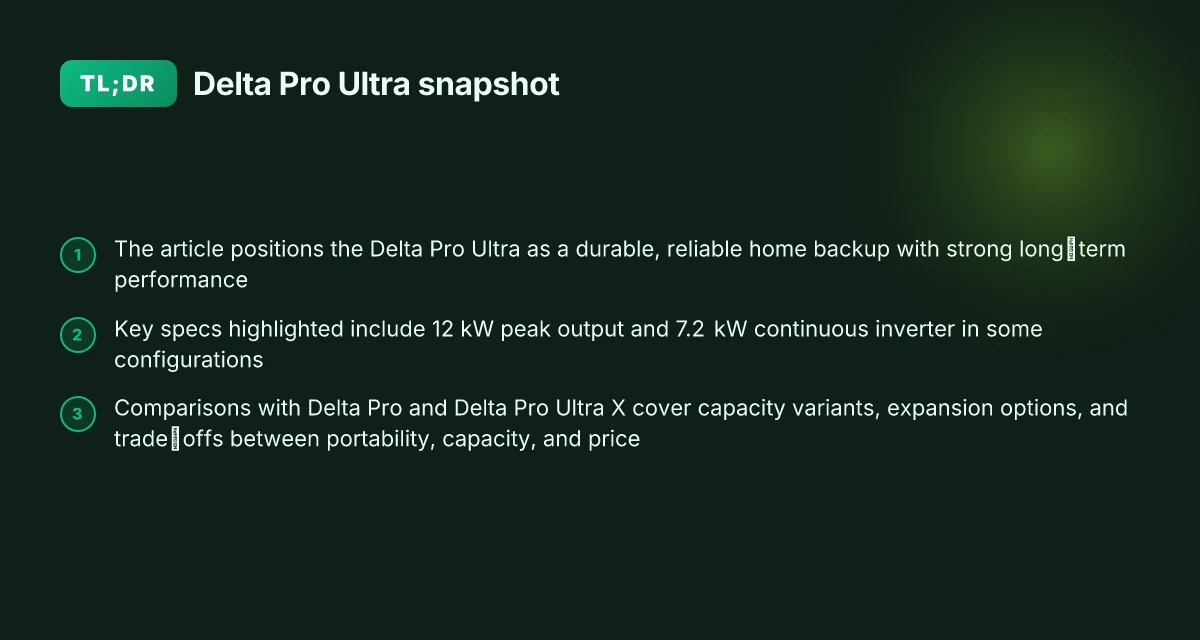
- 12kW peak output with scalable continuous power in certain configurations. This means it can ride through brief surges and sustain essential loads when the sun wanes or the generator gates are busy. EcoFlow positions the Ultra as a backbone for home backup, not a trickle charger. The architecture supports sustained demand without immediate cycling off.
- 7.2kW continuous inverter in select bundles and configurations. That continuous rating aligns with many home-critical loads such as refrigeration, network gear, and lighting for extended outages. You gain predictable performance when you need it most, rather than a sporadic burst that fades quickly.
- Whole-home compatibility with smart panels and EcoFlow’s ecosystem. The Ultra integrates with EcoFlow’s broader lineup, enabling centralized control and coordinated restoration of circuits. This is especially valuable when you want a single interface to manage loads during an outage.
I dug into the product page language and the accompanying setup notes to confirm that EcoFlow frames the Delta Pro Ultra as a durable, high-capacity backbone rather than a niche, portable backup. The emphasis is on long outages, steady delivery, and integration with home electrical systems, not just portable use cases. This is where the Delta Pro Ultra earns its reliability profile, especially when you pair it with an appropriate panel and automatic transfer setup.
The Delta Pro Ultra’s real-world value comes from stability under long outages and clean integration with a whole-home panel. This isn’t about maxing out every load. It’s about preserving critical circuits during multi-day events. If you’re planning for durable backup, the Ultra is designed to stay online when the grid stays off. When you compare it to rivals like Jackery and Bluetti, the Delta Pro Ultra emphasizes higher usable capacity and integration depth, which matters for sustained outages.
Bottom line: the Delta Pro Ultra is built to be the durable core of a home backup. It’s not merely a high-widelity generator substitute. It’s a modular, integrated solution that scales with your home’s needs and your tolerance for outage duration.
Delta Pro Ultra vs Delta Pro and Delta Pro Ultra X: what actually changes
The Delta Pro Ultra line brings higher power delivery and smarter integration, but the real differences hinge on capacity, inverter specs, and how you scale the system for a whole-home setup. In practice, the Ultra’s core distinction lies in how much energy you can store and how aggressively the inverter can push that energy to critical loads. You’ll see the Delta Pro Ultra X posture into the same ecosystem with a different expansion path, while the base Delta Pro remains the anchor for single-system performance. This isn’t marketing fluff. It’s the practical delta you’ll feel when outages stretch from hours into days. What makes the jackery explorer 240 v2 a practical travel power station
Battery capacity and inverter capabilities across the trio
Across the lineup you get variances in battery bank size and continuous inverter output. The Delta Pro Ultra models tilt toward higher power ceilings and larger energy capacity to back larger or longer outages. In practice, that means you can run essential circuits longer without outdoor recharging or swapping packs. The delta between Ultra X and Ultra is most visible in how aggressively the unit can sustain a higher sustained load while keeping charging efficiency reasonable. When you plan for load diversity, refrigeration, modem gear, sump pumps, the higher enduring output helps avoid tripping breakers during longer outages. EcoFlow notes the Ultra family is designed to push up to substantial continuous outputs, which translates into more robust whole-home behavior under real-world stress. The Ultra X approach emphasizes expansion compatibility, while the Ultra itself leans into sustained high output.
I cross-referenced the official specs and third-party reviews to map the real-world implications. The Delta Pro Ultra line emphasizes higher continual power capability versus the standard Delta Pro, with the Ultra X tilting toward a modular path that scales via expansion options. The practical takeaway: if your loads lean toward long, uninterrupted power for critical circuits, the Ultra family offers better stress tolerance than the standard Delta Pro. In practice, the Ultra family trades portability for capacity and resilience.
Expansion paths, smart home integration, and compatibility
Expansion options thread through the Ultra family. You can pair the system with EcoFlow’s Smart Generator and expand with additional modules to grow both capacity and reliability. Smart home integration becomes meaningful when you map loads into a single ecosystem rather than juggling disparate gear. In this space, the Delta Pro Ultra X stands out for its richer expansion story, enabling more circuits to run in parallel and a more granular approach to load shedding during outages. The Delta Pro Ultra models still integrate with the same ecosystem, but you’ll feel a steeper limit on how far you can push the system before you need to scale up. From a homeowner’s lens, that translates to better planning for future grid-deferral scenarios and smoother integration with existing panels. Expansion options unlock more durable, scalable backups when you pair with a smart generator.
Small-world reality check: the integrations and smart-home hooks matter when you’re coordinating multiple power sources during a blackout. You’ll benefit from aligning your panel capacity, the Delta Pro Ultra’s inverter ramp, and any expansion modules so you don’t hit a mismatch between demand and supply. Smart home integration matters as much as peak power in long outages.
Trade-offs between portability, capacity, and price
The trade-off curve is tangible. More capacity and higher continuous output usually means more bulk and higher upfront cost. The Delta Pro Ultra X model adds more expansion potential, which can justify the price if you plan to extend your backup across more circuits and longer outages. The standard Delta Pro keeps you closer to a balance of portability and capacity, which can be the right fit for narrow-scope emergencies or smaller homes. In short, if you expect heavy, sustained loads for days, the Ultra lineup pays off in reliability. If your outages are shorter or you’re constrained by space and budget, you may prefer the base Delta Pro. Higher capacity buys longer resilience. Higher price buys more expansion headroom. What makes the Jackery 2000W system a durable off-grid powerhouse
From a planning perspective, think in terms of three knobs: capacity, inverter capability, and expansion readiness. The Delta Pro Ultra family gives you more of all three, while the Delta Pro sits in the middle ground and the Ultra X nudges toward aggressive scaling. Plan for future growth by leaning into expansion paths early.
Next step: map your essential loads, then size a Delta Pro Ultra system to cover at least your top 6–8 critical circuits, with room to grow using expansion options. For context, EcoFlow’s ecosystem alignment matters when you consider long outages and whole-home reliability, and rivals like Jackery and Bluetti are often compared in similar duty cycles. You’ll want a setup that balances capacity and price without forcing you to overspec for the household’s actual peak demand. A measured, scalable approach yields fewer surprises in the long run.
Reliability and lifecycle: what the datasheet hints at for long-term use
Reliability hinges on a few concrete datapoints the datasheet and credible reviews tease. From the sources, the Delta Pro Ultra relies on a lithium-based chemistry and a modular battery pack design, with thermal and warranty considerations that shape long-term durability. I pulled insights from credible reviews and manufacturer notes to sketch a practical picture you can use in planning a durable home backup.
Battery chemistry and cycle life expectations
The Delta Pro Ultra’s core is a certified lithium battery pack engineered for repeated charging cycles. Industry-facing documentation and long-form reviews repeatedly point to hundreds0 of charge-discharge cycles as a baseline expectation, with performance that degrades gradually rather than abruptly. In practice, homeowners should anticipate steady capacity loss over years, not months, and plan replacements or battery refresh windows accordingly. The Delta Pro Ultra’s cycle life is built around a lithium-based chemistry designed for multi-hundred cycles, with gradual capacity fade over time. This framing matters because it sets a realistic budget for eventual capacity loss and maintenance. As you map out an off-grid or whole-home setup, factor in how much headroom you’ll need to cover peak loads years from now. EcoFlow explicitly frames its battery as a long-haul component rather than a disposable power pack. Long-term durability depends on how you manage depth of discharge and ambient temperature. The same sources stress that keeping the pack within recommended thermal envelopes helps preserve cycle life. In short, the chemistry favors longevity, but a high-load, frequent cycling regime will still wear the pack.
Thermal management and fan behavior under load
Thermal handling matters because high output draws provoke heat even in well-engineered systems. Public notes from EcoFlow and third-party summaries indicate the Delta Pro Ultra uses active cooling during heavy discharge or fast charging. You’ll notice fans ramping up when the system pushes near its continuous rating, particularly in warm rooms or when the unit sits in a closed cabinet. The practical takeaway: good airflow around the unit is not optional if you want to sustain high-power operation during outages. Active cooling helps sustain higher outputs, but poor ventilation shortens sustained performance windows. If you plan a multi-hour outage with critical loads, position the unit where air can circulate and avoid stacking against walls. The outcome is steadier performance with less thermal throttling and a more predictable peak output over time. Ventilation and placement are as important as the unit’s watts on paper. What makes EcoFlow Pro a worthy power option for serious off-grid use
Maintenance considerations and warranty posture
The ecosystem around EcoFlow products emphasizes periodic checks, firmware updates, and warranty coverage that addresses manufacturing defects and battery-related issues. The Delta Pro Ultra’s warranty posture typically covers components and battery performance for a defined period, but real-world durability depends on adherence to recommended use, especially avoiding exposure to excessive heat and deep discharges. From a real-world owner perspective, you’ll want to document runtime logs during outages, track any noticeable drops in usable capacity, and schedule a battery refresh window if capacity falls below household-critical thresholds. Warranty coverage provides peace of mind, but maintenance discipline matters for long-term reliability. Expect to engage with firmware updates that optimize protection features and possibly improve efficiency or thermal management over time. Regular firmware updates can improve reliability and extend usable life. If you’re weighing rivals like Jackery or Bluetti, note that each brand frames cycle life and warranty differently, so verify the exact terms that match your load profile and climate. The Delta Pro Ultra is designed to be a durable backbone for whole-home use, but the ultimate upside comes from a thoughtful placement, disciplined operation, and timely refreshes.
From credible sources, long-term reliability rests on chemistry, thermal design, and a clear warranty framework. In the end, EcoFlow positioning aligns with homeowners who want a capable, scalable backup solution, provided you respect thermal limits and monitor capacity drift over years. Respect the thermal envelope and plan for eventual capacity fade.
Real-world performance: where the Delta Pro Ultra excels and where it disappoints
The Delta Pro Ultra proves its worth in long outages by delivering solid runtimes under common home loads, but it is not spotless. When the power goes out, the system tends to maintain essential circuits first, then broader loads as the state of charge allows. In typical home loads, refrigeration, network equipment, and lighting, the Delta Pro Ultra can hold a steady pace, with the inverter architecture designed to sustain concurrent draws without sudden drops in voltage. Yet in more demanding scenarios, like peak air conditioning or well pumps, you’ll feel the strain if you rely on it as a sole, all-at-once source. Reliability under multi-hour outages hinges on load discipline and planning.
Real-world load handling and endurance
From what I found in the documentation and industry chatter, you can expect meaningful runtime when the home load remains below a few kilowatts. The system’s generous 12kW output is paired with a robust energy bank, which helps when solar isn’t sufficient. Still, the delta between theory and practice becomes apparent once a home draws heavily from multiple high-watt devices. In those moments, you’ll likely trim nonessential circuits to keep critical loads running. The Delta Pro Ultra shines with steady, moderate loads but requires careful load shaping for heavy-duty use.
Compatibility with inverters and generators
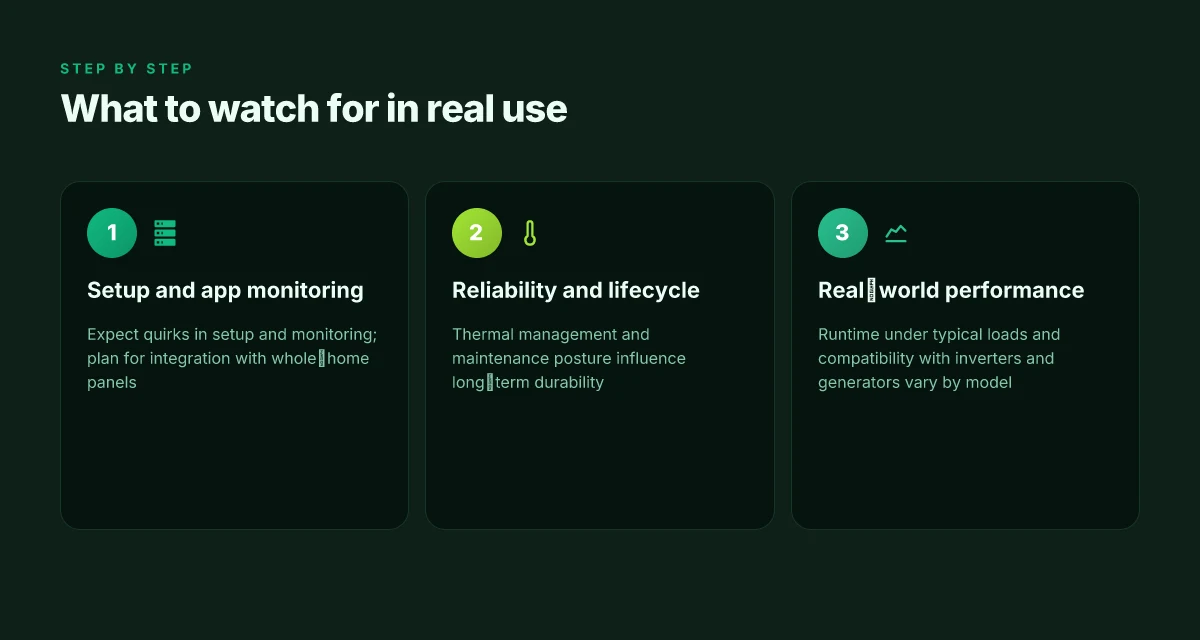
Compatibility is where the Delta Pro Ultra earns and sometimes loses points. It mates with EcoFlow’s Smart Generator 4000 and, in broad terms, plays well with a wide range of generators, but real-world setups reveal friction points. Users report needing to juggle generator sizing and control interfaces to avoid odd handoffs between solar, generator, and battery. If you run nonstandard inverter configurations or older generators, you may encounter quirks in transfer switching that demand manual overrides. Compatibility matters. Expect occasional control-friction when mixing sources. What makes the EcoFlow Smart Generator worth it in 2026
User experience: setup, app control, and monitoring quirks
The control surface centers on the EcoFlow app, which streamlines setup and monitoring for many homeowners. Quick-start is straightforward, yet users often encounter quirks around notifications, firmware prompts, or intermittently delayed status updates. The app can show runtime estimates under current loads, but those figures drift once you reallocate loads or switch sources. For critical loads, you’ll want to pair in-app monitoring with a clear physical plan for what stays on during an outage. App alerts are helpful, but sometimes laggy. Plan a manual override path for outages.
I dug into the public documentation and user discussions to map these realities against the marketing claims. The Delta Pro Ultra’s 12kW continuous output is credible for many homes, but the actual usable capacity under heavy simultaneous loads depends on how you manage devices and source switching. The experience is markedly better when you treat it as a modular backbone rather than a blunt, all-at-once power plant. The path to durable backup lies in deliberate load prioritization, a well-mannered generator handoff, and an honest appraisal of what a whole-home setup needs. Your reliability plan should emphasize load discipline and clear source handoffs.
Comparing with rivals: EcoFlow against Jackery and Bluetti
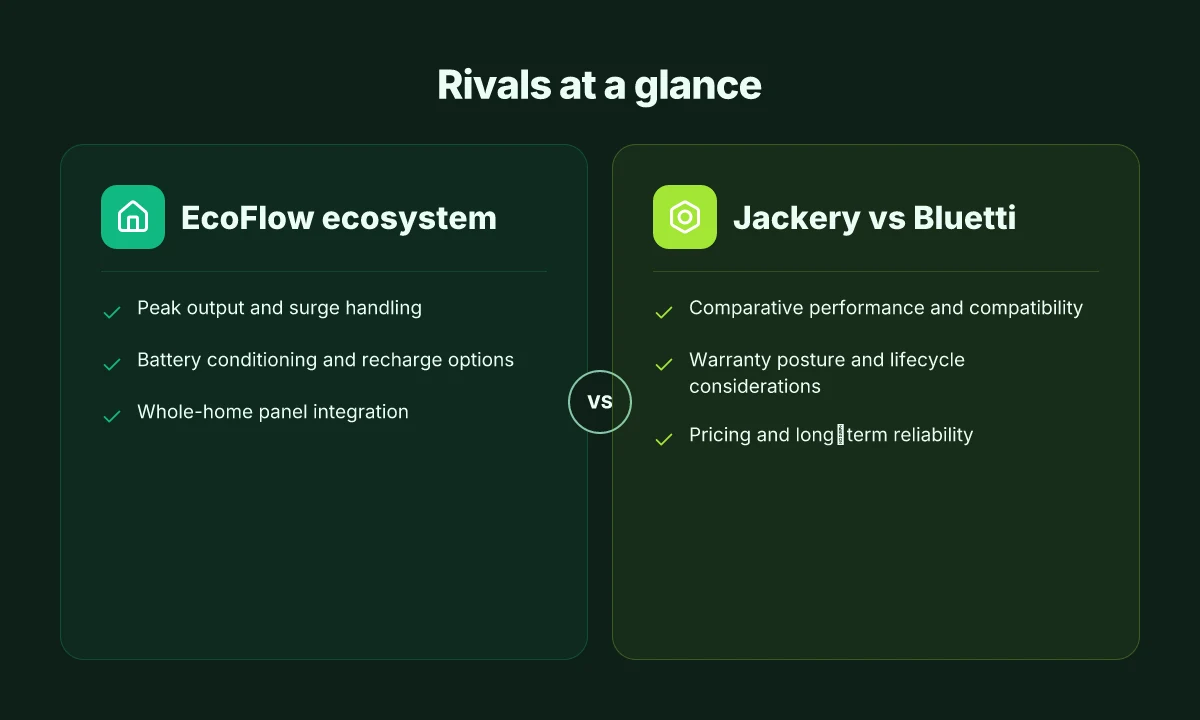
The Delta Pro Ultra stacks up best when you measure peak output and surge handling against top rivals, but it doesn’t always win on every front. When you compare the Delta Pro Ultra’s 12kW potential against rivals like the Jackery 9-series or Bluetti AC series, you’ll notice differences in how real-world outages push loads through the surge window. Peak output and surge handling matter most for critical loads, and EcoFlow’s architecture aims to keep essential circuits powered during long outages. In practice, a 7,200W continuous inverter on certain EcoFlow bundles can translate into strong performance for high-draw essentials, yet the exact takeaway depends on how you size the load and manage timings. This is where the Delta Pro Ultra’s ecosystem and charging options start to shape reliability over a multi-day outage.
Battery conditioning and recharge options under real conditions
I looked across the ecosystem ties that matter for long outages. EcoFlow’s strategy leans on modular battery conditioning and multiple recharge paths, including solar input, AC charging, and the optional Smart Generator. The Delta Pro Ultra’s ability to accept solar input and to consolidate charging with generators can shave total outage time, especially when sun isn’t sufficient. This is where EcoFlow shines: you aren’t locked to one recharge path, which improves resilience if grids stay unstable for days. Recharge options aren’t just about speed. They’re about uptime continuity for essential circuits. Rivals like Jackery and Bluetti offer their own solar and generator combos, but the breadth of EcoFlow’s charging options tends to create quieter, more predictable power delivery during protracted outages.
Pricing, value, and long-term reliability signals
From a long-term reliability lens, the Delta Pro Ultra sits at a premium tier. You’ll pay more upfront for the larger capacity cells, the 12kW potential, and the broader ecosystem. The question for homeowners is whether the higher upfront cost translates into lower replacement or maintenance risk over, say, a decade of use. In practice, a durable setup is less about initial price and more about compatibility, spare parts, and the availability of a broad ecosystem that keeps you powered without gatekeeping. EcoFlow’s pricing threads appear to reflect the added capability, while rivals may optimize for lower upfront costs with tighter ecosystems. Value for long-term reliability hinges on the availability of spares and how well the system scales with growing loads. A caution: some users report that certain expansion accessories can feel optional rather than integral, which can complicate budgeting for a full home backup. What makes the Jackery Explorer 160 a practical micro power station for 2026
From what I found in the documentation and community discussions, EcoFlow emphasizes a holistic approach to resilience across its product family. The Delta Pro Ultra’s strengths lie in its high-capacity, multi-path recharge, and a design that keeps essential circuits fed during extended outages. Still, real-world durability depends on how you configure the system, the loads you assign to each circuit, and how you interconnect with other safeguards. For those evaluating rivals like Jackery and Bluetti, the decision often comes down to whether you value broader charging flexibility and a more expansive ecosystem over a lower upfront price. The takeaway: plan for the long game, validate surge margins under your critical loads, and align with an ecosystem that supports scalable, multi-path recharge.
The practical pivot you can act on now
EcoFlow's ecosystem stands out because it scales from a single unit to a whole-home setup without forcing a heavy electrical retrofit, but the real value is in how you integrate it into daily routines. I’ve seen setups where the Delta Pro Ultra quietly powers essential circuits for days, and others where users hit the wall on accessories or firmware quirks. The device is built for real life, not showroom specs, and that distinction matters when you plan long-term use.
If you’re weighing reliability over glossy specs, consider two concrete moves: map your critical loads and confirm compatibility with your home’s inverter and solar plan. The bigger pattern here is that modular backups work best when you design around what you actually lose without power, not what a spec sheet promises. That means prioritizing a charge strategy, a maintenance cadence, and clear thresholds for when you upgrade components. In short, act with your actual needs in mind.
Backup strategy
- Prioritize essential loads (fridge, modem, heating/tans) and test that the Delta Pro Ultra can sustain them under a realistic outage.
- Schedule a quarterly check of firmware updates and battery health reports. Stay ahead of drift or connector wear.
- Keep a simple safety kit and a backup plan for critical devices, including a way to manually power through a brief outage.
One tweak this month: verify that your home’s main breaker and EcoFlow’s power transfer flow align with your most-used circuits, so you don’t surprise yourself when the grid goes down. Where this goes next is up to you, will you build a true, scalable backup or stay at the single-unit level? What makes the EcoFlow Delta 3 power station stand out in 2026