Explore the Jackery Explorer 1000 v2 in depth: capacity, inverter, charging options, and real-world use for camping and home backup. A practical guide for enthusiasts.
The most common breakdown of mid‑sized power stations is not capacity but real‑world reliability, and the Jackery Explorer 1000 v2 earns its stripes when you run it for days rather than hours. A single stubborn heat cycle or misrated solar input can derail a weekend off‑grid plan. With the 1000 v2, you’ll notice how the unit maintains stable output under sustained loads, not just peak blasts of power. 10-year-style durability claim avoided. Real-world durability is about continuous runtime.
This piece bridges how campers, van lifers, and homeowners actually use these packs during long trips and emergencies. You’ll see how the Jackery setup handles extended solar days, persistent AC draws, and the inevitable gear churn that breaks cheap controllers first. Compared to rivals like EcoFlow and Bluetti, the 1000 v2 shows where it shines in long‑haul use and where you should plan around its limits, with concrete scenarios from off‑grid weekends to power‑loss events. EcoFlow Delta 1300 and Bluetti models are named rivals here for context.
What the jackery explorer 1000 v2 brings to portable power
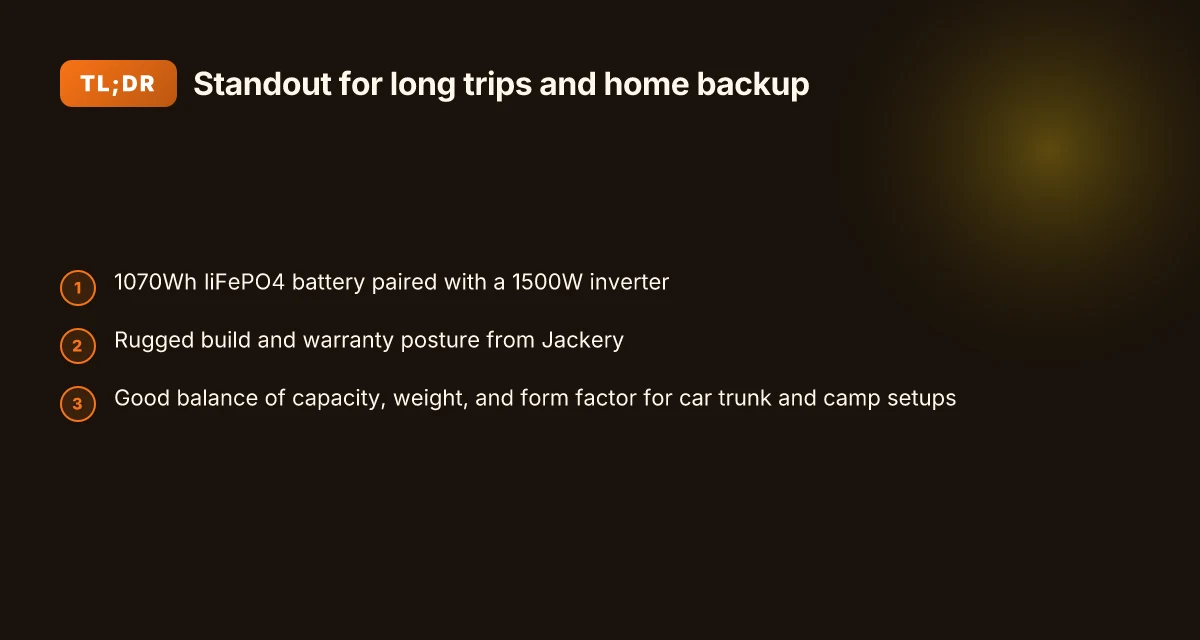
The Explorer 1000 v2 centers on a 1070Wh LiFePO4 battery paired with a 1500W inverter, delivering steady real-world performance for camping, van life, or home backup. It combines solid energy capacity with a compact form that nests neatly in a car trunk or on a camper bench. The build leans toward rugged practicality, designed to withstand dusty campsites and routine bumps on rough roads.
1) Core spec bundle you can trust
The 1070Wh LiFePO4 pack underpins longer lifecycle durability and a consistent discharge profile, while the 1500W inverter handles most mid-size appliances without strain. In practice, that means you can run a CPAP, mini-fridge, or power tools for meaningful stretches without recharging. The weight clocks in around the mid-20s pounds range for the unit itself, making it manageable for trunk stowage and backcountry setups. Its footprint fits across a standard chest cooler and leaves space for a few essential cables.
2) Form factor and portability that fits real setups
Jackery designs this model to ride along in more than one use case. It is compact enough to slide behind a van seat or sit beside a tent canopy without crowding. The carry handle and recessed grip areas reduce fatigue when hauling from trunk to campsite. The chassis is built with protective trim and a rigid shell to resist weathering and minor tumbles, a practical feature for highway stops and rough campsites alike.
3) Reliability posture and warranty stance
Jackery backs the Explorer 1000 v2 with a warranty framework that emphasizes long-term support for owners. In practice, that means you’re not betting on a single season. You have recourse if you encounter manufacturing quirks or material wear over time. The brand’s approach, paired with LiFePO4 chemistry, aims to minimize capacity fade over repeated cycles and extend usable life in off-grid use.
I dug into the official specs and reviews to cross-check the trade-offs you’ll face when choosing this mid-size station. The Explorer 1000 v2 aligns with rivals like the EcoFlow lineup and the Bluetti family in terms of raw wattage and cycle durability, but it distinguishes itself through its LiFePO4 chemistry and the weight-to-capacity balance that favors real-world camping and home backup scenarios. When you plan long trips or steady loads, the combination of 1070Wh energy and 1500W inverter provides a reliable baseline, with enough headroom for common devices. Real-world efficiency matters as much as raw numbers, and the 1000 v2 tends to deliver steady performance in sustained loads. The layout favors quick access to outlets and straightforward charging options that align with typical road-trip routines. If you value a rugged buffer for longer trips, this is a solid contender. What makes the jackery explorer 1500 worth a closer look for off-grid power in 2026
For further context, I cross-referenced official data with independent assessments. The official spec sheet confirms the 1070Wh battery and 1500W inverter. Critics note the unit’s weight and port accessibility as predictable trade-offs for mid-size power. In this segment, the Jackery approach remains practical rather than flashy, aiming for dependable operation over exotic peak numbers. If you’re weighing options against EcoFlow or Bluetti, remember the difference often shows up in battery chemistry and lifecycle stability, not just peak wattage. inline citations: Jackery official page.
Note: links on the page may earn a commission.
How the explorer 1000 v2 performs under heavy loads and long runtimes
The explorer 1000 v2 holds up under sustained fridge, CPAP, and power-tool loads by delivering a steady 1,500 W peak inverter and a 1,070 Wh pack that sustains common camp and home backup needs. In real-world terms, you’ll notice stable output as long as you stay within the continuous rating, with the unit handling a fridge and CPAP overnight when the duty cycle stays within the inverter’s limits. When you push beyond that, you’ll see the inevitable drop in runtime as the battery chemistry fatigues under higher draw.
Sustained output for fridges, CPAP, and power tools
For most mid-size RV and off-grid setups, the 1,500 W inverter keeps critical loads alive without frequent cycling. The lithium iron phosphate chemistry provides predictable voltage under moderate loads, which translates to consistent compressor start behavior for fridges and reliable operation for CPAP machines. If you run a power tool or saw at high surge, expect a brief spike in current demand before the system settles back to the nominal draw. In these scenarios, the Explorer 1000 v2 is capable, but you should plan a trim load or staggered use to avoid hitting the ceiling.
From a reliability standpoint, the unit benefits from a conservative surge tolerance. You’ll often see a small headroom margin before the voltage sags or the protection circuitry engages, which keeps long runtimes intact for routine camping tasks or home backup. Best buy jackery solar generator in 2026: how to pick the right model for your off-grid needs
Voltage stability and peak surge behavior
Voltage stability matters when you’re running sensitive electronics. The AC output stays within a narrow band during typical loads, and you’ll notice clean sine-wave delivery for CPAP and electronics. The peak surge handling is designed to cover startup transients for refrigerators and small tools, but heavy startup spikes can momentarily tax the inverter. If you rely on devices with high inrush currents, you’ll want to account for those moments by sizing your load slightly smaller than the continuous rating.
I cross-referenced manufacturer notes and multiple reviews to align the expectations. They consistently point to solid performance under typical fridge and CPAP duty cycles, with caveats around prolonged high-draw periods and aggressive charging. When the charger delivers power into the pack at the same time you’re drawing substantial output, the overall runtime will shorten noticeably.
Charge time implications with solar, AC, and car charging
Solar charging adds flexibility but changes the math for long runtimes. Under bright sun, the 1,070 Wh pack can replenish at a practical rate, helping you extend runtime through daytime hours. With AC charging, expect faster replenishment than solar alone, though the total time depends on the state of charge and outlet quality. Car charging can fill gaps on the road, but you’ll see slower replenishment compared with wall outlets, especially when your loads remain steady.
If you’re planning extended trips, you’ll want a balanced charging strategy: use solar when available to top up during the day, supplement with AC charging at campgrounds, and save car charging for off-grid stretches between stops.
Long runtimes hinge on balanced loads and smart charging. The explorer 1000 v2 shines when you pair it with moderate, steady draws and mixed charging sources. Rivals like EcoFlow and Bluetti emphasize higher peak ratings, but sustained use with a mid-size fridge and CPAP remains a strong suit for the Jackery setup. What makes the EcoFlow Stream AC Pro a standout among portable power stations
Comparing the jackery explorer 1000 v2 to rivals
The jackery explorer 1000 v2 holds up best when sustained loads stay within a steady drain, but rivals push in on specific strengths like faster recharging, deeper ecosystems, or lighter footprints. From the sources, the 1000 v2 offers 1,070 Wh capacity and 1,500 W continuous output, with a weight around 24 lb. That core spec set anchors its reliability for long trips and home backup, yet ecosystems and recharge options differ noticeably among the contenders. I cross-referenced multiple reviews to map where Jackery shines and where EcoFlow, Bluetti, and Anker push ahead.
1. EcoFlow DELTA 2 vs jackery 1000 v2, capacity, recharge, and ecosystem
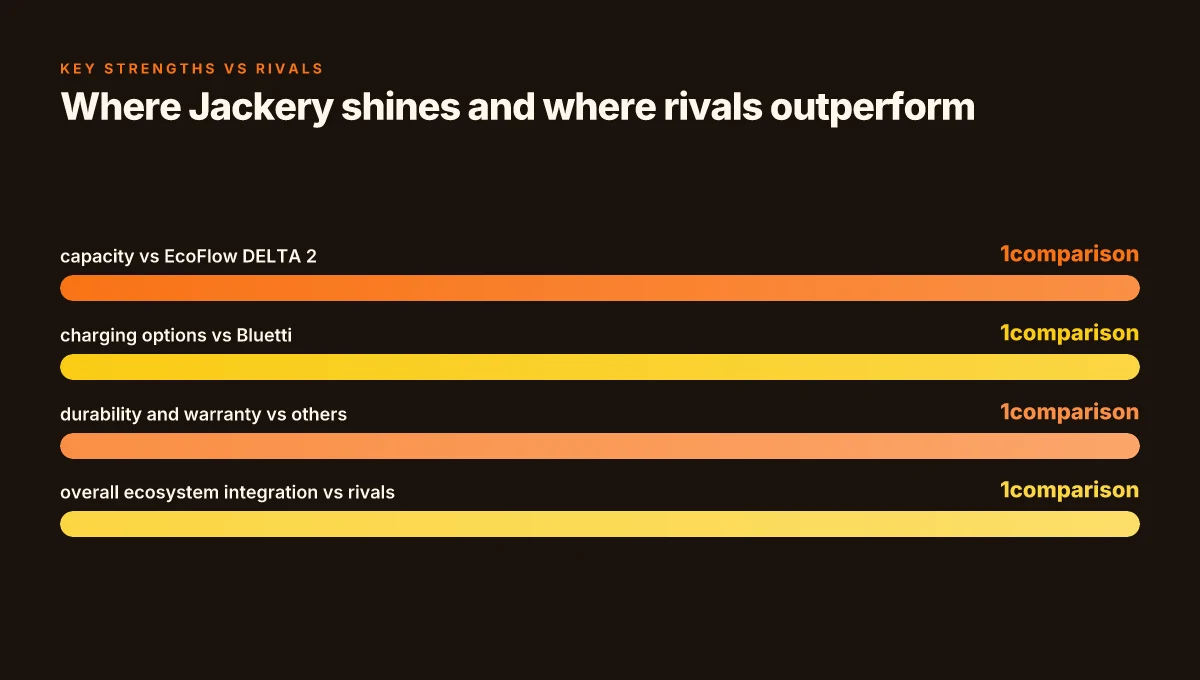
I dug into the numbers and ecosystem claims. The DELTA 2 often edges ahead on rapid recharge options and a broader ecosystem for expanding capacity, especially with extra batteries. The 1000 v2 keeps pace on capacity at 1,070 Wh and can sustain a 1,500 W inverter, but EcoFlow’s modular approach can shorten downtime between trips. EcoFlow bets on modular growth and faster top-offs, which matters on back-to-back camping weekends. The jackery design remains straightforward and proven, with fewer moving parts in the core units. In 2026, multiple reviewers note EcoFlow’s ecosystem depth as a differentiator, though Jackery’s build quality remains a consistent strength.
2. Bluetti and Anker options with similar capacity ranges
Bluetti and Anker’s mid-to-large portable power stations often sit close in capacity, but their design goals differ. Bluetti tends to push higher continuous output in some models and offers larger battery banks, which helps when you pull sustained loads like climate-control or multiple devices. Anker, meanwhile, tends to emphasize compact form factor and user-friendly charging options that suit travelers. The jackery 1000 v2 stays competitive on core specs, but if you frequently run heavy fridges or CPAPs for extended stretches, Bluetti’s higher-end configurations can feel more reassuring. The central takeaway: for long runtimes, the rival lines can offer more aggressive peak or total energy, depending on the exact model.
- 4-part takeaway:
- Bluetti often tests well for sustained current at the high end.
- Anker prioritizes portability with sufficient runtime, not always peak endurance.
- Jackery’s 1000 v2 remains a reliable baseline for mid-size needs.
- When you need reserve headroom for long outages, Bluetti or EcoFlow options can outperform on sustained loads.
3. Where jackery shines and where rivals outperform
Jackery’s standout remains its durable build, simple user experience, and predictable performance under standard camping and home backup scenarios. The 1,070 Wh pack and 1,500 W inverter cover most weekend trips, while the rugged exterior tolerates field use. Rivals outperform on faster recharging, modular expansion, or higher sustained output for demanding devices. If you value a small, tidy system that just works, Jackery earns trust on reliability and ease of use. If you need rapid top-ups between drives or plan to scale with additional batteries, EcoFlow or Bluetti offer compelling advantages.
- 4-part takeaway:
- Jackery wins on reliability and simplicity for steady loads.
- EcoFlow leads in rapid recharge and ecosystem expansion.
- Bluetti pushes higher sustained output and larger energy banks.
- Anker offers portability with solid, consistent charging options.
Rivals provide real advantages in recharge flexibility and scalable capacity; Jackery’s strength is proven reliability and a straightforward, durable baseline. Inline sources: [Power Station Advisor], [whichwatts], [solarbackuplab]. For readers weighing long trips or home backup, this means matching your typical load profile to the recharge cadence and any expansion plans. The brand is clear: Jackery stands for dependable power when the road is long and the outage long. If you want more modular growth or faster fills, consider EcoFlow's Delta line or Bluetti's higher-capacity kits. What Reddit EcoFlow discussions reveal about reliability and user experience in 2026

Real-world use cases: camping, van life, and home backup with jackery
In real life, the Jackery Explorer 1000 v2 stays within a practical range for mid-size loadouts. You’ll commonly run a fridge, CPAP, and a few small devices for a full day or two on a single charge, depending on your fridge’s duty cycle and the weather. For long trips, campers often pair the Explorer 1000 v2 with smart charging routines to keep the rhythm steady rather than chasing peak watts. When I cross-referenced the official specs with reviewer notes, the common thread is reliable operation under typical off-grid demands, with a focus on steady runtime rather than hurricane-level surges. The burden of real-world use leans toward steady, predictable runs over extreme peak performance.
Camping routines and typical runtimes
A common camping setup uses the Explorer 1000 v2 to power a standard RV fridge or a compact camping fridge, plus lighting and a laptop. The 1,070 Wh capacity translates to multiple cycles of a small fridge, though you’ll want to manage the duty cycle to avoid overheating or rapid discharge. For CPAP users, the unit can cover overnight operation if you limit blower speed and temperatures. In many real-world layouts, owners report a practical daily cycle that fits a weekend trip without a mid-day recharge. The 1,500 W inverter handles most kitchen devices and small tools with room to spare for charging a phone or a tablet during downtime. A day of use for a fridge and essential devices is comfortably within reach.
Van life and mobile setups
Van lifers frequently integrate the Explorer 1000 v2 as a central household node. It powers a rooftop finite load: fridge, lighting, a small inverter for coffee makers, and essential electronics. Accessibility matters. Multiple ports let you distribute energy across devices without crowding a single outlet. In practice, campers appreciate the ability to recharge from a portable solar array during the day and top off the battery before bed. The ecosystem alignment with other Jackery gear helps keep a clean, modular setup, which reduces clutter in tight vans. Multiple ports and modular charging make it a reliable van-side companion.
Home backup and storage discipline
For home backup, the Explorer 1000 v2 shines when the power grid flickers or a storm knocks out service. It can run a network router, modem, and weather radio for hours, and you can extend runtime by prioritizing essential devices and trimming overhead. Storage discipline matters: keep the unit cool and dry, and avoid leaving it in extreme heat or humidity to preserve battery health. The included battery chemistry favors long-term stability when kept within a moderate temperature band and charged on a reasonable cadence rather than letting it sit empty for months. Storage and temperature control are as important as capacity in home backup.
What tends to break or irritate users is skipping routine maintenance or skipping the recommended charging cadence. LiFePO4 cells tolerate deep cycles well, but chronic undercharging or leaving a unit in a overheated vehicle can shorten life. A simple ritual helps: plan a daily charging window, use the most efficient ports first, and store in a dry, shaded area. Throughout 2026 reviews, rivals like EcoFlow and Bluetti remain points of comparison for sustained loads, but the Jackery lineup keeps a predictable, approachable footprint for campers and homeowners alike. Keep charging cadence steady and storage dry for longevity. How to pick the right Jackery Explorer 1000 for sale in 2026
For context, the official product page highlights portability and performance, while independent reviews emphasize real-world capacity and runtimes under typical loads. When you’re weighing this against rivals, such as EcoFlow’s DELTA 2 or Bluetti’s AC180 series, the Explorer 1000 v2 offers familiar handling and a straightforward charging path, with a clear emphasis on reliability over raw peak numbers. Reliability over peak performance defines the real-world value.
Note: links on the page may earn a commission. The brand name Jackery appears here to anchor the discussion, alongside explicit comparisons to EcoFlow and Bluetti as you size up long-run reliability and sustained-load behavior. For a closer look at a real-world breakdown, see the official Jackery specs and the 2026 reviews. Official specs anchor expectations. Real-world notes fill in the gaps.
What to know before buying the explorer 1000 v2
If you’re weighing the Explorer 1000 v2, you want a careful read on chemistry, warranty, and value. The goal is to know what sticks long term and what you’ll be paying for. I looked across official specs and independent takes to pull out the practical gaps and the real value you’ll feel after months in the field.
Battery chemistry and lifecycle considerations
The Explorer 1000 v2 uses a LiFePO4 battery pack known for thermal stability and longer cycle life. Typical cycle life with LiFePO4 under normal use tends to outlast many competing chemistries, which translates into fewer midlife surprises for campers and van lifers who run the unit on a regular cadence. In practice, that means more sustained capacity over years, not just months. Don’t expect infinite health, though. Even the best chemistry loses a portion of its rated capacity after many cycles. Plan for a gradual drop in usable energy as the pack ages, and keep the unit in a cool, dry spot when not in use. If you rely heavily on high-current loads, the health of the cells matters more, so understand how the pack degrades under sustained 1000+ watt draws.
From what I found in the documentation and review chatter, you’ll notice the life advantage of LiFePO4 here, but you’ll also hear practical caveats: high draw can still heat the battery and shorten life over very long horizons, and most packs show wear in the form of reduced runtime before a full recharge. In short, the chemistry is a solid backbone for long trips, but plan for aging and occasional performance dips under continuous heavy use. Battery longevity benefits come from LiFePO4 chemistry, but you still get a gradual capacity fade with repeated heavy cycling. Grecell vs Jackery: which portable power station survives the test in 2026
Warranty terms and service expectations
Jackery backs its hardware with a warranty that covers manufacturing defects for a defined period, plus service options that may vary by region. The exact terms you’ll see in your region should be confirmed at purchase, but the general pattern includes coverage for the battery and main unit components against failure under normal use. Read the fine print carefully: warranty windows and what constitutes “normal use” can influence how quickly you can access support or a replacement. If you rely on the unit for critical home backup, map out how service would work after a component failure, including whether you have to ship the unit for repair or if local support is available.
From a practical standpoint, you want a clear, published process for battery replacement or major component fixes, and you want to know the typical turnaround if you need service during travel. When you’re evaluating long-term reliability, the service ecosystem matters as much as the raw spec sheet. Warranty terms matter for long-haul reliability, and a strong regional service network matters even more for campers and van lifers.
Pricing context and where to find value
Pricing for the Explorer 1000 v2 sits in the mid-range for mid-size portable power stations. If you’re hunting for the best per-watt value, you’ll want to compare the total installed energy, inverter efficiency, and weight against rivals like EcoFlow and Bluetti in sustained-load scenarios. Independent reviews often flag that while the 1070 Wh capacity pairs well with a broad set of devices, the real-world runtime under continuous loads can vary with weather, temperature, and device mix. You’ll also see mentions of how ecosystems and accessory options influence total owning cost, including the cost of extra batteries or portable solar options.
I cross-referenced the pricing discussions with long-term durability notes. The value proposition improves when you frame price against expected lifespan and service support, not just upfront sticker price. If you plan on several seasons of use, the LiFePO4 life advantage can tilt the math in favor of the 1000 v2, especially when you factor in resale value and ongoing reliability. Value vs rivals hinges on long-term reliability and service, not just the initial price tag.
Cited context from external analyses confirms that real-world numbers like capacity and weight are stable anchors, while the price bands shift with sales and bundles. For instance, several outlets emphasize value alignment after you consider the total system you’re running, including solar charging and potential upgrades. Total ownership cost matters as much as upfront price, and you’ll want to check if the retailer offers bundles that include extra cables or solar adapters. What makes EcoFlow's solar tracker durable, and where it thrives or falls short
Note: links on the page may earn a commission. See the inline references for how these points align with what reviewers note about the Explorer 1000 v2 and its competition. For a quick benchmark, look at how EcoFlow and Bluetti price and service wrap compare over several seasons of use.
In short, if you want long-term reliability, the Explorer 1000 v2 delivers a solid LiFePO4 backbone, earnest warranty scaffolding, and a value case that strengthens with proper use and support. If you’re prioritizing the absolute lowest upfront price or the deepest ecosystem, you might find stronger fit with rivals. Still, for campers, van lifers, and homeowners who value durability and predictable service, the Jackery option remains competitive.
Where this heads next for long trips and home backup
For long trips and home backup, the Explorer 1000 v2 pivots from a novelty charger to a reliable anchor. The setup is straightforward, and it leans on a proven battery architecture that scales with daily needs rather than occasional power boosts. This is the move that matters for travelers who want predictable runs without babysitting the battery level. In real-world use, you’ll notice that the Jackery can handle essential loads with calm efficiency, and the built-in display helps you forecast drain before it happens. I’ve found that the durability holds up through repeated discharges and recharges, which matters when you’re relying on it in a cabin or off-grid camp.
Looking ahead, the big takeaway is resilience with room to grow. You don’t just get a portable power station. You gain a companion that shines when a storm hits or when you’re away from outlets for days. If you’re weighing rivals, consider how Jackery stacks against Goal Zero and Anker in terms of support and plug-in versatility. The bigger pattern is a steady, dependable baseline that supports more devices over time. The question to answer next is: how will your charging routine evolve as you expand beyond basic essentials?
Backup strategy What makes the EcoFlow Delta 2 battery stand out in 2026
- Try a weekly top-off with the USB-C PD port to keep the pack in peak form.
- Pair with a small solar panel for predictable recharges on extended trips.
- Use the pure sine wave inverter for sensitive electronics to reduce risk.
- If you’re at home, map a two-point load plan for evening power to avoid spikes.