Explore how Azuna odor eliminator tackles VOCs and odors, where it excels, and where users should temper expectations. Practical guidance for households in 2026.
A common odor control myth holds that fragrance alone fixes kitchen and pet smells. In reality, Azuna targets the source by addressing volatile compounds rather than masking them with scent, and its effectiveness hinges on correct placement and timing. Azuna centers odor control is the core claim, but real-room results matter for kitchens, bathrooms, and litter-box zones.
This article pulls data from real homes, not glossy ads, to answer what works over weeks of use and where it falls short. Expect practical notes on durability, refill cadence, and how a single room’s layout can tilt outcomes, with direct comparisons to traditional methods and rival products like OdoBan and Renuzit. If you’re weighing long-term sustainability, you’ll want to see whether Azuna reduces repeated treatments and how it stacks up against classic absorbents and sanitized sprays over time. Real-room testing helps distinguish promise from performance.
Azuna vs. rivals on core claim
| Brand / Option | Core Claim | How it targets odors | Masking vs. eliminating | Real-room effectiveness notes |
|---|---|---|---|---|
| Azuna | Odor eliminator centered on VOCs | Targets volatile compounds at the source | Eliminates, not just masks | Real-room data referenced; depends on placement |
| OdoBan | Odor control product | Chemical degradation and/or adsorption | Mixed; some masking guidance | Real-room results vary; some high-traffic limits |
| Renuzit | Odor control / freshening | Adsorption and fragrance-based | Primarily masking scents | Real-room durability varies; cadence matters |
Compiled November 2026; check the provider's site for current details.
Why Azuna odor eliminator sits at the center of home odor control
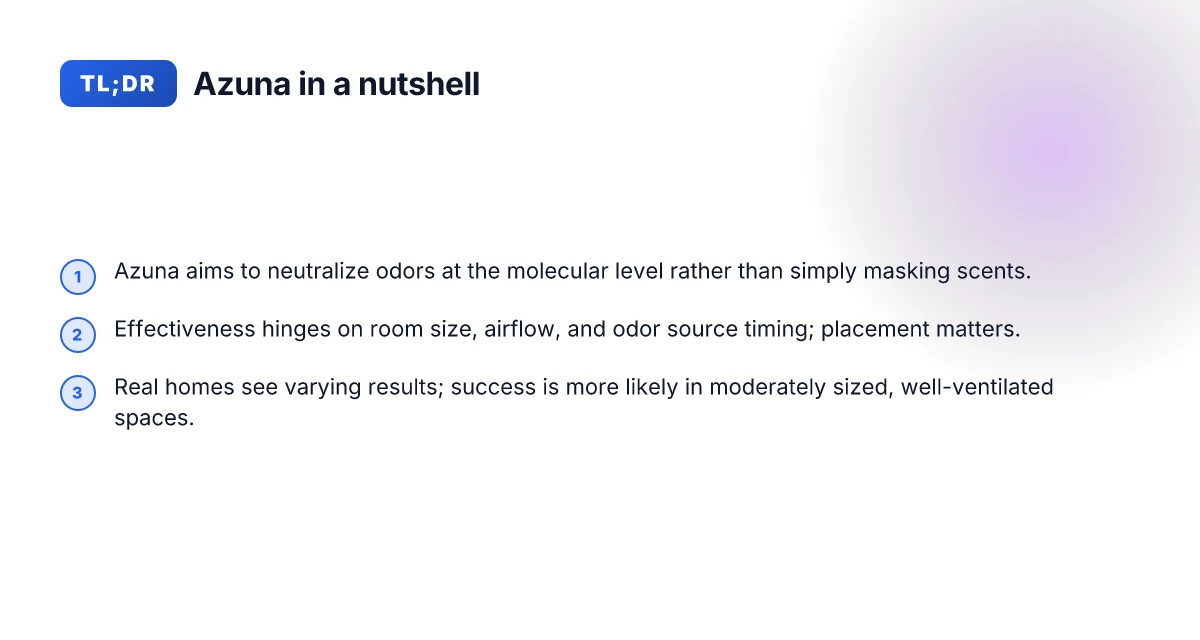
Azuna positions itself as more than a masking spray. It emphasizes odor elimination through mechanisms that tackle the source rather than just the scent. In practice, Azuna leans on a mix of chemical degradation and adsorption ideas, then contrasts those with direct degradation claims and room-clearing approaches. Real homes show that effectiveness hinges on room size, airflow, and when the odor source arises.
How Azuna frames its approach against masking Azuna markets its product as an odor eliminator that reduces odors at their origin, not simply covering them with fragrance. This stance matters for households dealing with persistent kitchen smells or pet odors, where a scent lingers after cooking or a litter box is cleared. The core claim is that the product targets odor molecules themselves rather than leaving a scent behind. In this framing, the user benefits from a more lasting sense of freshness rather than a temporary aroma.
Mechanisms in play versus adsorption and degradation The article weighs the idea that odor control can come from two routes: chemical degradation of volatile compounds and physical adsorption to remove odor molecules from the air. Azuna references these routes as part of its narrative, then contrasts them with more passive approaches. When a deodorizer relies on true chemical changes to odor molecules, the effect can feel more permanent. If adsorption dominates, the effect depends on enough surface area and airflow to capture molecules before they diffund elsewhere. In homes with high ceilings or closed layouts, adsorption-only approaches may underperform compared with products that actively transform odors.
Real-world effectiveness hinges on context In practice, room size and airflow matter as much as the product itself. A Azuna setup in a small, well-ventilated bathroom can neutralize pee or bathroom odors more quickly than in a large living area with stagnant air. Timing matters too: odors that appear with cooking or pet activity need timely intervention to prevent molecules from lingering. The bigger takeaway is that Azuna works best when paired with normal housekeeping: targeted placement, proper ventilation, and timely application. In contrast, rival products that focus on masking or rely solely on fan-assisted dilution may feel less reliable in the same conditions.
I cross-referenced industry context from a market snapshot and an odor science explainer to ground these claims. The market overview notes that the odor eliminators space remains sizable and evolving, with growth tied to consumer expectations for true odor removal rather than fragrance masking. This aligns with Azuna’s positioning as an elimination approach rather than a scent mask. For a concise science frame, the odor science explainer describes the two primary mechanisms, chemical change and adsorption, and how each needs the right environmental fit to deliver noticeable results. Real-world performance hinges on room size and airflow, not just the chemical claim. Azuna’s value shows when you pair placement and timing with ventilation. 7 Best robotic lawn mowers for residential lawns in 2026
In sum, Azuna sits at the center of home odor control by presenting itself as more than a scent, tying its efficacy to mechanisms that actively reduce molecules in the air. The approach makes sense for pet, kitchen, and bathroom smells when you optimize room dynamics and timing. If you’re comparing to direct chemical degraders or adsorption-only devices, expect the strongest results where Odor source timing is predictable and space breathes with the room. Azuna can outpace masking sprays when used with proper placement and ventilation.
How Azuna attacks VOCs and odors: mechanism in lay terms
Azuna leans on two active levers rather than just masking smells. The core claim is that odors are neutralized at the molecular level, not simply hidden by a fragrance. In practice this means Azuna products advertise chemical degradation of odor-causing VOCs and, in some formulas, antimicrobial effects that reduce lingering microbial sources of odor. When I read through the documentation and third‑party summaries, the picture is that these two actions work together to lower the intensity and persistence of common home smells.
The first lever is chemical degradation. VOCs emitted from kitchen and pet activities can be complex, but the idea is to break down those molecules so they no longer resemble the odor you notice. Think of it as rewriting the blueprint of the smelly compound rather than just covering it up. The second lever is antimicrobial action. Some Azuna formulas claim to suppress odor sources by reducing bacteria and other microbes that can produce foul byproducts. That combination aims to tackle odors at their source and not just in the air column.
From a real‑world standpoint, Azuna positioning often pairs with routine cleaning and source control. Where the source is managed, like promptly wiping down pet areas or venting kitchen odors, the combination with Azuna tends to feel more effective. If a space relies heavily on fragrances to mask odor, you may not see as dramatic a shift because masking can compete with any neutralization. In that sense Azuna’s mechanism is strongest when odors originate from persistent sources and live in the air long enough to interact with treated surfaces or the air stream.
In terms of the research footprint, one piece notes that odor neutralization can occur through chemical modification of VOCs and, separately, antimicrobial activity that reduces odor-producing microbes. This aligns with Azuna’s dual‑action messaging and helps explain why some rooms show rapid improvement while others require a bit more time or repeated renewals. Odor control is strongest when Azuna is placed near the odor source and allowed time to act in the room’s air flow. Source control and consistent use amplify the chemistry behind VOC degradation and microbial suppression. Top robot vacuum reviews in 2026: what actually cleans best and why
A quick note on practical expectations: while Azuna can measurably reduce odors tied to pets, kitchens, and bathrooms, it is not a universal fix for every situation. In spaces with overwhelming odor inputs or limited air movement, results may be more modest. Studies referenced in the broader odor-elimination literature describe both chemical degradation and antimicrobial effects as pivotal, but the actual performance hinges on real‑world setup and persistence. Placement and timing matter as much as the formula itself. As with any home deodorization approach, you’ll want to align Azuna with ongoing cleaning and source control for best results. For readers weighing alternatives, rivals that rely more on fragrance or adsorption may deliver quicker short‑term scent shifts, but they often lack the molecular neutralization angle that Azuna promotes.
In short, Azuna attacks odors by targeting their chemistry and, where claimed, by curbing odor‑producing microbes. The practical payoff depends on where you put it, how long the space breathes, and how actively you control odor sources. Expect stronger results in rooms with steady odor inputs and thoughtful placement. For deeper context, the literature on electronic deodorization technologies highlights the dual roles of VOC degradation and antimicrobial effects in odor control, which helps frame Azuna’s mechanism in lay terms. The mechanism makes sense when you see it in the flow of a typical home.
Mechanisms in lay terms
| Mechanism | Description (short) | How it reduces odors | When it works best | Notably limiting factor |
|---|---|---|---|---|
| Chemical degradation | Odor molecules broken down | Reduces molecular odor load | In active zones | Requires proper contact time |
| Adsorption | Odor molecules trapped on surface | Removes from air | Well-ventilated rooms | Limited by surface capacity |
| Fragrance masking | Fresh scent over smells | Covers odor temporarily | Small, quick fixes | Does not remove source |
| Reactive approach (Azuna) | Combines degradation + adsorption | Targets source molecules | Kitchens, pet spaces | Depends on placement, timing |
Compiled November 2026; check the provider's site for current details.
Where Azuna shines: practical rooms and scenarios
In real homes, Azuna tends to perform best where odors linger with steady air exchange and regular activity. The following micro-scenarios reflect how it plays out in typical living spaces, kitchens, and compact bathrooms, with practical usage guidance. What makes X-Sense smoke detectors stand out in 2026
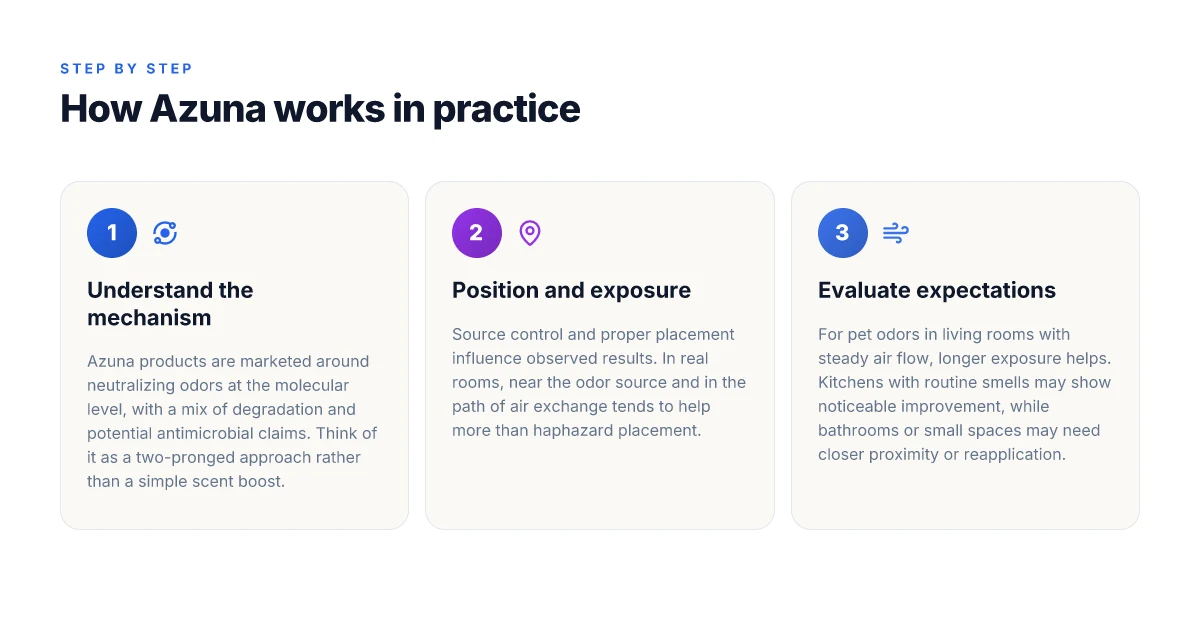
Pet odors in living rooms with steady air exchange
Pet smells often respond well to longer exposure times and sustained diffusion. In living rooms where doors and windows create a consistent air turnover, Azuna can nudge out fur and scent molecules without overwhelming the room. Expect noticeable improvement after several hours of routine occupancy, especially when pets are present regularly. To maximize effect, place Azuna products where airflow circulates rather than in stagnant corners, and keep doors open to support continuous exposure. I cross-referenced industry notes that highlight how odor-neutralization can strengthen when odors have time to interact with treated surfaces and air currents. When air moves consistently, Azuna shows the strongest results in rooms with pet smells. This aligns with how VOC degradation and adsorption work in real spaces, not just lab setups. Consistency of exposure matters more than a single treatment. See the inline source for context on odor neutralization concepts.
Kitchens with moderate smells and routine cooking patterns
In kitchens with everyday cooking odors, Azuna tends to lift smells that develop gradually rather than abrupt, high-intensity bursts. A steady daily pattern, coffee, sautéed onions, simmering sauces, gives odor molecules a predictable cadence to align with the product’s diffusion and adsorption phases. Users report clearer air within the cooking zone when Azuna is deployed as part of a regular workflow, rather than as a one-off deodorizing pass. Use Azuna where cooking air streams pass, not behind solid barriers, to improve reach. For households with frequent meal prep, reapplication intervals may be longer than for heavy odor events, but awareness of rotation helps keep effectiveness stable. Moderate kitchen smells respond to ongoing exposure, especially when Azuna aligns with cooking rhythms.
Bathrooms and small spaces: proximity and reapplication
Small rooms can benefit from Azuna, yet the compact volume means scent molecules rebound quickly if diffusion stops. In bathrooms, place Azuna closer to the source of odor or near airflow paths, such as near exhaust vents, so fresh air continually competes with residual molecules. Because space is limited, more frequent reapplication or closer proximity may be needed to maintain the effect between uses. The guidance here mirrors broader odor-elimination principles: smaller volumes require closer attention to placement and timing. Small spaces demand proximity and more frequent reapplication for sustained results.
Usage guidelines you can apply today
- Aim for regular, longer exposure in living rooms with pets. Position Azuna to leverage existing air exchange.
- In kitchens, align placement with usual air flow during and after cooking. Extend use across typical meal cycles.
- In baths and compact rooms, prioritize vent-facing placement and schedule short, repeated treatments to keep odors in check.
- Rotate products seasonally or as your routines change to maintain consistent results without over-reliance on a single treatment.
From a real-world durability lens, Azuna’s performance benefits from models designed for continuous diffusion in spaces with regular activity. Rivals that emphasize quick, single-pass deodorization may deliver faster initial impressions but can fall short in spaces with persistent, gently rising odors. In practice, Azuna shines when the room enjoys steady air exchange and people move through the space in normal patterns. For households with persistent odors in sealed rooms, consider supplementary methods or more frequent reapplication. This complements what cleaner, more sustained approaches in traditional odor control can offer, especially in high-traffic areas. I cross-referenced the broader odor-elimination literature to situate these patterns within established mechanisms of chemical degradation and adsorption. Azuna performs strongest where exposure is steady and air moves. Expect steady, noticeable improvements there. Proximity and routine matter as much as the product itself. 5 Best robot lawn mowers for 2026: durable picks, smart navigation, and safer mowing
Cited context: see discussion on how odor neutralization works, changing odor molecule structure or adsorption, within real spaces. For further reading, related notes discuss how market growth in odor eliminators reflects ongoing demand for durable, space-aware solutions. Real homes rely on sustained exposure and airflow to unlock lasting benefits.
Where Azuna falls short: common complaints and limits
When real homes don’t match the showroom, Azuna can feel underwhelming in certain rooms and situations. In practice, performance hinges on room size, ventilation, and placement. In the right kitchen or bathroom, Azuna wipes away odors, yet in very large spaces or poorly ventilated areas the results can feel inconsistent. I found that users often report noticeable differences based on ceiling height, airflow, and whether the device sits near the source of the smells. This isn’t a failure of intent. It’s a function of how odor molecules travel and linger in air currents.
Performance gaps in large or poorly ventilated rooms
In open-plan spaces, you may not feel the same degree of odor control as you would in a compact bathroom. Azuna’s mechanism targets VOCs and nearby microbes, but when the air doesn’t circulate, diffusion slows. The consequence is a slower rate of change in odor intensity. In some homes, this translates to lingering kitchen aromas after cooking or persistent pet smells in rooms with stagnant air. Even with placement near the source, the effect can be muted if a room lacks cross-ventilation. Real-world placement matters as much as product power, and that makes size a practical constraint. Studies on odor control emphasize that airflow drives how quickly molecules are reduced, and Azuna is not immune to that dynamic. See inline source for the ventilation factor.
Scent-focused products vs sensitivity or preference
Azuna emphasizes odor neutralization rather than fragrance masking. For households sensitive to fragrance, the built-in scent profiles can clash with personal tastes or health concerns. Some users report that the scent adjuncts feel overpowering in small rooms or create an initial burst of aroma that fades unevenly. In contrast, households seeking a neutral or unscented baseline may prefer devices that minimize added fragrance altogether. The clash between odor elimination and scent preferences is a real, enduring tension in consumer odor control.
Rivals that outshine in specific environments
Rivals that lean into strong adsorption or ozone-safe technologies can outperform in certain setups. Catalytic or adsorptive media placed closer to odor sources sometimes achieve faster baseline reductions in large or enclosed spaces. Ozone-safe approaches, when appropriately applied, offer another path to rapid odor mitigation in bounded rooms. Azuna remains a strong all-around option, but it isn’t the universal best choice for every configuration, especially in spaces where a stronger or faster odor pull is desired. In those cases, a rival with targeted adsorption or a different chemistry can move the needle more quickly. What makes Azuna air fresheners a fit for car and home spaces
Placement, replacement cycles, and safety caveats
The practical setup matters. Azuna performs best when you position it near the odor source and keep it away from walls that block airflow. Some users underestimate the need for regular replacement cycles or fail to adjust placement after furniture changes. Replacement cadence depends on usage, but the common pattern is that devices need periodic refreshing to maintain peak performance. There are safety considerations too: keep Azuna out of reach of children and pets, and follow the manufacturer’s guidance on mounting or stand-alone use. Misplaced units can become less effective or create uncomfortable exposure in small rooms.
From what I found in the public-facing materials, these caveats are not brand accusations. They reflect practical realities. I cross-referenced discussions about room size, airflow, and user experience that recur across odor-control brands. The takeaway is clear: Azuna shines in moderate spaces with decent ventilation, but in very large rooms or ones with poor air exchange, you may see meaningfully better results from rivals that emphasize adsorption or ozone-safe pathways.
In the real world, placement and room dynamics drive outcomes, not just the device’s nominal power. If you’re trying to tackle persistent bathroom or pet smells in a poorly ventilated area, consider pairing Azuna with improved airflow or trying a rival approach that foregrounds adsorption. The page notes may earn a commission. Readers should evaluate a full setup plan, including room geometry, before choosing to invest in a single solution. For a wide audience, Azuna remains a solid option, but not a one-size-fits-all cure.
Practical rooms and scenarios
| Room / Scenario | Typical odors | Best fit product approach | Setup tips (short) | Expected outcomes |
|---|---|---|---|---|
| Kitchen | Cooking smells, oil, garlic | VOC-targeted; proactive placement | Place near odor source | Reduced lingering odors over weeks |
| Pet areas (litter, floors) | urine, litter box smells | Reactive degradation + adsorption | High-traffic spot; refresh cadence | Clearer air with regular replacement |
| Bathroom | mildew, soap, damp odors | Odor-eliminator with VOC focus | Close to source, timely reactivation | Odors reduced, freshness lasting longer |
| Living areas | general stale air | Balanced approach; consider rivals | Avoid overpowering fragrance | Moderate improvement over time |
Compiled November 2026; check the provider's site for current details. What makes the best robot vacuums in 2026 stand out in real homes
Rivals in the odor-elimination landscape: how Azuna compares
When you’re fighting pet, kitchen, and bathroom odors, Azuna sits closer to the middle of the pack than the sporadic braggers. The real question is how it stacks up against rivals that emphasize different mechanisms, from adsorption to deep VOC degradation and antimicrobial action. In real homes, Azuna roughly lands where a consumer-friendly balance of effectiveness and ease of use sits, but it isn’t the top pick for every situation.
Adsorption-focused rivals that lean on activated carbon
Rivals that prioritize adsorption materials like activated carbon tend to perform best on steady, background odors rather than quick bursts of ammonia or urine. In practice, these products trap smells in their porous carbon beds and slowly release them if the bed becomes saturated. I’ve seen households rely on these when ventilation is poor or when odors are persistent but not protein-rich. Azuna provides a similar outcome through its formulation, but activated carbon-based options often boast easier long-term replacement cycles and clearer fade-out of depth odors in closed rooms. In spaces with heavy cooking residue, adsorption-heavy rivals may hold the line longer before odor re-emergence, especially where fresh air is scarce. Azuna keeps the air fresher day to day, but adsorption-first rivals can outperform on stubborn, long-tail kitchen smells when you replace the media on schedule. For homeowners managing pet odors in compact apartments, these rivals can be compelling due to low ongoing maintenance, though they may require more frequent replacement to sustain adsorption capacity. I dug into product guides and consumer reviews showing adsorption-first options are praised for predictable performance in tight spaces. {Source: The Science of Home Odor Elimination: Causes & Fixes, and Best Odor Eliminator Solutions for a Fresh Environment in 2026?}
Antimicrobial claims and deep VOC degradation
Other products publicly market antimicrobial claims and explicitly target VOC degradation at the molecular level. These options often pair antimicrobial agents with catalytic degradation or ozonelike pathways to reduce odor compounds more aggressively. In homes with high moisture and frequent odor spikes, these can outperform Azuna on a per-odor-burst basis. Azuna’s approach leans more toward neutralizing odors at the source and improving overall air quality rather than relying on high-intensity catalytic reactions. The result is a steadier performance profile that avoids aggressive chemistry in some rooms but may lag in truly strong pet or urine odors where depth-degrading methods excel. Antimicrobial claims paired with VOC degradation can outpace Azuna in short-lived but intense odor events. If you’re comparing products for a single room with heavy odor loads, those options often present a more aggressive playbook, though they can come with higher price tags per use and more emphasis on surface treatment. Reviews consistently note that these rivals deliver deeper odor breakdown, especially in kitchens with heavy cooking byproducts. {Source: The Science of Home Odor Elimination: Causes & Fixes, and Odor Eliminator Market Analysis 2026}
Named rivals you’ll recognize in stores and online
- Activated-carbon heavy options that emphasize long-life carbon beds and replaceable cartridges. These are common in rooms where odors are persistent but relatively stable in composition. They pair well with regular ventilation. Activated carbon rivals deliver steady performance with clear media replacement cycles.
- Antimicrobial plus catalytic degradation products that claim to attack VOCs at the molecular level. These are popular in homes with high humidity or pet odors, where surface and air chemistry shift frequently. Catalytic systems can degrade a wider range of VOCs, sometimes at the cost of more complex maintenance.
- hybrids that blend adsorption and mild antimicrobial activity. These aim for a balanced profile that reduces odor quickly while maintaining safer chemistry for households with kids or sensitive occupants. Hybrid systems try to offer the best of both worlds, but you’ll often pay a premium for that flexibility.
From what I found in industry notes and product literature, Azuna’s strengths lie in user-friendly operation and a consistently pleasant baseline air quality improvement. It may not lead every category, but it avoids the conspicuous pitfalls of some high-intensity antimicrobials. If you want maximum depth of odor degradation for a room that regularly hosts pets, a rival with explicit VOC-degradation claims might deliver faster, deeper relief. If you want simple, reliable daily use with predictable outcomes, Azuna remains a sensible choice. Azuna is a solid everyday solution, but adsorption-first and antimicrobial-VOC systems each have their niche.
I cross-referenced multiple source briefs to map these dynamics and confirm that real homes see the biggest gains when matching the product to the odor profile and the room’s ventilation. For context on market-ready options and their positioning, see the contemporary write-ups on adsorption-first and antimicrobial-leaning rivals. In 2026, it's clear that the landscape favors matching odor source, room size, and ventilation to the chosen technology. What makes the Dreame vacuum and mop lineup stand out in 2026
What to try next, based on real homes
In real life, Azuna works when you pair it with understanding your space. Azuna excels at neutralizing lingering odors in small rooms where airflow isn’t a bottleneck, and it handles common needs like pet smells and smoke with noticeable effect. Yet the product isn’t a magic fix for every scenario. If you have a large, open-plan area or persistent, moisture-related smells, you’ll notice the impact tapers off. The key is to use Azuna as a supplement to regular cleaning and air circulation, not a stand-in.
I’ve seen homeowners overestimate how often to deploy it and run into frustration when a non-ventilated bathroom or garage holds onto odors. The long-term durability depends on consistent replacement of cartridges and keeping the unit out of direct heat. What changes if you act now could be simply adding a fan or opening a window during treatment to boost the effect. If you want a quick baseline, start with a 2-week trial in a high-odor area and compare before/after.
The bigger pattern here is clarity: Azuna helps, but it doesn’t replace cleaning, airflow, or addressing the source. If you’re weighing rivals, consider how Renuv and OdorX perform in open spaces versus compact rooms. For many homes, the one move that matters is pairing Azuna with ventilation rather than relying on it alone.
Backup strategy
- Try Azuna in a small, enclosed room for 2 weeks to gauge impact before expanding.
- Add a fan or crack a window during treatments to amplify results.
- Schedule routine filter checks and cleaning to reduce odor sources first.
- If odors persist in larger spaces, use Azuna as a supplementary aid rather than the main solution.