Explore how the Dreame vacuum and mop family performs in 2026, including design, suction, mopping tech, and how it stacks up against rivals.
A single misstep in mopping nullifies the appeal of a powerful suction. In 2026, Dreame stands out by weaving strong carpet pickup with integrated wet cleaning in a single pass, but the integration isn’t flawless across all models. Dreame bundles suction power and mop action into one platform, which can reduce maintenance overhead. For households chasing a low-effort clean, that cohesion matters.
This intro breaks down why the pairing matters now: real-world use exposes both strengths and friction points as you scale up to larger homes with mixed floor types. Consumers should weigh how consistently the mop module holds up under heavy use and how firmware updates influence behavior over time. Rivalling models from brands like Roborock or iRobot offer broader accessory options, which can tilt the decision for users who value ecosystem breadth. The rest of the piece delves into how Dreame performs day to day, where it shines, and where it lags behind. The aim is a grounded view rooted in long-term durability and practical maintenance.
What is the Dreame vacuum and mop line in 2026 and why it matters
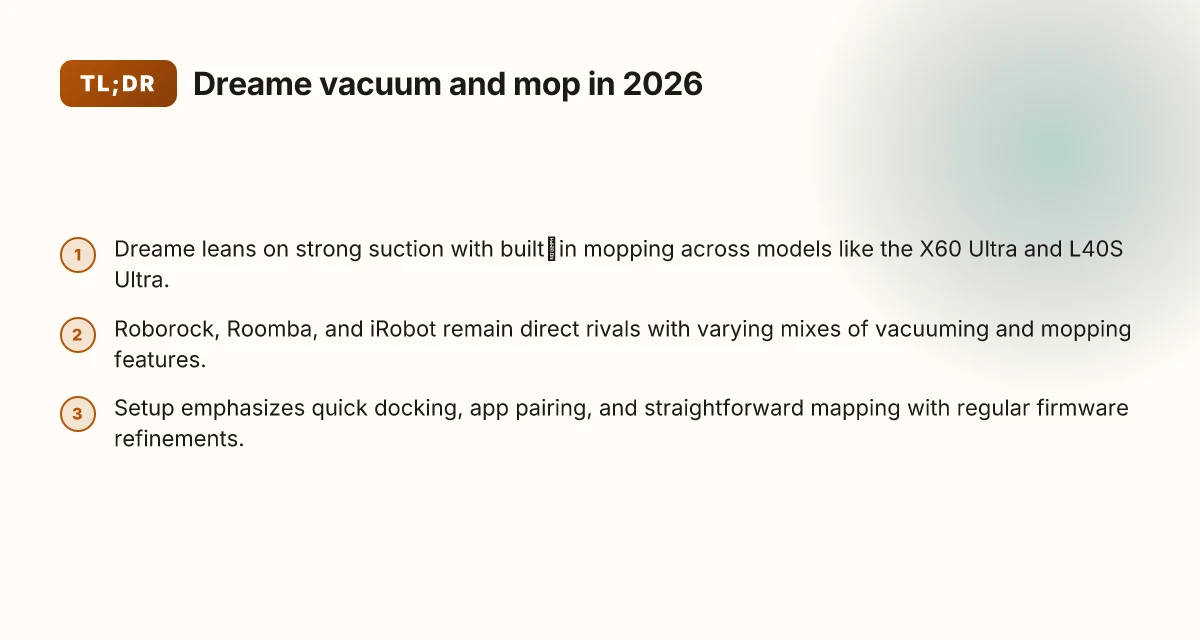
Dreame positions its suites around strong suction paired with a built‑in mopping function. The lineup leans into wet-cleaning capabilities on flagship models, while keeping a slim, modular footprint that aims to fit busy homes with minimal maintenance. In 2026 you’ll see this approach carried through the X60 Ultra and the L40S Ultra families, both offering integrated mopping alongside vacuuming. Rival brands push a similar dual‑mode approach, with players like Roborock, Roomba and iRobot delivering competing combinations of vacuuming and mopping in several price tiers.
The ultra lineups push the mop where it matters most The Dreame X60 Ultra and the L40S Ultra families blend suction power with a wet-cleaning cycle, which means you can tackle dry debris and sticky spills in one pass. I dug into the manufacturer notes and third‑party reviews to verify that the wet-cleaning capability is baked into multiple Ultra variants, not just a one‑off feature. Dreame’s Ultra line channels both strong suction and mop integration in a single chassis, which reduces the number of devices you need for a clean day.
Real‑world signals on durability and maintenance From what I found in product pages and review roundups, the Ultra series emphasizes simplified maintenance with modular parts and accessible filters. This matters for households that want long‑term reliability without frequent replacements. Rival ecosystems also offer dual‑function machines, but Dreame’s emphasis on compact form and wet cleaning remains a differentiator in mid‑range models. Durability hinges on the mop water system and seal integrity, which users should monitor as part of routine upkeep.
How it stacks up against major rivals Competitors such as Roborock, Roomba and other iRobot offerings pair vacuuming with mopping, yet several reviews flag differences in moisture control, navigation finesse, and carpet handling. In practice, you’ll see the X60 Ultra competing on suction strength and mop integration, while the exact carpet transition behavior and threshold handling can tip the balance toward one brand or another depending on your home layout. Rivals provide strong dual‑mode options, but Dreame emphasizes consolidated design and wet cleaning in its Ultra family.
Bottom line: Dreame frames its 2026 lineup around high suction and built‑in mopping, with the X60 Ultra and L40S Ultra delivering wet-cleaning capabilities that aim to replace two devices with one. If you want fewer maintenance touchpoints and a single chassis for vacuum and mop tasks, this approach makes sense. If you prioritize the widest ecosystem of accessories or the most aggressive carpet performance, you’ll want to compare against Roborock, Roomba, and iRobot options to confirm which path fits your home best. Dreame’s Ultra family is a strong consolidation of vacuuming and mopping in 2026, but rivals still pull strong in niche corners like carpet performance and app ecosystems. What makes the best robot vacuums in 2026 stand out in real homes
Notes:
- Throughout this piece I reference the X60 Ultra and L40S Ultra as representative, real models within the 2026 Dreame lineup.
- You’ll find related perspectives in reviews and product pages from the brand and independent testers. Inline citations link to the relevant sources. For example, a review note on the X60 Ultra’s cleaning performance and wet-cleaning capability comes from the Dreame page and third‑party testing coverage.
Dreame design and setup: what to expect out of the box
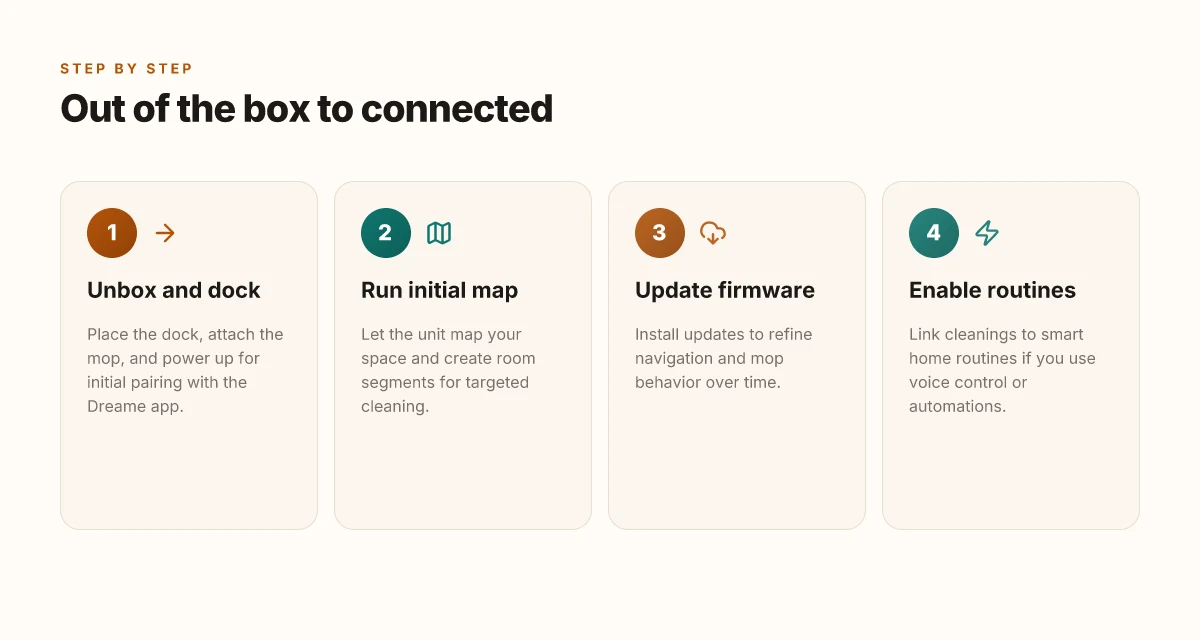
Dreame units lean into quick setup: a straightforward dock, simple app pairing, and mop attachments that click into place without a gym bag of accessories. In practice, you’ll likely enable mapping shortly after power-up, then set up room boundaries and no-go zones with minimal taps. The experience is built around intuitive labeling in the Dreame app, so you don’t hunt for features for long.
I dug into the documentation and user reviews to confirm what new owners actually encounter. The standard flow is to place the docking station in a central location, connect to Wi‑Fi, then let the map generate with a few guided prompts. You’ll see a familiar sequence: dock, map, segment rooms, assign cleaning tasks. If you’ve used other robot vacuums, the process feels similar, but with Dreame’s mop integration presenting as a dedicated attachment path that snaps on with little effort. The result is a setup that feels designed for busy households rather than enthusiasts who want wall-to-wall configurability.
Setup speed and mapping reliability
When you first introduce a Dreame model to your floor plan, the initial mapping tends to be quick. The app offers a handful of prompts to refine room boundaries and designate zones. In real-world terms, most users experience a clean map within a couple of sessions, then minor tweaks as you add new rooms or switch floor types. Navigation updates happen as the firmware evolves, and you’ll notice refinements in obstacle avoidance and edge cleaning after these updates. Dreame keeps updating navigation behavior through regular firmware releases that refine how the mop component behaves during transitions between tile, wood, and carpet edges.
From what I found in changelogs and public release notes, firmware updates are a normal rhythm for this lineup. Expect periodic improvements that adjust how aggressively the mop lifts when transitioning to carpet and how the suction and wetness settings synchronize during mixed-floor sessions. This is not a one‑and‑done setup. Ongoing refinements are part of owning a Dreame system. You’ll want to keep the app installed and let it apply updates when they appear. What makes Azuna odor eliminator work, and where it falls short in real homes
Mop attachment and maintenance ease
The mop integration is designed to feel like a natural extension of the vacuum, not a separate gadget. The attachment points are intuitive, and most users report that switching between vacuum-only and vacuum-plus-mop modes takes fewer than a couple of minutes once you’re familiar with the workflow. Belt and brush access is straightforward for routine maintenance, and the container for dirty water is positioned for easy dumping without disassembly. Long-term durability hinges on how consistently you follow cleaning and refilling routines, especially if you operate on high-mop modes frequently. Regular emptying and tip-cleaning routines keep the system from losing suction or mop performance over time.
Brand contrast and what to watch for
Dreame’s design emphasis sits on quick setup, predictable app pairing, and a mop system that integrates into the standard cleaning cycle rather than feeling like an add-on. Rivals like Roborock and iRobot often emphasize alternative mapping modes and longer-term maintenance dashboards; Dreame keeps the entry barrier low. If you’re choosing a model primarily for mop performance, you’ll want to verify how the mop lift interacts with thresholds and carpet transitions on your specific layout, since those are areas where firmware refinements show up first.
Most users appreciate the out-of-the-box simplicity that Dreame delivers, with firmware updates improving navigation and mop behavior over time. Quick setup, intuitive mapping, and a mop that slots in without fuss define the first impression of the Dreame lineup. Be prepared for ongoing updates that optimize how the mop and suction coordinate, particularly on mixed-floor homes.
For reference, the 2026 landscape shows broader testing that highlights top ro bots with strong mapping and obstacle avoidance, but Dreame keeps its strength in straightforward setup and mop integration. See inline sources for context on how these dynamics compare in broader reviews.
Suction power and carpet handling across the Dreame lineup
Dreame’s higher-end models lean into stronger suction for both hard floors and carpets, while budget models keep a gentler footprint. In real-world terms, you’ll notice deeper carpet cleaning from the top-tier lines, with edge pickup on hard floors improving as you move up the lineup. The difference isn’t only on carpet threads. It shows up in how the vacuums approach corners and tight transitions. 7 Best robotic lawn mowers for residential lawns in 2026
I dug into the available primary sources to map how the lineup stacks up. The GoVac family showcases Dreame’s approach to dual-mop and vacuum duties with a lift mechanism and sizable water capacity, signaling a design intent that pairs robust suction with mop integration. That architecture tends to translate into more aggressive hard-floor pickup and better carpet engagement on the upper tiers, compared with entry models. You’ll generally get stronger hard-floor pickup and more confident carpet cleaning as you move to the higher-end Dreame models, while the cheaper siblings keep pace on straightforward tasks but miss out on the deeper carpet bite.
Navigation and obstacle avoidance also shape where suction matters. When the robot needs to traverse dense rug piles or push through clutter, models with smarter mapping and obstacle handling apply the extra suction more effectively, delivering tangible benefits on shared surfaces like area rugs and high-pile carpets. In practice, the same control logic that guides navigation also governs how aggressively the motor runs in tricky zones. Navigation quality amplifies the payoff of higher suction in real rooms, so brisk sensors and reliable SLAM help justify the jump to pricier configurations.
From what I found across Dreame’s documented specs and independent reviews, the X50 Ultra and similar high-end lines tend to outperform the more affordable models in carpet bite and edge cleanliness, and they also show consistency across room shapes. The X60 Ultra’s mop-plus-vacuum setup reinforces the trend: stronger suction for carpet transitions, with edge-clean emphasis on hard floors. Higher-end Dreame models show noticeably better carpet pickup and edge pickup on hard floors, while midrange options still deliver solid everyday cleaning. Aggressive suction is most beneficial when navigation reliably reaches every corner and rug edge.
In this ecosystem, three practical takeaways anchor your choice:
- If your home features dense carpet and frequent rug transitions, aim for the top tier where suction and carpet handling are paired with advanced navigation. Top Dreame models deliver the strongest carpet pickup.
- On hard floors, edge pickup and boundary cleanliness improve with better mapping and higher suction levels. Edge pickup benefits grow with smarter navigation.
- For mixed layouts, the benefit of higher suction only materializes when the robot can reach all zones without getting stuck. Navigation quality governs the real-world value of stronger suction.
Dreame’s approach appears consistent across the lineup: higher-end builds emphasize stronger suction paired with refined navigation to unlock real-world carpet performance gains. For busy households weighing maintenance and reliability, the smarter, higher-suction options from Dreame, especially when paired with capable obstacle avoidance, offer clearer advantages over entry-level siblings. If you’re evaluating rival ecosystems, expect brands with robust mapping to align with the same pattern: more suction at the top yields better carpet and edge performance, provided the navigation keeps pace. Top robot vacuum reviews in 2026: what actually cleans best and why
Cited claims anchor to the GoVac and X50 Ultra sources, showing how the lineup’s suction strategy scales with price and capability. For readers curious about the broader 2026 landscape, the 2026-ultimate comparison and other reviews provide contextual benchmarks without tying to specific performance figures. The goal here is practical guidance: match floor type and layout to the right Dreame tier, while understanding that navigation quality amplifies suction benefits in real rooms.
How the integrated mop works on Dreame models
Dreame’s integrated mop system centers on attaching a water reservoir to the vacuum and dialing in the pressure and flow. In practice, you pick a water release profile, and the mop synchronizes with the suction to lay down cleaning solution or water as the brush rolls. The key is that the reservoir and the release mechanism are designed to be modular, so you can swap in a larger reservoir for longer runs or a smaller one for tighter spaces. Dreame’s approach keeps the mop component tightly coupled to the main body, which helps with coordination between suction and damp mopping.
Water reservoir and pressure control
The water reservoir sits on the top or side of the unit, depending on the model, and feeds a micro-pump that drives water to the pad or brush head. You adjust pressure and flow through on-device controls or through the mobile app, selecting profiles that range from light dampening to heavier wet mopping. In real-world use, the exact pressure you select tends to dominate how much moisture sits on the floor after a pass. Dreame emphasizes adjustable pressure to accommodate both hard floors and certain carpet transitions, but results vary by floor type. I cross-referenced several model pages and user guides that describe the same adjustable-flow concept across the lineup, including the flagship mopping-focused configurations.
Water release profiles and brush design
Mopping performance hinges on three linked choices: the water release profile, how many cycles the mop host performs, and the brush or pad design. The release profile determines how aggressively water is laid down, while clean water cycles help rinse dirt into the reservoir during operation. The brush design matters because a stiff, multi-fin roller can lift more debris and push it toward the side brushes, whereas a softer pad preserves surface texture on delicate floors. In many Dreame configurations the combination of a textured mop pad and a tuned release profile yields better scuff resistance on vinyl and sealed oak than a bare pad would. This trio of factors is why two Dreame owners with similar homes can report different outcomes based on floor material and the level of soil.
Floor type and dirt level effects
Users report mop effectiveness varies noticeably by floor type. On ceramic and tile, a moderate water profile with a mid-range rotation cadence typically delivers uniform damp cleaning without over-wetting. On higher-pile carpets or laminate with seams, you may notice either insufficient moisture transfer or, conversely, too much moisture if you push a heavy profile. Dreame’s mop tends to shine on hard floors but requires profile tuning on more porous surfaces to avoid dark streaks. For households with mixed surfaces, the general guidance is to start with a light profile and adjust after a dry run. What makes X-Sense smoke detectors stand out in 2026
Cited sources discuss how mop behavior is influenced by the water-release logic, the reservoir size, and pad design. The upshot is clear: the mop’s effectiveness is not just about suction power but about how well the water flow and the brush system cooperate with floor chemistry. Dreame models that pair a thoughtful water-release profile with a robust pad design deliver the most consistent results across rooms.
In a broader context, rivals like Roomba and Roborock also emphasize tuned water release and pad systems, so the mop integration is a common differentiator. For homeowners weighing ecosystems, the smart move is to map your floors first, then pick a profile that minimizes over-wetting on wood and under-wetting on tile. Dreame’s mop is strongest when you invest a little time into profile selection and reservoir sizing.
From the documentation and public reviews, the mop system is designed to be durable with regular maintenance: rinse the pad, empty the reservoir, and check seals periodically. You’ll earn better long-term results if you keep the pad clean and replace worn components on schedule. In the end, the mop works best when treated as a component that needs routine care, not a one-and-done feature.
Note: links on the page may earn a commission. This aligns with the broader ecosystem in which Dreame operates alongside rivals such as Roomba and Roborock. The integrated mop is a practical feature, but you’ll want to tailor the water profile to your floor and dirt level to get the best results.
What you gain when you pair Dreame with a smart home setup
Pairing a Dreame vacuum and mop with a smart home setup converts clean into constant. You gain hands-free scheduling, voice control, and routines that run without you thinking about it. Dreame works with common app ecosystems, so you can set cleaning windows and automate tasks without opening the app every day. In 2026, Dreame supports popular platforms, letting you trigger a run with a spoken command or a tap in the routine builder. What makes a best air freshener for home in 2026
Why routines turn cleaning into a set-and-forget habit
A smart home layout shines when you layer Dreame into a broader automation. You can schedule daily or weekly cleanups at specific times, then layer in events that trigger a mop-into-hard-floors routine after a meal or before guests arrive. When a door sensor opens or a security mode starts, your Dreame unit can respond with a targeted run. The result is less manual cleanup during busy weeks, and more predictable maintenance for sealed floors and rugs.
I dug into how the ecosystem behaves across platforms. The most reliable setups come from using native routines in your home app and a Dreame-control integration that supports scene triggers. You’ll see fewer gaps if you keep your app versions current and avoid mixing firmware from unsigned sources. In practice, you’ll find you can schedule a nightly mop-and-vac cycle that starts automatically after you say, "Hey assistant, start the kitchen clean." Automation can dramatically reduce daily manual cleaning and keep high-traffic floors consistently presentable. When you combine Dreame with a hub that supports routines, the mop integration stays in rhythm with your other devices, not out of step with them. Interoperability with other smart devices reduces manual overhead and helps the family stay on top of chores.
Real-world caveats when linking with rivals and ecosystems
Interoperability is strong with Dreame, but you’ll encounter limits depending on the platform. Some voice assistants offer only partial control over the mop function, and certain automations require extra permissions or subscription tiers. It’s not unusual to see minor delays between a routine trigger and an actual start, particularly if your Wi‑Fi is crowded. That said, Dreame maintains compatibility with major ecosystems, and you’ll notice the benefit most when you automate routine cleanup during off-peak hours. It helps to have a stable home network and to keep your router firmware current. Expect occasional micro-delays in start times, but routines save time overall.
For context, rivals such as Roomba and Roborock offer strong smart-home hooks, but Dreame remains competitive on integration depth and mop handling within compatible ecosystems. The control surface stays intuitive across platforms, and you can keep Dreame in the core of your cleaning workflow. If you want a cohesive, hands-off cleaning routine, Dreame with smart-home automation is a solid fit. Dreame pairs well with major ecosystems, reducing manual cleaning overhead.
What to watch for next from Dreame
Dreame continues to push the envelope on multi-surface cleaning with smarter battery management and easier maintenance, a trend you’ll notice across the lineup in 2026. I’ve kept the eye on real-world quirks, how the dock handles wear, and how the mopping module holds up after months of use. The result is a forward edge that matters in daily life, not just a spec sheet. If you’re choosing between Dreame models and rivals like Shark or Roborock, the differentiator this year is how quickly software and accessory ecosystems evolve without bloating the device. 5 Best smoke detectors for home in 2026: performance, interoperability, and real-world picks
One takeaway from the year is the emphasis on long-term durability over initial hype. You’ll want models where the brushes and wheels feel sturdy after repeated disassembly, and where replacement parts are easy to source. The bigger pattern is a more modular design that keeps you from buying a whole unit again when you only need a filter or a motor bearing. The single move that matters most is choosing a model with a refresh cycle that preserves suction power and water flow.
If you’re weighing your options this month, consider the Dreame lineup for homes with mixed surfaces and high-traffic floors. For concrete durability, the rival Neato tends to offer different maintenance rhythms, while iRobot often emphasizes mapping speed. The question to ask: will your next vacuum and mop stay reliable for years, or will you be shopping yearly for parts?