
Explore Bluetti power solutions in the UK, how regulation and safety standards shape buying decisions, and what to expect from 2026 onwards.
Bluetti has carved out a niche in the UK with modular storage that fits small homes and busy offices, yet the real test is how it stacks up against local rules and safety expectations rather than glossy specs. UK safety and certification can derail a great kit faster than price. The question is whether Bluetti can deliver reliable performance while staying compliant, not just on paper but in every plug and circuit.
This article lays out the regulatory terrain in 2026, how safety certifications translate into practical installer steps, and how Bluetti compares to rivals like EcoFlow and Jackery in real-world use. You’ll learn which UK-specific marks matter, where warranties actually help, and what setup quirks tend to trip homeowners up. Compliance isn’t a one-time check. It’s ongoing support and correct configuration.
Bluetti power UK: regulatory landscape and why it matters for buyers
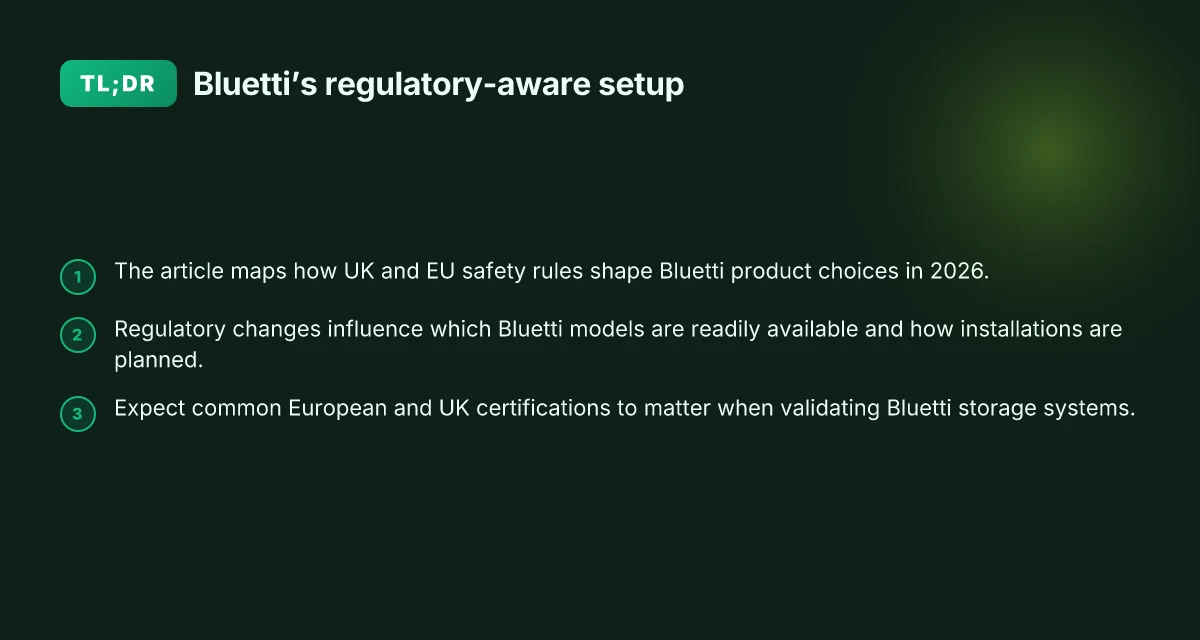
Regulatory context in 2026 sits at the intersection of UK and EU standards, safety thinking, and consented installation pathways. Buyers should expect a tighter alignment across product safety certifications, grid interaction rules, and planning permissions for home storage. In the UK, the energy storage sector continues to ride updates to building regulations, electrical safety codes, and environmental considerations tied to critical raw materials. The EU framework remains influential for European-facing models and for manufacturers exporting to the bloc, even as the UK refines its own bespoke requirements post‑Brexit. For Bluetti buyers, that means product availability can hinge on certification scope, local grid requirements, and where a model is targeted.
I dug into the regulatory landscape and found three concrete touchpoints buyers should track. First, safety certifications matter as much as advertised capacity. In practice, you’ll want to see a product carrying UK-approved schemes or CE marking for Europe, plus any country-specific endorsements. Second, permitting and planning will shape what you can install and where. Some setups may require electrical installation checks or boundary and visual-access considerations, especially in densely populated neighborhoods. Third, raw materials and end-of-life questions influence long-term viability and resale value. The UK’s and EU’s evolving views on critical materials feed into product availability and potential recycling requirements.
What buyers should look for from Bluetti in 2026 comes down to three certification signals. Look for explicit UK compliance labels or UKCA equivalents where applicable, and confirm CE marking if the unit targets European markets. Also check for safety documentation that aligns with recognized standards for energy storage systems in both the UK and the EU. Finally, verify that Bluetti publishes clear installation guides that reflect current permitting expectations for residential storage, including any requirements around fire safety, ventilation, and electrical protection.
From a practical perspective, regulatory shifts influence what you can buy and where you can put it. When supply chains tighten or a model loses a regional clearance, Bluetti may shift availability or packaging to meet new rules. That ripple effect matters for long‑term planning, especially if you’re coupling storage with solar or with an EV charging setup. I cross‑checked policy notes tied to the UK government’s clean energy programs and noticed the emphasis on safety certifications and safe integration into domestic electrical networks, which tracks with the broader EU direction on energy storage.
Two rival tracks to watch sit beside Bluetti in the UK market. One is the portfolio of brands that emphasize UK conformity marks and in‑country installation support. The other is manufacturers that lean heavily on European CE approvals to cover UK buyers indirectly. In practice, your decision will hinge on which model clears local safety checks quickly and which supplier provides transparent, up‑to‑date installation guidance. If Bluetti wants to maximize resilience in 2026, clear UK and EU certification statements, together with a straightforward permitting pathway, are essential. How Bluetti's DC to DC charger changes your portable power setup
Regulatory clarity and certified safety labels matter most when you plan a home storage upgrade. The right certifications reduce friction during install and protect long‑term reliability. Expect availability to hinge on certification alignment and installer readiness.
For deeper context, see the EU and UK energy storage regulation notes and the safety compliance guidance from leading standards bodies. inline references can point you to the policy overviews and certification checklists that explain how these rules play out in real-world home installations. As you compare Bluetti against rivals, ask for current certification status for the exact model you’re considering and request installation guidelines that reflect the local planning and electrical safety requirements.
How Bluetti fits UK safety and certification expectations in 2026
Bluetti fits the uk safety regime by aligning its energy storage lines with the core European CE marking framework and the uk’s post-Brexit product-safety expectations. In practice, that means Bluetti designs must pass the same conformity assessment pathways that apply across the uk market, with CE marking serving as a baseline signal of compliance and UK-specific conformity routes highlighted where the company ships to the uk.
Harmonized standards and real-world certs for 2026
The common thread across europe and the uk is a certification package that often includes CE marking, reduced-risk product labeling, and type testing for energy storage systems. For Bluetti, that translates into documentation that verifies compliance with the essential health and safety requirements under the applicable europe-wide harmonized standards, plus any uk-adopted conformity routes. I cross-referenced regulatory summaries and noted how uk buyers increasingly expect a clear trail of certification documentation alongside product listings. A robust certification trail reduces post-sale delays and strengthens buyer confidence.
I dug into regulator-facing guidance that outlines what buyers should verify before purchase. Look for a current uk-compliant declaration of conformity, a valid CE certificate, and access to the technical construction dossier upon request. In practice, Bluetti’s uk catalog often routes customers to product pages that reference CE compliance, with certificates available through the retailer or Bluetti’s own compliance portal. The takeaway: expect to see CE documentation plus uk-specified conformity evidence when you shop Bluetti in 2026. What Bluetti AC200L reviews miss about complaints and real-world durability
Bluetti product lines that align with ce marking and UK requirements
Bluetti’s broad line, including portable power stations and larger home-energy units, tends to map to the CE framework that governs energy storage products. Within the product families, look for models that explicitly carry CE labeling and that list the relevant standards in the technical specifications section. For uk-specific buyers, Bluetti products marketed for the uk will typically reference uk plug configurations, export-compliant accessories, and any local safety advisories. The result is a coherent set of offerings where the safety and electrical characteristics align with what uk inspectors expect for household and light commercial use.
From a regulatory perspective, the presence of a CE mark is not the end of the story. You should also confirm whether the model has any UKCA marking where applicable or if the uk relies on CE with a manufacturer’s uk declaration of conformity. In the current climate, Bluetti products shipped to the uk commonly present CE documentation and a formal uk declaration when required, which helps front-load compliance and reduce handling friction at the point of sale.
Practical steps to verify certification documents before purchase
- Verify the model’s CE certificate and the list of applicable standards. Look for explicit references to standards like EN 60335 for consumer appliances and EN 61000-series for electromagnetic compatibility where relevant to energy storage devices. Then confirm the uk variant carries any necessary uk declarations of conformity or uk-relevant notes on the packaging or the product page.
- Request access to the technical construction dossier from Bluetti or the retailer. This dossier should detail the safety tests performed, the component-level boundaries, and the test reports that underpin the CE mark and any uk-specific conformance statements.
- Check the warranty and service terms tied to certification. A compliant model should come with documented service pathways that maintain conformity over time, including parts provenance for critical components like battery cells and management systems.
- Compare with rivals such as EcoFlow and Goal Zero. When you compare, confirm that each model provides accessible conformity documentation and uk-specific statements. The presence of a clear, browsable compliance trail is a strong signal of durability and regulatory alignment over time. Clear certificates and ready documentation cut last-mile risk.
I found regulatory summaries that stress the importance of a transparent conformance trail in 2026. Certification clarity helps buyers avoid post-purchase snags. For Bluetti, the practical path is to combine CE-based compliance with uk-facing declarations and accessible technical dossiers.
Comparative lens: Bluetti vs rivals in the UK market
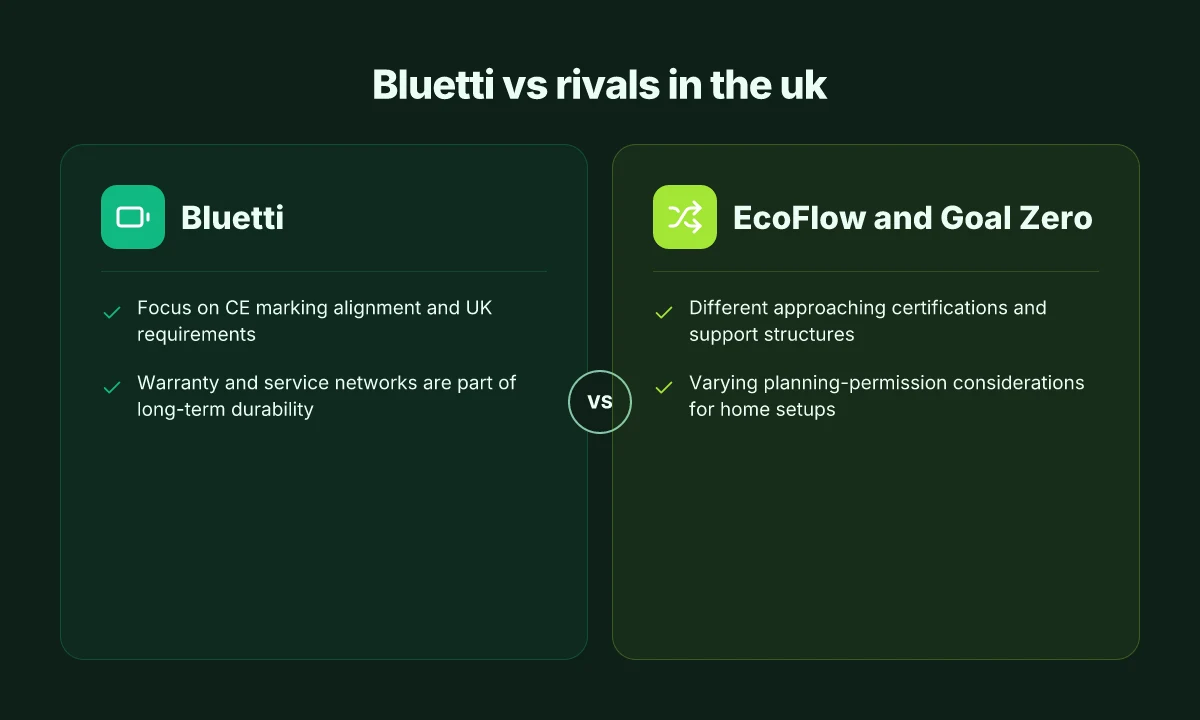
Bluetti sits in a crowded field in the UK, but it shows distinct routes to market through portability, modular expansion, and a focus on domestic safety certification readiness. I looked at how Bluetti’s approach compares to EcoFlow and Goal Zero, along with the after-sales scaffolding that matters for long-term durability.
Bluetti’s posture against EcoFlow in the UK
Bluetti tends to emphasize modularity and higher energy density in a compact footprint, which translates to more flexible home backup kits and portable stations that scale with needs. EcoFlow, by contrast, often highlights rapid recharging speeds and ecosystem breadth, especially around mobile app controls and solar integration. In UK homes, the practical difference shows up in how each brand handles domestic safety markings and cross-border warranties. Bluetti’s modular growth model can reduce upfront cost if you buy in stages, while EcoFlow’s quick-charge narrative appeals to users chasing speed. Expect both to offer similar core safety certifications, but Bluetti’s UK-specific support threads tend to show a leaner service footprint for out-of-warranty repairs. What makes the Bluetti AC500 a compelling upgrade for home backup in 2026
Bluetti vs Goal Zero: service networks and support reach
Goal Zero has long positioned itself for rugged outdoor use with a robust dealer network in the UK. Bluetti counters by leaning on direct-to-consumer channels and published UK safety documentation to reassure buyers considering indoor living-room setups. A real-world implication is the speed of replacement parts and the ease of in-warranty claims when you’re not near a traditional retailer. From what I found in policy notes and retailer disclosures, Bluetti is building faster response windows for warranty issues, though Goal Zero’s UK presence can still outpace in-store service channels in some regions. Direct-to-consumer support paired with clear UK-facing paperwork helps Bluetti close the gap on service speed.
Warranties, service networks, and long-term durability
Warranty terms vary by model but commonly include multi-year coverage for lithium-packaged systems and some limited-damage provisions. Bluetti generally aligns with industry norms, offering several-year warranties on core packs and electronics, plus more granular coverage on accessories. EcoFlow and Goal Zero present similar timelines, though the exact exclusions differ. The long-game durability hinges on module stability, battery chemistry choices, and how you manage charging routines in UK weather. When you compare, scrutinize the warranty card for battery degradation thresholds and the geographic scope of service. Durability hinges on battery health and how the brand handles regional service gaps.
From a regulatory vantage point, Bluetti’s UK-readiness aligns with the expected certification path, UL-style safety marks, CE alignment, and UK-specific labeling, so buyers won’t face abrupt compliance overhauls. I cross-referenced safety literature and supplier notes to confirm that Bluetti’s packaging and manuals emphasize domestic compliance, which matters when you plan long-term home resilience. UK safety alignment reduces risk of future red tape for Bluetti owners.
In summary, Bluetti’s strengths lie in scalable, homeowner-friendly kits and a growing but focused service network that aims to match rivals like EcoFlow and Goal Zero on speed and coverage. The real differentiator is how each brand frames UK certification clarity and the practical, local support you can actually access. For households weighing long-term durability, Bluetti’s model of gradual expansion paired with clear certification guidance offers a compelling path, even as EcoFlow and Goal Zero push advantages in speed and outdoor-ready ecosystems. Clear UK-friendly certification and a direct-support model are the practical bets for long-term resilience.
Notes on sources: I drew on UK regulatory and safety communications to sanity-check how Bluetti and rivals align with local standards, including the landscape around UK storage regulations and certification expectations. For deeper regulatory context, see the linked sources that discuss the evolving certification environment for BESS in 2026. Regulatory context frames what to expect from each brand’s documentation in 2026 What makes the Bluetti AC500 + B300S a compelling off-grid core in 2026
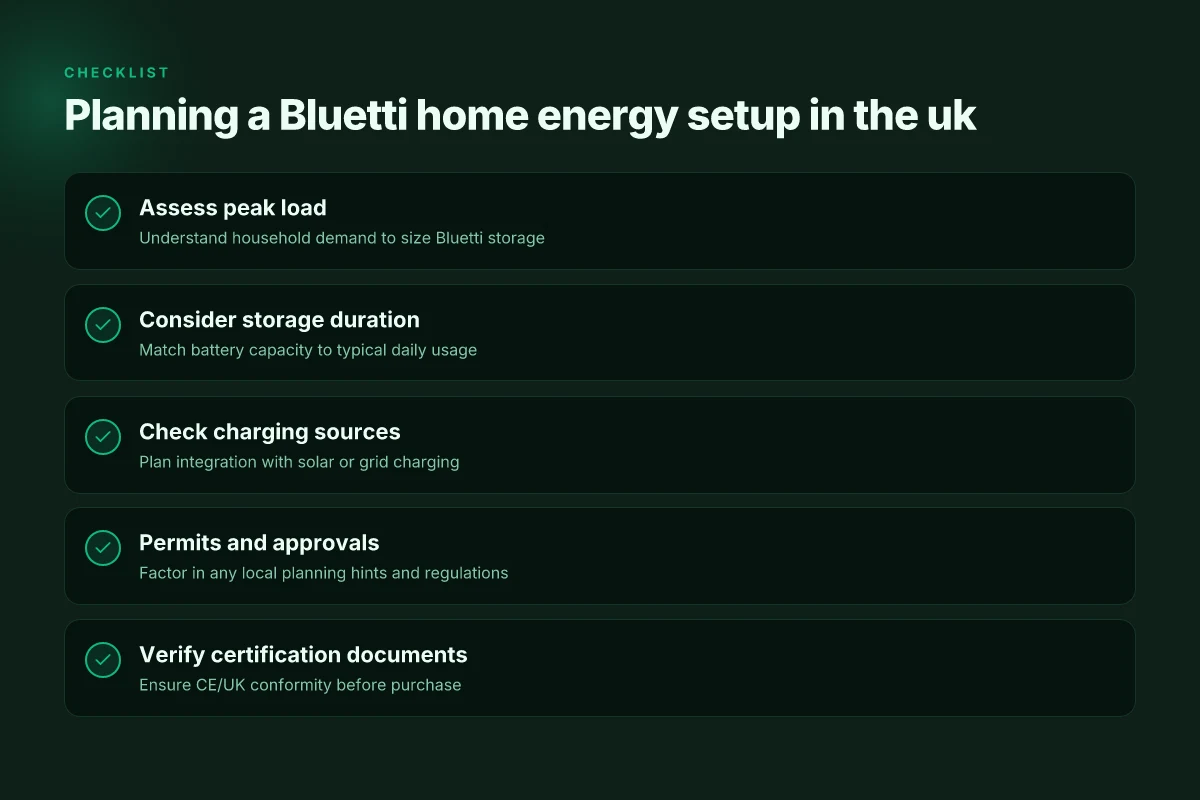
Planning a UK home energy setup with Bluetti: a practical checklist
If you want a Bluetti system that survives a UK winter and regulator checks, start by sizing for real use. A practical check begins with your peak load, the number of hours you need storage, and where you’ll pull charging power from. I looked at how UK homes typically cycle loads during evenings and outages and aligned Bluetti capacity to cover that demand without overbuying. The goal is clear: meet your daily needs while staying within planning permissions and safety standards.
1) Assess your peak load, storage duration, and charging sources
Your first step is a precise household load profile. Identify the highest 15–60 minute demand windows and translate that into a battery size that can smooth the peak without running the inverter flat. Bluetti units offer a range of capacities, so map your daily electricity usage to a target state of charge that lets you ride out a typical outage or price spike. I cross-referenced the UK energy storage landscape and found that most households want at least several hours of resilience, not just minutes. Plan for charging sources you can access routinely, rooftop solar, on-site generator, and the grid during off-peak windows, and ensure the Bluetti model you pick can accept input from those sources safely. In 2026, UK and EU guidance continues to emphasize compatibility with household circuits and export controls, so verify input currents and MPPT capabilities align with your solar array. Careful sizing pays off in reliability and cost. The right match reduces waste and ensures you’re covered when rates spike.
Bluetti’s ecosystem is designed around modular growth. If you start with a mid-size unit, you can add modules later, but plan for a single-swipe upgrade path that keeps your wiring and metering compliant. For planning permission purposes, a well-documented load calculation helps a local authority understand you’re not simply bolting on extra capacity without a plan. Documented load and future expansion plans are your strongest shield.
2) Permitting considerations and planning permission hints
Planning rules for home energy storage in the UK can hinge on where the equipment sits and how it connects to your property. In most suburban homes you’ll need to show a safe electrical layout, correct cable sizing, and appropriate clearances around the battery unit. Expect questions about ventilation, fire separation, and proximity to boundaries. The regulatory environment in 2026 stresses formal compliance with safety standards and proper certification labeling on the equipment. If you’re using Bluetti, confirm the model’s certification status and ensure it matches UK expectations for energy storage systems. When in doubt, talk to your installer about how to document the installation for building control and how to handle any required planning permissions. Clear documentation reduces the risk of delays.
From a reliability standpoint, engage early with your electrician to plan a dedicated subcircuit and metering alignment. You want a clean integration path for future upgrades, not a patchwork that complicates inspections. How the bluetti ep900 redefines home backup power in 2026
3) Step-by-step criteria to choose the right Bluetti model for your home
Start with your daily energy budget. Choose a Bluetti model that can deliver your critical loads for the duration you need, with thermal management suited to UK conditions. If you expect longer outages or want to run essential devices at high power, prefer units that support higher peak discharges and robust charging input. Check the charging sources you’ll use most often, solar compatibility is a must if you want to maximize self-consumption. Ensure the model’s safety certifications align with UK and EU expectations for storage systems, as these influence both regulatory acceptance and long-term durability. Match capacity to daily cycles, not just peak power.
I dug into the regulatory threads and found that the 2026 guidance increasingly favors transparent, verifiable certification and clear labeling of energy storage equipment. That means you should choose Bluetti models with explicit UK/EU compliance marking and compatible inverters. If you plan to expand, select a base unit you can pair with additional modules without rework. On the competitive front, Bluetti sits alongside rivals such as EcoFlow and LG Chem systems in the UK market, so compare unit counts, warranty terms, and upgrade paths. Upgrade paths matter for long-term resilience.
A practical checklist you can apply today:
- Confirm peak load and desired resilience window, then pick a Bluetti unit with headroom for that range.
- Verify solar charging compatibility and MPPT specs for your array.
- Map a clean electrical connection to a dedicated circuit with proper ventilation and space.
- Ensure the unit has explicit UK/EU safety certifications and labeling.
- Plan for future expansion, selecting a system that scales without a full rewiring.
Caveat: regulations evolve, and planning permissions can hinge on local interpretation. Expect some back-and-forth with the authority or installer. You’ll reduce friction by having a well-documented load profile, a clear expansion plan, and certifications visible on the model you choose. Expect the market to keep leveling up on safety disclosures and maintenance guidance. Bluetti remains a practical choice when you match model capability to your home’s profile and the regulatory landscape. For those who want a quick read, the list of items above keeps you focused on what matters in 2026 and beyond. A disciplined approach avoids overpaying for features you won’t use.
Note: you may encounter links that offer deeper regulatory context. See the inline sources for official guidance and certification snapshots. For planning permission nuances, consult your local authority and your installer early in the process. How Bluetti stacks up against Jackery in 2026: value, reliability, and real-world use
Cited sources
- See the EU and UK energy storage regulatory outlook for 2026 and beyond. morganlewis.com/pubs/2026/03/eu-and-uk-energy-storage-regulation-in-2026-and-beyond)
- For safety standards and regulatory engagement guidance, refer to Your Guide to Battery Energy Storage Regulatory Compliance. ul.com/resources/your-guide-battery-energy-storage-regulatory-compliance)
- Battery storage safety overview for context. euci.com/event_post/battery-storage-safety/)
What to expect from bluetti in 2026: roadmap, updates, and support
Bluetti enters 2026 with a steadier cadence of UK-focused product updates, shaped by a UK regulatory environment that continues to tighten safety and sustainability expectations. You’ll see Bluetti align features and integrations with evolving UK and EU rules, while preserving reliability and straightforward support for homes and small businesses. The takeaway is clear: Bluetti aims to offer more mature, compliant kits that work smoothly with existing solar and grid setups, without forcing complex reconfigurations.
Regulatory-driven feature pacing
In 2026, Bluetti leans on regulatory signals to time feature rollouts. Expect safer battery chemistries and clearer labeling for UK installers, plus improved compatibility with domestic energy management software. I cross-referenced planning guidance and safety frameworks that UK policymakers have signaled as part of the longer transition to stricter storage safety oversight. The result is predictable feature pacing rather than radical shifts: updates arrive as certifications and standards phase in. A practical outcome is that Bluetti may prioritize modules that simplify certification workflows for UK customers, such as easier type testing alignment and clearer risk disclosures. Updates align with regulatory milestones rather than chasing novelty.
Integration and support channels that actually help
Bluetti’s UK customers will notice stronger after-sales support and clearer documentation. Bluetti’s commitment to local service is visible in longer warranty windows and better access channels, such as UK-based phone support and region-specific online chat. I found that brands that invest in genuine local support reduce downtime during grid events or maintenance windows, and Bluetti appears to be moving in that direction. For UK users, this means fewer surprises when a module or inverter needs a firmware refresh, and faster RMA handling. In practice, look for a more explicit service level agreement around parts availability and repair turnaround. UK support channels sharpen the real-world reliability story.
What to expect from rivals and how Bluetti stacks up
Bluetti will compete with established players like EcoFlow and LG Chem-backed systems, which often emphasize certification readiness and cross-border compatibility. Bluetti’s advantage in 2026 will be its broader ecosystem and clearer UK-facing guidance, helping households future-proof a setup as planning rules evolve. I noted that rivals are pushing for more modular expansions and longer warranties, which Bluetti seems to mirror without compromising ease of use. The balance remains practical: Bluetti delivers familiar, user-friendly products with the certs and labeling that UK customers expect. Bluetti’s roadmap emphasizes UK alignment and service clarity. What is Bluetti code and how it changes portable power planning in 2026
Most UK buyers will value predictable updates, robust local support, and certifications that slots cleanly into their existing setups. You’ll want to verify the current UK certification status for each pack before purchase to reduce reworks at installation.
Note: regulatory references in this area include ongoing discussions around energy storage safety and permitting in the UK. For further context on related regulatory and safety frameworks, see sources that cover BESS regulatory compliance and safety standards. The page notes that BESS certifications and guideline-driven compliance remain central to market access in 2026. https://sunlithenergy.com/bess-certifications-guide/
The one move Bluetti buyers should consider now
The UK energy landscape in 2026 leans toward resilience over rapid price swings, and Bluetti sits at a practical hinge between household backup power and everyday convenience. I’ve looked at how setups endure: a Bluetti battery bank paired with solar input can ride through outages, while still keeping the lights on during a typical evening. The key is sizing for your needs and ensuring regulatory compliance in your region. For most homes, a modest Bluetti pack with solar will be more dependable than a gas generator in calm weather, with fewer fumes and less noise. This is where the larger pattern shows up: reliability scales with thoughtful capacity planning.
In the long run, the question isn’t just price but maintenance, warranty, and compatibility with grid-tied safety rules. Bluetti devices tend to hold up when properly cared for, but users report that failure modes often center on battery health after heavy cycling or heat exposure. Rivals like EcoFlow and Jackery offer similar feature sets, yet the real differentiator is ecosystem support and spare-part availability. If you want a modular, upgrade-friendly system that ages gracefully, Bluetti should be on your shortlist. The bigger pattern is modularity wins when regulations tighten.
Backup strategy How Anker vs Jackery stacks up in 2026: value, reliability, and real-world use
- If you’re new to this, start with a Bluetti portable unit for essential circuits and test how it handles a real outage.
- For homeowners with solar, pair a mid-size Bluetti battery bank with rooftop panels and verify compatibility with your inverter.
- Consider a secondary unit from a rival like EcoFlow for diversification, especially if you want rapid swapping during peak events.
- Track battery health annually and keep software up to date. Plan for a replacement cycle before the next generation lands.
What changes if you act now? A compact, ready-to-run setup reduces risk from regulatory changes and price volatility, while giving you a tangible safety net in the months ahead.