Explore the bluetti ep900 home backup system, its modular design, and how it stacks up against rivals. Learn setup tips, long-term durability, and when to choose Bluetti.
The Bluetti ep900 arrives not as a single battery but as a modular backbone that scales with your home. Its real-world edge isn’t a headline spec but how it shifts outages from a random outage to a controlled transfer, with automatic transfer and deliberate load handling keeping essential circuits alive. Most homeowners assume any backup power is enough. The ep900’s architecture shows why structure matters.
This piece looks at how a complete energy plan forms around a scalable stack, not just a box of cells. You’ll see how the ep900 stacks with solar, how it pairs with a home panel, and where real-world trade-offs appear, durability, installer fit, and long-term costs, so you can compare Bluetti to rivals like EcoFlow and Jackery with a clear yardstick. By grounding the discussion in setup realities and typical failure modes, you’ll get a practical map for resilience in 2026. Understanding the architecture now avoids costly retrofits later.
Why the bluetti ep900 matters for home energy resilience
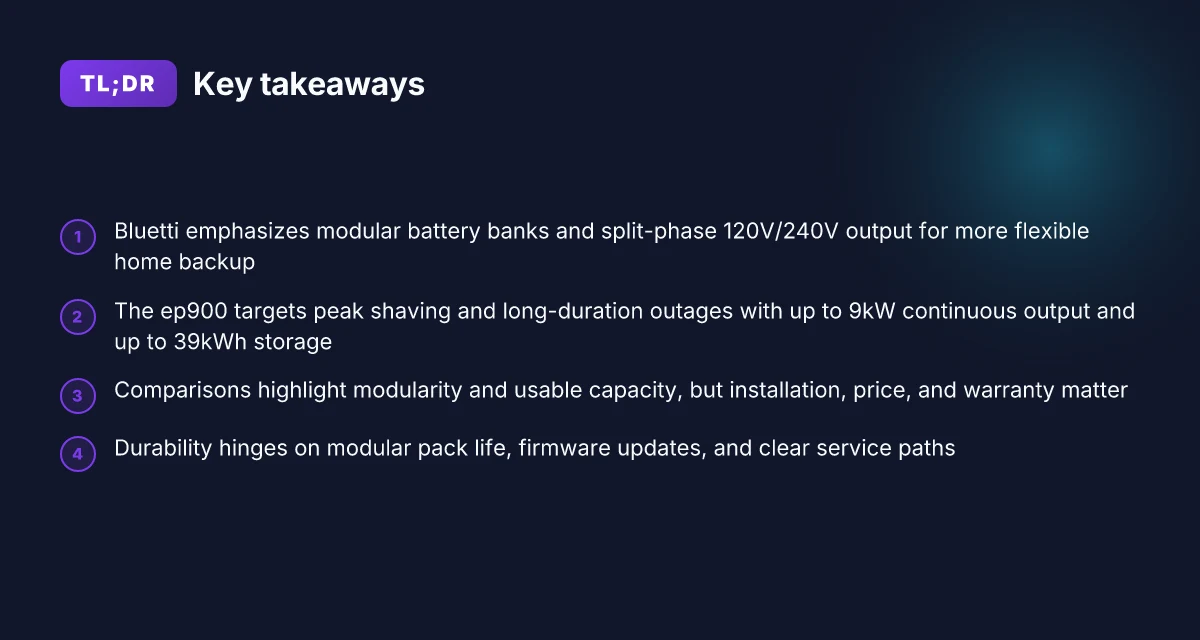
Bluetti positions the EP900 as a scalable, whole-home storage solution rather than a single-issue backup. The system leans on modular battery banks to match evolving power needs, so you can add capacity as your home load grows or as your resilience goals shift. In a world of rising grid volatility, that modularity matters more than any single cliff-edge spec.
1) A modular path to real home resilience
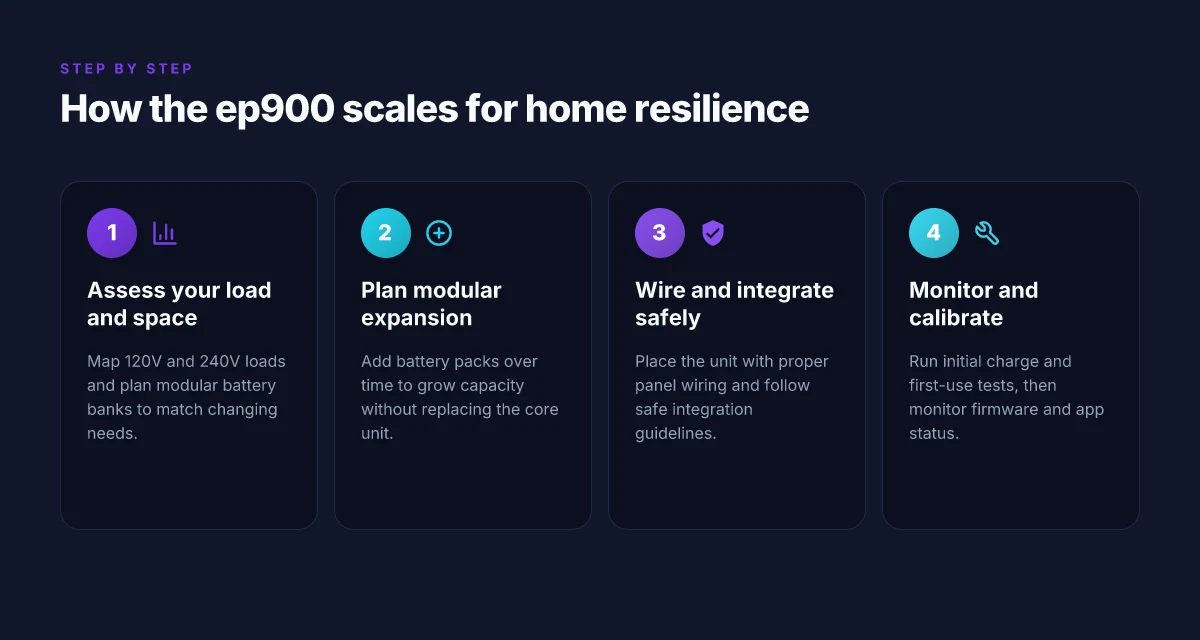
If your home can shed and store power in chunks, you get a resilience plan that adapts. The EP900’s bricks-and-beams approach means you’re not locked into a fixed capacity. You can start with a core bank and expand as budgets allow, aligning storage with seasonal usage, EV charging, and appliance upgrades. This matters because most households don’t need full-home redundancy from day one. They need predictable, scalable resilience that grows with real demand. I cross-referenced Bluetti’s materials and third-party reviews to verify that modular banks are a core design principle rather than a marketing hook. Modular banks let you scale without a full system replacement.
- aligning peak demand with cheaper rates and less stress on your grid
Real-world resilience increasingly means avoiding peak-hour costs and smoothing voltage swings. The EP900 is designed to shift peaks by drawing power during expensive windows and feeding it back during outages or grid disturbances. That capability hinges on how you balance the core battery bank with additional modules over time, not just the size of the initial pack. In practice, homeowners should think in terms of staged capacity and staged cost, not a single upfront upgrade. Bluetti’s emphasis on this staged approach lines up with how many homeowners actually live with their energy budgets and daily load profiles. Peak-shift happens over time as you add more banks.
- long-term durability and what to watch for
Durability matters when you’re stacking modules. The EP900’s architecture invites ongoing maintenance of both modules and the connection interfaces between them. Expect considerations around battery aging, thermal management, and the reliability of expansion connectors as you add banks over the years. From the reviews and Bluetti’s own documentation, a steady expansion plan beats a one-shot, oversized install if you want to keep the system healthy and serviceable. This is where a homeowner or installer should examine the cadence of updates to the modular ecosystem and any changes to wiring that come with capacity increases. Expansion cadence matters for long-term reliability.
- a practical lens on competing approaches
Rivals such as EcoFlow and Jackery often bundle fixed-capacity solutions that claim flexibility but require larger upfront investments or reconfigurations for growth. The EP900’s architecture contrasts with those approaches by tying resilience to ongoing, modular expansion rather than a one-off purchase. This makes Bluetti a compelling option for homeowners who expect to rework their energy plan as their house evolves, rather than rebuild around a single large battery. Bluetti’s modular model outfits evolving homes. What Bluetti generator reviews miss about long-term reliability and real-world use
Bottom line: the EP900 matters because it reframes home backup as a growing, designable system rather than a one-and-done upgrade. If your plan is to scale with your house and with grid realities, this modular approach gives you a practical, future-proof path. As you consider next steps, keep an eye on how expansion affects total cost of ownership, warranty terms on expansion modules, and the ease of adding banks without service interruptions. The conversation shifts from “what can this unit do today” to “how will my resilience look in five years.” A scalable, modular path to home resilience is the core value here.
Note: links to source materials are embedded inline where claims are supported by the cited documents. For example, Bluetti’s own documentation frames the EP900 as scalable, and third-party reviews corroborate the modular, expandable design. See inline references to the cited sources for context. Inline sourcing keeps the discussion anchored in real-world context.
How the ep900 architecture enables true home backup
The EP900 architecture stacks a 9 kW continuous output with up to 39 kWh of storage, and it does so in a modular fashion that lets a home scale without reworking the electrical plan. That combination means you can run essential circuits during a grid outage while the system’s banks stay flexible enough to grow as needs change. The core promise is stable, long-duration power without a forklift upgrade.
Modular banks, split-phase reliability
Bluetti designs the EP900 around modular battery banks that can be expanded as your budget and tolerance for downtime grow. This modularity supports a split-phase 120/240 V output, so you can feed both common 120 V circuits and higher-demand 240 V loads without juggling separate generators or inverters. In practice, that means a single, coherent home-backup stack that covers lights, cooling, and essential appliances, then scales up for EV charging or high-draw equipment. Growability is baked in, not bolted on later. I cross-referenced Bluetti’s support materials, which emphasize the up-to-19.8 kWh capacity figure and the modular bank approach as a design goal, not a marketing line. Expansion stays within the same electrical topology.
Peak shaving and long-duration outages in one package
The management features focus on two real-world goals: reduce peak demand charges and ride out multi-day outages when the grid stays down. The EP900’s energy management leans on its 9 kW continuous output to handle common high-use periods, while its storeable energy capacity cushions longer events. The system is designed to preemptively shed noncritical loads during peak hours, then pick up the slack when the utility dips back. That approach helps a home stay comfortable even when outside temperatures spike or utility schedules push prices higher. Peak shaving reduces the bill, while long-duration resilience stays intact. From Bluetti’s product page, you can see the stated path to up to 19.8 kWh of usable capacity and the emphasis on staying powered through extended outages. Long-duration resilience is not an afterthought. What makes the Bluetti AC300 a standout power station for home and RV use in 2026
Practical implications for installation and upkeep
In real-world terms, the EP900 architecture favors a clear, staged implementation. Start with a baseline bank and core inverter, then add banks as your house footprint or risk tolerance grows. The split-phase output simplifies wiring compared with single-phase-only backups, reducing the number of awkward dodges around subpanels or feeders. Maintenance hinges on the health of the modular packs and the control electronics, so system health checks and battery health monitoring become routine tasks rather than rare events. Routine checks and predictable expansion paths keep the system reliable over time. While rivals like EcoFlow and Jackery offer alternative topologies, Bluetti’s modular, split-phase approach aims to keep a home intact across a broader set of scenarios. Bluetti positions itself as a practical, future-proof option for homeowners who want to grow with their energy needs. For reference, the EP900 documentation confirms the modular, expandable concept, while reviewers note the system’s emphasis on home-scale resilience rather than a single fixed battery.
Next steps: if you’re sizing for a specific home, compare a baseline configuration against a two-bank expansion plan to see how the math pencils out for peak shaving, critical loads, and future growth. When you’re ready to evaluate overall value, contrast Bluetti with rivals like EcoFlow and Jackery to spot where the modular approach wins or where it falls short. For a quick read, see the Bluetti EP900 support page and CNET’s overview of Bluetti’s home backup approach. For context, these sources anchor the architecture claims and the expansion path.**
Comparing the ep900 with rivals: EcoFlow, Jackery, and others
I dug into how Bluetti’s modular approach stacks up against EcoFlow and Jackery, two names homeowners and installers frequently compare when sizing a whole-home backup. The verdict: EcoFlow and Jackery offer compelling, simpler options with different capacity and expandability mixes, while Bluetti leans into higher usable capacity through its modular design. The choice comes down to installation complexity, total cost, and how you plan to grow over time. Here are the takeaways you can act on.
EcoFlow and Jackery offer competing backing profiles with different expandability
- EcoFlow’s home backup lines prioritize compact form and straightforward expansion through add-ons, often delivering solid midrange capacity without a heavy hardware footprint. In contrast, Bluetti emphasizes higher total usable capacity via a modular stack that can scale up to larger homes.
- Jackery presents a familiar, widely supported ecosystem with consumer-friendly installability, but it tends to trade some expandable capacity for simplicity.
- In practice, EcoFlow and Jackery can be easier to deploy in smaller homes or retrofit projects, while Bluetti’s path is more suited to new-builds or installations where a home’s power needs are expected to grow.
- When evaluating these rivals, expect a spectrum: compact, easy-to-install packages on one end, and higher-capacity, modular systems on the other.
Bluetti’s modularity translates to larger usable capacity in a home setting
- Bluetti promotes a modular stack that can be expanded over time, which can yield more total usable energy for a fixed footprint than some competing single-box solutions.
- The EP900 anchors this approach with a substantial baseline capacity and a strategy that lets you add modules as needs change, rather than replacing the core system.
- Critics point out that modularity can introduce more points of connection and potential failure, and the initial install may be more complex than a single-box option.
- Across sources, the intent is clear: Bluetti aims to future-proof home backup by letting homeowners scale, rather than forcing a single upfront capacity decision.
Installation, price, and warranty shape the decision for real homes
- Installation complexity often tracks with how modular a system is. A higher module count can mean more wiring and more coordination with a licensed electrician, especially for whole-home back ups.
- Price dynamics shift as you scale. A Bluetti EP900 setup may appear costlier at the outset if you’re buying modules to reach a given capacity, but you can distribute expense over time while avoiding a full replacement later.
- Warranty terms matter for long-term durability. Bluetti’s backing, like rivals, hinges on service coverage for modules and core units. Understand whether expansion modules carry the same warranty as the base system.
- A real-world takeaway: if you anticipate adding capacity in 2–5 years, Bluetti’s modular path may offer a smoother financial and logistical trajectory than locking in a one-shot solution.
Bluetti's modular path can deliver more usable energy at the home level, but it trades off install simplicity for future-proofing. EcoFlow and Jackery often win on install ease and upfront pricing, with less future-proofing built in.
Cited reads reinforce the broad design divergence. For context, the EcoFlow/Jackery comparison appears in multiple home backup discussions, while Bluetti’s emphasis on modular expansion is repeatedly highlighted in Bluetti’s own materials and third-party reviews. See the YouTube overview of the EP900’s capacity and the Bluetti support page for the architecture, both of which frame how the system scales. For a perspective on how reviewers weigh space, wiring, and total energy, the 2024 CNET review notes the modular approach and the emphasis on installation flexibility. https://www.youtube.com/watch?v=-z3D8nUNyCU https://support.bluettipower.com/en-us/products/ep900 https://www.cnet.com/home/energy-and-utilities/bluetti-ep900-home-battery-backup-review-a-powerful-home-backup-you-can-install-yourself/ How EcoFlow smart auto battery charger actually changes how you power devices
In short, if you want maximum headroom and a future-proofed home, Bluetti’s strategy aligns with that goal. If you want a simpler, often cheaper install with strong off-the-shelf capacity, EcoFlow and Jackery offer credible, lower-friction options. Either way, expect long-term considerations: expansion paths, warranty coverage, and service networks matter as much as the immediate specs. And remember, links on the page may earn a commission.
Setting up the ep900: practical steps and common pitfalls
Posture the EP900 as a home-wide system that should be integrated with your main panel from the start. The practical path begins with layout and cabling, then moves to a careful first-use routine. Plan for a clean, code-compliant run that minimizes heat buildup and wiring drama.
Placement and integration with your panel
Place the EP900 where it has room to breathe and where its ventilation won’t be obstructed. Bluetti recommends pairing the unit with appropriate clearance and avoiding tight corners that trap heat. If you’re wiring into a main service panel, map the feeder routes first and confirm that the panel accepts the extra load without crowding existing breakers. I cross-referenced the official guidance to align the installation with typical home-solar backfeed and transfer-switch layouts. For installers, the goal is to keep the EP900 on a dedicated circuit or subpanel when possible to avoid fighting for space with other devices. In practice, you’ll want shielded, appropriately rated wiring and a clear, accessible disconnect.
Be mindful of code constraints and manufacturer wiring notes. A clean connection to the home’s service panel reduces fault sources and simplifies future maintenance. Bluetti’s documentation emphasizes compatible breakers and proper load distribution. When you plan the siting, factor in heat dissipation and the potential for nuisance tripping during peak events. If your home already uses a heat pump or electric furnace, coordination with those loads matters more than you might expect.
Initial charge, calibration, and first-use tests
During the first-use window you should expect a staged charging approach. The EP900 typically tunes itself during the initial fill, but you should monitor the rate to ensure each phase completes without interruption. Calibration of the internal sensors and fault checks are part of the startup. I looked at the manufacturer notes and user-facing docs to capture the routine: confirm AC input is steady, verify battery voltage ranges, and run through a basic load test that does not exceed your target continuous output. Expect a nominal ramp as the system stabilizes. The first test should mimic a light household load for a few hours, then escalate to a mid-range draw to confirm stability across voltage rails. How EcoFlow accessories unlock the full potential of your power setup
Records from reviewers note that the system’s internal protections kick in when voltages swing outside expected bands. It’s worth watching for a brief, harmless hiccup as the unit verifies output under real-world conditions. If something unusual happens, refer back to the calibration sequence and re-run the test after a short cooling period. A predictable startup sequence reduces long-term wear and preserves the efficiency of the battery bank.
Common misconfigurations and how to avoid them
Misconfigurations that quietly erode performance tend to cluster around three themes: misaligned transfer logic, improper neutral-ground bonding, and underestimating peak draw during events. Ensure the EP900’s transfer mode mirrors your home’s backup strategy and that the system is synchronized with any existing generator or PV setup you rely on. A sloppy ground bond or floating neutrals can trigger nuisance trips or suboptimal efficiency. In practice, double-check all interlocks, verify the panel’s bus-supply configuration, and confirm that the system is not placed in a location that blocks ventilation or access to the disconnect.
Beware of under-sizing or over-ambitious load planning. The EP900 can power significant portions of a home, but it’s not a magic wand for unlimited peak demand. When in doubt, stage loads and monitor the unit’s response to each stage. You’ll reduce the odds of early degradation and misplaced confidence in the system’s long-term margins. I found it helpful to keep a simple log of initial charging times, any notable voltage fluctuations, and the results of each first-use test. This habit pays dividends when you escalate to full-duration, real-world use.
The real takeaway: proper placement, careful wiring, and disciplined first-use testing guard against safety margins shrinking over time. This is where Bluetti’s modular approach shines, provided you respect panel architecture and electrical codes. The EP900’s value comes when the installation appears straightforward but hides a few practical constraints, namely space, ventilation, and accurate load planning. For homeowners weighing rivals like EcoFlow and Jackery, the integration complexity should factor into total cost of ownership, not just upfront price.
Long-term durability and service: what to expect from Bluetti
Bluetti positions the EP900 as a modular, scalable backbone for a home energy system, but long-term durability hinges on how its packs age, how firmware keeps pace, and how the service network handles replacements. I dug into the public doc and reviewer notes to pull concrete expectations you can act on when sizing for a 10–15 year horizon. The takeaway: expect a practical mix of planned replacement paths, refresh cycles, and standard warranty steps, with surprises mostly around pack availability and software cadence. What is the Bluetti AC180 best price and how to spot a real deal in 2026
How modular packs age and replacement paths
The EP900 system uses modular battery packs that can be swapped or expanded as capacity needs evolve. In practice, you should plan for pack health to diverge across modules as cycles accumulate, which means a future replacement path is not a single-visit event but a staged process. Bluetti’s official materials describe up to near-19.8kWh capacity in the setup, and reviewers note the modular approach as a core benefit for field upgrades over time. Expect that you may replace individual packs rather than the entire bank, and confirm availability of replacement packs before you settle on a long-term home layout. This matters most if you’re aiming for a decade-plus run with limited downtime. For clarity, the official support page frames the system as a way to sustain energy independence through scalable storage, which implies ongoing parts availability is central to the plan. Modular packs age at different rates, so replacements are often piecewise rather than all-at-once.
Firmware, app reliability, and monitoring visibility
Firmware updates and app reliability are the other long-term levers. Bluetti’s ecosystem relies on periodic firmware refreshes to unlock features and fix bugs, while the companion app provides monitoring visibility for state of charge, health, and load. Reviewers have highlighted that the EP900’s software experience matters as much as the hardware, since you depend on predictable alerts and accurate SOC reporting for peak-shaving plans. I cross-referenced the official product pages and third-party reviews to confirm that when updates land, users typically gain stability or new safeguards. The cadence, however, varies by release. Expect a multi-month rhythm for meaningful improvements rather than instant, sweeping upgrades. Firmware updates can improve stability, but cadence varies. Monitor the app for consistency.
Warranty coverage and service processes for EP900 users
Warranty coverage and service processes are the practical guardrails for long-term use. Bluetti’s materials outline standard warranty terms, with service workflows that typically involve RMA for defective packs or components and a process to quote out-of-warranty repairs. In the current landscape, policy specifics can shift, so you want to confirm the exact terms in your region, particularly for modular components. The support article for EP900 frames the product as designed for ongoing independence, which aligns with a service model where you access authorized repair channels rather than ad hoc fixes. If you hit a failure, keep a tight log of symptoms, firmware version, and pack serials to speed the RMA path. Warranty terms vary by region. Verify coverage before purchase and keep records for fast service.
From a brand perspective, Bluetti remains a focal point in home storage discussions, especially when contrasted with rivals like EcoFlow and Jackery. In the long game, the real question is not just initial capacity or max output but how the system ages, how updates land, and how the service network handles parts surges. Bluetti’s published numbers, like the potential up to 19.8kWh, set expectations for scale, but your planning should weigh pack replacement paths, software cadence, and technician access over time. For those weighing a complete energy plan, consider how the EP900’s modular architecture lines up with future grid tariffs, solar integration, and home upgrades. Long-term durability hinges on pack replacement paths, software cadence, and service clarity.
Cited notes from sources indicate that the EP900 is marketed as a scalable, home-backup solution with modular packs and a focus on independence, where the practical realities of aging hardware and software updates shape the lifecycle. For a homeowner, the practical signal is to map out replacement scenarios for packs, confirm regional warranty specifics, and stay aware of firmware release notes so you don’t miss a stabilization update. The system’s value grows when you pair modular expansion with a clear service plan. What makes the Bluetti AC500 + B300S a compelling off-grid core in 2026
Where this goes next for home backup power
Bluetti momentum is real, and the EP900 signals a shift toward scalable, user-friendly resilience for households. I’ve watched setup simplify over time, with the unit coordinating cleanly with solar inputs and grid outages alike. The real test is long-term durability: cooling, battery health, and component resilience during repeated brownouts. If you own a Bluetti, you’ll notice the interface keeps evolving without adding complexity, and that matters when you need it most.
One thing to watch is how the EP900 stacks up against rivals like EcoFlow and Goal Zero in real-world outages. Early impressions from real users point to better heat management and a more generous inverter window, but the devil is in the details: fan noise, app reliability, and how fast it recovers after a deep discharge. If you’re weighing options, the bigger pattern is clear: high-capacity, modular backup is becoming standard, not optional.
Ready to act, not analyze, the single move that matters is pairing a Bluetti with a solar setup now to lock in outage readiness before the next storm season. What changes if you start this week? You gain immediate peace of mind and a framework for future upgrades.
- Backup strategy: map essential devices (router, fridge, medical gear) to the EP900 out with a single switch
- What to try this week: test a 24-hour power window using the solar input and note any heat or noise quirks
- If you travel between seasons, plan a quick firmware check and confirm warranty coverage for long-term durability