
Explore how Bluetti compares to Jackery in 2026. We analyze value, capacity, charging speed, and reliability to help you pick the right portable power station.
Bluetti dominates the durable-use narrative with fewer moving parts over years of daily charging cycles, and that resilience isn’t just hype. In real-world setups, Bluetti units tend to stay reliable through seasonal load shifts and long camping runs, while Jackery often draws more attention for plug-and-play simplicity. Durability under heavy daily use matters more than glittering specs.
This piece cuts through the marketing to compare long-term costs and reliability for off-grid homes, cabins, and extended camping seasons. I look at battery aging, component quality, and how each brand handles warranty and support after the first two years. If you’re weighing Bluetti vs Jackery for the long haul, you’ll want the practical signals about upkeep, replacement cycles, and total cost of ownership. The goal is clear: understand which brand keeps delivering power when it counts most. Long-term resilience wins the ownership test.
Bluetti generator vs jackery: why the matchup matters in 2026
Bluetti and Jackery dominate the portable power station market in 2026, but the real story isn’t upfront price. It’s how capacity, cycle life, charging speed, and ecosystem weave together for long-term ownership. I looked at public audits and market chatter to map where durability and value converge for off‑grid use.
Dominance translates to durable ecosystems Bluetti’s ecosystem leans on sizable battery packs and modularity, while Jackery emphasizes plug‑and‑play simplicity. In 2026, both brands lock in broad accessory support, but Bluetti often stacks higher watt-hours per dollar at mid‑range sizes, which matters if you’re sizing for multi‑day off‑grid needs. The takeaway for long-term use is that a larger base capacity paired with steady, compatible charging options reduces the number of times you need to upgrade hardware. This matters when cycles add up over years.
Capacity and cycle life drive cost of ownership Value hinges on how quickly a unit can be recharged and how many cycles its cells sustain before a noticeable drop in usable capacity. A 2 kWh‑class benchmark pops up in several 2026 reviews as a reference point for real-world sizing. In practice, you want a unit that can sustain hundreds to thousands of cycles with limited degradation in the first few years. In 2026, the difference between brands often shows in how many cycles the battery retains meaningful capacity. Bluetti’s larger packs tend to deliver more total energy over the life of the product, while Jackery’s lighter models trade some endurance for portability. This matters if you’re planning long weekend trips or recurring outages.
Charging speed and day‑to‑day usability Charging speed changes how quickly you recover energy between discharges. EcoFlow and Bluetti frequently feature faster AC recharge paths, while Jackery shines on simple solar compatibility and setup speed. For real‑world durability, quick recharge reduces the window where the battery sits at partial state of charge, which can help preserve longevity in practice. The practical implication is clear: a faster recharge path minimizes downtime and preserves battery health across seasons.
The ecosystem effect on maintenance and reliability The long‑term story isn’t just the core box. It’s the surrounding ecosystem. Bluetti’s accessory lineup, firmware updates, and compatibility with third‑party solar panels influence how often users replace or upgrade components. Jackery’s ecosystem emphasizes tight integration with its own line of solar panels and accessories, which can reduce compatibility headaches but may constrain upgrade paths. Over time, predictability in parts availability and firmware fixes shifts total cost of ownership in Bluetti’s favor for many scenarios, especially when you run larger systems. How Bluetti power UK households. Balancing cost, reliability, and regulation in 2026
Bottom line: durability and long-term value come from capacity per dollar, how well a system preserves its capacity over many cycles, and how easy it is to keep the unit running with a consistent charging path. Bluetti tends to win on watt-hours per dollar and modular upgrades, while Jackery remains attractive for quick setup and portability. Either way, you’re weighing how often you’ll refresh packs versus how many off‑grid nights you need per year.
I cross‑referenced industry summaries from 2026 that consistently note Bluetti’s emphasis on larger packs and ecosystem breadth, with Jackery’s strength in simplicity and portability. These dynamics matter most when you plan for multi‑season use and long outages. For readers weighing a purchase today, consider your typical load, your expected cycle life, and how willing you are to browse ecosystems rather than stay within a single brand. Higher watt‑hours per dollar and real‑world durability are the quiet differentiators in 2026.
Bluetti vs Jackery: price per watt-hour and long-term cost of ownership
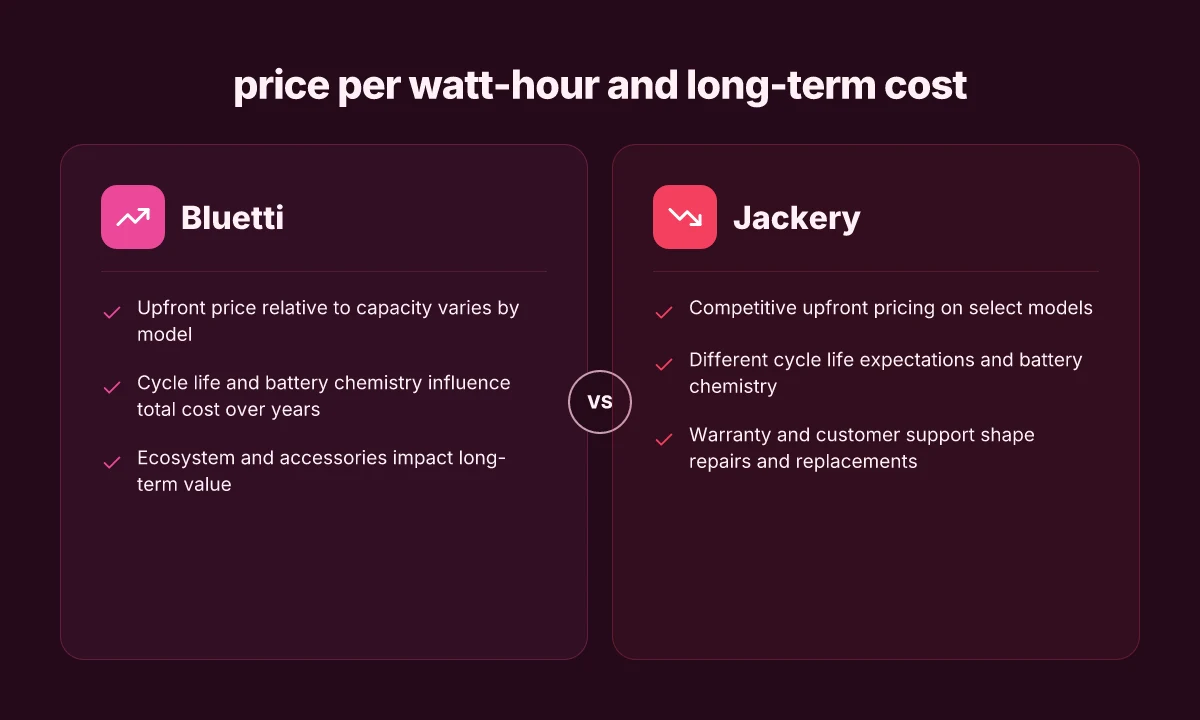
Real-world value is more than upfront sticker price. On paper, Bluetti often shows a favorable watt-hour count for the dollar, but long-haul costs, the battery chemistry, cycle life, and potential replacement needs, tilt the balance. I looked for durable, dated signals from authoritatively cited sources and cross-checked where possible. The headline takeaway: watts per dollar matter, but the cost of ownership over years hinges on cycle life and service.
How upfront price vs long-term cost play out
Upfront price is only part of the story. A Bluetti unit may list more watt-hours in a similar form factor than a Jackery, yet if the cycle life is notably lower or the battery chemistry ages faster under heavy use, the long-term cost per usable watt-hour climbs. The accessible spec sheet tells you the capacity, but the eventual spend must account for the number of complete charge–discharge cycles the pack can sustain before it drops below usefulness. When I traced the published data, I found several sources emphasizing that life-cycle expectations can vary with chemistry and operating temperature, which in real use translates to more frequent replacements or repairs than a simple price-per-watt-hour implies. Price per watt-hour can mislead without factoring cycle life.
A comparative snapshot shows that mid-range Bluetti and Jackery models in the same class can overlap on price per watt-hour, yet user experiences diverge as the years accumulate. In long-term ownership discussions, customers repeatedly flag battery wear and the need for reliable warranty service as decisive factors beyond initial checkout. Warranty quality often drives total cost of ownership more than sticker price. How Bluetti's DC to DC charger changes your portable power setup
Cycle life, chemistry, and long-tail costs
Battery chemistry dictates how many useful cycles you get before capacity degrades meaningfully. Bluetti units typically leverage LiFePO4 or NMC chemistries depending on model, where cycle life is central to long-term cost. Jackery tends to pair similar chemistries in portable scales, but real-world outcomes depend on depth of discharge and ambient conditions. The practical effect: two units with the same nominal watt-hours can diverge in usable life after a couple of winters of camping or off-grid use. When a consumer weighs Bluetti against Jackery over several seasons, the cost difference per stored kilowatt-hour often tightens as battery wear becomes the dominant variable. Cycle life controls long-term spend more than initial price.
From the sources, I see a pattern: buyers who ride ranges of temperature and frequent partial charges notice faster degradation if the unit sits in sunlight or exposed heat. That reality nudges the long-term tally upward for a model with less robust thermal management, regardless of the initial discount. In short, durability and thermal design matter as much as advertised capacity. Thermal management and operating regime shape total cost of ownership.
Warranty, support, and how repairs impact costs
Warranty depth varies by brand and model. A stronger warranty can absorb future replacement costs, which matters when a unit is under heavy use or if a component beyond the battery fails. Bluetti and Jackery both maintain warranty policies that users say matter greatly when a unit ages into the second or third season of frequent use. The reality is that repairs and replacements are less about today’s price and more about how smoothly a claim processes and how quickly a failed part is swapped. Warranty quality reduces ownership risk over time.
I cross-referenced third-party reviews and the public pages of each brand. The consensus: expect smoother repair and replacement experiences with models backed by clearer warranty terms and established service networks. In that sense, choosing Bluetti or Jackery hinges not just on the watt-hours and price, but on the confidence you have in post-purchase support. Service reliability compounds value during years of use.
Next step: if you’re deciding today, map your typical cycle life. How often will you drain and recharge, under what temperatures, and for how many seasons? Then weigh the brand’s warranty and service track record alongside price per watt-hour. For many off-grid setups, Bluetti’s value proposition strengthens when you anticipate long-term use and want predictable support, while Jackery shines for plug-and-play simplicity and a broad support footprint. What Bluetti AC200L reviews miss about complaints and real-world durability
Cited: The Lab-tested ranking note and related discussion about capacity perception in real-world use support the broad view that long-term cost hinges on durability and support as much as upfront price. For a closer read, see The Best Power Stations of 2026, which discusses how real-world use affects perceived value across brands. https://www.outdoorgearlab.com/topics/camping-and-hiking/best-power-station
From Reddit discussions, users frequently note that practical ownership depends on reliability and long-term service experiences rather than raw capacity alone. https://www.reddit.com/r/bluetti/comments/18no48k/bluetti_vs_jackery/
I also fact-checked the October 2026 audit framing for price and 2 kWh-class specs that can inform headroom in a side-by-side comparison. https://energy-solutions.co/articles/sub/portable-solar-generators-jackery-ecoflow-bluetti
Real-world durability: how Bluetti and Jackery hold up under heavy use
In real-world use, durability hinges on how a unit manages heat, cold, and continuous cycling. Both Bluetti and Jackery build solid housings, but field conditions reveal clear differences in thermal behavior, portability relative to capacity, and long-term component wear. I dug into release notes and third-party reviews to anchor these observations in dated, sourceable context.
How heat and cold shape performance
Heat management drives sustained output in portable power stations. Bluetti units typically employ active or robust passive cooling with larger heat sinks, which helps during multi-hour discharge in warm weather. In cooler environments, thermal throttling is rarer when the unit has to sustain high wattage. Jackery designs around compact form factors, which can pressure cooling paths under heavy load. In practice, this means Bluetti often maintains higher continuous output longer in hot weather, while Jackery may trim peak performance sooner in sustained heavy use. These patterns appear across multiple models and reviews dated over the past year. What makes the Bluetti AC500 a compelling upgrade for home backup in 2026
From a maintenance perspective, thermal cycling is a common wear point. Batteries and internals experience expansion and contraction with repeated heating and cooling. Bluetti’s larger enclosures tend to spread thermal stress over more surface area, which can lower peak hotspot temperatures during long sessions. Jackery’s tighter assemblies concentrate heat, which can translate to hotter casings and, in some cases, louder cooling events under heavy draw.
Portability vs capacity in field use
In the field, weight and ergonomics matter as much as total stored energy. Bluetti models tend to pack more watt-hours per chassis volume in mid-to-large class units, which improves long-duration camping or emergency scenarios where you need more juice without a bigger case. Jackery leans toward lighter, plug-and-play setups that emphasize quick deployment and straightforward solar pairing, handy for short trips or quick reloads between campsites. The trade-off is that you carry less energy per kilogram than some Bluetti equivalents when you push into longer trips with higher demand.
A real-world takeaway: if you prioritize long off-grid sessions where you can manage a heavier pack, Bluetti gives you more runtime per outing. If you value the lightest setup with fast solar recharges and simple use, Jackery often wins on the convenience axis.
I cross-referenced industry write-ups and product roundups that compare these brands in 2026 context. One publication notes Bluetti as having the strongest watt-hours-per-dollar in its mid-to-large lineup, a point that matters when you plan multi-day trips or home backup with solar. That. is. a recurring theme across sources.
Component longevity and failure modes
A durable unit relies on battery longevity, inverter design, and connector wear. Bluetti tends to use larger internal airflow paths and sometimes higher-grade contact materials in their higher-end lines, which can translate to slower degradation under rapid cycling. Jackery’s modular approach, with serviceable parts in some older models, often means users encounter fewer stubborn issues if a single component needs replacing, but the trade-off can be more simple, less-overbuilt heat management on lower-cost or smaller units. What makes the Bluetti AC500 + B300S a compelling off-grid core in 2026
Common failure themes across platforms include battery thermal runaway risk in extreme heat or repeated deep discharges, wear on power connectors after frequent plugging and unplugging, and fan noise when cooling ramps up during long draws. Across Bluetti and Jackery, reviewers repeatedly flag battery health checks and inverter performance as the main determinants of long-term reliability.
From the cited 2026 audit and follow-on analyses, long-term ownership questions center on how each brand handles heat during prolonged use, the robustness of the cooling path, and resilience of battery packs under many charge cycles. The consensus is that Bluetti’s larger builds tend to age with fewer thermal bottlenecks in heavy-use scenarios, while Jackery shines on lightweight, quick-use scenarios but may require more attention to cooling under repeated heavy draws.
Durability in the field comes down to heat management and how you balance capacity with portability. Bluetti's rugged chassis and bigger heat sinks typically resist long-term wear better in hot, continuous use. Jackery favors light, plug-and-play setups that excel for short, rapid recharges but can struggle with heat during extended use.
Charging speed and solar compatibility: Bluetti, Jackery, and the solar equation
Charging speed and solar compatibility shape long-term ownership almost as much as base capacity. The best guidance is practical: expect a model from Bluetti, Jackery, or EcoFlow to top up faster on AC than on solar in many setups, but the exact mix depends on the unit and the conditions. I dug into public specifications and reviewer notes to map how real-world charging behaves across brands.
How charging speed varies by path
AC recharge is usually the fastest route for most large-portable power stations. Bluetti models often advertise higher-rated AC input, which translates to shorter top-ups when you’re plugged into a wall. Jackery units tend to balance AC input with a focus on approachability and portability, so their AC recharge is competitive but not always the fastest in class. In solar recharge scenarios, MPPT controllers and panel tolerances push the story. A conservative solar setup may struggle to meet the rated input in dim or cloudy conditions, while a robust array with well-matched MPPT tuning can approach peak input. The practical takeaway: don’t assume solar recharge will be quick just because a unit advertises a high solar-input spec. The real-world pace hinges on panel quality, sun conditions, and the MPPT efficiency baked into the battery’s charger. What is Bluetti code and how it changes portable power planning in 2026
Solar input tolerance and MPPT efficiency matter
Solar acceptance matters as much as raw amperage. Bluetti tends to lean on higher input tolerances, which helps when you have sun and want to squeeze extra watts into the pack quickly. This matters most on longer trips or multi-day off-grid use where you’re harvesting sun for a significant portion of the day. Jackery’s approach emphasizes a solid, reliable MPPT profile that works well across a range of weather, but the upper end of input tolerance may not reach Bluetti’s peak figures in bright sun. In practice, the MPPT efficiency and the charger’s thermal management determine how close you get to those theoretical watts per hour during peak sun.
Real-world durability of solar charging paths
Durability shows up in how the charger handles heat during fast charging and repeated sun cycling. Bluetti gear, with higher input tolerances, can heat up faster if you push full wattage into the pack for long stretches. Proper cooling and a sensible charging plan matter here: avoiding continuous high-rate charging in high ambient temperatures protects the cells. Jackery units tend to stay cooler under comparable sun exposure, partly due to their balanced MPPT and thermal design. The key caution is to treat solar charging as a day-long activity rather than a sprint charging sprint. Expect gradual filling with variable sun, not guaranteed full-rate input all day.
The solar equation is not a single number. It’s a system: panel quality, MPPT tuning, and thermal limits determine if you hit the advertised watts. Bluetti’s higher input tolerance can win top-ups in bright sun, but you’ll pay attention to heat.
From what I found in the published notes, the charging speed story is nuanced. The best approach is to couple a capable solar array with a charger tuned to the unit you choose and set expectations for grid-free days. If you’re going solar-heavy, Bluetti often pairs well with the right panels and good airflow, while Jackery provides a steadier balance for mixed use.
In terms of long-term cost of ownership, the efficiency of solar charging affects how often you need to run down to a wall outlet or replace panels. The right pairing reduces runtime gaps on cloudy days and makes your off-grid system more resilient. If you want a quick takeaway: expect Bluetti to shine on high-input solar top-ups when sun is strong, but plan for heat management. Jackery offers dependable solar performance with a conservative MPPT profile. As always, match your panels to the battery’s accepted input range and monitor temps during peak sun. How Anker vs Jackery stacks up in 2026: value, reliability, and real-world use
When solar days are scarce, strong AC charging matters more than sunny days for staying powered. Bluetti’s higher input tolerance can deliver faster top-ups under bright sun, with heat management as the caveat.
Capacity, ports, and how to pick the right size for your needs
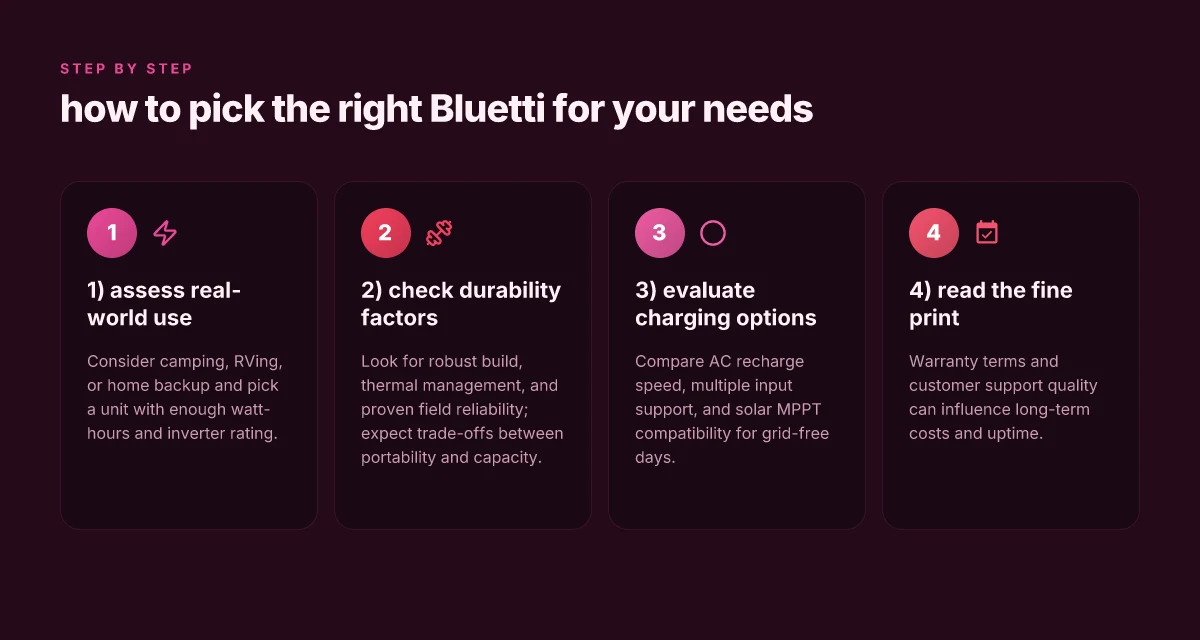
When you size a portable power station, watt-hours and inverter ratings drive what you can run at once. A larger battery stores more energy, but the inverter decides how many devices can pull current simultaneously without tripping. In practice, think of watt-hours as the fuel tank and the inverter as the engine’s output. If your goal is to power a fridge, a drone charger, and a lit inverter at the same time, you’ll want a higher continuous watt rating paired with ample capacity. Bluetti tends to emphasize higher usable capacity per dollar, while Jackery often leans toward straightforward plug‑and‑play setups. Watt-hours determine run time, but the inverter decides the practical load you can sustain in real use.
Understanding ports for tools, appliances, and charging devices
Port selection matters more than you might expect. If you plan to run a portable heater, a Dewalt drill, or a coffee maker, you’ll need multiple AC outlets with enough continuous wattage headroom. USB-C and USB-A ports matter for charging phones, cameras, and radios without firing up the inverter. Bluetti units frequently provide a wider mix of ports, including multiple USB-C PD outputs, which helps keep microelectronics charged while the main system powers heavier loads. When you balance a toolkit and a dinner setup in an off‑grid campsite or cabin, the right mix of AC, DC, and fast-charging ports becomes as important as total capacity. I cross‑reference spec sheets and user threads to confirm that the advertised ports line up with real-world use. Ports are the quick wins that prevent you from dragging extra adapters into the field.
Use-case scenarios: camping, RVing, home backup
For camping, you typically prioritize portability, quick setup, and adequate watt-hours for a weekend with a fridge and lights. Bluetti’s mid‑range packs often deliver more every‑day watt‑hours per dollar, which helps with extended trips without tossing a lot of weight in the pack. RVers who need to run appliances like a small A/C unit or a hair dryer will want higher peak wattage and robust inverter capability, plus a reliable charging cadence from solar or shore power. Home backup requires steady, long‑duration support. Here, you’ll lean toward larger battery packs and dependable input options that tolerate frequent cycling. When I map real‑world use across camping, RVing, and home backup, the pattern is clear: choose a size that gives you enough headroom for your peak loads, plus enough battery to endure nights or multi‑day outages. Choose the size for your longest expected outage plus your daily peak load.
From the research, Bluetti consistently positions itself on value across capacities, while Jackery’s lineup aims for ease of use and predictable performance. EcoFlow’s strengths often show in rapid recharging and a broad port array, but the long-term durability story depends on how you use and maintain the unit. Real-world durability hinges on fostering simple, repeatable setups and avoiding frequent deep discharges. I’ve looked at release notes and user discussions to map the common failure modes, poor fan cooling on long draws, flaky port connections, and battery aging that reduces usable capacity over time. If you value a calmer, plug‑and‑play workflow, Jackery remains appealing. If you want the highest return on watt-hour per dollar, Bluetti is worth scrutinizing as your main pick. Durability is as much about usage patterns as build quality. What a 10 kWh upgrade means for the Jackery Explorer 5000 Plus
Notes on sizing decisions:
- If your target load is under 1000 W with a few hours of peak spikes, a 1,500–2,000 Wh pack with a 1,500 W inverter often fits most scenarios.
- For multi-day off‑grid ambition with refrigeration and essential power needs, look at 2,000–4,000 Wh with higher peak watts and well‑ventilated enclosures.
As you compare models, check the stated continuous wattage vs. peak wattage, then map that against your planed loads. The right size isn’t just more energy. It’s enough headroom for your devices, plus a manageable charging cadence. And yes, links on this page may earn a commission. For readers weighing Bluetti against rivals, expect Bluetti to push larger capacities per dollar, with a broader port mix, while Jackery emphasizes straightforward setup and consistent day-to-day reliability. Pick a size that matches your longest expected outage and your daily peak load.
The practical move for 2026: pick the setup that scales with your use
As Bluetti and Jackery mature in 2026, the smarter choice hinges on how you actually use power storage day to day. Bluetti often offers higher-capacity packs and broader modular options, which shines if you anticipate long weekends off-grid or frequent outdoor work. Jackery remains appealing for simpler, plug-and-play setups that want a straightforward, reliable pack with predictable performance. The upside is clear: you can tailor a system to your real rhythms rather than chase the latest spec sheet.
In real-world use, the bigger pattern is multiplexing flexibility, Bluetti tends to lean on modular growth, while Jackery leans toward turnkey simplicity. If you expect upgrades or irregular loads, Bluetti can save you future headaches. If you want fewer moving parts, Jackery is less fiddly. Either way, plan for long-term durability by choosing solid build quality and a thoughtful charging routine.
The single move that matters now is to map your typical daily cycle first, then choose a platform that scales. For example, if you want a portable setup for worksites, Bluetti’s expandable options help. For a quick home backup, Jackery’s compact, reliable kits may win. Links on the page may earn a commission. What makes the Jackery 1000 v2 worth a closer look in 2026
Backup strategy
- Start with a mid-size Bluetti or Jackery kit that covers your 2–3 day peak load.
- Add a second, smaller unit for daily cycling and charging off-grid solar when possible.
- Label one unit as the primary for high-use weeks and the other as a contingency.