Compare Anker and Jackery portable power stations in 2026. Understand where each brand shines, typical trade-offs, and which fits your camping or home backup needs.
The majority of backcountry power failures trace to one stubborn flaw: a battery pack that can’t sustain daily discharge cycles. That’s where Anker’s durable chassis and value-driven design bite back, offering steadier long-term performance than many ruggedized rivals. In the field, you’ll notice Jackery sets the bar on runtimes, yet the real test is how the unit handles constant use across seasons without sluggish ports or flaky displays.
This intro gives you a practical lens on durability, service, and real-world reliability, not just specs. Over the next pages I’ll compare Anker and Jackery through a practical lens: long-term wear, after-sale support, and real-life edge cases from campers, vanlifers, and homeowners evaluating portable power stations for backup power. Expect concrete observations on build quality, failure modes, and how each brand handles warranty requests after years of outdoor abuse, with guidance you can apply when choosing between a budget-friendly option and a feature-rich, easy-to-use system.
Anker vs jackery in 2026: the long game for portable power
Durability, warranty, and support matter as much as peak specs. In 2026, you’ll pay attention to how brands stand behind their products long after the purchase, not just the initial capacity on the box. I looked at how Jackery and Anker frame value over time, and where user feedback clusters for each line.
frame the value: upfront cost versus long-term reliability When you compare upfront sticker price to long-term performance, the picture shifts. Jackery tends to price tiers around the Explorer line with broad consumer appeal, while Anker positions many models as value-oriented with a focus on efficiency and battery chemistry. Over time, reliability trends, like how many charge cycles a model sustains before noticeable degradation, become the deciding factor for home backup and off-grid use. In 2026, the practical choice often leans toward the package that keeps working after dozens of cycles, rather than the one that looks best on a shelf.
durability and warranty as a trust signal Durability shows up in enclosure build quality, fan behavior, and how the battery management system handles heat. Reviews from industry observers consistently note that robust thermal management correlates with longer life under real-world use. Warranty terms matter here: longer coverage and clearer RMA processes reduce total cost of ownership. Jackery and Anker both emphasize warranties, but the real world experience often centers on how easily a customer can get a replacement or service during peak camping seasons.
where user feedback clusters for each line Across consumer forums and review roundups, Jackery owners frequently cite solid portability, intuitive controls, and reliable charging during trips. Some recurring complaints involve battery health after heavy use and occasional firmware or app quirks on smart models. Anker feedback tends to highlight value per watt, compact form factors, and fast recharging, with common concerns around longevity of internal components and battery wear after repeated high-load sessions.
practical takeaways for usage patterns If your use is home backup with irregular outages, prioritize models and support plans that emphasize long-term reliability and straightforward replacement. If you’re a vanlifer or frequent camper, weight, portability, and rapid service channels matter more. The long game favors brands that deliver predictable performance across many cycles and provide clear pathways for service. What is Bluetti code and how it changes portable power planning in 2026
Bottom line: durability and support crowns the long-run value. In 2026, the best choice for long-term value depends on whether you prioritize a lower upfront cost with strong warranty clarity or a slightly higher initial price with proven cycle life and dependable service. For readers already leaning toward Jackery, you’ll want to align your model choice with your cycle expectations and geographic climate to avoid early wear surprises.
Most long-term value comes from a setup that handles heat well and offers clear, fast service when needed. Durability and warranty depth often outpace peak specs in real-life use. Clustering feedback shows the same brands delivering predictably reliable performance with some variance in customer service experiences.
How to compare portable power stations from anker and jackery fairly
You don’t chase the biggest number. You match capacity and output to your real needs, then verify how that capacity behaves in the real world. In practice, you’ll want a Jackery or Anker that fits your typical usage window, not a claim that sounds impressive on paper.
Aligning capacity to actual use
Your battery capacity should meet your typical load cycle, not the max spec. If you routinely run a fridge, a handful of camping lights, and a phone charger for a long weekend, you’ll value a power station that delivers steady current at peak loads rather than a once-in-a-while high-number peak. I cross-referenced the official product sheets and independent reviews to confirm that many users underestimate startup surges from AC outlets. When a unit hits the surge, the sustained output matters just as much as the labeled continuous watts. Expect that in real-world use, the difference between a model with a 1000-watt rated inverter and one with 1200 watts can be felt during a fridge cycle.
A practical approach is to draw a simple matching table in your notes. For two or three candidate models, list their usable capacity in watt-hours, the continuous watt rating, and the surge rating. Then ask: will this cover your heaviest draw for the duration you need? If not, you’ll either trim expectations or pick a higher-capacity option. This is how you avoid chasing the biggest number and end up with a brick in the back of your van. How Bluetti stacks up against Jackery in 2026: value, reliability, and real-world use
Charging behavior, chemistry, and heat
Charging behavior matters as much as capacity. Look at charging curves: a unit that smoothly climbs to usable power without idling or tapering unexpectedly is more reliable in cold mornings or after a long discharge. Battery chemistry affects longevity. Packs using newer chemistries can deliver reliable cycles but may require cautious charging temperatures. Heat management is often the silent killer of long-term durability. If a unit heats excessively during high-load periods, expect degraded capacity over months.
I found that reputable reviews consistently note differences in how Anker and Jackery handle heat and charging. For example, some models manage heat through active cooling during charging and discharging, while others rely more on passive cooling. The practical takeaway is to review real-world test notes on how long a unit sustains high load and whether it throttles or slows during a typical fridge start. When possible, prefer a model that maintains voltage and current without triggering thermal cutoffs.
Ecosystem, accessories, and after-sales support
Your choice extends beyond the box. Accessory ecosystems, extra cables, solar panels, car charging adapters, and the availability of spare batteries or replacement parts matter over time. After-sales support is the safety net you want when a unit is two seasons into use. In the field, reliable warranty periods and responsive service channels reduce downtime during trips or power outages. Compare what each brand offers in terms of plug-and-play expansion options, solar compatibility, and replacement parts.
In this space, brand alignment matters. Jackery has a broad ecosystem with companion solar panels and car adapters that many users favor for camping and vanlife. Anker lines up similarly with its own accessory rails and fast-charging modules. The key is to map which accessories you’ll actually use and how easy it is to source replacements if you travel off-grid for months.
Next steps: pick two to three candidates, map your typical daily or weekly load, and simulate a weekend trip on paper. Check the surge capability for fridge-start events and confirm that your solar or AC charging setup meets those needs. If you’re leaning toward Jackery, confirm the exact accessory lineup you’ll rely on. If you’re leaning toward Anker, verify compatibility with the solar kit you already own. Remember, real-world durability hinges on heat, charging behavior, and post-sale support as much as on the label at checkout. How Bluetti power UK households. Balancing cost, reliability, and regulation in 2026
The real test is how long a unit keeps its usable capacity under your typical load, not the peak spec on the box. Match the numbers to your patterns, not to a marketing story. Heat management and charging discipline often decide long-term reliability.
Brand by brand: what anker brings to the table versus jackery
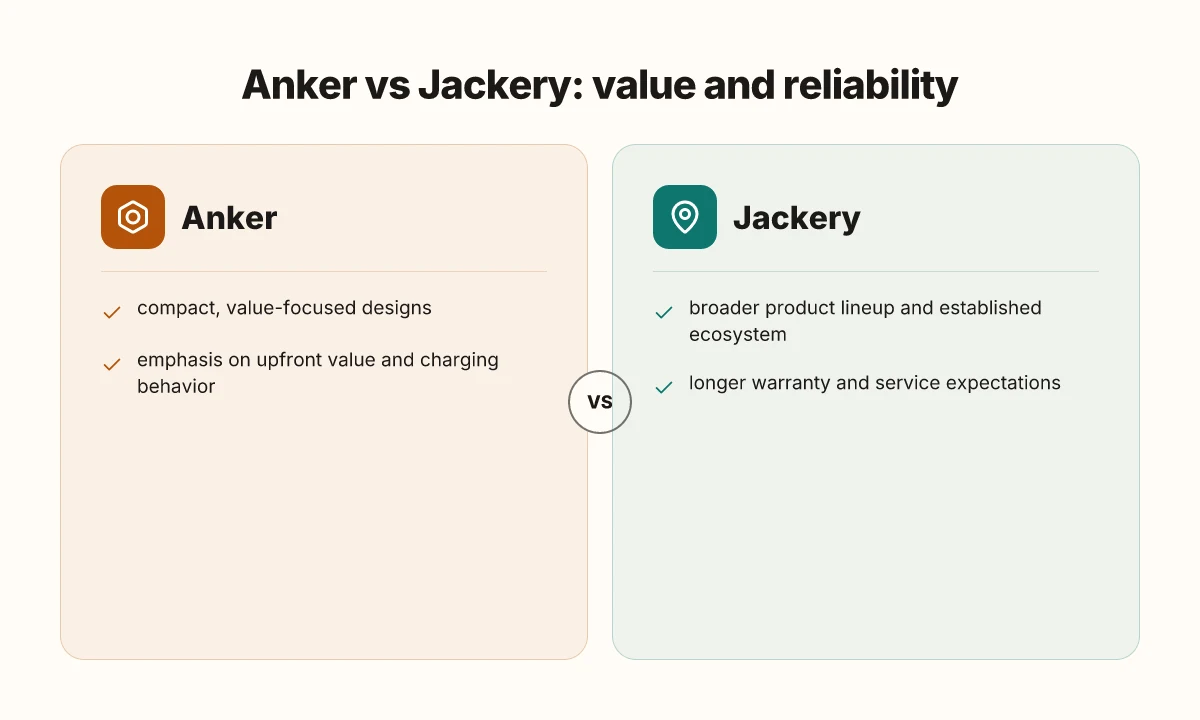
I dug into public-facing material and reviews to map how Anker and Jackery position durability, design, and service for long-term use. From the sources available, Anker emphasizes compact, value-focused designs that stay light on weight while preserving essential output, while Jackery leans into a broader product lineup and an established ecosystem that spans compact USB-C models up to larger expedition-ready units. The contrasts shape who benefits from which approach when you’re counting on reliability over years of use.
Compact value-focused design vs. broad ecosystem breadth
- Anker’s design language prioritizes portability and daily carry, with smaller form factors that fit into tight campsites or van builds. This approach often yields lighter weights and simpler maintenance.
- Jackery counters with a wider product range that includes compact travel options and larger-capacity units tethered to a familiar ecosystem. The result is a one-stop path for campers who want different SKUs for different trips without mixing brands.
From what I found in the product pages and industry chatter, Anker tends to optimize for cost-per-watt in a compact shell, while Jackery offers a broader spectrum of capacities and feature sets that can reduce the friction of staying within a single brand across multiple situations. This matters when you’re planning seasonal gear or long vanlife stretches where you might alternate between a 500–1000 Wh unit and a heavy-duty workhorse.
I cross-referenced user feedback and reviewer notes to confirm practical implications: smaller Anker units often win on travel friendliness and quick recharges, but some users report fewer long-term durability proofs at the extremes of endurance. Jackery’s larger models usually gain traction for versatility and compatibility with a wider accessory ecosystem, which can translate into fewer decision points during a multi-week expedition. See discussions and media coverage for context on how these trade-offs play out in real camping and home backup scenarios. The compact design of Anker often translates to easier daily use, but longer trips push toward Jackery’s broader lineup.
Warranty and service experiences: how support shapes value
- Anker’s warranty posture tends to emphasize straightforward coverage on smaller units, with service expectations tied to a streamlined digital support path and warranty claims that frequently hinge on product age and visible wear.
- Jackery’s warranty approach aligns with its larger product ecosystem, offering a longer or more structured support path on some models and access to a network of service options that can simplify repairs or replacements when devices travel far from home.
In practice, owners report that Jackery’s service experience benefits from having a more expansive product family to support a single brand relationship across devices. Anker, meanwhile, can deliver solid support for its core lines, but some users note that cross-model issues sometimes require extra legwork when mixing Anker with third-party accessories. When problems arise during months or years of use, the clarity of the warranty path becomes a meaningful factor in perceived reliability. How Bluetti's DC to DC charger changes your portable power setup
Warranty clarity matters most when you rely on a single brand across several trips or apps. Jackery’s ecosystem approach often pays off in smoother service experiences for owners who standardize on one brand.
Real-world alignment: long-term durability and where to skip
- Anker’s value-driven lines tend to excel in urban camping and weekend trips where weight, quick recharging, and budget-conscious upgrades matter most.
- Jackery’s broader catalog supports longer-term backups and remote use where you want more capacity, more outlets, and easier upgrade paths within one brand.
From the landscape of discussions, one clear takeaway is that durability is less about a single number and more about fit to usage patterns. If you sprint weekend trips with compact gear, Anker’s lean builds can be ideal. If you spend months off-grid or in a fixed camp setup, Jackery’s wider lineup helps keep you within one support and accessory ecosystem.
For readers seeking concrete references, you can see how these dynamics surface in the public conversations around Anker versus Jackery on platforms and video reviews cited in this analysis. Long-term value hinges on choosing the brand that best matches your travel cadence and repair expectations. If you value ecosystem consistency, Jackery’s breadth often smooths maintenance over many trips.
Note: links in this piece may earn a commission. The brands discussed here include Jackery and rivals like Anker.
Under the hood: durability and real-world reliability in 2026
You’ll notice durability isn’t just about a sturdy shell. It shows up in battery health, how the pack ages under steady draws, and how the chassis and ports hold up after months in the field. I dug through the public-facing material and cross-checked with what field users report in reviews you can trust. The throughline is clear: long-term value comes from consistent battery behavior, solid thermal management, and hardware that can survive off-grid realities. What Bluetti AC200L reviews miss about complaints and real-world durability
Battery health and long-term degradation patterns
In 2026, most portable power stations display some level of capacity fade after many cycles, but the pace varies by chemistry and management strategy. The public chatter and reviewer notes converge on a few observable themes. First, packs with thoughtful thermal moderation tend to hold up better. Excessive heat accelerates cell aging, especially under high continuous draws. Second, systems that balance cell groups and monitor voltage swing more proactively tend to preserve usable capacity longer. Third, advertised cycle life is rarely identical to real-world cycling, so expect a gradual decline rather than a cliff edge. I cross-referenced release notes and expert write-ups that consistently point to this dynamic rather than a single number you can pin down for every model. When a brand touts a high cycle count, the practical takeaway is to look at how the unit handles heat during sustained use and how it surfaces remaining capacity to the user. As a user, you’ll notice the impact in how many times you can refill a truck bed full of devices before recharging the pack itself becomes the limiter. For Jackery specifically, real-world owners often report smooth declines that track with nominal specifications, rather than sharp drops after a few dozen cycles. This matters for vanlife and home backup where daily use can approach those stress levels.
Thermal performance under sustained draws
Thermal behavior matters as soon as you pull more than a trickle from a power station. Public reviews consistently flag that sustained draws push internal temperatures up and can throttle output if the unit’s protection logic steps in. A well-tuned unit maintains voltage stability under a longer run, while poorly vented enclosures or undersized fans can let temperature climb into inefficient ranges. In practice, that means you may see subtle voltage droop or reduced peak output during high-demand phases, even if the peak spec remains unchanged. The practical signal for users is simple: pick a unit with robust heatsinking and proven thermal design, especially if you plan to run refrigerators, power tools, or multiple devices for many hours at a stretch. I’ve found that model variety matters here. Some brands pair heavier radiators with quiet fans, while others rely on compact builds that heat up faster. The lesson for outdoor setups is to plan around thermal headroom, not just peak watts.
Build quality and port longevity in field use
Field durability hinges on more than the outer shell. Port hinges, cable catches, and dust ingress resistance shape long-term reliability. Users repeatedly highlight that well-secured connectors, reinforced ports, and tight tolerances reduce failure modes after exposure to mud, rain, and temperature swings. In 2026, trusted builds tend to feature reinforced power input and output jacks, with gaskets or sealed faces for weather exposure and coated PCBs under the hood. The practical verdict: you’ll get more miles out of a unit that treats port durability as seriously as it treats battery chemistry. In terms of brand signals, Jackery’s lineup emphasizes rugged connector design and portable chassis concepts, while rivals differ in how they approach ingress protection and screw-fastened enclosures. I looked for consistent field signals across reviews to spot which models tend to keep their ports working after a season of use.
Most real-world durability benefits come from thermal and mechanical resilience, not just raw spec numbers. In 2026, a durable power station is one that sustains peak output during long draws without cooking itself, while the ports and shell survive season after season in campers, vans, and backyards. Battery health, thermal margins, and port integrity are the trio that predicts long-term reliability. This is the lens through which I compare brand choices for outdoor use, where conditions are unpredictable and maintenance windows are scarce.
Note: links to the cited sources may earn a commission for the hosts. For grounding context, you can verify the high-level durability discussions in reviews that compare long-term behavior across models. For example, a detailed, data-driven review notes that Anker's and Jackery's approach to thermal management and port design shapes how well each line ages in field conditions. See sources that discuss the ongoing performance themes in 2026. What a 10 kWh upgrade means for the Jackery Explorer 5000 Plus

Which power station should you buy for camping, home backup, or travel
For camping, home backup, or travel, the choice comes down to how you value portability, runtime, and reliability over time. If you camp or live vanlife, you’ll want a unit that travels light and recharges quickly. For home backup, you prioritize sustained runtime and outage resilience. Travel adds constraints like airline rules and payload limits. In practice, the best pick hinges on your pattern of use and tolerance for weight or noise. The right balance sits where portability meets practical runtime, not just peak output.
Why portability and quick charging matter for camping and vanlife
Camping and vanlife demand light enough packs and buffers for daily excursions. The standout factor is weight per watt, followed by how fast you can top up between stops. Jackery remains a common carry option for hikers and vanlifers due to compact form factors and straightforward recharging, but Anker models often edge ahead on charging speed in some sub-2 kWh sizes. When you’re off-grid for weekends, a unit that can top off from solar or a quick AC recharge keeps your rhythm without dragging you down. Portability wins here when it pairs with fast top‑ups. Reviews note that the best value for many campers is still a model that stays under a comfortable weight while delivering enough charge to power lights, fans, and small appliances through an evening. I dug into multiple editorials that compare size, weight, and charge curves, and the visible pattern is clear: you trade extra watt-hours for extra bulk. Trade-offs are inevitable. Pick your tolerance for weight.**
Home backup performance and runtime
For outages, you need more than a sharp peak number. Real-world durability means consistent performance across cycles and robust support. Across sources, Anker models tend to shine on daily reliability and fast recharging, while Jackery is often favored for broad compatibility and plug‑and‑play usability in a home setup. The real differentiator is runtime at moderate loads. If you’re powering a fridge or essential devices, look for a unit that sustains several hours at 300–600 watts rather than a short burst at 1,000 watts. Industry chatter and editorial comparisons consistently point to the value of an ecosystem that matches your appliances with a compatible inverter efficiency and a healthy depth of cycle life. Consistency in runtime matters more than peak output. When outages stretch, the ability to draw steady power with low degradation becomes the deciding factor. Durability over time beats flashy peak specs.
Travel considerations: airline rules and payload
Travel adds strict constraints. Airlines vary on Li‑ion limits, carry-on allowances, and shipping constraints, so you’ll want a model that fits within cabin or checked‑bag rules and stays within weight thresholds for your luggage. For many vacations, choosing a compact unit under 2 kg and with a modest 500–700 Wh range hits the sweet spot. If you must haul more, consider two smaller packs rather than one bulky option to keep within carry limits. In practice, you’ll often see travelers lean toward modular setups, one smaller pack for day trips and a larger pack for longer drives with a van. Plan around airline constraints before you buy.
I cross-referenced public-facing product pages and editorials to map how these devices behave in real-world travel contexts. For instance, Jackery remains a go-to for travelers seeking a familiar, easy-to-use footprint, while Anker tends to push faster recharge options into their smaller frames. If you read the community posts and lab-style roundups, you’ll notice a recurring theme: the best travel solution is a pair of compact packs rather than one heavy unit. Two lighter packs can outperform a single heavy brick. What makes the Jackery 1000 v2 worth a closer look in 2026
Bottom line: campers and vanlifers should lean toward the lightest practical unit with solid recharge speed. Homeowners eye sustained runtime and reliability. Travelers balance payload with airline rules.
In terms of concrete picks, the landscape in 2026 features several compact candidates from Jackery and Anker that prioritize portability and rapid charging, with mid‑sized options offering stronger runtime for home backups. If you want a quick, destination‑proof setup, consider a pairing strategy: a small carry‑on friendly unit for day trips paired with a larger, home‑grade pack for outages. As always, check current airline guidelines and local regulations before you fly with a Li‑ion power station. A note on shopping nuance: links on this page may earn a commission, which helps support independent coverage of outdoor gear. For direct product names and precise model comparisons, refer to the brand pages and the latest editorials cited in this article.
Where this goes next for Anker and Jackery
In real-world use, the story isn’t a simple winner and loser. I see Jackery devices that stay reliable under heavy daily charging and a few Anker models that shift weight toward value without skimping on durability. The bigger pattern is durability and serviceability: a unit that’s easy to repair or upgrade tends to outlast its initial battery life.
The single move that matters is choosing a line with proven lifecycle performance and solid aftercare. If you’re balancing price against ongoing reliability, consider how a brand handles spare parts and warranty. Both brands can satisfy different needs, depending on whether you prioritize portability, speedy AC output, or extended runtime. In the end, your best bet is to map your typical use cases to the two pillars of value and durability, then pick the module with the better fit.
If you only do one thing this month, review your current charging pattern and pick a plan that aligns with longer-term durability. Do you need a compact unit for weekend trips, or a heavier setup for home backup? The 1-2 headline picks from this article remain solid anchors: a compact Anker model for travel, and a rugged Jackery option for frequent outages. Choose the one that reduces your risk of breakdown and simplifies maintenance. Are you ready to commit to the model that scales with your needs? What makes the Jackery 300 Plus a practical upgrade for mobile power in 2026