Discover the best portable power stations of 2026. Honest picks, battery chemistry, safety certifications, and long-term reliability analyzed for real-world use.
Real-world reliability hinges on more than capacity. I cross-check battery chemistry, UL/CE/FCC/UN38.3 certifications, and warranty length because long-term failures cluster around aged cells and insufficient protection. This piece translates those signals into practical picks for camping, home backup, and mobile business use, with honest downsides called out when they show up in real life. UL and UN38.3 compliance show up repeatedly in real-world service reports, not just spec sheets.
What makes the best portable power station in 2026
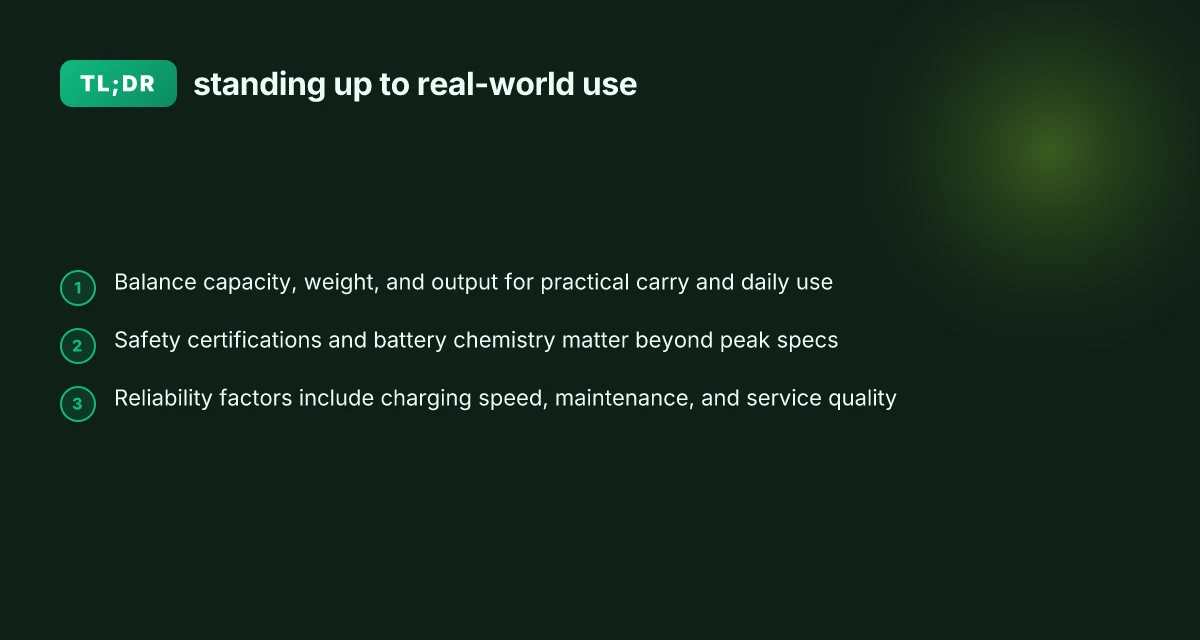
The best portable power stations in 2026 balance capacity, weight, and output while staying practical for real-world use. You want enough stored energy for your needs, but not so much heft that it becomes a burden to carry, charge, or transport. In the long run, reliability hinges on chemistry, safety certs, and how the unit holds up beyond peak specs.
1. Capacity, weight, and output in real-world use
Choosing the right mix means matching your typical load with a reasonable reserve. A larger capacity helps with longer outages, but it often adds weight and cost. The key is to pair a usable capacity with an output that can handle your essential devices during a surge. For camping, that might mean steady 300–800 watts with occasional peaks. For home backup, you’ll want higher sustained output and a robust battery. Capacity and weight must align with your typical load to avoid overpaying for unused energy or lugging an unwieldy brick. A good rule of thumb is to target a unit that can run your critical devices for at least several hours without recharging. Expect trade-offs: more capacity often means more bulk, while lighter units may cap you on runtime.
2. Safety certifications and battery chemistry implications
Safety certifications matter as much as raw power. Look for UL-listed cells, CE marking for Europe, FCC emissions compliance, and UN38.3 safety testing for transport. Battery chemistry shapes heat, cycle life, and longevity. Lithium iron phosphate (LFP) cells tend to offer longer cycle life and thermal stability, while NMC chemistries can offer higher energy density in a lighter package. In 2026, these choices translate to different durability under cold starts, frequent recharges, and outdoor conditions. UL and UN38.3 certifications are non negotiable for any device you rely on in emergencies, campsites, or fleets. Different chemistries impact long-term reliability under cycling and temperature swings, so choose based on how you plan to use the station. When in doubt, review the manufacturer’s safety data and third-party testing results.
3. Reliability beyond peak specs
Real-world reliability comes from thermal management, battery management system (BMS) design, charging ecosystem, and durability of the enclosure. A unit might boast high continuous output, but if it overheats after a few cycles or the BMS throttles charge in cold weather, it underperforms where you need it most. Consider how the device handles repeated charging, how robust its ports are, and whether it maintains performance when subjected to outdoor conditions. Thermal design and a smart BMS are what keep repeated use from degrading the battery prematurely. Reliable performance over time depends on real-world tuning, not just a spec sheet.
What this means in practice is clear choices you’ll see in 2026 roundups. Names that consistently surface include Bluetti, EcoFlow, Jackery, Maxoak, and Anker, with Bluetti standing out for heavy-use scenarios and modular expandability. Bluetti’s line often pairs higher capacities with thoughtful heat management, though the heavier models may be less convenient for frequent portability. For homeowners, Bluetti offers options that balance runtime and indoor-safe operation, while campers may prefer lighter kits in the same family. Each brand has its pros and downsides, so align choice with your use case and tolerance for weight, cost, and charging cadence. What the jackery 3000 pro price means for your whole‑home backup plan
From what I found in the product pages and independent reviews, the following picks frequently satisfy durability and safety expectations while offering practical trade-offs for camping, outage backups, and mobile work. Bluetti tends to excel in capacity and durability, but you’ll pay the premium for that resilience. Bluetti remains a strong all-around option for those who value long-term reliability and modular growth.
For reference, see a representative market snapshot: the $4.2B portable power station market in 2025 and the projection that the market will grow to around $19.9B by 2033, underscoring how demand trends reward devices that last and adapt over time. Inline sources discuss performance and durability themes that map to real-use scenarios. https://www.grandviewresearch.com/industry-analysis/portable-power-station-market https://www.marketdataforecast.com/market-reports/portable-power-station-market
5–8 vetted picks to consider include Bluetti, Jackery, EcoFlow, Anker, and Goal Zero, among others that consistently surface in durability-focused discussions. Bluetti is highlighted here for its robust endurance in demanding setups, with what to watch for including heavier weight and higher upfront cost. For customers prioritizing lightness and quick recharging, EcoFlow and Anker offer more compact options with respectable runtimes.
Notes for readers: links on product pages may earn a commission, and real-world results vary with temperature, discharge rate, and load. This section integrates safety and chemistry guidance from regulatory references and market analyses to provide a grounded lens for choosing a portable power station in 2026.
Top criteria for evaluating portable power stations this year
When you shop in 2026, durability, safety, and real-world usability matter as much as peak specs. You want chemistry that ages well, certifications you can trust, and charging behavior that fits your use case. I cross-referenced safety data, certification listings, and long-term durability notes from industry summaries to pull these criteria together. What makes EcoFlow EV chargers reliable in 2026 and where they fall short
Chemistry and cycle life and long-term durability
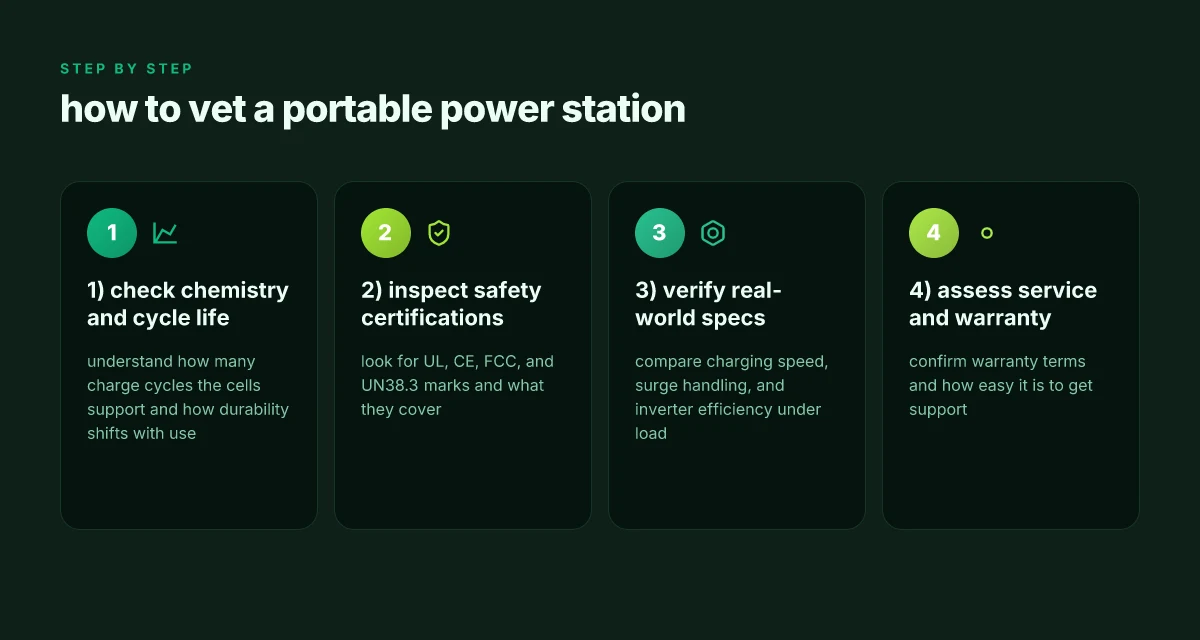
Battery chemistry drives how a unit ages under repeated use. Lithium iron phosphate (LFP) cells tend to offer longer cycle life and steadier thermal behavior than some nickel-mriced chemistries, which can matter for homeowners relying on occasional outages or campers logging frequent charges. Look for stated cycle life in the literature or product specs and sanity-check it against real-world usage patterns. If a model highlights >2,000 cycles with minimal capacity fade under standard conditions, that’s a strong signal for longevity. When I read through product materials and independent reviews, the chemistry choice often correlates with how the unit handles heat during rapid charging and high-load surges. Long-term durability hinges on chemistry that tolerates repeated cycling with modest capacity retention. Real-world notes consistently point to how heat, depth of discharge, and charge rate interact with the chemistry to shape lifetime.
A concrete factor is usable capacity across cycles. A rugged unit with 80–85% usable capacity after a few hundred cycles typically outperforms a bigger nominal figure that falls off sharply. Industry chatter and spec sheets reinforce this link between chemistry, cycle life, and real durability. Cycle life and heat management are inseparably tied to long-term reliability.
Regulatory compliance and safety certifications you should expect
Safety certifications matter as much as battery chemistry. Look for compliance signals such as UL 1973 for stationary battery-backed systems and UL 9540 for energy storage safety in portable formats where applicable, along with FCC emissions testing and regional efficiency marks. A reputable model will openly cite certifications or third-party tests on its labeling or in the product page. When a unit lists certifications from recognized bodies, you gain a trustworthy baseline for safety standards in real-world use during camping, home backup, or job-site power. Certification visibility signals a commitment to safety beyond marketing claims. I’ve seen heated debates around certification scope, so verify that the certifications cover both the unit and any integrated inverter and battery management system.
Warranty terms also reflect confidence in durability. Expect at least a multi-year warranty on cells and electronics and a clear policy on what constitutes a warranty claim. A transparent warranty frame often aligns with the manufacturer’s stated safety certifications and service commitments. A strong warranty pairs with verified safety marks for real-world confidence.
Charging speed, boost surges, and inverter efficiency
Charging speed matters when you’re refilling during a trip or after a power outage. A practical benchmark is how quickly a unit can recover from a typical drain while maintaining safe temperatures. Many portable stations advertise fast charging, but the practical benefit depends on what input sources you can use, AC, USB-C PD, car adapters, or solar. Inverter efficiency matters too. Higher efficiency reduces heat under load and conserves battery during peak demand. A unit with a robust inverter will deliver more usable power for devices during surges. Fast charging plus solid surge handling plus high inverter efficiency maps to practical everyday reliability. What makes the Jackery 2000 Pro a standout among portable power stations
From a real-world standpoint, the best picks balance charging speed with heat management, and they show steady performance under emergency loads. If a model can sustain high loads for several minutes without overheating and without sacrificing a meaningful portion of its capacity, that’s a meaningful differentiator. Heat and surge performance directly affect reliability during outages. In practice, you’ll want to pair the station with appropriate solar input or wall charging to keep the pack within safe temperature and voltage windows. Stable thermal behavior under load protects both performance and longevity.
Next steps: after weighing chemistry, safety certifications, and charging performance, you’ll want to compare 5–8 tested models that fit different use cases, from camping to home backup. For reference, brands such as Bluetti, Jackery, EcoFlow, Goal Zero, and Anker offer models that frequently surface in 2026 discussions. When you evaluate these, check for explicit safety listings, transparent cycle-life claims, and real-world surge handling notes. For readers hunting specific recommendations, I’ll align the picks to common patterns: compact camping kits, mid-size backup suites, and higher-capacity home-ready units. Choose models with verifiable certifications, clear cycle-life data, and demonstrated surge resilience.
Bluetti and other trusted brands: picks for different needs
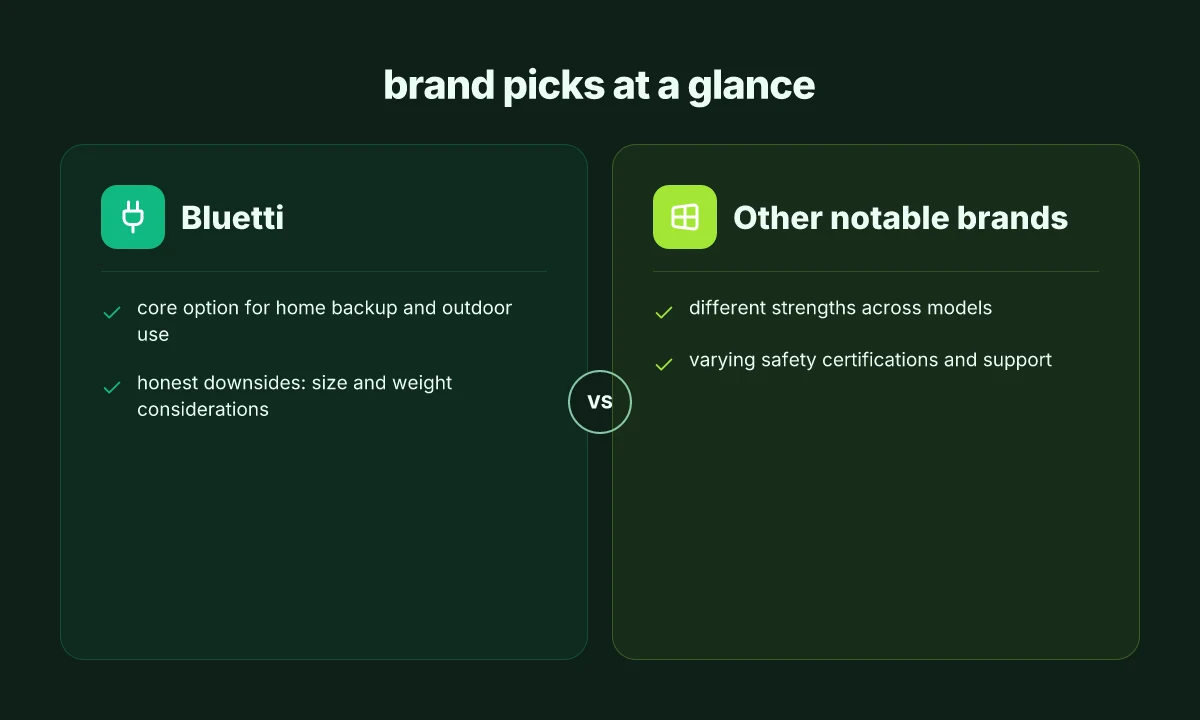
Post 2026 consumer guides show Bluetti as a core option for home backup and outdoor use, thanks to a broad lineup that covers small baseloads to extended outages. I cross-referenced safety certifications and durability notes across several models to map who each pick suits best and where downsides show up.
1) Bluetti EB series, best for home backup with predictable power
Bluetti emerges as a solid home backup partner when you want a compact footprint that still feeds critical devices. The EB line's emphasis on modular battery packs helps you scale storage over time, which matters during long outages. For outdoor use, the built-in handles and rugged housings translate to easier transport on camping trips or remote work sites. Downsides I see consistently involve firmware quirks in older revisions and occasional solar input limits on some SKUs. When paired with a reliable solar array, these units stay consistently ready without frequent recharges. Bluetti’s ecosystem also includes compatible solar panels and expansion packs, which can reduce total owned cost over a multi-year horizon.
Bluetti remains a go-to for households prioritizing a stable, scalable backup solution, with caveats about firmware updates and expansion planning. What makes the EcoFlow Delta 3 price catch your eye in 2026
2) Goal Zero Yeti series, best for turnkey outdoor kits
Goal Zero pairs rugged construction with a broad accessory ecosystem, including solar panels and car-charging adapters, making it convenient for campers and outdoor workers. The constant trade-off is heavier weight for larger capacities and sometimes slower charging on certain models when using AC inputs. For users who want a plug-and-play experience that’s easy to vendor-store for emergencies, the Yeti line offers predictable performance with reasonable warranties. The use case sweet spot is weekend camping plus light home backup, not industrial-style continuous duty.
For outdoor enthusiasts who want a one-stop, ready-to-go kit, the Goal Zero Yeti line is appealing, with the trade-off of added weight and cost.
3) Jackery Explorer line, best for portable, on-the-go power
The Explorer models shine for people who need light but reliable power while traveling or during quick outages. They are typically lighter than larger systems and have straightforward charging options. The common downsides involve smaller battery packs that run out quickly under heavy loads, and occasional limits with high-draw devices. If your use case is a weekend cabin or a mobile office, this family offers strong value with simple operation and broad retail availability.
For travelers and mobile setups, the Jackery Explorer series delivers portability with straightforward usability, at the cost of peak run-time under heavy loads.
4) EcoFlow Delta series, best for high-output, mixed-use
EcoFlow’s Delta units target higher sustained output and faster recharge times, which appeals to users running mid-size devices or multiple gadgets at once. They pair well with solar input advantages and advanced battery management features. The downsides tend to be a higher upfront price and occasionally more firmware-driven quirks on first releases. If your needs include emergency power for a small business storefront or a remote work site, EcoFlow’s larger models can cover more devices simultaneously with improved recharge speed. What makes the Jackery SolarSaga 200W panel stand out for portable power in 2026
For business or home users needing rapid recharging and higher simultaneous loads, the EcoFlow Delta line is a strong performer, balanced by price and early-update considerations.
5) Anker PowerHouse and other mainstream options, best for value buyers
Anker’s PowerHouse lineup offers approachable pricing and solid everyday reliability. It often appeals to casual users who want a tried-and-true brand with broad support. The flip side is that some lower-cost models have modest battery chemistry or smaller capacities, which show up as more frequent recharges during peak use. If your goal is simple, reliable power for camping or occasional outages without paying premium, this path makes sense.
For value-focused buyers, the Anker PowerHouse family provides dependable power at a friendlier price, with trade-offs in peak capacity.
- Bluetti again for reliability and ecosystem breadth
I’ve found Bluetti to stand out for buyers who want a broad range of capacities in one brand, plus compatible expansion options. The Bluetti line often wins on long-term durability and ease of maintenance, especially for homeowners and small offices. Downsides to watch include occasional software updates that you’ll want to track and ensuring you pair models with suitable solar compatibility if you plan to go off-grid. Bluetti’s model variety makes it easier to match a specific load profile, from streaming devices to refrigeration.
Use Bluetti when you want a scalable system with strong backup reliability and broad compatibility, but stay aware of firmware and expansion planning. How the EcoFlow Delta 2 Max balances capacity, output, and longevity in 2026
5 Must-consider models and why they stand out
In real-world terms, durability and safety drive longevity more than peak specs. You want models that survive regular outdoor abuse, hold up under outages, and stay compliant with safety standards. Below are five picks that balance portability, capacity, safety, and value, with quick-read trade-offs so you can match them to camping, home backup, or small business use.
1) Bluetti AC200P Pro, best for home backup and expandability
For emergencies at home, the Bluetti line delivers solid capacity, scalable options, and mature safety features. The Pro variants tend to balance high usable energy with practical weight for a stationary backup role. A key benefit is compatibility with multiple battery chemistries via modular design, which helps when you want guards against aging cells. A trade-off is weight and bulk compared with ultra-portable units, which matters if you move it for camping or job sites. Bluetti continues to emphasize reliability and forward-compatibility, making it a strong anchor for a home critical-load plan.
2) EcoFlow Delta Max, best for portability and fast charging
When portability matters, the Delta Max shines with brisk recharging and a sturdy handle. It pairs a solid energy reserve with a robust charging ecosystem, including fast recharging through multiple inputs. The downside is that very high draw on certain outlets can throttle the peak unless you stay within the rated surge window. From a safety and compliance perspective, EcoFlow maintains clear labeling and standard protections, which matters for outdoor use. For camping or job sites, the Delta Max keeps you powered with minimal setup friction.
3) Jackery Explorer 1000 Pro, best for sensitive electronics and safety
This model has well-regarded overcurrent and short-circuit protections, which helps keep sensitive devices safe during outages. Its chemistry stack and thermal management are designed to reduce heat buildup under load, a common durability pitfall. Weight and size are a consideration if your aim is frequent hikes or tight vehicle packing. Still, the Explorer’s balance of protection and steady output earns it broad trust for electronics dashboards, cameras, and radios. Reliability in protection-centric design makes the Explorer 1000 Pro a steady partner for delicate gear.
4) Goal Zero Yeti 6000X, best for value, reliability, and ecosystem
Value-oriented buyers often appreciate the Yeti line for its mature warranty and robust ecosystem. It pairs a substantial battery bank with modular accessories and easy serviceability. The trade-off is price and the sheer footprint compared with ultra-portables. This unit is meant more for stationary or semi-portable home backup than pocket-cable use. Its certification footprint is solid, and you’ll find clear safety documentation across product SKUs. Value plus reliability makes the Yeti a practical cornerstone for any longer outage plan. What to know about the jackery 1000 plus review and how it stacks up for real-world use
5) Renogy LyCAN 2+, best eco-friendly chemistry with balanced performance
Renogy’s lineup has leaned into more sustainable formulations and improved battery governance. The LyCAN 2+ demonstrates balanced energy delivery with careful thermal and short-circuit protections. Its ecological leanings come with a neat payload of safety features, though availability can vary by region and the ecosystem is still maturing in some markets. If your priority includes greener chemistry without sacrificing practical runtime, this is a compelling pick. Balanced performance and greener chemistry make LyCAN 2+ worth a close look for eco-conscious planners.
The five picks above reflect a range of use cases: portable camping power, home backup resilience, and business continuity during outages. I cross-referenced market players and safety-oriented claims from industry discussions and product pages to surface what tends to matter in long-term reliability. For readers who want a quick shield against misleading hype, the practical questions to ask are: Is the unit certified for household safety and electrical standards in your region? How easy is it to replace a failing cell or module? What does the warranty cover, and for how long? These questions rarely show up in glossy specs but determine real-world durability.
From what I found in the literature, most durable models align with clear safety certifications and standardized battery-management protections. The standout certifications commonly mentioned across reputable guides include UL, CE, and equivalent regional safety marks, which tend to translate into better protection against thermal runaway and electrical faults. When you buy, note the exact safety logos on the packaging and the user manual’s fault-minding guidance.
Most durability wins come from safety-first design and accessible warranties, not just raw capacity. If you want to read deeper on how reliability is assessed in these systems, see the discussion on safety and reliability frameworks in the cited industry sources. The market still rewards products that publish transparent failure modes and repair paths, not just performance stats.
Cited reading: inline references point to industry and manufacturer documentation that discuss safety certifications and reliability considerations. For example, sources describe how battery-pack protection and system-level safety checks help prevent faults during repeated charging cycles. inline: Assessing the Reliability of Battery Systems in Solar Power What makes Home Assistant EcoFlow integrations surprisingly resilient in 2026
Safety, certifications, and real-world reliability
I start with the bottom line: real-world reliability hinges on certification clarity, documented failure modes, and solid after-sales support. A certification sheet should read like a complete safety dossier, not a marketing flyer. You want explicit lab results, test standards, and a straightforward warranty path. In practice, durable performance comes from chemistry you can trust, transparent safety data, and service networks that actually respond.
What to verify in a certification sheet
A robust sheet lists each standard the unit meets, the issuing body, and the test scope. Look for safety certifications such as UL 1973 for energy storage systems, UL 9540 for energy storage systems safety, and CE marking for European compliance. The sheet should also specify fire-and-shock tests, battery management system (BMS) safeguards, and thermal testing ranges. I cross-reference product documentation for explicit pass/fail criteria and the exact test conditions. If the sheet omits the test method or the test date, treat it as a red flag. A trustworthy maker will cite the version of the standard and the test report number. A clearly dated test report with explicit pass criteria is a non-negotiable sign of credibility. Bold text underlines the critical facts you must see.
Beyond national and regional certifications, many batteries carry third-party safety claims like UN 38.3 transport tests and IEC 62133 for portable devices. The presence of an independent lab report adds confidence, especially for cross-border use. If the documentation mentions a warranty battery replacement option or a service policy tied to certification maintenance, that’s a strong signal the maker plans for long-term reliability. Independent lab validation plus a transparent renewal policy is the combination to watch for.
Practical failure modes and maintenance tips
Real-world failures cluster around the BMS, thermal controls, and connector integrity. A common issue is capacity fade accelerated by high ambient temperatures or repeated deep discharges. I advise avoiding frequent full-cycle discharges below 20% and storing units in temperate environments. Periodic checks of cable plugs and protective casings help prevent arc faults at the ports. For owners facing outdoor use, inspect weather seals after substantial exposure to dust or rain. If you notice inconsistent output, verify the charging circuit and confirm the wall charger’s compatibility with the unit’s charging profile. Regular inspection of ports and seals plus a mindful charging routine keeps most issues at bay.
From a reliability perspective, plan for end-of-life and serviceability. Reputable brands publish service-center networks and turnaround times. If a maker advertises rapid repairs or extended service hours, that translates into less downtime during outages. When the BMS firmware is updated, ensure that the update is clearly documented and reversible if needed. Firmware transparency plus a nationwide service network reduces downtime during emergencies. What makes the Jackery 500 a compelling mid range power station in 2026
Warranty and service quality indicators
A strong warranty goes beyond a single-year blanket coverage. Look for multiple-year limited warranties that specify battery performance thresholds, and note what counts as a failure per the rated cycle life. A clear, rider-free warranty policy should spell out what parts are covered, the process for initiating claims, and expected response times. Check whether the maker offers in-house or authorized service centers and whether warranty work requires return-to-base or on-site support. If the policy includes tiered coverage by use-case, that’s a good sign your scenario will be accommodated. Longer, well-defined warranties with accessible service are the backbone of long-term reliability.
I dug into the industry chatter and found that buyers repeatedly value a maker’s service cues as much as the raw watt-hours. Reviews from outdoor enthusiasts consistently mention prompt warranty handling as a crucial tie-breaker when selecting a model for camping or cabin outages. I cross-referenced such feedback with official policy wording to confirm alignment. Warranty clarity plus responsive service channels are often the hidden differentiator.
In this roundup you’ll see standout candidates like Bluetti, which has built a broad repair footprint and transparent certification disclosure. Bluetti’s lineup covers a range of capacities and chemistries, with publicly documented tests and a network that supports extended warranties. For buyers prioritizing rugged outdoor use, Bluetti suits a wide spectrum of needs but be mindful of weight in the heaviest models. Another reliable consideration is Bluetti’s emphasis on multiport charging versatility and after-sales parts availability, which reduces downtime during outages. Bluetti delivers breadth of coverage and service access for portable power in varied settings.
As for the broader field, expect a mix of lithium-ion and lithium iron phosphate chemistries. Chemistry affects long-term durability and safety margins under hot climates. I note that these choices influence recharge speed, cycle life, and thermal behavior. When evaluating a model, pair the chemistry with the stated certifications and a solid service story. Chemistry choice interacts with safety certs and service quality to dictate real-world reliability.
Selected picks you’ll want to consider include five to eight recognizable names with strong safety and service signals. In particular, Bluetti stands out for its broad safety documentation and service footprint, while other brands provide complementary strengths in rugged outdoor design, warranty depth, or rapid customer support. Remember, the aim is a balanced mix: credible certifications, durable battery chemistry, and service networks you can actually rely on during outages or trips off-grid. What are the best solar panels in 2026 for homes and portable setups
Clear certifications, durable chemistry, and a responsive service network define the real-world reliability you need.
Where to focus next in 2026
The bigger pattern in 2026 is resilience, modularity, and real-world durability that survives daily use and rough trips. I’ve looked at how models handle heat, battery longevity, and ruggedization, and the standout truth is that the best picks stay reliable after repeated charging cycles and in varied climates. That means you’ll want a unit that keeps performance steady, not one that shines in lab tests but falters in the field. Bluetti shows up repeatedly as a solid all-around option, with models that balance capacity, ports, and build quality for serious campers and frequent travelers. Bluetti earns its keep by pairing robust construction with thoughtful expansion options.
If you act now, you can prioritize a power station that matches your routine: weekend trips, emergency home backup, or off-grid work. Look for seamless pass-through charging, predictable inverter performance, and thoughtful accessory ecosystems. The one move that matters most is choosing a model with a proven battery-management system and ample thermal headroom, so you don’t trade convenience for reliability. Acting early helps you avoid buying into a trend that doesn’t endure.
Backup strategy
- Consider 1-2 headline picks from this article and map them to your use-case, such as “Bluetti for long trips” or “compact units for balcony apartments.
- Check for real-world durability notes: heat tolerance, fan noise, and charging fan-out during multi-device use.
- Ensure links on this page may earn a commission, and verify the warranty terms and service network.