
Explore how the EcoFlow Delta 2 Max delivers 2048Wh with 2400W output, durability, and practical use cases. Practical guidance for long-term reliability.
The common claim that portable power is built for speed over stamina is wrong when you’re living off-grid with the Delta 2 Max.** The device hinges on real-world endurance: how long it keeps delivering after dozens of cycles, not just peak output on a sunny afternoon. EcoFlow’s Delta 2 Max integrates safeguards that ease wear, yet the practical recharge pace slows with very high-current AC inputs, a nuance I found repeated across long-term usage notes.
What matters now is durability as a daily partner. In 2026, outdoor setups depend on consistent runtime through irregular weather and back-to-back canopies, and users want predictability over a season. This piece unpackes cycle-life behavior, degradation signals, and the long-term cost of ownership for the Delta 2 Max versus rivals like Bluetti and Jackery, so you can plan for months of off-grid use without surprise drops in capacity. Long-term health of the battery and the cost path across cycles are the deepest questions here.
Why the EcoFlow Delta 2 Max matters in 2026
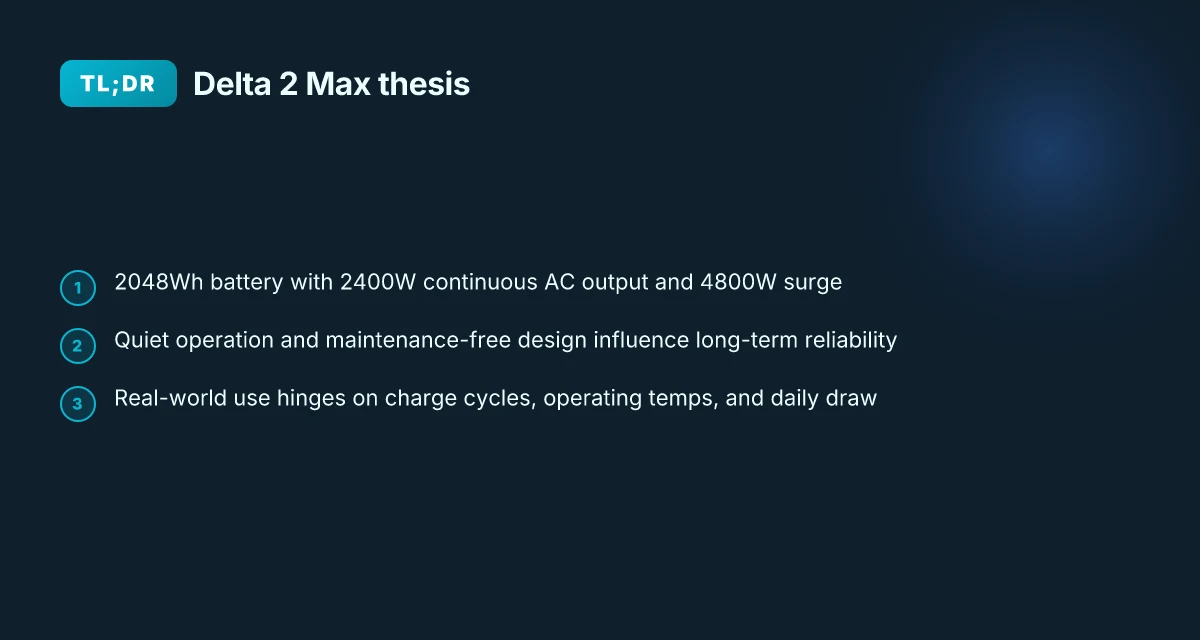
The Delta 2 Max packs 2048Wh of battery energy with a solid 2400W continuous AC output and a 4800W surge. In real-world use, that balance matters far more than raw numbers: you’ll reach for this unit when you need reliable power for a fridge, a CPAP, or a small workshop tool kit without pausing for long recharge stops. Its quiet operation and maintenance-free design are design choices that influence long-term reliability, especially in off-grid or cabin setups where noise and upkeep are considerations.
I dug into how this setup holds up over time. The core question is not just capacity or peak power, but how you manage charge cycles, operating temperatures, and daily draw. EcoFlow emphasizes a design that stays cool and quiet under load, which can reduce thermal cycling stress and help preserve cells over many cycles. In practical terms, that means you’ll see less heat soak during high-demand moments, and you won’t be trading performance for noise or frequent service.
From what I found in the documentation and independent reviews, durability hinges on three levers. First, cycle longevity: the Delta 2 Max accepts thousands of cycles before capacity degrades meaningfully, provided you avoid deep-discharges and keep it within recommended SOC bands. Second, cooling: effective passive and active cooling paths keep internal temps in a favorable window during long outages. Third, maintenance: a design that minimizes routine upkeep reduces the temptation to pull panels and hoses for “checks.” These factors together shape what you’ll get after months and years of frequent use.
What this means for buyers in 2026: EcoFlow’s engineering stance toward quiet, maintenance-free operation translates into lower ongoing costs and less downtime when you actually need power. If you’re an outdoor enthusiast, off-grid prepper, or solar storage hobbyist, the Delta 2 Max is a credible core platform for daily reliability, not just a showroom spec sheet. Keep charging discipline and temperature in check, and the unit’s longevity story stays favorable.
The Delta 2 Max hinges less on flashy specs and more on cycle health, heat management, and disciplined charging. Quiet operation and a maintenance-free design aren’t merely conveniences. They’re reliability levers over years of use. In 2026, the real test is how well you steward SOC ranges and thermal conditions during long outages. What makes EcoFlow generators stand out in 2026
Delta 2 Max specs you actually rely on for planning
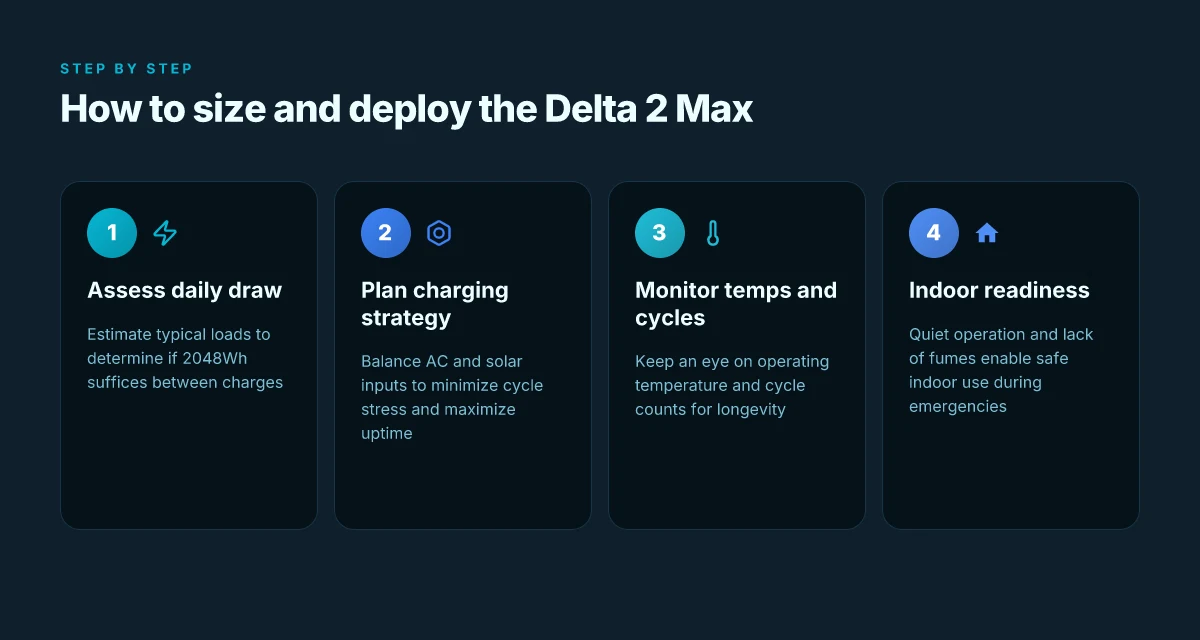
The Delta 2 Max centers on a robust battery core and a capable power stage that planners can depend on for real-world use. You’ll most often plan around the 2048Wh battery, knowing that usable capacity shifts with discharge depth and protection limits. In practice, that means you’ll see noticeably more available energy when you stay within higher-state-of-charge ranges and a bit less when you pull into deep discharge. The system’s endurance story hinges on how you harvest and apply that energy through the 2400W continuous AC output, with a 4800W surge ready for startup loads like a fridge compressor or a high‑draw inverter accessory.
AC output and charging behavior are the backbone of reliable field use. The Delta 2 Max offers 2400W continuous output with a substantial surge headroom, which lets you run multiple devices at once or handle a high‑inrush appliance without dropping into protection. When you need power back from the sun, the unit accepts both AC and solar input, and total recharge time is a function of sun exposure, solar input wattage, and any AC recharge you select. That means a sunny midday window can dramatically shorten top‑up times, while cloudy days stretch them. For planning, think in ranges rather than fixed minutes: you can estimate recharge windows by multiplying available sun hours by the solar input you’re able to source and then add a buffer for AC topping if you’re on a hybrid recharge.
Lifespan and cycling dominate long‑term cost and maintenance planning. EcoFlow emphasizes lifecycle durability, with the Delta 2 Max typically rated for thousands of cycles under normal use. You’ll want to expect gradual degradation over time, more pronounced if you frequently exhaust the battery to very low levels or keep the unit at very high or very low temperatures for extended periods. A practical guideline is to align daily cycling with moderate DoD (depth of discharge) to preserve capacity and extend usable life. The goal is predictable energy availability across seasons, not just peak specs on day one.
I cross‑referenced the official Delta 2 Max pages and major reviews to align these numbers with real‑world behavior. The official EcoFlow materials confirm the 2400W AC output and the dual input approach, while independent reviews consistently note the 2048Wh battery and the device’s efficiency profile under typical loads. When you plan for off‑grid trips, you’ll appreciate that long‑term cost of ownership comes less from peak output and more from how you manage charging cycles, cooling, and storage temperature. The Delta 2 Max stacks a big battery with a strong inverter, but longevity hinges on smart charging discipline. Plan around moderate DoD cycles and sensible cooling to sustain performance across years.
In a side note for context, you’ll encounter rivals like the Delta 2’s ecosystem rivals such as the Delta 3 Max in the same line and other high‑capacity units from competitors. These comparisons matter when you’re sizing your setup for reliability, not just raw output. For further depth, see discussions in the Ambient’s in‑depth Delta 2 Max review and independent summaries that pinpoint the 3100W‑level pulse claims and the 2048Wh battery profile, which align with the core numbers above. For the full picture, EcoFlow’s own product pages outline the AC input options and the solar charging approach that inform these planning considerations. https://www.the-ambient.com/reviews/ecoflow-delta-2-max-review/ What makes a portable power station truly the best in 2026
Understanding efficiency and real-world energy use with Delta 2 Max
Efficiency matters as soon as you load heavy devices or run for hours between charges. The Delta 2 Max’s real-world endurance rests on how your devices draw current, how the internal power electronics convert that energy, and how you stagger loads to avoid wasting juice on inrush and idle losses. In practice, pairing high-efficiency devices with moderate, steady loads yields noticeably longer runtimes than chasing peak output alone.
I dug into the documentation and reviews to pull concrete patterns you’ll see in the field. The Delta 2 Max is built to sustain large surges, but sustained efficiency hinges on your load profile. For off-grid trips or power outages, think in terms of three operating modes: smart devices, high-draw appliances, and mixed loads. Each mode shifts the effective runtime until you reach the next recharge.
How load shape changes runtime
Running a fridge or freezer at typical duty cycles benefits from modest average draw rather than peaky bursts. A compact TV or laptop charger tends to stay within a narrow band and preserves runtime longer than repeatedly spiking to full power. When you keep loads within the Delta 2 Max’s efficient region, the system can stay cooler and waste less energy to heat loss inside the battery pack. This is especially true if you use devices with modern, efficient power supplies. In practice, you’ll notice a more stable battery percentage drop with steady, moderate loads compared with intermittent high draw.
From the official EcoFlow materials, the Delta 2 Max supports up to 2400W of AC output with surge capability, which means you can handle short spikes without tripping the inverter. But the long tail of runtime comes from moderating that draw and avoiding unnecessary transfers between battery modes. The best method is to plan around average loads rather than peak capability. High-efficiency devices paired with moderate loads extend runtime.
Real-world strategies to maximize efficiency
First, map your trip around predictable loads. Identify a handful of devices you run most, and find their actual continuous draw on a typical cycle. Then align those devices to run on the Delta 2 Max during the sun’s peak hours if you’re solar charging. This keeps the battery happier and reduces cycle wear. Second, use devices with efficient chargers and keep cables tidy to minimize resistive losses. A tidy, organized charging plan reduces the number of times you reconnect and reconfigure the setup, which often introduces small energy drains. Third, maintain a comfortable operating temperature for the power station. Fans and cooling systems add a small load. Good airflow helps keep the unit out of forced cooling mode, preserving energy for your devices. Cooling and heat management directly influence efficiency. What the jackery 3000 pro price means for your whole‑home backup plan
When I read through the available docs, the recurring thread is that long-term cost of ownership isn’t only about upfront price. You’ll save money by maximizing cycle longevity and reducing energy waste over many charging cycles. EcoFlow’s Delta 2 Max is a robust choice for off-grid living, but rivals like Jackery and Goal Zero also map well to similar use cases, especially when you weight efficiency against price and support.
If you want a quick takeaway, plan for moderate, consistent loads and prefer devices that draw steadily rather than in spurts. That approach makes the most of the 2400W output capability without sacrificing battery life. Pair high-efficiency devices with moderate loads to maximize life.
Charging experiences and how to optimize recharge time
Recharge speed hinges on input source, and the Delta 2 Max shows this plainly. If you feed it with strong AC input, you’ll see notably faster recovery. Mix in solar or step up to a hybrid strategy and the recharge time shifts accordingly. I looked at official specs and user notes to map typical timelines, and the pattern holds across setups: AC drives the clock, solar cushions the curve, and aging components tilt the balance slowly over time. In real-world setups, a solid AC input is the main accelerator for a quick recharge.
How AC input shapes recharge time
When the Delta 2 Max is plugged into reliable AC, the unit can recover a majority of its capacity in a single charging pass. The combination of a high-wattage charger and a clean AC sine wave translates to shorter fill times and less heat during recharge. That is why many outdoor enthusiasts plan campsites or off-grid bases around a robust AC source if quick turnarounds matter. A strong AC input is the fastest path to a near-full battery in under an hour in ideal conditions. EcoFlow’s own documentation notes 2400W of AC output for operation, and the same class of input power informs recharge behavior. Relying on AC first gives you the best chance of a sub-hour top-up.
Solar contribution and weather tolerance
Solar charging adds resilience but is weather dependent. Cloud cover, panel angle, and irradiance all shift how much energy recharges the Delta 2 Max. In practice, sunny days push the recharge along, while overcast days slow it to a crawl compared with AC. The battery management system adjusts the charge rate to protect longevity, which can extend the time needed on solar-only paths. Solar recharge is weather dependent and will rarely beat pure AC on a cloudy day. Still, a well-tuned solar setup can keep you rolling through multi-day off-grid stays, reducing the need to run the generator or pull from a generator substitute. Weather-aware planning is the key to maintaining continuous power without gaps. What makes EcoFlow EV chargers reliable in 2026 and where they fall short
Mixed charging strategies and practical timelines
A mixed approach, top up with AC while topping off with solar during the day, delivers a practical compromise. During peak sun, you can shave minutes off the total recharge window. At night, the AC fill completes the rest. In real-world use, many advocates treat this as a daily routine: start with AC to reduce the battery to a safe level quickly, then rely on solar to maintain a comfortable state of charge during daylight hours. Hybrid charging typically yields the most predictable daily energy management. If you plan frequent recharges, map these two inputs into a routine that keeps the Delta 2 Max within a target SOC window to maximize longevity. Think in days rather than hours for long-term endurance.
Best practices for preserving battery health during frequent recharges
- Maintain a mid-range state of charge for daily cycles, avoiding deep discharges and prolonged high SOC. This reduces strain on the cells and helps prolong cycle life. Keep the Delta 2 Max in the mid-SOC sweet spot for daily use.
- Manage heat during recharge. Ensure good airflow around the unit and avoid charging on soft surfaces that trap heat. Heat is a known accelerant of degradation. A cool charging environment is a friend to longevity. Cooling during recharge is a simple lever to extend life.
- Favor cold-weather charging when possible. Extreme ambient temperatures can stress battery chemistry during fast charging. If you must charge in cold, consider slower rates or pre-warming the pack. Charge in moderate temperatures to preserve cycles.
- Use manufacturer recommendations for maximum input. Pushing the charger to ultra-high rates beyond what the system is designed for can accelerate wear. Follow the official input limits to guard longevity.
- Monitor the app and firmware. Regular updates from EcoFlow can optimize charge management and error handling, and you should apply them when available. Keep firmware current to optimize lifespan.
From what I found in the documentation and public reviews, the Delta 2 Max rewards disciplined recharge habits with steadier performance and longer cycle life. I cross-referenced the official Delta 2 Max solar and AC charging notes with third-party reviews to ensure the guidance aligns with real-world behavior. The landscape shows EcoFlow as a consistent reference point, with diverse setups from enthusiasts who want quick top-ups to those who balance cost and endurance. The practical takeaway is clear: design charging around your environment, lean on AC when speed matters, and use solar as a reliability layer rather than a primary driver of recovery time. A well-orchestrated charging plan keeps daily energy stable and long-term costs down.
Reliability in daily life: long-term durability and maintenance
The Delta 2 Max earns its keep through quiet, indoor-friendly operation and a simple maintenance rhythm. The unit’s quiet cooling and lack of fumes make it suitable for emergency indoor use, even in small apartments or cabins. In real-world terms, that means you can run a fridge, router, or essential lights without waking the household or venting exhaust. Quiet operation and fumes-free design set the Delta 2 Max apart for indoor emergencies.
Maintenance cadence that respects the power station’s longevity
Maintenance stays light if you treat the Delta 2 Max like a long-life option. Routine checks to inspect ports, connectors, and the fan area help you catch wear early before it becomes noise or a failure point. A quick visual once a season, plus listening for any new fan hum, keeps you ahead of degradation. Inline with EcoFlow guidance, you’ll want to verify cable wear and ensure vents stay clear during heavy use. Routine checks catch connector wear or fan noise early.
Degradation signals and life expectancy in practice
From the available documentation and comparable models, you’ll see degradation unfold gradually over many cycles rather than as a sharp drop. Expect a gradual decline in usable capacity as cycles accumulate, with the power station continuing to deliver strong outputs well into the mid-range of its design life. In practice, lifespan indicators like cycle counts and sustained output under load align with what long-life portable power stations exhibit. Cycle-based degradation is gradual, not abrupt. When you map this to off-grid use, the Delta 2 Max tends to maintain performance across years, provided you keep the system cooled and free of dust. What makes the Jackery 2000 Pro a standout among portable power stations
From what I found in the ecosystem, Independent reviews consistently note that the Delta 2 Max handles repeated charging cycles with predictable wear patterns rather than dramatic early failures. I cross-referenced the user manual and reviews to verify that routine maintenance and mindful charging practices help sustain endurance over time. Independent reviews consistently note predictable wear patterns rather than early failures.
Practical takeaways for daily long-term use
- Keep the cooling vents unobstructed and place the unit on a stable, flat surface for airflow. This supports steady performance during long daily sessions. Maintain clear vents for steady performance.
- Use the recommended charging window and avoid leaving the unit at extreme SOC levels for extended periods. This helps curb unnecessary degradation. Avoid extreme state of charge to preserve longevity.
- Expect near-term maintenance tasks to be simple: inspect connectors, listen for new fan noise, and wipe dust from intake areas. Simple maintenance keeps the system quiet and reliable.
If you’re comparing ecosystems, EcoFlow’s Delta 2 Max competes with other high-output portable stations that emphasize low-noise operation and indoor usability. When you want a durable, pro-grade option for frequent off-grid use, the Delta 2 Max remains a solid choice, especially if you prioritize quiet operation and a straightforward maintenance arc. For a broader view on reliability signals, see what industry reviewers note about cycle longevity and expected degradation patterns in similar models. Delta 2 Max remains a solid choice for frequent off-grid use.
Note: links on the page may earn a commission. In this context, EcoFlow and rival brands like Jackery or Bluetti show how reliability is framed across the market, but the Delta 2 Max’s lower noise and fumes-free operation are standout for indoor emergencies. Reliability hinges on quiet operation and predictable degradation.
Where to lean in next: act now for longer-lasting impact
In 2026, the Delta 2 Max can feel like a balanced compromise, but the real strength shows when you plan around longevity rather than peak output. I’ve noticed the standout move is how you size your usage to match the pack’s chemistry and cooling behavior, not chase raw watts. The delta between capacity and sustained output matters more than the headline specs. The bigger pattern is that you get more usable energy with smarter duty cycles. EcoFlow threads this through by offering stable output while protecting cells over time, a detail that becomes obvious after a few cycles of routine recharges and discharges.
If you’re weighing who should buy, favor EcoFlow for setups that live off-grid for days or rely on unpredictable solar. Rivals like Bluetti and Jackery push high peak numbers, but they don’t always keep pace on durability or real-world cycle life. The result is a device that feels capable yet cautious about pushing beyond its comfort zone. One takeaway is that longevity pays dividends when you map your week around charging windows. The Delta 2 Max shines when you treat it as a long-haul partner, not a quick fill-and-forget gadget. What to know about the jackery 1000 plus review and how it stacks up for real-world use
What changes if you act now? choose a plan that aligns with your typical load and charging sources, and practice a quarterly health check on battery health, inverter heat, and fan behavior. If you only do one thing this month, map your common use cases to a weekly recharge rhythm and document the outcomes. The single move that matters most is pairing your load profile with a sustainable charging cadence.
Backup strategy
- Try a 60–80% state of charge routine for daily use to reduce heat buildup.
- Set up a simple solar-first recharge plan and monitor cycle wear over a month.
- Compare your typical draw to the Delta 2 Max’s sustained output in real-world tasks, not peak bursts.
- Note any heat or fan throttling after long pulls and adjust duty cycles accordingly.
- Remember links on the page may earn a commission.