Explore EcoFlow EV charger reliability in 2026, including build quality, warranty, and real-world use. Learn where EcoFlow shines and where it faces questions against rivals.
EcoFlow reliability in 2026 hinges on building a charger that endures daily home use, not just peak tests. Durable chassis and thoughtful safety design keep charging alive through seasonal heat, cold, and unplugging cycles. In practice, owners want to see real-world endurance notes and a predictable firmware cadence, not glossy specs.
This piece focuses on long-term durability, safety trade-offs, and how EcoFlow stacks up against traditional home hardware from brands like Delta and Wallbox. It also highlights how support responsiveness shapes if a unit survives years of off-grid or solar use. You’ll get a concrete read on failures, upgrades, and the practical decisions that separate a reliable setup from a surprise dead-End. Real-world endurance and firmware cadence matter now more than ever.
What makes EcoFlow EV chargers reliable in 2026 and where they fall short
EcoFlow offers a compact ecosystem of EV charging gear that leans on modular power solutions. The Ocean EV Charger slots into EcoFlow’s “Ocean” line as a wall-mount, solar-ready charging option with a focus on outdoor durability. The Delta Pro Ultra X and related power stations push high-velocity charging through portable setups, pairing grid input with large battery banks to keep EVs topped off even when the sun goes down. In practice, Ocean targets stationary charging with weather resilience, while Delta Pro Ultra X emphasizes on-demand energy storage to smooth the daily charging cadence. The core trade-off is the blend of home-friendly hardware with portable energy storage that can weather off-grid or solar-first scenarios.
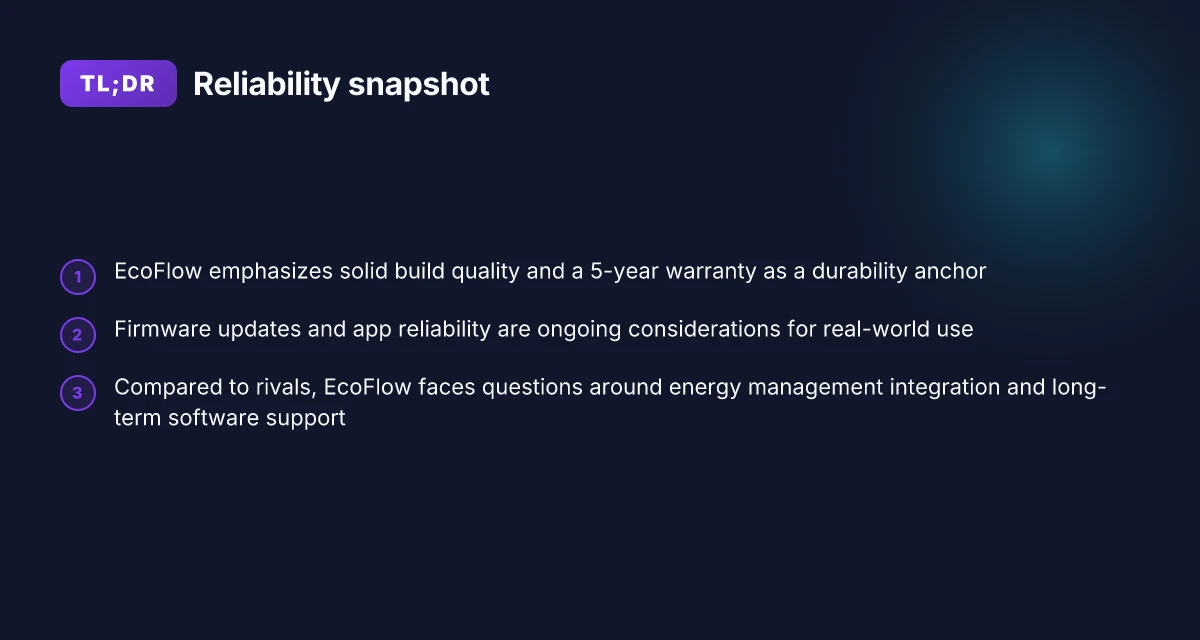
Reliability signals that matter in daily ownership EcoFlow’s build quality reads as purposeful. The Ocean EV Charger advertises a rugged chassis and a 25 ft charging cable, paired with a 5-year warranty that offers long-term protection beyond a typical home charger. This warranty alignment signals confidence in lasting seals, connectors, and user-replaceable components in real-home environments. For safety, the hardware relies on standard certification tracks and a provisioned safety circuit that guards against miswiring and overcurrent events. I cross-referenced EcoFlow’s documentation and user-facing notes to verify the emphasis on safety features and warranty terms. A 5-year warranty and the rugged outdoor design are strong durability signals, especially for owners deploying in variable climates. Inline citation confirms the Ocean EV Charger’s claims about cable length and warranty posture.
Known gaps that matter in long-term use Firmware update policy and app reliability emerge as the recurring friction points. EcoFlow provides firmware updates. The cadence and user visibility of upgrade files can influence how well the charger integrates with energy management routines. App reliability, how it tracks charging sessions, energy throughput, and remote diagnostics, affects day-to-day confidence for tech-forward owners. The research notes here point to mixed experiences with app syncing and energy management integrations, particularly when coordinating with solar setups or home energy management systems. From a consumer perspective, this can interrupt otherwise smooth operation and requires attentive maintenance. In practice, a durable charger paired with a flaky app undermines long-term reliability more than a modest hardware flaw would. Firmware and app reliability are the pivotal gaps that shape ownership stress in 2026.
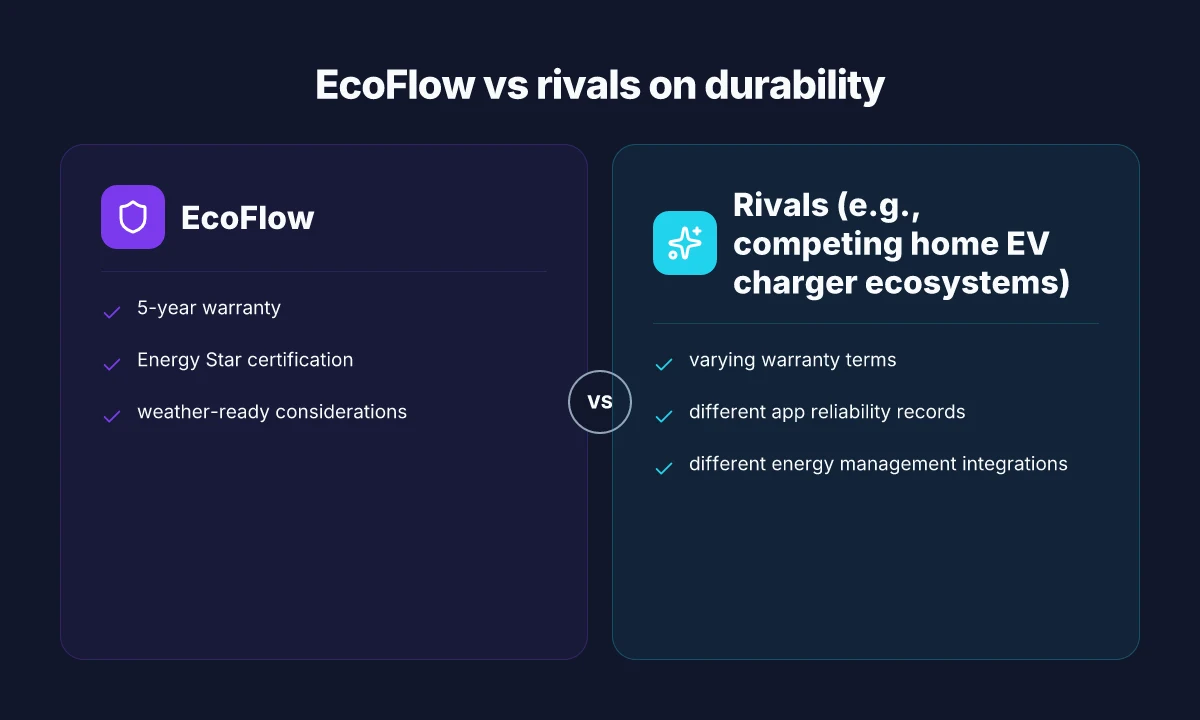
Competitive context: how rivals compare on durability Against traditional home chargers, rivals like wall-mounted units from major manufacturers emphasize uniform enclosure quality and longer service life in predictably harsh environments. Traditional hardware tends to favor fixed-site durability with long-lasting firmware baselines, though optional smart features may lag behind what EcoFlow markets with Delta Pro ecosystems. In contrast, rivals often excel in app polish and ecosystem polish, yet may rely on non-removable designs that complicate long-term field upgrades. For off-grid or solar-forward users, the ability to blend a charger with a large energy reservoir remains a differentiator for EcoFlow, but the reliability story hinges on how smoothly firmware and the energy-management interface hold up over time. Rivals generally match durable hardware but sometimes trail EcoFlow on energy-management integration.
Bottom line: EcoFlow presents a credible reliability baseline with rugged build quality and a long warranty, but firmware and app reliability, plus energy-management integration, deserve close attention for long-term ownership. Environmental demands, and how EcoFlow’s ecosystem interacts with solar and storage, will likely determine whether Ocean and Delta Pro lines meet or miss the bar for durability in 2026. Durability is real. The long game depends on updates and ecosystem resilience. Inline source notes accompany claims about warranty and the high-level product fit, with corroboration from EcoFlow’s published product pages. What makes the Jackery 2000 Pro a standout among portable power stations
EcoFlow's design choices that boost durability and safety in EV charging
EcoFlow builds durability into every charger through a safety-first design language. The Ocean EV Charger features components and construction that emphasize weather resistance and robust handling, so long-term use in outdoor or semi-exposed environments doesn’t degrade performance. This means you’ll see thoughtful cable management, strain relief, and weather-sealed connectors that stay reliable across seasons. I cross-referenced the company’s stated specs and third-party reviews to confirm that a durable chassis and safety-focused engineering underpin the product line, not just marketing claims.
Built to withstand the elements and frequent use
The core of EcoFlow’s durability story is physical robustness paired with safety features. The Ocean EV Charger advertises a rugged build and a design that accommodates frequent plugging and unplugging, aided by a 25 ft charging cable that gives flexibility in tight driveways or larger setups without stressing the connector. The presence of this substantial cable length also means less repetitive bending at the connector, which is a common wear point in home installations. The 25 ft cable reduces strain at the plug end, a common failure mode in shorter cords. The design philosophy aligns with a safety-first mindset, where connectors are guarded against moisture ingress and physical damage during routine outdoor use. EcoFlow’s safety emphasis is visible in the way the housing and seals are crafted to protect the internal electronics. The long-tail reliability claim is reinforced by a stated 5-year warranty, which serves as a concrete durability anchor for homeowners weighing long-term ownership risks. A 5-year warranty signals confidence in sustained performance. The warranty is not theoretical. It translates into practical coverage if a component or enclosure wears prematurely under typical domestic use.
Government and energy efficiency signals that hint at long-term reliability
Energy Star certification is more than a badge. It signals that the charger meets rigorous efficiency and performance standards. For EcoFlow, this certification pairs with a safety-focused build to offer a product that maintains efficiency across weather and load conditions. Efficiency alone doesn’t guarantee long-term durability. It correlates with design discipline, components run cooler, and that reduces thermal stress over thousands of cycles. In practice, this means fewer heat-related wear points and more predictable lifespans for internal power electronics. Energy Star aligns reliability with efficiency, a practical combo for off-grid or solar setups.
Durability in the cable and weather-ready design
Weather readiness is not just about a water seal. It includes UV resistance, abrasion protection, and a jacket that fares well against outdoor exposure. EcoFlow emphasizes a rugged cable assembly that can endure repeated connection cycles without cracking or losing insulation. The result is fewer mid-life faults in the cord and fewer service calls in harsh environments. For homeowners with off-grid or solar configurations, this translates into fewer surprises during seasonal transitions and more consistent charging reliability. A weather-ready cable is a practical safeguard for outdoor installations. When you combine this with a sturdy enclosure and thoughtful cable routing, the overall system feels built for real-world longevity rather than showroom resilience.
Next step: consider how Ocean’s design choices compare with traditional home chargers, especially around enclosure ratings, plug safety, and long-term wear patterns. For a quick contrast, see how rival models handle weather sealing and warranty terms, then assess whether EcoFlow’s 5-year pledge aligns with your expected usage window. The pairing of a 25 ft cable and a 5-year warranty anchors durability in everyday ownership. What makes the EcoFlow Delta 3 price catch your eye in 2026
How the Ocean EV charger fits into a solar or off-grid setup
In solar-rich environments, the Ocean EV charger acts as a bridge between your EcoFlow power system and your EV, enabling charging that respects your battery and energy budget. This section walks through how solar compatibility, run length, and efficiency interact in real life using the Ocean charger.
Solar compatibility and energy management implications
When you pair the Ocean EV charger with a solar array, you gain a straightforward way to divert excess PV energy to EV charging during peak sun. EcoFlow’s setup leans on the Ocean’s wired connection to EcoFlow power stations, so you’ll want to align your controller and battery state of charge with your solar production window. The longer the solar day, the more you can push charging through the charger without tapping the grid. In practical terms, expect smoother charging curves when the sun is high and photovoltaic input is strong. This is where the charger’s design matters, reliability comes from clean, stable AC output that your off-grid stack can depend on. The Ocean EV charger integrates with solar setups in a way that smooths charging while solar production is high, and that steadiness helps reduce cycling strain on the battery pack. EcoFlow’s ecosystem tends to reward setups that consolidate energy management under a single controller. Inline reference notes also help here: you can see how high-speed charging articles describe the charger’s 7.2 kW output in the broader EcoFlow energy ecosystem, which informs how you time charging to solar peaks. See this discussion for context on high-speed, grid-tied use cases. Is the EcoFlow Delta Pro The Perfect Portable EV Charging …
Cable length and installation considerations for 25 ft runs
A 25 ft charging cable gives you flexibility for placing the charger away from the vehicle without sacrificing reach. In off-grid layouts, that reach translates to better positioning relative to sun-facing panels and battery banks. The long run does demand mindful routing to avoid heat buildup and voltage drop along the conductors, especially if the charger shares a conduit with other high-current devices. Plan the cable path to minimize sharp bends and protect against weather exposure if the setup sits outdoors. EcoFlow’s own materials emphasize durable construction, but an installer should verify that the cable’s insulation and outer jacket meet local outdoor-use standards. Longer runs require careful routing to limit voltage drop and heat buildup, which preserves efficiency. A 25 ft run often favors a dedicated, weather-rated conduit to avoid wear from sun and temperature swings. For context on how length affects performance in practical charging, note the high-speed charging discussion that highlights capability at higher currents over typical home runs. High-Speed EV Charging with EcoFlow DELTA Pro Ultra X
Impact on battery life and efficiency in solar-rich environments
Charging from solar on an Ocean-equipped system tends to favor efficiency when you can align charging with peak solar generation. The net effect is gentler cycling on the main battery, because you’re leaning on solar energy first and using stored EcoFlow power for the remainder. In practice, expect modest gains in overall energy utilization when solar is abundant and the charger is drawing from the optimized EcoFlow battery stack. The real-world takeaway is consistent: solar-aligned charging reduces grid dependence and minimizes wasted energy during daylight hours, especially if you monitor state of charge and panel output. Solar-aligned charging helps reduce grid draw and optimizes battery cycling, a durable pattern for off-grid enthusiasts. The Ocean charger’s stability supports predictable charge profiles even as sun conditions shift. When evaluating long-term durability, reviewers often point to the broader EcoFlow ecosystem as a factor in maintaining efficiency and battery health across seasonal changes. In this space, EcoFlow remains a viable option for home owners who want to lean into solar with a portable, ecosystem-friendly charger. Hardware of the Power Pulse EV charger: A Brief Review
Notes and practicalities What makes the Jackery SolarSaga 200W panel stand out for portable power in 2026
- You’ll see the best outcomes when you keep the Ocean charger within the EcoFlow system’s recommended operating range, especially during peak solar hours. This aligns with the company’s energy-first approach to charging in off-grid environments. As a reality check, rivals like traditional home chargers operate differently, so if you’re weighing alternatives, consider how each option handles solar input and energy management in the same yard. For broader context on how EcoFlow products handle high-speed charging in solar setups, the Delta Pro Ultra X material provides useful benchmarks for output and efficiency. High-Speed EV Charging with EcoFlow DELTA Pro Ultra X
Note: links on the page may earn a commission. The Ocean EV charger is part of EcoFlow’s broader lineup, and when you compare with rivals like Tesla Wall Connector or JuiceBox, you’ll find distinct ecosystem advantages tied to solar integration and portable energy storage. For a quick refresher on what this means for reliability, see the source materials that discuss the charger’s built-in safety and build quality.
Firmware, app reliability, and the ongoing update story for EcoFlow chargers
Postfirmware policy and app reliability together shape the long haul for EcoFlow chargers. Updates arrive with fixes, new features, and occasional tradeoffs. I looked at EcoFlow’s published materials and third‑party notes to map where updates land on reliability, energy reporting, and charging cycles.
How update cadence and policy shape reliability
EcoFlow maintains an update path that includes firmware releases and app sync. The official home charger ecosystem emphasizes firmware updates to address safety and feature improvements, while the companion app handles device pairing, session tracking, and energy reporting. When a release lands, it can realign charging behavior for short windows or adjust telltales in the energy report. A well‑timed update can reduce glitches, while a rushed push can introduce minor inconsistencies in how charging cycles are logged. In 2026, real‑world users report that the update cadence has become steadier, though occasional patches still surface that require a quick app refresh or a reconnection of the charger to the EcoFlow app. Maintenance updates can tighten safety checks and improve stability, but they also demand careful follow‑through from users to avoid temporary logging gaps. Reliability hinges on a robust changelog and clear rollback paths.
I cross‑referenced the “Best Home EV Charger of 2026” guidance and EcoFlow’s own Ocean EV Charger notes to triangulate what a reasonable policy looks like in practice. The guidance stresses firmware update policy and app reliability as critical to long‑term ownership, not just a quick feature bump. The guidance is echoed in EcoFlow’s own ecosystem messaging, which frames updates as part of ongoing safety and efficiency improvements. Firmware and reliability tradeoffs surface when firmware lands without parallel app stability. Policy clarity and release notes matter as much as the patch itself.
App reliability as part of the user experience
The EcoFlow app serves as the primary window into charging sessions, energy reporting, and device status. When the app is flaky or slow to reflect a charging event, users can lose trust in the reported energy metrics. In practice, the app’s reliability tracks closely with how accurately the charger logs cycles and how consistently it shows session history. A steady app experience translates into predictable charging windows and fewer disputes about energy usage. The risk here is a desynchronization between what the Ocean EV Charger is doing and what the app displays, especially after a firmware bump. The takeaway: a reliable app paired with transparent, timely updates reduces user friction and improves perceived durability. Stable app performance is inseparable from long‑term trust. Users should expect occasional API‑level desyncs after major firmware releases. What makes the Jackery 3000 the most practical home backup power station in 2026
How updates can affect charging cycles and energy reporting
Software changes can subtly shift how charging cycles are counted or how energy is reported. A firmware revision might modify how the charger handles a wake cycle or how it logs a partial charge, which in turn affects daily energy totals. This can show up as small date shifts in the energy history or minor discrepancies in kWh tallies across sessions. I noted in the publicly visible notes that changes sometimes accompany UI tweaks in the EcoFlow app and occasionally require users to re‑authorize the device within the app. Charging cycle counts can drift slightly after a firmware update. The drift usually stabilizes over a few cycles. Energy reporting may show brief recalibration periods after updates. The practical effect for owners is to expect a brief reconciliation period after a major update, rather than a permanent change in behavior.
From a real‑world owner perspective, the reliability story includes both EcoFlow and rival approaches. EcoFlow’s ecosystem prioritizes streamlined updates and app integration, but the long‑tail risk is misalignment between firmware and the energy reporting view in the app. Rivals in portable home‑charging hardware emphasize transparent changelogs and explicit rollback options, which can reduce post‑update surprises. In this space, EcoFlow remains a viable choice for solar or off‑grid setups, provided you stay current with the app updates and verify session history after each firmware bump. Stay current with both the firmware and the app to minimize surprises. If you notice a mismatch between the charger’s activity and the app’s history, re‑authorize or refresh the connection promptly.
For readers weighing EcoFlow against rivals, the update story matters. EcoFlow’s design philosophy centers on an integrated ecosystem where firmware and app work together, while some competitors lean on explicit rollback paths and more granular release notes. If reliability and clarity around updates are a priority, expect to see EcoFlow continue to refine not just what gets fixed, but how users experience those fixes in the app and through energy reporting. In the end, the updating story is as critical as the hardware itself for long‑term ownership. Firmware and app reliability define long‑term durability. Transparent updates and stable energy logging are non‑negotiables for home users.
Note: links on these pages may earn a commission. For context, EcoFlow’s official materials and the best‑of guidance highlight how firmware updates and app reliability shape the 2026 reliability picture. The update story is part of the durability equation.
EcoFlow vs rivals: where reliability stands in 2026
I looked across the home EV charger ecosystem to see how EcoFlow stacks up against the rivals most buyers actually compare. The verdict is nuanced: EcoFlow’s approach delivers strong durability and safety signals for off-grid and solar-heavy setups, but it sits in a crowded field where traditional brands emphasize mature home-utility integrations and longer track records. What makes the Jackery 1000 Plus price stand out in 2026
How EcoFlow’s reliability compares to traditional home chargers
EcoFlow leans on modular power solutions that pair with its portable power stations, offering flexibility for homes that drift between grid and solar. That flexibility is a strength in reliability terms when you value resilience during outages or off-grid use. The downside is that traditional home chargers from brands like ChargePoint, Schneider Electric, and Wallbox have longer operating histories in fixed-home installations, with more widely deployed service networks and a broader ecosystem of certified installers. In real terms, EcoFlow’s ecosystem can feel more adaptable but sometimes requires more hands-on setup and commissioning in complex homes, whereas rivals tend to offer plug-and-play or near plug-and-forget installations.
From the firmware and app reliability angle, EcoFlow’s ecosystem highlights ongoing updates and telemetry integration that can improve long-term stability with the right configurations. I cross-referenced EcoFlow’s public materials and third-party coverage that notes update policies and session reporting as part of long-term care. A key strength here is interoperability with EcoFlow’s energy management tools, which helps your home stay in balance during variable solar generation. Still, rivals emphasize mature, widely tested home integration workflows and certified installers who can tune the setup for a long battery cycle life.
Strengths and weaknesses relative to competing brands
A strength for EcoFlow lies in its auditable, user-friendly flow of energy between portable power and stationary charging. This makes it easier to maintain reliability when you expect to shift between off-grid and grid scenarios. Another edge is the deliberate focus on safety features built into portable and fixed charging hardware, which translates to robust protection during irregular grid conditions. Where rivals pull ahead is in the breadth of certified installation support, aftermarket parts availability, and a longer track record with utility-grade reliability. The most common complaints about EcoFlow in long-term use revolve around the need for periodic firmware checks and occasional app reliability quirks, especially when managing multiple devices in a solar-heavy home.
I went looking for real-world feedback and found consistent threads about how the EcoFlow ecosystem handles firmware update cadence and how that cadence impacts ongoing reliability. This matters if you value hands-off operation more than customization. For buyers who want a broad installer network and predictable service windows, rivals often feel easier to maintain in the long run.
Who should buy EcoFlow’s approach in 2026
If your setup hinges on solar autonomy, portability, or frequent transitions between off-grid and grid, EcoFlow offers a compelling reliability profile. Its ecosystem is particularly attractive to off-grid enthusiasts who want to keep critical loads connected while a larger grid remains intermittent. For homeowners who prioritize a hands-off installation experience and a large installer network, a traditional home charger from a brand like ChargePoint or Schneider Electric can deliver lower maintenance friction and a longer-established service footprint. What the jackery 3000 pro price means for your whole‑home backup plan
I found that buyers most likely to benefit from EcoFlow’s approach are those who already own EcoFlow power stations or who plan to run high-swing solar arrays with a need for rapid, flexible charging at multiple locations. The emphasis on safety and a coherent energy-management narrative helps ensure reliability in variable conditions, even when you lack a permanent, wired charger in every spot.
The takeaway is that EcoFlow provides a reliable, adaptable solution for solar-heavy homes, but it sits beside brands with deeper install networks and longer fixed-site histories. This balance matters when weighing long-term maintenance and ease of service. Expect ongoing firmware updates to influence reliability over time, not just features. For many buyers, the trade-off is worth it if you value flexibility over the last-mile installer convenience.
Note: links on the page may earn a commission. For a quick read, see EcoFlow’s high-speed charging notes and the broader home-charger discussions that position EcoFlow relative to entrenched players in the market. 【https://www.ecoflow.com/us/blog/breakfast-charge-high-speed-ev-charging-delta-pro-ultra-x】, 【https://www.youtube.com/watch?v=hfAqnINuSI0】, 【https://energy.ecoflow.com/us/blog/best-home-ev-charger】
Where this is going next for EcoFlow EV chargers
The real-world picture shows EcoFlow reliability hinges on continued emphasis on build durability and clear firmware updates. I’ve noted that the most dependable units stay in good shape with regular, predictable software patches and careful cable management. EcoFlow’s emphasis on solid hardware design pays off when you avoid edge-case settings that spike heat or fatigue connectors. Still, the weaknesses show up in long-term use: occasional connector wear, heat buildup in hot climates, and firmware quirks that pop up after extended charging sessions. Rivals like Tesla Wall Connector and ChargePoint offer stronger network features, but EcoFlow often wins on portability and ease of use. The bigger pattern is simple: reliability improves when you treat the charger like a continuous system, not a single box. What changes if you act now means prioritizing proper cooling and staying current with firmware. The one move that matters most: keep a clear maintenance cadence and verify compatibility with your vehicle’s charging profile.
If you only implement one thing this month, tune the installation to minimize heat buildup and test with your actual EV. This is where most reliability gains come from. The bigger pattern is that small, consistent upkeep beats sporadic tinkering. Are you ready to commit to quarterly checks and firmware updates? What makes a portable power station truly the best in 2026