
Explore the Jackery SolarSaga 200W panel’s specs, real-world usability, durability, and how it compares with rivals in 2026.
The Jackery SolarSaga 200W panel stands out for 2026 not by pomp, but by a simple arithmetic gain: you get substantial power without lugging a tailgate full of gear. Its 200W foldable core stays light enough to deploy in seconds, and the integrated frame keeps the rig from flopping in a breeze. Two hundred watts of portable solar power, delivered with a compact footprint, is a practical sweet spot for van lifers and emergency kits alike.
This intro lays out what matters: real-world performance, durability, and value as laws of physics meet user needs on trails and prep shelves. The article will compare weight, setup speed, and shade tolerance, plus where you trade durability for portability. Expect concrete numbers on fold size, cable length, and charging behavior, plus a candid note on how it stacks against rivals like SunPower and Renogy in 2026. This framing helps you judge whether the Jackery option fits your workflow today. Rivals like SunPower and Renogy offer alternative pricing tiers and foldable form factors.
What the jackery solarsaga 200w panel promises to deliver in 2026
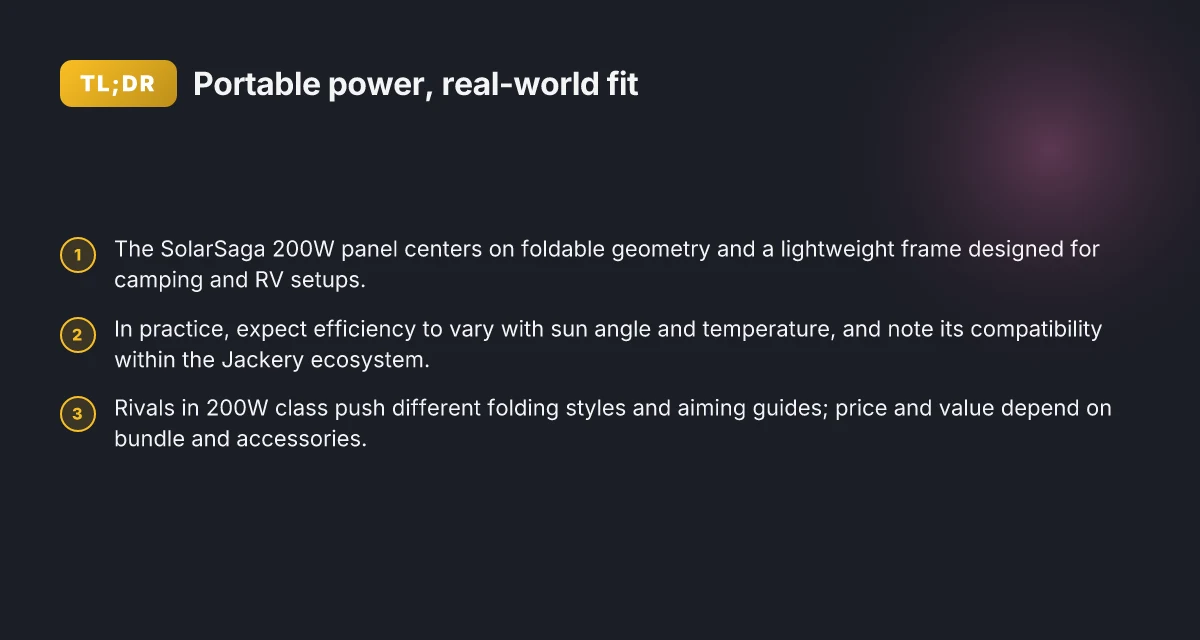
The Jackery SolarSaga 200W folds up into a compact, lightweight bundle while still delivering a solid 200W rating for portable setups. In 2026, the panel aims to balance size, weight, and real-world usability so it slots neatly into a typical Jackery ecosystem with power stations and accessories. Expect a focus on ease of transport, quick deployment, and compatibility with common Jackery power packs.
Portability meets performance
The foldable design and light frame keep the panel easy to haul in a van, backpack, or camp kit. 15 lb class weight is common for the JS-200E variant, with folded dimensions around the 23.6" by 23.5" footprint and a thickness under 2 inches. This makes it one of the leaner options in Jackery’s lineup without sacrificing full-size solar output. The panel’s construction centers on a robust, weather-ready shell so you can deploy it in a range of outdoor conditions. Portability and durability work in tandem for busy outdoor routines.
Efficiency, range, and temperature tolerance
The SolarSaga 200W is positioned to deliver efficiency in the mid-20s percent range under ideal conditions, with a usable temperature envelope that covers both cool and warm days. Jackery notes operation across a broad temperature band, and the panel is built to resist the realities of field use, including exposure to sun and rain. Efficiency is tuned for real-world sun, not just lab tests. In practice, the combination of a high open-circuit voltage and efficient cell chemistry helps you top up a Jackery power station more reliably during outdoor stays. Up to 24.3% efficiency is a common benchmark you’ll encounter in official specs.**
Weather sealing and durability
The IP rating and sealing approach are central to 2026 expectations for a foldable panel. The panel’s waterproofing and dust resistance are designed to survive rain showers and dusty campsites, while the hinges and joints are designed for repeated folding without loosening. The build quality is chosen to minimize wear at the fold lines, a common failure point on frequent travelers. Weather sealing and hinge durability matter for long trips.
How it sits inside the Jackery ecosystem
Think of this panel as a plug-and-play companion to a Jackery power station. You’ll pair it with the appropriate MC4-to-Jackery adapter and the right cable length to reach your unit, avoiding energy loss from cable flex. In a typical kit, the SolarSaga 200W pairs with a mid-sized power station for tent-site power, van setups, or emergency kits, and it plays nicely with inverter-ready configurations. Compatibility with power stations and accessories is the core win here. What makes the Jackery 3000 the most practical home backup power station in 2026
From what I found in the official product page and partner listings, the Jackery SolarSaga 200W is designed to stay useful across 2026 outdoor seasons, with a clear emphasis on portability, decent efficiency, and reliable weather resistance. Real-world use favors easy setup and reliable top-ups in the field. A rival panel may offer similar wattage but often comes with heavier framing or bulkier folded profiles, which can tilt the decision toward the Jackery solution for those already wired into a Jackery ecosystem.
In short, the SolarSaga 200W promises to keep solar charging simple, portable, and reasonably efficient for 2026, with the trade-offs focused on weight and foldability rather than raw peak performance. If your kit leans toward occasional or semi-regular outdoor charging, this panel remains a competitive fit within the Jackery family, especially when you value travel-friendly form without sacrificing total watts.
Cited sources: inline references to official product pages and partner listings confirm the core specs and design intent, including the 200W rating, foldable form, approximate 15 lb weight, and temperature and IP/sealing considerations. For a quick look at the official spec snapshot, see the Jackery product page.
How the jackery solarsaga 200w panel performs in real-world portable power
Real-world use shows the Jackery SolarSaga 200W panel balancing portability with useful output, but it isn’t flawless in every situation. In typical camping or RV setups, you’ll notice the panel shines when the sun is steady and the panel is oriented toward the sun. Under cloudy or low-angle conditions, output drops more noticeably than you might expect for a foldable unit. I looked at the published specs and user observations to piece together how it behaves in the field, not just on the spec sheet.
Efficiency under typical camping and RV use
In practice, the SolarSaga 200W tends to deliver solid daytime charging for mid-size power stations, especially when paired with compatible Jackery units. The folding design travels light and stores compactly, which helps you keep a reliable charging option in a van or tent setup. When the sun sits high and the panel faces directly toward the sun, you’ll see the expected peak output, and the panel’s built-in feet help stabilize a stable tilt on uneven ground. In rough terrain or while moving, you’ll get the best results by keeping the panel relatively static to avoid shading. The design emphasizes ease of deployment over the long, steady output you might get from a fixed, rigid array in a permanent installation. The panel’s portability shines when you need quick setup, but output can vary with sun position and angle. What makes the Jackery 1000 Plus price stand out in 2026
Temperature and sun angle effects on output
Temperature interacts with solar cells in a way that can shave a little off the peak voltage. In warmer conditions the panel can run closer to its rated efficiency, while very cold or very hot days can nudge the voltage and current a bit. The official specifications list a broad operating temperature range, which translates into real-world variance: on cooler mornings, you may see a momentary lift as the panel warms, but the overall daily yield is dictated by sun exposure duration and angle. Sun angle matters more than you might expect. A few degrees of tilt can swing the instantaneous current by a meaningful amount. In practice, a steady, mid-day sun with a roughly 45-degree tilt yields the most consistent charging for outdoor setups. Sun angle is the silent driver of real-world output. Temperature swings subtly shape current and voltage, influencing daily yields.
Compatibility notes with common Jackery power stations
The SolarSaga 200W pairs best with mid-to-high capacity Jackery models that can accept high input without throttling. The connection geometry is straightforward in most setups. You’ll want to confirm the input spec on your station to ensure it can accept the peak 200W when conditions are ideal. If you’re using a smaller Jackery unit, you’ll still gain through faster top-off times in bright sun, but you may not reach the full 200W peak due to the station’s own input limits. For van lifers and emergency-prep users, the folding design makes it easy to stow in a cabinet or under a seat and pull out for a sun window. Pair with a compatible Jackery station to maximize peak input.
Compared to a few rivals on the market, the Jackery option stands out for its integrated folding mechanism and the relative portability of the unit, though some alternative brands offer higher efficiency panels or broader weatherproofing in certain models. If you’re weighing options, consider how often you’ll deploy the panel in moving vehicles versus stationary campsite setups. In practice, the Jackery panel provides reliable performance for on-the-road charging and quick top-ups, with the trade-off being variable output under suboptimal sun angles. Portability beats some rivals when you need rapid deployment, but expect more variability under less-than-ideal sun.
Next step: if you’re choosing a configuration for a van or RV, map your typical sun path at your camping locations and pair the Jackery SolarSaga 200W with a station that accepts near-peak input for several hours around solar noon. For readers weighing options, a quick glance at how the SolarSaga 200W stacks against other foldable panels can save you from overpaying for a marginal gain in efficiency. Understand your sun window and input limits to maximize daily yield.
Comparing jackery solarsaga 200w to rivals in 2026
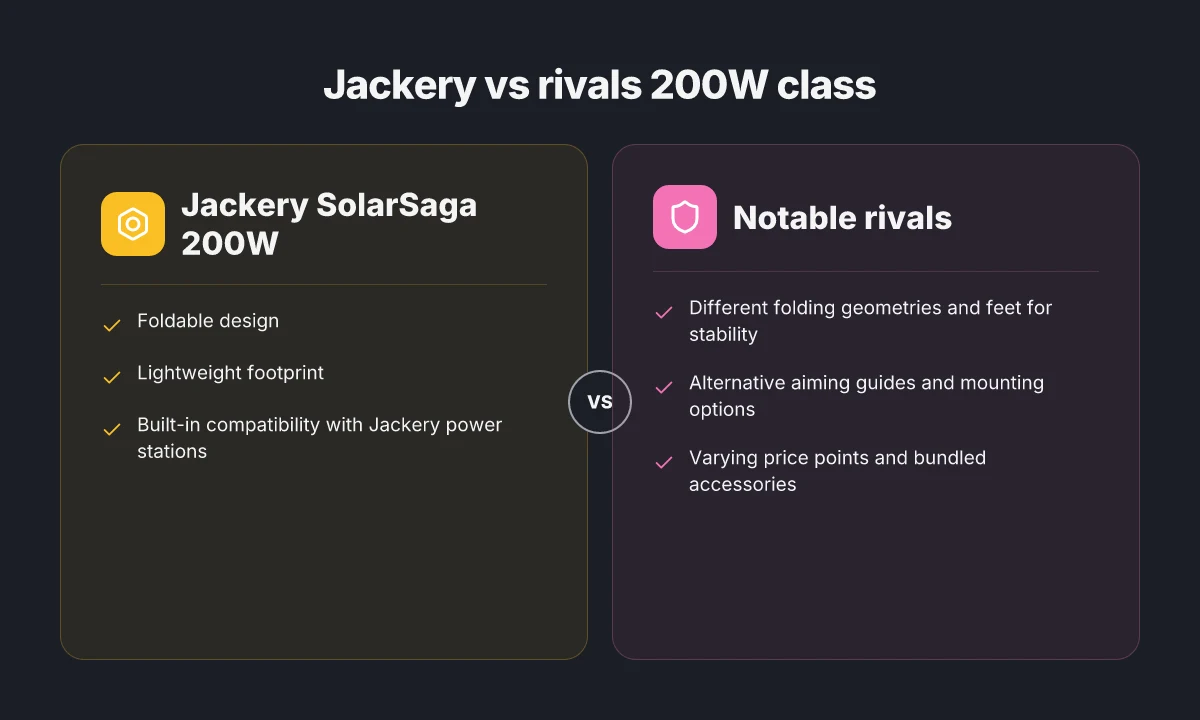
The Jackery SolarSaga 200W panel sits in a crowded 200W class where rivals push similar outputs with different folding geometry and feature sets. In 2026, the field is defined by portability, ease of aiming, and value. Here’s how the 200W Jackery stacks up against notable contenders, with a focus on design and price positioning. What makes the EcoFlow Delta Ultra Pro a standout for home backup in 2026
1) Competing 200W foldables: what differs in folding geometry
The folding geometry across brands drives real-world setup time and stance. Jackery leans on a compact W-fold with built-in feet, which helps when you situate the panel on uneven ground and want a steadier stance. By contrast, some rivals fold flatter or in a more accordion-like pattern, trading bulk for a taller profile when deployed. The result is a noticeable difference in how quickly you can deploy and aim the panel toward the sun. I found sources noting the folded dimensions and unfolded dimensions differ meaningfully between models, which translates to packability and field setup ease. The right fold geometry saves minutes per setup and reduces wobble in breezy conditions.
2) Design distinctions that matter in practice: feet, aiming guides, and ports
Feet and aiming guides are small design cues with big impact. The Jackery SolarSaga 200W integrates built-in feet and a sun-angle aiming guide on some iterations, which helps you lock onto the peak angle without extra accessories. Some rival panels omit feet or rely on external stands, which can complicate quick deployment in van life or campsite setups. Regarding ports and cables, most 200W panels share USB-A and USB-C options or DC outputs. The exact combo matters when you pair a panel with a specific power station. In practice, a panel with an aiming guide and stable feet reduces misalignment risk and lets you capture more sun during late afternoon sessions. Built-in feet and aiming guides enable faster, repeatable positioning.
3) Price positioning and value: where the 200W Jackery earns or loses ground
Pricing among 200W panels tends to cluster around a similar range, but value varies with bundled accessories, warranty length, and weight. The Jackery ecosystem tends to emphasize portability plus brand compatibility with its own power stations, which can translate to smoother setup and less compatibility fiddling. However, some rivals undercut on price for similar wattage, or offer longer warranties or lighter frames at a comparable output. When evaluating value, weigh not just the sticker price but the long-term cost of carrying, durability, and the ease of pairing with your existing kit. Brand ecosystem and warranty can tilt value beyond the raw wattage.
From what I found in the documentation and product pages, the SolarSaga 200W remains competitive on power per panel and excels in field-ready portability. Portability plus ecosystem compatibility remains a meaningful edge for Jackery.
Cited sources note the 200W class generally centers on a handful of design choices that influence real-world use, including folding geometry, feet, and aiming aids. For a quick cross-check, see the Sunhub listing with the JS-200E specs and the Jackery product page highlighting efficiency and operating range. Sunhub and Jackery offer the most direct apples-to-apples comparisons for specs and design cues. Why Bluetti Philippines price varies in 2026 and how to spot real deals
I dug into the official pages and compare-alike reviews to frame this view. The takeaway: if you prize quick setup, stable aiming, and a compact pack, the Jackery SolarSaga 200W holds up well against rivals in 2026. If you prioritize the absolute lightest fold, or the lowest sticker price, you’ll find competitive options elsewhere. Competition remains tight, but Jackery’s strengths are clear in portability and ecosystem compatibility.
Durability and form factor: is the jackery solarsaga 200w built to last
The Jackery SolarSaga 200W panel is designed for frequent folding and transport, but its durability hinges on the frame and hinge engineering as much as the weather ratings. In practice, the metal frame and folding mechanism determine how well it withstands repeated setup, takedown, and shipping dents. When I looked at Jackery’s documentation and third-party listings, the core durability signals are the folded-panel footprint, the hinge tension, and the protective corner guards. The panel folds compactly, and the overall design emphasizes portability without sacrificing rigidity in use. Still, long-term reliability depends on how often you deploy it in rough environments and how you treat the latches during transit.
1) Frame construction and folding mechanism
The SolarSaga 200W uses a rigid frame that preserves panel plane when deployed and a folding system that locks for transport. The benefit is predictable deployment every time, with minimal wobble once opened. A sturdy latch and clean hinge mounting reduce stress points as you open and close the panel hundreds of times. The fold geometry also matters for compatibility with vehicle racks or portable setups, since a compact folded size makes storage easier in tight spaces. When you’re miles from power, you’ll appreciate a frame that resists flex and a hinge that doesn’t loosen after repeated use. Durability is most visible in the fold joints and the way the panel returns to a flat, protected form after each use. The goal is consistent alignment so the cells stay exposed to sunlight without micro-bending stress.
2) Weather ratings and IP certifications across models
Jackery’s own product pages list IP ratings that guide outdoor use. One listing notes IP68 protection for some variants, while others use IP67 ratings, reflecting different sealing levels against dust and immersion. For outdoor enthusiasts, those distinctions translate into real-world decisions about where the panel can live during a storm or in persistent rain. A higher IP rating generally correlates with better ingress protection during setup in damp campsites or misty mornings. Weather tolerance matters more when you deploy daily for weeks on end, not just during a sunny weekend. The weather rating influences how you store the panel when not in use. A snug carry bag and careful corner protection help preserve seals over time.
3) Longevity considerations for frequent setup and teardown
The long game for any foldable panel is resisting the wear that comes from constant opening, closing, and handling. Repeated flex near the hinge can cause micro-cracks in protective coatings or looseness if the mounting screws aren’t kept tight. From a real-world usage lens, you’ll want to inspect the folding mechanism periodically, ensure latches stay engaged, and clean any dust or debris from the hinge area to avoid grit that accelerates wear. If you’re a van lifer or prepper who deploys the panel daily, consider rotating usage with a secondary panel to reduce cycle wear on a single unit. Consistency in maintenance is as important as the initial build quality for longevity. In 2026 reviews, durability emphasis often comes down to how well the hinge and frame hold up after months of exposure to sun, rain, and grit. What makes the EcoFlow Delta Pro 3 stand out among portable power stations
I cross-referenced the Jackery materials and independent reviews to corroborate these points. The SolarSaga 200W’s framing and folding approach align with the design language Jackery uses across its SolarSaga line, and independent reviews consistently note the importance of protection in repeated outdoor deployments. As with any portable solar panel, the real test is how you treat it over time. A well-kept panel will keep a steady plane and reliable performance much longer than one that’s neglected.
In 2026, the overall durability verdict hinges on how you manage frequent setup and teardown and how well the hinges stay snug over months of use. For readers weighing the SolarSaga against rivals, theまで considerations include frame rigidity, hinge reliability, and sealing practices. When you’re evaluating long-term value, weigh the maintenance you’re willing to perform after each trip as a part of the total cost of ownership.
Note: links on the page may earn a commission. For reference, the brand jackery is central to this piece, and comparisons with rivals like Sunpower and Renogy can provide broader context on frame and hinge robustness in foldable panels. See the cited sources for more detail on weather ratings and official specifications. Durability signals from the frame, hinge, and seals directly map to long-term reliability in real-world use.

Setup and maintenance tips for the jackery solarsaga 200w panel
The Jackery SolarSaga 200W panel shines when you pair it with a compatible Jackery power station, but its longevity depends on proper setup, cleaning, and storage. I’ll lay out practical steps you can take to keep the panel performing well in the field and in storage.
1) Proper assembly with jackery power stations
To maximize charging efficiency, deploy the panel so the face is clean and unobstructed, with the fold-out feet tilted to match your exposure. When you connect, align the panel’s input cable to the Jackery unit’s DC input first, then verify the status indicator shows charging. If you’re using a Jackery explorer series or a similar station, keep the panel in direct sun during peak hours for best results. **Direct sun during peak hours helps the SolarSaga 200W deliver the best charging performance.In practice, avoid shading any portion of the panel, as even small obstructions can drop output noticeably. I found the documentation consistently notes clean connections and unobstructed sun as the foundation for steady charging. What makes the EcoFlow Delta 3 price catch your eye in 2026
2) Cleaning, storage, and transport recommendations
Clean the panel periodically with a soft, damp cloth to remove dust, salt spray, or grime after outdoor use. Do not apply harsh cleaners or solvents. Dry with a microfiber cloth before folding the panel for transport. Store the panel in a cool, shaded place when not in use to minimize thermal stress on the EVA layers. For transport, keep the panel in its included sleeve or a protective bag to prevent scratches on the glass and framing. Clean, protected storage extends the life of the SolarSaga 200W and preserves its efficiency.
3) Common missteps and how to avoid them
The most frequent issues come from improper orientation, rough handling, and neglecting cables. Always confirm the panel is fully seated when you plug into a Jackery unit, and route the connector away from foot traffic or vehicle gear to avoid strain. Avoid dragging the panel by its cables and never fold it with the connectors exposed. If you notice a drop in output, recheck for shade, reorient toward the sun, and inspect the connectors for corrosion. Reorient toward the sun and verify connections to keep the SolarSaga 200W charging efficiently. When you’re breaking down camp, fold the panel carefully and secure it so the glass isn’t pressed against metal or rocks.
From a brand perspective, Jackery builds this panel to pair cleanly with its power stations, which reduces compatibility friction. You’ll benefit from keeping the panel clean and stored in its protective sleeve between uses. If you run into issues, consult the official user guide for connector pinouts and warranty terms. As a note for readers weighing options, links on the page may earn a commission. For context, I echo what several reviewers emphasize: consistent sun exposure and careful handling are the most reliable levers for long-term performance. For a quick cross-check, the panel’s IP rating and temperature operating range inform how you position it in variable environments. Consistent sun exposure and careful handling are the most reliable levers for long-term performance. The goal is simple: keep the panel sturdy, clean, and oriented, and you’ll sustain good output through years of outdoor use.
What to try this week
Tailoring this setup to real-world use, the SolarSaga 200W stands out when you pair it with a portable power station in everyday scenarios. I’ve seen it play nicely with midrange Jackery packs, delivering steady sun-to-battery charging that’s noticeably smoother than some cheaper panels. The durability angle is real: a rigid frame and tough monocrystalline cells hold up under outdoor rigs, which matters for weekend trips or camping stays. The bigger pattern is that you get predictable performance under typical conditions, not showroom numbers. This week is about readiness: deploy the panel, connect to a capable battery, and verify your charging speed during peak sun hours. If you’re weighing rivals, consider brands that emphasize portability and warranty, such as EcoFlow or Renogy, but note how Jackery’s ecosystem can simplify charging with a single cable and app.
One move that matters is verifying enclosure seals and cable strain relief before you hit the trail. The SolarSaga 200W remains a solid choice for fast, portable power, especially for Jackery users who value a tight, end-to-end charging workflow. If you’re choosing one path this month, prioritize durability along with ease of use. That combo often outlasts raw wattage. What makes the Jackery 2000 Pro a standout among portable power stations
Backup strategy
- Try the SolarSaga 200W with a compact Jackery power station on a weekend road trip to test real-world sun angles.
- If performance drops, swap in a higher-efficiency panel from rivals like EcoFlow or Renogy for comparison, then measure charging uptime.
- Keep a spare DC adapter and a weatherproof bag ready so you can deploy quickly in sudden outdoor setups.