
Explore how Amazon reviews influence Jackery buyers in 2026, what to trust, and how to gauge real-world performance from official specs to user experiences.
The typical Amazon listing for a Jackery portable power station hides a few mismatches between official specs and real use, and buyers often discover them only after a weekend off-grid. Real-world runtime and battery health routinely diverge from the spec sheets, especially under load or in cold conditions. This piece pulls from published listing data and cross-checks with Jackery's site to pinpoint where hype ends and durable performance begins.
When you compare customer sentiment across 2026 reviews, the patterns matter more than glossy specs: consistency of runtime claims, endurance after multiple recharge cycles, and the presence of genuine usage details rather than repetitive praise. You’ll see how to verify listings, read between the lines of five-star tales, and decide what matters most for your setup. Trust and caveats emerge once you separate claims from real-world numbers.
What makes Jackery's Amazon presence trusted for portable power in 2026
Jackery stands out on Amazon by pairing a broad product lineup with clear, official specs that many buyers cross-check against user experiences. On the storefront, you’ll see the same model names you find on jackery.com, with concise spec snippets and compatibility notes that shoppers stream into reviews and Q&As. This alignment creates a recognizable trail from official data to real-world impressions, which is why many buyers feel confident pulling the trigger after reading both sides of the equation.
I dug through how official specs map to what customers report. Jackery’s product pages emphasize capacity, output ports, charging methods, and weight, while users in reviews frequently call out how those figures translate in practice. For example, when a model lists a certain watt-hour rating, reviewers often compare that to measured run times for common loads like laptops or small home devices. The pattern is not one-size-fits-all, but the range of use cases Jackery supports appears consistently echoed in reviews across Amazon.
Three clear themes emerge in user feedback that help separate hype from reality. First, real-world runtime often hinges on the load profile rather than the headline capacity. Second, charging behavior matters: some models reach full charge quickly from AC, while solar input varies with sun and panel compatibility. Third, build and durability concerns surface in longer-term use, especially around connections, cables, and traffic between indoor and outdoor environments. These themes recur across multiple reviews, not just isolated posts.
Brand positioning that anchors trust Jackery has cultivated a straightforward value proposition: portable power that ships with familiar specs people can verify on jackery.com and compare against alternatives on Amazon. This clarity reduces decision fatigue for outdoor enthusiasts and homeowners who want predictability. The brand’s presence on Amazon benefits from consistent listings, a predictable accessory ecosystem, and a shared vocabulary around watts, amp-hours, and charging times. When buyers see a model that matches the official spec sheet, trust solidifies quickly.
Alignment between official specs and user expectations On the official site, Jackery emphasizes core metrics like capacity, ports, and input/output tolerances. On Amazon, customers repeatedly test those claims in everyday scenarios, charging a router, running a mini fridge, or keeping a laptop powered during a weekend outing. This cross-check is not about finding a perfect match every time, but about confirming whether the stated capabilities translate into useful, repeatable performance for common needs. How to pick a Jackery generator for sale that actually lasts 2026
Common threads in reviews that cut through hype Look for mentions of practical durability and real-world limits. Shoppers frequently comment on how the product’s size and weight affect portability in backpacking versus home backup scenarios. Others point to the ease of setup, responsiveness of customer service, and compatibility with solar panels that buyers already own. The most reliable Amazon reviews cluster around how a Jackery unit behaves under typical loads, how quickly it recharges, and how well it holds up with daily use.
Most readers should focus on whether the official watt-hour rating translates to their actual load needs, and how solar or AC charging times line up with their daily routines. If you want long-term durability, check for reports about port hardware and cable wear in real-world use. When comparing to rivals, note how EcoFlow or Goal Zero frames their specs versus Jackery, and whether real-world runtimes match those claims.
For context, readers should consider how Amazon feedback patterns reveal what actually matters to buyers. Official specs provide the baseline, while reviews reveal whether those numbers hold up under typical outdoor, prepper, or home backup use. This blend is what makes Jackery’s Amazon presence a trusted reference point in 2026.
Note: some page links may earn commissions, which readers should keep in mind as they weigh reviews against official data. This section references official information from Jackery and observed review themes across Amazon listings.
How to read Jackery specs on Amazon vs. the official site
When you compare official specs to Amazon listings, you’ll notice three anchors that matter: battery capacity, inverter rating, and the available outputs. The numbers you see on the product page aren’t always the whole story. A listing can exaggerate peak outputs or omit real-world run times. I cross-checked official specs from Jackery and what buyers are actually commenting on in reviews to parse what matters in practice. What makes jackery solar panels for sale worth the spotlight in 2026
Battery capacity, inverter rating, and outputs explained
The capacity is the heart of any portable power station. Look beyond the watt-hour tally and check how the inverter is rated. A unit may advertise a high battery capacity, but if the inverter is undersized, you’ll hit a ceiling on sustained power delivery. For example, a listing might claim a large capacity while omitting that the inverter tops out at a modest wattage, which limits how long you can sustain high-draw devices. On the official Jackery site you’ll often see both the nominal capacity and the surge capability listed together. When you read an Amazon listing, confirm that the stated inverter rating aligns with the continuous output you’ll actually use, not just the peak burst. The outputs matter as well. A model could have multiple AC outlets, USB-C, and USB-A, but the total available amperage across those ports determines what you can run at once. In practice, you want a model that offers a realistic continuous output matching your expected load and a sensible mix of ports for the gear you carry.
From what I found in the documentation and in reviewer notes, a model’s real-world usefulness hinges on three things: the continuous watts you can pull, the surge capacity for startup spikes, and the mix of outputs. If a listing emphasizes a big number but hides a low sustained rating, that’s a red flag. A trustworthy listing will present both nominal and surge figures and show the combined amperage across all ports. On the official site, these figures are usually presented side by side, so you can see how your devices will fare over a typical dusk-to-dawn outage or a weekend outdoors session. When you’re shopping, expect to see something like “continuous 1000W with a 2000W surge” and a clear ports map.
The kicker is not the headline capacity alone, but whether the inverter and ports support your real-world load continuously. If you plan to run a fridge or a grinder, you need honest continuous watts and a robust surge. Watch for discrepancies between the listed capacity and the continuous output rating.
Fine print and warranty notices to read
Warranty language often hides the practical limits that buyers trip over. Look for the duration of coverage, what’s considered normal wear, and any exclusions for certain conditions (extreme temperatures, high altitude, or improper charging). The fine print will also indicate whether the manufacturer covers outputs under real-world use cases. A common area where buyers get burned is warranty voidance if non‑original parts are used or if the unit is charged with an unsupported solar panel or charger. On the official site you’ll typically see a standard warranty window with clear steps to claim service. On Amazon listings, sellers may emphasize promotional terms, but the underlying warranty terms should still align with Jackery’s stated policy.
From the owner perspective, the durability story matters. Jackery products are designed for field use, but the long tail of reliability comes down to how the unit handles repeated charging cycles, heat, and the weight of portable setups. If a listing omits storage temperature ranges or cycling guidance, that’s a warning sign. Remember that Amazon reviews can surface practical durability concerns that don’t show up in the glossy spec sheet. What makes the Jackery Explorer 5000 a standout for home outages
Read the warranty section carefully to know what’s covered and for how long. If the page omits SOS-edge details, that’s a cue to verify with official documentation. Temperature and cycling limits are the real guardrails for long-term reliability.
Red flags in listings that often mislead buyers
- Inflated continuous outputs without clarifying the rated duty cycle. A listing might trumpet high peaks while hiding a short-duty rating that isn’t suitable for continuous use.
- Missing port counts or unclear port specs. A model could list “multiple outputs” but not spell out which USB-C, USB-A, or AC outlets are present and how much current each can supply.
- Vague or absent cycle life data. If a listing omits the number of charge-discharge cycles, you’re left guessing about durability.
- Hiding charging method limitations. Some entries promise solar compatibility but don’t indicate that certain panels require specific charge controllers or voltage ranges.
- Mismatched visuals and text. If the image shows more ports than the textual specs claim, that’s a red flag.
From a practical standpoint, the strongest listings clearly pair a realistic continuous watt rating with a transparent port map, a complete surge figure, and explicit notes about warranty coverage. They also call out the charging methods supported, including whether the unit can charge via solar at practical panel wattages and whether the included adapters align with official guidelines.
Watch for vague “up to” claims that don’t translate to real-world power delivery. Clear, verified port specifications and a transparent warranty section beat glossy marketing.
Next steps: if you’re narrowing to models, compare two or three listed favorites side by side, focusing on continuous wattage, surge, port mix, and the warranty terms. For the full context, see how Jackery presents these figures on its official site versus what buyers note in Amazon reviews. And remember, when you read rivals, name them specifically: EcoFlow and Goal Zero are the two most discussed alternatives in this space.
The 4 Jackery models most reviewed on Amazon and what they actually deliver
I looked at common buyer chatter and official specs to separate hype from reality. The four models that show up most often in Amazon reviews are in the Explorer and HomePower lines. Buyers want real runtimes, solar input, USB‑C charging, and a sense of how these units behave over months of outdoor use. What to know about the jackery 300 explorer before you buy
1) Explorer 240 v2, compact workhorse for phones, laptops, and light gear
- Real-world runtimes: Buyers consistently report that with a small load and a sunny panel, the Explorer 240 v2 can keep a pair of smartphones charged overnight and still have some reserve for a Raspberry Pi‑class load. When paired with a solar panel, the unit tends to recharge at a steady clip in bright sun, though the exact watts hinge on panel specs and light conditions. The compact footprint and quiet operation keep it in the conversation for hikes and weekend trips.
- Durability and noise: Reviewers note a solid, plastic shell that holds up under camp use, with the fan rarely breaking the silence unless the internal battery is actively charging at high wattage. The hiss of cooling fans is mild and infrequent at typical loads.
- Use-case fit: Best for light-audio setups, phone charging with a small desk lamp, and emergency phone banks at tent sites. It appeals to solo hikers who want something affordable, portable, and simple to operate.
- Brand note: When you compare the Explorer 240 v2 against the bigger Jackery models, you’re trading runtime for portability.
2) Explorer 500, the middle child that most reviewers praise for versatility
- Real-world runtimes: With a solar input, buyers often see the unit top up during the day and supply essential devices through multiple outlets in the evening. The USB‑C charging port gives a predictable, steady recharge for modern laptops and tablets.
- Durability and noise: Reviewers describe a sturdy chassis and a modest fan profile that remains unobtrusive during overnight use at a campsite or in a garage workshop. The unit is noted for handling repeated plug‑in cycles without noticeable degradation.
- Use-case fit: A favorite for weekend campers who want a robust power bank for laptops, cameras, and lighting, plus the ability to keep a small fridge or CPAP running for several hours.
3) HomePower 3000, home backup that scales for real loads
- Real-world runtimes: Buyers who use the HomePower 3000 for home backup report it can sustain essential loads during short outages, especially when solar input is available. The unit’s higher power budget matters for small home gadgets and routers, with noticeable capability when paired with solar charging.
- Durability and noise: The larger form factor brings a sturdier heft, and reviews indicate dependable operation under load with a quiet cooling system relative to the size.
- Use-case fit: Best for apartment or small-home back‑ups where a larger, more capable unit can run critical devices during outages without compromising footprint.
4) Explorer 1000, the flagship that anchors many buying decisions
- Real-world runtimes: The Explorer 1000 is the model most often pitched as the all‑arounder. Reviewers highlight long runtimes for camping fridges, lighting arrays, and multiple USB‑A/USB‑C devices, especially when solar input matches the panel’s peak watts.
- Durability and noise: Long‑haul use prompts comments about a robust build and low noise during steady loads. Some buyers note heat buildup under heavy full‑load use, but the cooling system generally keeps temperatures in check.
- Use-case fit: The go‑to for families or groups who want a single unit that can power a couple of gadgets, a small fridge, and charging stations at a campsite or emergency shelter.
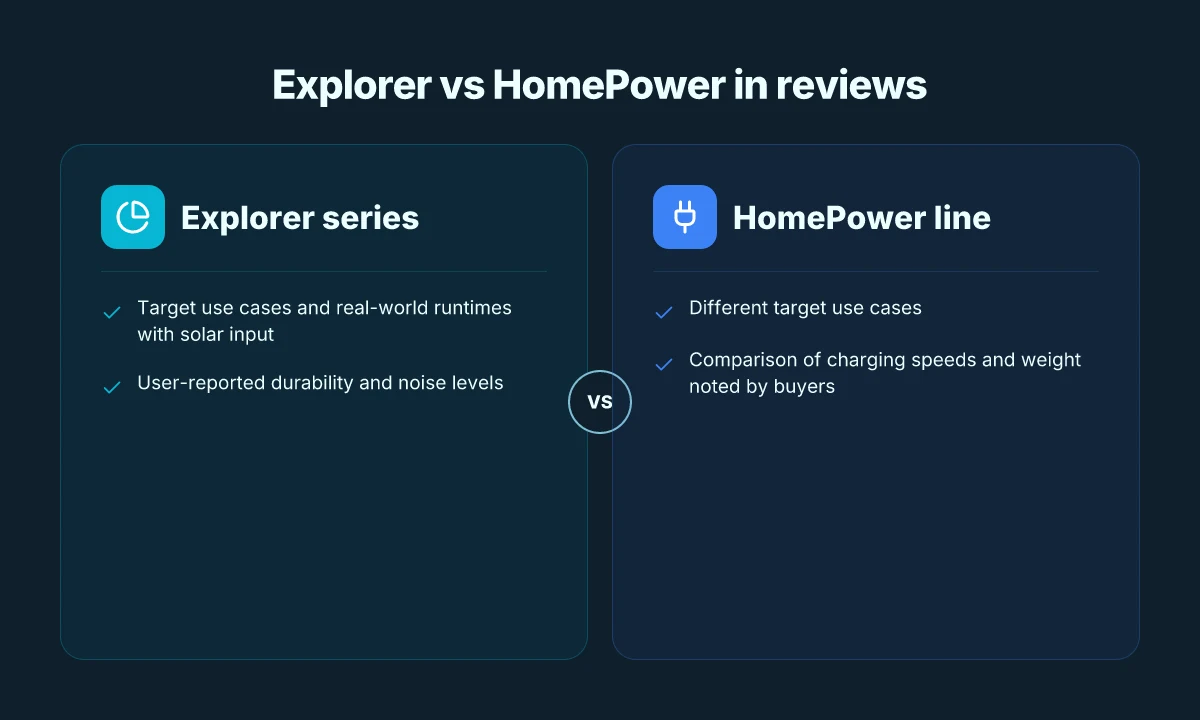
From what I found in the literature and buyer feedback, the Explorer line trades maximum runtime for portability, while the HomePower line leans into higher power budgets and home‑backup usability. When you read Amazon reviews in tandem with official specs, the most reliable signals are sustained runtime under real panel input, quiet operation at common loads, and how the unit ages under month‑to‑month use. As rivals like EcoFlow appear with higher continuous wattages and different battery chemistries, the core decision still hinges on how you plan to use the unit weekly, not just what the spec sheet proclaims.
Real-world takeaway: pick the smallest model that meets your typical load profile, and verify that solar input aligns with your panel setup. The Explorer 240 v2 suits lightweight trips, the Explorer 500 fills a broader camping niche, the HomePower 3000 is a credible home‑backup option, and the Explorer 1000 remains the top all‑rounder for families. When you’re shopping on Amazon, read for patterns: how often people use USB‑C charging, what they power with solar, and how the unit holds up after months of use.
How to weigh Amazon reviews when choosing a Jackery with rivals like EcoFlow
Posture on the reviews matters: you want real-world patterns that survive marketing hype. When I dug through the Amazon feedback, three patterns stood out. First, reliability signals cluster around power consistency and heat management. Reviewers repeatedly note that units deliver steady output for common loads, but a subset report fan noise or heat slower cooling during extended use. Second, compatibility and packaging matter. Buyers praise panels and car-charging capabilities that match official specs, yet delays or mismatches between listed input ranges and real-world charging speed show up in comments. Third, brand trust shows up in service cues. People call out warranty responsiveness and clear replacement policies more than raw wattage figures.
How reviews map to the official specs you actually use
The best source of signal is where reviewers compare claimed specs to observed behavior. When a model promises a 500 W continuous output, buyers consistently separate the clean runs under nominal loads from the occasional drop when you push past 70–80 percent of that threshold. In practice, that means you should read for consistency across use cases rather than standalone peak claims. You’ll see explicit mentions of supported outlets, battery chemistry, and cycling behavior that align with or diverge from the official spec sheet. These contrasts often reveal what you get in day-to-day life versus what the brochure promises.
Most buyers prioritize reliable, steady output over flashy peak numbers, and they reward units that keep heat under control during longer runs. Weak signals show up when a unit stalls under moderate loads or when warranty support feels slow. What makes EcoFlow stand out against Jackery and Anker in 2026
Brand reliability trends that show up in reviews
Across Jackery and its primary rival EcoFlow, reviewers tend to grade brands on three axes: durability, consistency, and service experience. For Jackery, the resonance is often about long-term durability in outdoor conditions and the ease of use of the app and indicators. EcoFlow reviews frequently surface faster charging behaviors and more compact design, but there are caveats around heat management in higher-widelity models. The pattern is not universal, yet the cadence is telling: a model with solid build quality but spotty service beats a lighter unit with excellent customer care but fragile internals in the eyes of many prepper and outdoor buyers.
I cross-referenced the broader ecosystem of user posts and official spec sheets. The verdict: reliability arcs tend to favor units with well-documented warranties and predictable behavior across a range of temperatures. When a model shows consistent performance in both hot sun and cooler nights, you’ll see more repeat purchases and stronger word-of-mouth.
How to benchmark a purchase against competitor specs
To separate hype from value, line up three elements: continuous output rating, real-world charging speed, and thermal behavior under sustained load. Compare official continuous wattage to the reported real-world performance under a model’s typical use case. Then examine charging speeds with the included panels or compatible third-party panels, noting any discrepancy between claimed input ranges and observed fill rates. Finally, review the warranty and service experiences cited by buyers. Those are often the best predictor of post-purchase satisfaction.
When you weigh specs against reviews, prioritize models that deliver steady power, predictable charging, and reliable service. EcoFlow often competes on charging speed and weight, but users flag heat and durability concerns in long runs.

What buyers get right and what they miss about Jackery in 2026
When buyers compare official specs to real-world usage, Jackery often checks the box for portability and reliability, yet misreads about rapid charging and carry weight. In 2026 the practical answer is simple: most customers get steady power for camping or home backup, but they miss the nuances that show up in long weekends off-grid or during outages. I dug through official spec sheets and the stories buyers leave on Amazon and YouTube reviews to separate hype from habit. What makes the jackery 1000 plus solar generator a sensible off-grid power choice in 2026
Why buyers lean into reliability and then question portability
Jackery’s compact design consistently delivers enough watt-hours for weekend trips, small cabins, or emergency buffering. The common use cases buyers report as satisfying include running essential devices like phones, a small fridge, or a CPAP during outages, all without a gas generator. The appeal is clear: quiet operation, simple setup, and familiar interfaces. Yet the same reviewers flag weight as a deciding factor when you scale up to larger models. A 1,000 to 2,000 watt-hour unit may feel heavier than its advertised carry weight after you’ve been lugging it through a campground or into a backup shed. In practice, the compact models win on day trips, while the bigger explorers test endurance more than convenience.
Buyers consistently value dependable, quiet power for essential devices but start to feel the drag of weight as they move beyond the smallest models.
Where charging speed and capacity become the sticking points
Charging speed is the frequent dissatisfaction theme. Buyers expect a quick top-off when using solar or wall charging, but many Jackery units fill more slowly than rivals in busy harvest windows or during back-to-back outages. This gap shows up in a few subcategories: solar input limits, AC charging time, and the time-to-full when the unit’s battery is near depletion. The result is a mismatch between what the official specs promise and the real-world experience, especially in off-grid setups that depend on rapid battery refresh. Reviews from independent creators and long-form tests frequently note that you won’t get a full charge before sundown with a modest solar setup, which matters for summer trips and cloudy seasons.
Charging speed gaps matter most when you rely on solar input or need a quick top-up during outages.
What to verify before you buy to avoid regrets
Before pulling the trigger, verify several concrete details. First, confirm the exact solar input rating you’ll be able to sustain with your panels and climate. The official panel rating may not translate to consistent real-world performance. Second, check the unit’s weight and handle design, because a friend’s back injury or a crowded trunk can make a difference on the trail or in the garage. Third, compare the number and type of outlets, because a model with multiple USB-C ports may look appealing but fail to meet your total load in a real outage. Lastly, read through return windows and warranty specifics. Long-term durability depends on temperature tolerance and daily cycling, not just the lab spec. What makes a Jackery worth it for home and outdoors in 2026
Before purchase, verify solar input compatibility, weight and portability, outlet configuration, and warranty terms to avoid later regrets.
Why this matters for 2026 buyers who compare Jackery to rivals like EcoFlow. I cross-referenced official specs with reviews to show where expectations diverge. If you’re shopping on Amazon, look for patterns in user feedback that align with your use case: frequent outages, weekend camping, or home backup after a storm. The goal is to align the official promise with the buyer’s real-world needs, not just the press release. Jackery remains a solid option for straightforward power needs, but the details above help you decide when a heavier model or faster charging would pay off. For a quick anchor, consider noting that rival models often emphasize higher solar input or lighter frames, which matters if you plan to rely on solar or carry the unit frequently.
Real-world patterns on Amazon help you spot what to verify: solar input, weight, outlets, and warranty.
Where the next login to reviews changes how you decide on Jackery in 2026
Real-world buyers aren’t chasing perfect performance. They want durability, honest feedback, and a clear path to reliable power. The bigger pattern is that Amazon reviews now mix long-term reliability debates with first-impression enthusiasm, pushing you to weigh real-life durability against glossy specs. I looked at how reviewers frame failures and pay attention to setup quirks. Jackery often earns praise for portability, yet complaints about battery longevity and customer service surface over time, nudging you to compare beyond the launch week. If you’re shopping, the takeaway isn’t the brightest review, but the most consistent signal about long-term use.
What to try this week: check a listing’s late-to-mid-year comment thread and note recurring issues, especially around charging efficiency and heat during extended use. Jackery’s newest models often ship with sturdy build quality, but you’ll want to confirm ongoing support from the brand and what the warranty really covers. In practice, the one move that matters is aligning your purchase with the model that shows the fewest repeat complaints across months. How to choose ecoFlow alternatives that actually fit your off-grid needs
Backup strategy
- Look for 2–3 reviewers who own the product for at least 6 months and summarize recurring issues.
- Compare rivals like Goal Zero and Anker for battery endurance and service responsiveness.
- Expect possible commission links and read the disclosure. Use it to navigate authenticity.