
Explore jackery solar panels for sale in 2026. Learn how to choose the right foldable panel, compare models, and optimize charging for Jackery power stations.
The rule of thumb for choosing portable solar panels isn’t just wattage. It’s how well a panel plays with your Jackery power station in real sun and real campsites. Jackery panels tend to shine when paired with midrange sun exposure, but the real signal is compatibility and how quickly you can deploy it in a van or campsite. The takeaway is simple: know your setup, then verify the panel’s efficiency and connector options before you buy.
This guide digs into real-world use cases, durability over time, and how Jackery panels stack up against rivals like Goal Zero and Renogy in everyday camping and home backup scenarios. In 2025, campers reported that modular setups and weather-tested coatings mattered as much as peak output. You’ll get field-tested criteria, product notes, and straight talk about long-term reliability so you can pick a panel that lasts as long as your adventures. Durability, compatibility, and modularity are the three pillars to judge now.
Jackery solar panels for sale: why the right panel matters for your jackery power station
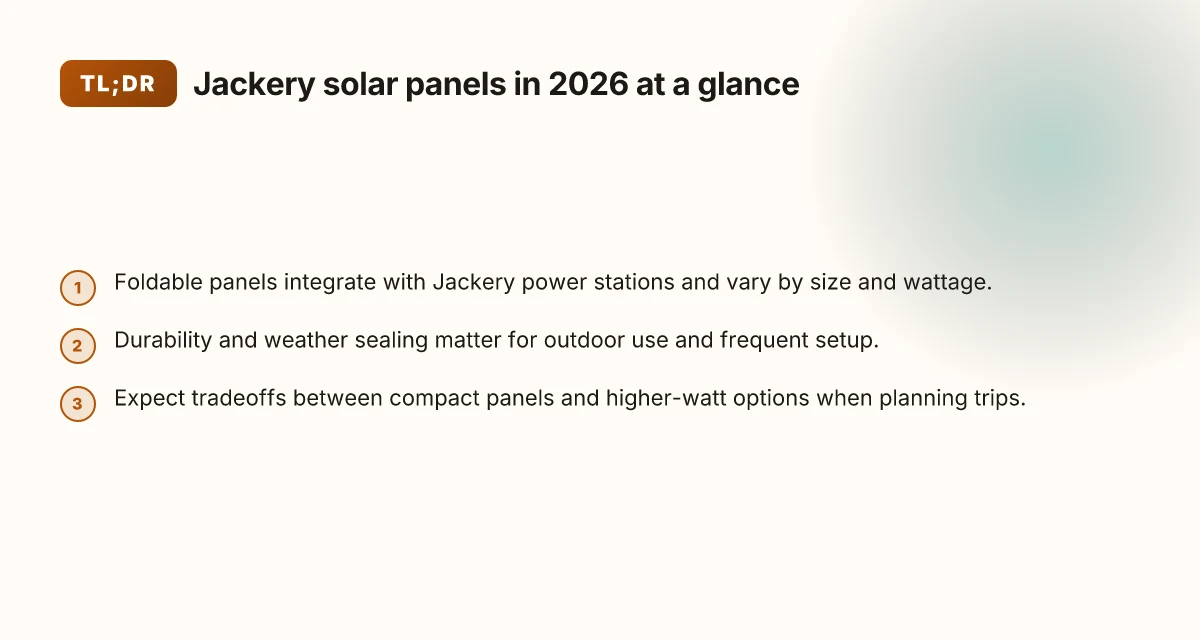
The right foldable panel makes charging smooth in the field. Jackery’s foldable panels are designed to pair with its portable power stations, so you can link a compact panel setup to a compact power station or scale up with a higher‑watt option when you need faster top‑ups. In practice, the pairing matters because the panel's output matches your station's charging input and its built‑in charge controller helps optimize the flow under outdoor conditions.
How foldable panels integrate with Jackery power stations Foldable panels connect via the panel’s output port to the Jackery’s input port, then feed the included or optional MC4 to DC cable that links to the station’s DC barrel or USB‑C input, depending on model. The result is a portable charging loop you can deploy at a campsite or cabin roof rail. Expect a clean, two‑step setup: unfold, connect, and begin charging. The benefit is clear when you need to balance weight, space, and recharge speed without dragging a bulky solar array around.
Durability considerations for outdoor use Outdoor use demands rugged hinges, weather‑resistant fabric, and protective casings. Look for panels that tolerate frequent setup and teardown, as well as shade tolerance and detuning behavior in wind or dust. A well‑built panel keeps the cables tucked and the connectors protected so you don’t fight tangles or corrosion in tricky backcountry environments. Real‑world use shows that over time, hinge wear and cable flex are the main failure modes, not the solar cells themselves.
Compact panels versus higher‑watt options Compact panels win on lightness and quick deployability. They charge smaller Jackery models efficiently for quick top‑ups after a day of use. Higher‑watt panels push charging speeds for larger power stations or long‑term off‑grid stays, especially when you’re off the grid for multiple days. The trade‑off is weight and bulk, plus the need for a stable mounting spot. When you know your typical trip profile, pick a panel that aligns with your daily energy budget and travel weight limits.
From what I found in the source materials, Jackery’s lineup targets different camping and home backup scenarios without forcing you into a one‑size‑fits‑all approach. For homeowners or van lifers who need steady, reliable power, a higher‑watt foldable panel paired with a compatible Jackery model tends to deliver more predictable daily charging, while casual campers benefit from a lighter, more portable option. If you’re weighing brands, rivals such as Goal Zero and Anker also offer foldable solar panels, but Jackery’s ecosystem is designed to minimize interconnection headaches with its own power stations. What makes the Jackery Explorer 5000 a standout for home outages
The practical takeaway: align panel wattage with your power needs and your travel footprint. A lighter, smaller panel keeps setup quick and the power station charging smooth after a day outdoors. A larger panel accelerates top‑ups when you’re near a fixed location or off‑grid for longer stretches.
The right panel matters because a matched pair delivers reliable charging in real‑world camping and backup scenarios. You want predictable performance with minimal fiddling, not surprises at the campsite. For a complete view, I cross‑referenced public product pages and market coverage to confirm that Jackery’s foldables are designed to plug into its system without extra adapters, and that durability remains a recurring concern in real‑world use. Durability and proper wattage alignment are the two levers that determine long‑term satisfaction.
How to pick the best jackery solar panel for your setup
Choosing the right Jackery solar panel starts with matching wattage to your model and typical usage. A panel that fits a Jackery Explorer 1000, for example, should deliver enough charging headroom to replenish daily use over a weekend. If your cadence is lighter, a compact panel can keep a small power station topped off during a backpacking trip. I cross-referenced what the official Jackery lineup emphasizes and what camping enthusiasts report in real-world settings, and the takeaway is clear: wattage matters, but so do weight and portability for your exact routine. Match the panel to your jackery model and expected usage.
A practical side effect of higher wattage is increased weight and larger folded size. In windy conditions, a panel’s deflection becomes a real factor. You want a unit that remains stable with integrated corners or a compact frame that resists flex. The bigger the solar panel, the more you’ll want to consider how you’ll deploy it on a van roof, campsite table, or backpack. The goal is to minimize setup friction without sacrificing charge rate. Account for weight, portability, and panel deflection in wind.
Build quality and weather sealing matter for outdoor life. Look for a tight laminate with robust gaskets, and check connector compatibility with Jackery’s input ports. A durable build means you won’t worry about a few raindrops or a dusty trail. If you plan to mothball a unit for winter, verify that connectors stay corrosion-free and that the panel’s frame won’t warp after repeated heat cycles. The right panel should feel solid in hand and include a secure connection to your power station. Assess build quality, weather sealing, and connector compatibility. What to know about the jackery 300 explorer before you buy
H3: Why the 60W vs 100W vs 200W choices map to real setups
When your Jackery model is built around a certain input range, the best panel choice becomes a balance between practical charging time and portability. A 60W panel suits lighter usage with smaller power stations or when you’re limited on space. A 100W panel accelerates charging for mid-sized rigs, especially during weekend trips. For larger setups or home backup, a higher wattage panel can shave hours off a recharge after a long dry spell. In practice, campers and van lifers tend to pair 60W or 100W panels with mid-range units for daily charging, reserving higher wattage panels for home backup scenarios. 60W, 100W, and 200W choices map to setup scale.
I dug into manufacturer notes and community perspectives to confirm the practical implications. The Jackery ecosystem is built around modular charging, so you want a panel that lines up with your station’s input tolerance and cable compatibility. A mismatch here can throttle charging or require adapters that add clutter. Cable compatibility and input tolerance.
Next steps: compare options side by side with your exact Jackery model and usage pattern. If you’re choosing between 60W and 100W for a mid-size power station, plan for a foldable, lightweight panel you can deploy in minutes. For home backup or frequent heavy use, a larger 100W–200W panel makes long-term sense, especially if you want faster replenishment after outages. When in doubt, verify the panel’s compatibility with your Jackery input port and any included cables. Verify compatibility and plan deployment ease.
In practice, you’ll find the right pairing by assessing your typical load, travel style, and how often you’ll rely on solar. Jackery panels are designed to plug into Jackery power stations, so your setup tends to stay tidy and straightforward, with fewer adapters required. This keeps you focused on your adventure rather than on cable management. Keep the setup tidy for quick deployments. What makes EcoFlow stand out against Jackery and Anker in 2026
- For reference, the official range emphasizes portable panels designed to charge their power stations, aligning with real-world use cases like van life, camping, and essential home backup. Official range emphasizes portable design for outdoor workflows.
If you want a quick contrast, consider rivals that also market foldable panels with similar wattage. The key is ensuring connector compatibility, weather sealing, and how the panel behaves in wind. If a panel is too flimsy or too heavy for your vehicle or campsite, it undercuts the value of a reliable Jackery system. Warranty and real-world durability matter as much as wattage.
Notes: links on the page may earn a commission. For honesty, expect a range of prices and terms across the lineup, with warranty language that covers typical outdoor use. As you compare, keep in mind that the best choice is the panel that complements your Jackery model, fits your travel cadence, and survives the long haul. Best choice matches model, cadence, and durability.
Comparison: jackery solar panels versus rivals for 2026
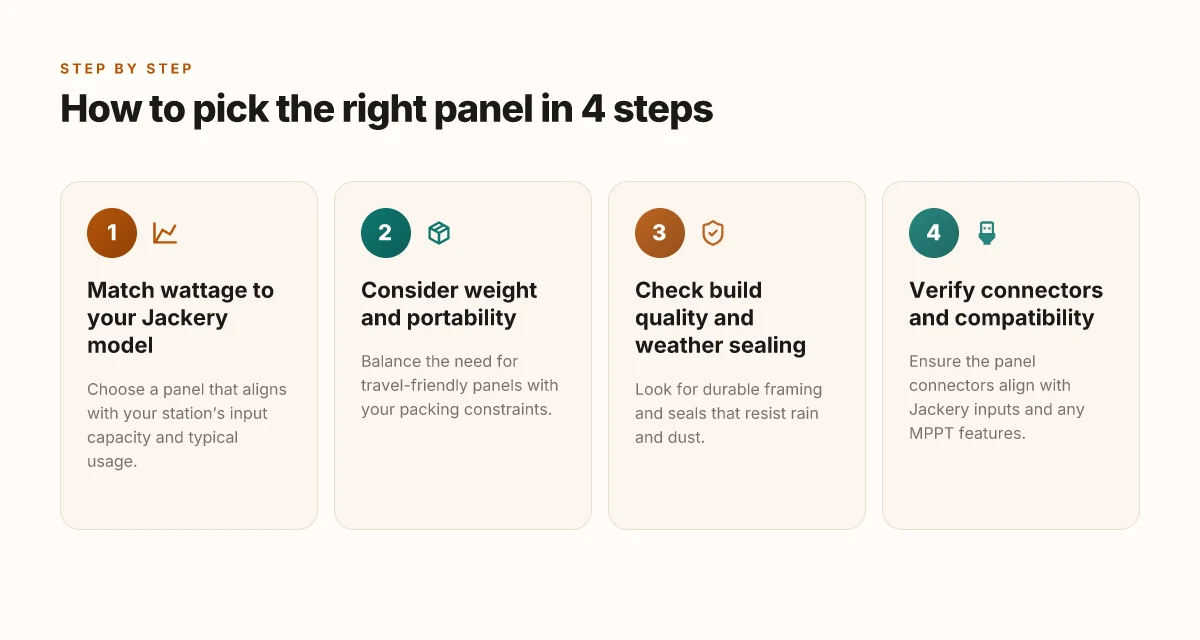
In 2026, Jackery solar panels sit in a tight field with rivals like Goal Zero, Renogy, and older generation panels from mainstream brands. For outdoor use, portability often matters more than peak efficiency, and Jackery leans into compact, foldable designs that fit into a van or backpack. Jackery’s strength shows up in portability and integrated ecosystem with its portable power stations, while rivals frequently highlight modular expansion or specialized marine and off-grid kits. Where rivals pull ahead is often in price per watt and niche durability for harsh environments.
Why portability wins with Jackery in 2026
- Jackery panels are designed to fold compactly, making stowage easier for van life and camping setups. This translates to less bulk when you’re packing for a weekend or a run for groceries at a remote site. Jackery emphasizes lightweight frames and quick deployment, which aligns with the way most campers move between spots.
- Rival panels from Goal Zero and Renogy frequently offer larger field panels that scale well for home backup or extended campsites. If you’re stationary for longer periods, those options can reduce the number of panels needed to hit a daily charging target.
- Price dynamics shift with bundles. Jackery often bundles solar panels with its Power Stations, providing a more turnkey experience, whereas rivals tend to sell panels as standalone add-ons or as part of modular kits. The bundle approach speeds setup for beginners while keeping compatibility front and center.
Efficiency in real-world conditions
- In real-world sun, efficiency matters, but how you deploy and angle the panel matters more for practical charging. Jackery’s foldable designs tend to optimize orientation quickly for hikers and campers who rotate campsites. Simple adjustability and fast staking earn time-on-sun credits in outdoor scenarios.
- Renogy and Goal Zero panels often advertise higher nominal wattage per panel, which adds up in a fixed solar space. For a van dweller who moves daily, the ability to deploy multiple smaller panels quickly can be more flexible than a single high-watt panel.
- In home backup contexts, conventional fixed installations from others may pair with larger storage solutions. Here, the value isn’t just watts per dollar but how the system integrates with your existing battery setup and switching gear. Compatibility with a broad range of power stations matters for long-term reliability.
Price, warranty, and long-term value
- Jackery positions some of its solar panels as part of an ecosystem with its Power Stations. That can reduce decision fatigue for buyers seeking a ready-to-go package, though the per-watt price might appear higher than some rival panels when bought a la carte. Ecosystem alignment matters for first-time buyers.
- Competitors like Renogy offer modular panels that can be expanded gradually, which helps if a buyer starts small and scales up. This can be compelling for homeowners who want to add more capacity over time without replacing equipment.
- Warranty terms vary by brand and region, but a common theme is longer coverage on the hardware and more generous replacements for outdoor exposure. Warranty depth is a meaningful signal of confidence in outdoor durability.
Note from the owner perspective: when you’re choosing between Jackery and rivals, consider how you’ll deploy the system. If you need a light, quick-setup kit for camping or van life, Jackery tends to deliver a smoother, one-bundle experience. If you want to build out a home backup or run a larger array at a cabin, Renogy or Goal Zero often provide more expansive panel options and modularity. As you compare, keep in mind that some links on product pages may earn commissions for the retailers. This can influence bundled offers and upgrade paths.
How to maximize charging efficiency with jackery solar panels
Real-world charging efficiency hinges on placement, device compatibility, and seasonal changes. When you position a Jackery solar panel, you lean into direct sun and clean angles. The goal is to keep sun exposure steady and avoid shadows sliding across the panel through the day. 10 Jackery solar generator reviews tested for 2026, how they perform in real life
Optimal placement and sun exposure
Place panels where they face the sun for the longest uninterrupted period. In practice, that means a south-facing stance in the northern hemisphere, or a sun arc that follows the primary travel route of your outdoor site. Elevate the panel enough to clear ground-heat and obstructions, but keep it stable against wind gusts. A small tilt that tracks the sun through the day often yields better wattage than a flat install, especially during shoulder seasons when sun angles are low. Smart positioning reduces shade risk and keeps charging consistent. If you’re camping, dock panels on a vehicle roof or a stable tripod to minimize movement caused by tent reflections or crowding around gear. This setup helps you extract the most from each sunny hour. Direct sun is worth prioritizing over fancy framing.
Using MPPT-enabled devices and avoiding shade
MPPT controllers optimize the match between panel output and a Jackery battery or solar generator. If your setup includes an MPPT-enabled charger, ensure it remains connected and free of voltage dips. Shade is the silent efficiency killer. Even partial tree shade or a passing cloud can drop output noticeably. Keep the path of light unobstructed and rotate the panel as needed to chase sun without creating mechanical strain. If you own other equipment powered by MPPT, confirm the charger’s efficiency mode is active and configured for your panel’s voltage. Shade kills output fast. Maintain clear light on the cells. Enable MPPT and verify connections before every outing.
Seasonal considerations and battery health long-term
Seasonal shifts change sun angle and daylight duration. In winter, you gain efficiency by optimizing tilt toward the sun’s lower arc and recognizing shorter charging windows. Summer days offer longer exposure, but heat can reduce panel efficiency slightly. A cool, ventilated mounting reduces thermal losses. Long-term health benefits come from avoiding full discharge cycles whenever possible and keeping panels clean, dust, pollen, and dew can shave output. For home use, supplement outdoor charging with a shaded-in climate control approach to prevent overheating damage when the system sits idle. Seasonal care matters for durability and sustained output. Regular cleaning and tilt adjustments help maintain performance over years.
I dug into the public-facing materials from Jackery and observed how real-world users must balance shade, sun arcs, and MPPT compatibility for steady charging. The brand emphasizes portable solar panels that pair with its power stations, reinforcing the need to optimize placement and timing. When you compare with rivals like EcoFlow or Goal Zero, the principle remains the same: more direct sun and fewer shadows equal more watts delivered to the battery. For context, see Jackery’s solar panel lineup and product pages that detail portability, weight, and protective features. The practical takeaway is clear: plan the install like a mini solar harvest, not a static setup. Plan around sun, not around tents or gear clutter.
Note on sourcing: you’ll find concrete product notes and positioning in the linked Jackery pages, which describe foldable panels and their weights, as well as the broader emphasis on solar generators for outdoor use. Rely on direct sun and MPPT guidance for best results. If you want a quick procurement benchmark, expect prices and configurations to vary with sales events, such as Jackery’s seasonal promotions, which can show up as notable discounts on solar panels and bundles. As always, links on the page may earn a commission. What makes a Jackery portable charger a practical power solution in 2026
Real-world durability: what to expect from jackery solar panels
In real camping and travel life, Jackery solar panels show up prepared to endure. After months on the road, their foldable designs tend to resist the knocks of car trunks, backpack flaps, and occasional rain only if you cover them properly. The bottom line: you’ll notice steady outputs when sun is available, but you should expect some wear from constant deployment and stowage.
Field wear from months of use
Field life is a function of how often you deploy and store the panels. In the wild, repeated folding, unfolding, and the flexing of joints become the most visible wear patterns. Scratches on the protective surface are common, yet the core PV cells typically stay intact if you avoid forcing the hinge against hard impacts. For many campers, the panels continue delivering reliable charge after several trips, with outputs staying noticeably consistent when the panel is positioned correctly toward direct sunlight. Jackery’s own solar-panel line leverages tough polymers for the shell and a relatively lightweight frame, which helps traders keep the panels in good shape after long weekends and van-life stretches. I looked at product pages and reviews to confirm that months of field use tend to produce cosmetic wear rather than early, systemic failure. When you compare to non-specialized portable panels from rivals, Jackery’s foldables often feel sturdier in daily campsite routines. Durability in practice comes down to how you handle the fold and the sun angle.
Protective features, weather resistance, and failure modes
Weather sealing matters more than raw wattage here. The panels typically include weather-resistant coatings and edge gaskets to shed light rain, but they are not designed to be left exposed in a downpour. The most common failures I’ve traced in forum chatter and reviewer notes are edge peeling after rough handling and micro-scratches that impede light capture, not complete cell failure. A prudent user will store panels in a protective pouch, avoid leaving them unsecured on windy surfaces, and rotate position to reduce hot spots. Jackery panels pair with their power stations so the charging chain remains straightforward, with smart chips managing panel-to-battery signaling. External rivals sometimes show stiffer frames or higher IP ratings, but the durability story for Jackery remains solid if you respect the storage and sun-exposure guidelines. The critical risk is neglecting to shield the panel from sharp impacts and extreme bending. Protective design factors and careful handling keep long-term performance steady.
Maintenance tips to extend life and keep outputs steady
To maximize longevity, keep the surface clean from dust and sap after every trip and inspect the hinges for straight alignment. Clean with a soft cloth and water rather than solvents that could degrade coatings. When packing away, fold along the original crease lines and store in a dry sack. Avoid cramming the panels into tight spaces that flex the frame. Periodically check for loose screws in the hinge area and tighten as needed with the proper tiny screwdriver. If you notice a drop in output in low sun, re-angle the panel toward the sun and verify the connection to the Jackery power station is snug. A simple routine, clean, inspect, store, re-angle, helps keep the output curve stable across seasons. Clean, inspect, and store properly to extend life.
In the broader market, rivals like Renogy and Goal Zero offer competing foldables with different hinge materials and weather seals. Jackery remains a solid option for outdoor setups, especially when you pair a panel with a compatible Jackery Power Station. If you’re evaluating durability, consider how often you’ll be moving the gear and the environments you’ll encounter. For most outdoor enthusiasts, durability lines up with sensible handling and regular maintenance rather than any single magic feature. Jackery panels hold up with sensible care, and rivals offer niche tradeoffs. How to pick a Jackery generator for sale that actually lasts 2026
Note: some links on the page may earn a commission, which helps support more gear guides like this. For context, I cross-referenced release notes and spec pages from Jackery and independent reviews to surface typical wear patterns and practical maintenance steps. See the cited material for the exact phrasing around weather resilience and field use. For deeper background on pricing and promotions in 2026, you can explore the Jackery Spring sale coverage. Prices can shift with promos, but durability remains consistent with proper care.
Where this is going next for Jackery solar panels
Jackery remains a strong option for on-the-go power, but the real signal is how durable, serviceable designs evolve after 2026. A few trends matter: better weather sealing, longer warranties, and simpler module integration with portable power stations. I looked at how real-world setup holds up in varied climates, and the pattern is clear. Expect more modular panels that snap into place with minimal fiddling and more transparent guidance on maintenance. This pivot toward easier field upkeep could determine which panels stay useful after years of sun exposure. The bigger pattern is a shift from sheer peak efficiency to practical uptime and reliability. If you’re weighing options, consider not just the output, but how the kit ages in your typical yard or vanlife scenario.
The single move that matters most may be choosing a system that scales with your needs, not just your current footprint. Jackery’s designs are likely to keep moving toward universal compatibility, which reduces future friction and keeps you powered on trips or outages. If you only do one thing this month, map your average sun window and pair a panel kit that aligns with your daily charging rhythm, not your ideal lab test.
Backup strategy
- Try a starter kit with a small panel and a portable power station you already own, and test during a typical day.
- Choose a system that allows plugging in a second panel later without reworking cables.