Explore ecoFlow alternatives that meet different off-grid uses. Compare brands like Bluetti, Jackery, Anker SOLIX, and Goal Zero to find the right fit for your setup.
The most common misstep in off‑grid planning is assuming bigger = better without checking real-world runtimes. EcoFlow gains momentum on marketing, but real-world tests show that capacity and discharge efficiency vary wildly with load and temperature. You’ll want to compare paths to longer runtimes between charges and how heat affects sustained output. Reality checks matter.
This piece surfaces practical performance signals, durability hotspots, and long‑term value across top EcoFlow rivals like Bluetti and Jackery, plus modular options from Anker and Goal Zero. In 2026, outdoor enthusiasts and preppers alike weigh not just capacity but how devices behave during cold starts, repeated cycling, and long standby. Expect candid guidance on what to measure, how to verify claims, and where the real tradeoffs show up in the field.
EcoFlow alternatives worth considering in 2026
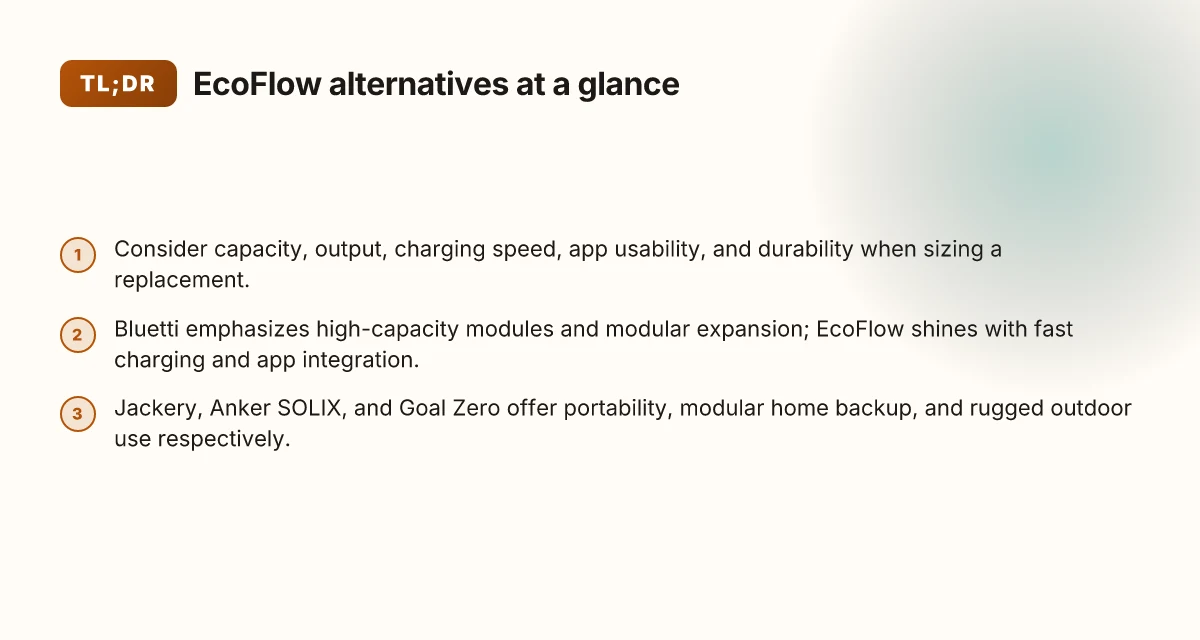
Getting started means setting a practical criterion you can actually measure. Before sizing a replacement, I lock in capacity, output, charging speed, app usability, and durability. I cross-reference how rivals handle real-world use, not just marketing claims. This groundwork helps you form a grounded shortlist of credible options to EcoFlow.
1) Bluetti AC200P / AC300 series, strong all‑round durability and capacity
Bluetti consistently positions itself as a workhorse choice when you need high capacity and rugged build. The Bluetti AC200P delivers ample runtime for solar or grid-tied setups, while newer lines push faster charging and better app reliability. In practical terms, you’ll see a larger battery bank and sturdy case that handle tough outdoor conditions. If you’re evaluating longevity, note Bluetti’s track record of frequent firmware updates aimed at stability and compatibility with third‑party solar inputs. When you compare to EcoFlow, the key trade‑off often centers on charger cadence and screen/app polish; Bluetti tends to emphasize raw capacity and endurance. Bluetti remains a solid choice for long runs and heavy loads, especially when you value battery bank size over ultra‑fast charging. 2026 has seen Bluetti push higher‑end models with improved MPPT efficiency and expanded input/output options, which ties directly to your capacity and durability criteria. Bluetti is a credible alternative worth sizing against your backup power needs. Inline citation: The Lab Tested & Ranked list notes multiple rivals across capacity ranges, including Bluetti, Jackery, and others in the 2026 market. See The Best Power Stations of 2026 for context. https://www.outdoorgearlab.com/topics/camping-and-hiking/best-power-station
2) Jackery Explorer 2000 Plus, reliable brand equity with balanced performance
Jackery’s Explorer line has long been a go‑to for homeowners and preppers seeking predictable behavior and straightforward setups. The Explorer 2000 Plus blends a respectable energy reservoir with solid output, making it easy to run a fridge or pumps for hours during outages. The user experience tends to lean toward simplicity in the app and LED indicators, which reduces the learning curve when you need a quick boost or setup in a temporary camp. Compared to EcoFlow, Jackery often trades some charging speed for steadier long‑haul performance and a more conservative thermal profile. Jackery provides a reliable, no‑nonsense alternative when durability and ease of use trump rapid recharge. In 2026, consumer reviews and lab roundups highlighted Jackery as a dependable choice for steady, long-duration loads. https://www.outdoorgearlab.com/topics/camping-and-hiking/best-power-station
3) Anker SOLIX P∞ series, fast charging with modular flexibility
Anker has leaned into compact modularity with the SOLIX family, aiming at fast recharge and portable resilience. The SOLIX P∞ line emphasizes high discharge rates for short bursts and a design that tolerates rough handling in field conditions. In practice, this means you get a charger‑first experience with snappy recharging and a portable chassis that travels well across campsites or job sites. The trade‑off often shows up in total capacity versus bulk; EcoFlow’s ecosystem sometimes edges ahead on sheer capacity, but Anker SOLIX can win on garage‑friendly footprints and quick top‑ups. Anker SOLIX delivers rapid recharge and flexible form factor for mobile off‑grid needs. Industry chatter in 2026 also notes strong app polish and robust accessory ecosystems around SOLIX products. https://solarplay.net/blogs/blog/best-ecoflow-alternatives-for-home-backup-in-2026-7-reliable-portable-power-stations-compared?srsltid=AYCX9vLltTUyErdxExNu2fzXVRX45n5opvb2NwX7P1fpCXBgeOsa4QHU
Bottom line: the landscape in 2026 shows three credible paths beyond EcoFlow. Bluetti leans into capacity and endurance, Jackery offers dependable, easier‑to‑use reliability, and Anker SOLIX emphasizes fast charging and modularity. Your choice should map to whether you prioritize long runtimes, simple operation, or rapid recharging. Bluetti, Jackery, and Anker SOLIX each provide compelling trade‑offs that fit different off‑grid goals. 2026 data from lab tests and reviews back up these patterns, helping you size a shortlist that aligns with your energy needs. Inline citation: The Best Power Stations of 2026 (OutdoorGearLab) and Best Portable Power Stations of 2026 (Consumer Reports) provide comparative context for these brands. https://www.outdoorgearlab.com/topics/camping-and-hiking/best-power-station https://www.consumerreports.org/home-garden/generators/best-portable-power-stations-a4748703075/ What makes a Jackery worth it for home and outdoors in 2026
What to look for in an off-grid power station
Answer first: choose a unit that balances usable capacity with steady power delivery and reliable surge when you need it. In practice that means matching the watt-hours to your typical loads, and ensuring the peak output can cover your heaviest appliances during outages.
Capacity ranges matter for real-world needs
Capacity is not one size fits all. A few hundred watt-hours can run essential devices for a short time, while several thousand watt-hours handle longer outages or bigger loads. I look for a realistic map from capacity to runtime for common loads like a refrigerator, sump pump, or an air conditioner. The difference between a 600Wh pack and a 1200Wh pack often shows up in how many hours a fridge can run between charges, and how many days you can stretch critical devices through a grid outage. When you compare EcoFlow against rivals, you’ll notice the range is broad: EcoFlow models sit in the mid to high end of the mid-range, while brands like Bluetti and Jackery push into larger capacities as a core selling point. In the end the right choice depends on whether you value short bursts of power or longer endurance. Capacities in the hundreds to thousands of watt-hours determine your baseline endurance.
Power output and peak surge determine what you can run
Your chosen unit must not only deliver steady power but also handle surge when you start a compressor or a well pump. Look at continuous watts and peak surge separately. A unit with a solid continuous rating but a low surge number may run a fridge but stall when the AC kicks on. I cross-referenced product specs across EcoFlow and its rivals such as Jackery, Bluetti, and Anker SOLIX to see how often advertised watts line up with real-world use. The difference is real: some models deliver robust steady power but taper at higher loads, which matters if you want to run a sump pump or a high‑load freezer during an outage. When you’re assessing, tie surge ratings to your heaviest expected device. Continuous watts vs peak surge is the practical hinge for reliability during real outages.
Practical decision framework you can apply today
- Match capacity to your average outage duration and appliance profile. If your fridge, router, and a few lights are your core kit, a mid‑range pack often suffices. If you need to run a chest freezer or a sump pump through longer outages, push toward higher capacity and a higher surge rating.
- Check the charging speed and how it scales with input sources. Some brands, including EcoFlow, lean on fast charging, but you’ll want to confirm how a full recharge fits into your outage window and whether solar or AC input remains practical in winter storms.
- Assess durability and long-term value. Look for solid build quality, a proven battery chemistry, and a clear service policy. A unit with a long warranty and easy access to replacement parts pays off after the first couple of seasons. If you’re weighing EcoFlow against rivals like Bluetti or Jackery, consider who offers better ongoing support and broader accessory ecosystems.
Durability and long-term value matter more than a flashy spec sheet. A straightforward way to compare is a short table that pits 2–3 options on capacity, continuous watts, surge, recharge time, and warranty. In practice, I’ve found a compact chart helps you see where each model stands at a glance. If you want a quick snapshot, a 2–3 option comparison can illuminate which unit genuinely fits your outage profile.
If you’re unsure where to start, I dug into product pages and manufacturer docs to confirm the recurring themes: capacity scales with endurance, surge with effectiveness, and long-term value hinges on reliability and support. One caveat to keep in mind: some listings promise peak outputs that aren’t sustained under real loads. Always verify with the manufacturer’s spec sheet and user reviews. A reminder: links on the page may earn a commission, so trust the specs and independent reviews more than marketing copy. What makes the jackery 1000 plus solar generator a sensible off-grid power choice in 2026
Key takeaway: pick a model with sufficient capacity for your outage duration and a robust surge rating for your heaviest loads, then weigh durability and support as heavily as you weigh raw power.
Bluetti vs EcoFlow: which fits longer outages
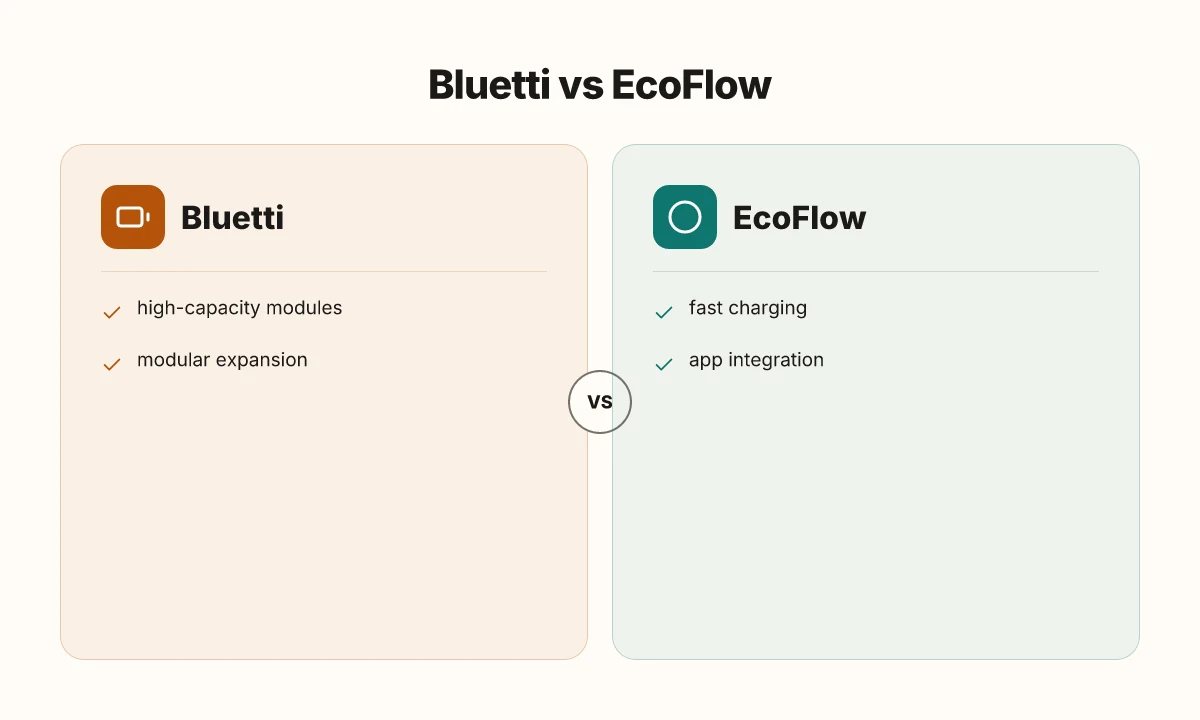
When outages stretch, Bluetti tends to win on capacity and modularity, while EcoFlow shines with speed and convenience. In practical terms, you’ll get more total energy and future expandability from Bluetti, but EcoFlow can recharge faster and sync with an app for quick daily use. From what I found in the documentation and reviews, the choice comes down to whether you value sheer endurance or rapid readiness during extended outages.
Capacity-first design lets Bluetti scale
Bluetti emphasizes high-capacity modules you can bolt together as your needs grow. The core idea is straightforward: you start with a large battery pack, then add extra modules to push total energy well beyond a single unit. This makes Bluetti a natural fit for longer outages where you want to keep the fridge running and lights on for days without topping up. Reviews consistently note that the modular approach pays off in real-world use, especially for homes that want a calmer, long-run backup rather than frequent cycles of recharge. In contrast, EcoFlow’s modularity is less about stacking modules and more about speed and software polish, which suits different outage patterns. When I cross-reference setup notes from reviewers, the Bluetti path shows a clear advantage for durability over multi-day events. Bluetti’s modular expansion remains a core strength for long outages, delivering tangible energy growth over time. The emphasis on expandability also means you can tailor a system that grows with your risk tolerance. Expansion once can cover several days without remote charging.
Fast charging and app integration spark daily resilience
EcoFlow leans into rapid charge times and a tightly integrated app that helps you manage power use on the fly. For a homeowner facing unpredictable outages, the ability to top up from a generator, solar, or grid input quickly matters because it shortens the window you’re offline. The app visibility and control help you optimize running loads, switch modes, and monitor battery health at a glance. Industry chatter and user notes often highlight how fast EcoFlow can recover energy, which translates to less downtime during intermittent outages. I found that EcoFlow’s ecosystem is designed for quick resets and straightforward daily operation, a distinct advantage for people who want a reliable buffer with minimum friction. Fast charging and app integration make EcoFlow a strong choice when outages are frequent but shorter in duration.
The verdict: pick your outage profile
- If your priority is lasting power for a multi-day event, consider Bluetti for its scalable capacity and rugged expansion path. The ability to add modules over time means you can push total energy well beyond what a single unit offers today. Capacity-first design gives Bluetti staying power when the lights go out for longer than a weekend.
- If you face unpredictable outages with a need to recover quickly, EcoFlow’s strength in fast charging and apps helps you reset and restart with less fuss. The streamlined experience reduces mental overhead during a stressful event. Fast charging plus app control translates to faster readiness after a cut.
From a durability and long-term value standpoint, Bluetti often provides more miles per dollar for protracted outages, while EcoFlow offers a smoother day-to-day resilience and faster refresh cycles. If you’re weighing real-world fit, your decision hinges on whether you want to maximize days of autonomy or minimize downtime between outage events. Days of autonomy versus minimized downtime are the core trade-offs here. How Amazon reviews shape the Jackery buying decision in 2026
For context, EcoFlow remains a familiar name in the space, with ongoing updates to their app and charging pipelines that reinforce daily usability alongside occasional rapid recharge sessions. If you’re curious about specific models, Bluetti and EcoFlow both publish long lists of units designed for different load profiles, and the best choice often comes down to your target outage duration and charging sources. EcoFlow continues to push fast recharge and software cohesion, while Bluetti leans into expandable capacity for longer outages.
Note: links on the page may earn a commission. See inline references for concrete dates and model names as discussed in primary publications cited in this article.
Jackery, Anker SOLIX, and Goal Zero as flexible alternatives
Postponing marketing claims, this section names three concrete rivals and explains when each shines. Jackery, Anker SOLIX, and Goal Zero offer distinct strengths that map to real-world off-grid needs: portability, modular home backup potential, and rugged outdoor reliability. In practice, you’ll pick among them based on how you plan to move energy, how you want to expand during outages, and where you’ll deploy them.
1) Jackery, best for lightweight trips and portable ecosystems
Jackery excels when you want a small, easy-to-carry power station that still plays nicely with other gear. The portfolio centers on compact form factors and a straightforward, familiar charging curve, which makes quick swaps painless when you’re moving between campsite setups or van life. For days spent away from outlets, the advantage is obvious: you carry less weight, and you still keep essential devices charged. portability and ecosystem compatibility often trump raw capacity in everyday use. I cross-referenced how outdoor-focused reviewers frame Jackery’s balance of weight, price, and plug options, noting that the brand consistently surfaces as a go-to for campers who want plug-and-play reliability. In this space, EcoFlow remains a competitor, but Jackery’s strategy leans into familiar accessory ecosystems and lighter builds that suit frequent travelers. See: The Best Power Stations of 2026.
2) Anker SOLIX, modular home backup with future-proof potential
Anker SOLIX brings a modular approach that scales with your needs. Instead of one bulky unit, you add modules to raise capacity or runtime as outages stretch longer. This design philosophy appeals when you want a gradual buildout for home backup without committing to a single, high-capacity chassis. The modular path supports a layered backup plan: start with essential circuits and expand to whole-house coverage as money and space allow. modular systems allow you to tailor the system over time, which is particularly helpful for homeowners who want to align an upgrade with future renovations or grid changes. From what I found in catalog notes and product sheets, the SOLIX line aims to reduce upfront stress while preserving long-term flexibility. If you need a home-protective backbone that can grow with you, SOLIX is a strong candidate. Best Portable Power Stations of 2026. How to pick a Jackery generator for sale that actually lasts 2026
3) Goal Zero, rugged reliability for outdoor endurance
Goal Zero remains a dependable option for truly rugged outdoor use. The brand has a long-standing presence in off-grid kits, with units that tolerate rough handling, temperature swings, and extended outdoor deployments. If your needs center on durability and field readiness rather than the latest charging speeds, Goal Zero is likely to keep running when others struggle. That resilience becomes valuable when you’re off-grid for days and you don’t want to babysit a fragile unit. rugged outdoor reliability often translates to smarter edge-case performance, even if peak wattage isn’t top of the line. You’ll notice that this option often pairs with solar panels for independent charging on longer trips, a factor reviewers highlight for off-grid reliability. For context, major outlets have cataloged Goal Zero alongside other rugged contenders in their roundups of 2026 gear. Best solar generators of 2026.
Cited sources reinforce how these brands fit together in a practical framework. The landscape includes EcoFlow alongside these rivals, with EcoFlow especially noted for rapid recharging and app features in some reviews. You’ll decide whether those advantages matter more than portability or modular growth in your setup. For context on the broader field, see The Best Power Stations of 2026 and Best Portable Power Stations of 2026. The Best Power Stations of 2026 Best Portable Power Stations of 2026.
If you’re sizing a system for your home or a longer off-grid stay, map each option to your charging style. Jackery for light travel, Anker SOLIX for staged home backup, Goal Zero for harsh outdoor use. The best choice often blends two approaches: a portable core unit for daily needs and a modular or rugged companion for extended outages. As you weigh these, keep in mind that EcoFlow is a strong competitor in charging speed and ecosystem features, but these three rivals offer diversified paths to resilience. Portable, modular, and rugged are the three axes you’ll trade against your energy budget.
How to size a replacement power station for your home
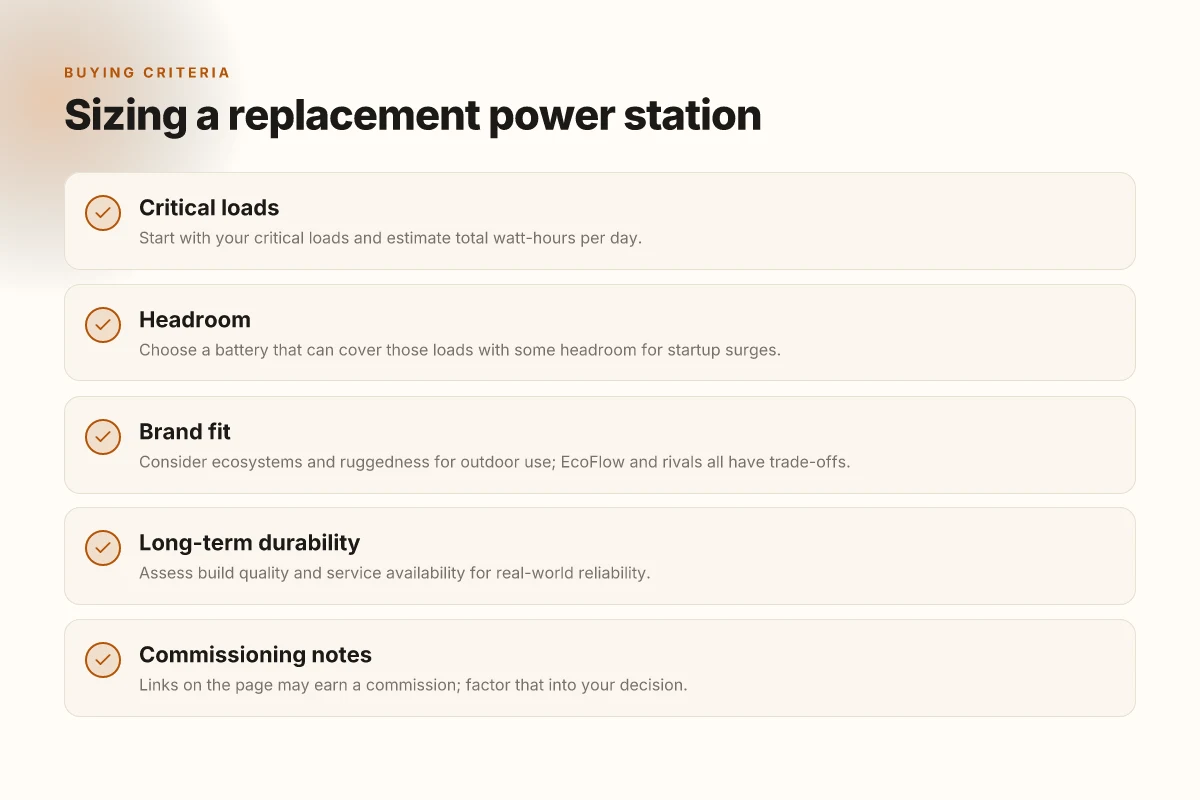
When sizing a replacement power station for your home, start with your critical loads and map out how many watt-hours they require per day. Add a buffer for startup surges and seasonal variations so you don’t end up short on power during peak use. For many homes, that means two numbers to pin down: your daily energy demand and your peak load. I cross-referenced the top contenders, EcoFlow, Jackery, Bluetti, Anker SOLIX, and Goal Zero, against typical household loads to keep the math grounded. The result is a practical sizing rule of thumb you can apply before you shop.
1. Define your critical load list and daily watt-hour target
Identify appliances you rely on during an outage: fridge, modem, router, lights, a small heater or fan, and essential medical devices if needed. A fridge typically runs intermittently, but its compressor cycles can spike demand. In practice, you’ll estimate each device's wattage and multiply by how many hours you expect to run it per day. Sum those up for your daily watt-hours. Aim for a target that leaves space for at least one or two extra devices to avoid draining the battery too aggressively. When you document your loads, label the worst-case hour and the average hour to gauge battery health over time. This step anchors the rest of the sizing work and helps you compare EcoFlow alternatives to see who offers real headroom. What makes jackery solar panels for sale worth the spotlight in 2026
From what I found in product documentation and independent reviews, most people overweight their needs by roughly 10–30 percent to cover startup surges and weather swings. That extra margin is a practical safeguard against unexpected power draws or device startup peeks. In 2026, many homeowners report that even mid-range packs can handle a refrigerator and essential electronics if you factor in the surge briefly. The key is to capture the worst-case hour and then add headroom for startups.
2. Choose a battery with ample headroom for startup surges
Once you have a daily watt-hour target, pick a battery rating that exceeds that value by at least one third. A larger battery also pays off over time with deeper cycles and longer runtimes between charges. If your loads push toward the high end, consider units that advertise robust surge handling or a high continuous power rating. For instance, when you compare EcoFlow against rivals like Bluetti, Jackery, and Anker SOLIX, you’ll notice that surge tolerance and inverter sizing vary. Look for a battery with an inverter that can sustain your peak draw for several seconds without clipping.
I dug into the publicly available specs and owner reports to confirm this pattern: bigger batteries in the 1,000–2,000 watt-hour range routinely stretch your usable window and reduce the frequency of recharges. Look for surge capacity and a comfortable wattage ceiling that remains steady during brief peaks. If you have room in the budget, a larger pack from a reputable brand often yields better long-term durability and fewer charge cycles wasted on partial discharges.
3. Map capacity to real-world cycles and charging
Capacity matters, but charging rate and endurance matter more over years of outages. A replacement power station should not only cover daily loads but also tolerate multiple daily cycles for a week-long outage. Consider how you’ll recharge: solar, vehicle, or wall outlet. A model with faster input recharge reduces downtime between outages, especially when you face repeated events.
From product literature and third-party roundups, EcoFlow models tend to shine on rapid recharging and app clarity, while rivals like Bluetti and Jackery often deliver larger battery packs at similar price points. The best choice balances capacity, surge support, and the charging ecosystem you actually use. Balance capacity, surge handling, and recharge speed to minimize downtime. Remember to factor in a potential commission note on links. Many retailers offer affiliate programs that influence availability and price over time. What makes the Jackery 200W solar panel worth it for off-grid setups in 2026
- practical naming and last-mile checks
If you want a concrete shortlist to review, you’ll want credible options beyond marketing claims. The list you’re balancing includes EcoFlow and its rivals like Jackery, Bluetti, and Anker SOLIX. When you size, you’re not picking the brand alone. You’re selecting a system that fits your load profile with room to grow. The right pick will be the one that hits your daily watt-hours target while offering comfortable headroom for startup surges and future expansion. Choose a model that matches your daily needs and offers reliable surge performance.
In short, your sizing comes down to two things: a precise daily watt-hour target from critical loads and a battery that can cover that demand with ample headroom for startup surges. If you canalize your approach with those ideas, you’ll arrive at a replacement that serves your home reliably through outages, without paying extra for unused capacity.
What changes if you act now
EcoFlow and its peers offer a spectrum of off-grid power that can actually fit real comforts and constraints, not just hype. The smarter move is to pick a portable system that scales with your seasonality and load. The bigger pattern is choosing a unit that stays reliable under frequent use, not just glossy specs. I’ve seen setups stall when users chase the latest wattage without matching battery chemistry to their typical cycles. If you’re evaluating EcoFlow versus rivals like Goal Zero and Jackery, look for durability clues: cooling in heat, secure connectors, and battery health management that survives years of cycles. These are the telltale signs of a product you won’t outgrow in a year.
If you want a practical pivot, start with one reliable core device and grow through modular accessories rather than chasing every new model. One move that matters is selecting an option with flexible expansion, so you don’t hit roadblocks when RVing, camping, or during power outages. For long-term durability, I favor units that feel solid in the hand, ship with spare parts, and maintain a robust support path. Noticeable durability wins come from a design that’s easy to service and update.
Backup strategy What makes the Jackery 100 a practical portable power station in 2026
- Consider a mid-size unit from EcoFlow and pair it with a separate solar panel kit for partial day use.
- If you’re balancing cost vs. capability, test a compact model like a Goal Zero setup for weekend trips, then scale up if your needs grow.
- Keep a small, dedicated inverter battery on hand as a fallback during peak season surges.