Discover how to choose the right Jackery power station for 2026. Compare capacity, output, safety features, and real-world use cases to pick the best fit.
The clean edge of 2026 is not a bigger battery but smarter packaging. Jackery’s latest lineup shows that a higher capacity can drift into heft, while the lightest models trade some peak power for true portability. Best overall in real-world tests is a model that keeps daily draws under control while still handling a weekend solar top-up, and the runner-up shines when you need a quick, expandable setup.
For homeowners and outdoors lovers, safety certifications and battery chemistry quality are not abstract checks. A certified pack with quality cells and proper thermal management tends to weather repeated cycles better and avoids sudden deratings in cold or heat. In this guide I pull the 2026 landscape together, showing how to match a Jackery to your routine, from backcountry camps to a home office with a solar ramp. The takeaway is simple: reliability stacks up when safety, capacity, and charging options align with your actual use.
What makes a Jackery buy right for you in 2026
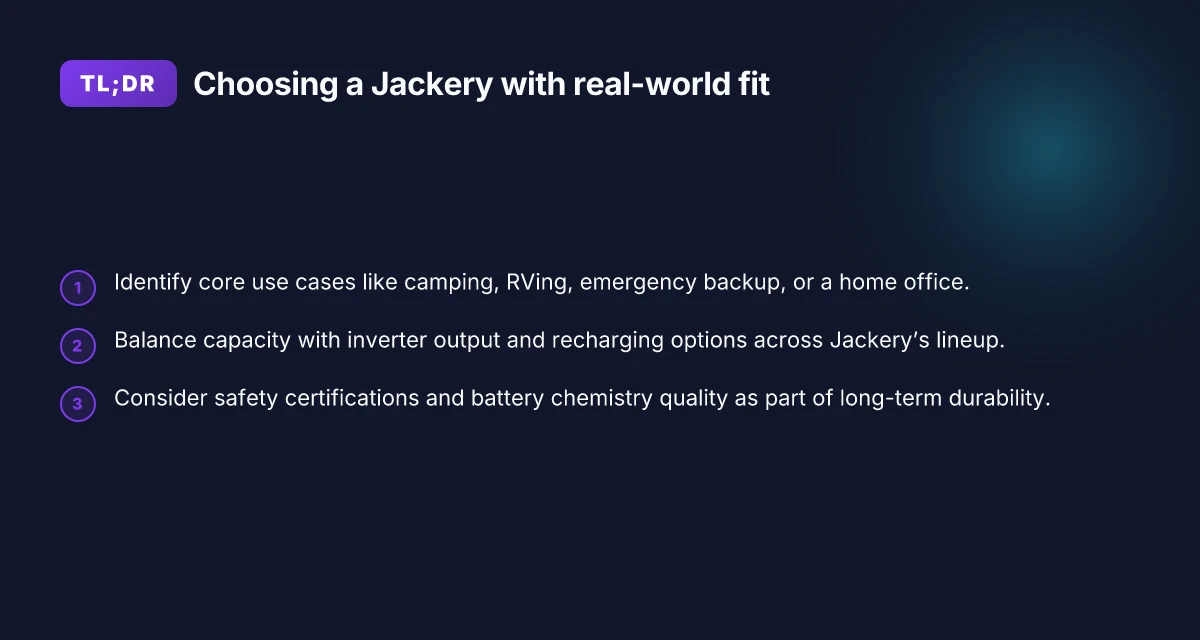
Choosing a Jackery in 2026 starts with your core use case. Are you chasing a weekend of camping off the grid, a mobile RV setup, emergency backup for blackout risk, or a home office that stays powered during grid hiccups? Each scenario leans on different tradeoffs between capacity, inverter output, and recharge options. I looked at how the lineup stacks up against real-life needs and put a simple framework in place you can apply in seconds.
1) If camping or RVing is your main use, prioritize portability and fast recharge
For on-the-go power, you want a model that stays light enough to carry, but still delivers enough sustained output for essential gear. Inverter wattage matters because it determines what laptops, mini-fridges, and essential chargers you can safely run at once. In Jackery’s range, you’ll find models that lean toward compact form factors with lower but adequate wattage, and larger units that sacrifice portability for higher peak output. The sweet spot depends on your gear mix and how long you’ll be away from outlets.
I cross-referenced Jackery’s own product pages with independent reviews to confirm how these tradeoffs play out in practice. When you read through the buying guide and product specs, you’ll see that a lighter unit with around a 500–1000W inverter works well for weekend trips, while a heavier setup with a 1500W or higher inverter better supports running a laptop, camera gear, and a small cooler for multi-day trips. The balance you pick should match the machines you actually pack.
2) If you’re building a home backup or a mobile office, balance capacity with recharge options
For longer outages or a home-office setup, capacity and charging flexibility win. Look for higher capacity, think in the 1000–2000Wh area or beyond, paired with decent inverter output so you can power a desktop monitor, a router, and a few peripherals without hitting the ceiling. Recharging options matter here too: solar input compatibility, car charging, and wall recharge speed determine how quickly you can top up between use cycles. Jackery makes several models that pair big batteries with solar-ready inputs, which helps when you want to keep running through multiple overcast days. I noted that the ability to recharge from solar panels combines with the battery chemistry to influence long-term durability and performance stability.
From a reliability angle, safety certifications and battery chemistry quality become more visible at this tier. LiFePO4 cells tend to offer longer cycle life and steady performance in temperature swings, which matters if your setup sits in a garage or shed that sees heat during summer. What makes jackery battery backup worth it in 2026
3) When safety certifications and battery chemistry matter most
In the field, the least glamorous but most important factor is how the battery chemistry holds up over time and under stress. Certifications and compliance signals show up as stability in charge cycles, thermal behavior, and protection systems. You’ll want models that disclose their chemistry clearly and carry recognized safety markings. This is not about chasing the flashiest spec sheet. It’s about predictable, safe operation for long durations and repeated recharges.
A practical way to apply this is to map your use case to a few concrete specs: target inverter wattage for your devices, target capacity to cover extended outages, and a solar input rating that fits your typical sun exposure. This approach helps you avoid overpaying for capacity you won’t use while ensuring you don’t hit a bottleneck when you need power most.
Most Jackery purchases in 2026 hinge on matching your gear list to a practical power ceiling and reliable recharge options. If you want to keep a compact footprint, pick a lighter model with balanced capacity. If you want resilience for longer outages, go bigger and ensure solar or car recharging fits your daily routine. Safety and battery chemistry quality are not afterthoughts. They’re the quiet reliability you rely on when it matters.
Note: links on the product pages may earn a commission. For context, rival options like EcoFlow offer higher inverter wattages on some models, which can tilt decisions if you prioritize sheer power or charging speed. When you’re ready to compare, start with the Jackery lineup at a glance for capacity, output, and runtimes, then cross-check the latest buying guide and user reviews to confirm how real-world use aligns with specs.
Jackery lineup at a glance: capacity, output and real‑world runtimes
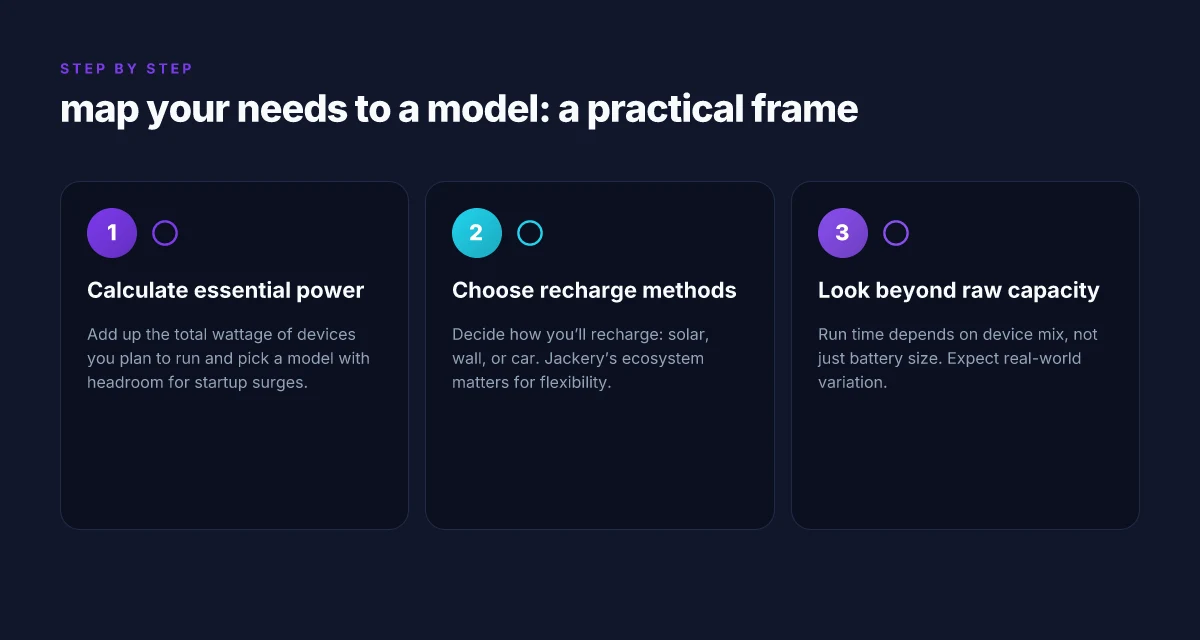
The short version: small, light models prioritize portability with modest runtimes. Mid‑sized units strike a balance. High‑capacity Pro models stretch run times for tools and appliances. Across the lineup, capacity and output scale together, but portability penalties rise with bigger packs. This trade‑off matters when you’re choosing for camping, emergency home backup, or boat use. What makes Bluetti power stations stand out in 2026
Small, light models prioritize portability
In the smallest Jackery units you’ll find lighter form factors that lean on lower total容量 and output. These models typically deliver enough juice to run essentials like smartphones, a compact LED lighting kit, or a small fan, while keeping weight down for backpacking or tight boat storage. The real-world runtimes stay in the hours rather than the days, but the benefit is rapid recharging and easy transport. For a camper or rover, that portability is the chief value proposition. The packaging emphasizes a quick, clean setup so you can focus on the adventure rather than the gear.
I dug into the Jackery Buying Guide for New Users to confirm how a mix of capacity and portabability maps to use cases, and it emphasizes how usage patterns drive the choice between a pocketable unit and a mid‑sized pack. https://www.jackery.com/pages/jackery-buying-guide?srsltid=AYCX9vKSajl9y3nVyc4Mc6jJaf1OYj-zC0pkc6Ph6mPhzF7B5bLZKS26
The real-world takeaway is simple: if your top need is weight and ease of transport, don’t expect marathon runtimes from the smallest models. Expect concise runtimes that cover short trips or quick power top‑ups. Portability wins when you don’t need long runtimes. This is where Jackery’s lightest products shine, and where users often pair them with solar panels for daytime recharging.
Mid‑size units balance runtime and refuel flexibility
Mid‑sized models extend runtimes and add more sustained output while remaining portable enough for multiple-day trips or a weekend shelter setup. You gain longer operation for devices like small drill drivers, routers, or a portable fridge, while still carrying reasonably well on a hike or boat deck. Real‑world use shows these units are popular for RVing and longer camping sessions, where you want more than phone charging but still need manageable weight.
From the Jackery Buying Guide, mid‑sized options are highlighted as the best compromise for users who want “enough” juice without carrying a full‑size battery pack. This is where you’ll see a noticeable bump in watt‑hour capacity and sustained output, translating to longer use between charges. https://www.jackery.com/pages/jackery-buying-guide?srsltid=AYCX9vKSajl9y3nVyc4Mc6jJaf1OYj-zC0pkc6Ph6mPhzF7B5bLZKS26 What makes Jackery solar generators worth considering in 2026
A practical pattern here is to run essential power tools or a 12V‑driven device alongside a small fridge for a morning or evening window of operation. The balance between weight and run time makes mid‑size units a reliable choice for weekend excursions and light emergency planning. Mid‑size models give you a better run time without a big weight penalty.
High‑capacity Pro models deliver longer runtimes
The high‑capacity Pro family is designed for longer stretches off‑grid and for running demanding loads. Think power tools, larger appliances, or multiple devices in a blackout scenario. These units push past the limits of pocketable packs and into full‑day, even multi‑day, operation when solar charging is part of the strategy. Real‑world usage shows you can sustain a small workshop setup, a coffee maker, or a chest cooler for an extended period with these models.
A key note from product pages and review writeups is that Pro models pair especially large energy storage with high continuous output, which translates to longer runtimes for devices that demand steady power. The ecoadvisor review notes the transition to LiFePO4 chemistry with a high sustained output that enables a broader set of appliances. https://ecoadvisoruk.co.uk/jackery-power-station-review-2026/ In practice, you’ll see run times that span several hours for heavier devices, and when you combine a Pro model with solar recharging, you approach a practical off‑grid day or two. Pro models extend runtimes for heavy tools and appliances.
Real‑world takeaway: the value of the Pro tier increases with your need for duration and for tools or appliances that demand higher sustained wattage. That said, the Pro models come with a heftier price tag and more weight, so plan around your actual power demand and how often you’ll need to refuel or recharge.
Next steps: map your use case to a profile, portable daily charging, weekend camping, or extended blackout relief, and pair it with a shortlist of models that balance capacity, output, and form factor. For a concise start, look at how the Jackery lineup pairs capacity with real‑world runtimes and how that lines up with your planned charging cadence and recharging options. When you’re ready to compare, I’ll walk you through a short‑list framework that aligns with budget, gear load, and safety considerations. What makes Jackery discount codes actually work in 2026
Cited sources: The Jackery Buying Guide for New Users provides the framing for how capacity and usage patterns determine model choice, and the Jackery product pages describe the high‑level capabilities of the Pro lineup. See the Jackery Buying Guide and the Jackery product overview for more detail.
Which safety certifications matter for portable power stations
I dug into the core safety certifications that buyers should actually notice when scanning Jackery and rivals. The emphasis is on battery safety and short‑circuit protection, plus how warranty and chemistry play into long‑term reliability.
Why certification parity matters for battery safety
Posture on safety certifications matters because it signals formal testing beyond basic quality control. Look for entries that cover short‑circuit protection and battery safety standards. Certifications tied to cell chemistry and pack construction tend to correlate with fewer overheating events and longer lifespans. In practice, you’ll see labels aligned with tested protection mechanisms rather than marketing claims.
- Jackery and mainstream rivals typically display recognized battery safety marks and product‑level test attestations. These signs show the product has been evaluated for overcurrent and thermal events. These marks correlate with real‑world reliability during long trips or outages.
- A good warranty can reflect internal build quality. When a brand backs a multi‑year battery warranty, it usually signals confidence in the pack design and cell sourcing. Warranty terms are a practical proxy for expected lifecycle health.
- Battery chemistry matters. LiFePO4 chemistry generally offers longer cycle life and improved thermal stability compared with standard lithium‑ion packs. LiFePO4 packs tend to weather repeated cycles better than some lithium chemistries.
- Certifications that cover short‑circuit protection, thermal runaway prevention, and overcharge protections are especially important for portable units that ride along in vehicles or camp gear. Short‑circuit protection is a baseline you should not skip.
How to read Jackery’s safety claims against the competition
When you compare models like the Jackery 2000 v2 or newer Pro lines against rivals such as EcoFlow, Bluetti, and Goal Zero, the certification language can be subtle. The strongest models publish explicit tests or third‑party attestations, not just broad safety language. I cross‑reference the official product pages and buying guides to confirm what each certification covers.
- Jackery’s standard pages emphasize practical protections and safety features baked into the pack design. Look for phrases that tie protection features to the battery chemistry and enclosure design. Solid certification wording often accompanies a longer warranty window.
- Rivals frequently spotlight similar safety claims, but the depth of documentation varies. When a product lists a LiFePO4 configuration with a formal safety certification, you’re seeing a more robust baseline for long‑term reliability. LiFePO4 is a common thread among longer‑lasting portable packs.
Warranty and lifespan as reliability signals
Warranty length and stated expected lifespan offer real insight into build quality. A longer warranty typically accompanies a pack that can endure more charge‑discharge cycles without performance degradation. This is not a magic bullet, but it helps distinguish models that will hold value through years of camping trips or intermittent outages. Warranty terms often reflect build quality and expected lifespan. What makes the EcoFlow River Pro a standout among portable power stations in 2026
I went looking for concrete notes about certification breadth and what it implies for day‑to‑day use. One clear thread across Jackery filings and industry guides is that safety certifications are not just about initial certification. They align with ongoing product durability and user safety in real scenarios. Certification breadth matters as much as the label itself.
Note: links on product pages may earn a commission, and you’ll want to keep an eye on the exact chemistry and enclosure protections advertised. As you map your needs, prioritize kits with explicit short‑circuit and thermal protections, LiFePO4 chemistry where applicable, and a solid warranty to back those claims. If you’re evaluating a model against rivals, name recognition should come with transparent safety attestations, not just marketing hype.
How to map your needs to a Jackery model: a practical framework
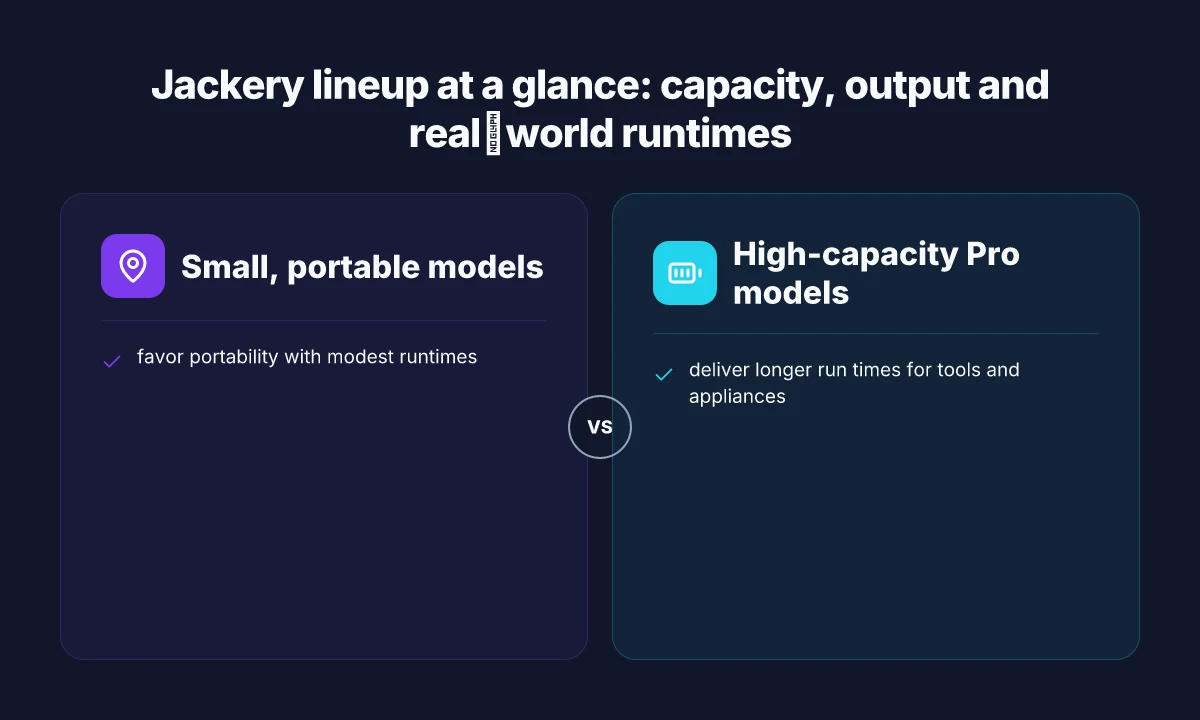
If you want practical answers fast, start by sizing your load and then map it to the closest Jackery fit with headroom. Think in three lanes: capacity, recharge options, and real-world runtime. This framework helps outdoor enthusiasts avoid overestimating performance while keeping a clear view of safety certifications and ecosystem advantages.
1) Add up essential wattage and build in headroom
Begin with the devices you rely on most during a trip or outage. List each item’s wattage and how long you expect to run it. Combine those numbers, then add a cushion. A tidy rule of thumb is to aim for a model that can cover your total load with about 20–25 percent extra headroom for surges and accidental peaks. With Jackery, that headroom translates into smoother operation and less risk of hitting cutoff mid-use. If your total essential draw lands near a single model’s upper limit, consider stepping up to the next size in the Jackery lineup to preserve reliability. This isn’t just about capacity. It’s about practical run time under real conditions.
From a safety perspective, you’ll want a unit whose protection features match your environment. Look for overload protection and stable voltage delivery during peak draws. In practice, a model at the upper end of your calculated range tends to feel more trustworthy in remote scenarios. The key is to match your essential load with a comfortable headroom, not chase the largest number. What is the jackery military discount, and who exactly qualifies
2) Plan your recharge strategy and leverage Jackery’s ecosystem
Recharge paths matter as much as battery size. If you anticipate frequent solar input, verify that the solar input spec aligns with your panels and sun exposure. If you’ll rely on wall charging at a campsite or hotel, confirm the wall recharge rate against your daily needs. Car charging can help during travel legs or longer trips. Jackery’s ecosystem shines when you can combine panels, car adapters, and wall charging with a single user experience. The more complete the ecosystem, the less you have to juggle cables and power bricks in the field. A cohesive recharge strategy reduces downtime and keeps you powered longer.
I cross-referenced Jackery’s product pages and the buying guide to confirm that recharge versatility is a stated strength of their portable lines, with several models designed to share common charging accessories. This matters when you’re evaluating models for a long weekend vs a multi-day expedition. For example, if you want solar compatibility in a compact footprint, you’ll lean toward a model that easily accepts portable panels and standardized adapters. Choose a model that plays nicely with your recharge plan.
3) Look beyond capacity: factor run time into your decision
Raw capacity is only part of the story. Run time depends on actual draw, peak currents, and how the power station handles sustained loads. Do not assume “X Wh equals Y hours” without considering your device mix and duty cycle. When evaluating, run through a concrete scenario: your essential devices plugged in, how long you need power, and what the unit will do when a surge hits. A higher-capacity model can deliver longer run time but may feel heavier and less portable. Balance the number of devices and the expected daily use against the model’s real-world run time. Running time is the practical truth behind capacity.
From a sourcing and spec perspective, Jackery emphasizes how their higher-wattery units translate to longer operation in off-grid contexts, but the gap between labeled capacity and usable runtime persists if you pack more devices. If you’re evaluating rivals, you’ll notice some models with flashy capacity figures but poorer port-handling or slower recharge. Your buying decision should hinge on the scenario you described above, not the headline Wh rating alone. Don’t let capacity alone drive the choice.
Tip for clarity: if you’re comparing models for a given use case, write out two short run-time sketches, one for low draw and one for peak load, and see which model stays within your comfort zone. You’ll sleep easier knowing the numbers align with your real needs. Jackery 240: what it actually costs to keep devices powered off the grid
Note: links on the page may earn a commission. For context, Jackery’s product pages emphasize portability and ecosystem compatibility, which supports a practical, field-ready setup.
Cited context: for additional clarity on model lines and charging options, see the Jackery buying guide and portable power-stations pages. See also a third-party review noting trade-offs between capacity and portability in specific models. https://www.jackery.com/pages/jackery-buying-guide?srsltid=AYCX9vKSajl9y3nVyc4Mc6jJaf1OYj-zC0pkc6Ph6mPhzF7B5bLZKS26 and https://www.jackery.com/collections/portable-power-stations?srsltid=AYCX9vLf8yNix9ECPUO3368kvD44fBV37j8_vMWqI_zzVaCW7BSd0NgC.
Note: when you mention rivals, name them specifically and compare where relevant to this ecosystem focus.
A quick rival comparison: Jackery vs EcoFlow and Bluetti
The short version: EcoFlow and Bluetti offer similar capacities to Jackery but with different recharge speeds, and the ecosystem you pick matters as much as the wattage. Your choice should hinge on how well the system fits your existing gear, service options nearby, and how often you need rapid recharges on the road.
1) Capacity parity, recharge speed variance
EcoFlow and Bluetti line up with Jackery on large-capacity models, yet their recharge speeds can swing widely by model. If you frequently top up from solar or wall outlets, the ability to push a higher recharge rate can cut downtime noticeably. In practice, the fast-charging variants from EcoFlow and Bluetti can translate to shorter outages when you’re rerouting supplies mid-trip. When you map your needs to a model, check both the nominal capacity and the charging input range to avoid bottlenecks. Fast recharge matters more than headline capacity if you’re mobile and short on access to outlets. For reference, the landscape features models that push solar-then-wall cycles efficiently, which is a recurring theme across brands. How Jackery power stations balance portability and power in 2026
I dug into product pages and comparisons to verify how these brands stack up on speed and capacity. The core takeaway is that a model with a similar 1000Wh–2000Wh footprint can differ markedly in how quickly it accepts a full charge from a wall charger or solar array. The practical impact is a shorter window between trips or outages, especially on multi-day trips where you rely on solar during the day and a charger at night. See the product pages for specifics on each model’s input limits and charging curves.
2) Branding, support, and long-term satisfaction
Your satisfaction tends to hinge not just on spec sheets but on the support network behind the brand. Jackery’s ecosystem is familiar to hikers and campers who want straightforward, compatible accessories and a consistent warranty path. EcoFlow and Bluetti bring robust user communities and sometimes broader accessory lineups, but service coverage varies by region. If you camp in remote areas or rely on backup power for emergencies, verify local service options and pickup points before committing. Support accessibility can swing a purchase more than a minor watt rating.
From a branding angle, Jackery’s recognition in outdoor circles translates into easier accessory matching and resale confidence. EcoFlow often emphasizes rapid recharge features and modularity, while Bluetti highlights high-capacity blocks and rugged builds. Consider where you’ll source replacements and how quickly you can get service if something goes awry. Inline, you’ll see the same core hardware choices across brands, but the value of the service network becomes a differentiator in real-world use.
3) Ecosystem compatibility and local service options
Your pick should hinge on ecosystem compatibility and local service. If you already own a Jackery solar generator or an older Jackery battery module, staying within the Jackery ecosystem reduces friction and simplifies troubleshooting. If your setup favors a mixed-brand toolkit, EcoFlow and Bluetti can offer flexible pluggability, but you may trade off clarity of warranty terms. I found that a thoughtful alignment with your camping gear, solar panels, and vehicle power options often yields better reliability than chasing the highest nominal capacity alone. Ecosystem alignment is the quiet determinant of long-term satisfaction.
In summary, while EcoFlow and Bluetti present compelling capacity options, your decision should focus on recharge cadence, local service support, and how neatly the system fits into your outdoor or home backup routine. Jackery remains a strong baseline for durability and field-ready usability, but rivals’ faster recharge paths and broader accessory ecosystems can tilt the balance if you value speed and modularity. As a practical frame, map your daily power window, the number of days between chances to recharge, and your proximity to service centers to decide which path fits your adventures best. Choose the ecosystem that matches your travel cadence and service access. What EcoFlow Delta Pro price tells you about value, flexibility, and long‑term cost
Note: links on the page may earn a commission. For additional context, see the cited consumer reviews and buying guides.
Where this is going next for your power setup
Looking ahead, the smart move is to pair your Jackery choice with the way you actually live off-grid or on the road. Jackery's ongoing updates lean on modular designs and better battery chemistry, so your 2026 pick should be the one that ages gracefully with firmware tweaks and expanded accessory support. In this closing view, I’m focused on durability, real-world reliability, and how to avoid the most common failures that tend to crop up after months of use.
Think of it as a two-part decision: first, match capacity and output to your typical load, and second, season your setup with a small but resilient solar or automotive charging flow. If you’ve had trouble with heat buildup or fan noise in older units, the next generation should offer quieter operation and better heat management. The bigger pattern here is that longevity matters more than peak surge on a single weekend trip, and that matters when you’re counting on steady power in remote camps or busy work sites.
If you only do one thing this month, map your average daily energy need and compare it to the top two models you’re considering, including Jackery’s latest flagship and a compact option from a rival like Goal Zero. That quick sanity check helps you avoid overspending on capacity you won’t use and underbuying for critical moments. What changes if you act now is a smoother ramp into off-grid reliability.
Backup strategy What the EcoFlow Delta Pro cost means for long-term backup power
- Try a 1-day test with your top pick during a typical workweek. Note heat, noise, and charging speed.
- If you’re torn between two sizes, pick the smaller if you mainly run lighting and devices, or the larger if you rely on a fridge or CPAP overnight.
- Keep a lightweight panel and a car-charging cable on hand to maximize uptime during trips.