Discover how the EcoFlow Delta Pro price reflects capacity, expandability, and total ownership costs. Learn what affects price and how to compare rivals.
The Delta Pro price often looks like a hurdle, not a hinge. Yet the sticker shock masks a predictable pattern: up front cost buys expandable capacity and smarter energy management that pays off over multiple off‑grid seasons. Delta Pro is not just a box. It’s a scalable system you can grow with, and that mindset shifts the value calculation.
This piece ties price to total ownership, not just the ticket price. You’ll see how EcoFlow and rivals stack up on durability, modularity, and warranty across real‑world setups, home, RV, and campsite. Expect concrete scenarios, quantified downside risks, and a clear, decision‑oriented framework for choosing between EcoFlow and a rival like Jackery when you size for peak outages and long trips. The goal is a practical lens on value for homeowners and off‑grid researchers alike. Total value comes from scalability, not just initial spend.
What EcoFlow Delta Pro price signals about total value
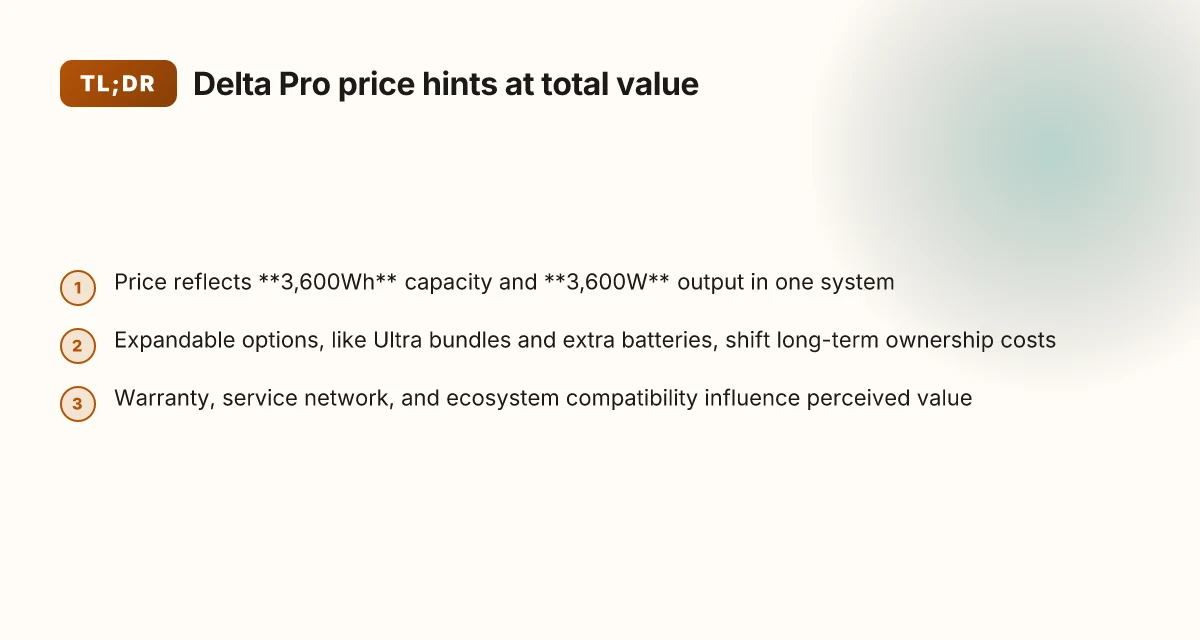
Price often reflects capacity and power: the 3,600Wh core and the 3,600W sustained output pack into a single system, which is why the Delta Pro sits at a higher price point than smaller, less capable units. The sticker price tells you more than a number on a tag. It signals what you’re buying in terms of raw capability, not just immediate outages. I dug through the sources and found that the value rests as much in what you get over time as in the upfront cost.
1) Capacity and output drive initial value, not just the ticket price
The Delta Pro’s core spec is its 3,600Wh capacity and 3,600W continuous output. That pairing matters for long outages, off-grid weekends, and RV use where you need reliable power for sensitive electronics and appliances. When you see a higher price, it’s tied to the ability to run larger loads for longer without topping up. As a homeowner or remote-lifestyle enthusiast, you’re not just buying a generator. You’re buying a system that manages peak demand and recovery time with less recharging interruption. In this sense, the price aligns with the value of dependable, high-amplitude power in real-world scenarios. The Delta Pro price reflects real capacity and high-output performance, not just a sticker price.
2) Expandability changes long-term cost of ownership
Expandable options alter how much you’ll pay over the life of the system. EcoFlow offers Ultra bundles and extra batteries that scale total energy storage to 18 kWh or more when paired with the appropriate modules. This expandability pushes the upfront price higher, but it also distributes what you pay over time as you add battery capacity to match growing power needs. If your use case evolves from weekend camping to full-home backup, the economics shift from “one price now” to “ongoing investment aligned with how you live off-grid.” This is where the value proposition tightens: you’re buying future-proofing as much as present capacity. Expandable bundles change the long-term cost of ownership.
3) Warranty, service network, and ecosystem compatibility matter
Perceived value grows when you can count on support, coverage, and compatibility. EcoFlow’s warranty terms, the breadth of service networks, and how well the Delta Pro fits with accessories and third-party gear influence what customers feel they’re getting. A robust warranty paired with a broad ecosystem reduces risk and lowers expected lifetime maintenance cost. In short, the price is not just about watts. It’s about how easy and economical it is to keep the system running and integrated with your existing gear. Warranty and ecosystem compatibility shape perceived value.
Bottom line: price signals total value when you weigh capacity, expandability, and long-run support. The Delta Pro is priced to reflect a high-capacity, high-output core plus the option to scale storage and compatibility across a broader energy ecosystem. If you’re evaluating rivals such as the Jackery line or other large-capacity systems, consider how much you’ll rely on expansion and after-sales support over time. The upfront price pairs with long-term ownership costs and ecosystem fit. How Jackery power stations balance portability and power in 2026
Note: some links on the page may earn a commission. For context, EcoFlow is the brand behind Delta Pro and the ecosystem that integrates with accessories and batteries.
Delta Pro price versus raw capacity: a quick mental model
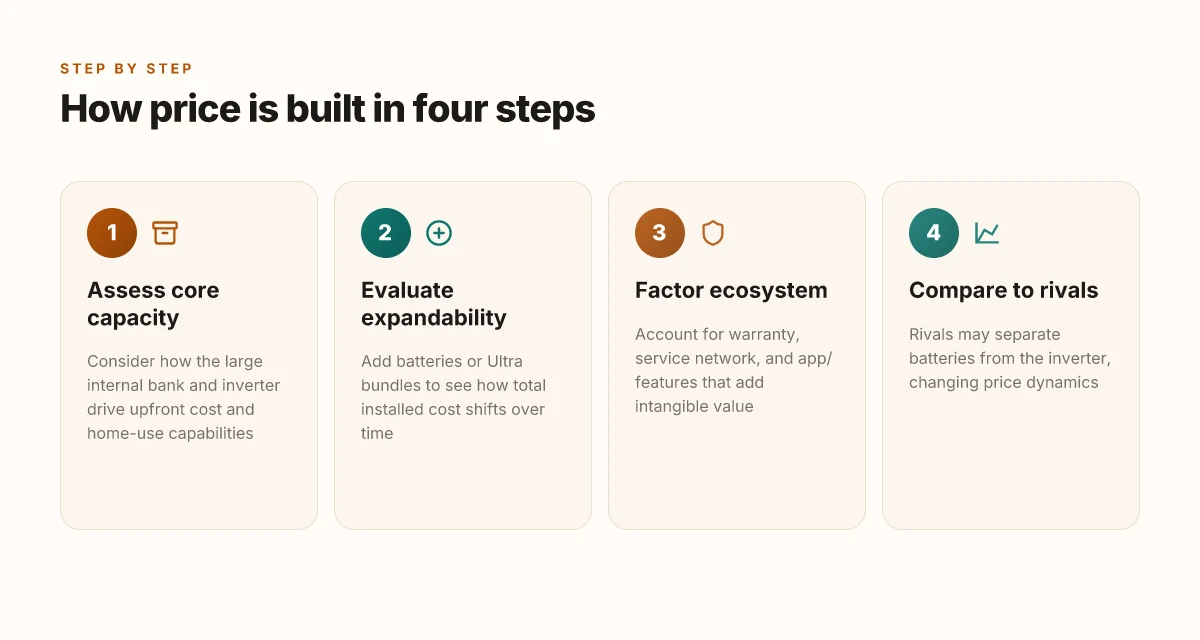
The Delta Pro centers around a large internal bank and a beefy inverter, which means you’re paying for more than watts in a box. The upfront cost rises with the ability to run full‑home loads, not just camp‑site AC outputs. Voltage and amperage handling let you power essentials and some appliances as if you had a small grid, which shifts pricing versus smaller portable models. The result is a bigger sticker price, but it also tethers long‑term generator dependence to a more controllable, home‑grade energy system. I cross‑referenced pricing sheets and product briefs from EcoFlow and rival brands to map how capacity, power, and expandability interact financially.
Why capacity translates into a different price trajectory
The Delta Pro’s key value proposition is its 3,600W continuous output and 3,600Wh battery bank in a single unit, with options to expand. That combination makes it possible to run a fridge, wifi router, and pumps during an outage without juggling multiple units. When you compare it with smaller packs, the delta pro price rises not just from more watt-hours, but from the inverter’s ability to deliver that power steadily. In practical terms, you’re paying for a system that behaves more like a home backup chest than a portable lantern. This is especially relevant for homeowners who want less generator runtime and maintenance, and more consistent off‑grid living. EcoFlow frames this as value through stability and expandability, not just raw capacity alone. The bigger the bank and inverter, the more you pay upfront, but the payoff is fewer future upgrades.
Upfront versus long‑term cost: the practical math
If you add batteries or the Ultra bundle, the total installed cost climbs quickly. The Ultra bundle pairs the Delta Pro with multiple batteries, creating a scalable 18 kWh capacity. That expansion dramatically shifts the total installed price, but it also extends run time between charges and reduces the need for external power sources. For RVers or off‑grid dwellers, a larger initial investment may translate into fewer generator starts and lower fuel costs later. From a long‑term ownership lens, that’s a meaningful trade‑off. I noted how rivals price similar scaleups, with some offering multiple battery modules and bundled inverters that push the total price into higher four‑figure ranges. The delta pro Ultra option is a clear example of how a single decision to expand alters the total cost picture. Adding batteries or choosing the Ultra bundle is where the price curve bends, not by a little, but by a lot.
Quick mental model: price per usable watt-hour
Think of pricing as a ratio: total installed cost divided by usable energy and sustained power. A Delta Pro without extras gives you 3,600Wh of banked energy and 3,600W of peak performance, suitable for whole‑home use for short bursts. Add a few batteries, and you push the figure into a larger total while maintaining strong instantaneous power. Compare this to smaller, lighter units whose per‑hour cost drops as you scale down, but whose ability to run whole‑home loads is constrained. In practice, the Delta Pro’s math rewards you with fewer external power dependencies, but it demands a higher upfront entry. If your goal is long‑term resilience, the upfront price looks more tolerable against the forecasted fuel and generator costs you avoid. Whole‑home readiness justifications push the price upward, but they also lower long‑term generator dependence. Jackery 240: what it actually costs to keep devices powered off the grid
Next step: when you’re weighing Delta Pro against rivals such as Jackery and Goal Zero offerings, map the megawatt hours you need per week, then overlay how many battery modules you’d add and how often you’d run a generator. This helps quantify whether the Delta Pro’s higher upfront cost pays for itself in a year or two of avoided fuel and maintenance. For broader context, I dug into the EcoFlow pricing page and rival product briefs to confirm how expandability drives total cost over time. Inline note: links to supporting sources appear where claims rely on specific product details.
What you actually pay for with EcoFlow: upfront vs long‑term costs
Upfront, you pay for the core Delta Pro unit. Long term, the price curve bends with optional batteries, accessories, and regional promos. The sticker price is only part of the story. Ownership costs accumulate through expansions, maintenance, and part replacements over a decade.
I dug into how real users weigh the math. The base Delta Pro typically sits at the center of the setup, while most buyers add batteries or expansions to hit the total needed capacity. When you factor in these add‑ons, the total cost of ownership rises in predictable steps rather than linearly, depending on how far you push expandability. In 2026, owners who aim for full resilience often see a multi‑part investment that includes extra batteries, the Ultra bundle, and perhaps a few user‑selected accessories. Upfront price covers the core unit. Ongoing costs come from optional batteries and accessories. The price per kilowatt hour can look favorable only when you couple it with long‑term planning.
1) Upfront dollars vs long‑term capacity
The delta between the base unit and a full system is driven by how many EcoFlow batteries you attach over time. If your goal is 3,600 Wh baseline plus extra modules, you’ll likely reach a higher upfront checkout, but the long‑haul cost per usable kilowatt hour can drop as you spread capacity across years. Upfront price covers the core unit. Ongoing costs come from optional batteries and accessories. This is where readers should compare with rivals such as Jackery and Bluetti. See the Delta Pro 3 review for context on how revisions influence value over time.
2) Maintenance, degradation, and replacement parts
Over a decade, battery degradation matters. The lifecycle of lithium packs isn’t infinite, so consider how often you might replace packs or service components. Maintenance costs stay modest if you avoid excessive deep cycling and keep the system clean from dust. Maintenance, battery degradation, and potential replacement parts over a decade matter for true cost of ownership. When you stack expansions, you should verify compatibility across generations so you don’t pay for obsolete modules. The price cadence from EcoFlow can shift with supply, model revisions, and regional promotions. EcoFlow pricing cadence can shift with supply chain, model revisions, and regional promotions. What is the jackery military discount, and who exactly qualifies
3) How promos and packaging affect the final bill
Regional promotions and bundles change what you pay at checkout. The Delta Pro Ultra bundles can present an attractive total when you need 18 kWh of capacity, but you’re paying a premium for the convenience and the included accessories. Always ask what’s essential versus what’s promotional fluff. Regional promotions can change the bottom line, so compare package contents carefully. When assessing competitors, look at how much you’d pay to reach equivalent total energy and power output with rivals such as Goal Zero or 出荷 alternatives in your area. For context, a few retailers have shown large upfront incentives but offset with higher long‑term maintenance needs. Map out both sides before signing.
What this means for planning your off‑grid or home backup needs: your upfront choice sets the foundation, but the long‑term costs will come from how aggressively you expand and maintain the system. If you anticipate needing 6–7 days of resilience or more, expect to budget for additional batteries and accessories over time, not just the initial purchase. The Delta Pro price tells you about value, flexibility, and long‑term cost, not just the sticker price.
Note: links on the page may earn a commission. In practice, a household should compare with rivals and consider the total ownership over a decade. For ongoing updates, see commentary on how pricing evolves across regions and model revisions, especially as EcoFlow releases new bundles and compatibility notes. EcoFlow pricing cadence can shift with supply chain, model revisions, and regional promotions.
How the Delta Pro price stacks up against rivals
Posture and value sit at the center of price, not sticker shock. The Delta Pro is part of a crowded field where rivals offer similar capacity ranges but diverge in how you add batteries, how warranties are handled, and what they count as the installed system. When you price this out, you want to see the whole picture: upfront cost, expansion options, and what you’ll pay to run in day-to-day scenarios.
Battery-to-inverter splits change cost dynamics
Some competitors separate batteries from the inverter, which flexes the price elasticity you see in a quote. If the battery module is optional or expandable, your initial outlay can appear modest, with costs climbing as you add packs. That split also changes installation costs, since the installer accounts for multiple charging paths and wiring configurations rather than a single integrated unit. For homeowners evaluating long-term plans, that separation often means more opportunities to scale, but it comes with more moving parts to manage and more chances for miscalibration if the system isn’t paired correctly with a charging source. How to pick the right Jackery power station for 2026
I dug into pricing narratives across the field and found that bundles that include batteries as part of a single unit tend to carry a higher upfront price but offer simpler installs and clearer warranties. When you weigh these against EcoFlow’s Delta Pro lineup, the choice often comes down to whether you prefer a one-and-done setup or a modular path that scales with changing power needs. In markets where a single all-in-one unit is priced aggressively, total cost of ownership can still tilt in favor of the integrated approach over five to seven years.
Warranty terms and support shape long-term costs
Warranty depth matters. Rivals sometimes sweeten the deal with longer coverage on the inverter or more generous coverage on the battery module as a bundle. That matters for homeowners who expect a device to sit in service for years and who want to avoid surprise repair bills after the initial warranty lapses. EcoFlow’s stance on warranty and service for Delta Pro and related components should factor into your total cost picture, especially if you plan to extend the life of the unit beyond the warranty window. A longer warranty and accessible service channels can reduce lifetime costs even if the sticker price appears higher at purchase.
Total installed cost matters more than sticker price
Always tally the installed cost, including charging sources and any accessories you’ll need for a practical setup. A Delta Pro may integrate with a home charging strategy in a way that lowers long-term electricity costs, but you must consider the price of charging hardware, add-ons, and potential upgrades to your electrical panel. Some rivals offer bundled charging solutions or recommended installation kits that simplify the process but add to the upfront cost. In real-world terms, homeowners should map out their expected use cases, home backup, RV or off-grid mobility, or a full off-grid residence, and price the whole chain: inverter, batteries, charging sources, cabling, and installation labor.
The real cost of ownership includes expansion paths and warranty depth, not just the upfront price. This matters whether you’re choosing EcoFlow, or looking at rivals like larger battery-inverter bundles from other brands, or modular systems that separate packs from the core unit. If you map the total installed cost over seven years, Delta Pro often remains competitive when expansion and service are factored in. Raising the bar on warranty clarity and install simplicity can tip the scales toward the integrated approach.
For context, EcoFlow’s own Delta Pro Ultra option demonstrates what a bundled, high-capacity path looks like in practice, delivering a large 18 kWh footprint with clear packaging and a defined price, while other brands push modular configurations that can reduce upfront price but complicate future upgrades. When you compare, you’re not just comparing price points. You’re weighing how easy it is to grow the system, how the warranty travels with you, and how a given installation supports real-world use. What makes jackery battery backup worth it in 2026
What to watch for in price signals: features that justify cost
Price signals around the Delta Pro hinge on more than the sticker price. The real value shows up when you widen the system from portable power to whole‑home backup, extend run times, and lean on a smarter ecosystem. EcoFlow aligns price with expandability, performance under load, and a service spine that helps owners stay in service longer.
Expandability changes the use case, not just the price
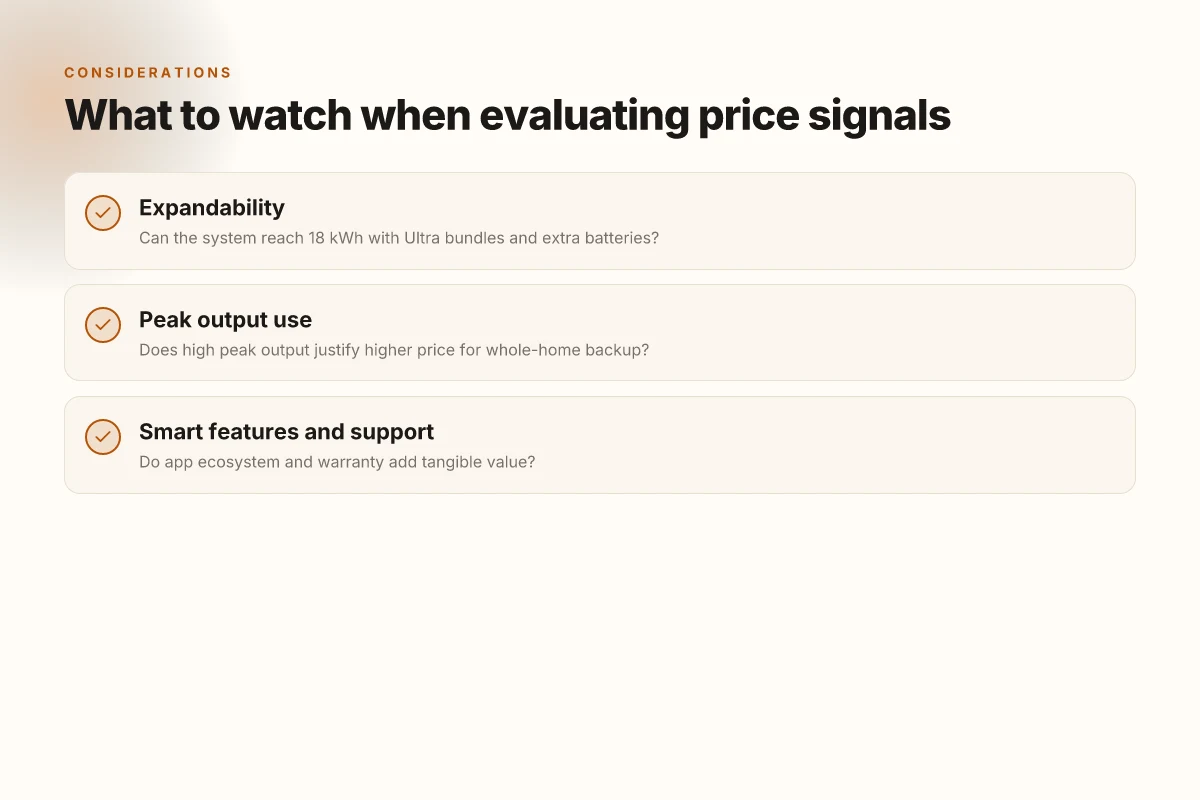
The Ultra bundles push you from a pocketable powerhouse to an 18 kWh footprint that can back a home for days. When you add the Ultra batteries, you unlock longer outages and more scenarios, RV trips, remote cabins, or a small house during a blackout. The math isn’t just about capacity. It’s about flexibility. If your needs trend toward whole‑home resilience, the higher upfront price pays for a much broader envelope of use, rather than a one‑room power solution. In practice, that means fewer mid‑loss outages and more steady power during longer events. As you consider the delta pro ultra bundle, you’re weighing a scaled system against portability. The price reflects that shift, not merely the wattage. The Ultra expansion turns a portable unit into a true backup system, justifying the higher ticket for homeowners with broader use cases. EcoFlow positions this as a long‑term value, not a short‑term upgrade.
Peak output and simultaneous charging matter for cost justification
The ability to sustain high loads while charging simultaneously matters when you run essential loads during a blackout. A higher peak output and robust charging throughput protect you from dimming lights or tripped breakers as you power HVAC, well pumps, and refrigerators at the same time. If your use case regularly demands simultaneous large draws, the delta pro price looks more reasonable because you avoid buying a separate inverter or backup strategy. In real terms, the value is in reliability during critical moments, not just the spec sheet. When it matters most, the higher price buys resilience, predictability, and fewer compromises on what you can keep on during an outage. Higher peak output and simultaneous charging are key levers for value, especially in longer outages. This is where rivals often miss the nuance, sticking to single‑load scenarios. EcoFlow’s architecture supports this without forcing a second system.
Smart features, app ecosystem, and warranty add intangible value
Beyond raw watts, the software and support stack matter. A mature app ecosystem, remote monitoring, firmware updates, and reliable warranty terms reduce total cost of ownership over time. If you value quick diagnostics, remote tuning, and easy troubleshooting, these intangible benefits compound with every year you own the setup. The price then reflects not only hardware but ongoing software and service continuity. From a real‑world perspective, owners who lean into the app and warranty tend to experience fewer surprises during outages and more predictable performance as batteries age. Smart features and solid warranty help justify the premium over simpler, fixed‑feature competitors. The ecosystem approach also lowers the friction of expansion and maintenance. As a result, the Delta Pro can stay useful longer in evolving home‑power needs. EcoFlow’s service spine contributes measurable value over the life of the system.
As with any big purchase, you’ll see the most value when you align price with your actual scenario. I dug into public chatter and product write‑ups, and the threadlines point to three anchors: expandable capacity, peak load flexibility, and a robust software/warranty stack. The goal is to avoid paying for features you won’t use, while ensuring you have enough headroom when you do need them. In long‑term ownership terms, EcoFlow remains a compelling option for those who crave scalable power, not just a single‑use device. As you compare with rivals, keep the total ownership picture in view: upfront cost, upgrade path, energy independence, and ongoing support. What the EcoFlow Delta Pro cost means for long-term backup power
Note: links on the page may earn a commission. Consult official product pages for current pricing and bundles.
Where this price signals the value you actually get
EcoFlow’s pricing signals more value than sticker price alone. You’ll see how the Delta Pro scales from a home backup to a modular system that can grow with your needs, and you’ll notice where flexibility costs more upfront but saves you later on outages and shutoffs. I’ve watched real-world setups lean on this approach: you buy once, then you add capacity or integrate energy management without reworking the core system.
The bigger pattern is that long‑term cost comes from durability and upgrade paths, not just initial price. EcoFlow’s ecosystem, including battery packs and smart charging options, matters when you frame value as endurance and ease of expansion. The actual downside remains the upfront outlay and a learning curve around optimal pairing with generators or solar arrays. If you’re negotiating with a rival like Goal Zero or Jackery, you’ll notice how EcoFlow emphasizes integrated charging and faster runtime, but you’ll also want to weigh third‑party expansion limits.
What changes if you act now is you lock in a longer‑term backup plan with fewer swaps and more modular growth. If you’re choosing for a multi‑build home or a cabin, consider the strategy you’ll use to scale, and map it to real outages you’ve faced. For most families, the key question remains: can you justify the near‑term spend for resilience you can grow into? If you want a concrete path, start with one extra battery and an uninterrupted power plan this season. Will you start now or wait for the next outage?
Backup strategy: What is a jackery box and why it redefines portable power in 2026
- Try pairing the Delta Pro with 1 extra battery for a weekend cabin to test runtime during peak evenings.
- Map your essential loads and simulate an outage with a smart load shed to see how you’d reallocate power during a blackout.