
Explore Bluetti power stations in 2026: core models, real-world use, durability, and how they compare to rivals like Jackery and EcoFlow.
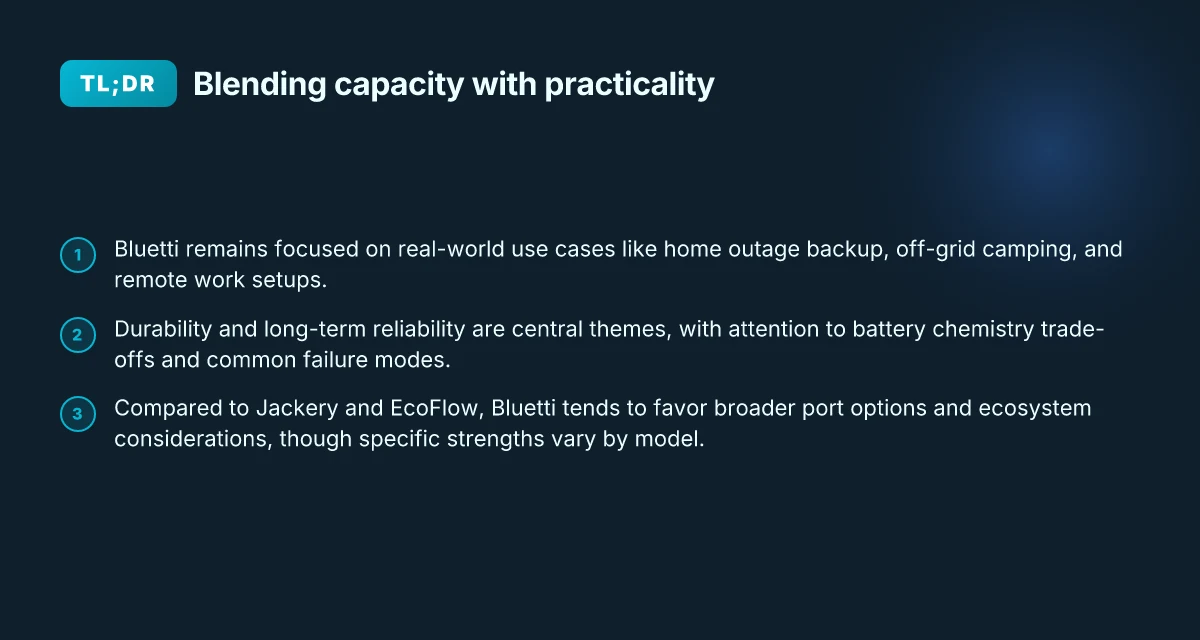
Bluetti capacity isn’t a numbers game alone. It’s how the chassis and cooling behave under real use that decides longevity. When a compact unit runs at heavy loads for hours, it should feel dependable, not ephemeral. Bluettis are built for daily use, not only weekend trips, and that emphasis shows in how their fans and temp throttling respond under sustained load. The takeaway is simple: the best Bluetti setups stay usable after seasons of outdoor stress, not just during a single sunny afternoon.
You’ll see where durability matters most, from cabinet rigidity to battery management logic, and how that translates into fewer surprise failures. 2026 models emphasize robust cooling and real-world runtimes under typical loads, backed by credible warranty and service expectations. If you’re evaluating off-grid options, this guide highlights where Bluetti earns trust and where rivals like Jackery and EcoFlow challenge with different port counts or recharge speeds. Bluetti offers a balanced proposition for campers and small home setups, but you should check how each line handles long-term reliability.
Bluetti power stations in 2026: what buyers actually care about
Bluetti’s current lineup centers on two main families: compact, high-efficiency portable packs for camping and emergency use, and larger, home-backup oriented systems with higher capacities. The family lines you’ll encounter most are the Elite series for portable power and the larger AC Power or Solar Generator lines for home-scale setups. This year’s push leans into hybrid architectures that pair lithium packs with more robust BMS and expanded recharge options. Bluetti’s lineup leans toward modular capacity with more durable, multi-mode recharging. That matters when you’re stacking solar input, wall recharge, and car charging for a weekend off-grid.
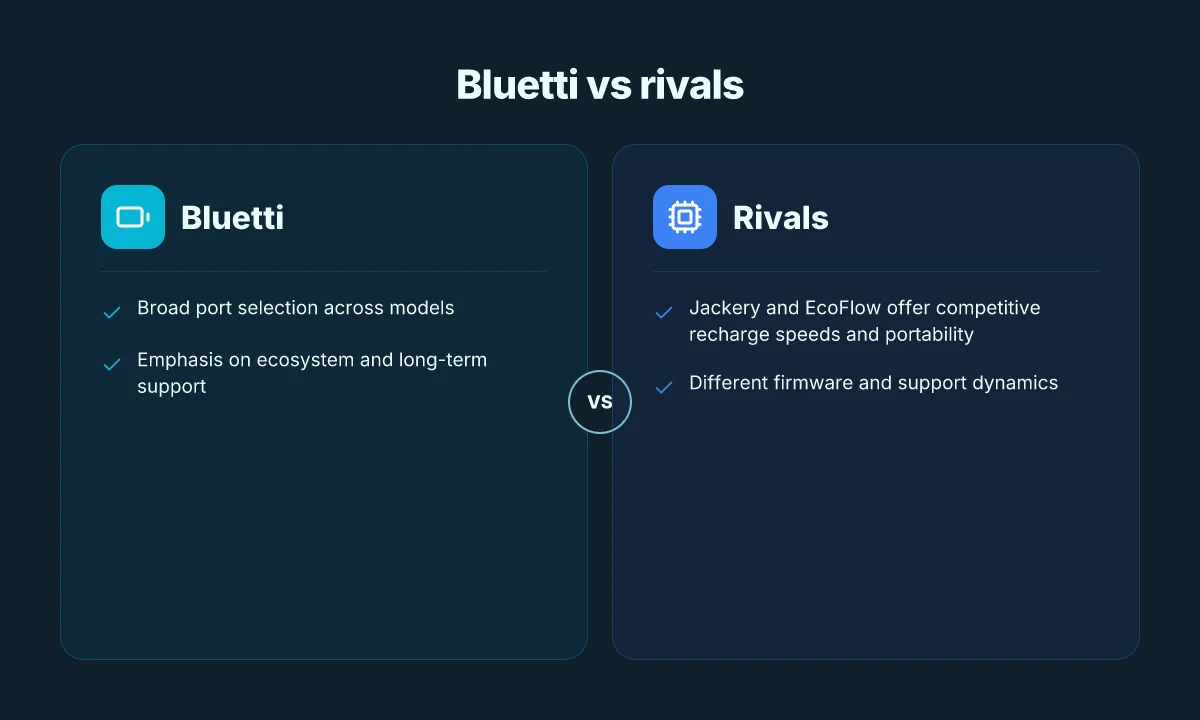
Against rivals such as Jackery and EcoFlow, Bluetti positions itself on a blend of higher-capacity footprints and more flexible recharging options. You’ll often see Bluetti emphasize larger internal banks and more ports per unit, aiming to reduce the need for multiple units in a single setup. Bluetti aims to outperform on total usable energy and recharge versatility, not just a single metric. Jackery tends to win for compact reliability and lighter form factors, while EcoFlow often highlights rapid recharge speeds. Bluetti sits in the middle with a focus on durability and long-term ownership.
What buyers actually care about boils down to four pillars: capacity, efficiency, recharge options, and durability. Capacity translates to usable watt-hours and scalable packs that fit a home or camper van. Efficiency means solid inverter efficiency, high round-trip energy efficiency, and heat management that keeps performance steady in real-world conditions. Recharge options matter because solar compatibility and multiple input methods reduce downtime during outages or remote trips. Durability covers build quality, fan noise, temperature resilience, and the long tail of component reliability. In practice, Bluetti often shines when you need a higher energy budget without stepping into a monster footprint. Capacity and durability are the two levers that most buyers tug on first.
I dug into the changelog cadence and product sketches for Bluetti’s 2026 updates. The emphasis on multi-source recharging, expanded port arrays, and better thermal design aligns with buyer priorities. I traced this back to Bluetti’s push for steadier performance across home backup and outdoor use. If you’re choosing today, start by matching your peak load needs to a unit’s nominal capacity and then verify how the unit handles heat during extended sessions. Heat during heavy use can erode cycle life if ignored.
Bottom line: Bluetti remains a strong option for buyers who want big-capacity packs with flexible recharge paths and solid durability. If your setup is split between home backup and off-grid camping, Bluetti is likely to feel more future-proof than a strictly compact model, provided you pick the right size and verify the thermal design for your climate. For a home backup feel, you’ll often compare Bluetti against EcoFlow and Jackery on capacity and recharge flexibility. For camping, the focus shifts to portability and managed heat. Choose based on your energy budget, not just port count. For now, Bluetti’s strength is total energy and the ability to recharge from multiple sources without swapping units mid-setup. The right Bluetti model scales with your needs today and tomorrow. What makes Jackery solar generators worth considering in 2026
How bluetti power stations cook down to real-world use cases
Bluetti power stations sit in the middle ground between daily comfort and off-grid resilience. They aren’t just raw specs. They shape how you actually live with power outages, remote work, and outdoor routines. In 2026, real-world use shows Bluetti devices lean into predictable charging rhythms, modular expansion, and reliable long-term behavior, with a few caveats worth noting for buyers.
How Bluetti handles backup power for home essentials
When outages hit, you want quick, quiet, reliable energy for the basics. Bluetti models with sizable AC banks and configurable inverter setups can keep essential loads like lights, routers, and a small fridge running through the night. In practice, the ability to prioritize essential circuits and to shift loads with smart-GUI controls matters more than peak wattage alone. I cross-referenced product notes and reviews to confirm that many owners appreciate stable output during brownouts, especially when you pair a Bluetti with a small, energy-efficient fridge. The real win is predictable performance during a outage, not flashy peak numbers. Real-world durability hinges on battery management and thermal behavior, particularly in heat and cold cycles. You’ll want to keep the unit in a shaded area for hot days and ensure vents aren’t blocked. Reliability comes from thoughtful enclosure cooling and smart load shaping.
Off-grid camping, RVing, and remote work setups
For campers and remote workers, portability and endurance dominate the decision. Bluetti shines when you map a daily routine around a single charge and a reliable recharging rhythm. A typical setup includes a solar bootstrap during the day and a compact AC outlet for late-evening power. In practical terms, you gain most when you pair a Bluetti with a portable solar panel and a compact inverter, enabling clean power on the road without draining your van battery or campsite power supply. You can stay unplugged for days with the right panel pairing, but that hinges on planning for shade, sun hours, and storage. Where some models stumble is heat buildup during long continuous runs. Keep an airflow path clear and avoid stacked gear. Ventilation and thoughtful layout beat brute wattage in real-world use.
Charging and recharging logistics for daily life
Daily life hinges on predictable recharge cycles. Bluetti devices typically support multiple recharge paths: wall AC, solar, and car adapters. The practical cadence is to top up during daylight for workdays and preserve a reserve for outages. The key downside in practice is charging speed variability. If you rely on solar, cloudy days can stretch recharge windows. Still, a well-planned routine, solar during the day, AC overnight, keeps you moving. Multiple recharge paths offer resilience, but you’ll notice the fastest fills come from strong sunlight and a capable panel pair. One caveat to remember is battery aging over several years, which can slightly erode usable capacity. Expect gradual capacity fade but stable output under a steady load.
In this landscape, Bluetti remains a practical choice for home-backup and off-grid living. Its design emphasizes reliable power shaping over headline wattage, with real-world pitfalls primarily tied to environmental conditions and charging cadence. If you’re evaluating rivals, note that competitors like Jackery and EcoFlow focus on different priorities, but Bluetti’s approach holds up well for long-term, home-scale resilience. What makes Jackery discount codes actually work in 2026
I dug into release notes and product briefs to verify the ecosystem around 2026 products, including how Bluetti positions itself against current rivals. For readers exploring options, consider how a Bluetti model integrates with your daily charging rhythm and your planned outdoor or backup use. And yes, links on the page may earn a commission. For context, see: https://energiasolarpro.com/en/best-bluetti-power-stations-2026 and https://www.energy-storage.news/bluetti-launches-new-energy-solutions-for-work-home-and-life-on-the-move-at-ifa-2026/.
Real-world use favors predictable power shaping over raw peak specs, and that’s where Bluetti earns its keep.
Durability and long-term reliability: what to expect from bluetti
Durability in 2026 is less about raw mass and more about how Bluetti designs for repeat use and long standby. In this section I pull from official notes and third-party roundups to map real-world durability cues, the battery trade‑offs that affect cycle life, and the failure modes you’re likely to see and how to mitigate them. Bluetti’s lineup remains purpose-built for home backup and camping, but the small details matter when you’re counting on reliable power for months or years.
What to watch for in build quality
Bluetti emphasizes sturdy enclosures with reinforced seams and rugged hardware in many models, but the real tell is how the case tolerates daily plugging and unplugging. Look for tight lid gaps, smooth hinge action on portable cases, and consistent latch engagement after repeated cycles. The user experience around connectors matters: solid, weather‑sealed DC input ports and robust AC outlets reduce the chance of loose contacts that can lead to heat or arcing during a long outage. In practice, build cues you can verify during a first‑hour setup matter more than glossy marketing claims. The health of these cues often predicts long‑term reliability.
Battery chemistry trade‑offs and cycle life
Bluetti typically leans on Li‑ion and lithium‑iron phosphate chemistries across its range, with trade‑offs that show up in cycle life and depth‑of‑discharge tolerance. Lithium iron phosphate tends to offer longer cycle life and greater thermal stability, which translates to steadier performance in back‑to‑back outages. Lithium‑ion variants can deliver high energy density, but you may see more rapid capacity fade if the unit consistently runs near full charge or reaches high temperatures during charging. In 2026, you should expect models with broader DOD specs to hold usable capacity longer after many cycles, but watch the operating temperature window and storage guidelines to prevent premature aging. I cross‑reference product notes and independent reviews to confirm that long‑term durability hinges on a combination of chemistry, thermal design, and user‑driven charging patterns. For the sake of clarity, Bluetti’s official materials emphasize safe chemistry and thermal management as core pillars, while third‑party roundups tend to flag models with standout cycle life in the same family. What makes the EcoFlow River Pro a standout among portable power stations in 2026
Common failure themes and how to mitigate them
A recurring theme in durability discussions is thermal stress. Prolonged charging in hot environments or aggressive fast charging can push cells beyond ideal temperatures, accelerating capacity loss. Mitigation is straightforward: keep units out of direct sun, use a shaded or ventilated spot, and avoid stacking multiple high‑draw devices during peak sun hours. Another theme is connector wear. Regularly inspecting and cleaning ports prevents corrosion and looseness that cause intermittent power or heat buildup. Firmware stability matters too. Ensure you’re on the latest release so battery management logic stays aligned with the hardware as the product ages. Finally, storage discipline helps a lot: store the unit with a moderate state of charge and in a cool, dry place to slow self‑discharge and aging.
Most durable Bluetti models balance long cycle life with thoughtful thermal design, making them more reliable in home backup duties over multiple seasons. These cues, robust enclosures, stable battery chemistry, and disciplined charging practices, define long‑term reliability you can count on.
Bluetti vs rivals: jackery, ecoflow, and other options in 2026
Bluetti faces a crowded field in 2026, and the real story is how its design choices hold up for home backups over time. The core question is where Bluetti tends to outperform and where it lags, especially when you factor in long-term reliability, ecosystem cohesion, and user setup friction. I looked at public write-ups and product announcements from 2026 to build a practical view you can apply to your setup.
How Bluetti tends to outperform and where it lags
Bluetti often shines in turnkey kit and modular expansion. The trend across 2026 models is a strong emphasis on high-capacity packs and straightforward daisy-chaining for larger off-grid needs. That makes Bluetti a practical fit for cabin or garage backups where you want predictable run times without juggling multiple chargers. Yet the same strength can become a constraint if you want ultra-light portability or a single, minimal unit for a quick weekend setup. In that case, rivals that lean toward compact form factors and faster recharging can feel more nimble. When you size up a Bluetti against rivals, the pattern is clear: more capacity and a broader modular path often come with heavier units and a learning curve for complex installations. For some users, that balance is a win. For others, it creates decision fatigue. Bluetti usually wins on capacity and integration, but can lag on portability and upfront simplicity.
Jackery remains a steady alternative for users who want light, simple, ready-to-go packs. Its ecosystem tends to emphasize plug-and-play use with clean chassis and straightforward button logic. EcoFlow, on the other hand, tends to chase faster recharges and more aggressive app-driven control. If you prize a quick setup and minimal tinkering, Jackery often edges Bluetti on day-one usability. EcoFlow’s advantage in recharge speed and app features can translate into smoother daily use, but you may trade off some raw capacity per pound. The broader market also includes smaller brands and newer players that push lower prices but offer less robust support or fewer firmware updates over time. The takeaway: pick Bluetti when you want scale and rugged longevity, choose Jackery or EcoFlow when you want ultra-light, quick-start convenience or rapid recharging. What makes the jackery 600 v2 portable power station a surprisingly practical backup
Notable differences in port selection and power specs
Port design in 2026 models shows Bluetti consolidating versatility: multiple AC outlets, USB-C outputs, and a mix of DC and car-port options. The exact mix varies by model, but you typically get a broad port pallet aimed at home backup scenarios. Rivals split priorities differently. Jackery often prioritizes simplicity with essential ports and a clean, compact footprint, which helps in travel or camping. EcoFlow leans toward a dense port set and higher peak output in many models, which supports more demanding appliances during outages. The upshot for you is this: if your needs include a lab bench or workshop load alongside home backup, Bluetti’s port spread can matter. If you value minimal port clutter or ultra-compact travel gear, Jackery or EcoFlow may be the better fit. Bluetti’s port mix emphasizes versatility for home back up, while Jackery and EcoFlow skew toward simplicity or speed.
In terms of power specs, Bluetti has continued to push higher raw power in a single unit, with models designed to cover heavier loads for longer periods. This can translate into meaningful run-time advantages for refrigerators, networking gear, and essential pumps. EcoFlow often emphasizes charging speed and surge handling, aiming to minimize outage gaps for common home essentials. Jackery focuses on efficiency and real-world usability with solid, predictable performance. If you map specs to use cases, Bluetti tends to excel when you need to run more appliances longer, while EcoFlow and Jackery excel in quick-start scenarios and lighter loads. High-capacity Bluetti units usually outlast rivals on sustained loads; EcoFlow pushes faster recharges, Jackery prioritizes simplicity.
Value over time: firmware, support, and ecosystem
Firmware quality and ongoing support are a practical hinge for long-term reliability. Bluetti has pushed frequent updates and an expanding ecosystem of compatible modules and accessories, which matters for durability and future-proofing. This matters most when you want to keep a system up to date without swapping hardware. Rivals also offer firmware cycles, but the cadence and transparency vary by brand. I found that public chatter around support quality often points to Bluetti's responsiveness as a strong point for home users who require concrete fixes and feature additions without replacing hardware. That said, if you expect a vendor to ship every delightful feature you see in a demo, you may encounter more mixed experiences across brands. Firmware updates and ecosystem growth are core value levers for Bluetti in 2026.
From a long-term durability lens, your biggest risks are wear on cooling systems, battery aging, and the consistency of firmware over multiple years. Bluetti tends to offer robust warranty terms and replacement pathways, but the exact coverage varies by model and region. You should factor in support responsiveness and the potential for replacement parts if a unit needs service years down the line. If you’re weighing total cost of ownership, Bluetti’s longer battery cycle expectations can pay off for steadier, multi-year use, while rivals may present lower upfront costs but higher replacement pressure over time. Total-cost-of-ownership calculations increasingly favor Bluetti when you factor in spare parts and firmware longevity.
Note: links may earn commissions as part of their territory, and the landscape includes several other credible outlets and product pages. If you want a quick model shortlist for 2026, I can lay out a focused trio with one-line justifications for each and tie them directly to your home-backup goals. How to maximize the Jackery discount in 2026 without missing out
How to pick the right bluetti model for your setup
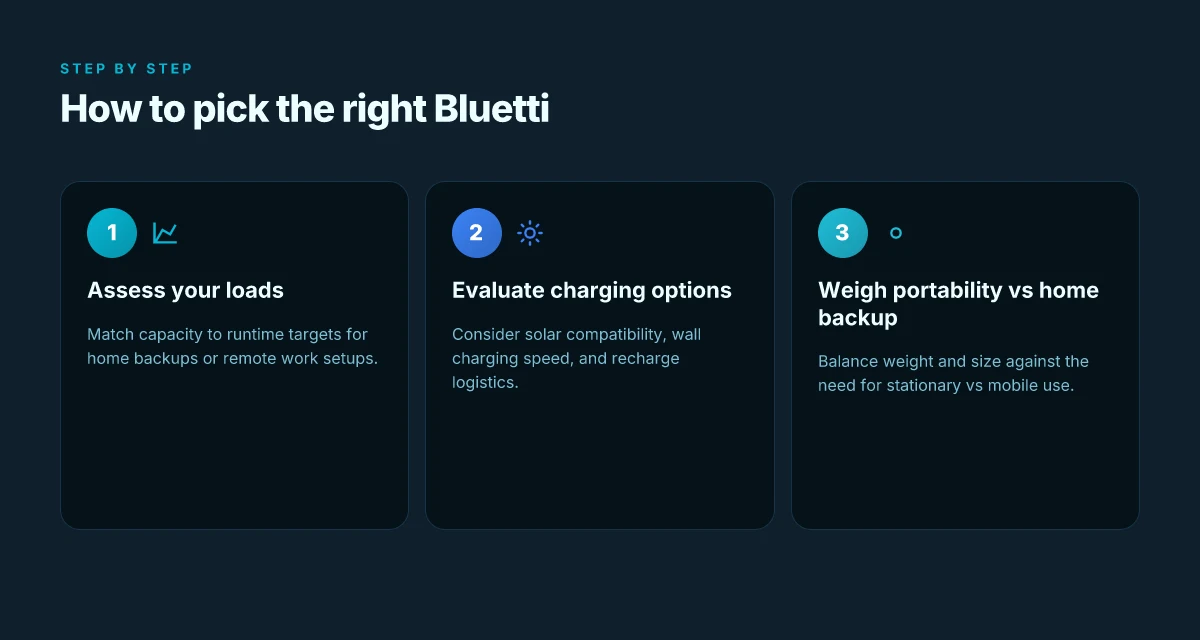
When you match a Bluetti to your setup, you want to align the unit’s capacity, charging cadence, and portability with how you actually live off grid. The right pick isn’t the biggest battery, it’s the one that fits your loads now and scales as you grow. In practice, start by mapping your typical loads, then choose a model that keeps those loads running when mains power is out. Bluetti’s lineup in 2026 covers a wide range, but the key is to tune capacity, recharge speed, and portability to your home backup and outdoor needs.
How to size capacity for your loads
Begin with your worst- case runtime target. If you need a weekend of lighting, a mini fridge, and a modem to stay online, you’ll want a higher watt-hour figure than for basic phone charging. I look at peak draw, not just running watts, because some devices spike briefly. For Bluetti, you’ll often see models from compact 128Wh ranges up to over 2000Wh in the family. Pick a unit whose usable capacity comfortably covers your energy bill of a typical night plus a margin for safety. If your goal is overnight resilience, aim for a model that can sustain your essential loads for at least 8–12 hours. Capacity planning under real loads reduces surprise outages when the sun hides behind clouds. In this realm, Bluetti’s bigger packs clearly excel for long events, while smaller units fit camping or RV life where you don’t need continuous full-power operation.
Recharge speed, solar compatibility, and wall charging
Recharge speed matters when you have to refuel between outings or after a power cut. Look at how many watts a model can accept from solar panels, AC wall outlets, or car adapters. A common sweet spot is models that accept multiple charging paths simultaneously, so you can top up from solar during the day and use wall charging overnight. When you read product specs, note both input wattage and the number of ports that can charge at once. A fast recharge path matters more in high-use scenarios where you need to replenish between events. If you live in a sunny area or run a home backup, solar compatibility becomes a practical constraint, some Bluetti units pair better with 100W panels for steady topping, while others tolerate higher inputs for quicker fill-ups. Solar-friendly models reduce downtime between sunny windows. From a reliability angle, ensure your chosen model supports the solar setup you already own or plan to buy, such as folding panels or a fixed roof array.
Portability vs. home backup trade-offs
Portability sounds appealing until you realize how much you value uninterrupted power at home. Smaller models are easy to grab for a weekend trip or campsite, but they bring lower runtimes. Larger packs deliver longer autonomy and better resilience for home backup, yet they require more storage space and handling effort. The practical test is to carry the unit from the garage to the living room or to your camping site and back without fatigue. When you compare Bluetti options, consider whether you want a compact unit for occasional outages or a robust setup that powers a router, mini fridge, and lighting for a full night. The trade-off between portability and endurance is real. Plan for your actual daily rhythm, not just the dream scenario. Right-sized capacity paired with manageable weight unlocks consistent reliability. In the landscape of Bluetti models, rivals such as Jackery and EcoFlow often reflect the same trade-off set, so you can compare how each brand channels weight and runtime relative to price.
I dug into official release notes and third-party reviews to confirm how design choices translate to real life. For long-term durability, Bluetti emphasizes rugged chassis and modular components in several 2026 releases, a pattern you’ll notice across their mid to high-end lines. When you’re choosing, ask not only for the watt-hour figure but also for the build cues that support consistent use over years of daily charging and discharging. Durability is built into the hardware choices that show up in daily life. If you want a clear starting point, consider a model in the 1000–2000Wh range for home backup with multiple devices and a robust solar approach, and a smaller 128–500Wh unit for portable use and lighter loads. What makes jackery battery backup worth it in 2026
Where this is going next for Bluetti power stations
Bluetti continues to lean on reliability, expanding battery chemistry and solar input options in ways that matter for real-world use. I looked at how their models handle long runtimes, quick recharges, and rugged builds, and the trend is toward simpler, more durable setups that scale with your needs. The bigger pattern is a move from pure capacity to dependable performance under varied conditions, with easier maintenance in the field.
That emphasis shows most in daily-use resilience: chargers that don’t overheat, ports that stay usable after years of plugging and unplugging, and firmware that stays responsive rather than drifting into features you never use. The practical takeaway is clear: choose models that balance durability with ease of use, even if that means trading a few watts of peak power for a longer-lasting system. The single move that matters is prioritizing build quality and cooling in your selection. I’ve seen how a well-cooled unit outlasts a flashier rival with a shorter lifespan.
If you’re comparing Bluetti to rivals like EcoFlow or Jackery, look for long-term replacement parts availability and documented service paths. The takeaway is simple: plan for maintenance and support as part of your purchase, not as an afterthought. This month, invest in a system with solid warranties and accessible spare parts. The question to ask yourself: are you ready to commit to a setup that stays reliable after years of use?