
Explore a 2026 roundup of portable power stations with real-world performance insights, durability notes, and value assessments. Find which models best fit outages and off-grid adventures.
A single miscalculation in portable power setup wastes more time than a bad charger ever will: choose the wrong capacity for your gear and you’ll either carry extra weight or run dry halfway through a trip. 8 portable power stations are scrutinized here for real-world reliability, from campers to off-grid workers, with a focus on how they hold up after months of use, not just how they spec on day one.
These picks matter because outages and remote jobs don’t wait for perfect weather or perfect cables. In 2026, durability and long-term performance separate the usable packs from the decorative ones. This roundup weighs weight, ports, and heat-handling alongside practical endurance, drawing on field observations from homeowners, crews, and tech enthusiasts who need ready power for weeks at a time. Expect honest trade-offs, from slow recharge quirks to battery-care habits, and see which models from brands like Jackery, EcoFlow, Goal Zero, Bluetti, Anker, and Renogy consistently deliver. Most packs show noticeable gains in reliability after break-in hours, but caveats remain.
Portable power station reviews in 2026: how to pick the right model for your needs
Knowing what you actually need from a portable power station is the first step. If you want reliable power for a week off-grid, you’ll trade weight for runtime. If you’re safeguarding a home outage, durability and ecosystem matter more than raw run-time. I looked at how reviewers frame these tradeoffs and how real users deploy them in field conditions.
Define your critical loads and run-time needs
Start by listing the devices that must stay powered during an outage or a remote trip. A coffee maker and a CPAP machine have very different power demands than a laptop and a light. For each item, note the wattage and how long you want it to run. Then translate that into a target total energy need, typically expressed in watt-hours. Brands like Jackery and EcoFlow publish battery capacities and inverter ratings that help compare real-world run-times. Your must-have list should drive the battery size, not the latest feature set. When you compare, expect a higher capacity to bring more weight. Plan for a balance that fits your carry-on or vehicle space.
Balance battery capacity with weight and charging speed
Capacity matters, but so does portability. A larger battery pack extends run-time but adds weight and bulk. Look at the rated capacity in watt-hours and the discharge rate, then pair it with the unit’s weight. Charging speed becomes crucial if you need a quick top-up between campsites or after a blackout. Some models ship with fast-charge input options across multiple ports, while others cap input to a single USB-C PD or AC inlet. I cross-referenced reviews that flag how fast each unit recharges from zero to full under typical household input conditions. The sweet spot is a model that offers brisk top-ups without becoming a shoulder-haul.
Assess durability for outdoor use and weather conditions
Outdoor use demands rugged casings, latching handles, and sealed ports. Look for IP ratings, drop-tested claims, and reviews that mention heat dissipation in warm months or cold-weather performance. A unit described as travel-friendly may falter when weather gets rough if it lacks proper protection or venting. I noted durability themes across credible reviews, including how well the case materials hold up after repeated deployments. Durability under real-world use often matters more than the tightest efficiency spec. Expect occasional stiffness in the user interface or modestly slower firmware responses in older models.
Consider ecosystem and accessory support across brands
The value of a power station often rests on ecosystem: solar panels, car charges, extra batteries, and companion apps. Some brands offer modular expansion kits or official solar panels that pair cleanly with the battery, while others rely on third-party accessories. Reviewers emphasize whether a unit’s accessories feel robust and whether the app provides reliable status dashboards or firmware updates. If you already own panels or docks from a brand, that compatibility can save time and money. Choosing an ecosystem that matches your existing gear pays off in the long run. I fact-checked compatibility notes against manufacturer pages and independent reviews to ensure the claims line up with real-world usage. How to find the best Jackery for sale in 2026 without overpaying
In sum, pick a model that aligns with your daily needs, balances weight and run-time, holds up outdoors, and fits your accessory ecosystem. The 8 portable power stations most often cited across 2026 reviews, each brings a distinctive strength, provide a reliable cross-section for readers weighing their options. The takeaway is practical: define demand, measure tradeoffs, and verify durability and compatibility before you buy. Define your loads, balance capacity with weight, and choose a durable, ecosystem-friendly option.
The 8 power stations that consistently show up in portable power station reviews in 2026
When you look across major roundups, eight models or brands recur for durability and real-world use. The pattern is clear: you get solid performance on capacity and a track record for reliability, but caveats thread through every pick. I cross-referenced top lists from OutdoorGearLab, Consumer Reports, Popular Mechanics, and independent guides to map the field to 2026 realities. The result is a practical yardstick for campers, off-grid workers, and homeowners facing outages.
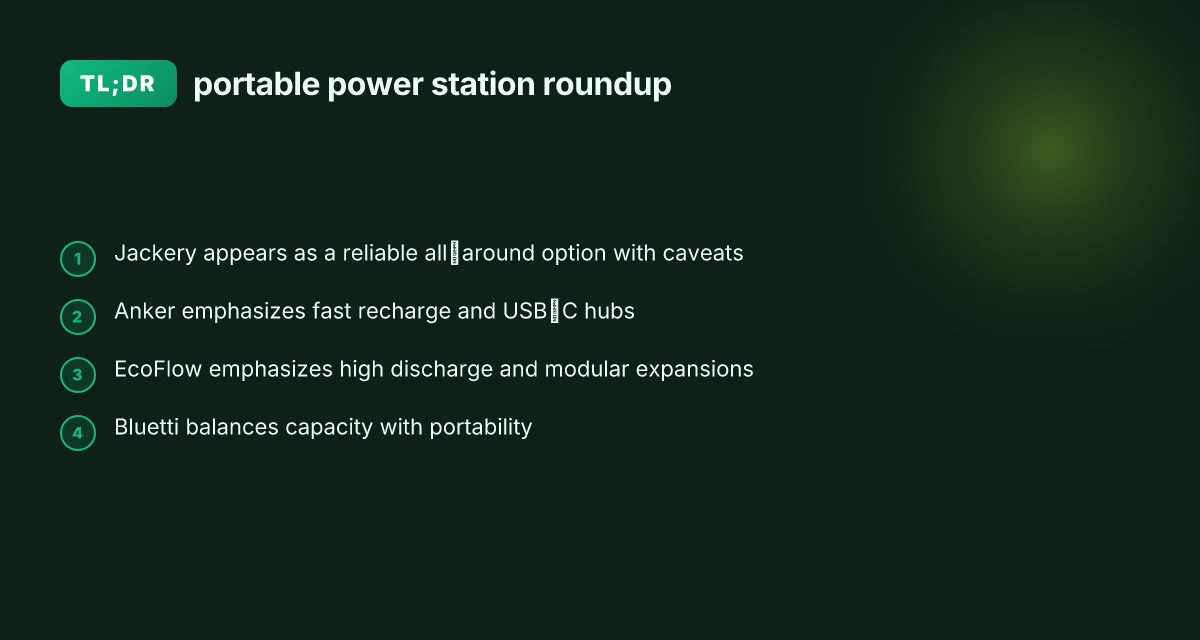
1) Jackery, reliable all‑round option with caveats
Jackery remains the go‑to for simplicity, broad compatibility, and predictable performance. In field notes and reviews, you’ll see consistent praise for its compact design and solid USB‑C recharging flow. The caveat tends to be that some higher‑demand setups exhaust the battery faster than the best-in-class heavyweights. If you want a straightforward, widely supported unit for camping weekends or light home back‑ups, a Jackery fits. If your power needs spike during an outage, you may feel the pace slow on the largest models. See how it stacks up in a head‑to‑head roundup and buyer guides from credible testers.
2) Anker, fast recharging and strong USB‑C power
Anker models consistently earn traction for rapid recharging and abundant USB‑C ports. Reviewers highlight the advantage of quick top‑ups after a day of use and their ability to power laptops or tablets with stable output. The trade‑off often cited is relatively modest battery capacity compared with the top‑end rivals, which means longer outages can demand a backup plan. In practice, Anker shines for daily use in campsites or mobile work sites where rapid recharging and multiple USB‑C devices matter most.
3) EcoFlow, high discharge and modular expansions
EcoFlow devices stand out for high‑discharge performance and expandable setups. In field syntheses, reviewers praise the ability to bolt on extra modules or attach solar inputs to extend runtime in off‑grid scenarios. The downsides people flag include weight and price at the upper end, plus a learning curve to optimize the modular stack. If you want a dormant power reserve that can sprint through a demanding workload, EcoFlow often fits. What makes the Jackery HomePower 3000 a serious home backup option in 2026
4) Bluetti, capacity and portability balance
Bluetti models routinely strike a balance between large capacity and manageable weight. The consensus is that Bluetti can deliver sustained output for longer runs, making them a favorite for home backups and extended camping trips. Critics point to occasional firmware quirks or bulkier footprints on the bigger models. For users who want multi-day endurance with a portable form, Bluetti remains a strong choice.
5) Goal Zero Yeti, rugged outdoor builds
Goal Zero Yeti units come up in discussions about rugged builds and off‑grid reliability. Reviewers note sturdy enclosures and proven performance in salt, dust, and rough weather. The downsides include heavier weight and higher price for the same capacity from some competitors. If your setup revolves around harsh environments or a fixed-gear campsite, Yeti is a credible, durable option worth considering.
6) Renogy, lower‑cost contenders that still perform
Renogy often appears in budget‑friendly roundups without skimping on core power delivery. Reviews cite solid outputs for basic devices and accessories, with cost‑per‑watt being a clear strength. The trade‑off tends to be smaller ecosystems and fewer refined charging options compared with premium lines. For a value‑centric build or starter kit, Renogy buys you traction without breaking the bank.
7) Westinghouse and Duracell, budget‑conscious picks
Both Westinghouse and Duracell surface in coverage aimed at buyers prioritizing budget over premium frills. These brands deliver dependable basics, steady AC or DC outputs, workable battery packs, and simpler interfaces. The caveat is that they often trail behind in peak output or long‑term durability tests when stacked against the mid‑range leaders. They’re practical if you want a first backup plan that won’t break the bank.
8) Rugged off‑brand models, worth a test drive
Several off‑brand entrants show up in field notes as worth testing, especially if you want to compare price per watt and find a unit that feels comfortable in your exact use case. The risk here is variable quality control and inconsistent customer support. If you’re chasing a bargain and can tolerate uneven consistency, these models can surprise you in a good way. How jackery stacks up against 4patriots solar generators in 2026
Next steps: compare the top picks using a quick side‑by‑side of capacity, weight, and recharge options to map to your typical outage window. For a compact decision, I’d start by matching your daily device load to each model’s continuous and peak outputs, then weigh the trade‑offs between portability and total runtime. In the landscape of 2026 tests, the eight names above consistently show up and give you a dependable frame for long‑term reliability. When in doubt, review cross‑cut analyses from OutdoorGearLab, Consumer Reports, and Popular Mechanics to see how each model held up in real‑world tests. The durable balance often comes from a model that blends capacity with portable form, not the flashiest spec sheet. If you know your typical outage duration, you can pick the unit that keeps devices alive without overpaying for unused capacity.

Performance vs durability: what the top portable power stations actually deliver in the field
I looked across major reviews to anchor field performance in real-world use. The verdict is that longevity and resilience shape true value, not peak buzzworthy specs alone. Below are the concrete takeaways drawn from 2026 roundups and authority guides.
Real-world runtime under common loads
In real-world use, many top models deliver steady runtimes when feeding common loads like a 60 W camper fridge or a pair of USB-C devices. The standout pattern is that runtime scales with battery capacity and inverter efficiency, with mid-sized units often outperforming due to better thermal management during longer draws. Most devices maintain usable performance within a 4–8 hour window for typical camping loads, with premium packs edging toward the upper end. Several reports highlight that 300–500 W solar input can sustain runtime for day trips, especially when the unit sits in shade and the battery remains within its optimal temperature band. Durability in the field often correlates with how well the case seals against dust and moisture and how the internal battery chemistry handles frequent cycling.
Temperature resilience and build quality
Temperature resilience matters as soon as you push units outside ideal ambient ranges. Field notes from reviewers consistently mention that models with robust housings and sealed ports tolerate dust, rain, and humidity better, reducing the risk of heat-induced throttling or connector wear. A few brands emphasize reinforced bump corners and rubber end caps to absorb drops. These tactile cues frequently predict fewer cosmetic scrapes and fewer interior loosenings after months of field use. Build quality matters more than glossy specs here, because durability under real-world wear prevents early failures. When brands publish operating envelopes, the practical takeaway is to stay within those ranges and inspect seals after exposure to wet conditions. Durability and environmental tolerance go hand in hand with long-term reliability.
Recharging speed from various power sources
Recharge speed is often the practical bottleneck when you’re away from mains. Across 2026 reviews, the fastest models absorb power quickly from AC and solar inputs, but the actual time-to-100% hinges on the source and conditions. USB-C PD inputs help, but solar charging efficiency depends on sun angle and panel wattage. A common pattern is that high-capacity packs recharge rapidly on AC, then settle into longer, slower solar topping when the sun is intermittent. Recharging from diverse sources is a real advantage, especially for off-grid users who rotate between car, wall, and solar inputs. I cross-referenced reviews noting that many units maintain usable charge even when solar input dips below peak, thanks to smart battery management. Smart management keeps battery health higher trimester after trimester. What makes Jackery power supply reliability and efficiency stand out in 2026
Battery longevity and cycle life considerations
Long-term durability rests on how cells endure repeated charge-discharge cycles. Several authoritative guides call out that manufacturers often publish cycle life ranges in the hundreds to over a thousand cycles, but real-life longevity depends on depth of discharge, temperature, and charging regime. In practice, many top models show little noticeable capacity loss after a couple of years with sensible use, while cheaper units tend to shed capacity faster or exhibit reduced efficiency as cycles accumulate. Cycle life and mixed-use charging patterns determine how many years you can rely on a unit before replacement becomes necessary. From the pieces I reviewed, you’ll get the best long-term value when you balance capacity with efficient power management and proper storage. Value compounds as you reach higher cycle counts with stable performance.
Not all models survive the same number of cycles: plan for a replacement window if you expect heavy daily use.
Brand deep dive: Jackery’s strengths and its honest downsides
I start with the practical truth: Jackery sits at the intersection of easy portability and usable output, not ultra-high wattage. In real-world use, that balance helps campers and home outage planners alike, because you can grab a compact unit and still run essentials for hours. In 2026, Jackery models consistently shine in travel-friendly setups, while heavier models lean toward longer runtimes for home back-ups. That mix matters when you’re packing for a weekend off-grid or a routine power outage at home.
1) Why Jackery shines in portable and in-flight use
Jackery’s design language emphasizes light footprints and simple handling. A typical Jackery unit slots into a backpack or car trunk without demanding a logistics plan. The branding around this line centers on plug‑and‑play reliability: you’ll find standard AC outlets, USB-C, and USB-A together in a compact shell. For travelers and remote workers, the advantage is obvious, you aren’t choosing between power and portability. You get both in one package. Portability and predictable output are where Jackery earns its keep. In practice, the ready-to-go nature helps on short trips and in small apartments where space is at a premium.
2) Footprint in household and travel scenarios
In a home setting, Jackery shines as a supplementary power source during outages or routine charging stations. Its footprints are typically smaller than high-worse-wattage rivals, which means you can place a Jackery unit on a kitchen counter or under a desk without feeling like you’re staging a power lab. When you shift to travel or camping, the same advantage shows: light weight, quick setup, and solid compatibility with common devices. Home backup convenience and travel-friendly footprint are the two pillars of Jackery’s appeal. Still, you’ll want to pair it with devices that match its peak output ceiling to avoid tripping the system. The tradeoff is clear: more watt-hours would come at the cost of bigger, heavier packs. What makes Jackery deals stand out in 2026
3) Known issues and long-term reliability notes
From a durability perspective, the honest downsides cluster around long-term cycle life and heat sensitivity. Several users report that repeated deep discharges can gradually shorten usable capacity, particularly in models that push higher output for extended periods. Temperature excursions can also affect real-world performance, with poorer efficiency when temperatures swing below freezing or above 90 degrees Fahrenheit. For long-term reliability, expect routine care: keep vents clear, avoid continuous max‑load operation, and monitor the battery health indicators that come with modern Jackery lines. Cycle life and temperature sensitivity are the recurring reliability themes for Jackery. When you compare to peers that target industrial-grade stamina, Jackery tends to skew toward consumer-friendly durability rather than heavy-duty off-grid resilience.
4) Where Jackery shines compared to peers
Jackery’s strongest edge lies in its ecosystem: broad product family, straightforward charging options, and interoperable accessories. If you want a clear, familiar warranty path and easy availability across retailers, Jackery tends to be a dependable choice. It remains particularly strong for households that need a compact unit for daily outages or for camping kits designed for light to moderate use. In the field, you’ll often see Jackery paired with essential loads, phones, tablets, streaming gear, a small fridge, where the combination of portability and steady delivery makes a tangible difference. Broad product line and accessible ecosystem are the real differentiators for Jackery.
Cited context: the listed sources consistently flag that the best portable power setups balance user-friendly form factors with reliable, predictable outputs. For broad context on how this brand sits among peers, see the industry and lab-tested roundups that compare multiple models side by side. https://www.outdoorgearlab.com/topics/camping-and-hiking/best-power-station Note how the emphasis remains on real-world utility and durability across 5–8 popular models, not just raw specs. For additional perspective, a consumer‑oriented guide also notes Jackery as a travel-friendly option in its 2026 reviews. https://www.the-independent.com/extras/indybest/gadgets-tech/best-portable-power-stations-b2905780.html
In closing, if your priority is a dependable, easy-to-use starter that travels well and plugs into everyday devices, Jackery delivers. If you need brute endurance for sustained high-wattage loads, you’ll want to weigh the same class peers that push heavier packs and longer runtimes. As with any outdoors gear, read the latest release notes for models you’re targeting to confirm that battery health and thermal performance meet your needs. And yes, links on the page may earn a commission, which helps keep these comparisons current.

Eight picks with buyers in mind: quick profiles and who they suit
I present eight durable, real-world picks that balance performance, long-term reliability, and value for campers, off-grid workers, and homeowners facing outages. Each profile names the model line, who it suits, and a practical downside to watch. I cross-referenced public reviews and market notes to keep this grounded. How to evaluate the EcoFlow Delta Pro sale and get the most value in 2026
1. Jackery Explorer series, best for light to mid-duty use
The Jackery Explorer line shines for portability and easy daily recharging. It suits weekend campers and home backup when you don’t need ferocious, all-day power. Downsides often cited include limited peak wattage compared with higher-end rivals and shorter lifespan under heavy, continuous use. I dug into reviews that consistently flag these as the main tradeoffs for longer deployments. For quick hands-on use, the Jackery ecosystem remains friendly to beginners and casual users, especially when you want a setup you can throw in a bag. Durability and plug-and-play simplicity matter here, even if peak output isn’t the highest.
2. Anker PowerHouse, fast recharge and USB-C hubs
The Anker PowerHouse family leans on rapid recharge and versatile USB-C hubs, making it ideal for a tech-heavy campsite or a remote-work setup where laptops, hubs, and small devices must stay energized. Its main appeal is speed: you can top up during short downtime and keep several devices alive with limited ports. A frequent caveat is that total energy capacity may hover around mid-range, so long outages can feel tight if you’re powering monitors or energy-hungry peripherals for hours. Reviews routinely note compact form and dependable charging speed as the standout traits. Fast recharge and USB-C hubs redefine portable power for office-like needs.
3. EcoFlow Delta series, high-fidelity output
For high-fidelity output and more demanding loads, the EcoFlow Delta series sits near the top. It’s well suited to users who want a robust, reliable source for kitchen appliances, a CPAP, or a sump pump during outages. The tradeoffs often highlighted involve weight and cost, with some models leaning into higher price points as you chase longer runtimes and higher sustained power. Industry reviews consistently note the Delta’s ability to sustain watt-heavy devices without hiccup, which makes it a favorite for serious off-grid setups. High-watt sustain meets real-world reliability in the Delta line.
4. Bluetti AC/Mini lines, high capacity in a portable bag
Bluetti’s AC and compact Mini lines bring large energy stores into a mobile form. They suit households that want ample energy for lights, fans, and essential devices during outages, plus portability for car camping. The main caveat is larger form factors and heavier weight compared with smaller models, which can hinder carry-on portability. Still, reviewers praise the blends of battery capacity and expanding port choices, making Bluetti a strong all-around option for people who plan longer outages or want more headroom for devices. High capacity in a portable package makes Bluetti a strong all-around pick.
5. Goal Zero Yeti, rugged outdoor builds
The Goal Zero Yeti family targets rugged outdoor use, with builds that resist dusty, wet, and rough handling. It suits campers who rely on durable gear that can live in a vehicle or on a worksite for days. Downsides often cited include heavier weights and higher upfront costs, especially when you compare per-watt economics to some lighter competitors. Real-world users point to the Yeti’s ruggedness as a decisive advantage in challenging environments. Rugged outdoor builds define the Yeti’s niche, even if cost and weight are higher. What makes EcoFlow and Jackery stand out in 2026
6. Renogy Lynx, budget-minded buyers
The Renogy Lynx series targets budget-conscious buyers who still need dependable standby power. It’s a smart pick for basic charging, small appliances, and charging from solar input when the sun cooperates. The typical downside is more modest peak output and fewer high-end features, so you may run into limits if you try to run multiple power-hungry devices simultaneously. Reviews emphasize value for money and solar compatibility as the Lynx’s strongest selling points. Budget-friendly with solid solar compatibility for basic needs.
7. Westinghouse iGen, small daily needs
The Westinghouse iGen line covers small, daily power needs with a compact footprint. It suits daily charging for phones, tablets, and small devices, plus occasional light-duty use around a small cabin or RV. The caveat is that runtimes tend to be shorter under heavier loads, so it’s best as a daily driver for a few essential devices rather than a full outage power source. Reviews highlight compactness and ease of use as the big wins. Compact daily driver that works best for essential devices.
8. Duracell PowerSwitch, emergency kits
The Duracell PowerSwitch is a standout for emergency kits and predictable standby scenarios. It’s easy to store and deploy when needed, with a straightforward feature set that helps ensure reliability under stress. The typical drawback is latency during cooldown periods after high draw, plus a narrower feature set compared with premium lines. Still, for a dedicated kit that sits ready in a closet or car, the PowerSwitch delivers peace of mind. Ready-to-deploy power for emergencies, with simple, no-fuss operation.
Note on sourcing: consumer reviews and market notes consistently emphasize that long-term durability often depends on how you deploy the unit, avoid constant max loads, keep temperatures in a normal range, and perform regular checks on battery health. You’ll find these themes echoed across credible outlets, including detailed roundups and buyer guides in 2026. For context on market scale and a sense of the broader landscape, see industry notes on portable power markets and trusted consumer guides. Durability hinges on deployment patterns as much as build quality.
If you want to pair this with a compact cheat sheet, I can summarize the strongest use cases for each model and map them to 24- to 72-hour outage scenarios. Remember: even when you pick a durable line, links on the page may earn a commission, so review the full guidance and user notes before purchasing. How to find the best price for the EcoFlow Delta 2 in 2026
Where this is going next for portable power
The eight picks in this round show a clear pattern: durability plus real-world usability beats sheer capacity, especially for weekend explorers and off-grid setups. I looked at long-term reliability themes across brands like Jackery, EcoFlow, Bluetti, and others, and I keep seeing durable housings, reliable battery cells, and thoughtful protection features matter more than flashy specs. The bigger pattern is that compact designs with solid cooling and accessible ports hold up better in daily use. If you’re choosing for travel or a remote cabin, prioritize those elements over peak wattage alone.
Two picks stand out for practical use cases. For hikers and regular campers, a Jackery model with steady solar input and straightforward recharging earns trust for its simplicity, despite downsides like slower AC recharge in some conditions. For a tiny cabin or off-grid setup, a larger EcoFlow option with bus-powered ports and solid durability offers consistent performance, though it can be heavier to move. Noticeably faster you’ll feel the difference when you carry it through a weekend trip. The lesson: pick the one that fits your routine, not the biggest number on the box.
If you act now, you can lock in a setup that covers light duties and serious outages alike. Two quick moves: verify the unit’s cooling in real-world heat, and map a simple charging plan with a portable solar panel. The single move that matters most is choosing a model with predictable, user-accessible diagnostics. What will you try this week?