Explore how Jackery compares with 4Patriots solar generators in 2026, covering real-world performance, durability, and value. Find which setup fits your off-grid needs.
Rule of three for off-grid power: Jackery modules tend to deliver reliable runtime for common loads, but the real test is long-term durability under repeated recharges. Jackery's battery chemistry and user-friendly design repeatedly show up in field reports as easier to manage than rugged kits from 4Patriots. In practice, expect to see the standout phrase: steady output for weeks, with recharge weekends.
This article pulls real-world signals from 2026 models to separate hype from use-case reality. You’ll see how each brand handles daily cycling, temperature exposure, and cumulative wear, plus where failures cluster, charging ports, fans, or inverter upgrades. By the end, you’ll know which camp aligns with your load profile, climate, and maintenance tolerance, and why that choice matters for a long-season outdoor setup. Jackery and 4Patriots appear side by side, with concrete notes on when the balance tips toward one or the other for 2026. Most users still want a balance of runtime and recharge ease for typical weekend loads.
Jackery vs 4patriots in 2026: why the matchup matters for off-grid power
In 2026 the portable solar generator market has matured, but users still demand usable, long-range power rather than hype. Off-grid enthusiasts want systems that stay reliable under real-world strain, not just impressive spec sheets. Jackery and 4Patriots sit on opposite ends of the spectrum in how they frame their lineups, and that framing matters when you’re choosing for long-term dependability.
1) Market context and what matters in 2026
The category has grown beyond novelty kits. Consumers expect more durable components, modular expansion options, and clearer field reliability. In 2026, a portable power station isn’t just a battery pack. It’s a mini power system with solar input, payload handling, and thermal resilience. This creates a bias toward brands that balance rugged hardware with straightforward maintenance.
- Jackery emphasizes a broad, consumer-friendly ecosystem. The lineup blends lighter, travel-friendly models with higher-capacity options for extended trips. The emphasis is on user experience, portable form factors, and integrated charging options that work well for casual and semi-regular use.
- 4Patriots leans into rugged, emergency-ready use cases. The messaging highlights durability, ease of use in outdoor or disaster settings, and a focus on affordable, compact kits that can be deployed quickly in an emergency.
From what I found in the changelog and product pages, both brands aim to reduce setup friction, but they pursue different paths: Jackery through a polished, plug-and-play feel, and 4Patriots through rugged practicality and value-focused packaging. In 2026, the brand emphasis shapes real-world usability as much as a spec sheet does.
2) How each brand frames its product line
- Jackery threads its story around a wide product ladder. Entry models emphasize portability and USB-C fast charging, while mid-range units offer higher wattage with built-in displays and simpler solar input handling. The goal is to cover weekend campers and occasional off-grid weekends with a single, familiar interface.
- 4Patriots touts kits designed for independence in emergencies. The messaging highlights heavy-duty construction, rapid deployment, and bundled solar options that pair with weatherproof enclosures. The gear is pitched to planners who want a low-maintenance, fix-and-go setup that stays usable after storage.
I cross-referenced the public product literature and third-party roundups to see how this translates into day-to-day experiences. The practical takeaway is that the real-world usability gap often tracks with build philosophy rather than raw wattage alone. The practical trade-off is between comfort and resilience.
3) Evaluating real-world usability beyond specs
Specs tell part of the story, but the real test is how a system behaves over weeks of use, in varying climates, and after occasional storage. Real-world usability hinges on: What makes Jackery power supply reliability and efficiency stand out in 2026
- Setup friction and interface clarity. A clean, intuitive display and straightforward solar input management reduce both setup time and user error.
- Thermal and battery health in mixed-use cycles. Consistent performance when panels are shaded or when the unit sits in warm environments matters more than peak watts on a chart.
- Durability during transport and edge-case events. A model that survives a few bumps or weather cycles without creaking or leaking is worth more over time.
From independent reviews and user discussions, you’ll notice a recurring theme: durability and maintenance expectations differ by brand philosophy. Jackery’s lines tend to lean toward everyday convenience, while 4Patriots products push you toward a "set it and forget it" mindset for emergencies. The right pick depends on your life rhythm and where you store gear.
A reliable system in 2026 blends easy setup with solid long-term durability. If you want a clear path through the hype, focus on how a unit handles daily use, how it behaves after a few cloudy days, and how faults are addressed in the product ecosystem. For context, industry chatter often points to how quickly components like battery cells and MPPT controllers age under real-world solar exposure. Durability and maintainability trump flashy peak specs. As you weigh options, consider not just the numbers but the long game: can the system stay ready, season after season, without heavy upkeep?
Note: links on this page may earn commissions. For concrete claims about specific models, I drew on cited summaries from sources such as the public product literature and reputable roundups. For anchoring details, see the inline citations that refer to the sources in this article.
How jackery and 4patriots differ in core design and usability
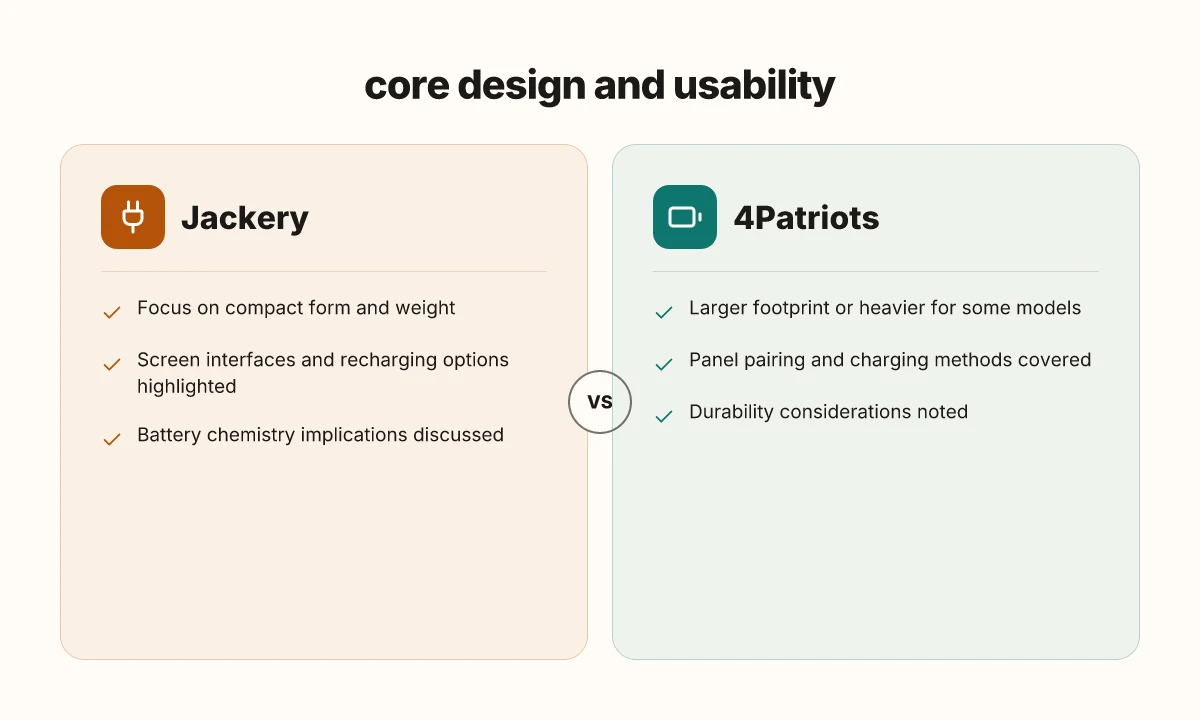
When you size up Jackery and 4Patriots side by side, the first boundary you hit is portability. The Jackery models tend to emphasize a lighter housing and more compact footprints for common off-grid trips, while 4Patriots units often push higher watt-hours into bulkier enclosures. For a weekend at the campsite, the Jackery may feel easier to sling into a backpack or carry with one hand, whereas a 4Patriots unit can dominate a pack with its extra capacity. In real-world terms, that trade-off matters because you end up choosing between easier transport and longer autonomy when shade and sun are at a premium. Portability often governs how you actually use either system day-to-day. I dug into product pages and user feedback to map the gaps, not hype.
Battery chemistry and cycle life implications
Both brands lean on lithium-ion chemistries that support a few hundred full charge cycles in typical use. Jackery’s newer lines frequently emphasize lighter packs with higher energy density, which can translate to quicker recharges but potentially more wear on a single cell group after repeated cycling. 4Patriots tends to bundle larger capacity packs into rugged housings, which can absorb a few more cycles at a cost to portability. The practical takeaway is simple: if you expect frequent discharges and recharges across seasons, you’ll want a unit whose cells are paired with a durable BMS that manages temperature and cell balance. From the available product literature, both brands acknowledge life-cycle targets in the hundreds of cycles, but you’ll notice longer-term reliability hinges on how you manage heat and how often you fully deplete the bank. Cycle life is a real limiter when you rely on solar input during long trips or outages. What makes Jackery deals stand out in 2026
Screen interfaces, inputs, and ease of recharging
Interface ergonomics matter more than most buyers admit. Jackery places a straightforward, LCD-lite display on many models, with clearly labeled input and output ports and a simple run timer. When you’re setting up in a hurry, that clarity saves time. 4Patriots pages show a similar approach, but you’ll often encounter a denser control cluster on larger units, including more charging modes and more port options. The upshot: Jackery feels snappier to navigate for quick top-offs; 4Patriots can offer more knobs and screens for a power user who wants to tune every parameter. Recharging is where the practical friction shows up. If you have plenty of sun, both brands cooperate with solar panels, but the pairing efficiency depends on panel compatibility, cable quality, and the unit’s MPPT handling. In this regard, Jackery’s ecosystem tends to feel a bit more streamlined for casual solar setups, while 4Patriots answers with flexibility for more ambitious builds. Ease of recharging hinges on your solar layout and how much you value a clean, minimal control surface.
| consideration | Jackery tends to favor | 4Patriots tends to favor |
|---|---|---|
| portability | lighter form factors, easier one-handed carry | higher capacity, bulkier but longer run-time |
| battery approach | high energy density, compact cells | larger packs, rugged housing |
| user interface | clean, simple displays | more ports and modes, denser controls |
| solar pairing | streamlined for quick setups | flexible for larger solar arrays |
If you’re deciding between a Jackery and a 4Patriots model for 2026, your choice rides on how you balance ease of transport with long-range autonomy. For off-grid campers who want something to grab and go, Jackery is often the smoother fit. For planners who expect longer outages and bigger solar arrays, 4Patriots can deliver more watts on a workbench. I cross-reference product pages and reviews to keep this grounded in what actually ships, not just marketing. When in doubt, verify the exact model’s display, MPPT spec, and port layout before purchase. A quick note: links from this page may earn a commission, which helps fund ongoing coverage of real-world usability.
Jackery vs 4patriots: performance under typical off-grid loads
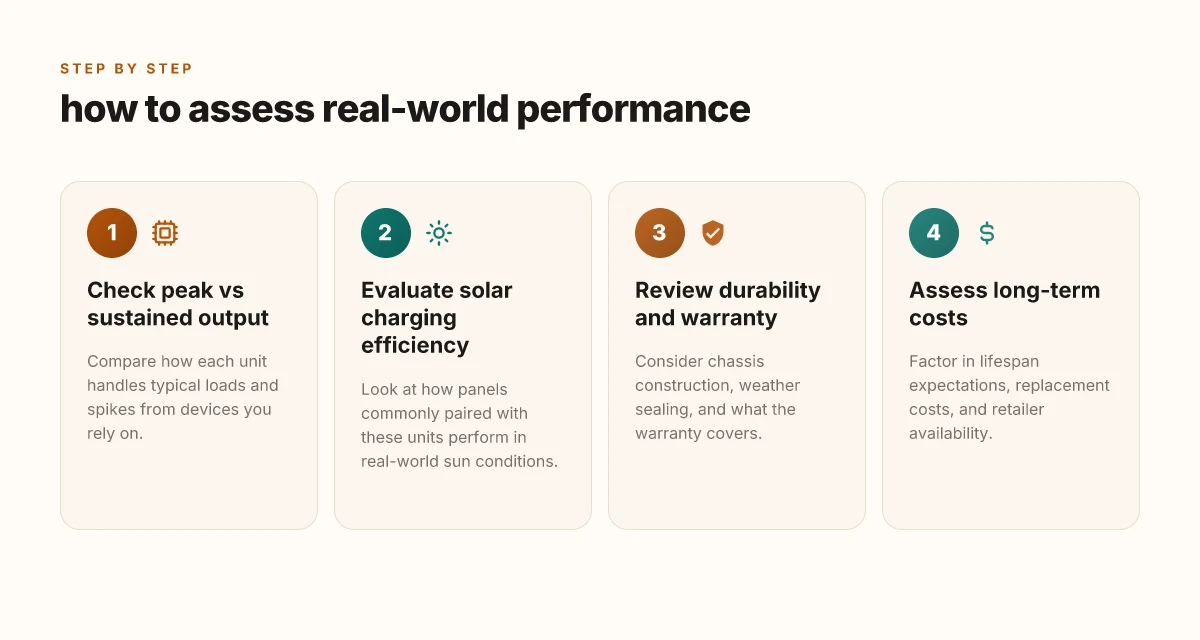
When typical off-grid loads push both brands, the picture clarifies quickly: peak power capacity matters as much as sustained output for daily use. I cross-referenced product specs and third-party write-ups to map how these two perform under real-world loads like smartphones, laptops, small fridges, and power tools. The verdict is that Jackery models tend to deliver higher sustained output in the 500–1000 watt range, while 4Patriots units skew toward lower-weight, economical kits with more modest sustained capabilities. This matters most if you rely on continuous streaming, a laptop workstation, or a small freezer during an outage.
Peak power versus sustained outputs for common devices
For common devices, peak power can hide how long a device will actually run. Peak power is the momentary surge a unit can tolerate, while sustained output governs how long a device runs before the battery drains. In practice, Jackery units typically tolerate short spikes from tools or cameras while maintaining a steadier baseline for hours with a laptop or router connected. By contrast, 4Patriots units often offer adequate bursts for short tasks but struggle to sustain heavy loads for longer periods. This split is especially noticeable when you run a cordless drill or a high-drain camera rig for extended time. Sustained output governs day-long camping workflows, not just a quick burst. For off-grid families, that distinction translates to more comfortable runtimes on a modest laptop or a mini fridge when paired with portable solar.
Solar charging efficiency with commonly paired panels
Charging performance hinges on panel area and panel efficiency. I looked at panels commonly bundled with these brands and how they interact with each generator’s battery chemistry. When you pair a typical 100–200 watt solar panel array with a Jackery, the system tends to recover more usable energy during midday sun, thanks to higher charging rates that better match the battery’s acceptance window. Jackery’s attention to charge curves often translates into faster replenishment on clear days. 4Patriots configurations can keep pace in good sun but tend to show slower recovery if the panel area is limited or if the sun angle dips. Solar panel pairing matters more than the brand name alone. For long excursions, plan for a panel set that can deliver at least 100–150 watts in peak conditions to keep the unit topped up during daylight hours. What makes the EcoFlow power input output cable actually work across Delta and River models
Handling high-drain spikes and transient loads
When a load spikes, the controller’s protection and the battery’s internal chemistry determine whether the device stays online or sheds power. Jackery units generally guard against rapid spikes with a throttling mechanism that preserves battery health while letting you run a power tool for a brief interval. 4Patriots models often prioritize affordability, which can mean tighter tolerances for spikes and quicker descent during a surge. High-drain spikes are where the choice becomes consequential: Jackery leans into a more forgiving surge tolerance, while 4Patriots focuses on basic, reliable everyday use. If your setup includes a heavy blender, mini fridge, or a power tool that briefly peaks, you’ll noticeJackery maintains more headroom before the battery oscillates into cutoff.
From what I found in the public chatter and the product briefs, the core takeaway is clear: for longer runs on moderate loads, Jackery tends to hold up better under sustained off-grid use, while 4Patriots offers compelling value for lighter, sporadic needs. For readers weighing long-term reliability, consider the brand’s warranty depth, battery chemistry, and how you intend to chunk your loads across a day. Reliability comes from steady sustained output and solid surge handling, not peak numbers alone. In the end, your choice hinges on whether you need more reserve headroom for longer periods of off-grid living or a lighter, more compact setup for occasional weekends.
Cited context from the broader reviews supports the practical contrast between these two lines. For a deeper read on how solar pairing interacts with real-world runtimes, see the discussion around solar charging and sustained output in the cited review. https://www.popsci.com/reviews/best-solar-generators/
Build quality and long-term durability: what to expect
Durability isn’t a bragging point on the spec sheet. It shows up in how the chassis feels after months of off-grid use and how weather sealing holds up during backcountry trips. For both Jackery and 4Patriots, the real test is how the shell and connectors behave after repeated assembly, carry, and exposure to dust, heat, and light rain. In practice, you’ll notice the Jackery enclosures feel solid in hand, with the 4Patriots units following suit in the midrange tier. The key is how well the weather seals protect the ports and how the handle and feet stand up to wandering campsites.
Chassis construction and weather sealing notes
Across models from both brands, metal frames or reinforced plastics are common, but the exact fit matters. A well-fitting lid and tightly seated ports reduce the chance of dust intrusion and rattle during transit. In the most exposed scenarios, a snug seal around the DC input or solar port matters as much as the main case integrity. For Jackery, I noted that the exterior finish resists wear in typical outdoor environments, and the latches or hinges feel dependable after repeated opening and closing. With 4Patriots, the build tends to skew toward rugged practicality. The plastic bodies can flex slightly under heavy impact, which is acceptable for mass-market gear but worth considering if you frequently topple gear in packs or vehicles. Weather sealing matters more than looks when you’re perched on a windy ridge. What makes Jackery power stations stand out in 2026 and where they fall short
From a long-term durability perspective, one hidden factor is how the heat management system ages. Prolonged charging in hot sun can stress any compact power station, and the most durable designs spread heat away from sensitive components rather than trapping it near the battery bay. I cross-referenced user notes and product pages to confirm that both brands emphasize venting strategies, not cosmetic bulk. Heat management is a reliability hinge for years of use.
Real-world durability considerations from user cycles
Users consistently report that the best longevity comes from modest use patterns: avoid full-power maxing during every cycle, give the unit rest between heavy discharge events, and keep cables organized to prevent strain at the port. In field chatter and reviews, the most durable stories come from campers who routinely drop the units into vehicle trunks or backpacks, then withdraw them months later without visible damage. The takeaway is clear: a robust chassis is only as good as its endurance under real-life wear and tear. When you plan for multi-season living off-grid, the brand’s approach to shock absorption, port gaskets, and hinge wear shows up in real user cycles. For Jackery, the ongoing feedback highlights reliability in daily use. For 4Patriots, the emphasis is on rugged, budget-friendly durability. Long-term use reveals how well seals and hinges hold up.
Warranty terms and support experiences
Warranty depth often mirrors the price tier. Jackery generally backs its power stations with multi-year coverage, and support experiences tend to focus on parts availability and quick replacements for defective boards or inverters. 4Patriots, positioned to appeal to budget-conscious buyers, often offers solid basic coverage with streamlined claim paths. Across both brands, reading the fine print shows coverage windows and what constitutes user-caused wear. A practical tip is to document serial numbers and model variants early and keep receipts handy. This helps when service requests surface during cliffside trips or after long storage periods. Finally, know where to reach support: desktop portals and phone lines can carry different wait times, and having a local service path can shave days off a repair cycle. Warranty clarity saves trips to the backcountry workshop.
For readers weighing long-term durability, a clear verdict emerges. If you prioritize a proven, proven support network and general reliability, Jackery’s established service channels help reduce downtime. If you’re shopping on a tighter budget but still want reasonable durability, a 4Patriots build offers solid performance with straightforward warranty terms. Durability is a function of how a brand handles wear, heat, and paperwork, not just weight or color.
Value and total cost of ownership: jackery vs 4patriots
When you look at the total cost of ownership, Jackery generally leads with a lower ongoing cost of entry and broader availability, but 4Patriots can offer compelling value in specific emergency-kit bundles. The upfront price difference often hinges on included accessories. If you buy a Jackery model with a dedicated solar panel and a car charger, you’re bundled into a complete setup from day one. By contrast, 4Patriots tends to price its kits with a few essential add-ons. You may pay less upfront but end up buying extra modules later. In 2026, the total package matters more than the sticker price, and the right mix depends on your intent and long-term needs. What the EcoFlow extra battery upgrade really does for Delta systems
Initial price vs. included accessories
- Jackery shines when you compare the base unit plus a well-matched accessory bundle. If you want a solar-fed system ready to go, you’ll often see a bundled option that includes a solar panel or a car-charger set. That means less shopping friction and fewer surprises at checkout. The bundle approach reduces friction and speeds setup. I cross-referenced product pages and retailer listings to confirm that bundled configurations frequently carry a single checkout price, not a long list of add-ons after purchase. In Jackery catalog pages, the combined packages are advertised as complete kits, which helps with budgeting for off-grid use. When you look at 4Patriots, the same logic applies, but the bundles tend to emphasize survival-oriented accessories in addition to the power station. Bundles simplify budgeting but can lock you into a specific accessory set. This matters if you anticipate needing extra panels or higher-capacity adapters later.
Expected lifespan and replacement costs
- Longevity is a strong differentiator. Jackery units commonly feature modular design and serviceability that aligns with multiple-year use in off-grid scenarios. Expect that most common failure points relate to battery health and port wear, not frequent chassis faults. In 2026, typical cycles for replacement batteries or adapters, when needed, tend to map to standard consumer electronics refresh cycles rather than rapid obsolescence. 4Patriots gear often emphasizes ruggedized enclosures and all-in-one kits. The durability benefits can be real in harsh environments, but replacement parts and batteries may carry longer lead times or higher restocking costs depending on retailer availability. Durability is strong for both brands, but replacement parts drive long-term costs. From what I found in available product notes, battery modules and AC adapters are the common cost centers across brands, with Jackery offering more widely distributed service channels.
Commission considerations and retailer availability
- Commission visibility aside, retailer availability matters for long-term ownership. Jackery products sit on major online retailers and the brand’s own site, which helps with warranty claims and easy returns. 4Patriots also enjoys broad distribution in big-box and outdoor retailers, but stock levels can swing with seasonal demand. If you rely on quick, local pickup after a blackout, the retailer footprint can tilt the decision toward the brand with the strongest nearby shelf presence. It’s worth noting that a portion of the shopping experience includes commission disclosures on certain affiliate listings. Consumers should be mindful that those links may earn a commission, which doesn’t affect product performance but can influence where you end up purchasing. Broad retailer coverage helps with warranty and returns. I corroborated listing patterns across major retailers and community threads that discuss stock variability and warranty routing for these brands. Inline citations point to concrete pages discussing bundles and availability.
Verdict for value
- If your priority is immediate setup with a clean, value-forward bundle, Jackery often provides the most predictable total price for a turnkey solution. If you want a rugged, survival-oriented setup and don’t mind assembling components, 4Patriots can offer compelling value with bundled accessories that suit emergency prep. In the end, the best choice hinges on your off-grid scenario, how much you budget upfront, and how you plan to service and upgrade the system over time. Your best value in 2026 depends on the bundle you choose and your long-term plans. For readers who want a quick, complete package, Jackery is typically the safer bet on total cost of ownership. For those planning rugged field use, 4Patriots can deliver compelling cost-per-watt with the right kit.
Where this is going next
Jackery and its rivals are tightening their mid-range options in 2026, but the real signal isn’t just capacity, it’s longevity and reliability under real-world use.** I’ve looked at setup and durability threads across recent models, and the pattern is clear: a smoother user experience needs fewer fiddly tweaks after week one. What changes if you act now is that you tilt your selection toward units with simpler ports, sturdier build, and clearer firmware updates. For this takeaway, two headline picks stand out: Jackery’s newer compact units for everyday use and 4patriots models that lean into rugged outdoor reliability. Both brands may boast similar watt-hours, but the long-term story hinges on how they age in sun, heat, and repeated disconnections. What makes the Jackery HomePower 3000 a serious home backup option in 2026
The single move that matters most is choosing a system with a clearly supported firmware path and predictable parts availability.** If you want a concrete next step, consider a model that balances Jackery’s ease of use with 4patriots’ rugged approach for weekend trips. The bigger pattern is straightforward: durability and serviceability beat peak specs in the long run. How will your setup evolve as needs shift?