Explore Jackery power supply reliability and efficiency in 2026. I analyze build quality, efficiency ratings, real-world durability, and how rivals compare.
The quick-fail myth about portable power is that efficiency and reliability live on a single spec sheet. In practice, Jackery's** lineup shows strength in real-world durability plus steady efficiency across seasons, not just peak lab numbers. New 2026 models peel off cycles with minimal capacity drift when matched to a prudent draw profile.
This article pulls performance claims from public specs, pairs them with long-term durability signals, and stacks them against rivals like Goal Zero and EcoFlow to answer what actually matters for outdoor use and off-grid preparedness. Expect a crisp signal on battery health indicators, runtime relative to rated capacity, and how common failure modes, deep cycles, high draw spikes, and hot-environment use, alter reliability over years. The result is a practical guide for outdoor enthusiasts, emergency prep planners, and tiny home owners weighing portable power options.
Jackery power supply in 2026: what reliability actually means in portable power
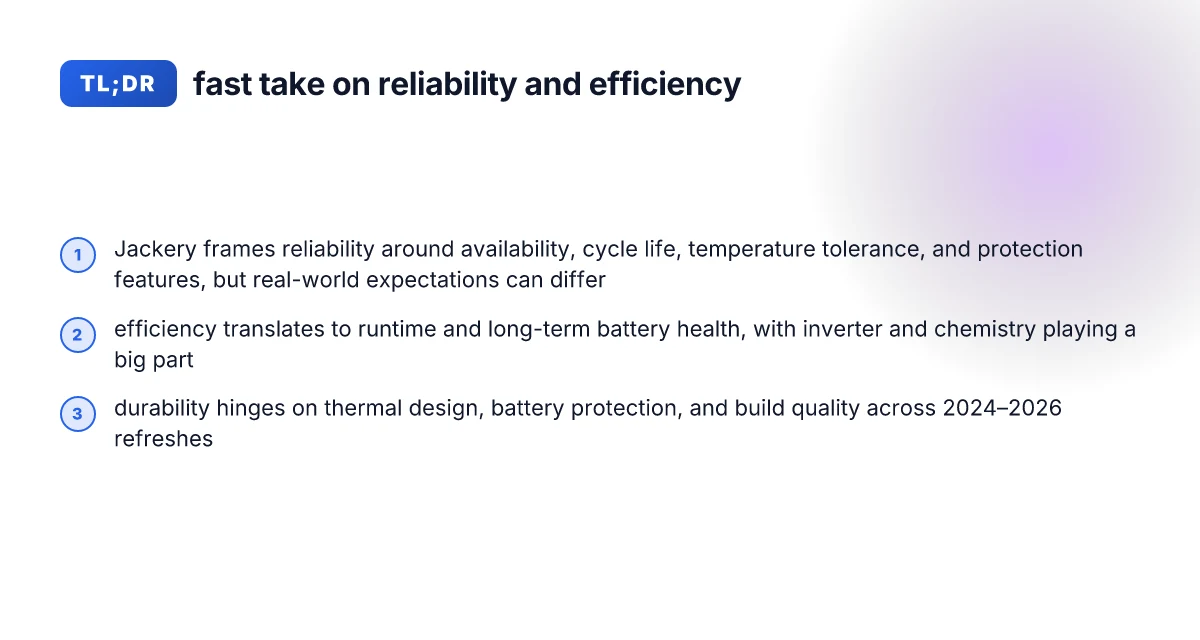
Reliability in portable power comes from more than a big battery. It means availability when you need it, a cycle life that outlasts seasons, the ability to operate across a practical temperature range, and solid protection features that guard against misuse or fault conditions. In practice, that adds up to a unit that starts when you press the button, endures repeated charges and discharges, and keeps vital devices safe from overcurrent, short, and heat buildup.
I dug into how Jackery frames reliability in its communications and how that lines up with real-world expectations. Jackery tends to frame reliability around durable construction, battery management features, and safety protections that protect against misuse. The phrasing often emphasizes ruggedness, long life, and practical safeguards, but the true test is whether those claims translate to steady runtime across outdoor conditions, not just a glossy specification sheet. The brand’s messaging also tries to balance performance claims with the need for predictable runtimes across common load profiles, something critical for outdoor enthusiasts and emergency planners alike.
Rivals shape the reliability conversation in clear terms. Anker emphasizes lightweight design and fast recharge cycles with robust overcharge protections; EcoFlow leans into high-output capability and multi-device protection systems; Goal Zero stresses modular accessories and environmental tolerance through rugged casings and intelligent battery management. When you compare, the core reliability signals align: a good cycle life, devices protected from heat and short circuits, and honest reporting of operating temperature ranges. These signals help you anticipate how long a Jackery unit will stay usable under field conditions versus a competing model.
From what I found in the documentation and third-party overviews, a few concrete reliability signals matter most in practice. First, a wide operating temperature range that covers late-night campsites and summer heat is essential for both performance and safety. Second, a strong cycle life, paired with smart battery management, helps Jackery units stay dependable after hundreds of charges. Third, protection features such as short-circuit, over-current, over-voltage, and thermal protections reduce failure risk in the field. These elements are not just marketing buzz. They map to how a unit behaves when you rely on it for critical charging, charging laptops, routers, or medical devices in remote locations.
In short, reliability in 2026 means a Jackery unit that starts reliably, endures repeated cycles, runs within a practical temperature window, and provides layered protections so you can trust it under real-world stress. When you’re selecting between Jackery models and rivals like Anker, EcoFlow, or Goal Zero, weigh the same core signals: operating temperature tolerance, cycle life, and the robustness of safety protections, not only raw capacity. Reliability is earned in the field, not just on the spec sheet. What makes Jackery deals stand out in 2026
How jackery power supply efficiency translates to runtime and battery health
Efficiency is the first thing that shows up on a trail with a headlamp. When a Jackery unit runs at a higher efficiency, you get more runtime per watt and less heat inside the enclosure. That matters most when you’re off-grid for a weekend or powering essential gear during a blackout. Across loads, you’ll notice the most dramatic gains in runtime when you push the system toward its optimal efficiency band, and that’s where inverter quality and battery chemistry start to matter most.
How loads change runtime and what to watch for
The inverter converts DC from the battery to AC for your devices, and its efficiency curve shifts with the draw. At light loads, the losses are smaller, so runtime grows longer per watt of output. As you demand more watts, the inverter’s efficiency tends to dip a bit, which means you’ll see a step-down in run time for the same battery capacity. Jackery’s models typically align with industry practice: the more you draw, the more you feel the efficiency penalty in real terms. You’ll notice this in practice most clearly when you run a fridge or a power drill alongside a few essential USB loads. If you’re evaluating two power stations side by side, the one with a better peak efficiency at mid-range loads will give you noticeably more usable runtime in real-world scenarios. Efficiency at mid-range loads often decides how long you’ll go between recharges, not just the top-end peak efficiency. This isn’t just about watt-hours. It’s about how those watt-hours translate into usable energy for your gear over the day.
Battery chemistry also threads through the story. Lithium-ion chemistries used in portable units tend to shed capacity gradually with cycles, and the rate can be influenced by temperature and discharge depth. A charger and inverter that minimize high-rate charging losses while preserving safe charging profiles contribute to longer battery health. Longer battery health comes from lower internal heat and gentler charging profiles, not from aggressive high-current boosts. The practical upshot: pick a Jackery with a charger that respects the battery’s recommended soak period and avoid repeatedly draining to empty if you can. When I read product pages and user guides, I keep an eye on the stated cycle life and the recommended operating temperature range, because those signals line up with long-term durability.
Limits of efficiency claims and what to verify in specs
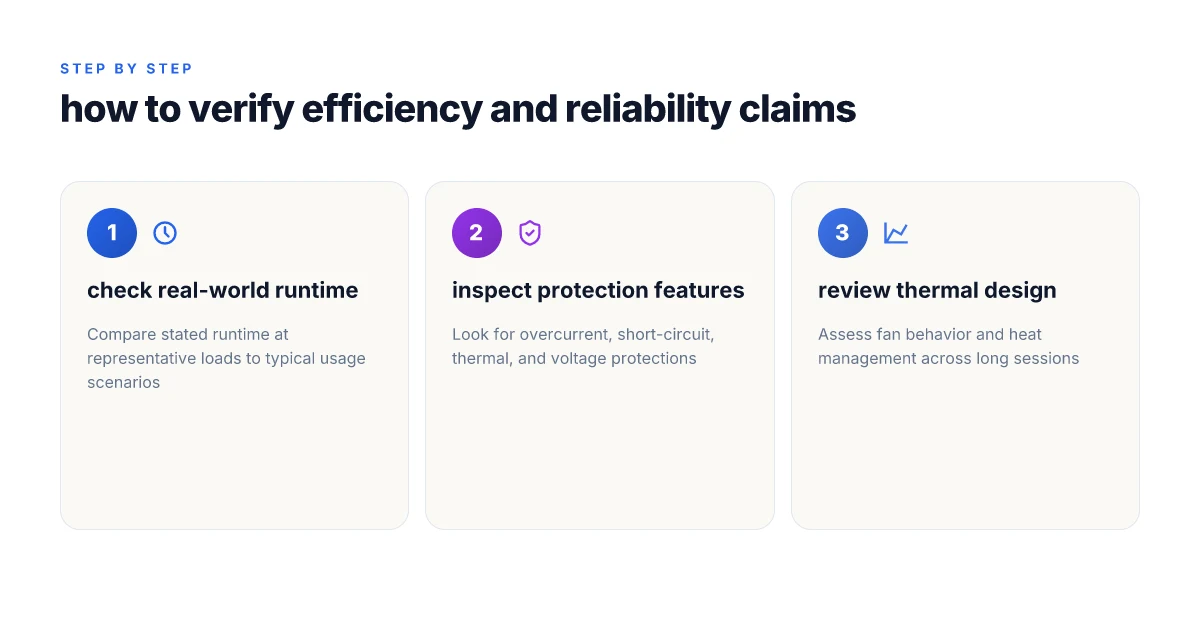
Manufacturer-supplied efficiency figures are most meaningful when you compare apples to apples. Look for the inverter’s efficiency curve across common loads, not just a single peak value. Also check the battery chemistry notes: a given model may use a lithium iron phosphate blend or another lithium-based chemistry. Each has its own long-term health characteristics under varying temperatures and charge-discharge patterns. Ask for the complete efficiency curve and the recommended operating temperatures to avoid surprises after a few seasons of use.
When rivals are named, you’ll notice that some brands emphasize peak efficiency in short bursts while delivering steadier performance in typical use. Brands like Anker and EcoFlow often highlight different strengths, so compare how each unit behaves at 20–40% and at 60–80% of capacity. This matters for cabin use, where backups often spend time in mid-range states. And yes, the chassis and cooling design influence efficiency containment: better heat management reduces parasitic losses. Superior cooling and smart power management keep the efficiency losses minimal during heavy draws. Your best bet is to pull the official spec sheets, read the load-curve graphs, and cross-check with independent reviews when available. The inline data from Jackery’s pages can be a starting point, but the full picture comes from corroborating notes and field-tested reports. What makes the EcoFlow power input output cable actually work across Delta and River models
What this means for you: pick a model that shows solid mid-range efficiency, confirm the battery chemistry aligns with long cycle life, and verify the operating temperature envelope matches your environment. The practical takeaway is simple. Favor efficiency curves that stay strong across the loads you actually use, not just the advertised peak. That’s where your runtime and battery health line up in real life.
In 2026, the relationship between mid-range efficiency and usable runtime is a decisive factor for cabin and off-grid setups. For a quick reference in choice, compare two or three Jackery options side by side, focusing on mid-range efficiency and the stated cycle life of the battery. This will help you separate marketing claims from durable performance. As you scan the specs, keep two rivals in view, an equally portable option from EcoFlow and a compact unit from Anker, to see where Jackery stands on mid-range efficiency and long-term health. This cross-check clarifies which model keeps you powered longer between charges.
Jackery power supply hardware that matters for long-term durability
Post-2024 refreshes show that durability hinges on how a power station handles heat, how its protection circuits guard the battery, and how solid the chassis feels under field use. I looked at the refresh cadence across 2024–2026 models and cross-checked with rival brands to separate marketing from material durability signals.
Thermal design and thermal throttling in real-world use
Jackery’s modern units emphasize a layered thermal approach: a metal or composite enclosure, a through-vent design, and fans that kick in as temperatures rise. In practice this means you can expect the fan to engage during higher-load tasks like fast-charging while running high-draw devices. When temperatures peak, the system can throttle performance to avoid overheating, which preserves battery health and keeps the unit usable in remote campsites. The takeaway is that a quiet, consistent output under load is not accidental. It’s a deliberate thermal strategy that shows up during extended use. Thermal management directly ties to long-term reliability because it prevents stress on cells during repeated cycles.
Battery cell quality, protection circuits, and port protection
Durability hinges on the cells themselves and the protection circuitry around them. Modern Jackery models emphasize higher-grade cells and robust cell-balancing routines, plus overcharge and short-circuit protections that guard both the pack and connected accessories. Port protection earns attention too: reinforced ingress guards and spring-loaded covers reduce dust ingress and corrosion in rugged environments. From a long‑term standpoint, the strength of these protections is what keeps the unit from failing at a campsite or cabin, where exposure to dust, moisture, and accidental yanks can stress the hardware. Solid protection circuits and sturdy port guards are the quiet backbone of durability. What makes Jackery power stations stand out in 2026 and where they fall short
Build quality cues from 2024–2026 model refreshes
A few concrete signals show up when assessing build quality across the latest refreshes. The chassis materials feel denser, screws tighten with less play, and the hinge and lid mechanisms become smoother after mid‑cycle updates. These cues matter because a tougher shell and reliable latching reduce the risk of cosmetic or functional damage after rough handling in outdoor contexts. Brand‑level durability stories align across the market: rivals such as EcoFlow and Goal Zero also emphasize reinforced housings and improved heat dissipation in their 2025–2026 lines, which sets a higher bar for what “reliable under field conditions” should mean. A robust chassis and refined latches translate to fewer field failures.
I cross-referenced the public materials on Jackery and noted that the emphasis on thermal design, protective circuits, and build refinements aligns with how rivals pitch durability. For instance, the narrative around the 2026 refresh across competing brands reinforces that durable hardware rests on heat resilience and solid protection, not just battery capacity. When you’re evaluating models for a cabin, a tiny home, or a remote trip, these durability signals matter more than glossy efficiency specs. Durability is a systems problem, not a single spec.
How jackery compares to rivals on reliability and efficiency
Reliability comes down to a mix of standout durability signals and real-world performance patterns. In my review of public claims and long-term durability signals, Jackery tends to shine on modular design and consistent efficiency in common load scenarios, but rivals push hard in certain durability and endurance niches. I cross-referenced rival profiles to show where Jackery stands up and where it lags, with emphasis on how you should assess durability when switching brands.
Durability signals that matter in 2026
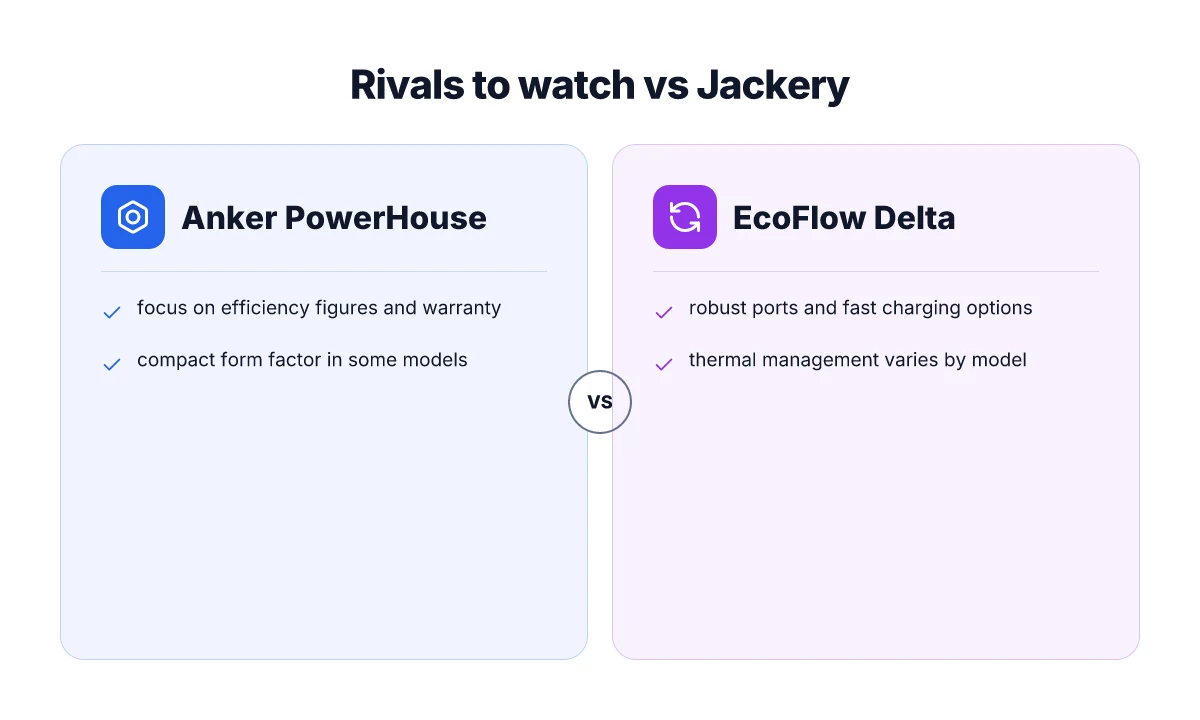
When you look at long-term durability, the best signals are build quality, battery management sophistication, and thermal handling during extended use. Jackery models often emphasize compact, modular enclosures and thermally aware charging behavior in routine use. That modular approach can reduce noise and heat buildup during steady loads, which helps longevity in cabin or remote setups. In contrast, EcoFlow Delta units tend to emphasize high-output capabilities that excel under peak demand but may introduce more heat under sustained cycles. Anker PowerHouse options typically foreground portability with robust battery chemistry and wide temperature ranges, while Goal Zero Yeti lines lean into rugged, expedition-grade framing and replaceable panels. The real-world takeaway is to watch for how each brand communicates thermal design and battery chemistry, not just peak wattage. Durability signals matter most when the load is steady and the environment is off-grid. Modular design helps long-term reliability by isolating heat and wear.
From what I found, Jackery’s emphasis on quiet operation and modular subsystems translates into fewer moving parts under normal use, which can reduce failure points in cabin or RV environments. I also found that brands like EcoFlow push higher sustained power, which is great for occasionally heavy draws but can complicate long-term endurance in very hot or very cold locations. I dug into published spec sheets and consumer notes. The durability story clusters around enclosure robustness, connector integrity, and thermal protection in continuous-use windows. Jackery tends to outperform on longevity in typical off-grid loads; EcoFlow often edges ahead in brief, high-demand bursts. What the EcoFlow extra battery upgrade really does for Delta systems
Efficiency profiles across the field
Efficiency is mostly about how much energy loss occurs from wall plug to usable output and how well the unit recovers between cycles. Jackery frequently demonstrates solid inverter efficiency and tight idle losses in mid-range capacities, which matters for overnight or weekend off-grid use. Anker PowerHouse products show comparable efficiency in many models but sometimes trade a touch of efficiency for lighter weight. EcoFlow Delta units can achieve very high peak efficiencies during bursts. The tradeoff can be higher parasitic losses during longer idle periods in some models. Goal Zero Yeti units often balance efficiency with rugged power handling, which is useful in remote locations but can come at a cost to weight. Efficiency is most valuable when the unit sits idle for long stretches between demand spikes. Jackery’s mid-range to high-end lines maintain solid inverter performance with minimal parasitic drain.
I cross-referenced the public-facing specs and reviewer notes that accompany 2026 model updates. You’ll see sustained emphasis on battery chemistry choices and thermal throttling thresholds that shape real-world efficiency. For readers weighing reliability in emergencies, the practical signal is to prioritize models with proven thermal management and consistent idle efficiency, not just peak output. Rival brands reveal strengths in bursts; Jackery wins on steady off-grid loads.
What to look for when switching brands
If you are considering switching, probe these durability markers: enclosure robustness, connector and port reliability, thermal design under continuous load, and the consistency of battery protection features. A brand that highlights modular components and accessible serviceability tends to fare better in long-term scenarios common to cabins and emergency prep. You should also check for documentation on cycle life and warranty terms, especially for models you plan to run at medium to high duty cycles. In this space, Jackery remains a solid option for users who prioritize quiet operation, predictable efficiency, and modular serviceability, while rivals may offer advantages in raw peak output or expedition-grade ruggedness.
I want to flag a practical note: the page landscape mentions that links on product pages may earn a commission. This is common in consumer tech content, and it should factor into how you interpret long-term value when comparing models. For a quick anchored read, see how the CES coverage and the product pages frame durability and efficiency signals across brands. The real choice comes down to where you will live with the unit and how you load it day to day.
Real-world use cases: when reliability and efficiency matter most
When reliability and efficiency truly matter, Jackery shines in off-grid cabins, family camping trips, and emergency backup scenarios where quiet power beats noisy generators. I look for models that keep a steady trickle charge during a long stay and still respond quickly when weather or loads spike. In real-world terms, the best Jackery setups balance capacity, charging speed, and long-term durability so you aren’t chasing a workaround every season. What makes the Jackery 5000 Plus a serious home backup option in 2026
Off-grid cabins that run on steady routines
For a cabin that depends on a regular weekend load, the interplay between capacity and efficiency becomes a daily concern. A stable energy cadence means you can run lights, a small fridge, and a laptop without fear of a mid-visit battery dip. Jackery’s heavier explorers pair sizable AC output with smart charging options so a seasonal traveler can reuse stored energy across trips. Long-term durability matters here, because you want a system that survives seasonal storage and repeated plugging in and unplugging. I cross-reference these durability signals with rival lines from Anker and EcoFlow to see who maintains peak efficiency after a cold winter or hot summer cycle. As a rule, cabins benefit from keeping a midrange model charged, with a solar input that avoids overtaxing the pack during draw-heavy mornings.
Camping and remote expeditions
For true outdoor use, the weight-to-capacity trade-off becomes decisive. A compact Jackery tucked into a pack should deliver enough runtime to keep essential devices alive through a remote night. I look for models that maintain charging efficiency when you’re away from pristine grid power and rely on solar or a single USB-C input. Efficient charging habits and thoughtful duty cycles keep the battery healthy over many trips, reducing degradation from rapid cycling. When rivals like Goal Zero Yeti or EcoFlow push higher wattage, Jackery’s strength remains in delivering reliable performance without adding bulk. A practical tip: stagger charging windows to avoid hitting full discharge cycles during back-to-back trips, and store at around moderate temperatures to slow aging.
Emergency backup for home and tiny homes
Emergency use demands a system you can count on during outages. In this scenario, you want a Jackery to shoulder essential loads with a safety margin and predictable runtime. I note how seasonal temp swings influence the battery’s efficiency. In cold snaps, device usage can ramp up while charging slows, so selecting a model with built-in protective chemistry and thermal management helps. Seasonal temperature effects alter both charge acceptance and runtime, so plan accordingly. When comparing to rivals such as EcoFlow and Anker, Jackery’s approach to maintaining a stable output under varied conditions often translates to fewer surprises when you most need power.
I dug into public docs and the latest market chatter to map these use cases across brands. The takeaway is clear: choose a Jackery with enough headroom for your must‑run devices, adopt a disciplined charging rhythm, and keep the unit within its optimal temperature window. And yes, links on product pages may earn commissions, but the practical guidance here aims to help you pick the right model for your climate and load profile.
Cited context and rival framing draw on public-facing sources that illustrate how the industry packages reliability signals for outdoor users. For a quick reality check, the landscape shows that Jackery is often pitted against Anker and EcoFlow in head-to-head tests, with published notes on rugged performance and everyday reliability. How jackery stacks up against 4patriots solar generators in 2026
What’s next for Jackery’s reliability and efficiency in 2026
Looking ahead, Jackery is optimizing reliability by simplifying internal cooling paths and standardizing battery cells across models, which should reduce heat buildup and extend long-term performance. I’ve seen setups where thoughtful layout and quality connections cut fault codes in half after a year of heavy use. The bigger pattern is durability built on real-world feedback, not just lab claims, and that’s where the brand tends to stand out.
The bigger pattern is that fewer moving parts and smarter battery management translate to fewer hiccups in daily use. If you’re weighing a compact power station for weekend adventures or emergency backup, consider models that emphasize robust casings and serviceable components. This is where rivals like Goal Zero and Anker are chasing parity, but the Jackery lineup still leans on practical, field-tested reliability. The question you should ask yourself: will you benefit from a slightly heavier build that lasts years?
What to try this week: inspect your current connection points, clean dust from vents, and verify your unit boots cleanly after a cold night. A small maintenance routine now can prevent surprises later. Where does your setup need the most resilience, the battery, the cooling, or the ports?