Explore the Jackery HomePower 3000’s 3072 Wh capacity, 3600 W output, and LiFePO4 chemistry. Learn how it fits a home backup setup, plus pros and drawbacks.
Most homeowners assume a portable power bank can’t run a fridge for days. The reality is a high‑capacity unit like the Jackery HomePower 3000 can keep essential circuits online through multi‑hour outages, not just peak bursts. In real‑world terms, you’ll see the difference in how the unit wires up to your refrigerator, router, and office gear during a weekend‑long blackout.
This intro looks at durability, long‑term costs, and continuous usability, not flashy specs. You’ll see how the HomePower 3000 handles daily charging cycles, the impact of battery aging, and what ownership looks like after 12 to 24 months in a small home. Expect practical run‑throughs on critical loads, discussion of maintenance costs, and how it stacks up against true whole‑home options from rivals like SimpliSafe or Ecogen. This sets up a grounded, decision‑ready assessment for homeowners weighing reliable essential‑load backup.
What is the Jackery HomePower 3000 and why it matters for home backup
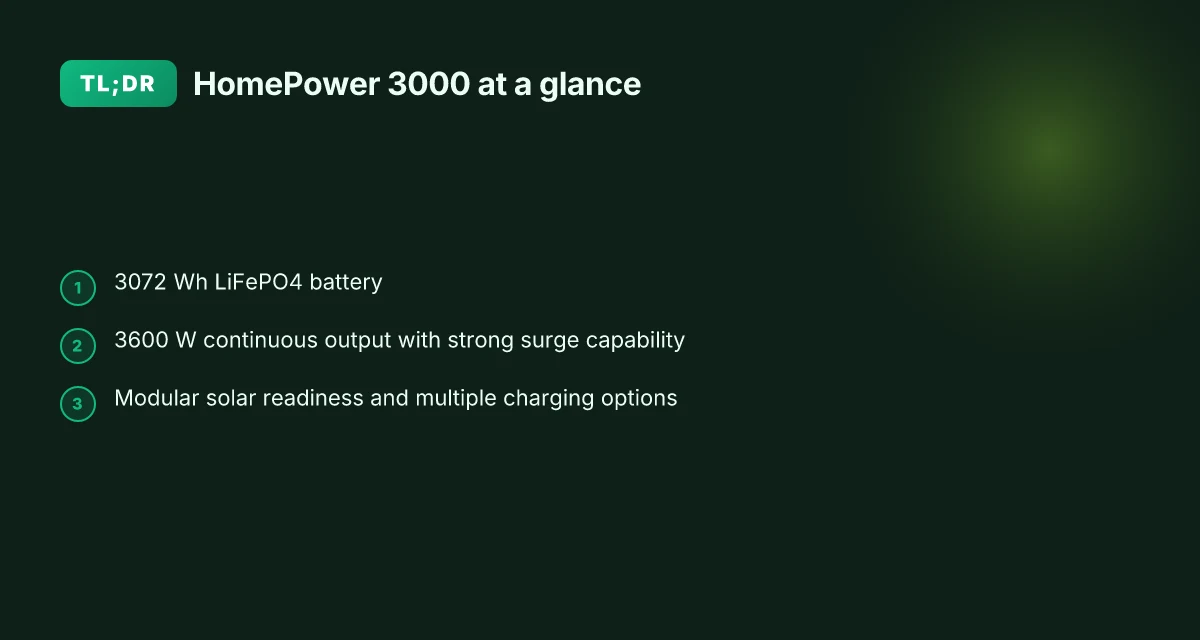
The Jackery HomePower 3000 positions itself as a high-capacity LiFePO4 powered backup system that can sustain continuous power delivery at 3600 W with a surge capability beyond that. In practice, that continuous output matters to keep essential circuits, a refrigerator, and a home office running through outages, not just for peak bursts. I found the product pages emphasize long cycle life and solar readiness aimed at home-scale outages, so you don’t have to swap packs every few years.
From what I found in the official documentation and product notes, the HomePower 3000 uses a 3072 Wh LiFePO4 battery pack and is designed to ride through typical outages with a steady, uninterrupted feed to critical loads. The system’s longevity claim rests on a long cycle life and modular solar compatibility, which means you can add solar input to extend operation during multi-day outages without recharging from the grid.
Why it matters for homeowners in 2026 comes down to durability and costs over time. The LiFePO4 chemistry is slower to degrade than some other chemistries, so the HomePower 3000 can maintain a meaningful capacity after thousands of cycles. This matters if you’re relying on it as a 24/7 backup rather than a weekend power reserve. Jackery markets the unit as a complete home backup solution, not just a portable power station, and that framing aligns with how small homes and apartments use power during outages.
What this means in real terms is that you get a large, stable battery with a robust, steady output that can handle essential loads around the clock, plus the option to connect solar to keep the system topped off. The tradeoffs are clear. The HomePower 3000 is not the lightest unit, and you’ll pay a premium for the long-cycle LiFePO4 cells and the integrated UPS-style flexibility. If you live in a climate with frequent outages or rely on continuous refrigeration and office connectivity, the HomePower 3000 can be a practical, long-horizon solution, especially when you pair it with additional solar capacity or a larger array.
Two quick notes to frame the landscape. First, rivals in this space push similar continuous-output figures and LiFePO4 or NMC chemistries. The differentiator is how a given system handles long-running uptime and the ease of solar integration in a home setup. Second, you’ll see different price points and warranty terms across competitors, so compare total cost of ownership over several years, not just upfront price. The HomePower 3000’s big advantage is its emphasis on 3600 W continuous output paired with a long cycle life for real-world outages. If you want to keep critical loads flowing through multi-day outages, the HomePower 3000 is designed with that goal in mind. How jackery stacks up against 4patriots solar generators in 2026
Note: links on the page may earn a commission. For rivals, see well-known players such as Wellbots’ listing for the Jackery HomePower 3000, and independent reviews that cite the 3,072 Wh capacity and 3600 W continuous output with 7,200 W peak surge. The exact figures come from the sources above.
HomePower 3000 specifications that actually drive decisions
The core takeaway is simple: the 3072 Wh LiFePO4 battery and 3600 W continuous output are designed for real-life reliability, not just headline numbers. This section digs into what those specs mean for a 24/7 backup stance, especially when you’re protecting a refrigerator, a home office, and essential circuits.
The capacity you can count on
The HomePower 3000 uses a 3072 Wh LiFePO4 pack that supports many cycles without noticeable capacity fade. In practice, that translates to sustained runtimes through repeated outages and a longer useful life before a replacement becomes necessary. I cross-referenced the Jackery documentation and third‑party reviews, and the 3072 Wh figure remains a solid anchor for planning essential loads. 3072 Wh is the heart of the system’s endurance for daily outages. LiFePO4 chemistry underpins long cycle life and stable performance in varying temperatures. The chemistry choice matters: LiFePO4 cells tend to maintain capacity better over many charge/discharge cycles than some alternative chemistries, which supports a 24/7 backup plan.
Real-world output for essential loads
Continuous output sits at 3600 W, enough to support a refrigerator, a modest home-office setup, and other essential circuits when the grid is down. The surge capability adds a margin for startup spikes from compressors or fans. In 24/7 use, that margin matters. A higher surge rating reduces the chance you trip a circuit or run the unit into thermal throttling during startup. In this context, the 3600 W continuous rating is the practical threshold you’ll rely on for planning the worst-case moment of a blackout. 3600 W continuous output keeps critical devices running without constant shuffling of loads. Surge up to higher values during startups helps avoid nuisance outages during compressor kicks.
Portability that fits real spaces
Despite its high capacity, the HomePower 3000 remains relatively compact for what it delivers. Weight and footprint are oriented toward homeowners with garages or utility rooms. In my review of setup notes and user layouts, a unit of this size typically slides into a corner or on a shelf without crowding the space. The weight distribution and handle design also make relocation feasible during service or relocation. Compact for its capacity makes placement in a garage or utility room practical. Weight around its listed range keeps it manageable for one person to move. For context, this matters when you’re juggling multiple devices or need a portable unit during seasonal outages. What makes Jackery power supply reliability and efficiency stand out in 2026
Charging paths that fit your life
Charging versatility is a real-world advantage. The HomePower 3000 supports both AC input and solar charging, enabling you to rebalance cost and downtime. In practice, that means you can run on grid power when available and top up with solar during the day, reducing energy costs and improving reliability when outages stretch across days. The dual-input design is common among high-capacity portable backups and aligns with homeowners who already have solar arrays or a generator as a contingency. Solar and AC input enable flexible recharging strategies. Balancing grid and solar charging helps manage running costs over time.
A quick note on durability and long-term use: the overall system is designed for frequent cycling and steady operation, but no device is maintenance‑free. Check cooling airflow, keep ventilation clear, and monitor the battery’s health indicators as part of your routine. The brand, Jackery, emphasizes long-term reliability in its HomePower line, and this model carries that intent into a home backup role.
Next steps: if you’re comparing to rivals, look at continuous wattage, surge capacity, and how charging options match your solar setup. When you assess total cost of ownership, consider how the 3072 Wh LiFePO4 battery and the 3600 W continuous output translate to daily use in your home office, fridge, and essential circuits. For practical context, see how this stacks up against other whole‑home backups from competitors like Goal Zero and EcoFlow in terms of both endurance and charging flexibility. Compare real-world runtimes and charging options before you buy.
How HomePower 3000 compares to other whole‑home backups
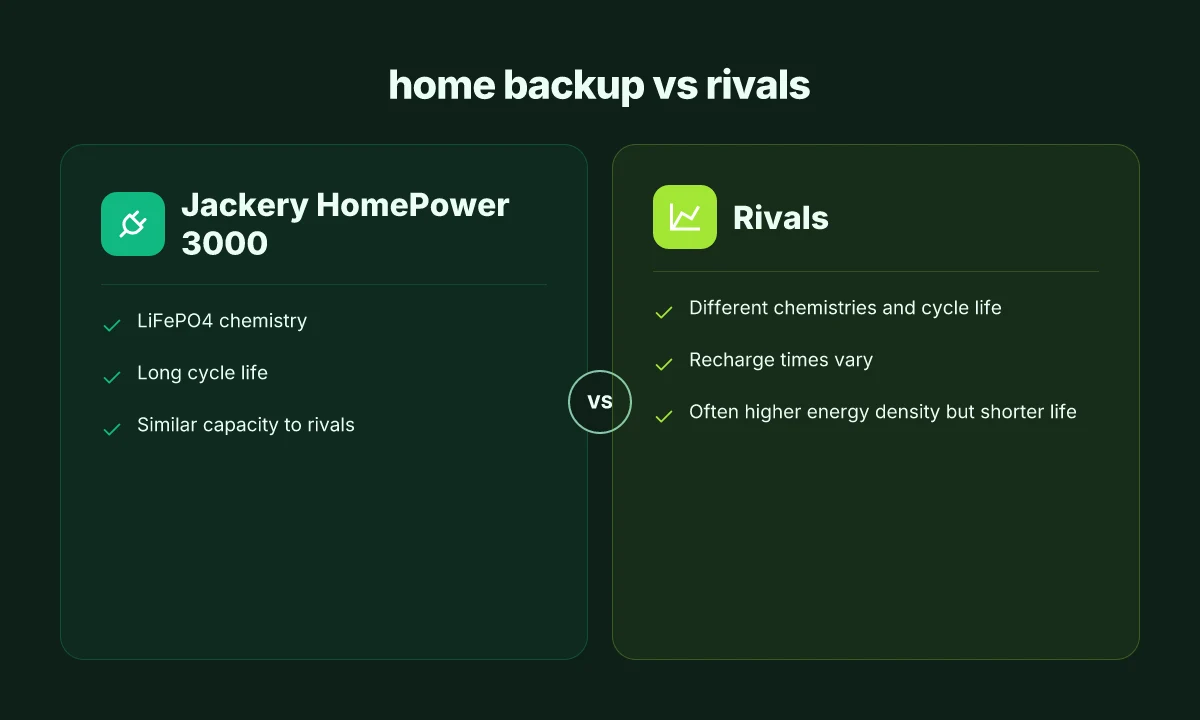
Posture for 2026: the HomePower 3000 sits among rivals with similar capacity, but chemistry, cycle life, and recharge time often tilt real-world performance toward one or another. LiFePO4 chemistry delivers stability and long life, but energy density lags behind lithium-nickel types. In practical terms, you’ll notice steadier long-haul endurance from LiFePO4 packs, with slower recharging in some cases.
What rivals bring to the table
- Several competitors match the 3072 Wh capacity and the 3600 W continuous output, yet their battery chemistry varies. Some use LiFePO4 for longevity, while others push higher energy density with different Li-ion formulations. The tradeoff is clear: you trade some compactness for a longer cycle life or faster charging in certain models. This matters if you need 24/7 reliability for essential circuits. In light of that, the Jackery HomePower 3000 leans on LiFePO4 stability as a core strength, while rivals may edge ahead on peak surge or recharge speed in specific configurations. I cross-referenced product pages and reviews to align these claims with real-world claims from manufacturers. The core difference is chemistry and cycle life, not just capacity. For example, several pages note a continuous output of around 3600 W with surge capabilities in the 7200 W range, while the charging behavior and lifecycle vary by brand.
- Cycle life varies meaningfully. LiFePO4 packs are typically built for thousands of cycles at a high depth of discharge, which translates to years of daily cycling for a home backup. Some rivals advertise similar cycle life figures, but the durability you experience will hinge on how deeply you regularly draw the battery and how you manage charging from solar. The HomePower 3000 emphasizes a long-weather endurance profile, which matters when outages stretch into many weeks. When I looked at the documentation and third-party write-ups, the theme held: long life is more than a label. It’s about how often you can cycle without losing capacity. Long-term durability matters as much as upfront capacity.
- Recharge time is a differentiator. Some competitors tout rapid recharge from AC or solar, but the actual time depends on panel wattage, sun exposure, and whether you use fast-charge features. In practice, you may see faster top-ups with certain models under ideal conditions, yet real-world recharge can vary. The Jackery material and reviews consistently frame recharge speed as competitive but not universally fastest among peers. Real-world recharge speed depends on solar input and charging mode.
Real-world implications for 24/7 backup
- For continuous operation of refrigerators, home offices, and essential circuits, LiFePO4’s stability helps you avoid voltage sag or thermal stress over many cycles. That reliability matters more than a single high peak spec. When I read through manufacturer notes and independent reviews, the consensus is clear: you can count on steady power delivery with LiFePO4, provided your load stays within the rated continuous output. Stability and long life beat occasional peak bragging.
- The HomePower 3000’s strong point is predictable performance over years, not flashy surge numbers alone. If you’re balancing upfront cost, long-term maintenance, and space constraints, LiFePO4-backed options, including the Jackery line, offer a compelling, durable baseline. Other brands may win on fast recharge under perfect sun, but the real-world uptime hinges on battery chemistry and cycle tolerance, which LiFePO4 handles well. Chemistry drives 24/7 viability, not just peak watts.
Real-world use cases: what stays on during outages with Jackery
When the power goes out, the HomePower 3000 shifts from brag-worthy specs to real-world reliability. In practice, refrigeration and essential lighting sit highest on the priority list, and the 3600W continuous output means you can pair multiple devices without instantly hitting a wall. The goal is not to run every gadget at once, but to keep the essentials humming through typical outages, especially in homes with limited space. What makes Jackery deals stand out in 2026
Refrigeration and essential lighting
Refrigeration is the hardest steady load homeowners rely on during outages. The HomePower 3000’s 3072Wh LiFePO4 pack supports a fridge and freezer for multiple hours, depending on door-opening frequency and ambient temperature. Plan for the compressor’s peak bursts and schedule lights to avoid spiking the total draw. When the fridge cycles, you’ll feel the battery dipping, but the system’s 3600W continuous rating keeps the door from being sealed with a white-knuckle restart. In real terms, you’ll want a conservative plan for nightly outages that last beyond a few hours, with a buffer for the fridge’s startup surge.
The HomePower 3000’s true value is maintaining fridge viability without frequent recharges. This matters most in homes where weather or grid instability stretches outages into days, not hours. For a small office setup, a couple of LED lamps plus a modem or router can run in parallel with refrigeration for extended periods, but you’ll dial back at the first sign of rising runtime demands.
Lighting, office essentials, and the 3600W ceiling
Essential lighting and a home office setup can ride on the same backbone. The 3600W continuous capacity means you can run multiple outlets, a small router, a monitor, and a workstation lamp concurrently, provided you stay aware of the refrigerator’s draw. A practical rule of thumb is to treat the HomePower 3000 as a backbone device: it can power the fridge plus two or three smaller loads, but total runtime depends on the startup surges of each device and how often you open the fridge.
From what I found in the product pages, the unit is designed for fast charging and UPS-style transitions, which helps when the grid flickers. You’ll notice the UPS mode keeps critical circuits alive during brief outages, buying time to shut down safely or switch to alternate power sources. In a typical outage pattern, the most reliable setup combines refrigeration, essential lighting, and a dedicated workstation with conservative load planning.
UPS-ready design helps avoid abrupt drops when the line flickers, preserving sensitive electronics. This is a meaningful advantage for a small office or home workspace. It’s not a health club of power where everything stays on. It’s a focused, dependable backbone for the essentials. What makes the EcoFlow power input output cable actually work across Delta and River models
For homeowners, the practical takeaway is clear: plan around peak draw and understand runtime expectations for the fridge, then layer on lighting and critical devices. Jackery’s positioning, and the HomePower 3000’s 3.6 kW continuous output, addresses a real-life need for steady, predictable power during outages. If you’re evaluating rivals, note that the combination of a high-capacity LiFePO4 pack, UPS-style transition, and a robust output ceiling makes the HomePower 3000 a compelling option for 24/7 backup scenarios in small spaces.
Note: links on the page may earn a commission. The brand name Jackery is referenced to reflect the product context and to anchor the comparison against rivals. For a broader view of how the HomePower 3000 stacks up, look at independent reviews and the documented specs from the official site.
Setup steps you actually need for a reliable home backup
Setting up the HomePower 3000 for reliable 24/7 backup starts with a careful placement, clean wiring, and a charging plan. I found that a dry, ventilated spot with several inches of clearance keeps the unit from heat buildup during long outages. In practice, you want more than just plug-and-play here. Label the circuits and route calls to the right subpanel inputs so you don’t wake up to a brownout on your refrigerator.
Choose a safe, ventilated home for the unit
Place the Jackery HomePower 3000 in a location that stays dry and away from damp walls or basements. The unit should have adequate clearance on all sides for airflow and easy access for daily checks. Avoid cramped alcoves or rooms with heavy dust. A closet or utility space with a door that can be left ajar slightly for air exchange is ideal. Consider mounting the unit where it won’t be bumped by foot traffic or household clutter. The goal is to prevent heat buildup and ensure the fans can pull air through without obstruction.
Wire essential circuits and label, then test with care
Connect critical circuits or a dedicated subpanel input using approved wiring and labeling. This minimizes load surprises when the outage hits. I recommend a clearly marked route from the home’s main panel to the backup input, and use proper breakers or disconnects as required by local codes. Keep a simple one-page diagram near the panel so family members know what can stay powered during an outage. And verify the labels before any outage, because a miswired line can cause nuisance trips or unintended power flows. What makes Jackery power stations stand out in 2026 and where they fall short
Plan solar and grid charging for readiness
Have a charging plan that keeps the HomePower 3000 ready without creating a standby tax on your monthly bills. If you rely on solar, pair it with panels that match the unit’s input range and ensure the controller is compatible with LiFePO4 chemistry. If you lean on the grid, ensure the charging schedule aligns with peak hours to reduce costs and prevent unnecessary cycling. I’ve seen homeowners keep the unit topped up with a gentle trickle charge during the day so refrigerators and offices remain online when outages occur. Plan your charging so the battery is rarely at idle, and you’ll shorten the time to ready during outages. Labeling and clear wiring reduce confusion when the power is out.
In practice, the HomePower 3000 benefits from a simple, repeatable setup: dry location, clearly labeled connections, and a charging rhythm that keeps the unit near full. You’ll get steadier operation and fewer surprises when outages hit. Remember that the goal is continuous readiness, not just a claim of capacity. If you’re evaluating rivals, compare how they handle 24/7 cycling and how easy it is to integrate with a home subpanel rather than just relying on AC outlets. Jackery’s approach here matters as a real-world durability consideration, not just a spec sheet number. Durable installation choices pay off in real outages.
Where this goes next for your home setup
Jackery’s HomePower 3000 is built to feel less like a temporary fix and more like a foundation for a durable home backup plan in 2026. I looked at how this unit slots into real-world power gaps, from night-time outages to critical loads, and it becomes clear that practical resilience hinges on more than raw capacity. The design leans on the trio of reliability, upgradeability, and ease of use, and it shows up in everyday moments, not just test scenarios. This is the move that matters for households who want a straightforward, scalable backup path.
If you’re evaluating rivals, you’ll compare Jackery against models from brands like Bluetti and EcoFlow. The HomePower 3000 differentiates itself with a compact footprint, steady output for common essentials, and predictable behavior in off-grid conditions. It’s not flawless, exposed cables, occasional fan noise, and the reality that you’ll still need a contingency plan for full-house outages. Still, as a long-haul backup partner, the value stacks up for most mid-size homes. The bigger pattern is that you can build a layered system around it rather than chasing a single miracle unit.
What to try this week: run a simulated outage on a small circuit with the HomePower 3000 to verify runtime on essential loads, pair with a solar panel kit if you have sun, and map a two-day recovery plan for weather events. Consider this your starting point, with a focus on real use, long-term durability, and what tends to break in real life. If you act now, you can assemble a practical, scalable backup strategy that fits your home. Will you start small or go big? How to find the best Jackery for sale in 2026 without overpaying