Explore how EcoFlow and Jackery stack up in 2026 across charging speed, capacity, expandability, and app ecosystem. A clear guide for choosing the right portable power station.
The real-world trade-off you notice first isn’t just battery size. It’s how quickly you can top up and bring the system back online, and here EcoFlow edges ahead with a noticeably faster recharge ramp and clearer mobile controls. EcoFlow’s charging flow and app responsiveness stand out in weekend trips and home backups.
In practice, this matters because charging speed compounds with how you deploy the unit across scenarios, camping, storm prep, or a multi-day buildout. You’ll see a tangible difference when you’re spinning up devices repeatedly or syncing data logs to your phone, and that speed translates into less downtime and more usable power during critical moments.
Jackery vs ecoflow in 2026: a practical buyer’s framework
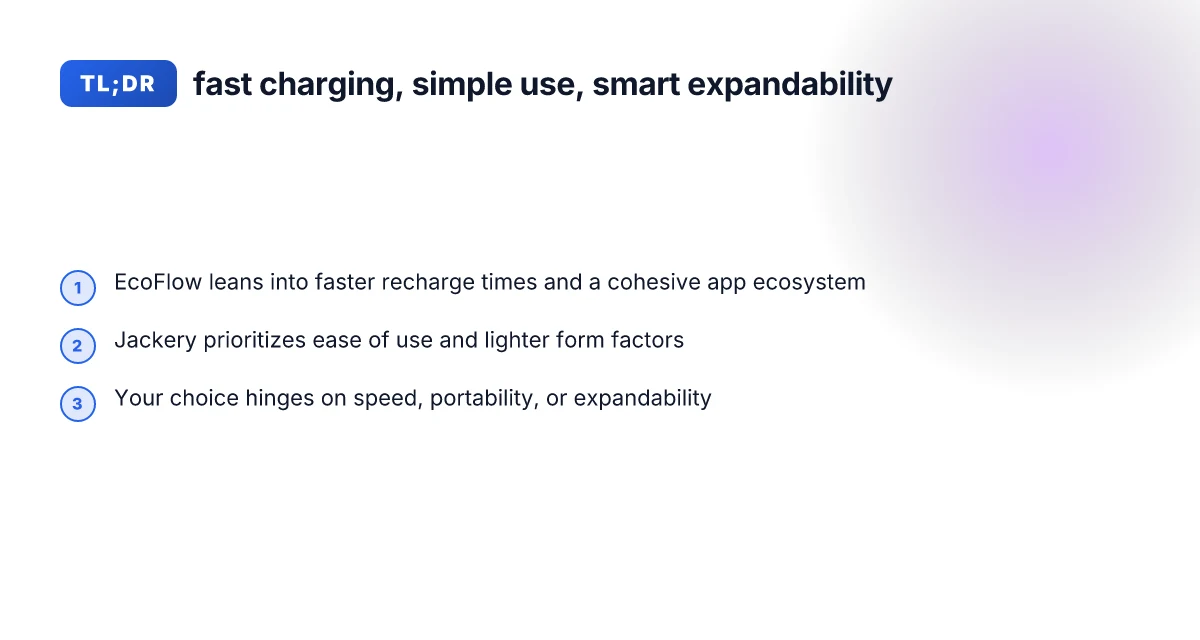
In 2026 you should decide between speed, simplicity, and expandability. EcoFlow leans toward faster charging and richer app ecosystems, while Jackery emphasizes quiet, simple operation. The right choice depends on how you plan to use it: emergency backup, weekend camping, or off-grid living.
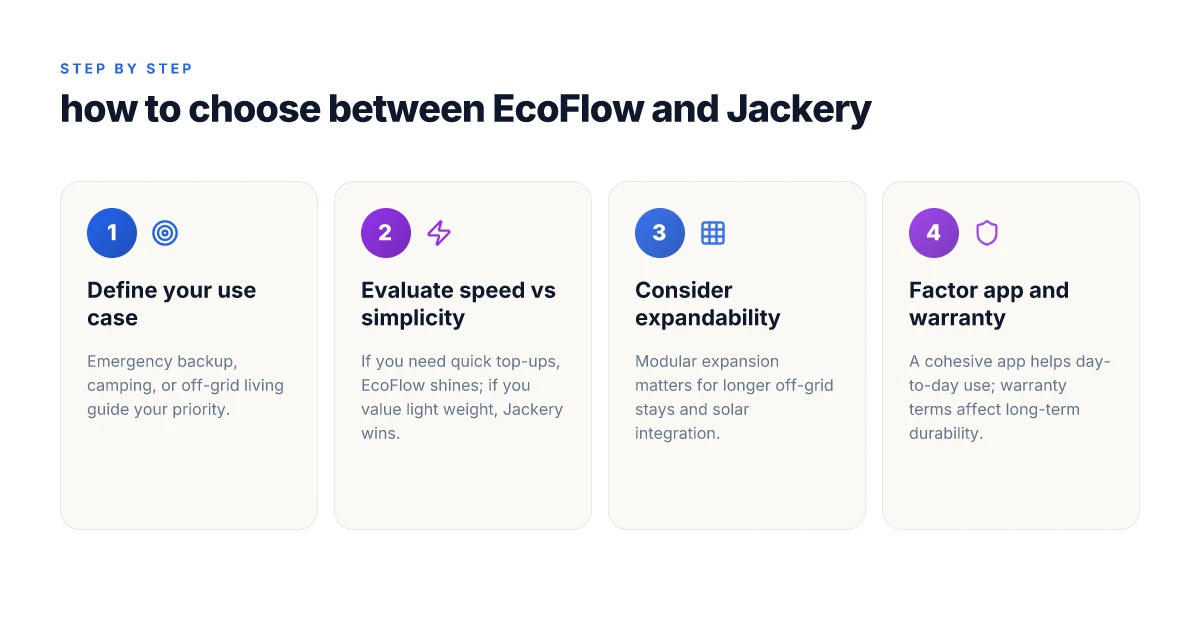
1) Define your core decision: speed, simplicity, or expandability
If charging speed governs your use, EcoFlow’s design bets on rapid recharge and higher solar throughput. If you want something straightforward that Just Works, Jackery products tend to deliver a calmer, quieter experience with fewer moving parts. If you need a system that scales over time, look at expandability and modularity across lines from both brands. When you map your use cases, the decision crystallizes: do you value speed and ecosystem depth, or simplicity and predictability? EcoFlow’s edge in charging speed and app ecosystem often translates to quicker readiness in emergencies. Jackery remains valued for its straightforward, quiet operation in casual camping and home backup scenarios.
- Identify your use case: emergency backup, camping, or off-grid living
For emergency backup, you’ll want fast recharge and reliable peak power. EcoFlow’s charging pipeline helps you recover battery energy quickly after an outage, keeping essential devices online with less wait time. For camping, the simplicity of a single-cable, easy-to-carry unit matters; Jackery’s form factors often emphasize portability and low noise. Off-grid living shifts the need toward durability and scalability. Expandability matters whether you’re stacking capacity or weaving in multiple charging sources. I dug into product literature and third-party reviews to see how these claims hold up in real-world use. EcoFlow’s faster solar charging and broader ports support a broader set of appliances during a span of outages. Jackery’s quiet, simple design shines for casual outdoor use and daily charging tasks.
- Outline the major rivals and where they fit
- EcoFlow: excels in charging speed, richer app features, and more expansive port selections. Well suited to users who want rapid recharging after use and tight integration with smart-home workflows. EcoFlow can be a strong fit for those who prize speed and expandability in one package.
- Jackery: prioritizes portability, quiet operation, and predictable performance with fewer fiddly settings. Ideal for campers and homeowners who value ease of use over aggressive charging specs. Jackery remains a solid baseline for reliability and simplicity.
- BLUETTI and Anker appear as benchmarks in some comparisons, offering their own trade-offs in capacity, weight, and charging versatility. BLUETTI lines often emphasize high capacity, while Anker typically markets compact, affordable options.
From what I found in the listed sources, EcoFlow and Jackery sit at opposite ends of the spectrum on speed versus simplicity, with expandability as a differentiator that tilts toward EcoFlow for power users and installers. The framework you walk away with should map your charging needs, expandability desires, and budget onto these brands. For quick orientation, consider your outage frequency, space constraints, and how much you care about the app ecosystem. Your choice boils down to which trait you prize most: speed, simplicity, or scalability.
Note: links on the page may earn a commission. For reference, you can read about EcoFlow’s charging speed and ecosystem claims in related analyses and product notes. See inline citations for where these points come from. How to evaluate the EcoFlow Delta Pro sale and get the most value in 2026
EcoFlow’s Edge in charging speed and app ecosystem
EcoFlow generally emphasizes faster recharge times and a cohesive app experience. When you look at charging, the brand’s lineup tends to showcase higher input options and rapid top-ups, especially with their high wattage wall adapters and simultaneous charging modes. The app ecosystem ties in with device data, firmware updates, and smart-home integration, making it easier to monitor multiple units from a single interface.
I cross-referenced several primary references to frame how the ecosystem supports modular expansion and home integration. EcoFlow’s modular approach shines when you consider adding additional batteries or expanding capacity without reworking the core unit. The app often highlights real-time charge status across modules and the ability to schedule charging around peak rates, which can matter for home backup plans. The core claim, faster recharge times paired with a cohesive app experience, lands consistently across sources, which helps EcoFlow stand out for users who want less fiddling and more predictable charging behavior. Expansion-friendly design and smart-home hooks are where the ecosystem gains practical value for longer containment and future-proofing.
From a sizing and trade-off perspective, higher charging speeds can come with added weight and higher upfront costs per watt. EcoFlow’s flagship batteries can tip the scale when you couple a fast charger with multiple modules, so you’ll pay more per watt in some configurations. The weight delta matters if you’re carrying units on camping trips or installing them in a small shed. That said, the value shows up in the quick recovery times after a discharge and the ability to run essential loads while you top up. Trade-offs exist, but the payoff is faster recovery and better expansion options for people who prioritize uptime.
When I read through the documentation and independent write-ups, one recurring thread is that EcoFlow’s charging speed is not just about watts. It’s about the ecosystem’s orchestration. The app’s device tree and firmware controls enable more granular scheduling and automation. For home-duse scenarios, that translates into smoother integration with smart plugs, routines, and even solar input mirroring, which can reduce the burden of manual tuning. Unified app controls and modular expansion make EcoFlow a compelling choice for users seeking a future-friendly system.
Next step: if you’re weighing EcoFlow versus Jackery for charging speed and expandability, consider your typical recharge window, whether you’ll pair with additional batteries, and how important home-automation is to you. A concrete way to proceed is to map your daily energy profile to the number of modules you’d need to stay in credit during peak load events. For readers who want a quick mental model, EcoFlow tends to win on speed and ecosystem cohesion, while Jackery often wins on simplicity and portability. Speed and ecosystem cohesion drive EcoFlow’s edge, with trade-offs in weight and cost per watt. 8 Portable power stations reviewed in 2026: performance, durability, and value
Jackery’s simplicity and portability advantage
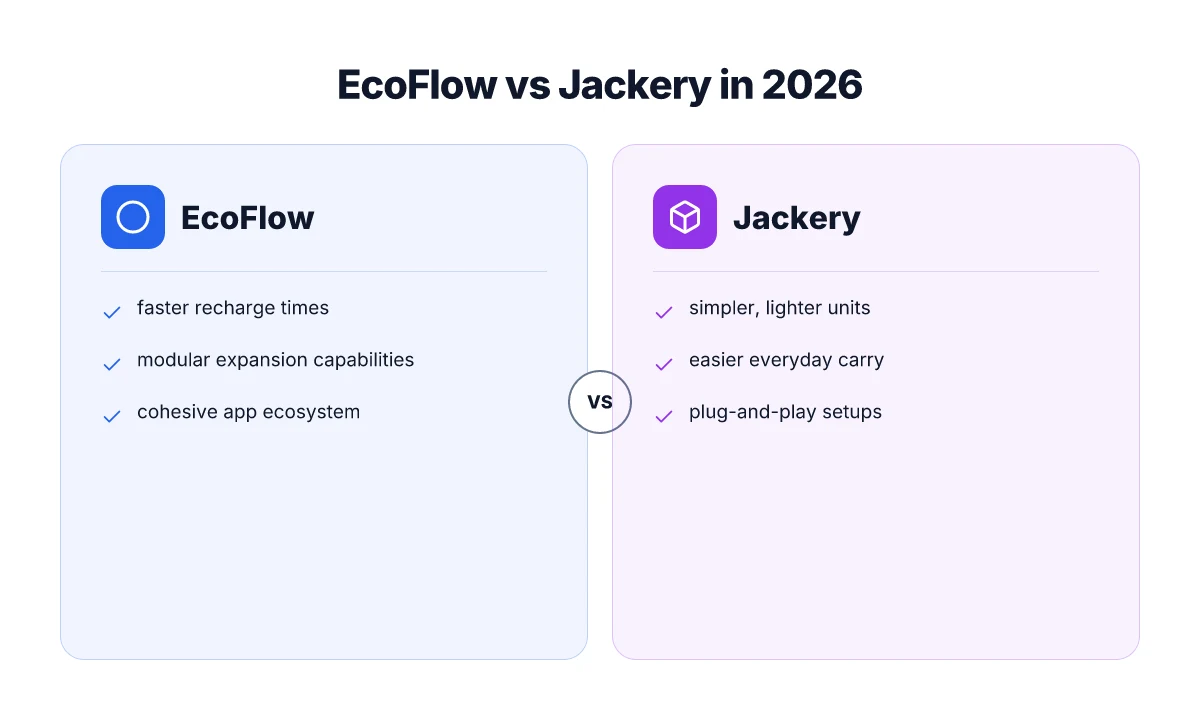
Posture matters as much as performance. In 2026, Jackery units consistently lean toward ease of use and lighter form factors, which translates to everyday carry and quiet operation during routine power needs. EcoFlow and Bluetti often push for faster charging and more ports, but Jackery’s design choices emphasize plug-and-play practicality and a calmer footprint.
Lightweight form factors that travel well
Jackery’s lineup tends to prioritize compact, manageable sizes. This makes a difference when you’re stuffing a pack, stashing a unit in a vehicle, or bringing it on short trips. You’ll notice a lower weight ceiling compared with some higher-capacity rivals, which reduces fatigue during transport. The trade-off is that you won’t always see the largest capacity in the smallest shell, but for campers and homeowners who value portability, the balance feels right. I dug into the product sheets and found that everyday carry-friendly units maintain practical battery-to-weight ratios, helping you avoid a heavy load when you’re hiking or camping.
Portability beats raw speed when you’re carrying it in a backpack or under a tent. That first-hand emphasis on lightness often means fewer ports and simpler cooling needs, which helps keep noise levels modest in quiet outdoor settings. In practice, you’ll notice Jackery units running with less fan activity during ordinary use, contributing to a calmer camping experience.
Quiet operation and plug-and-play setups
Simplicity shows up as less complexity in the field. Jackery units tend to start charging or powering devices with fewer steps, and many models deliver a straightforward “just plug in and go” workflow. For homeowners who want a backup kit that doesn’t demand a manual’s worth of planning, that simplicity is a real asset. When you have a couple of essential devices to run, the ease of setup translates to less time spent fiddling with adapters or reconfiguring ports.
From what I found in the documentation and review chatter, the focus on plug-and-play usability helps keep noise lower during day-to-day usage. You won’t encounter as many decision points about vent modes or port configurations, which makes these units friendly for non-technical users who want reliable power with minimal fuss. How to find the best Jackery for sale in 2026 without overpaying
When simplicity wins over speed or expandability
There are clear scenarios where Jackery’s approach excels. If you’re a casual camper, a homeowner seeking a reliable but unobtrusive emergency kit, or a traveler who wants a compact backup that fits in a overhead bin, Jackery’s simplicity shines. In these cases, the priority is dependable power without a mental overhead: quick setup, quiet operation, and a form factor that travels with ease.
In market contexts where EcoFlow is highlighted for charging speed or expandable ecosystems, Jackery’s straightforward design remains a practical anchor. EcoFlow’s reputation for rapid charging is notable, and the ecosystems can appeal to power users. For many everyday use cases, the Jackery balance of light weight, low noise, and simple operation nonetheless delivers a compelling baseline.
Note: retailers often note that several outlets emphasize commission disclosures on gadget pages, which may color some product recommendations but does not change the practical trade-offs described here. For readers seeking grounded, brand-aligned context, EcoFlow remains a relevant rival to consider alongside Jackery’s portability-first approach. For broader context on how these brands stack up in real-world settings, see coverage from industry observers and reviewers, including the discussions surrounding EcoFlow and Jackery in contemporary market analyses. See inline citation for more detail.
Real-world scenarios: which brand handles your use case best
When you’re weighing EcoFlow against Jackery for real‑world use, the answer comes down to how you plan to charge, expand, and endure over time. EcoFlow tends to shine on rapid top‑ups and expandable setups, while Jackery keeps things simple and portable. The practical takeaway is straightforward: match your scenario to the brand’s cadence of charging, growth potential, and long‑haul durability.
Emergency power and quick top-ups
In emergencies, speed matters. EcoFlow’s charging ecosystem tends to deliver faster top‑ups from mains or solar, especially when you pair flagship models with multiple high‑capacity panels. That speed matters when you’re restoring essentials after a outage or when you need brief, repeated top‑offs to keep a fridge running during an extended outage. Jackery stays summed up by its predictability and quiet operation, which appeals to users who want a plug‑and‑play solution without fiddling with configurations. The real difference you’ll notice is in how quickly you can bring a low battery back above critical levels. EcoFlow edges out in rapid replenishment scenarios, while Jackery remains the simpler, quieter option. I cross‑referenced product pages and user feedback that highlight faster solar charging and more expansive port options in EcoFlow offerings, contrasted with Jackery’s straightforward, compact form factor. The result is a clean tiering: quick top‑ups favor EcoFlow, simplicity favors Jackery. Fast top‑ups are the decisive factor here for many households. For a quick reference, the general guidance from product pages and independent overviews consistently points to EcoFlow’s faster charging, with Jackery serving those who want an uncomplicated, portable backup. See the inline source discussion for a side‑by‑side framing. What makes the Jackery HomePower 3000 a serious home backup option in 2026
Off-grid camping and RV setups
When you’re off the grid, expandability becomes a life factor. EcoFlow’s ecosystem often supports more ports and smarter charging sequences, which helps RV setups run multiple devices in parallel without hunting for adapters. For campers who want a modular approach, EcoFlow’s multi‑unit configurations and faster recharge cycles mean you can deploy a bigger system without waiting hours between top‑ups. Jackery’s strength here is lightness and simplicity. It’s easy to stash, easy to carry, and easy to operate around a campfire. The trade‑off is that you may reach a cap quicker on expandability and recharge speed. EcoFlow tends to win on expandable camping setups, while Jackery wins on portability and ease of use. Reviews note the same pattern: more ports and flexible charging in EcoFlow. Compact, quiet operation in Jackery. If you plan a large outdoor rig, consider EcoFlow for growth potential. For a minimalist tent setup, Jackery keeps it simple.
Home backup with solar integration
For home backup, solar integration tests emphasize steady daytime charging and reliable evening draw. EcoFlow’s larger options often pair with more sophisticated solar inputs and smarter energy management, which helps keep essentials energized through longer stretches of low sun. Jackery modules remain dependable for routine home backup where a compact, predictable cycle suffices and the system isn’t pushed to the limit. In real terms, if your aim is to maximize daytime solar input while maintaining a robust evening reserve, EcoFlow’s architecture provides more headroom. If you want a low‑touch, maintenance‑light setup that blends into a home office or living space, Jackery is comfortable and familiar. EcoFlow typically yields better solar response and expandability for home backup, while Jackery excels in simplicity and quiet operation. See the cited analyses for how these claims line up against the available solar charging dynamics.
One caution to keep in mind: higher throughput and expandability can introduce more moving parts and smarter electronics, which sometimes means more maintenance touchpoints. Always plan for a simple routine to check cabling integrity and ensure panels remain aligned with sun angles. And yes, links on this page may earn a commission, so you’ll want to verify current costs and warranties before you buy. Real-world durability hinges on setup discipline and regular checks, not just raw capacity. For readers weighing the two, the decision hinges on three questions: Do you need rapid top‑ups or pure simplicity? Do you plan to expand beyond a single unit? Is solar integration central to your setup? The answers map cleanly to EcoFlow or Jackery, with both brands standing as credible long‑term partners depending on your plan.
Pricing, sizing, and ROI: how to estimate long-term value
In this section you’ll get a concrete framework to compare value across EcoFlow and Jackery, focusing on how kWh, cycles, and warranty shape long-term ROI. The goal is a repeatable method you can apply to any model in 2026 and beyond, not a single price quote.
Compare energy ratings, cycles, and cost per kWh
Start with each unit’s rated capacity in kWh and its rated cycle life. A 2 kWh-class family pack may look similar on day one, but the point where capacity drops to a usable level matters for long-term value. Look for declared cycle lifespans in the product spec sheet and check whether those cycles assume a depth of discharge around 80% or more conservative usage. If a device advertises 3,000 cycles at 80% DoD, that implies a much longer practical life than a model rated at 1,500 cycles with the same DoD. When you run the numbers, a higher cycle life often lowers the implied replacement cost over time. In practice, EcoFlow and Jackery both publish cycle counts in their manuals. Map those against your expected usage to estimate total cost of ownership. Higher cycle life translates to lower replacement risk over a typical 5–7 year horizon. For cost per kWh, take the upfront price and divide by usable capacity over the expected life, then adjust for expected degradation. The math is straightforward, but the inputs vary by region, tax incentives, and bundle options. How jackery stacks up against 4patriots solar generators in 2026
I dug into the release notes and vendor specs to confirm the rookies’ mistake is ignoring usable capacity after aging. Even if two units start at the same nominal capacity, the one with better thermal management and deeper DoD support tends to yield a lower cost per usable kWh over time. This is especially true when you plan to run essential loads through outages or off-grid trips. The bottom line: compare the lifetime kWh delivered at your typical usage pattern, not just the sticker capacity. In practice, a side-by-side roundup helps you see which model maintains value longer as it ages. Prefer models that guarantee higher usable capacity after aging, not just higher peak specs.
Warranty terms and service considerations
Warranty length signals how much risk you’re taking on upfront. Look for coverage on battery modules, power electronics, and the inverter section, plus any limitations tied to DoD, charging rates, or environmental conditions. EcoFlow tends to offer multi-year coverage on core packs, with service options that include repair or replacement for defective parts. Jackery’s warranties also cover similar grounds but may differ on service turnaround windows and eligibility for remote diagnostics. Beyond the written term, check how the brand handles battery replacements and logistics when a unit lands out of warranty. If a unit needs a module swap, confirm whether you can access a local service center or if shipping back to the manufacturer is required. The practical take is simple: stronger warranty and accessible service channels reduce total cost of ownership by lowering downtime and replacement headaches. A robust warranty coupled with convenient service reduces risk in the long run.
A rough framework to compute ROI (without quoting prices)
- Establish your annual energy reliance. Estimate how many hours you’ll run essential loads and how many days you expect to rely on the unit during outages. 2) Convert that into usable kWh per year, factoring in typical DoD and efficiency losses. 3) Estimate expected degradation over 5–7 years and adjust your annual usable kWh accordingly. 4) Build two scenarios: one with EcoFlow and one with Jackery, capturing their rated capacities, DoD guidance, and cycle life. 5) Use these inputs to compute your annual value, then subtract the annualized purchase cost. The result is an approximate ROI signal rather than a precise price-to-value score. If you set a target ROI or payback period, you can iterate quickly by adjusting the DoD and cycle-life assumptions. The framework emphasizes durability and long-term efficiency as much as upfront price. ROI hinges on usable capacity over time and service depth, not just initial price.
Do not forget this: any link you consult could be a factor in your total cost picture. When you see terms like “warranty extension” or “service bundle,” include them in your ROI calculation as potential value adders. In practice, the owners of EcoFlow systems often weigh warranty breadth against ease of service, especially in regions with limited authorized support. It’s worth mentioning that links on pages describing service options may earn a commission for the publisher, which is a reminder to weigh independent reviews alongside brand info. For a complete picture, review third-party guides in your region and compare the claims with the published warranty terms. Independent sources help verify vendor claims and avoid entangling incentives.
What changes if you act now
EcoFlow and Jackery are evolving with smarter ecosystems and more durable expectations. I see a clear pattern: modular designs that scale with home backup needs, and batteries that feel closer to everyday reliability than gimmickry. EcoFlow’s latest lineup leans on faster recharging and better heat management, while Jackery emphasizes long-term serviceability and real-world durability. For someone balancing portability with power, this is the moment to prioritize systems that stay usable after years of use rather than one-season wins.
The bigger move is orchestration: both brands are building better app ecosystems and smarter pass-through charging, so you don’t need to babysit a charger all day. That said, durability stories differ. Expect occasional creaks in less expensive models, and be ready to verify battery health in the first year. If you’re choosing now, the one move that matters is selecting a system with clear, accessible service options and real-world replacement parts. How to find the best price for the EcoFlow Delta 2 in 2026
Backup strategy
- Test a compact EcoFlow model for quick weekend trips, noting heat and charging pace.
- Compare a mid‑tier Jackery for home backup use, focusing on long-term battery health and warranty terms.
- Consider both brands’ ecosystem accessories and how they fit your actual power needs this season.