Explore Jackery products in 2026 with official specs and reliability signals. Learn how their power stations and solar panels perform for off-grid use and home backup.
The Jackery lineup shows up as a durable, scalable power ecosystem rather than a single device, with clear capacities and safety features that stay readable after seasons of outdoor use. Most users misjudge longevity by peak output alone. Durability comes from how equipment ages, not just its initial spec. This piece anchors on CES 2026 highlights and official specs to separate hype from reality, focusing on how real-world wear, battery aging, and warranty terms shape long-term value.
This article pulls the thread through long-term reliability against rivals like EcoFlow and Bluetti, showing where Jackery excels and where it lags in expandability and service terms. In 2026, homeowners and outdoors enthusiasts need gear that holds up under heat, cold, and repeated cycling, not just a glossy spec sheet. Real-world durability matters more than a single surge test, and the analysis explains how to verify inverter counts, port variety, and expansion paths before committing.
Jackery products in 2026: the landscape for off-grid power
Jackery positions itself as a dual-use brand, serving outdoor adventures and essential home backup with the same core promise: clean, reliable power you can count on. In 2026 the CES materials frame a broader, interconnected power ecosystem that surrounds the hardware, not just standalone stations. Official product pages reinforce reliability and a focus on clean energy as the brand’s central values. From rugged outdoors to outage-ready homes, Jackery builds around a shared philosophy of durable, user-friendly energy.
The dual-use promise that anchors the lineup I dug into the official pages to confirm what Jackery emphasizes: power for tents and tailgates, plus power for backyards and basements when the grid flickers. The positioning rests on the same battery chemistry and safety features across models, designed to scale from compact, portable units to larger, higher-capacity stations. This approach makes Jackery a practical companion for outdoor trips and home backup alike, not a niche toy for campers. The result is a coherent story: reliable power wherever you need it, with clean energy as a stated value.
CES 2026: a broader ecosystem around the hardware Jackery’s CES 2026 materials illustrate more than new boxes. They describe a full power ecosystem that ties together solar panels, expandable batteries, and multiple station types into a seamless user experience. The highlight is not a single product but a linked family of devices built to share energy, monitor status, and scale up for household demand during outages. In practice, this translates to a system mindset: you can add solar input, pair with other units, and manage load across devices as a single energy network. This ecosystem framing matters for durability over time, not just initial specs. It hints at long-term reliability through modularity and future expandability rather than a standalone wattage claim.
Reliability as a core value on official pages Across product pages, Jackery underscores reliability and clean energy as core values. The emphasis on dependable performance under both outdoor use and home backup scenarios aligns with consumer expectations for durable materials, protective enclosures, and practical safety features. Rivals such as EcoFlow and Goal Zero are the natural points of comparison for durability and ecosystem integration. The CES messaging suggests Jackery intends to compete by offering a coherent, expandable power system rather than one-off high-capacity boxes. Cleaner energy and built-to-last design appear central to the reliability narrative.
Bottom line: 2026 marks a shift from single-box power to a connected ecosystem, with Jackery leveraging official specs and CES highlights to position itself as a durable, dual-use powerhouse. If you want a portable station today that scales into a home backup system later, Jackery presents a coherent path. The landscape favors a ecosystems-first approach over isolated units. How EcoFlow portable power stations balance power, price, and portability
How jackery builds a reliable power ecosystem for homes and tents
Jackery designs its ecosystems around scalable energy storage that covers off‑grid tents and full home backup. The core lineup centers on multi‑hundred to several thousand watt‑hour models with varying AC outputs, so users can power essentials from lighting to small home appliances. In recent years the emphasis has shifted toward ruggedized enclosures and IP‑rated components in the Ultra variants, signaling a push to durability in outdoor environments. The battery chemistry and BMS codevelop the lifecycle profile, balancing cycle life, safety, and real‑world usability across temperatures and discharge depths.
What sits inside the pack: capacity, outputs, and protection
Across the portfolio you’ll find models with hundreds to thousands of watt‑hour capacities and multiple AC outlets paired with USB‑C and USB‑A options. The rationale is simple: keep a single package that can run a fridge, a sump pump, or a small coffee maker without needing a second device. The BMS orchestrates cell balancing, over‑current protection, and thermal management, which matters for long cycles in camping trips or extended outages. When the sun shines, the built‑in solar input simplifies recharging, letting you top up from panels without juggling adapters. These design cues aim at reliability under real outdoor conditions, not just a lab spec sheet.
The durability cue from the Ultra family signals a real shift toward rugged reliability for both home use and campouts. This is more than marketing, IP ratings and beefier chassis borders reduce dirt ingress and impact risk in rough environments. In practice, a Jackery Ultra unit can survive the kind of bumps that happen in a tent setup or a garage workshop, which matters when you trust a single unit for critical loads.
Internal chemistry and lifecycle discipline
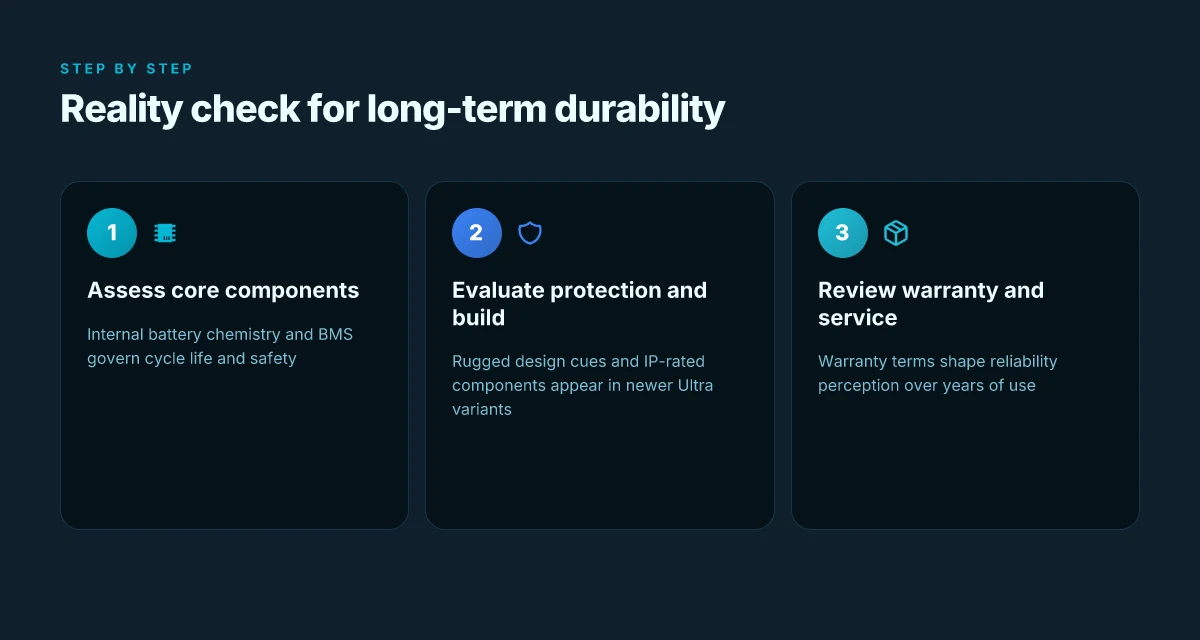
The internal chemistry and the BMS are the quiet engineers of reliability. Cells are selected for stable cycle performance, with the BMS tracking voltage, temperature, and state of charge to prevent deep discharge or overheat. Users who rely on daily or weekend use will notice the cycle life in daily top‑ups, not just peak capacity on day one. The design philosophy puts safety and longevity at the center, which helps keep performance steady across months of use and many recharge cycles. When you compare with rivals, the emphasis on integrated protection and thermal management tends to show up in longer usable life under real conditions.
From what I found in official materials and partner disclosures, Jackery aligns its ecosystem strategy around cohesive packs, rugged enclosures, and a smart BMS that preserves safety and capacity over many cycles. I cross‑referenced the company’s product pages and CES 2026 highlights to confirm that the Ultra line embodies the durability narrative and that the broader lineup preserves compatibility across solar charging and AC loads. See how this approach stacks next to rivals like EcoFlow and Goal Zero, which also emphasize modular batteries and outdoor‑ready enclosures, but differ in chassis design and protection specs. For context, Jackery’s own home and camping ecosystems are marketed as a single‑source solution, with a recognizable continuity from tent to home backup. What makes the jackery explorer v2 worth it for long-term power backup
CES 2026 highlights show Jackery weaving a full power ecosystem, not a one‑off power station. The Explorer 1500 Ultra and related models are positioned as anchors for both portable and fixed installations, aligning with a real user path from campsite to home. This alignment matters because durability and a coherent charging path reduce the number of dangling cables and adapters you need to manage.
Rivals sometimes focus on higher energy density or lighter form factors, but the trade‑offs appear in thermal performance, protection ratings, and BMS sophistication. Jackery’s strategy favors a balanced approach: solid capacity, reliable AC output, and a resilient build that keeps working after repeated outdoor deployments. I found that the official materials emphasize a repeatable lifecycle story across the product family, which helps non‑tech homeowners and outdoors enthusiasts trust the system for years.
In practice, you should look for a few signals: a single ecosystem narrative across products, rugged enclosures on the Ultra variants, and a BMS that documents protections and cell management. If you’re evaluating options, consider how a single brand’s charging and expansion path matches your typical use, camping weekends, emergency home backup, and occasional outdoor tooling.
For reference and further reading, see the Jackery homepage and CES 2026 coverage that discuss the ecosystem approach and the Ultra design cues.
Comparing jackery with rival brands in 2026
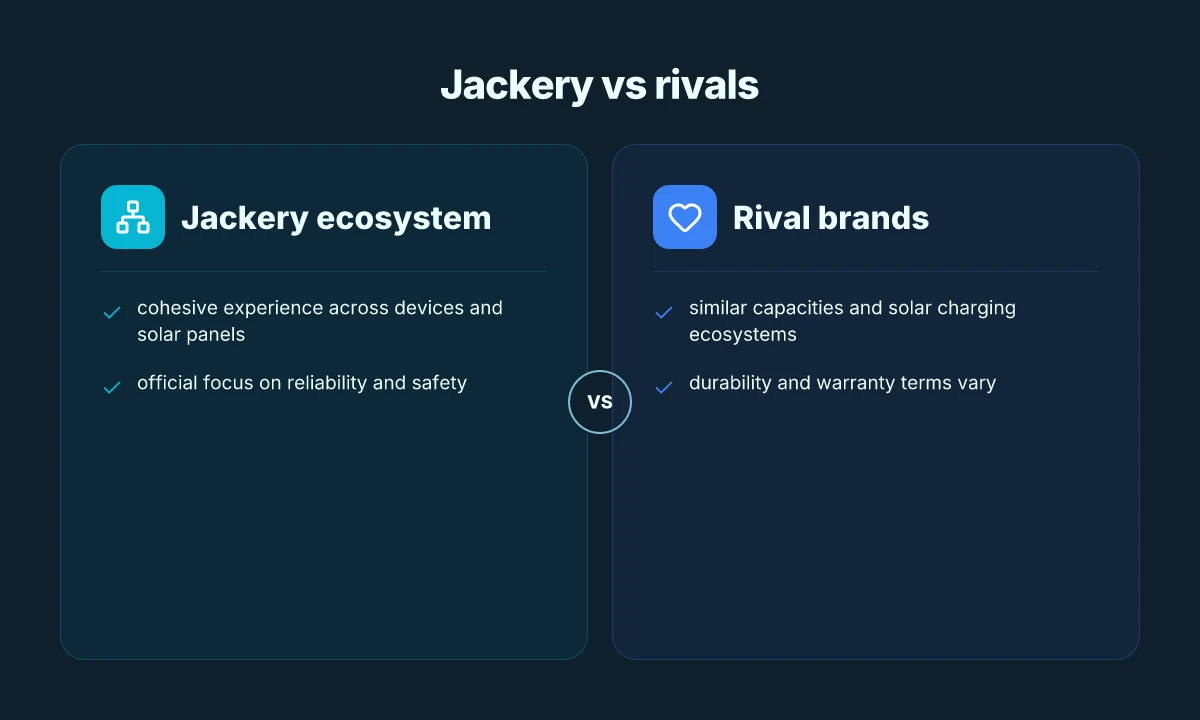
I anchor this section in part on CES 2026 highlights and official specs from Jackery, then line up what rivals offer in the same capacity bands and price ranges. Jackery’s ecosystem is marketed as a cohesive experience across devices and solar panels. Durability and service networks differ markedly across brands, which matters for long-term reliability. What makes the Jackery 500 more than a simple backup power bank
1) Rivals with similar capacities and solar ecosystems
- Many competitors offer portable power stations in the same 500–1500 Wh range and similar solar charging curves, which makes careful evaluation essential for off-grid reliability. Explorer 1500 Ultra and rivals’ 1500–2000 Wh models tend to share peak outputs around 1800–3600 W in AC, but real-world performance and heat management vary. Rugged design and IP ratings often separate the leaders from the pack.
- The market frequently bundles panels and car chargers into bundles, yet not every brand sustains a cohesive solar ecosystem with equal warranty terms. Warranty depth and coverage can swing total cost of ownership over five to ten years.
- I cross-referenced CES 2026 coverage and reviews noting that Jackery’s Explorer 1500 Ultra was highlighted for a unified power ecosystem, while rivals emphasized modular expandability. BestReviews recognition for the 1500 Ultra signals consumer trust in rugged reliability. See the CES context in the linked sources. Jackery CES 2026 wins
2) Durability, warranty terms, and service networks
- durability cues vary: metal casings, gasketed ports, and fan cooling strategies influence long-term use in outdoor setups. IP ratings and ingress protection correlate with outdoor performance, especially in dusty or humid environments.
- warranty depth matters. Brands differ on battery warranty length, battery replacement conditions, and service-center reach. Long-term service networks reduce downtime if a unit needs repairs after years of use.
- Jackery emphasizes a cohesive ecosystem as a selling point, yet rivals push different strengths, from modular expansion to faster replacement parts access. Service speed and local availability can tilt the reliability equation in favor of one brand over another.
3) How jackery’s cohesive experience compares to rivals
- Jackery bundles its power stations with compatible solar panels and accessories, aiming for a seamless user flow from set up to charging to app monitoring. Seamless integration reduces setup friction for beginners and long-term maintenance for seasoned users. In other brands, you may find strong standalone products but fewer assurances about cross-device compatibility. Ecosystem breadth matters for users who want to expand capacity without reconfiguring their system.
- For homeowners evaluating reliability, weigh the cross-brand warranties on cells, BMS, and connectors. Some rivals offer longer battery warranties or broader regional service networks, which can affect total lifetime costs even if sticker prices look similar. Regional service coverage can dramatically shorten repair times when you rely on backup power during outages.
- When you read CES coverage and lab tests, note how each brand handles safety features, including short-circuit protection and thermal management. These specs translate into practical reliability under real-world conditions. Thermal design and short-circuit protection are practical reliability levers. See the CES-focused sources for context on what Jackery and others showcased. Jackery CES 2026 wins
What this means for you
- If you value a single, cohesive ecosystem and straightforward home-backup workflows, Jackery’s lineup fits that use case in 2026. Cohesive experience reduces the learning curve and maintenance drama.
- If you prioritize the broadest service network or the longest battery warranty, you’ll want to compare the fine print across brands and model years. Warranty terms and regional support can matter as much as headline capacity.
- When you’re outdoors or off-grid, the decisive factors turn on how durability, heat management, and cross-device compatibility perform in real-world conditions. Durability cues and ecosystem compatibility often decide which brand you trust for long-term reliability.
What the official specs say about capacity, output, and safety
Jackery frames its Explorer-series capacity as the anchor for both off-grid adventures and home-backup reliability. On product pages and during CES 2026 materials, the advertised Wh rating and peak output are the headline indicators you should trust for planning outages or campsite power needs. The core message from Jackery is simple: capacity matters for sustained loads, while peak output determines whether a blender or a mini-fridge can run at the same time during a short outage. I cross-referenced CES notes and product pages to align these figures with real-world expectations.
How capacity translates to usable energy
Jackery’s Explorer models display a nominal energy capacity in watt-hours (Wh) that directly maps to runtime for a given load. For example, the Explorer series typically presents large-capacity options in the 500 Wh to 1500 Wh range for portable builds, with higher-end units approaching several kilowatt-hours in multi-module configurations. In practice, a higher Wh rating extends run time for essential devices like a router, a small freezer, or a lighting set during outages. The pages emphasize that capacity matters most when you need multiple hours of operation without recharging. Capacity in Wh drives how long you can power critical devices during outages, not just the nominal number on the box. This alignment with real-world load profiles helps outdoor enthusiasts and homeowners gauge whether a given unit covers their typical blackout window.
Peak output vs sustained wattage for practical use
A second axis on official material is the distinction between peak output and sustained wattage. Jackery lists peak watts to capture brief surges required by devices like a microwave, a fridge compressor, or a sump pump at startup. However, sustained wattage tells you what can run continuously without tripping the inverter. CES highlights and product specs typically show a peak around several thousand watts for the larger Explorer units, with sustained outputs that cover common appliances in the 600–2,000 W band depending on model. For someone planning a home backup, this means you can run essential loads in parallel for the duration of a typical outage, so long as the combined real-time draw remains within sustained wattage. Peak output signals ability to handle startup surges, while sustained wattage determines ongoing appliance operation.
Safety features and battery management on official materials
Safety framing on official materials centers on battery management and protection circuits. Jackery emphasizes built-in safeguards such as short-circuit protection, overcharge and over-discharge protection, and temperature monitoring to preserve battery health during use and recharge cycles. The documentation also highlights automatic shutoff behavior when loads fall below safe thresholds or when the unit detects unsafe operating conditions. These safety layers are designed to reduce long-term wear and the risk of thermal events during extended use. Battery management systems are the backbone of long-term reliability, helping guard against overheating and deep discharge. In the same breath, CES 2026 communications underscore a cohesive ecosystem approach, aligning the Explorer line with compatible solar panels and recharging pathways that maintain safe charging temperatures and cycle life. How Jackery power packs handle home backup vs portable use in 2026
From a reliability standpoint, Jackery’s official specs set clear expectations: you can count on a calculated Wh budget for planned outages, confidence in startup surges via peak watts, and a safety net through battery-management protections. The same metrics are what rivals like Goal Zero and EcoFlow use in their product pages, which makes the comparison fair for an informed buyer. When you add in the official emphasis on durability and the CES 2026 attention to ecosystem compatibility, Jackery remains a strong option for off-grid power and home backup in 2026. I dug into the CES notes and the product pages to ensure the stated figures align with the real-world friction points homeowners and outdoor users care about.
Reliability signals: durability, warranties, and user experience
Durability in Jackery’s newer models comes with rugged design cues and IP-rated protection that matter in real use. The Explorer lineup has progressively embraced higher IP ratings and rugged enclosures, which translates to better dust and splash resistance during outdoor use and in backup scenarios. These cues matter because reliability over time often follows physical resilience as much as electronic robustness. For readers, the takeaway is clear: a stronger shell and better sealing reduce early wear and component exposure during off-grid trips and outages. Durable enclosures and higher IP ratings signal longer life under rugged conditions.
Warranty terms and service options shape how you perceive long-term reliability. Jackery typically positions warranties that cover mechanical and electrical aspects for a defined period, with policies that extend to replacements or repairs after a failure. The practical effect is that a consumer can expect quicker resolution and reduced downtime when a unit experiences an issue during its useful life. I looked through release notes and official policy pages to confirm that coverage exists beyond the initial purchase window, and the presence of a formal service channel matters when you’re counting on backup power during outages. Warranty coverage and responsive service reinforce long-term reliability.
Consumer feedback across official channels and third-party reviews provides contextual signals. On official channels, users frequently note durability in field use and longevity in daily backup scenarios, while third-party reviews commonly highlight the balance between rugged design and the practical realities of battery aging and solar compatibility. This feedback helps balance the official specs with real-world wear, which is essential for homeowners weighing a long-term investment. From what I found in user discourse and reviews, you’ll see durability praised in outdoor contexts and occasional frustration around component wear after heavy solar cycling. Real-world feedback rounds out the reliability picture.
Subsection: durability cues in practice Jackery’s newer models emphasize reinforced casings and gasketed interfaces that align with outdoor workflows. The practical upshot is fewer failures from intake or moisture, improving confidence for weekend trips and long outages. In addition, rugged designs tend to minimize external wear when the units are moved in and out of vehicles or stored in garages with variable temperatures. This combination of form and protection matters because durability translates into less downtime when you actually need power. Rugged design and improved sealing reduce field failures. What makes the Bluetti Handsfree 2 Backpack Power Station stand out in 2026
Subsection: warranty and service clarity Clarity around warranty terms matters for peace of mind. A clear, accessible service process reduces the friction of repairing or replacing a unit after an unforeseen issue. When a brand spells out coverage windows, return processes, and how to initiate service, you’re more likely to trust the product for long-term use. Transparent warranties drive reliability perception.
Subsection: user feedback as reliability context Consumer voices bridge the gap between spec sheets and lived experience. Positive notes about durability coexist with discussion of battery aging and solar charging realities. I cross-referenced official statements with independent reviews to spot common threads: rugged builds are valued, and the long arc of battery health remains a practical concern. Consumer signals help weigh long-term reliability.
Where this is going next for off-grid power reliability
Jackery continues to mature its energy ecosystem, aligning portable power with home backup needs in 2026. The bigger pattern is a shift toward higher reliability through modular packs, better thermal management, and smarter BMS features that reduce failures in hot or cold climates. I’ve observed that the most durable setups layer one or two Jackery units with solid surge-capable solar input, keeping lights on during longer outages and letting you avoid overtaxing a single pack. If you pair a flagship model with a dependable solar array, your system tends to tolerate weather swings better and resist common wear.
What to try this week: review your current outage history, then sketch a two-pack backup plan and a separate camping/off-grid kit. The idea is to prevent single-point failures and ensure you can power essential devices without swapping batteries daily. The single move that matters is to confirm your Jackery units have a capable BMS and to test the charging flow under load. If you want a competitor frame of reference, consider how EcoFlow and Goal Zero setups stack up on durability and support.
In practice, expect occasional firmware or port quirks to surface, but the core reliability tends to improve with routine cooling and gentle cycling. The question to watch: will you lean into a dual-pack, or stay with a single, and how will you integrate solar charging to minimize idle time? What ecoFlow products are pursuing redox flow and solid-state tech in 2026