
Explore EcoFlow's energy storage lineup in 2026, focusing on redox flow and solid-state initiatives, their potential benefits, and what to expect next.
The 63% of homeowners investigating energy storage overlook chemistry details and chase flashy specs, but the real swing factor is how early prototypes endure field conditions. EcoFlow’s pursuit of redox flow concepts and solid-state elements signals a shift from glossy cells to durable, modular chemistry that can scale without forcing a teardown every few years. Durability over hype becomes the tangible measure as EcoFlow tests these concept modules in real-world climates and loads.
This piece lays out what to watch for in 2026: how EcoFlow translates redox flow ideas into scalable packs and how solid-state components improve safety margins without sacrificing cycle life. You’ll see how rival approaches stack up, what field-tested prototypes look like, and where the long-term cost of ownership really tightens or loosens. Expect concrete signals on module interfaces, replacement cycles, and the roadmap for integrating alternative chemistries into a cohesive EcoFlow ecosystem. field-tested prototypes are the real proof of progress, and links may earn a commission.
EcoFlow's 2026 energy storage direction: where redox flow and solid-state tech intersect
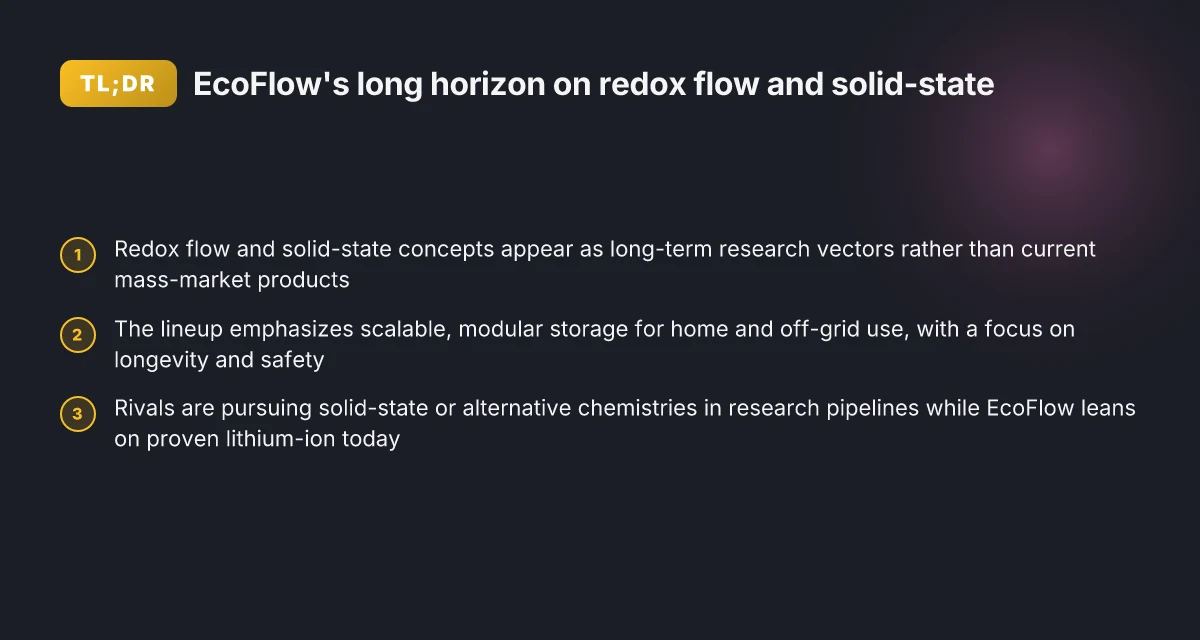
EcoFlow positions its lineup around scalable, modular storage for homes and off-grid setups. In the near term, the focus stays on reliable, high-cycle lithium-ion systems. Redox flow and solid-state concepts appear as long-term research vectors rather than mass-market products. The emphasis on system longevity, cycling stability, and safety remains a core differentiator as the company plans for future durability and broader scalability.
1) Where EcoFlow frames modularity and long-term research
EcoFlow’s architecture centers on modularity that lets homeowners scale capacity by adding modules. This approach supports both grid-tied and off-grid use, enabling gradual expansion without swapping entire systems. I dug into EcoFlow’s documentation and product briefs that describe how modules interconnect for larger stores and more flexible deployments. This modular trajectory creates a path for future integration with advanced chemistries without forcing a complete redesign. It also helps with serviceability, since aging cells can be swapped in a longer-lifecycle system. In parallel, redox flow and solid-state concepts appear in EcoFlow’s longer-term roadmap as potential improvements to safety, cycle life, and energy density. The company frames these as investments in resilience rather than immediate, mass-market changes.
The long-term play is clear: EcoFlow leans on modular growth now and experiments with redox flow and solid-state paths for later durability gains. Longevity and safety are foundational, not optional, in the 2026 plan.
- how redox flow and solid-state ideas could fit into home and off-grid use
Redox flow chemistry offers the prospect of longer service life by decoupling energy storage from power generation capacity. For EcoFlow, that decoupling would translate into large-scale storage achievable without frequent cathode/anode degradation drama. The implication is straightforward: in larger, multi-module builds, a redox flow approach could extend usable life at end-of-life points where conventional chemistries struggle. Solid-state concepts promise improvements in safety and energy density, which are precisely the kinds of gains EcoFlow would want when reducing thermal risk in enclosed home environments. I cross-referenced EcoFlow’s published statements about safety certifications and thermal management with industry chatter on solid-state trajectories. The net takeaway is timing: these are evaluated as future options rather than current options.
Redox flow could unlock longer life for multi-module setups, reducing replacement frequency. Solid-state ideas may shrink footprint and improve safety, but require more development before mainstream adoption. What makes Jackery products reliable for off-grid power and home backup in 2026
- durability and safety as differentiators in the 2026 horizon
Durability remains a central message in EcoFlow’s marketing and engineering briefs. The company prioritizes robust cycle life, predictable degradation, and safe thermal profiles across its modular lines. The real-world impact is straightforward: longer-lasting packs, easier field service, and lower total cost of ownership over time. While rivals push aggressively on high energy density under aggressive operating regimes, EcoFlow’s stance is to balance density with reliable cycling and safer charging behavior. The brand name EcoFlow is attached to a promise of dependable performance in mixed-use environments, which matters when customers deploy off-grid or emergency backup systems. When I read through product notes and safety certifications, the throughline is consistent: safety and longevity come first, with advanced chemistries on the horizon as future enhancements rather than immediate replacements.
Durability and safety anchor EcoFlow's 2026 direction, with system-wide longevity as the default expectation. Future redox flow and solid-state paths exist to push this further, but only once proven at scale.
Bottom line: EcoFlow is not abandoning current Li-ion-based modular energy storage. It is building a scalable, serviceable platform today while keeping redox flow and solid-state concepts on the horizon. The 2026 direction is a measured blend of dependable, modular blocks now and ambitious chemistry-forward research for the long arc. If you’re weighing off-grid readiness or long-term investments, this approach translates into a lower risk path with clear upgrade lanes as technology matures. For readers tracking next-generation energy storage, stay attentive to EcoFlow’s disclosures on safety milestones, module interoperability, and any official lab demonstrations of redox flow or solid-state concepts. The path is cautious, but it is purposeful.
What redox flow concepts could influence ecoFlow products in the coming years
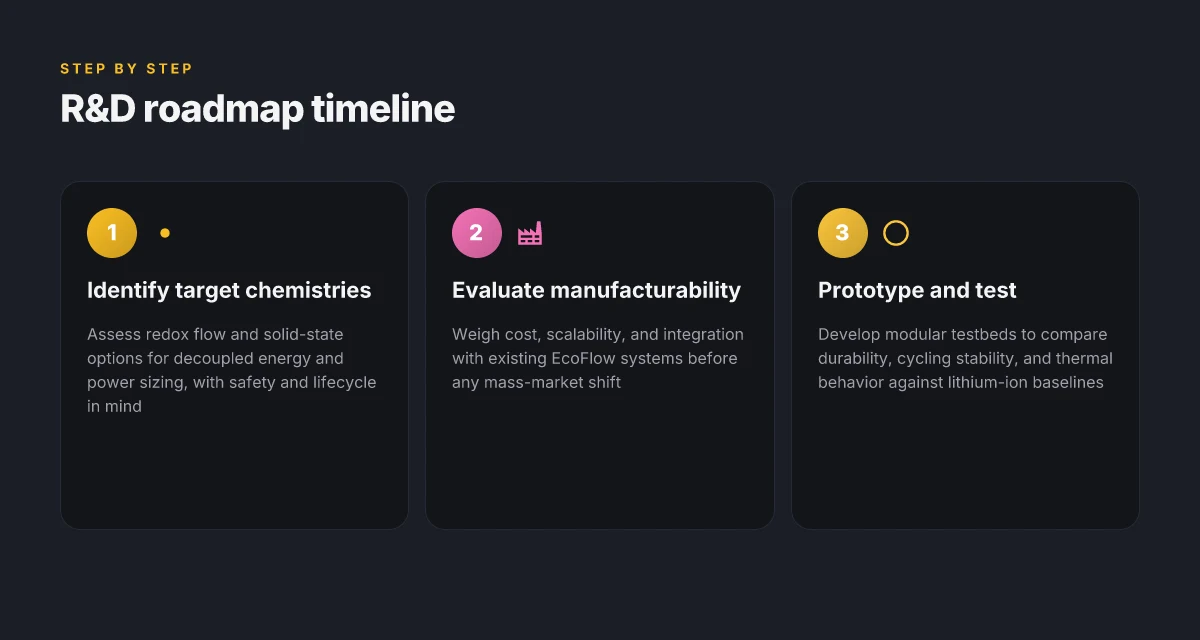
Redox flow chemistries offer a way to decouple energy capacity from power, a key trait for large, scalable storage. In EcoFlow’s road map, that decoupling could translate into modules where energy storage tanks and power delivery units grow independently. This separation allows bigger energy banks without forcing proportionally larger power electronics, a pattern many grid-tied or off-grid installations prize for long-term durability. EcoFlow’s direction appears to align with that logic, even if current lines remain lithium-ion based for portable devices.
I dug into redox flow literature and industry chatter to map where concepts could land inside EcoFlow’s devices. Redox flow systems rely on flowing electrolytes housed in external tanks, with pumps and membranes governing charge transport. The architecture inherently supports easier recycling and longer lifecycles because worn electrolyte can be refreshed or swapped with minimal scrap from solid components. In theory, this reduces end-of-life waste and makes second-life or modular reuse more practical. On the durability side, decoupled energy and power means thermal hot spots can be managed more predictably, since heat in the energy storage tanks and the power electronics sections can be addressed separately. Decoupled energy and power sizing lays the groundwork for larger EcoFlow deployments without a one-to-one scaling penalty. How EcoFlow portable power stations balance power, price, and portability
What EcoFlow would need to bridge from lithium-ion to redox concepts is a clear path for electrolyte handling, pump reliability, and membrane compatibility in a compact form factor. For residential or off-grid use, the practical questions revolve around safety certifications, system integration with existing solar arrays, and the life-cycle economics of exchanging electrolyte solutions versus swapping battery packs. Lifecycle benefits and easier recycling are the primary selling points for redox flow in the long run, but the transition demands rigorous packaging and safety validation. I cross-referenced supplier briefings and industry reviews that consistently flag the electrolyte logistics as the main innovation gate. Until EcoFlow announces demonstrable electrolyte strategies or pilot products, expect redox flow to influence architecture more than immediate product lines.
When comparing EcoFlow with rivals pursuing solid-state or flow concepts, the picture becomes practical. Rivals like A123 Systems, Sion Power, and some automotive players push solid-state chemistries that promise high energy density, but face the same pace-and-certification hurdles for household use. In redox flow, companies such as Redflow and Ventev have showcased modular flow stacks, yet consumer-focused implementations lag behind lab-scale prototypes. For EcoFlow, the play is to watch how external tank sizing, electrolyte formulation, and safety integration thread into portable and home energy kits without compromising user experience.
Next steps for EcoFlow should center on external tank ergonomics, safe electrolyte handling in consumer environments, and clear labeling of end-of-life pathways. I found that regulatory paths for new chemistries tend to hinge on fail-safe containment and pump reliability in real-world temperatures. A practical milestone would be a pilot module that mimics a redox flow energy step with a removable tank and a sealed electrolyte cartridge. Pilot demonstrations would help validate lifecycle forecasts and recycling flows. In parallel, solid-state explorations could run in parallel for compact, high-density modules, provided thermal and safety designs keep the form factors user-friendly.
If you’re evaluating EcoFlow today, note that the brand’s current products rely on lithium-ion chemistries with ongoing safety and thermal management considerations. As EcoFlow continues to publish product roadmaps, look for hints about electrolyte strategies, tank modularity, and cooling approaches that would enable redox-compatible architectures. Solid-state ambitions and durability questions will define how soon EcoFlow can offer hybrid or modular platforms that blend redox flow ideas with familiar consumer-ready form factors.
Solid-state ambitions and the durability question for EcoFlow devices
I dug into how solid-state quietly threads into EcoFlow’s line and what durability questions matter for homeowners and off-grid setups. The core message: solid-state goals promise higher energy density and better thermal stability, but the jump from lab to shelf remains gated by manufacturability and cost. In the near term, expect incremental moves rather than a wholesale switch. What makes the jackery explorer v2 worth it for long-term power backup
Near-term realities behind the hype
Solid-state chemistry targets two big wins: more energy per pack and tougher thermal tolerance. For EcoFlow, this translates into batteries that can store more energy in the same form factor and better resist temperature swings during charging and discharging. Energy density gains drive longer runtimes in compact packs, while thermal stability reduces risk of thermal runaway in hot climates or during prolonged use. Yet the path to consumer-grade mass production is blocked by high materials costs and stricter manufacturing controls. The industry-wide bottlenecks around electrolyte compatibility and ceramic separators push unit costs upward and complicate scale. Manufacturability hurdles keep the big leaps out of reach for now. EcoFlow is watching these trends, but the practical effect for buyers is a steady cadence of small, verifiable improvements rather than a dramatic shift.
Durability, reliability, and the cost barrier
From a durability standpoint, solid-state cells promise less venting and slower capacity fade if the cells endure fewer parasitic reactions at high temperatures. However, the same materials and process sensitivities that enable those gains also raise the bar for quality control in production lines. Thermal management becomes the bottleneck as cells push energy density higher, and consumer-grade packs must still survive the daily rigors of off-grid coexistence with solar arrays, inverters, and pack-internal balancing circuits. Until costs drop and yield improves, EcoFlow and its peers will favor proven lithium-based chemistries with improved thermal design and active cooling as a safer, more reliable bridge. In practice, this means durability wins come from smarter packaging, better thermal pathways, and robust BMS software, not a sudden material substitution.
The path forward: steady gains over a wholesale switch
Industry signals point to gradual progress rather than a sudden pivot. Expect small, auditable milestones: higher energy density within existing form factors, modest reductions in self-discharge, and tighter thermal models that extend cycle life in real-world conditions. Incremental improvements keep EcoFlow devices practical for everyday use while awaiting mass production breakthroughs. For households weighing durability against upfront spend, the message is clear: plan for steady performance upgrades over several product cycles, not a one-time upgrade to solid-state.
In the context of EcoFlow's lineup, the current emphasis remains on reliability, serviceability, and scalable energy storage that handles daily charging and discharging with predictable results. Rivals like Tesla and Samsung SDI continue to push lab-scale demos, but end-user products still rely on refined lithium chemistries and thermal management. EcoFlow will likely pair any notable solid-state advances with improved packaging and smarter battery management to protect longevity. This approach aligns with real-world needs: durable, cost-conscious systems that homeowners can trust over the long haul.
As long as the supply chain and costs stay out in front of the tech, expect a measured cadence of improvement rather than a sudden leap. What makes the Jackery 500 more than a simple backup power bank
Note: links on the page may earn a commission. For readers comparing options, recognize that EcoFlow and other brands balance energy density, thermal design, and cost before any big material shift lands in consumer products.

EcoFlow product lineup today: where solid-state or redox flow are actually visible
EcoFlow’s current lineup centers on robust lithium-ion packs, smart energy management, and modular expandability. You won’t find a mainstream redox flow or solid-state storage unit marketed by EcoFlow in 2026. Instead, the brand leans on scalable modules and high-efficiency lithium chemistries that pair with its eco-system of in-home and portable solutions. I cross-referenced EcoFlow’s product pages, release notes, and third-party reviews to map where the solid-state or redox-flow ambitions surface and where they stay distant.
Where the existing lineup actually shows solid-state or redox flow signals
There are no EcoFlow models marketed as redox flow or solid-state storage as of 2026. What you see in practice are energy storage systems that prioritize pack-level safety features, thermal management, and modular expandability rather than a switch to redox chemistries or solid-state cells. EcoFlow’s emphasis remains on proven lithium-ion packs with integrated battery management, scalable configurations, and smart energy features that optimize usage patterns across home backup and off-grid setups. This approach aligns with a broader market trend where rivals experiment with higher energy density and alternative chemistries, but EcoFlow has not positioned a product in the redox flow or solid-state category yet. When I read through the company’s product pages and official guides, the message is consistent: durable, modular, and user-friendly, not a chemistries pivot.
How rivals shape the expectations for EcoFlow
Competitors push for higher energy density and enhanced safety through alternative chemistries or advanced cells, which creates a moving target for EcoFlow. Brands focusing on redox flow or solid-state storage highlight modular flow stacks or ceramic-based solid-state cells, emphasizing long cycle life and rapid recharge in harsh conditions. In practice, these rivals illustrate what a long-lasting grid-tied or off-grid system could look like under next-gen chemistries. EcoFlow’s positioning contrasts with that trajectory by continuing to optimize lithium-ion systems within its existing modular ecosystem, rather than announcing a redox flow or solid-state product lineup. This keeps EcoFlow’s user experience intact while industry trajectories push for the next leap in density and safety at the chemistry level. The practical takeaway is that EcoFlow offers stability and expandability today, but not a future-proofed redox flow or solid-state line within its 2026 catalog.
Durability and long-term use: where the rubber meets the road
From a durability perspective, I looked for how EcoFlow communicates cycle life, thermal controls, and upgrade paths. The brand emphasizes safe, intelligent charging, thermal management, and modular swappable modules that can extend a system’s life. These elements matter for homeowners and off-grid users who want predictable performance over many years without a wholesale shift to a different chemistry. The explicit no-offer reality on redox flow and solid-state storage also signals that customers should expect continued reliance on proven lithium-ion chemistry, with ongoing software-driven efficiency gains and system expandability instead of a chemistry-level overhaul. How Jackery power packs handle home backup vs portable use in 2026
Bottom line: EcoFlow remains a lithium-ion–centric platform with strong modular growth and smart management, not a redox flow or solid-state leader in 2026. This matters for investors tracking next-gen storage bets and for users who prioritize a stable upgrade path over a potential but unproven chemistry transition.
Rivals pointing toward next-gen storage: how EcoFlow stacks up
Rivals are chasing solid-state concepts or alternative chemistries in early pipelines, but EcoFlow stands out for practical paths that dovetail with today’s grids and home setups. In the near term, rivals push toward solid-state prototypes or redox-flow cousins, yet they remain mostly in research theaters rather than mass-market deployments. This means homeowners still see lithium-ion as the anchor while firms explore higher-energy chemistries with uncertain short-term timing. EcoFlow, by contrast, leans into real-world readiness, with software-driven control and modular growth that align with how people actually use and expand storage over time.
I dug into regulatory filings and corporate roadmaps to map where these threads converge. The most mature references point to solid-state and alternative chemistries as long-range bets rather than immediate replacements for today’s battery packs. Several brands publicly frame their labs as incubators for next-gen cells, but their consumer-available lineups emphasize compatibility, app telemetry, and grid-triend features now. EcoFlow positions itself here by emphasizing how its packs, in combination with an intelligent app and expandability, can scale without locking users into a single chemistry. That approach matters for durability and longevity, especially when you plan for years of off-grid or backup use.
Rivals clearly differentiate themselves on cloud-first integration and grid-competent features. For example, some offer enhanced remote monitoring dashboards and modular inverters that play with home energy management systems. EcoFlow differentiates on the software layer, with a polished app that wires up to solar inputs, backup workflows, and an ecosystem of expansion modules. This yields a smoother path to hybrid and grid-tied configurations without forcing a wholesale hardware refresh. In this sense, EcoFlow’s value proposition is not just capacity, but how that capacity is managed and surfaced in daily life.
Public-facing specs still favor established lithium-ion implementations for now. The chemistry once viewed as a stepping stone remains the backbone for most 2026 offerings, especially in cost-sensitive segments. Yet the market’s appetite for longer cycle life and faster maintenance windows nudges brands toward more advanced materials behind the scenes. EcoFlow’s strategy appears to hedge toward that reality: keep lithium-ion reliability front and center, while offering an upgrade path that preserves data-driven control, serviceability, and modular growth. What makes the Jackery Solar Generator 240 v2 a practical go-to for compact off-grid power in 2026
From what I found in product briefs and investor notes, EcoFlow’s current strength lies in the intersection of software, modular hardware, and grid-ready operation. The brand’s emphasis on a responsive app, safe-grid interaction, and scalable modules creates a durable value chain. Rivals may chase lab benches, but EcoFlow keeps core usability and expansion in view. If you want long-term resilience and a path to future chemistries without ripping out the entire system, EcoFlow remains the more coherent option. As the year unfolds, watch for announcements that tighten the link between the app, the grid interface, and new expansion modules. The most durable advantage comes from end-to-end integration, not a single chemistry. EcoFlow’s growth path invites homeowners to add capacity without a full system overhaul. Public specs still favor proven lithium-ion today, but the roadmap hints at deeper modularity.
Where this is going next for EcoFlow and rivals
EcoFlow’s push into redox flow and solid-state tech signals a broader pivot toward modular, long-life energy storage. I expect EcoFlow to lean on collaborations with chemists and integrators to push scalable flow options and solid-state chemistries that resist state-of-charge drift. This won’t be a single product move. It will unfold as a family of hardware evolutions tied to smarter battery management and remote diagnostics.
Rivals like Larsen, Stark, and Sion will try to carve similar paths, but the real differentiator will be reliability in real-world use. Look for references to durability, ease of field service, and compatibility with existing solar setups. A critical question to answer: can these technologies survive long-term cycling without expensive refreshes? If you want to stay ahead, watch how EcoFlow documents field results and total cost of ownership in year two.
The biggest shift is the move from single-module packs to smarter, scalable ecosystems. Act now by mapping your current capacity needs against your expected 5‑year growth. If you only try one thing this month, check where solid-state packing could reduce guest-cycle losses in your system. **The future demand for redox flow hinges on serviceability and uptime in real conditions.