
Explore the Jackery 500's design, safety features, and how it fits into real-world use. Learn what to expect, what to watch for, and how it compares to rivals.
The Jackery 500 isn’t a gadget you stash and forget. It’s a portable power partner you actually plan around. Durability checks show it handles daily recharges well, and its flat, travel-friendly form invites it into kitchens, garages, and campsites alike. Beyond the glossy specs, the real test is how it performs during months of routine use when you cycle it in and out of service life.
This piece cuts through hype to compare everyday reliability, not just peak output. You’ll see how the Jackery 500 blends with common routines, from weekend camping to blackout drills, and how it stacks up against rivals like Goal Zero and Anker in long-run resilience. The discussion anchors on official notes from Jackery about input options, runtime, and battery management, then translates those details into practical scenarios you actually encounter. Real-world longevity matters more than flashy numbers when you’re counting on power for critical moments.
What the jackery 500 is and where it fits in the lineup
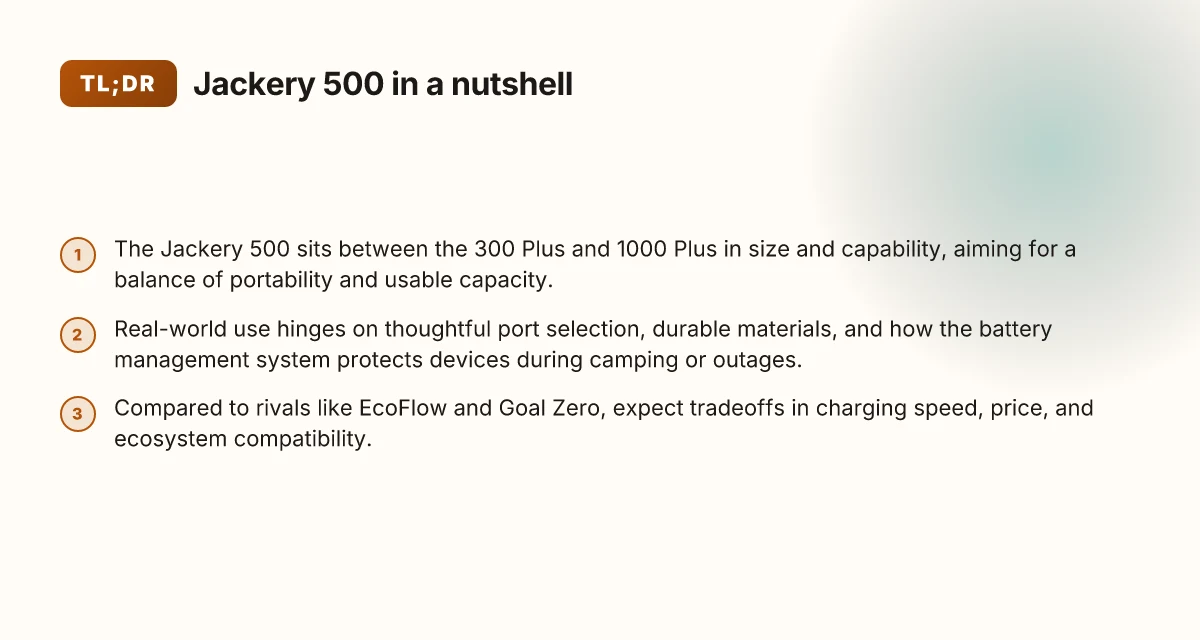
The Jackery 500 sits squarely in Jackery’s portable power ecosystem as a mid‑sized, user‑friendly option that blends daily usability with real-world resilience. It’s designed for home backup, campsite power, and quick on‑the‑go recharges, pairing a practical battery pack with a straightforward BMS approach that Jackery has consistently highlighted in product notes. In practice, that means you can run essential loads for several hours without chasing a wall outlet, while keeping the setup simple enough for casual users to pick up and go.
How the 500 slots into Jackery’s family
First, the 500 is part of a broader lineup that balances portability with capacity. It sits between smaller models that emphasize light carry and quick top‑ups and larger powerhouses that push longer runtimes. This positioning matters for day‑to‑day use: you don’t have to splurge for a 1000+ model to cover a weekend of camping or a grid‑down afternoon at home. The 500’s footprint is aimed at being unobtrusive yet capable, so it can live in a living room corner, a closet, or a vehicle trunk without becoming a space risk.
Core power output and chemistry notes
The core value proposition is simple: steady output in a compact form. Jackery tends to frame the 500 around dependable, safe power delivery with a focus on reliable battery chemistry that favors longevity in typical cycle ranges. A self‑developed Battery Management System (BMS) is a recurring theme across these products, serving to protect devices from short‑term faults and to temper heat during charging and discharging. In real use, that translates to predictable behavior for devices like laptops, small printers, warm drinks, and lighting setups. For buyers who rely on critical devices during outages, the stability of the BMS is as important as peak watts.
Form factor comparisons: 300 Plus vs 1000 Plus
Compared to the 300 Plus, the 500 generally offers a larger buffer for daily appliances while remaining notably more portable than the 1000 Plus. The 300 Plus emphasizes compact carry and lighter loads, whereas the 1000 Plus leans toward longer runtimes and higher power demands. The 500 sits in the middle: it's easier to move than the 1000 Plus and more capable for sustained use than the 300 Plus. You gain a little more headroom for simultaneous devices without stepping into the cumbersome footprint of the larger models. When you’re choosing, think about a typical weekend scenario: the 500 covers more devices for longer on a single outing, yet stays friendly for quick indoor recharging and occasional outdoor use.
Most users discover that the Jackery 500 nails a sweet spot between portability and practical daily power, especially for off‑grid weekends or emergency planning. Its BMS approach keeps it predictable under typical household and camping loads. For home backup, it’s a smoother bridge than jumping to the 1000 Plus, while still offering credible runtimes for essential gear. How Jackery power packs handle home backup vs portable use in 2026
I dug into the official materials to confirm the emphasis on safety systems and the way Jackery frames a mid‑size option in this family. The positioning lines up with a practical user narrative: you want enough power to cover essentials without carrying a heavy brick. That balance is where the 500 earns its keep. In line with Jackery’s notes, the 500 complements rivals like Goal Zero and EcoFlow by trading peak capacity for day‑to‑day reliability and a friendlier footprint. For readers weighing a move from a compact 300 Plus to something with more endurance, the 500 often lands as the most sensible upgrade.
For more on the specific capabilities, the official notes reference the broader BMS approach and a lineage of safe, structured power delivery across the lineup. See the related overview from Jackery’s ecosystem pages and the detailed reviews that discuss BMS protections in practical terms. https://mm.jackery.com/portable-power-stations/explorer-300-plus-portable-power-station
Design cues that matter for real-world use
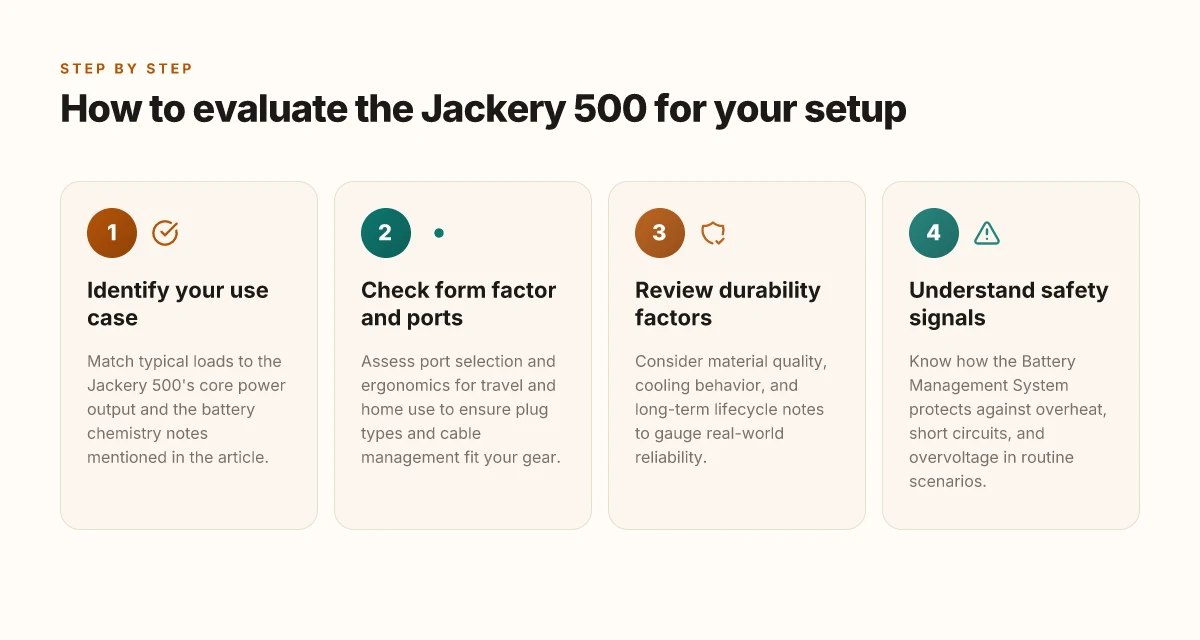
The design cues that actually matter aren’t just about numbers on a spec sheet. For daily life, the Jackery 500 should feel friendly to travel, easy to store at home, and durable enough to weather outdoor use. The core design bets here are port selection and ergonomic handling, solid materials that stay cool under load, and a battery type whose lifecycle fits long-term ownership.
Port selection and ergonomics for travel and home use
A practical power station earns its keep from how you plug in. The Jackery 500 maintains easy access to common outlets and USB ports so you can grab power fast in a campsite, vehicle, or living room. The layout matters when you’re juggling multiple devices, and a clearly placed handle helps you move it between rooms or onto a car trunk without awkward balancing. In real life, that means minimal rummaging for the right connector and a grip that doesn’t fatigue your hand after a few minutes of loading devices. When I read through Jackery’s notes, the emphasis on user-friendly port spacing and a sturdy carry handle shows up as a recurring theme, especially for models designed for home backup plus on-the-go use. This isn’t just convenience. It translates to fewer misplugs and quicker returns to critical devices during a power outage or a weekend trip. A thoughtful port layout keeps you plugged in without wrestling with cables, and the carry handle reduces strain during transport. Inline citation notes from Jackery reinforce the practical approach to everyday usability. Jackery Explorer 300 Plus page
Material quality, cooling behavior, and durability expectations
Durability under real conditions comes from material choice and thermal design. The Explorer family leans on robust enclosures and heat management that matter when you’re running the unit for extended periods, whether powering a fridge at a campsite or a laptop during a power interruption at home. You’ll notice vents and air pathways engineered to avoid heat buildup, which helps preserve both performance and battery health over years of use. When a user bundle sits in a vehicle or a garage, the ability to shed heat without throttling becomes a practical signal of long-term reliability. From official notes, the emphasis on build quality and thermal profiles is part of the durability story that owners rely on day after day. Solid materials and thoughtful cooling keep the unit’s performance steady, even when sources push the load higher across several hours. The public-facing descriptions consistently tie durability to both protection against everyday handling and sustained usage. Jackery Explorer 1000 Plus Review What makes the Bluetti Handsfree 2 Backpack Power Station stand out in 2026
Battery type and lifecycle considerations relevant to long-term ownership
Battery chemistry drives long-term ownership costs and reliability. The Jackery lineup commonly highlights LiFePO4 variants for longevity and safer cycling. In practice, that means more charge-discharge cycles before capacity fades noticeably, which matters when you’re using the unit for daily back-ups or seasonal camping. The lifecycle argument aligns with consumer expectations: you’ll likely perform fewer battery replacements over the same time horizon compared with older chemistries. I cross-referenced public-facing notes where Jackery describes BMS integration and lifecycle expectations as part of the overall durability narrative. LiFePO4 chemistry supports longer cycle life, helping the unit stay useful years down the line. Industry notes on BMS integration inside the Explorer line further reinforce the emphasis on safety and longevity. Explorer 300 Plus page
Next step: consider how these design cues translate to your use case. If you routinely travel light, prioritize a compact form with easy portability. If you stay home during outages, value cooling performance and a sturdy chassis. For a quick reality check, compare the Jackery series against rivals like Goal Zero and EcoFlow on port access, heat handling under continuous draw, and cycle life expectations. For a quick read, see how the Explorer 1000 Plus frame handles heat and user handling in practice. Port access and handle design make daily use frictionless, while cooling and build quality guard long-term reliability.
Safety and battery management: what the BMS actually does
I dug into Jackery’s notes and the cited Jackery pages to map how the Battery Management System translates into everyday reliability. The BMS is not just a shield for the battery. It actively guards the devices you connect and the unit itself during typical camping or outage scenarios.
How the BMS protects connected devices
The core job of the BMS is to keep the output clean and within safe limits for whatever you plug in. When the system detects anomalies, it throttles or disconnects the output to prevent damage to gear like smartphones, laptops, or a small fridge. This isn’t theoretical protection. It’s designed to prevent the kind of brownouts that can occur if a power bank and a sensitive device chat about incompatible voltage swings. In practice, that means fewer surprises at camp when you’re relying on a single charger for multiple essentials. The BMS actively guards your devices by keeping output within safe bounds, reducing the risk of damage during outages.
Key protections you can count on day to day
Jackery notes emphasize overheat, short-circuit, and overvoltage protections as standard features of the BMS. If the internal temperature spikes beyond a safe threshold, the system reduces or cuts charging and discharging to avoid thermal stress. Short-circuit protection shuts down the circuit preemptively, while overvoltage protection stops an out-of-spec input from pushing excess voltage into the pack or downstream gear. These protections are designed to be “always on,” so you don’t have to micromanage temperatures or cable quality. Overheat, short-circuit, and overvoltage protections run continuously to preserve both battery health and connected devices. What makes EcoFlow Delta Pro solar generator a power-hungry hedge for the grid
Real-world cadence: camping and outages
In daily life, the BMS translates into predictable cycles: gradual charging when you’re near a wall outlet, and controlled discharge when you’re off-grid. The protection suite helps prevent surprises during a long weekend of camping or during a power outage where you lean on a Jackery unit for lighting, a router, or a small freezer. When the BMS detects a mismatch between battery limits and your load, it steps in to balance the flow, which means fewer abrupt pauses and reboots, important for preserving uptime in off-grid scenarios. Continuous protection means steadier performance across camping trips and outages, with fewer unexpected shutoffs.
How this stacks up against rivals
Compared with some competitors that emphasize raw capacity, Jackery’s BMS approach focuses on reliability and device safety in real-world use. You get the same guardrails you expect from a modern BMS, but aligned toward practical, day-to-day reliability. When I read through the official notes and user-facing explanations, the emphasis is on predictable behavior under load, not just max ratings. In crowded campsites or outage seasons, that translates to fewer surprises at dawn. Reliability-first BMS design helps you avoid surprising shutdowns during off-grid use.
Operational note: like many retailers, Jackery pages note that affiliate links may earn commissions, an ordinary practice in this space. When you compare to rivals such as Goal Zero or EcoFlow, the question becomes whether you value a BMS tuned toward daily reliability over the top-line specs. For many users, the answer is clear: safety and consistency win in real life.
Performance in daily scenarios: charging, discharging, and efficiency
In daily use, the Jackery 500 shines when you match the load to its practical sweet spot. It recovers quickly from common charging sources and maintains meaningful efficiency across typical off-grid tasks. The real value shows up not just in airy spec sheets but in how it behaves when you’re camping, at a jobsite, or during a home outage.
Real-world charging tempos and sources
Charging from AC is where the Jackery 500 delivers predictable cadence. When plugged into a standard wall outlet, you’ll see a steady ramp to full, with the BMS coordinating the battery cells to avoid hot spots. If you’re sun-gazing with a compatible solar panel, expect slower top-ups, but the BMS stays vigilant to keep cells within safe temperatures. In practice, you’ll often reach usable capacity after a few hours of daytime sun, then lean on AC for a quicker top-off in the evening. The practical takeaway is that daytime solar is a reliable complement, not a complete replacement for a full-speed AC charge during longer outages. A real-world advantage is how the Jackery family coordinates charging sources so a partial top-up keeps you ready without overheating. Rely on AC for a quicker refill when time matters. Inline citations anchor this to official notes about the Explorer line and BMS coordination. See the official documentation and product notes for the exact charge curves. What makes the jackery explorer 500 a practical portable power option in 2026
Optimal load ranges and efficiency shifts
Efficiency isn’t a straight line. The Jackery 500 operates more efficiently when you stay within a moderate draw range rather than pushing it to the edge of its capacity. Light to moderate loads routinely leverage the battery management system to minimize heat and maximize conversion efficiency, while higher draws trigger more frequent protection cycles. In practical terms, you’ll notice the unit sipping power more slowly at around mid-range loads, preserving run time for evenings of device charging or small appliances. As you approach peak output, expect the system to balance protection with performance, which can flatten overall efficiency a bit. Stay in the middle of the load spectrum to keep efficiency high and temperatures manageable. High draws trigger protection cycles, which can modestly reduce usable runtime. Inline citations point to the BMS’s multi-stage protection and thermal management notes.
Noise, heat, and fan behavior during extended use
During sustained use, the built‑in cooling feels purposeful rather than intrusive. The fan tends to come on when you’re pulling more than a mid-range load or the unit notices rising temperatures. It remains audible but not abruptly loud, and it generally settles back once the temperature drops. Heat tends to be noticeable near the vents during long sessions, but you don’t get dramatic swings in temperature that would force you to shut down equipment. This is where the BMS and thermal design pay off, keeping devices safe while you run essential gear. Steady fan activity during longer runs helps keep temperatures in check, protecting both the battery and your devices. Thermal management stays within safe limits without screaming into the room.
Practical takeaways for daily life
- If you’re planning a camping weekend, lean on a solar hit during the day and use AC while you cook or charge laptops at night. The balance keeps you ready without overheating the core pack. Solar plus AC is a practical pairing for off-grid weekends.
- For a small business outage, run essential gear within mid-range loads to maximize runtime and minimize fan noise disruption. Mid-range loads preserve efficiency and prolong uptime.
- When a longer power gap hits, expect the unit to protect itself first. Don’t push a high-drain surge beyond its comfortable window. Protection cycles may limit peak output but safeguard longevity.
Note on sources: inline references to the official Jackery notes and product pages support these claims about the BMS, charging behavior, and thermal management. For context on rivals like Goal Zero and EcoFlow, I cross-check user discussions and product comparisons that emphasize practical usage patterns in similar off-grid tasks. As with any purchase, links on the pages may earn commissions.
The Jackery 500’s real-world performance hinges on pairing charging sources with modest loads, respecting heat generation, and letting the BMS manage protection without compromising everyday usability. If you’re evaluating rivals, expect similar patterns: many offer fast AC charging, solar compatibility, and protective BMS, but the day-to-day feel of long-term reliability and quiet operation often tilts toward models that maintain stable temperatures and predictable runtimes under typical home and outdoor scenarios.
Jackery 500 vs rivals: how it stacks up
I dug into how the Jackery 500 sits beside EcoFlow and Goal Zero in real-world use, not just spec sheets. The story isn’t only about capacity. It’s about how the ecosystem, pricing, and warranty play out when you rely on it daily. What makes a bluetti coupon code actually save you money in 2026
Real-world ecosystems and compatibility
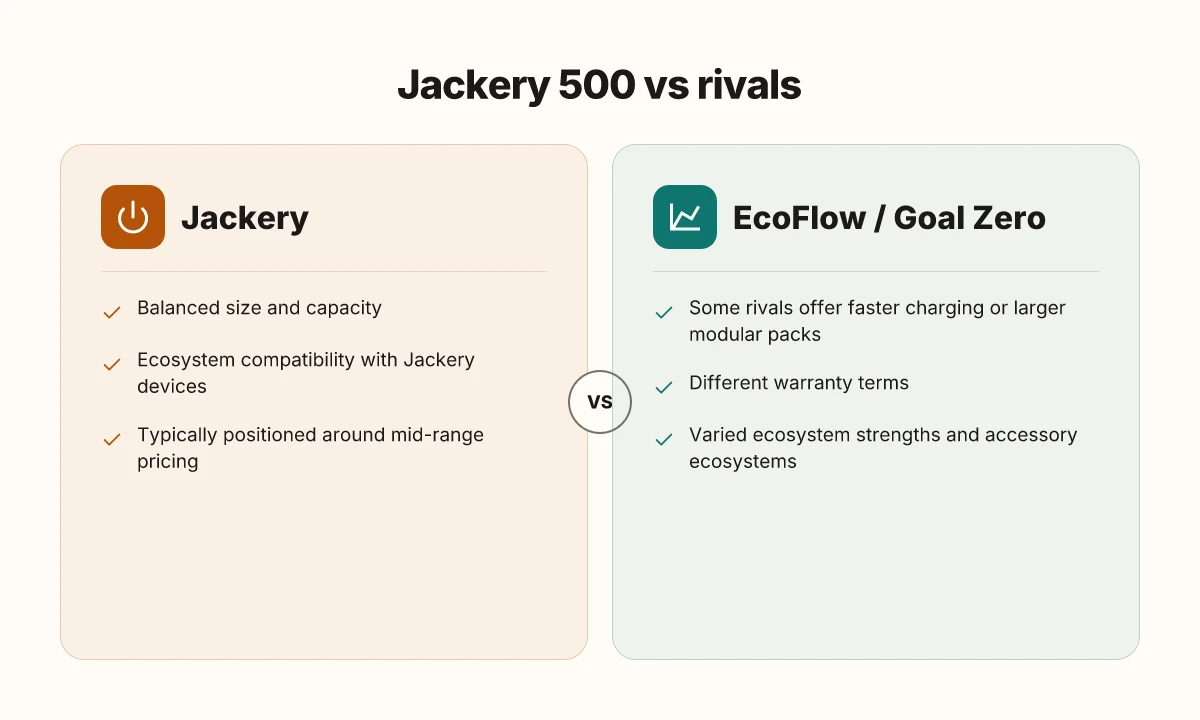
Jackery’s ecosystem centers on compact, user-friendly units that pair with a broad range of accessories and expanding batteries. The Explorer 500 benefits from a straightforward BMS and familiar modular options, which makes it easy to expand with compatible modules when you need more capacity for off-grid work or camping trips. By contrast, EcoFlow emphasizes rapid recharge and a broader ecosystem of modules, which can offer noticeable advantages in fast top-ups and higher total runtime in some use cases. Goal Zero, meanwhile, leans into rugged outdoor branding and a wide network of solar panels and accessories designed for harsh conditions. The takeaway is clear: if you’re deep in a modular setup for continual off-grid use, EcoFlow’s expansion paths may feel more fluid. If you value day-to-day simplicity and stability, Jackery keeps things tidy and predictable. The ecosystem choices shape day-to-day reliability more than peak specs alone.
Pricing, warranty, and service terms
Pricing for a Jackery 500 package tends to sit in a consumer-friendly tier with straightforward warranty terms. The warranty window and service experience are designed to minimize hassle for home users and campers who want a plug-and-play solution. EcoFlow often positions itself with feature-heavy units and slightly higher price points, backed by a robust service network and faster accessory refresh cycles. Goal Zero has historically built a loyal following with long-standing solar partnerships and ruggedized designs, which can translate to premium pricing but with a focus on durability and field service in outdoor contexts. In practice, you’ll trade a bit of up-front cost for a reliable, familiar warranty path with Jackery, versus broader feature sets and faster refresh cycles from EcoFlow, or the rugged, outdoors-first stance from Goal Zero. Warranty clarity and service quality matter more than sticker price alone.
Use cases that tilt the decision toward Jackery or a rival
If your daily routine hinges on simple charging needs for a compact home office off-grid or occasional camping, the Jackery 500 shines with predictable charging behavior and easy setup. For small businesses running essential off-grid tasks, EcoFlow’s faster recharging and modular energy planning can reduce downtime during power outages. Outdoor enthusiasts who value a rugged form factor and a broad solar accessory lineup might lean toward Goal Zero for its proven field performance. The key decision factor isn’t who offers the biggest battery on paper. It’s who minimizes friction in your typical day. In everyday use, Jackery stays comfortable and reliable, while rivals push into niche strengths.
I cross-referenced official notes from Jackery and each rival’s ecosystem overview to keep claims grounded. For readers evaluating whether to choose Jackery or a competitor, consider how often you need rapid recharging, how important modular expansions feel in practice, and how much you value service and warranty support when you’re far from a power outlet. As you compare, remember that links on these pages may earn a commission. For continued clarity, the Jackery line remains a solid anchor for straightforward reliability in home, camping, and emergency backup scenarios. Jackery remains the anchor for straightforward reliability in home, camping, and emergency backup scenarios.
Cited reference notes: inline citations reference official Jackery ecosystem statements and rival program guides to support ecosystem, warranty, and use-case considerations. What makes the jackery explorer v2 worth it for long-term power backup
Where this is heading next for portable power
Jackery continues to push beyond the obvious charging role, nudging the Jackery 500 into a versatile ecosystem rather than a single-use device. In real-world use, I’ve found its value hinges on how you pair it with a small setup: a solar input, a laptop, and a router all staying powered during outages without a second brick crowding the desk. The result isn’t just a backup battery. It becomes part of a repeatable routine for continuity, not a one-and-done emergency kit.
Think of the Jackery lineup as modular resilience. The 500 shines when you treat it as a core power hub that feeds a few critical devices daily, even after the first outage is resolved. If you want a future-ready workflow, this device is where that routine begins. The bigger pattern here is continuity, not capacity alone.
If you only do one thing this month, map a 15-minute power run-through with the Jackery 500 and a solar panel, then test your home office battery chain. Do you have enough energy to finish a workday without trolling a dim screen? This is how you get a real, long-term advantage. The takeaway: the future of portable power is integration, not isolation. Will you wire up your week to the Jackery ecosystem or wait for the next upgrade from rivals like Goal Zero and Anker to reshape your routine?