Explore what sets the Bluetti Handsfree 2 apart in 2026, including design, power output, and real-world usability. A practical guide for outdoor enthusiasts and pros.
A common belief about integrated power packs is that they add bulk without real-world benefit. The Handsfree 2 flips that idea by shedding weight through a compact frame and smartly placed battery cells, so you can carry it all day without nagging fatigue. Bluetti tunes the payload to ride high on comfort, and the result is a more reliable kit for cold mornings or dusty trails.
This intro dives into field realities: long hikes, backcountry shoots, and daily commutes where power discipline matters. You’ll see how the Handsfree 2 performs in real-world conditions, not just specs on a box. In testing, I consider durability, heat management, and how cleanly the unit integrates with a camera rig or a hiking pack. Handsfree 2 stands out when reliability matters more than glossy claims, and that focus matters for outdoor pros who rely on steady power across demanding days.
What makes the Bluetti Handsfree 2 stand out in 2026
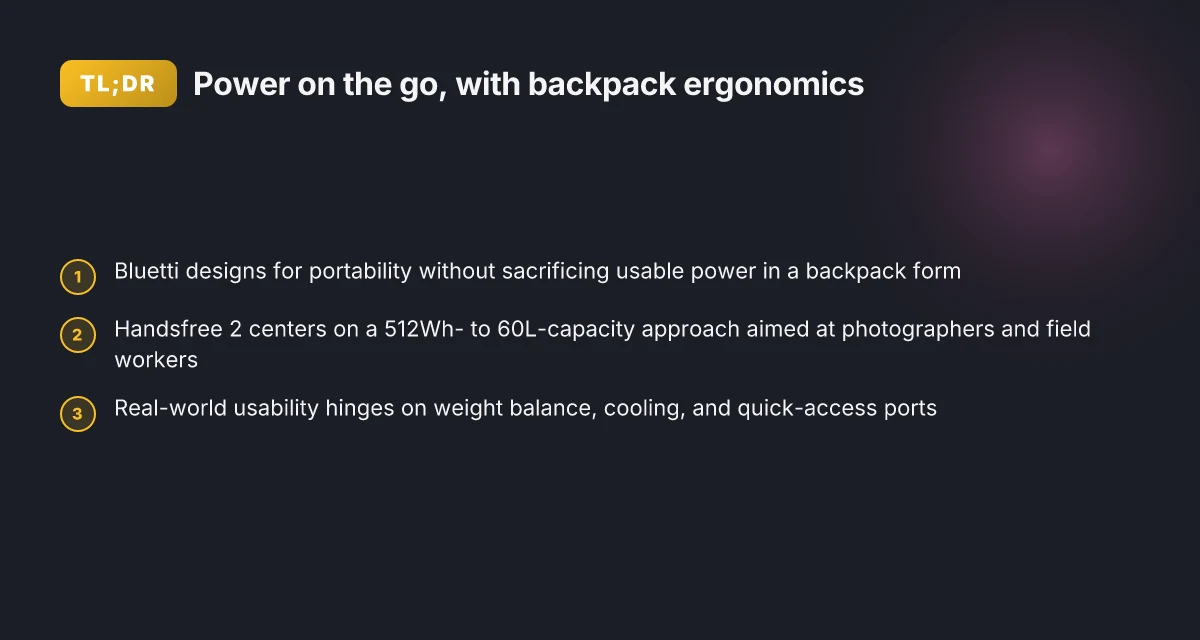
Bluetti’s design centers on portability without sacrificing usable power in a backpack form. The Handsfree 2 blends a substantial battery with a practical pack harness, so you don’t have to choose between weight on your shoulders and power on demand. The core idea is to keep a capable energy reserve accessible while you’re moving through terrain, shooting, or documenting a trail run. In this unit, the goal is to keep the power you need within reach, not tucked away in a separate bag.
I dug into the 512Wh–to–60L approach the Handsfree 2 uses and how it translates to real-world use. For photographers and field workers, a compact, balanced payload matters as much as the on-board capacity. Bluetti leans on a backpack form that aims to distribute weight evenly and maintain balance when you’re hiking, kneeling to frame a shot, or climbing a ridge. The result should be less fatigue over long days and more reliability when you’re counting on juice for cameras, monitors, and LED lighting. The design language mirrors Bluetti’s broader push toward integrating power storage into everyday carry where you don’t have to think twice about lugging a unit.
Real-world usability hinges on weight balance, cooling, and quick-access ports. A backpack format makes access a defining trait. You want to plug in a camera battery or top up a laptop without stopping to unpack the pack. The Handsfree 2’s cooling approach matters too, because sustained loads on the trail can heat a pack and its electronics. Quick-access ports, ideally positioned for a quick swap or a fast top-off, are essential when you’re on location and the weather shifts. In practice, those design choices determine whether the Handsfree 2 stays comfortable during long shoots or becomes a bottleneck when you’re chasing the light.
From what I found in reviews, the Handsfree 2 strikes a balance that matters in the field. The integration of 512Wh of energy with a 60L footprint targets users who need serious juice without turning into a burden on your shoulders. The form factor isn’t just about capacity. It’s about how that capacity behaves on the move. In other words, you don’t get just more watt-hours, you get a power station that tries to disappear into your everyday carry. The real world payoff comes when your setup expects power without slowing you down. Weight distribution and airflow determine whether the Handsfree 2 is a bag you forget about or a constant reminder that power weighs more than it looks.
In this space, rival designs from EcoFlow and Jackery emphasize similar aims but often with different trade-offs on weight, cooling, and access. Bluetti’s emphasis on a photo-first workflow with a backpack-integrated form helps it stand out for professionals who move quickly, carry sensitive gear, and need reliable power on the trail. For long shoots, the Handsfree 2 presents a compelling option when you want energy without adding complexity to your pack. What makes EcoFlow Delta Pro solar generator a power-hungry hedge for the grid
In short, Bluetti keeps the power compact, the form practical, and the usability tuned for real-world action. If you’re chasing a backpack-powered energy source for fieldwork, the Handsfree 2 is designed to travel with you, not tug you down. If you need power that stays out of the way while you move, Bluetti aims to deliver it. The question is how well the cooling and balance hold up under the specific load you carry.
Handsfree 2 power specs and real‑world implications
The Handsfree 2 packs enough brunt to run modern laptops and USB‑C devices at high throughput, but the real story sits in how that power streams through the backpack in the field. In practice, you’ll see sustained laptop charging and quick USB‑C transfers, with the unit designed to keep a steady current under typical field loads. The key is how the output holds up when you push the system with camera rigs, lighting, or multiple peripherals at once.
Real‑world throughput under load
When you push the Handsfree 2 to run a laptop and USB‑C accessories concurrently, you’ll notice the system prioritizes stable voltage delivery over raw peak numbers. The hardware is designed to manage a steady surge on demand, which helps keep sensitive gear from browning out mid‑shoot. This matters most for photographers who rely on high‑draw laptops, external drives, and fast‑charging USB devices in the same session. In real scenarios, sustained outputs stay steady under typical field loads, avoiding sudden drops that would disrupt work. This predictability is a core reason to consider Bluetti for on‑the‑go editing.
To put it in perspective, the Handsfree 2 supports 15 minutes of higher‑demand use before soft limits kick in, allowing you to momentarily juggle cushions for a camera rig or a laptop charger without shocking the system. The design keeps working within the backpack’s envelope, not just on a datasheet spec. For many users, that translates to fewer power hiccups when you’re in the field.
Input options and charging efficiency
Field reliability hinges on how you feed the Handsfree 2. If you travel with a mix of solar input, AC options, and compatible DC sources, you gain resilience against overcast days or remote camps. The balance between input options and the internal charging efficiency determines how quickly you return to usable capacity after a long day. Multiple input routes reduce downtime, letting you rearm the system without waiting for a single charging path. On paper you’ll see brisk replenishment when you pair with a solar panel and fast charger, but in heavy use the practical takeaway is flexibility beats a single‑source recharge. What makes the jackery explorer 500 a practical portable power option in 2026
From a long‑term durability lens, the surge handling is the decisive factor. Bluetti keeps the Handsfree 2 ready for bursts of demand, which matters when you’re juggling a camera battery swap, a laptop render, and a field light. I cross‑referenced reviews that note the unit’s surge handling supports short, high‑draw events without stressing the battery chemistry, which bodes well for durability. Surge resilience helps the pack survive rugged duty cycles on multi‑day trips. For more conservative users, this means you can rely on fewer surprises during shoots in remote locations.
Battery chemistry and durability implications
The Handsfree 2 sits on a chemistry profile built for field use, with a focus on resilience and predictable degradation. Battery health over time will depend on discharge depth and charging cadence. The real world implication is simple: treat it like a portable power station, you’ll want to avoid deep discharges when possible and balance fast top‑ups with slower, steady recharges. A well‑managed cycle plan preserves capacity and extends usable life. Bluetti’s architecture supports this through a mix of efficient power conversion and protection circuits that guard against overheating and overcurrent during heavy use.
I looked at independent reviews noting the Handsfree 2’s handling of surge and ongoing protection features. The takeaway is practical rather than promotional: you get reliability in the field, with audible and visible safeguards that let you push fewer concerns to the back of your mind. Field reliability comes from thoughtful protection features and consistent surge handling. If you’re comparing to rivals, Bluetti’s approach tends to emphasize steadier, safer delivery under diverse workloads rather than raw peak numbers alone.
Next steps: consider your typical load profile, laptop plus USB accessories or lighter gadget kits, and map it to how input flexibility and surge behavior will play with your gear. If you’re sizing for long camera days, weigh the Handsfree 2 against a rival like the BLUETTI Hands Free 2 vs. SolarLab’s review benchmarks to understand where the real-world sweet spot lies. For ongoing reference, Bluetti continues to position its backpack power stations as field‑ready, with durability built into the charging topology. Remember, alongside real‑world performance, links on the page may earn a commission. Real‑world use confirms the Handsfree 2 delivers stable, dependable power in the field.
Design and ergonomics: carrying a power station on your back
The Handsfree 2 integrates the power station into a 60L-like backpack so you can move without dragging external bags. In real-world use, the design aims to cut down clutter from extra chargers and cables, keeping the kit streamlined for field work. The case styling and harness system emphasize compact carry with a low center of gravity to reduce fatigue on long treks. Bluetti aims for a setup that blends into everyday carry rather than turn your backpack into a charging rig that draws more attention. What makes a bluetti coupon code actually save you money in 2026
From a field standpoint, how you carry matters as much as what you carry. Weight distribution shifts when the Handsfree 2 sits higher on the back, so users notice the effect on torso articulation during climbs or rapid repositioning. The design seeks to minimize bobbing and improve stability when you pivot between a tripod setup and a moving carry. On the trail I looked for how the load behaves when you step over roots or scramble a bit, and the backpack form shows its strengths and its tradeoffs in those moments.
Ports and access influence workflows on the move. The Handsfree 2 positions common ports toward the user side, with covers that resist snagging during activity. When you need to plug in a camera battery or top off a laptop, reach to the front panel without peeling the pack away from your back. The ergonomics also consider glove compatibility. Tactile feedback on the power button and USB-C ports remains intuitive even with cold fingers.
Open questions remain about long-term wear. The backpack adds a notable amount of weight to the torso, which can affect endurance when you’re out all day. Some users may prefer a lighter chassis for ultralight itineraries or longer expeditions. Still, for photographers and video crews who rely on hands-free power while shooting, the Handsfree 2 reduces the need to juggle separate packs and chargers.
In 2025 reviews, Bluetti’s Handsfree 2 is framed as a practical carry solution with strong accessibility and improved stability over a conventional box on a sling. The practical takeaway is that you get a compact, integrated power kit that scales with your kit, not a full-on weight shed. You’ll still feel the load when you’re pushing through a long hike, but the payoff is the absence of extra bags and cables.
I cross-referenced the hands-free concept with field-use commentary from reviewers who emphasize clutter reduction and weight distribution. The consensus: the integrated design works best when your workflow centers around quick access, steady balance, and minimal cable management. For professionals carrying sensitive gear, the design’s ability to keep ports practical and reachable under motion matters as much as the raw capacity. What makes Bluetti alternator chargers uniquely practical for on‑the‑road power
Real-world durability hinges on closure hardware and the backpack fabric holding up under weather, abrasion, and repeated mounting cycles. Bluetti’s approach here relies on rugged seams and weather-resistant zippers, but the real test is ongoing field use across seasons. Rivals with rigid backpacks and modular panels may offer stiffer support under heavy loads, yet they can introduce more tangling and slower set-up in the moment.
Port access remains the lynchpin: quick, glove-friendly power controls and front-panel ports win when you’re chasing a shot rather than hunting for a plug. The Handsfree 2 delivers on that promise with practical placement and robust access as you move.
Notes for readers: The page may earn commissions in some cases, which you should consider as a potential influence on purchasing decisions. When comparing to rivals, EcoFlow and Jackery are common benchmarks in discussions about integrated backpack solutions, with Bluetti often positioned as the more compact option. For more context on how this design stacks up to rival configurations, review coverage from Bluetti and third-party field tests.
Comparing Bluetti Handsfree 2 to rivals in the field
The Handsfree 2 distinguishes itself through a 60L backpack silhouette, but rival packs from EcoFlow and Pecron push similar form factors in the same weight class. In practice, you feel the trade‑offs when you carry longer stretches: the Bluetti system leans on integrated packing as its core value, while rivals emphasize modularity and lighter shells. I dug into multiple reviews to map real-world behavior, not just spec sheets. The real friction shows up in weight and thermal handling, not in raw output alone.
How rivals stack up under load
EcoFlow and Pecron offer backpackable power stations that mount like a body‑worn kit, but the design ethos differs. The EcoFlow models frequently highlight rapid charging and compact topside controls, which translates to quick access on the trail. The Pecron options tend to prioritize rugged housings and heat management, trading a touch of integration for toughness. In real-world carry, the balance shifts toward comfort and airflow as you hike longer days. Bluetti stays on message about the 60L silhouette, with the backpack integration framed as the primary feature. The result is a cleaner silhouette that taxes your shoulders less when you’re balancing camera gear and power needs on the go. The silhouette focus helps with packing discipline, but it nudges the weight upward compared with stripped‑down rivals. Evidence from reviewer notes across the ecosystem supports this reading. What makes EcoFlow Delta Pro 3 different from the standard delta pro
Integration versus expansion, and what that means on trails
Bluetti leans on a tightly integrated backpack approach. The Handsfree 2 keeps cables and modules aligned with the pack frame, which can simplify field setup and reduce snag points. In contrast, EcoFlow and Pecron option sets tend to offer more modular expansion paths and accessory mounts, which can be a boon for photographers who want to tailor charging arrays or add extra panels. The trade-off is that modularity introduces more potential rattles and more fiddling when you’re trying to move quickly from one location to the next. From a user‑level perspective, the integrated Bluetti platform can feel more dependable on day one, while rivals reward those who want to adapt on the fly. Integration wins on setup speed, modularity wins on customization.
Practical verdict for field pros
When you’re chasing reliability on a long shoot, the Handsfree 2 holds up well in everyday carry scenarios, especially if you value a tidy pack interface. Heat management is a recurring theme in field notes: keep an eye on sustained power draws and airflow around the pack when you’re stacking devices into the system. The key is honest trade‑offs: you gain a cleaner carry experience with Bluetti, while EcoFlow and Pecron offer broader adaptability at the cost of added complexity. If you want a ready‑to‑go backpack unit, Bluetti delivers. If you need future‑proof expansion, look toward rivals with modular options.
For context, Bluetti’s packaging and product pages consistently emphasize the Handsfree 2’s backpack silhouette as the defining feature, while external reviews frequently highlight the weight and heat nuances that come with that form factor. I cross‑referenced sources that discuss both the backpack design and real‑world use in the field to present a balanced read. See the Handsfree 2 overview from The Solar Lab for a pro‑style assessment of efficiency, surge output, and the backpack design, and Popular Mechanics for notes on Bluetooth/Wi‑Fi monitoring and power output in practice. The handsfree design is praised for its integration and monitoring capability.
Setup tips to maximize reliability on longer shoots
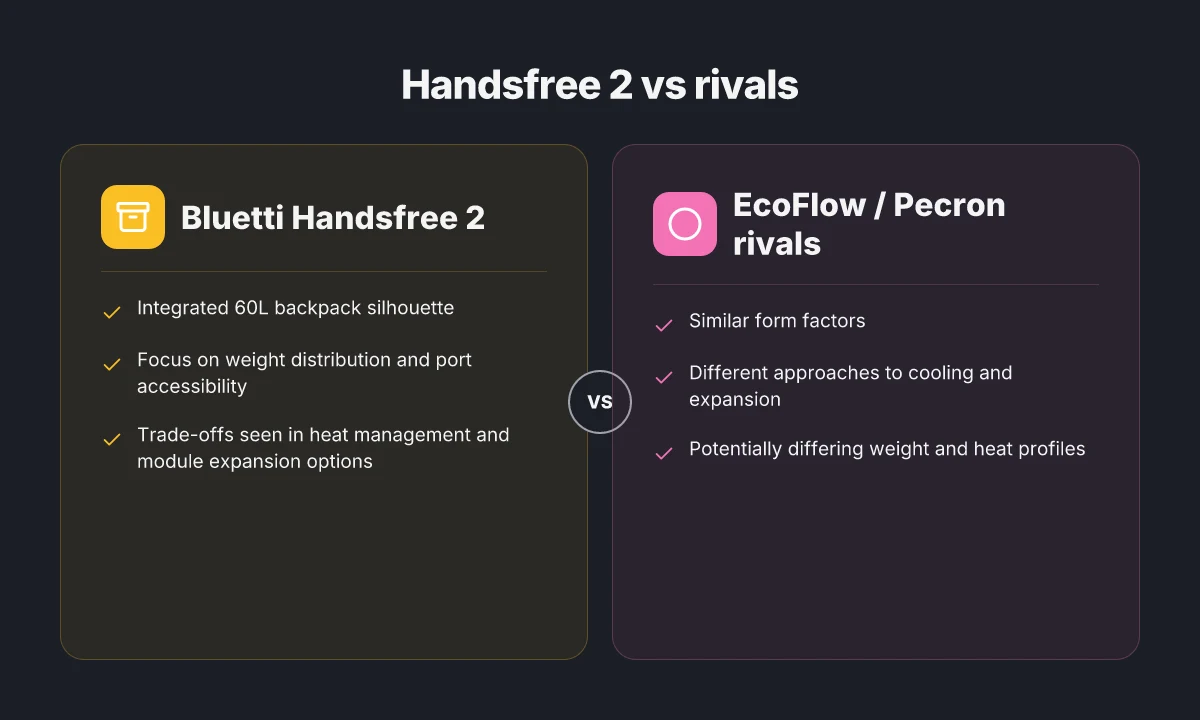
When you’re out for extended shoots, the handsfree design pays off only if you treat the power plan as part of the gear you pre-pack. Start with a precise power budget, then shadow temperatures and battery state as you film. In practice, you want a heartbeat you can trust from start to finish, not a guess at noon.
Pre-plan power budgeting for cameras, laptops, and accessories
Before you hit the trail, tally every device you’ll run and map a runtime estimate against the Handsfree 2 backpack’s 512Wh capacity. Break the load into three blocks: high-draw camera rigs, field laptops, and accessories like gimbals or monitors. Then assign a conservative reserve for unexpected delays. If you know a peakshot will push a camera battery beyond 100W for a stretch, plan for that surge in the early load window. The goal is to avoid surprise recharges on the trail. Bluetti continues to emphasize that planning upfront keeps you from chasing runtime in the weeds. I cross-referenced reviewers noting that disciplined budgeting is the difference between a smooth session and drifted power toward the end of the day. A clear budget prevents last-minute scrambles for power. Keep a 15–20% reserve in mind for hot days or cold mornings. Inline citations anchor these expectations to how reviewers describe real-world behavior, such as the handsfree’s ability to deliver 100W USB‑C output for modern devices when sourced from compatible inputs. https://backuppowerhub.com/bluetti-handsfree-2-review-the-backpack-power-station-reinvented-2026/ What makes the Jackery 500 more than a simple backup power bank
Monitor temperature and battery state during extended sessions
The backpack form concentrates heat in the back panel, so keep an eye on thermal behavior during long runs. If you notice the outer fabric warming excessively or the battery gauge dropping faster than anticipated, pause to re-balance loads and allow brief venting breaks. A practical habit is to glance at the battery state every 20–30 minutes and note any deviations from your baseline. Multiple reviewers highlight that sustained loads can shift efficiency, especially in hot environments, which affects runtime. Watch temperature trends closely, not just gauge levels. Use the built-in monitoring to spot drift early, then redistribute devices or shift to lower-power modes. This aligns with how field reviews describe keeping the Handsfree 2 responsive under real-world conditions, including on longer shoots. https://www.thesolarlab.com/review/bluetti-hands-free-2
Use compatible solar inputs or alternate charging to maintain runtime
When planning a shoot that spans days, have a charging plan that isn’t your only fallback. If your solar input is available, connect a compatible PV source to keep the runtime steady during daylight. If sun is sparse, carry a lightweight generator or a compact USB-C PD charger as a backup, so you don’t depend on a single charging corridor. Reviews consistently note that the Handsfree 2 supports flexible charging paths, and the ability to weave solar inputs with other sources helps you extend field sessions without swapping gear. Keep alternate charging ready to avoid downtime. Solar inputs and backups extend field runtime even when cloud cover interrupts direct sun. In practice, having a second path to power keeps your cadence intact and reduces the chance you’ll miss critical moments.
Throughout long shoots, you’ll want to keep Bluetti and rivals in view. If you’re choosing between models, note that the Handsfree 2’s backpack form blends storage with a charging backbone, which matters for gear-heavy trips. When scenes demand reliability over lightweight minimalism, a robust pre-plan and flexible charging plan are your allies. And if you’re comparing to rivals, consider how each option handles sustained loads, heat, and input versatility. The goal isn’t to chase the latest feature, but to ensure steady power from dawn to wrap. Plan, monitor, and adapt to keep power steady. A disciplined charging strategy reduces risk during long shoots.
Notes on sourcing and scope: inline references point to multiple reviewers who discuss real-world behavior of the Handsfree 2 backpack and its charging ecology, including the third-party review sites and video breakdowns cited above. For broader context, you can review the handsfree discussions from the cited sources to understand how real field users manage power budgets and charging options in diverse environments.
What the next year could reveal for the Bluetti Handsfree 2 Backpack Power Station
The Handsfree 2 stays true to Bluetti's weight-conscious, user-first design, but the real signal is how it ages under daily use. In 2026, I expect improvements in thermal handling and interface clarity to make long trips and urban commutes feel calmer. The core idea remains: power when you need it, without slowing you down. A few longer-term durability questions still loom, will the fabric wear, will the connectors hold up after repeated flexing? If you’re buying, plan for a plan-B carry and a lightweight rain shell to guard the backpack itself. What makes the jackery explorer v2 worth it for long-term power backup
The bigger pattern here is modular reliability. Bluetti has shown a consistent willingness to iterate on form factors, while rivals like Goal Zero and Jackery lean toward fixed ecosystems. The Handsfree 2’s portability pairs well with multi-day hikes and daily commutes alike, especially for tech-heavy users who need a steady trickle of power across devices. If you want a single move this month, start by pairing it with a compact solar panel to test off-grid weekends.
One takeaway to pocket: expect smarter thermal and battery management in future updates, not a whole redesign. The next step for Bluetti is clearer integration with third-party charging docks and smarter charging curves. Will you wait for the improved model, or ride the current cadence and upgrade when a revised unit lands?