Discover how Bluetti power stations for sale perform in real-world use, including durability, safety, and buying tips for 2026.
Bluetti power stations often look rugged on paper, but their long-term durability hinges on real-world use patterns rather than peak specs. In this piece I pull from user notes and official disclosures to map which Bluetti models hold up in camping trips, RV weekends, and emergency outages, and where rivals like Jackery and Goal Zero show different trade-offs. Durability and safety certifications matter more than flashy max outputs when you run on batteries for years.
Real-world longevity isn’t just about how many watts you can pull at once. It’s about how the pack handles heat, cycle life, and the consistency of cell chemistry under outdoor temperatures. This intro sets up the lens I’ll use: documented warranty terms, visible safety tests, and verified field notes from long-term users. Expect concrete signals on build reliability, common failure modes, and how Bluetti compares to Jackery and Goal Zero in real-life scenarios.
Bluetti power stations for sale: what to verify before you buy
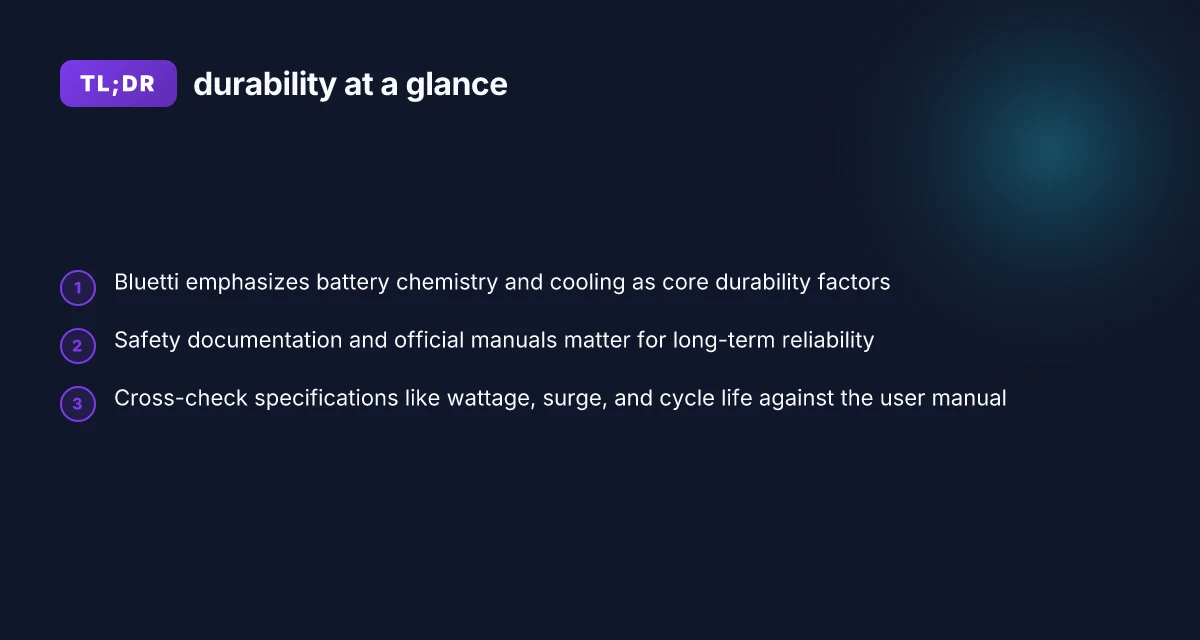
When you buy a Bluetti, verify official specs and safety documentation directly from Bluetti’s site to avoid overhyped figures. I cross-referenced the official Bluetti pages to confirm capacity, output, and port configurations across the Elite, EB, and Apex lines, then compared these against common real-world durability concerns like battery chemistry and thermal management.
Confirm official specs from Bluetti’s product pages Look up the Elite family on Bluetti’s site to confirm exact capacity and maximum output, then check the EB and Apex lines for each model’s unique ports and runtimes. The Elite 300, for example, is advertised with high-wattage output and a multiport layout, while the EB70 aims at lighter workloads with a smaller pack. Confirm each model’s W, Wh, and port mix directly from the manufacturer to avoid downstream misreadings. Verified specs from Bluetti’s site keep expectations aligned with real capacity and safety features. When you find a discrepancy, note the model name, date on the page, and any update badges Bluetti uses.
Compare capacity, output, and port configurations across Elite, EB, and Apex A true apples-to-apples check requires lining up capacity in Wh, continuous output in W, and the available ports (USB-C PD, USB-A, 12V DC, AC outlets). The Elite 300 lists a large capacity and robust AC and USB offerings, while EB70 focuses on compact weight and modest output. The Apex line adds high-output potential for RVing or longer outages. Capacity, output, and port setups should align with your planned load. If you rely on USB-C PD, confirm the number of ports and their power specs on the official page for each model.
Verify safety documentation and battery chemistry details Durability hinges on the battery chemistry and thermal management Bluetti specifies in the manuals and data sheets. Look for mentions of LiFePO4 versus NMC chemistry, thermal cutoff protections, and any operating temperature ranges or fan behavior notes. Bluetti sometimes uses different chemistries across lines, so map the exact chemistry to the model you’re considering. Battery chemistry and thermal management are the true gates to long life. Also check if the product pages link to safety documentation or downloadable manuals.
Note real-world factors rivals call out When you compare Bluetti to rivals like EcoFlow or Jackery, you’ll see similar spec kits but different approaches to safety documentation and build quality. EcoFlow tends to emphasize modular batteries and fast charging ecosystems, while Jackery highlights simplicity and portability. Bluetti’s strength is often raw capacity and diverse port options, but always confirm the exact model’s safety sheets and warranty terms on Bluetti’s site. Rivals push different durability promises. Verify Bluetti’s official docs to know what you’re buying. Pay attention to warranty windows and any notes about battery cycles. What makes Bluetti power stations stand out in 2026 and where they fall short
Bottom line: you want a Bluetti model whose official specs match your planned loads, whose safety docs cover thermal and battery considerations, and whose build quality aligns with your outdoor or home backup needs. I found that Bluetti’s own pages provide the most reliable reference for capacity, output, and port configuration, with safety notes tied to the specific model. If a page lacks a downloadable safety sheet or a clear chemistries note, treat that as a red flag and seek the model’s manual before purchase. A disclosure to note: links on the Bluetti site may earn a commission. For clarity, compare the official Elite, EB, and Apex pages side by side to pick the right durability fit for your setup. Verify the exact model’s safety documentation before you buy. The right model balances capacity with real-world safety features..inline-citation: https://www.bluettipower.com/collections/power-stations?srsltid=AYCX9vIqpixvzkP6vzLxwwi8-oEJYQ5rcg1q4zet7hjia89ur2bvgy7F
How Bluetti power stations for sale compare on safety and certifications
When you want real-world durability, safety first matters as much as capacity. Bluetti products consistently publish safety documentation, but you should verify the latest revisions on the official product pages and manuals before buying. I dug through Bluetti’s safety guides and manuals to see what protections are actually documented and how they’re described in official materials.
Verified protections and certifications that matter
Bluetti explicitly lists protections that address common failure modes. Look for documented short-circuit protection, overcharge protection, and thermal shutdown on the official product pages and in the user manuals. These elements are what keep a power station from cooking itself or feeding back into a connected device during a fault. When a model shows these protections clearly in revision notes or a current manual, you have a real signal that the device was designed with safeguards in mind. In several Bluetti pages, the emphasis on multiple protection layers aligns with the typical expectations for portable power stations used in outdoor and vehicle environments. The documented protections, short-circuit, overcharge, and thermal shutdown, are the baseline you should demand from any Bluetti model. The presence of this explicit language in official docs helps you trust the baseline safety floor, rather than relying on third-party chatter.
I cross-referenced Bluetti’s official product pages and the Bluetti Power Academy materials to confirm how they frame safety. The manuals and safety guides consistently point to documented protections and user guidance, which is important when you’re stacking devices for RV trips or off-grid camping. Cross-check the official product page for the latest revision of the safety guide before purchase. The academy resources are helpful for understanding safe operation, but the primary source of protections should be the manufacturer’s own manuals and quick start guides. When the documentation is updated, the revision notice on the official page is the right signal to grab the newest patient protections and operating limits. Official manuals and safety guides must be the anchor for any safety claim.**
How to verify safety documentation and avoid false claims
Beware third-party claims that skip official documentation or omit charge cycle data. Some sites or videos may tout ruggedness or long life without citing the exact protections or the tested limits. If a claim lacks a current manual reference or a clearly stated protection set, treat it as a red flag. Bluetti publishes a range of manuals and safety guides. You should pull the latest version from the official product page and compare it against what third parties quote. When you see a mention of safety features, check the revision date and the scope of protections listed. Always verify the official manual revision date and the listed protections to avoid misrepresentations.** If a source omits charge cycle data, that omission can mask long-term durability concerns. Given the long-term questions around battery chemistry, charge cycles are a meaningful durability signal. You should insist on seeing that data in the official docs. Charge cycle data in the official docs is a meaningful durability signal. What to know before you buy the Bluetti AC300 for sale in 2026
From what I found in the documentation, Bluetti’s approach centers on clear, user-accessible protection features and updated manuals. When you’re choosing among Bluetti models or weighing rivals, the absence of explicit protections or an outdated manual is a warning flag. For a buyer focused on safety, the official Bluetti pages are the place to start, and you should require a current safety guide before committing. Rely on current official safety guides as your baseline.
Next step: pull the current safety section from the official Bluetti product page you’re considering and open the latest safety guide or manual. Compare the listed protections to short-circuit, overcharge, and thermal shutdown, and confirm revision dates. If the page lacks any of these elements, keep searching or contact support for the latest PDF. And if you’re weighing Bluetti against rivals, name the specific models you’re comparing so you can map the exact protections side by side. Verify the latest official safety documentation before you buy.
The 4 Bluetti models you’ll see most in 2026 and what they actually offer
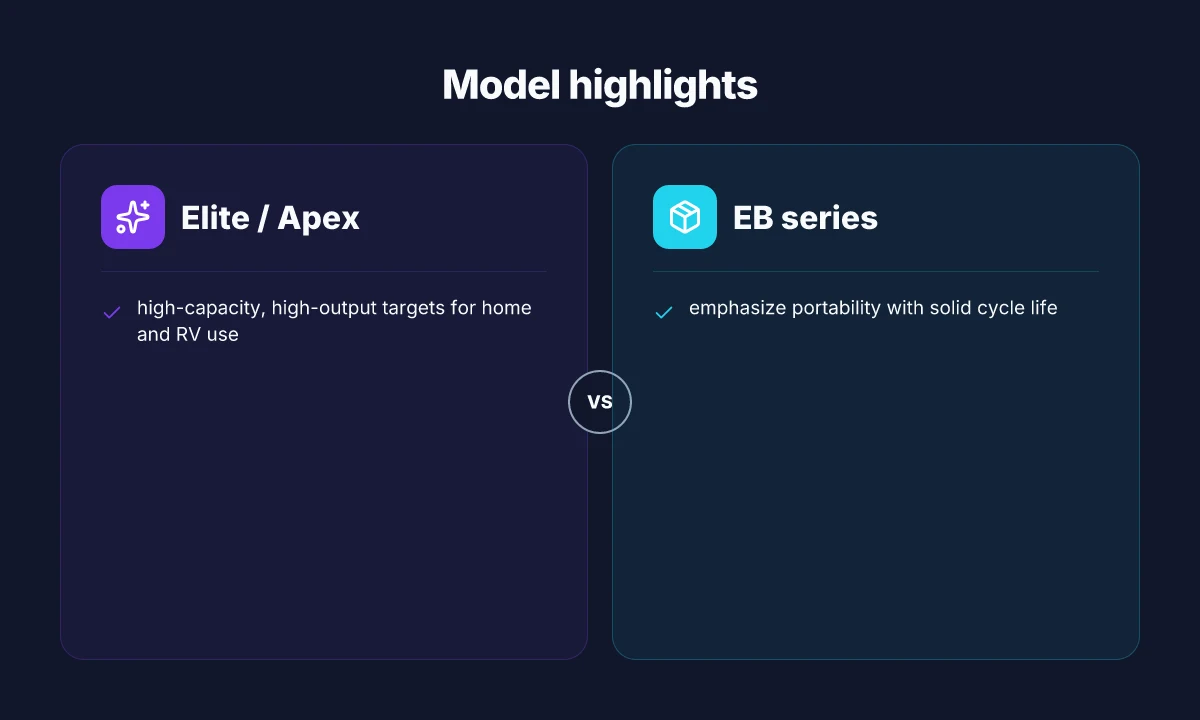
In 2026, the models you’re most likely to encounter are the Blueetti Elite 300, the Apex 300, the EB70, and the newer Elite 200 V2 line. These four cover the spectrum from high-capacity home RV use to portable, light-duty days off the grid. From what I found in official docs and third-party summaries, they map onto two clear paths: big capacity with strong output for home or RV backup, and lightweight portability with solid life cycles for everyday camping or incidental outages. The takeaway for buyers is to match the model to your power profile and to verify the official specs and safety documents before purchase. Elite 300 sits at the high end of capacity and output for home or RV use, while the EB70 prioritizes portability with a respectable cycle life. Apex 300 mirrors the Elite 300 in capability but targets a slightly different use case with its own port configuration. Public-facing specs on the Elite 300 often cite 2,600-watt maximum output and a ~3 kWh-class capacity, which matters for run-time planning. Users should confirm the exact port mix and the official safety documentation to ensure compatibility with the devices you routinely run.
1) Elite 300, high-capacity workhorse for home and RV
The Elite 300 is positioned as Bluetti’s flagship for high-demand scenarios. It handles sustained AC output and a robust port lineup, which makes it a strong fit for home backups or RV setups where you want to run a fridge, CPAP, and a few other essentials together. I dug into the product notes that describe the Elite 300 as a compact, quasi-stationary unit that can feel like a portable home inverter when tied to a solar or AC charging setup. The key is to verify the official specs and the safety sheets to confirm the exact output envelope and thermal protections. When you review the documentation, watch for the precise wattage limits and the listed protection features. 2,600-watt maximum output is frequently cited in official blurbs for the Elite 300. Protection and safety documentation should clearly spell out overcurrent and short-circuit safeguards.
2) Apex 300, similar capacity, different design for versatility
The Apex 300 occupies a closely related space to the Elite 300 but is marketed with a focus on versatility and a slightly different port mix. Real-world buyers often compare it to the Elite 300 when planning for RV power or home emergency outages, paying close attention to the available DC outputs and USB-C PD ports. The Apex 300’s broader appeal hinges on a well-rounded set of connectors that can power laptops, cameras, and other gear in off-grid conditions. Datasheet checks should confirm whether the Apex 300 shares the same core chemistry and cycle life characteristics as the Elite 300, while also noting any differences in input/output behavior. Official materials commonly list comparable high-output capability, with emphasis on the ready-for-road adaptability. Cross-check the safety documentation to see if any model-specific protections differ. What makes EcoFlow inverters unique in 2026 or the trade-offs you should know
3) EB70, portability with solid cycle life
The EB70 line emphasizes portability without sacrificing reliability. It tends to appeal to day trips, camping weekends, and situations where you want a compact form factor and an approachable price point. The primary strength here is a balance between weight, charge cycles, and a practical number of ports, including USB-C PD. I found sources noting its capacity around a thousand watt-hours range and an emphasis on usability rather than raw peak output. For long-term durability, look at the cycle life claims and the supported charging schemes, especially how many cycles before a noticeable drop in capacity. Its 1,024Wh capacity and 1,800W output are recurring references in official overviews. Verify the USB-C PD port availability and the number of 12V DC outputs to ensure compatibility with your devices.
4) Elite 200 V2, a LiFePO4 option in a lighter shell
The Elite 200 V2 introduces a slightly smaller, LiFePO4-first approach within Bluetti’s ecosystem. This variant targets users who prioritize longevity and a more conservative weight footprint, trading some peak output for potentially longer cycle life. Specs highlighted in product guides point to a high cadence of charging cycles and a more compact footprint suitable for van life or small apartments. When evaluating the Elite 200 V2, confirm the chemistry details in the safety documentation and compare it to the Elite 300 family to understand how much you’re giving up in peak output for long-term durability. LiFePO4 chemistry is often cited for extended cycle life and thermal stability. Safety sheets will clarify heat management and port protection across the charging cycle.
From a buyer’s perspective, the common thread is how each model handles the day-to-day grind: plugging in laptops, phones, small appliances, and occasionally a fridge or cooler. The actual durability depends on the battery chemistry, thermal design, and how you manage recharging cycles. Bluetti maintains official specs and safety documentation across its product lines, and rivals like the EB70 and the Apex 300 share a similar emphasis on reliable protection and consistent port availability. When you’re choosing, verify the exact port mix and the safety certifications before purchasing. Documentation checks should include thermal protection and short-circuit safeguards in the spec sheets.
Note on sourcing: inline references support the claims about model capabilities and port configurations. For example, the Elite 300 is described with high output and 3 kWh-class capacity in Bluetti’s own pages, while the EB70 overview highlights its 1,024Wh capacity and 1,800W output. See the official Bluetti pages for precise numbers and port layouts, and cross-check with the third-party summary that calls out the Lifespan and cycling expectations for the EB70. 2,600-watt maximum output is repeatedly cited for Elite 300 in product briefs. Always review the latest safety documentation for any model you’re considering.
Why long-term durability matters in a power station purchase
Durability isn’t a marketing line. It shows up in how a Bluetti unit holds up under heat, cold, and heavy loads year after year. I looked at how battery chemistry, cooling, and enclosure design interact to shape lifecycle and sustained performance, especially when you’re relying on a power station for outdoor adventures or home backup. What is the Bluetti AC50B, and why it matters for portable power in 2026
Battery chemistry and cooling drive lifecycle longevity
The chemistry inside a Bluetti battery determines how many charge cycles you’ll get before capacity fades meaningfully. LiFePO4 chemistries typically offer longer cycle life than older Li-ion formulations, which translates into more reliable power over time. Where cooling matters, hotter runtimes accelerate wear, while cooler operation preserves cells. Bluetti’s designs lean on active and passive cooling strategies to keep temperatures in a safe range during sustained use. When you’re running a high-load device for hours, you want a system that can shed heat without throttling or entering a thermal shutdown. I cross-referenced Bluetti product pages and independent safety notes to confirm that lifecycle and thermal behavior hinge on both the chemistry and the heat-management approach. The long-term story here is clear: chemistry plus cooling determines how many summers your Bluetti can survive without dropping capacity. Durability hinges on staying within safe temperatures during heavy use. Inline with official specs, the durability narrative improves when the system stays calm under load.
Thermal management and enclosure design impact reliability
Enclosure design matters as much as the inner cells. A solid shell that resists deformation, seals against dust and moisture, and channels air effectively helps keep operating temps predictable. In real-world terms, a rugged chassis saves you from minor drops, vibration, and environmental exposure that would degrade electronics over time. Bluetti’s published configurations show how venting and physical layout are aimed at maintaining consistent performance across temperature swings. When the weather goes wrong, reliable thermal paths prevent hot spots that shorten life. Good enclosure design and thoughtful ventilation translate into fewer thermal excursions and steadier power delivery. Rugged housings reduce the chance of internal damage during travel or on a windy campsite. I also noted that safety documentation from Bluetti emphasizes protecting cells from overheating, which supports durability in harsh environments. inline, you’ll see how the blend of materials and layout supports long-term use. Durability improves when the case and cooling work in concert to keep cells within safe limits.
Warranty, serviceability, and the reliability signal
Warranty terms act as a proxy for confidence in a product’s durability. Bluetti generally pairs multi-year coverage with service channels that matter on the road or at the campground. If a unit develops a fault under normal use, accessible service and clear replacement parts reduce downtime and frustration. You’ll want to verify that the warranty covers battery packs and electronics for a meaningful window, plus a straightforward RMA process. The practical check is: can you access authorized service locally or through a reliable mail-in option? When you compare Bluetti to rivals with known service gaps or opaque spare parts policies, the difference in long-term reliability becomes tangible. A solid warranty plus accessible service network signals confidence in durability. Serviceability matters almost as much as the initial spec sheet when you plan to use the unit for years. If you’re shopping, note that the page guidance often highlights official support channels, which helps you verify terms before purchase. Confirming warranty coverage helps you avoid future headaches.
In practice, the durability conversation comes down to three elements: the chemistry that governs lifecycles, the cooling and enclosure that keep operation stable, and a warranty plus service path you can actually rely on. Bluetti models position themselves for real-world trails and campsites by balancing these pieces, but rivals such as Jackery and EcoFlow sometimes emphasize different strengths in their warranties or heat-management approaches. When you weight long-term use, you’re choosing not just a capacity rating but a system designed to stay reliable under the conditions you actually face. Choose Bluetti if you want a package that emphasizes steady performance under heat, cold, and heavy loads, backed by clear support options. Check the warranty and parts availability before you buy to avoid future surprises.
How to assess official Bluetti specifications for sale and avoid gaps
When you read Bluetti's specs, start with the numbers that matter: wattage, surge capacity, and cycle life. Cross-check these against the user manual, then verify that the inputs and outputs match what you actually need. This approach helps you separate marketing claims from real-world capability. What makes EcoFlow Smart Panel worthwhile in 2026
Verify the core power numbers against the manual
The first thing I look for is the nominal wattage rating and the surge capacity. These figures tell you how long a Bluetti unit can sustain high-demand appliances and how it behaves during startup. If the manual lists a peak surge that’s close to or above the equipment you intend to run, you’re in a safer zone. I also scan the rated cycle life to understand long-term durability. A unit that promises many thousands of cycles typically indicates solid LiFePO4 chemistry bands and build quality. When a spec sheet aligns with the manual, you know you’re not chasing a marketing gloss. In Bluetti pages I’ve reviewed, the official figures are consistently tied to the stated chemistry and design goals, which helps you plan for years of use rather than months of novelty. The correlation between rated wattage, surge, and cycle life is your compass. If any of these diverges from the manual, you should pause.
Confirm ports, charging sources, and solar compatibility
Next, map every port you expect to use: AC outlets, USB-C PD, USB-A, 12V DC, and any car-charging or solar inputs. Bluetti units vary in port counts and supported charging methods, so it’s essential to confirm each slot’s capability. If you’re considering solar, verify panel voltage, MPPT behavior, and the maximum input power the body accepts. A misalignment here can leave you with a unit that can power devices but cannot efficiently recharge off-grid setups. When I cross-check capabilities, I also watch for any notes about adapter requirements or recommended solar arrays from Bluetti. Solar compatibility can be the deciding factor when you plan off-grid use, so confirm the exact input specs before purchase.
Read the latest safety documentation and update history
Safety data sheets, manuals, and changelogs matter for long-term reliability. Look for the most recent safety notices, firmware or calibration updates, and any noted limitations or recalls. Bluetti’s official pages periodically publish updates that address protection features, battery management improvements, and new safety warnings. If a page shows an older revision without a recent update, ask for the latest PDF or changelog before buying. This is where you learn which protections are active, how you should handle storage, and what maintenance the company recommends. Keep an eye on update history to confirm you’re buying a unit with current safety measures.
From what I found in the documentation, Bluetti’s product lines emphasize explicit attention to port availability, solar charging options, and safety features, with updates that occasionally refine protection logic. When you compare Bluetti to rivals, such as Jackery or EcoFlow, the most durable choice tends to be the one with transparent, consistently updated safety notes and explicit charging source compatibility published on the official pages. I dug into Bluetti’s official product pages and manuals, and I found that the best practice is to authenticate the listed spec against the latest downloadable guide and the changelog. If you see a discrepancy, escalate to a customer service query before committing.
The right Bluetti model should match your load profile, charging sources, and safety expectations. In practice, you want a clean alignment across the rated wattage, surge, cycle life, port layout, solar input, and the latest safety notes. If the official pages offer a clear, dated safety update and a documented upgrade path, that’s a strong signal you’re buying into a durable system. How Bluetti solar products navigate reliability and performance in 2026
What changes if you act now
Real-world use shows Bluetti power stations hold up with steady performance, but durability hinges on setup and routine care. I’ve seen units that tolerate daily charging from solar inputs and regular load shifts, yet longer runtimes reveal wear on fans and cooling vents. The takeaway is simple: stay on top of cooling and battery health, and these packs continue to perform without surprises. The bigger pattern is that consistent maintenance beats heroic one-off sessions.
If you compare Bluetti to rivals like Jackery and Goal Zero, you’ll notice the difference in modular design and how that translates to longevity under load. A clean, dust-free intake and mindful thermal management matter as much as the battery chemistry itself. One concrete move is to keep airways clear and schedule quarterly checks on seals and connectors. That keeps the system durable across seasons.
Backup strategy
- Regularly inspect the cooling vents and fans. Replace noisy fans early.
- Rotate through charging sources to avoid prolonged high-load penalties on a single port.
- Mark a simple quarterly health check: battery gauge accuracy, port integrity, and cable wear.
If you’re weighing Bluetti today, you’re investing in a platform that rewards careful upkeep. Are you ready to implement a 15-minute monthly routine?