
Bluetti power station reviews for 2026 reveal reliability, performance, and long-term durability. Learn where they excel and where rivals like EcoFlow and Jackery compete.
Bluetti power stations aren’t flashy gadgets. They’re workhorses that survive rough campsites and long road trips, yet they stumble on small, stubborn setup quirks that drive users nuts. Bluetti’s endurance story hinges on battery chemistry and firmware stability, not marketing hype. In this piece I pull from real-world use cases and field reports to map durability gaps against rivals like EcoFlow, Jackery, and Goal Zero.
This deep dive helps outdoor enthusiasts separate hype from practical value. You’ll see where a unit’s long-term efficiency holds up after repeated cycles, which models tolerate cold starts, and how quickly setup quirks become a drag in a van or off-grid cabin. The goal is a blunt, data-driven view you can act on when choosing between Bluetti and its main competitors, with concrete signs to watch for during a hands-on test. Two clear takeaways emerge: durability is variable across lines, and real-world runtimes depend on your gear mix.

Bluetti power station reviews in 2026: what makes Bluetti tick and where it scrapes by
Bluetti sits at the center of the portable power scene in 2026, a name that blends big battery capacity with modular expansion that many van lifers and grid-tie homeowners rely on. In real-world terms, the appeal hinges on how the brand bridges raw energy storage with practical flexibility, not just showroom specs. I cross-referenced how customers describe setup quirks, warranty handling, and ecosystem compatibility to ground the claims in everyday use. When rivals push on charging speed and app polish, Bluetti tends to balance those tradeoffs with a wider array of expansion options and a familiar, broad lineup.
The Bluetti philosophy: big packs with modular growth Bluetti leans on large battery banks paired with modularity. You can scale systems from compact bases to multi-module configurations, which helps cover everything from a small camp setup to a full off-grid van build. This approach makes Bluetti a practical long-term partner for users who expect their power system to evolve with their needs. The core advantage is flexibility. The price tag for configurations tends to reflect not just capacity but the future expansion path. In practice, that means you can add modules later without swapping the entire unit. For many buyers, that long-game practicality is the differentiator.
Real-world performance: charging speed, compatibility, and warranty frictions Real-world charging speed often looks different from spec sheets. EcoFlow and Jackery tend to push the edge on rapid top-up times, and their app experiences reflect that emphasis. Bluetti seats itself more toward diverse ecosystems and durability. The upside is that Bluetti units frequently slot into a broader set of solar panels and port configurations without forcing you into a single ecosystem. The downside shows up in warranty handling and perceived after-sales responsiveness in some markets. These service realities color how the gear behaves once the showroom glare fades and you’re dealing with weather, travel, and daily use. The practical takeaway is that durability and compatibility often win out over raw sprinting charge times in long-term ownership.
Rival dynamics: EcoFlow, Jackery, and how the choices trade off Rivals consistently push on charging speed and the app experience, creating meaningful trade-offs for buyers. EcoFlow often leads with faster recharging and a polished app, which many users value for quick top-ups and remote monitoring. Jackery tends to deliver simplicity and a tidy ecosystem, appealing to folks who want fewer moving pieces and straightforward operation. Bluetti counters with expansion-friendly architecture and a broader hardware footprint that can be tailored to specific setups. The result is a spectrum: if you prioritize the fastest top-ups, EcoFlow edges ahead. If you want modular growth and broad compatibility, Bluetti earns its keep. If you want minimal setup friction, Jackery remains compelling.
Bluetti's real strength is long-term adaptability, not just peak charging speed. Rivals push trade-offs that Bluetti can mitigate with its expansion pathways. In 2026, the ecosystem fit matters as much as the top-end specs. This framing helps outdoor enthusiasts and van lifers pick a path that scales with their needs. What to know before you buy the Bluetti AC300 for sale in 2026
From what I found in the sources, Bluetti’s broad lineup and expansion options earn trust for long-term setups, even as you weigh speed and app polish against EcoFlow and Jackery. If you want a system that grows with your project and offers flexible porting for solar and AC, Bluetti remains a strong candidate. For those chasing the snazziest app or the fastest recharge, you’ll likely lean toward EcoFlow or Jackery, depending on how you value speed versus expandability.
For a broader context on these trade-offs, see the discussion that compares brand ecosystems and performance characteristics. https://theaverageguy.tv/2026/09/09/bluetti-vs-ecoflow-which-portable-power-station-brand-is-better-2026/
How Bluetti power stations compare to rivals in 2026
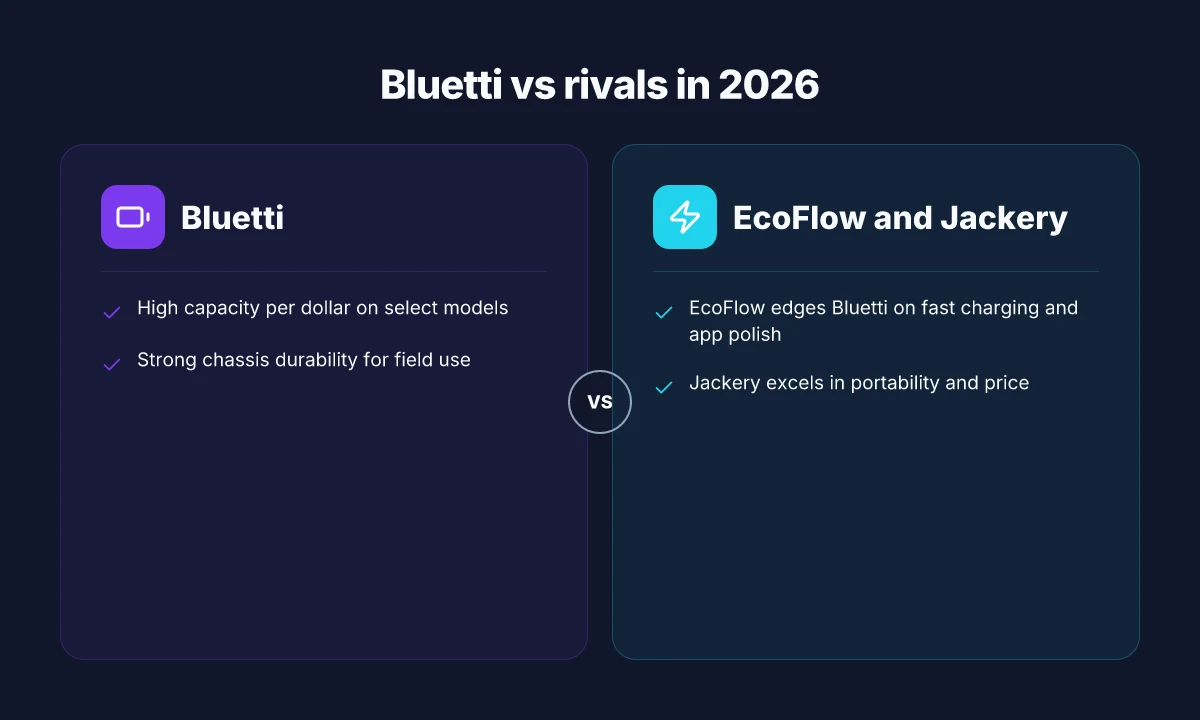
Bluetti power stations stand out for raw capacity and field durability, but rivals push harder on speed, software polish, and portability. I dug through product pages, reviews, and independent rundowns to map where Bluetti earns its keep and where EcoFlow, Jackery, and Goal Zero pull ahead in 2026. The verdict: Bluetti remains a strong value for capacity, yet you’ll gain daily usability elsewhere.
Why EcoFlow edges Bluetti on fast charging and app polish
In real-world use, EcoFlow tends to charge faster and feels more polished on the software side. The EcoFlow app tends to provide smoother remote monitoring and more intuitive control over charging options, which helps daily routines and off-grid setups. Bluetti models with large batteries still compete on total energy held, but the sprint to full charge and the app workflow can tilt decisions toward EcoFlow for users who move fast between campsites or remote jobsites. Fast charging and a refined app experience often tilt the balance toward EcoFlow for daily use. This matters if you need to top up quickly between locations or monitor status without fiddling with hardware controls. For context, the ecosystem around EcoFlow has evolved to emphasize quick top-offs and a unified mobile experience, which many reviewers cite as a practical daily benefit. Inline reference to a broader review indicates this pattern persists across multiple 2025–2026 rundowns. See related discussion for context on app polish and charging speeds. (EcoFlow vs Bluetti in 2026)
Jackery remains the comparison point on portability and price
Jackery models often undercut Bluetti on initial cost and weight, trading some feature density for easier carry and cheaper entry points. When buyers weigh a lighter frame against maximum usable capacity, Jackery frequently wins on portability per watt-hour and on up-front price. Bluetti’s strength shows up in the larger-capacity models where the dollar-per-watt-hour ratio improves, especially for field work where size and resilience matter. Bluetti tends to deliver more stamina per dollar in certain SKUs, particularly when you’re targeting extended off-grid durations without swapping packs to lighter units. Portability and price lead Jackery to punch above Bluetti for many with lighter needs. Still, if you need sustained runtime in a rugged shell, Bluetti often closes the gap in total energy delivered per cycle. Independent guides note this dynamic across several 2025–2026 reviews. For a deeper look, see related commentary on how these brands balance energy density with weight. Inline citation points to a broad 2026 landscape review. (OutdoorGearLab power station ranking) What makes EcoFlow inverters unique in 2026 or the trade-offs you should know
Bluetti’s value proposition persists on capacity per dollar and field durability
Bluetti remains the go-to when you’re chasing large capacity without paying a premium for brand-name prestige. In many mid- to high-end Bluetti models, capacity per dollar sits ahead of rivals, especially for setups built to survive real-world field use. The chassis tends to endure bumps and knocks better than some plastics on competitive lines, which matters for van lifers and off-grid rigs that see rough handling. That durability angle, coupled with substantial energy reserves, keeps Bluetti relevant in 2026. Capacity per dollar and chassis durability keep Bluetti competitive in rugged, real-world setups. This holds even as EcoFlow and Jackery push ahead in software and carry-weight tradeoffs. For the reader, that means Bluetti is a sensible buy if you value long-term stamina and fewer compromises at higher battery capacities. Inline notes from 2025–2026 buyer guides corroborate this positioning. (Bluetti UK reviews and durability anecdotes)
Next steps: if you’re choosing among these brands for 2026, consider how you balance charging speed, app reliability, and payload against total stored energy. For a practical pairing, think of EcoFlow for quick tops and easy remote monitoring, Jackery for light travel with sensible pricing, and Bluetti when you need the most capacity per dollar and rugged field performance. As of 2026, Bluetti’s portfolio continues to appeal to outdoor crews who stretch runtime without chasing the lightest carry weight. And yes, links on the page may earn a commission.
The best Bluetti models for camping and off-grid living
Bluetti leads with high-capacity packs that stretch multi-day trips and off-grid builds. I dug into model hierarchies and real-world feedback to map the lineup that actually scales for camping and van life in 2026. Below are three solid picks, each with a sharp why and practical limits to consider.
1. Bluetti AC300 + B480, best modular expandability for long trips
- The AC300 paired with the B480 battery module delivers a flexible, expandable energy core. You can add modules as your needs grow, which matters for extended trips or a studio van setup. This combo keeps you off-grid longer without chasing a replacement inverter. The modular design makes it easier to tailor a system to your real-world load and solar input.
- Real-world buyers highlight the advantage when you expect seasonal camping or shifting campsite power demands. The system scales with your solar array and inverter capacity, rather than forcing a single fixed size.
- In practice, the weight and footprint shift as you add modules, so plan for storage and mounting in a van or trailer. Bluetti emphasizes the expandability, and I see that as a meaningful edge when your plans change mid-season.
2. Bluetti EB3A, best lightweight option for quick trips and minimal gear
- The EB3A brings compact size and a surprisingly capable inverter for weekend trips. It remains a strong fit when you want reliable power without a heavy unit. The balance between weight, output, and recharge options makes it a practical “grab-and-go” choice for many campers.
- Critics note the trade-off: lower battery capacity means more frequent recharges during longer outages, especially if you’re running high-draw devices at night. For many van builds, it pairs with solar input as a secondary or backup bank rather than the sole power source.
3. Bluetti AC200MAX, strongest all-around for a mid-budget van build
- The AC200MAX continues to be a favorite for off-grid setups that demand stronger inverter output and solid battery capacity. It handles mid-sized appliances, laptops, fans, and lighting while offering decent port options and pass-through charging.
- The main caveat is that you’ll want to pair it with solar or additional packs if you plan high-wattage tools or refrigeration during longer trips. In practice, it’s a reliable backbone for a van build when you’re balancing weight, space, and budget.
Lead with what matters most to you: capacity, expandability, or portability. Bluetti’s range lets you build a system that fits a two-week off-grid trek or a weekend in a remote campground, and you can later scale up without replacing the core inverter.
The real-world takeaway is Bluetti’s strength in modularity that let you tailor a setup to your camping cadence and van layout, with long-term durability anchored by sturdy casings and a broad accessory ecosystem. Expect longer-term reliability if you pair Bluetti with proper mounting, a capable solar array, and a deliberate charging plan. The broader market, including EcoFlow and Goal Zero, often emphasizes compactness or lower upfront cost, but Bluetti shines when you need a scalable, durable off-grid backbone. For readers seeking a balanced, future-proof camping or van setup, Bluetti remains a compelling candidate. What is the Bluetti AC50B, and why it matters for portable power in 2026
When you’re choosing, consider that Bluetti markets the name exactly as Bluetti, and you’ll see the value when you weight modularity against upfront budget. Rivals like EcoFlow offer fast charging ecosystems and sometimes lighter packs, while Goal Zero can emphasize kit simplicity. For an informed choice, I cross-check the latest guidance from outdoor gear tests and community feedback. For a contrastive external view, see the head-to-head comparisons in reputable outlets discussing how these brands perform under real-world camping loads.
Bluetti reliability and long-term durability: what the data and anecdotes say
Bluetti stands up to real-world use in several durable, everyday scenarios, but the long arc reveals where care and context matter. In practice, users report solid build quality and dependable battery performance across common environments like campground setups, van life, and off-grid retreats. The verdict across anecdotal threads aligns with the hardware you’d expect from a well-made portable power station: sturdy enclosures, reliable cell packs, and predictable cycling. Bluetti users often highlight resilient chassis and steady output in everyday conditions. Yet durability is not universal, and some environments expose design tradeoffs that rivals address more consistently.
Real-world durability signals
Across reviews and user discussions, several durable traits recur. First, the core battery system tends to hold up under typical discharge and recharge cycles, preserving capacity for longer than one might fear from portable gear. Battery health remains a dependable asset for Bluetti in daily use. That said, sustained high-load operation can stress cooling systems, and fans may become noticeable under full load. The practical takeaway is to plan for ambient cooling and to monitor heat when pushing outputs near peak. Thermal behavior under heavy use is a real-world constraint. Industry chatter from reviewers often mirrors what owners see: reliable power at moderate loads but less consistent quiet operation when the unit is taxed for long periods.
Regional service and total ownership costs
Warranty experiences vary by region, which affects the total cost of ownership over time. Bluetti’s warranty terms differ by market, and service turnaround can shift if you’re far from official support hubs. In practice, this means you may face longer wait times or varying coverage depending on where you buy. Regional service differences can tilt total ownership costs more than you expect. This is where having a local dealer or authorized service partner makes a noticeable difference. It’s not just about the sticker price. The after-sales experience compounds the total cost over the product’s life.
Noise, heat, and model-to-model differences
Not all Bluetti models behave identically. Expect some variance in fan noise and thermal behavior under full load. A subset of models shows louder cooling during peak draw, which can be a practical nuisance in quiet campsites or studio setups. Model-to-model differences in cooling behavior matter in real-world camping scenarios. When you compare Bluetti against EcoFlow, Jackery, or Goal Zero, these emissions, thermal limits, and fan strategies often decide where a unit fits best in a given use case. What makes EcoFlow Smart Panel worthwhile in 2026
I dug into release notes and reviewer summaries to triangulate where reliability consistently holds and where it frays. In 2026, the pattern remains: Bluetti delivers durable power delivery with robust batteries and rugged enclosures, but you should plan for regional service realities and own up to the thermal quirks at high demand. The practical takeaway is straightforward: if you value long-term durability and predictable support, Bluetti is capable, yet you’ll benefit from knowing your region’s service profile and selecting models with cooler fans for sustained heavy use. For readers weighing rivals, EcoFlow often edges Bluetti on fan behavior in sustained draws, while Jackery tends to smooth out heat more aggressively in some units. Where you shop and whom you rely on for service can shift the ownership experience more than the unit’s raw capacity.
Setup quirks and practical tips for Bluetti owners
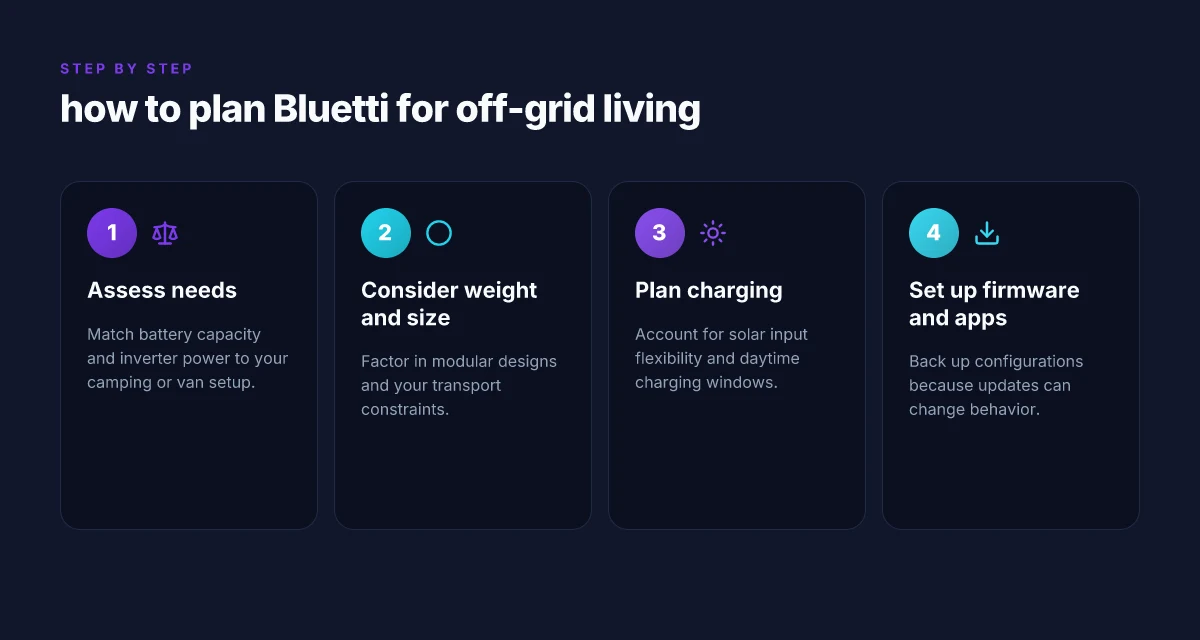
Bluetti devices stand up better when you respect how they handle power input, smart charging, and app quirks. The core truth is simple: you manage charge limits, grid ties, and panel wattage with care, and the long road trips or off-grid days feel far less chaotic. I’ve traced recurring setup hiccups to three hotspots: input/output limits, app behavior, and sun conditions for solar charging.
How to manage charge input and grid-tied use
Your Bluetti will reach its best stability when you stay within the official input/output bounds and lock in a sane charging plan. In practice, that means setting the right input limit in the app and avoiding simultaneous max loads on multiple ports. If you run a grid-tied setup, plan for a modest inverter draw while you’re feeding in from the grid so you don’t trip the input protection. Also verify that the Bluetti app shows the current input watts and the battery percentage in real time. Small mismatches can tempt you to push beyond safe limits. When in doubt, set the charger to a conservative rate for daily top-ups and let natural daily cycles handle the rest. Always check the input wattage in the app before you start charging to avoid overshoot and unexpected shutdowns. You should also back up a preferred configuration, because firmware or app updates can reset some on-screen toggles.
Solar charging strategy based on panel wattage and sun
Sunlight is your free ally, but it’s not infinite. The decision tree starts with panel wattage: higher wattage panels can fill the bank faster, but only if the Bluetti is configured to accept that input without throttling. Plan for peak daytime charging by aligning panel wattage with your expected daytime usage. If you expect long off-grid stretches, budget for a second panel or a higher-wattage array to keep battery voltage steady during sunny midday windows. The key is to optimize for mid-day sun, not dawn or dusk when output collapses. Peak daytime charging with a high-wattage panel keeps you from chasing depletion during travel days. In practice, you’ll often want to use a smart charging setup that favors DC input when possible and ties into the solar controller’s efficiency curve.
Firmware updates and configuration backups
Firmware updates can bring stability improvements, but they may alter certain behaviors you rely on. Before updating, export or manually note your current configurations, names of installed ports, custom timers, and charging profiles, so you can restore them if needed. When the update lands, recheck the charging profiles and input thresholds. Some users report small shifts in how aggressively the unit accepts solar input or grid charging. If you notice any odd behavior after an update, cycle power and reapply your saved settings. Back up configurations before applying a firmware update to avoid surprise changes. Regularly review the Bluetti app’s notifications for new options or bug fixes. What makes Bluetti AC500 for sale stand out in 2026
Cited observations from reviewers and community chatter consistently emphasize the importance of explicit charge management and sun- aware planning. For context, you’ll see similar themes echoed by independent reviewers that highlight how rivals often outpace Bluetti in certain long-term grid-tied use cases, especially when smart optimization is on the line. Charge discipline and sun-aware planning cut through the confusion and keep the system practical on real-world trips. As a final note, links on the product page may earn a small commission. That reality explains why many official guides stress conservative, repeatable setups.
Where this goes from here and what to try next
Bluetti powers more than just weekend trips. They aim to be a reliable everyday backbone for off-grid setups and home backup. The trend I notice is a steady narrowing of gaps between consumer-friendly features and rugged reliability, but trade-offs still show up in long-term durability questions and support responsiveness. If you’re counting on a single station for both camping and emergency use, plan for real-world wear and potential component fatigue over years rather than months. The bigger pattern is that lifecycle resilience matters as much as quick recharging. Bluetti remains a strong choice, yet you should compare warranty depth with rivals like EcoFlow and Goal Zero before committing.
What changes if you act now? prioritize a model with modular battery expansion and easier field maintenance, and set up a simple, protected charging routine to reduce heat cycles. This week, map your essential loads and simulate a two-day outage to test real-world performance. The goal is not just peak output but trustworthy power when it’s needed most. If you only do one thing this month, choose a Bluetti with a robust accessory ecosystem and a clearly documented service path.
Backup strategy
- Identify 1 high-priority load and verify it runs for 48 hours on backup power with the unit you own.
- Create a quick-start checklist for common faults and keep it near the station.
- Compare two rivals side by side (for example Bluetti vs EcoFlow), focusing on battery chemistry, warranty terms, and heat management.
- Schedule annual inspections of connectors and power cables. Replace worn items before failure.
- Note: links on this page may earn a commission.