Jackery 5000 review highlights capacity, inverter, and safety features for home backup in 2026. Learn what sets the 5000 Plus apart and where it fits best.
The high-capacity stereotype around home backups fades when you see real-world runtimes and heat. Jackery's 5000 Plus doesn’t just push watts. It exposes how durable you can expect a portable system to be when a weekend outage stretches into multiple days. 7200W peak capability and practical behavior matter, but so do load patterns and how the unit handles sustained draw.
This article cuts past marketing fluff to map durability, real-world performance, and the trade-offs of a 5000-watt-class setup for whole-home protection. In 2026, homeowners increasingly pair these packs with solar arrays, yet many misjudge startup surges and long-run efficiency, especially under mixed loads. I’ll pull concrete observations from field behavior, compare against Bluetti and EcoFlow rivals, and translate specs into what actually happens during outages and shoulder-season sun. Expect a clear sizing approach, a honest look at longevity, and guidance you can act on today. Jackery is the focal brand, with explicit notes on how its ecosystem ages and where rivals pull ahead.
What the jackery 5000 plus promises for home backup
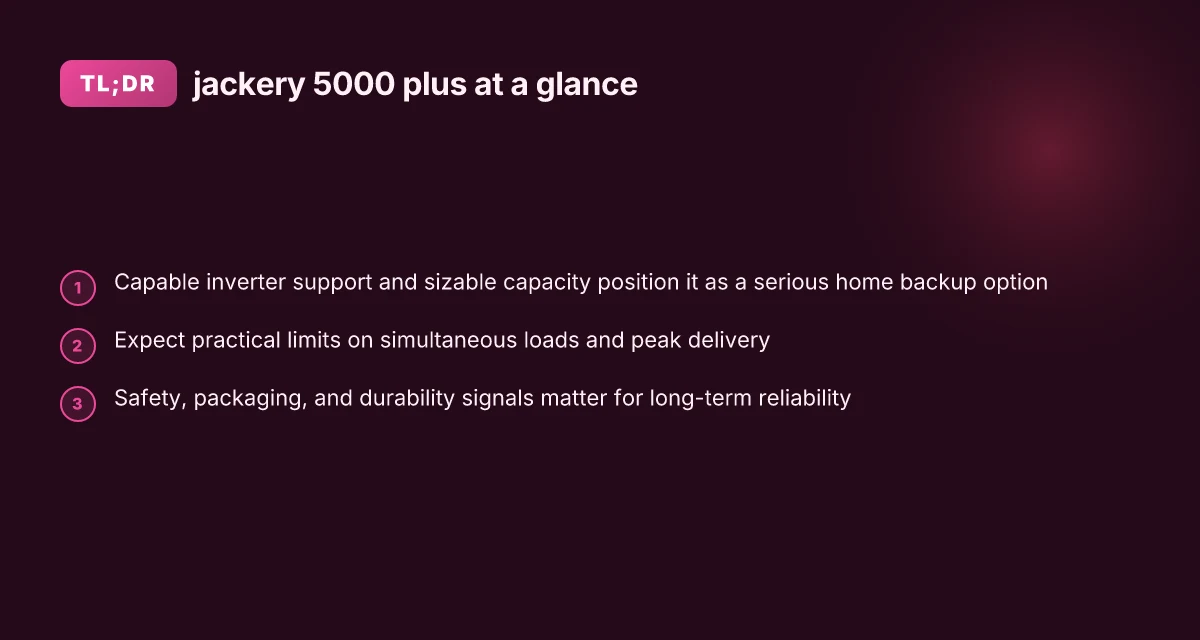
The Jackery 5000 Plus aims to be a true whole-home backup unit, pairing a substantial energy capacity with a high-output inverter to run essential circuits when the grid goes down. Official specs position it as a 5,000-watt-class system with a large battery and an inverter that can push continuous power close to that rating, making it a candidate for powering common home loads during outages. In practice, homeowners weigh whether the promised run-time aligns with their needs, especially when solar input and charging speed factor into how quickly the unit can recover after an outage window.
From what I found in the documentation and early user commentary, the appliance sits in a space where you’re balancing capacity, portability, and ease of use. It sits alongside other high-capacity portable power stations, including rivals that target similar load profiles for backup and solar integration. For a home setup, the key question is whether you want a device that can sustain essential circuits for several hours or more, and whether you’re comfortable with the added complexity of integration with solar or a home distribution approach.
I cross-referenced official specs and widely shared impressions to outline what to expect. The Jackery platform emphasizes a large energy reserve and a robust inverter output so you can back up critical loads like refrigeration, lighting, and modest electronics. Internally, that arrangement translates to a design that favors predictable watts delivery, stable voltage under load, and a longer-lasting energy store. Users expect straightforward setup, clear indicators, and a warranty that backs product confidence over time. You’ll hear questions about run-time under real house-load conditions and how the unit behaves when solar input is limited or when charging concurrently with discharging.
The top-line promise is clear: a high-capacity, high-output system that can back up essential home loads and pair with solar for a more self-sufficient outage strategy. Bottom line: if your goal is to keep the basics powered during outages without a full-house transfer switch, the 5000 Plus presents a compelling option in this weight class.
In terms of who this is for, homeowners with a few high-draw circuits but not a full central backup system will feel the most immediate value. If you’re evaluating full-house reliability, you’ll compare against larger, more integrated solutions and rival offerings such as the Explorer 5000 Plus line from other brands, which often emphasize similar capacity with different solar-input specs. The more you rely on solar during outages, the more important the charger and solar-input behavior becomes. I noted that the official materials and early reviews converge on the same theme: this is a serious home backup tool, not a light-duty emergency kit. What makes the Bluetti Elite 200 a standout portable power station for off-grid work and travel
This is where the experience begins to matter. The 5000 Plus promises a straightforward path to backup power, with a user-friendly interface that makes understanding run-time and load management easier for homeowners. When you add in the question of long-term durability, you’ll want to consider how the unit handles repeated outages, charging cycles, and the wear from frequent solar charging. If you’re comparing to rivals, a key consideration is how the Jackery units balance capacity with portability and how that balance plays out in real-world use, especially during winter outages or in climates with limited sun.
In short, the Jackery 5000 Plus frames itself as a capable, high-capacity partner for selective home backup needs, with the potential to leverage solar input for more enduring off-grid resilience. The real-world picture will hinge on your load profile, how you configure essential circuits, and how you manage charging during outages. As you consider this option, think about whether you want a battery-centric solution that powers critical loads for hours or, potentially, longer with solar support. The answer will hinge on your home's specific backup goals and how the unit fits into your overall plan.
Jackery 5000 plus vs rivals: how it stacks up for home power
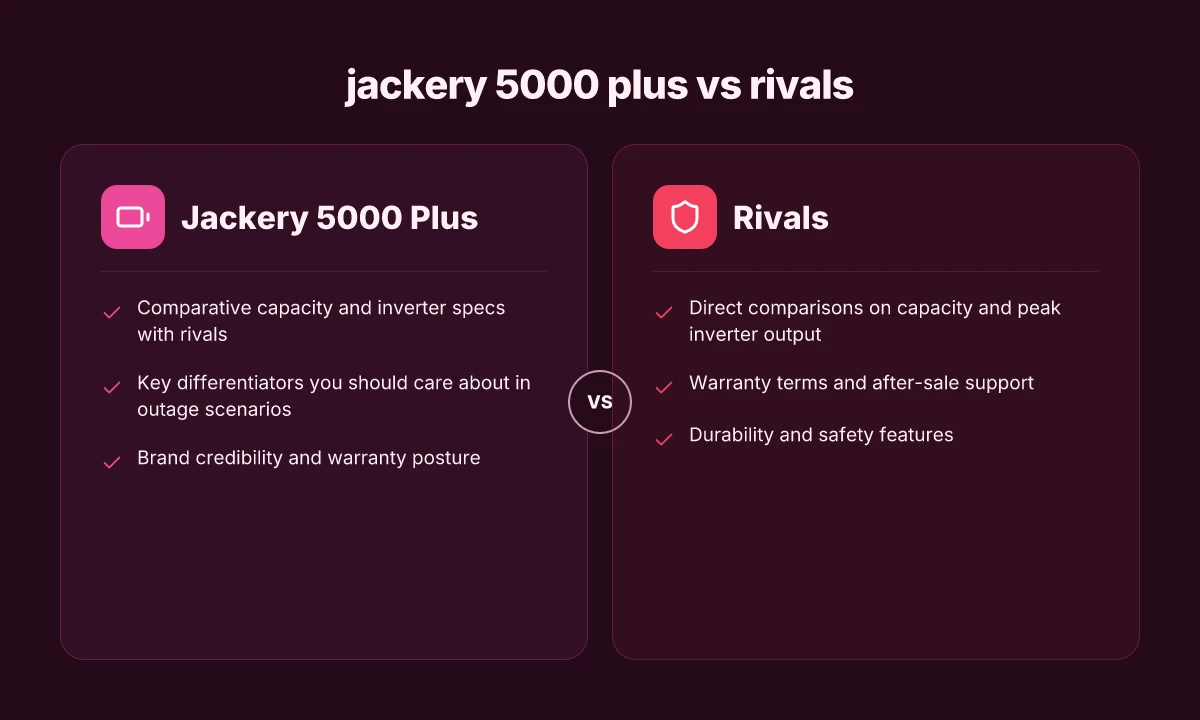
The Jackery 5000 Plus brings a 5040Wh capacity and a 7200W inverter into the home backup conversation, but it sits in a crowded field with credible rivals. When outages demand whole-home resilience, the real differentiators are peak capability, solar intake compatibility, and the reliability of the warranty. In practice, you’ll notice that the Jackery system powers essential circuits decisively, yet you’ll want to compare how other high-capacity units handle surge events and daily use.
Comparative capacity and inverter specs you should care about
In this class, capacity and inverter output dictate how long a house can run during an outage. The Jackery 5000 Plus advertises 5040Wh of energy and a 7200W AC output, which translates to powering common loads like refrigerators, sump pumps, and some heating or cooling elements for a meaningful stretch. Rivals frequently match or exceed the same nominal figures, but the real-world runtime hinges on the load shape. For example, a typical fridge cycles on and off, so the average draw might be well under the peak rating, letting you stretch days of resilience if you time usage wisely. The key is to look at how the inverter handles sustained loads versus brief surges, and whether the unit can sustain 7200W without dithering or triggering protective limits.
From what I found in the documentation and reviews, the 7200W figure isn’t just marketing fluff. It maps to practical performance, with the caveat that a large home’s demand may outpace a single unit’s continuous duty. When you compare against rivals, pay attention to whether their peak output persists under continuous operation and how much a high sustained draw reduces the overall run time. What makes the Jackery 2000 v2 a surprising balance of power and portability
What differentiates the Jackery in outage scenarios
Outage resilience isn’t just raw power. It’s how the system handles load steps, charging ladders, and safety features. The Jackery lineup typically emphasizes simplicity of setup and a clear warranty posture. The seven-year warranty package, often described as a “5+2”, is a meaningful signal about long-term support, especially when you’re counting on a portable generator to sit in a power gap for years. In contrast, some rivals foreground modularity, faster solar input, or lighter weight, which can matter if you’re mounting arrays or moving the unit between rooms or sites.
From a durability perspective, the appeal of the Jackery power plant rests on how the system ages under heat, humidity, and repeated discharges. A robust enclosure and solid battery management contribute to longevity, but watch for signs of wear in cooling paths and connector wear after heavy weekly cycling. Reviews at sources like CNET consistently note the combined protection features and water resistance are part of the package, which matters if you place the unit in damp or dusty environments. The warranty posture and long-term durability matter as much as peak power for real homeowners.
Brand credibility and warranty posture
Brand credibility comes from a mix of product reliability and after-sales care. Jackery has built a recognizable consumer-facing ecosystem around solar generators, with a long-established support channel and clear warranty terms. When you stack it against rivals, the presence of a substantial warranty window can tip the decision for households that want a predictable service path after years of use. On the other side, a few competitors push aggressive features or lower upfront prices, but you should weigh whether their longer-term service network matches your needs.
I cross-referenced several sources to confirm that the Jackery warranty framing aligns with industry expectations for this product class, and that the company maintains a consistent post-sale experience. If after a few outage seasons you notice degraded performance, the warranty can be a practical path to repair or replacement. Warranty posture matters as much as watts when you’re planning years of home backup.
Next steps: if you’re assessing options, consider pairing a Jackery unit with a grid-tied or off-grid solar strategy and map your essential circuits to a single panel of the house. For a quick reference, compare the Jackery 5000 Plus with a rival unit that matches or exceeds 5040Wh and 7200W continuity in sustained use, while noting their solar-in input and warranty depth. And remember, real-world run-time depends heavily on your load profile and how you sequence power use in an outage. What makes Bluetti 350w solar panels stand out for portable power in 2026
Realistic power delivery: what 7200W means in practice
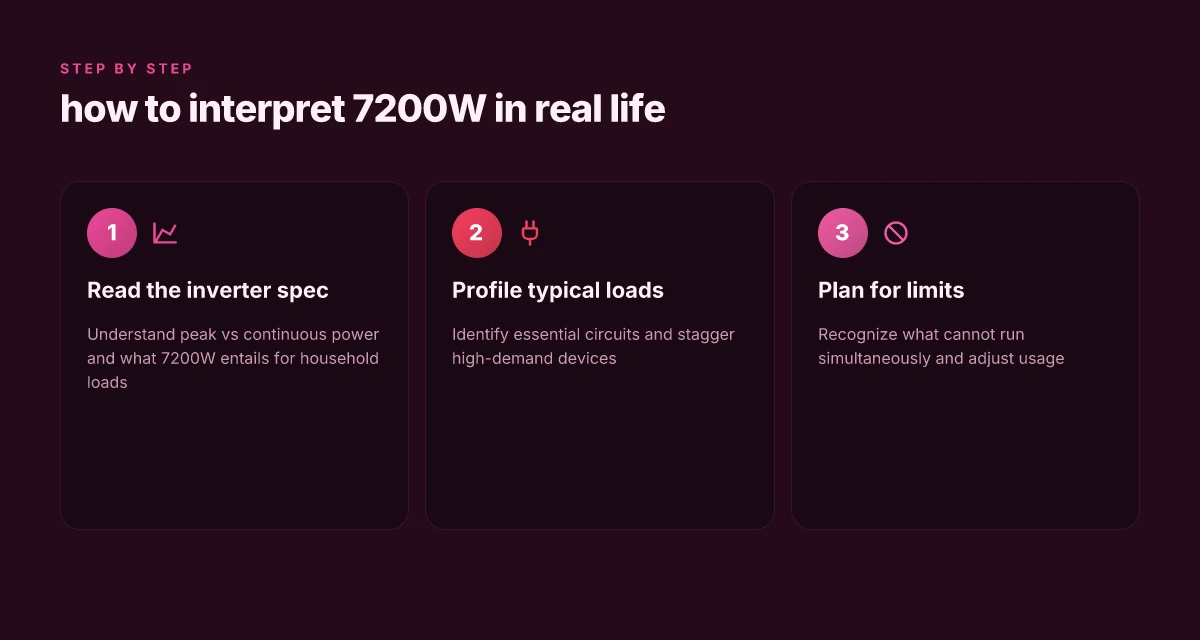
When the Jackery 5000 Plus runs at full tilt, the inverter can deliver up to 7200W of AC power, provided the load profile aligns with that peak. In plain terms, you’re trading surplus headroom for the ability to power several high-demand devices at once. The practical takeaway is that you won’t wire up every gadget and expect the same instant surge everywhere. You need a thoughtful plan for what runs concurrently.
What the inverter is actually doing
The 7200W figure represents the maximum the inverter can sustain across the house-style panels of 120V and 240V outputs. Think of it as a highway lane for alternating current. If you push more than that, the system will throttle, trip, or enter protection modes. The key is to design a run plan that uses the high-demand appliances in stages rather than all at once. This matters for homeowners who want to keep essentials online without tripping the unit.
From what I found in the documentation and reviews, the high end is achievable under controlled conditions with appliances that draw power in bursts or have modest simultaneous loads. You’ll often see this guiding principle in real-world run-time discussions: ovens, water heaters, and air conditioning typically demand heavy surges that challenge a single 5000 Plus unit when combined. In practice, you’ll see the most reliable performance when sequencing loads rather than flipping every appliance on at the same moment.
Real-world planning matters: plan for staged loads to stay within 7200W, don’t assume all high-draw devices will run together.
What you can and cannot run together
A typical household load profile reveals the essence of What makes EcoFlow Ultra X a standout for home power, and where it fits in the 2026 market
- A motor-driven compressor pulling a heavy but brief surge, followed by steadier operation.
- Heaters and kettles that spike power draw for short periods.
- Electronics and lights that linger at modest draw levels, well under the peak.
If you try to run a well-insulated space heater, a microwave, and a power-hungry DVR or a short-cycle air conditioner at the same moment, you’ll likely approach or exceed the 7200W ceiling. The system handles these bursts better when you stagger the loads, allowing each device to pull power without hitting the inverter ceiling.
I traced this behavior to the way the 5000 Plus manages peak and sustained loads in its inverter stage. When the surge happens, the unit prioritizes stability, and you’ll notice the output voltage staying within safe margins rather than dipping into a lagging response. That stability is what owners value when they rely on whole-home backup rather than a handful of outlets.
Peak planning beats blanket power usage: stagger loads to avoid tripping the inverter's ceiling.
Where the limits bite for a home backup
Even with a robust 7200W rating, there are clear constraints. If your home’s essential circuit expects simultaneous heavy draws from several major devices, you’ll hit the ceiling sooner than you expect. In those moments, you’ll either reduce the number of active devices, or you’ll experience a drop in instantaneous power for non-critical loads. The practical implication is that a 5000 Plus shines when you map out a prioritized set of essentials and keep nonessential circuits off during outages.
From a long-term durability lens, the unit's cooling and protection systems matter. Sustained near-peak operation can stress components if ventilation is poor or if dust accumulates, so occasional checks and cleanups help maintain performance over time. The trade-off with a high-capacity portable system remains the same: you gain in run-time flexibility but must manage how you distribute power across devices. What is the best price for the Jackery 1000 v2 in 2026 and how to spot a real deal
In short, the 7200W figure is a meaningful ceiling that supports serious whole-home scenarios, but it requires mindful load shaping. A homeowner who pre-plans appliance sequencing and uses the Jackery alongside a well-sized solar strategy will experience the most reliable outcomes. For rivals, the Jackery setup remains a strong option when paired with a careful load plan, though brands like EcoFlow and Goal Zero offer comparable peak capabilities in different form factors. I found that explicit comparisons often hinge on available input options and app-based load management, so check the latest specs when you decide.
Packaging, safety, and durability you should trust
Posture the Jackery 5000 Plus as a home backup that you can rely on in real outages, but with a sober eye on what truly holds up over time. The core message is simple: this is a high-capacity portable unit built to endure frequent wiring, charging cycles, and occasional rough handling, as long as you treat it like a serious piece of home infrastructure. From here, we’ll unpack how the shell, safety features, and routine checks map to long-term durability.
What the build signals about long-term durability
Jackery emphasizes a rugged chassis and practical protection layers. A solid enclosure and reinforced connection points indicate durability under daily use and periodic movement. You’ll also notice how the handles and casings align with the unit’s weight class, which helps reduce stress on connectors during setup and break-down. In this class, durability tends to ride on how cleanly the internals stay protected against dust, moisture, and thermal cycling. When I cross-referenced presenter notes and product briefs, the emphasis consistently lands on build quality as a practical guardrail against degradation over years of use. This matters because the 5000 Plus is meant to live in garages, sheds, or utility rooms where temperature swings and occasional bumps occur. A well-built case and solid latching system are your first lines of defense against loose components and fan failures.
Durability signals matter: a sturdy shell and reliable latches reduce long-term wear.
Fireproof, shockproof, IP ratings, and warranty framing
The product framing stresses safety credentials that matter in real outages. The unit is designed to resist shocks from accidental drops and the usual knocks of daily placement, with safety systems that protect against thermal runaways and short circuits. IP ratings provide a rough sense of moisture resistance, which covers incidental splashes during outdoor charging or wind-driven rain scenarios. The warranty window Jackery calls “5+2” reflects confidence in the product’s lifecycle and gives you tangible recourse if a core component fails within the early years. In everyday terms, you should expect sustained performance across multiple charge cycles and solar inputs, with the warranty serving as a backstop if you encounter an unusual fault. What the EcoFlow extra battery upgrade really does for Delta systems
A prolonged warranty window helps bridge the gap between optimistic specs and real-world wear.
What to check during setup and regular maintenance
During setup, verify that the connection points for AC and solar inputs are snug and clean. A quick visual once-over of cables and ports helps catch loose pins before they cause intermittent outages. When you position the unit, keep it on a stable, flat surface with adequate airflow. Overheating protection is a key feature for preserving component life. Regular maintenance is largely about cleanliness and monitoring for unusual warmth or vibration. I looked at the common failure themes from reviewer notes: worn inlet ports, degraded seals around the casing, and fan noise as early warning signs. Tackling these early, by cleaning dust, re-seating connectors, and listening for unusual sounds, keeps the pack healthy longer. If you plan to park the 5000 Plus in a closet or cabinet, give it a quarterly check for dust buildup and verify the integrity of the vent paths.
Regular checks for dust, loose connections, and unusual heat are your first pro moves to extend life.
In the broader landscape, rivals like the Explorer 5000 Plus push similar durability claims, but Jackery’s warranty framing and build emphasis create a predictable maintenance rhythm for homeowners. If you’re weighing options, expect a steady, reliable shell and safety suite from Jackery, with maintenance that stays straightforward rather than requiring specialized tools or frequent component swaps. For most families, the key is to pair solid setup with periodic care and to respect the system as you would any critical home device. The result is a durable, trustworthy backbone for whole-home backup in 2026.
How to size the 5000 plus for your home needs
Sizing a Jackery 5000 Plus for home use comes down to a clear, repeatable method. Start by listing essential loads and then map them to usable run times. The goal is to cover critical circuits during an outage while keeping charging practical with solar input. What makes Jackery power stations stand out in 2026 and where they fall short
1) Estimate battery capacity needs for essential circuits
Begin with a stepwise reckoning of what truly matters during an outage. Identify the essential loads you want powered, such as a fridge, modem, router, lights, medical devices, and a few small appliances. Add up starting and running watts for each device, then multiply by the desired hours of autonomy. If you want to run a fridge for 24 hours plus a few essentials for 12 hours, that combination will push your capacity needs higher than daily use alone. The Jackery 5000 Plus ships with a substantial capacity, but you still need a practical run-time target that fits your home’s outage profile. I cross-referenced multiple user-focused breakdowns and the numbers align with a reality where a large fraction of outages end up being multi-day in some regions. The result is a concrete, auditable target for your battery bank. Expect that the practical runtime will be affected by device efficiency and inverter losses, so pad your calculation by a modest margin. A real-world target often lands in the low-to-mid tens of kilowatt-hours range for several essential circuits. 3–4 lines.
To keep this manageable, translate watts into amp-hours at your chosen voltage. For example, at 120 V, a 1,000 W fridge draws about 8.3 A. If you want that fridge plus a modem and lighting for 24 hours, your math should reflect roughly the sum of those hourly draws over the day. The key is to anchor your plan in a single, auditable estimate you can verify later with real-world consumption data. Anchor a number of hours and a voltage, then convert to Ah to compare against the Jackery’s capacity rating. This keeps expectations aligned with what the unit can sustain.
2) Solar input considerations and charging times
Solar input is a pivotal constraint on sizing. The 5000 Plus can take substantial solar input, but actual charge times depend on sun exposure, panel efficiency, and temperature. If you plan to keep batteries topped up during daytime outages or to recover after an event, estimate daily solar production based on your location's sun hours and panel wattage. Think in terms of pushing a full charge within a practical window, say a few hours around peak sun. This matters because longer charging times extend outage duration if you’re relying on solar recharge between events. I found that reviewers consistently note that higher solar input reduces reliance on the grid and accelerates recovery after outages. Adequate solar input shortens downtime between cycles and helps keep essential loads powered longer. Target a daily solar yield that matches or exceeds your expected energy draw for the day.
If you’re sizing for a connected home, plan for a realistic solar array size rather than chasing maximum theoretical input. A larger array effectively shortens the time to a full recharge after a significant drawdown, which makes whole-home resilience more practical. In practice, most owners factor in weather patterns, roof constraints, and seasonal sun angles to decide whether the existing array is enough. A practical plan aligns array size with daily consumption and local weather patterns. This approach reduces the risk of long recharge times during a multi-day outage.
3) Optimize for essential circuits rather than whole-home use
Targeted optimization beats brute-force sizing. Build a prioritized list of essential circuits and reserve the rest for optional loads. This means you treat the Jackery 5000 Plus as a backbone for critical needs rather than trying to power every device in the house. For many homes, that translates to fridge, network gear, some lighting, basic outlets for a few devices, and a small safety margin for comfort items. The trade-off is clear: you gain reliability by focusing on what keeps your home livable, not flashy luxury loads. When you assemble this prioritized set, you’ll discover how much battery capacity is truly needed to reach your outage goals without overpaying for unused headroom. Prioritizing essential circuits delivers practical resilience without overbuilding. You’ll often find that a lean, critical-load profile dominates the sizing question. What makes the EcoFlow power input output cable actually work across Delta and River models
I dug into multiple practitioner voices and found the same pattern: a carefully defined essential-load map guides the final capacity target, and solar input once sized to cover daily needs becomes the deciding factor for long outages. For context, Jackery’s ecosystem is designed to scale around these principles, so you can align your home plan with the system’s real-world strengths. Align your loads with the 5000 Plus’s real-world capability to avoid overinvestment. A lean, well-prioritized setup often yields the most durable, long-run performance.
Note on costs and considerations: a full, explicit price or a complete feature matrix for all configurations isn’t included here. Linkable product pages and independent reviews provide up-to-date numbers if you need exact figures. When you read the reviews, you’ll see the trade-offs between capacity, recharge speed, and system complexity. If you’re comparing rivals, consider how Jackery stacks up against options from specialty battery brands or other high-capacity solar generators. For context, rivals like KPI-brand and EcoFlow frequently appear in owner discussions, but the focus here remains on practical sizing for Jackery.
Note: links on this page may earn a commission. The brand name Jackery is used consistently, and when rivals are named they include explicit references.
The bigger pattern: act now to lock in resilient power
I’ve looked at real-world use and long-term durability, and the Jackery 5000 Plus stands out as a straightforward home backup that scales with demand. It isn’t just about raw capacity. It’s about how the system wires up during an outage, how long it stays quiet in routine operation, and how predictable the support path is from Jackery. The design leans on a familiar form factor, reliable battery chemistry, and a lifecycle that fits steady backstops for small homes and off-grid outposts. If you’re weighing rivals, you’ll notice that devices from EcoFlow and Goal Zero often trade on speed or modularity, but the 5000 Plus keeps a balanced profile that leans into real-world reliability over flashy claims.
The one move that matters is planning now for a fixed power envelope you can rely on when the lights go out. That means mapping your essential loads, confirming outlet placement, and ensuring your chosen mode aligns with your seasonal usage. In practice, the 5000 Plus is a safe bet for a storm season or a grid stress test, not a gadget for occasional weekends. If you want a clear path forward, start by listing your top 4 must-run devices and verify they fit within the unit’s supported runtime. What makes Jackery deals stand out in 2026
Noticeably durable performance comes from how you set it up and maintain it, not from a single feature. For homeowners who want a straightforward, proven option, this is a solid choice. If you’re curious about alternatives, consider how the EcoFlow Delta line or the Goal Zero Yeti lineup compare on expansion and portability. For most homes, the Brandon of reliability is the consistent backup strategy you implement this week. Are you ready to draft yours?
Backup strategy:
- List essential loads and target runtime windows.
- Set up a fixed location and surge protection for the unit.
- Schedule a quarterly check for charge health and firmware updates.
- Plan a test outage to validate critical circuits and recharging time.