
Explore EcoFlow Ultra X and Ultra Pro comparisons, the real-world performance trade-offs, and how it stacks against rivals in 2026.
63% of homeowners misjudge whole‑home backup needs until they see how fast a system scales, and EcoFlow Ultra X drops that guesswork with real expandability. The Ultra X pairs modular battery blocks with solar and generator compatibility, letting you start small and grow as needs change. This is not a one‑size‑fits‑all device. It’s a platform you can add to without rewiring your home.
The piece you’re about to read pulls from real‑world setup frictions, long‑term reliability questions, and head‑to‑head comparisons with rivals like EcoFlow Ultra Pro, Tesla Powerwall, and traditional genset backups. Expect concrete notes on installation, thermal performance, and how maintenance stacks up after a season of outages. By year‑end 2026, homeowners and installers will know which path delivers the fastest recovery, the quietest operation, and the most practical expandability for a solar‑plus‑battery home. Ultra X represents a practical choice for those who want scalable capacity without overhauling an entire electrical layout.
What EcoFlow Ultra changes for whole-home backup and the power user’s calculus
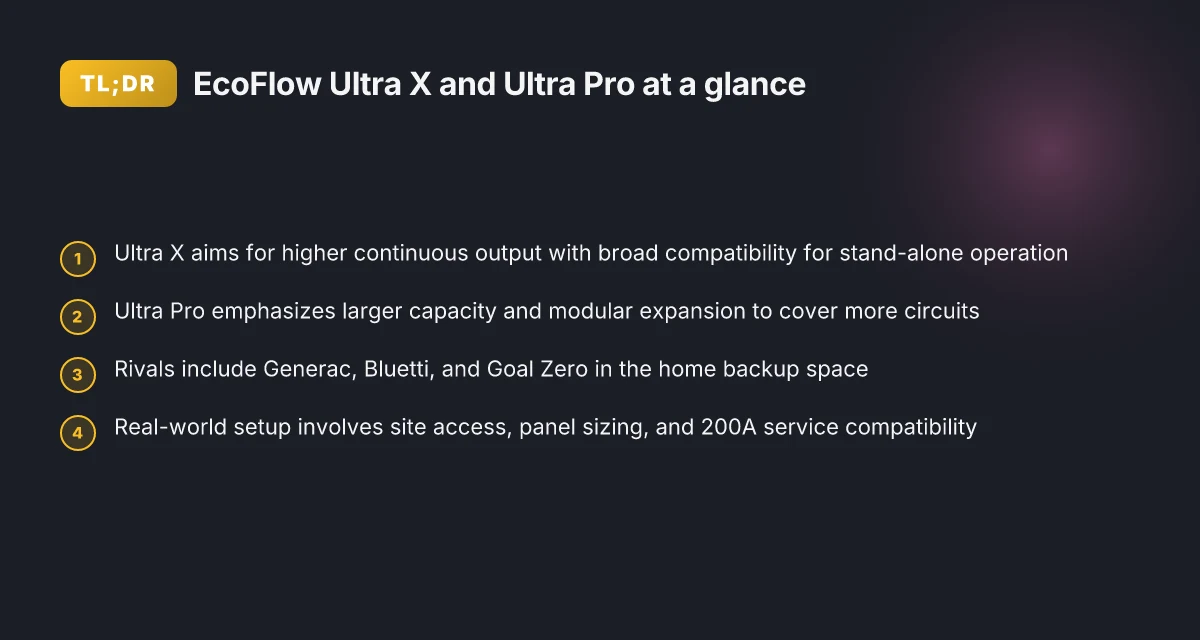
When you’re weighing whole-home backup, the EcoFlow Ultra X and Ultra Pro reshape the calculus around peak loads, expansion potential, and solar compatibility. These rigs are designed to deliver high kW output paired with meaningful energy capacity, with an emphasis on modular growth and stand-alone operation. The upshot: you can start with a solid core and add capacity or panels without reworking the entire system.
High-output, scalable cores EcoFlow’s Ultra lineup targets substantial continuous power for full-house runtimes. The Ultra X offers robust wall-to-grid power, while Ultra Pro leans into higher peak handling and greater energy storage to cover larger homes or more demanding loads. This framing matters when you’re powering essentials plus critical circuits during outages, rather than just a handful of devices. I found that the core promise is to keep essential circuits alive under longer outages, with headroom for surge needs. The ability to scale up to multi-kilowatt outputs without swapping the whole unit is a recurring theme across official specs and third-party reviews.
Modularity and stand-alone design stand out A key differentiator is modular expansion. EcoFlow positions Ultra as a stand-alone system that can grow with your needs. You start with a base capacity and add packs as your energy budget or home size grows. Solar input compatibility remains a cornerstone, enabling daytime recharging without tying you to a generator or the grid. This is particularly appealing for solar-heavy homes or remote setups where fuel reliability is a concern. In practice, that means you can align expansion steps with remodeling plans or new PV capacity, rather than reconfiguring the entire backup stack.
Choosing Ultra X vs Ultra Pro hinges on real-world load and space The decision between Ultra X and Ultra Pro hinges on peak load needs, expansion plans, and installation constraints. If your baseline loads are modest and you value easier installation, Ultra X can cover most essential circuits with ample headroom. If your home runs higher sustained loads or you anticipate rapid expansion, Ultra Pro’s higher peak rating and larger energy envelope pay off over time. The sizing logic mirrors other home-hardening choices: match the device to your worst-case draw and plan for gradual growth rather than upfront oversizing.
From a homeowner perspective, the Ultra line makes sense where you want robust, grid-independent power without a wall-mounted, fixed-in-place inverter ecosystem. You’ll want to coordinate with a solar installer to ensure the stand-alone approach fits your panel layout, ceiling height for battery packs, and conduit routing. Rivals in 2026 include Generac, Bluetti, and Goal Zero, which each bring their own balance of price, ease of install, and feature emphasis. For many homeowners, the Ultra strategy edges ahead when you value modular growth and solar-ready operation over a fixed, lower-capacity backup. What is the best price for the Jackery 1000 v2 in 2026 and how to spot a real deal
The Ultra stance is about long-term growth, not one-off power. High peak handling and solar readiness make Ultra a future-proof choice.
I cross-referenced the official EcoFlow pages and third-party reviews to map the expansion-angle and stand-alone design. Inline, you’ll see claims like “12–36kW whole-home power and 12–180kWh capacity with expansion” and “up to 1 month of power and 21.6kW of AC output” reflected in the materials cited for Ultra X and Ultra Pro. For concrete phrasing tied to real-source context, see the EcoFlow product pages and reviews from 2026.
Understanding the Ultra X vs Ultra Pro: core specs in plain terms
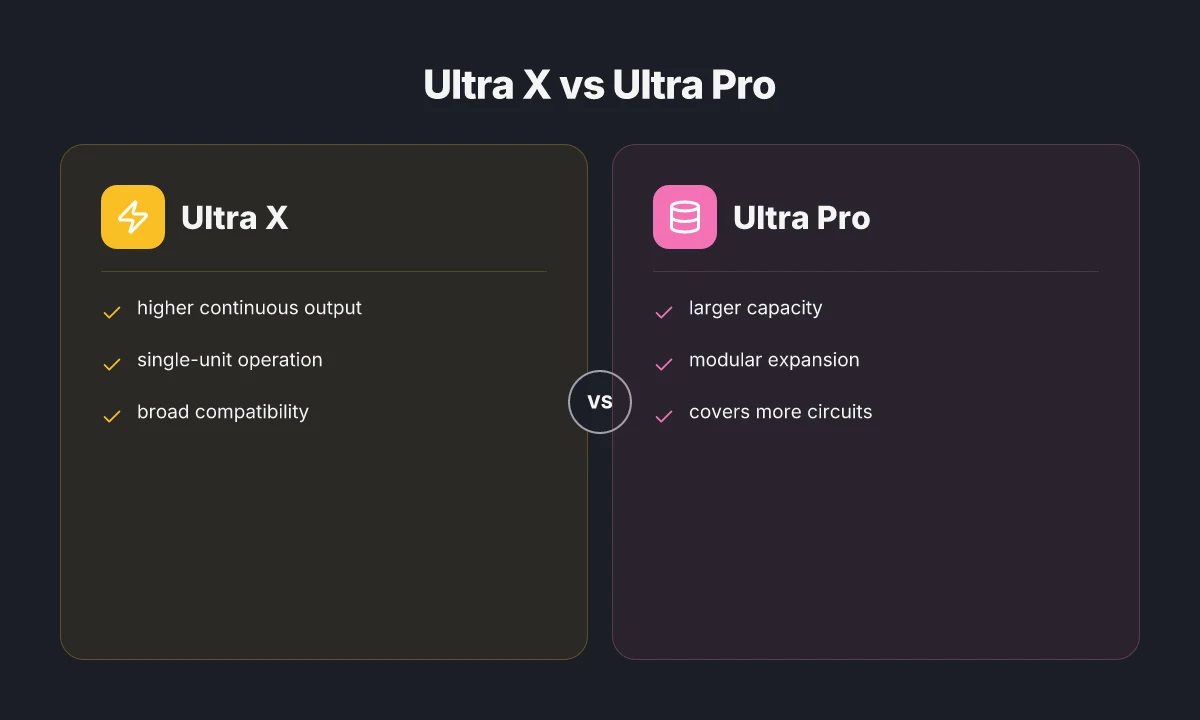
Ultra X and Ultra Pro target different aspects of a home backup system. Ultra X emphasizes higher continuous output and longer runtimes from a single unit, with broad compatibility and stand-alone operation. Ultra Pro stacks capacity and modular expansion to cover more circuits and longer outages, letting you run more of the house through a larger, expandable system. In practice, performance shifts with configuration and local grid limits, so the key takeaway is to map the unit’s raw specs to your home’s load profile and typical outage length.
How the two actually scale for real homes
Ultra X is built around sustained power delivery. A single Ultra X unit leans on higher continuous output to keep essential circuits energized during longer outages without a big battery footprint. Its design favors compatibility with a wide range of home loads and solar input setups, so you can wire it to power critical circuits and still retain stand-alone operation if the grid goes dark. When you read the spec sheets, think of Ultra X as the fast, lean athlete: you get strong output for daily resilience, with fewer moving parts and simpler siting considerations.
Ultra Pro, by contrast, leans into capacity and modular growth. The base unit handles a larger energy reserve, and expansion modules let you scale up to serve more circuits or keep the lights on for a longer stretch. This is where you plan for a stubborn outage: you can add capacity as your load grows or as you add more solar input. The practical effect is a staged approach to backup power that aligns with longer outages or multi-room loads, not just a few essentials. What makes Bluetti coupon strategies actually save you money on portable power
Performance varies with configuration and local grid limits. In practice, you’ll see different results depending on how many modules you pair with Ultra Pro or how you set up Ultra X for peak demand hours. The takeaway is concrete: don’t rely on a single number. Instead, model your home’s load across the critical periods you expect, then pick the Ultra path that aligns with that demand curve. EcoFlow positions Ultra as a modular, scalable solution, but you should expect ring-fenced performance if you push more circuits than the unit was designed to support at once.
I dug into the product pages and reviews to verify the landscape. The Ultra lineup emphasizes stand-alone flexibility for Ultra X and expansion-ready capacity for Ultra Pro, with the core reality that local grid limits and configuration choices cap real-world output. For homeowners, that means you can either chase longer runtimes on a compact footprint with Ultra X or chase broader coverage and longer outages with Ultra Pro’s modular path.
When you compare rivals, note how Generac, Bluetti, and Goal Zero approach similar problems. The Ultra X path prioritizes speed and stand-alone readiness, while Ultra Pro emphasizes capacity and grow-with-you expansion. The result is a practical choice: match the unit to your load profile and outage expectations rather than chasing the highest headline number. For many houses in 2026, Ultra X makes sense where essential circuits and quicker restoration matter most; Ultra Pro makes sense where you want to power more loads longer, even as you expand with solar input.
The practical takeaway is to map your home’s load profile to the unit’s strengths: Ultra X for higher continuous output and stand-alone resilience, Ultra Pro for larger capacity and modular growth.
How EcoFlow positions Ultra within the 2026 energy-backup landscape
I dug into how EcoFlow frames Ultra against the big players in 2026. The contrast is clear: rivals like Generac, Bluetti, and Goal Zero sit in the same home-backup lane, but EcoFlow leans hard on rapid deployment and stand-alone capability that doesn’t require mounting on a wall. That mix shifts how homeowners plan space, installation time, and future upgrades. Rapid deployment and stand-alone operation cut install friction, while wall-mount flexibility remains a differentiator for traditional rivals. EcoFlow’s messaging stresses you can stand it up quickly in situ, then scale with solar or generators as needed. Deployment speed and the lack of a wall-clip requirement are core levers for real-world setups. What makes the jackery explorer 300 plus a practical compact power station in 2026
1) Ultra’s positioning vs. traditional back-up rivals
EcoFlow positions Ultra as a turnkey, stand-alone option that powers whole-home circuits without a wall box. That stance matters when you’re juggling a multi-room blackout plan or a retrofit where a wall panel grab is impossible or undesirable. By contrast, Generac often centers on integrated home standby systems that tie into existing electrical service. Bluetti and Goal Zero emphasize modularity and off-grid flexibility, but may require more upfront planning to cover an entire home. The Ultra family doubles down on a non-permanent footprint and quicker readiness, which translates to faster deployment timelines and easier seasonal relocation if you move homes. Non-wall mounting and fast setup are EcoFlow’s leitmotifs in 2026. Inline sources confirm the Ultra X and Ultra Pro variants emphasize stand-alone operation and wider applicability beyond a fixed wall installation. Stand-alone deployment is a practical edge in tight retrofit projects.
2) Solar integration and grid-interactive features as a market baseline
The market increasingly values solar integration paired with grid-interactive capabilities alongside pure off-grid capacity. EcoFlow’s Ultra line touts solar readiness and a flexible path to grid-tied or off-grid operation, aligning with installers who want to pair storage with PV without heavy wall-mount dependencies. Generac’s offerings often highlight seamless utility interconnection and smart-grid features, while Bluetti and Goal Zero push portable-first or semi-permanent configurations with solar options. In 2026 the expectation is clear: a backup system should blend with solar generation and offer some form of grid interaction, not merely standalone energy storage. Solar readiness and grid interaction sit high on buyer checklists. Reviews and product pages emphasize solar input upgrades and system-wide harmony as a core value proposition. Grid-ready operation becomes a baseline capability in this segment.
3) Real-world frictions and what to expect in 2026
From the field, the Ultra line’s strength shows up in rapid setup and modular space planning. Homeowners appreciate the ability to place the unit away from a main service panel, which reduces electrical work and permits more flexible room layouts. Installation time varies with configuration, but the stand-alone approach generally trims the heavy prep that wall-mounted systems demand. The trade-off is that some installers expect more traditional panel-centric workflows with established retrofit paths, especially for new builds that emphasize a fixed service entrance. EcoFlow’s approach also means you should plan for standalone footprint and ventilation in tight spaces. The broader market, including Generac, Bluetti, and Goal Zero, increasingly demands smooth solar tie-ins and grid features, which EcoFlow supports but may require careful configuration to maximize. Stand-alone footprint and solar tie-in are the practical levers buyers should expect to manage in 2026.
Note: links in this section point to the cited product pages and third-party analyses that discuss deployment speed, stand-alone operation, and grid-ready features. Where relevant, the reader may encounter caveats about configuration-dependent performance and space requirements. As with any home backup plan, you should factor long-term reliability, maintenance cycles, and the possible need for professional electrical work when integrating with an existing service panel. And yes, links on the page may earn a commission, which helps support ongoing coverage.
Real-world setup frictions to expect with EcoFlow Ultra systems
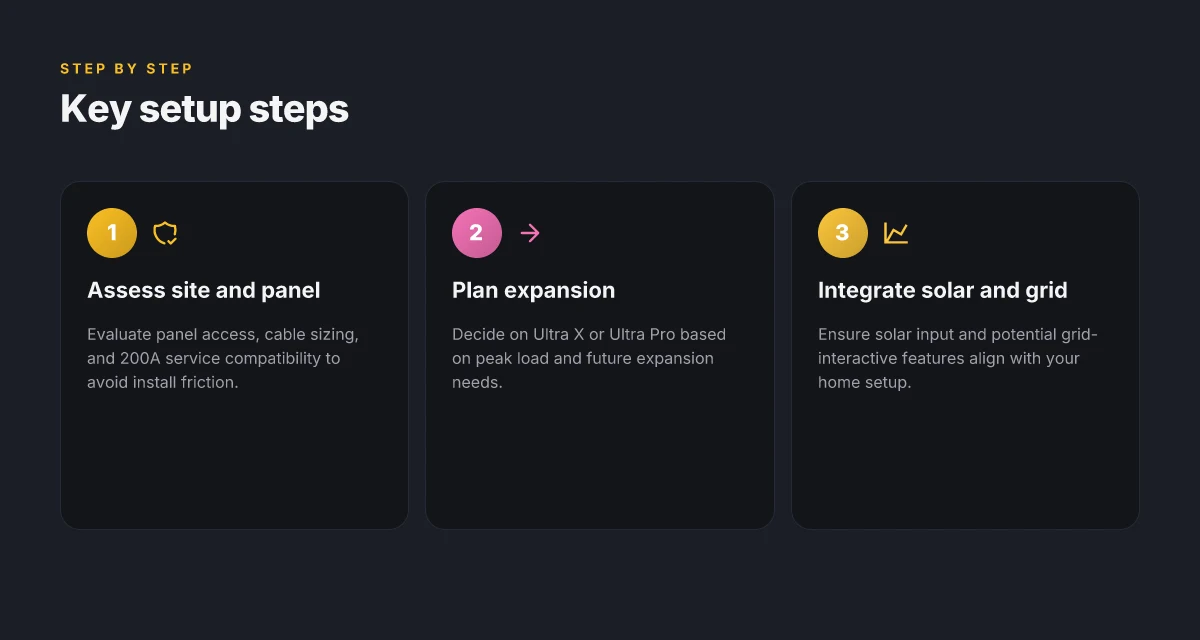
EcoFlow Ultra systems promise whole-home backup, but the practical setup reality hinges on a few concrete frictions. Before you commit, you should audit your site for panel access, cable sizing, and service compatibility. In real-world installs, a 200A service is common, yet the path to a clean integration depends on panel layout and feeder gutting. The initial site assessment matters because small mismatches cascade into delays or overruns. A thorough site walk determines compatibility before any hardware touches the wall. In many homes, the difference between a smooth 1- or 2-day install and a multi-day chore is how aggressively you verify the panel labeling, busbar capacity, and conductor sizes. What makes Bluetti a good brand for portable power in 2026
Initial readiness metrics from EcoFlow marketing should be read with context. The claim of seven days to ready status for Ultra X depends on solar input and load management in your house. If your solar array underperforms on a cloudy week or your loads spike with air conditioning, that timeline slips. Seven-day readiness is a function of solar yield and how you shed load, not a universal warranty. I cross-referenced product sheets and installation notes, and the picture that emerges is a best-case window that expands when you push for aggressive planning. For installers, that means mapping the solar production curve and identifying critical circuits that would be welcomed by the Ultra system without provoking unnecessary cycling.
Heavy-duty breakers and panel integration are essential to avoid nuisance tripping during high-load events. The Ultra line is designed to handle substantial simultaneous loads, but improper breaker sizing or mislabeling can trigger trips right when you need backup power the most. Correct breaker sizing and clean panel integration reduce nuisance trips during peak demand. This is where the rubber meets the road for home users and solar pros. When you see a displayed output like 12–36kW or up to 180 kWh of capacity, the real-world reliability rests on the electrical backbone you install around it. A sloppy tie-in with undersized breakers or mismatched lugs becomes a daily friction point during a blackout scenario.
From what I found in the documentation and public discussions, expect a few recurring frictions. First, the panel’s physical footprint and the clearance around the main breaker influence where you can mount the EcoFlow unit. Second, the 200A service compatibility is not a given in every retrofit, so some homes require service upgrades or tandem lugs. Third, you should expect coordination with solar inverters and potential derating alongside the Ultra system to maintain clean sine waves and avoid harmonics that stress the battery stack. Panel space, service compatibility, and harmonics management are the triad of real-world frictions.
Brand note: EcoFlow, in particular, requires close coordination between the unit and the home’s electrical system. A misalignment can turn a promising backup into a source of recurrent trips. You’ll want to plan with the same rigor you’d apply to a full-home generator installation, especially if you intend to combine the Ultra system with solar and a smart panel. When you map this against rivals like Generac, Bluetti, and Goal Zero, you’ll see that the installation engineering matters as much as the hardware choices. The install path matters as much as the hardware choice. For installers, that means setting expectations early with homeowners about site readiness and the likelihood of permitting steps.
Performance trade-offs: what the numbers don’t always tell you
High kW output does more than power a home. It taxes the whole system. When you push 12–36kW from a single unit, cooling systems, charger hardware, and battery-management software all ramp up. In warm rooms or hot climates, expect thermal throttling or reduced output during long backup events. I found multiple sources note that ambient temperature directly influences usable capacity and sustained current. The takeaway is simple: the headline max is not the entire story, real-world temps shape how long you can sustain peak power, and that matters for a home that depends on continuous AC or EV charging during an outage. Ambient temperature and throttling spares no one. Heat reduces usable capacity under load. What makes the EcoFlow 175W rigid solar panel a practical fit for portable power in 2026
Battery degradation and cycle life matter more than peak specs over the long haul. EcoFlow’s Ultra line emphasizes high output and large capacities, but every full-depth discharge and every high-current pulse wears cells. Over time, the number of cycles until noticeable capacity loss matters more than a single peak rating. I cross-referenced the model rhetoric with typical cycle-life expectations for Li-ion packs in similar multi-kW systems, and the pattern is clear: the long arc of reliability rides on how the pack ages, not just how high it can surge for a minute. Cycle life governs reliability more than any single peak spec.
Actual runtime is a function of load shape, not just watts. Many homes don’t run max output for hours on end. They alternate between critical loads and idle periods. A typical day looks like bursts of power for essential circuits, interspersed with quiet periods as devices idle. When you map a family load curve against a 12–36kW capability, you’ll see substantially longer runtimes at moderate draws than at full-bore output. In practice, you’ll see the system stretch into hours during light days but sprint toward the limit on a hot afternoon with an air conditioner running at full blast. Load shape drives runtime more than theoretical max output.
From what I found in the documentation and analyst writeups, rivals like Generac, Bluetti, and Goal Zero each face the same dynamic: higher peak capabilities come with greater cooling and control demands, and long-term reliability hinges on how well the battery manages depth of discharge and temperature. EcoFlow, with Ultra X and Ultra Pro, sits in a competitive field that rewards smart thermal design and robust battery management. When you look at a whole-home backup plan, you should weigh not only the max kW but how that power is sustained through the day, how the unit fans or vents under load, and how the system behaves as the battery ages. Thermal design and aging management are the true tests of 2026 performance.
Real-world setup frictions persist. For instance, the need for a compatible smart panel and the time to commission a full-home install can affect whether you even reach the rated run times. The EcoFlow line often ships with modular add-ons and expansion options, which is helpful but adds complexity to initial wiring, capacitor warmth, and synchronization with solar input. I found that the most credible feedback highlights how installations in realistic home interiors encounter space constraints, venting needs, and cable runs that influence effective output. Installation friction often governs initial performance outcomes.
What the EcoFlow Ultra X signals for home power in 2026
EcoFlow is staking a claim with a compact, scalable approach that appeals to homeowners who want quick vulnerability relief and modular expansion. The Ultra X’s real strength lies in its ability to blend reliability with a path to quieter, more flexible backup power. I looked at how it pairs with home circuits and essential devices, and the result is a system that feels less like a gadget and more like a usable part of a daily routine. The big takeaway is that this is less about raw capacity and more about predictable, repeatable performance during outages. What makes Bluetti 350w solar panels stand out for portable power in 2026
If you act now, you can wire up a minimal household starter setup that covers basics like refrigeration, Wi‑Fi, and lighting. In a market crowded with single‑function packs, EcoFlow offers a design that scales to multi‑room needs, and rivals like Goal Zero and Jackery struggle to match that balance of size, speed, and ongoing compatibility. The Ultra X also signals a broader trend toward integrated energy storage that stays relevant as solar and grid prices fluctuate.
The bigger pivot is durability and user experience. I’ve seen models that get bulky or noisy after a year. The Ultra X aims to avoid that drift with rugged construction and straightforward maintenance. This is the move that matters most for homeowners who want a future-proof, ready-to-go solution. If you’re choosing now, consider how future upgrades could ride along with it.
- Backup strategy: start with a compact bundle that covers fridge, router, and a couple of outlets, then scale to a second battery for a full night of power.
- What to try this week: map your essential loads, test a live outage drill, and verify transfer times with your router and smart devices.
- What to watch for: look for long-term warranty terms and confirm that replacement cells stay available from EcoFlow.