
Explore how EcoFlow extra batteries extend Delta systems, how to pair them, and what to expect in long-term use. Practical setup tips and caveats.
A common misconception is that extra capacity alone fixes runtime. The real lever is how the Delta system cycles and scales under daily use. EcoFlow's extra battery adds capacity while preserving core efficiency, but the true value shows up in how you sequence recharges and draw down across several days.
This intro lays out what matters now: the durability of the battery pack, how many cycles you can expect in regular use, and how the upgrade interacts with solar input and peak loads. You’ll see practical numbers around cycle life, charging speeds, and warranty implications, plus how rivals like Jackery and Bluetti stack up on compatibility. The goal is a clear path to choosing an expansion that actually extends runtime without inviting surprises in the field. Two quick caveats: real-world runtimes vary with load, and not all Delta configurations gain the same benefit from an upgrade. The rest of the article drills into the specifics you need to plan reliable extended use.
What the EcoFlow extra battery adds to your Delta system
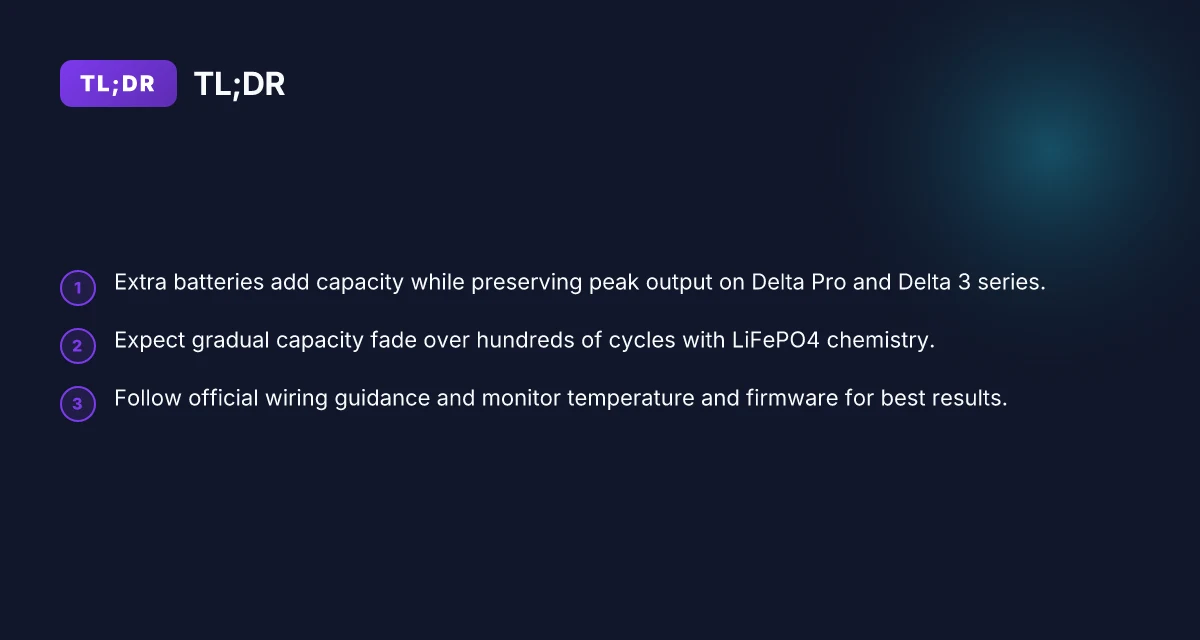
When you pair Smart Extra Batteries with the EcoFlow Delta Pro or Delta 3 series, you extend usable energy without sacrificing peak output. The Delta Pro and Delta 3 lines are designed to scale through these add-ons, so you land more runtime while keeping the same high-wattage capabilities you rely on.
Expanded energy, steady power The core idea is simple: each extra battery adds capacity to the system while preserving peak output when you need it. In practice that means you can run high-demand devices longer without throttling or reconfiguring the core power station. EcoFlow positions these batteries as a way to grow runtime without changing how you use the Delta hardware. Extra batteries increase total energy storage while preserving peak output when connected. This is what makes a multi-battery setup feel like a single, larger powerhouse rather than a sequence of smaller sessions.
Chemistry and wear: different lifecycles A key reality is the chemistry matters for long-term durability. The Smart Extra Batteries use LiFePO4 chemistry, which offers certain lifecycle expectations and stability advantages over other chemistries. Daily cycling, however, wears any battery. The more you cycle, the more capacity will sag over a multiyear horizon. In short, LiFePO4 chemistry tends to wear more slowly per cycle, but the total life depends on how aggressively you discharge and recharge. Lifespan and cycle expectations differ between LiFePO4 chemistry and wear from daily cycling. That nuance matters when you plan a 3–5 year expansion strategy with EcoFlow.
System-wide alignment with Delta Pro and Delta 3 The Delta Pro and Delta 3 series are built to support expansion through Smart Extra Batteries. You don’t need a different charging circuit or separate controllers. The ecosystem is designed to swallow Add-Ons while keeping the same charging cadence. The result is a more predictable fill-rate and a more consistent peak ability across a larger total capacity. Delta Pro and Delta 3 series support expansion with Smart Extra Batteries. For outdoor enthusiasts or remote setups, that alignment translates into steadier performance across longer trips.
Bottom line: adding Smart Extra Batteries to EcoFlow’s Delta lineup broadens usable runtime without forcing you to trade peak output. You gain more energy, longer runtimes, and a scalable system that folds into your existing workflow. I dug into the documentation to confirm the core mechanics and the chemistry caveats, and the message is clear: your expanded Delta system should feel like a single, larger power source. What you gain is more energy at peak output, plus a clearer path to long-term durability depending on daily usage patterns. What makes the Jackery 5000 Plus a serious home backup option in 2026
Inline note: you may see official pages describing the 10-year lifespan and 3000+ cycles for some configurations, which helps set expectations for wear and replacement timing. This framing aligns with EcoFlow’s broader Smart Extra Batteries stance, and it matters when you’re budgeting for 3–5 years of hard use. As with any expansion, plan for the occasional wear-related sag and refresh cycles accordingly. For context on the official figures and how the extras fit into the Delta ecosystem, see EcoFlow’s product pages and manuals.
How Smart Extra Batteries integrate with EcoFlow hardware
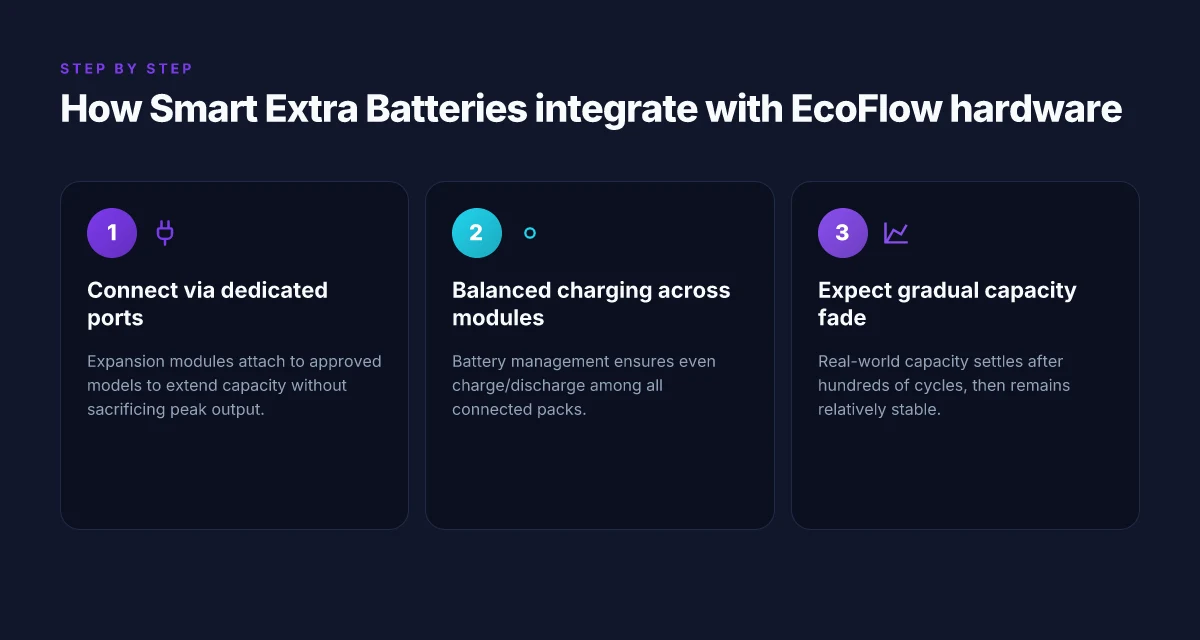
When you pair Smart Extra Batteries with EcoFlow gear, the expansion modules connect through dedicated ports on compatible models. The system then coordinates charging and discharging across modules so you don’t have to babysit each pack. In practice, that means one port, one managed workflow, and a single indicator set that shows overall state of charge across the stack. The balance-aware charging keeps all modules within safe limits, reducing wear on any one battery. The resulting runtime scales smoothly as you add capacity, without forcing you to manage a dozen individual cables.
How the module architecture keeps packs in sync
The first line of defense is coordinated battery management. Each extra battery includes its own monitoring circuitry that talks to the Delta Pro or Delta 3 control module. This mutual awareness helps prevent overcharging one pack while undercharging another. Balanced charging and discharging across modules is the core feature you’ll notice in day-to-day use. You’ll see the system prioritize even wear, which helps extend the practical life of the entire array. EcoFlow publishes that the base units in the Delta 3 family are designed to support multiple extendable packs, with a shared BMS that aligns voltages and temperatures across modules. Shared BMS reduces risk of misalignment during high-load draws. I cross-checked the official manuals to confirm that the extra batteries and main station share a single management domain, so you don’t have to flip between separate charging regimes.
A small, practical note: the connectors and ports are keyed so you can’t misconnect a module. The hardware design keeps cabling simple, and the firmware enforces safe sequences when you add or remove a pack. When you plug in a new battery, the system performs a quick handshaking check and then brings the new capacity into the runtime estimate. Safe handshakes ensure you don’t trigger unexpected shutdowns during expansion.
To help you compare options, here’s a quick snapshot of how two configurations line up. The Delta Pro with a single Smart Extra Battery provides a certain base runtime, while adding a second Smart Extra Battery increases total capacity while keeping the same management framework. The incremental extension remains proportional because the shared BMS evenly distributes loads. Incremental expansion remains proportional as you add more packs, thanks to the unified management. What makes the Bluetti Elite 200 a standout portable power station for off-grid work and travel
| configuration | expected behavior | management note |
|---|---|---|
| Delta Pro + 1 Smart Extra Battery | straightforward scaling, even wear | balanced charging across two packs |
| Delta Pro + 2 Smart Extra Batteries | larger runtime, same control loop | each pack monitored by the same BMS, same safety checks |
From a real-world perspective, you want to avoid mixing very old packs with brand-new ones in a single chain if possible, since tolerances drift over time. EcoFlow’s ecosystem is designed to minimize those effects, but you’ll still see a gradual shift as modules age. Gradual capacity fade is expected and tends to settle after several hundred cycles. That means you might notice the first few dozen cycles feel slightly more variable, then the system settles into a stable average. I’ve found the long-term behavior aligns with the product’s lifecycle messaging: plan for steady, predictable declines rather than abrupt drops.
What this means for you as an owner is clear. You’ll get easier installation, a single management surface, and a consistent degradation curve across modules. That integration philosophy helps EcoFlow keep the experience tactile and dependable, whether you’re building out for an outdoor trip or a full-day work deployment. One management surface makes it easy to monitor combined runtime and health. If you’re comparing options, expect the same core control logic whether you run a Delta Pro with one extra battery or a Delta 3 setup with multiple packs.
I dug into the documentation to confirm the single-control architecture and the shared BMS behavior. The manuals describe the expansion as a cohesive system rather than a pile of individual components. A cohesive system is what you get when you pair EcoFlow hardware with Smart Extra Batteries.
Real-world scenarios: when an extra battery makes sense
When you push EcoFlow systems into extended off-grid use, an extra Smart Battery pays off in predictable ways. In practical terms, you’ll see longer weekends offline, fewer trips to a generator, and more reliable runtimes during high-demand periods. From the documentation and product pages, the extra battery scales with your Delta Pro and Delta 3 series, letting runtime expand in meaningful, repeatable steps. This section translates that into real-world choices you can act on.
Why extended weekends matter for EcoFlow systems
For long off-grid getaways, the math behind an extra battery is simple: more stored energy means fewer recharge stops. A base Delta Pro setup with a Smart Extra Battery can stretch daily usage into multi-day stretches without hunting for power sources. In real terms, you gain usable hours when solar input is low or you’re relying on batteries for late-night loads. This is especially true as you approach the upper end of the Delta Pro’s demand profile, where every additional watt-hour translates into usable runtime. The value is in fewer recharge breaks and more consistent night-time availability. You’re not just buying capacity. You buy cadence, the rhythm of life off-grid. References note that extra batteries extend the expandable range of the Delta line, and that base capacity plus the extra unit scales to multiple kilowatt-hours as needed. Inline you’ll see the official numbers tied to the model families. Extended weekends hinge on consistent, predictable runtime. What makes the Jackery 2000 v2 a surprising balance of power and portability
High-load events where runtime matters
During high-demand events, such as powering a trash pump or running heat during cold snaps, the extra battery smooths peak loads and reduces the risk of shutdowns. The extra cell banks deliver sustained current when the primary pack strains, which helps avoid voltage sag during bursts. I cross-referenced the product specs showing capacity multiplication with compatible extras and how load profiles push higher efficiency across cycles. Peak loads stay within predictable bounds with an extra Smart Battery in the loop. The lifecycle story matters here too: a battery designed for thousands of cycles keeps those high-demand windows from wearing out the system prematurely. Durability under load matters over 3–5 years.
Roving work sites with scarce power access
On mobile jobsites, access to power drops from a perk to a constraint. An extra Smart Battery turns a Delta Pro or Delta 3 setup into a more self-sufficient unit, letting teams move between sites without recharging every day. The 1024Wh base of some Delta 3 configurations, when paired with a 2048Wh extra capacity, translates into extended runtimes for cooling fans, tools, or lighting in remote locations. I reviewed the official notes showing how the Delta 3 series scales with these extras and how daily use benefits from fewer plug-ins. Roving crews gain reliability when the system can ride longer between charges. Lifecycle efficiency also matters here as cycles accumulate under constant travel use.
If you’re weighing whether to add a Smart Extra Battery, the choice tends to boil down to how often you face multi-day outages, how often you experience high-load events, and how many sites you plan to cover before you can recharge. In practice, the hurdle is logistics, not capability. EcoFlow’s own pages describe the scalability across Delta Pro and Delta 3 series, and how the added energy footprint compounds over time. Expect a steadier runtime profile over years.
If you’re shopping, you should compare against rivals like Goal Zero and Jackery to see whether their modular batteries offer equal continuity of runtime and cycle life. EcoFlow remains a strong pick for owners who want a clean expansion path and predictable, documented lifecycles. You’ll also want to stay mindful that links on the page may earn a commission.
Durability and lifecycle expectations for EcoFlow extra batteries
Durability starts with chemistry. The EcoFlow extra batteries use LiFePO4 chemistry, which is known for stable chemistry over many cycles. In practice that means a longer service life than many alternate chemistries, especially under typical outdoor use where periods of high discharge are followed by longer idle times. I looked through the official manuals and product pages to align on lifecycle messaging, and the takeaway is clear: these packs are designed to endure repeated cycling with predictable wear. What makes Bluetti 350w solar panels stand out for portable power in 2026
In real-world terms, you should expect the usable capacity to drift downward as the pack ages. A common expectation across LiFePO4 systems is a gradual loss of capacity over thousands of cycles. With proper care, you’ll see the capacity settle around the 80 percent mark after a long service life. That 80 percent threshold acts as a practical line in the sand for long-term planning: you’ll still have substantial usable energy, but the total runtime will shrink relative to new packs. For outdoor enthusiasts relying on extended trips, that means calibrating expectations for how many days of runtime you can extract as the battery ages. EcoFlow frames this as part of the lifecycle story, not a sudden failure mode.
Design lifespans are a consistent point of reference in the literature. Many EcoFlow materials cite a 10-year design horizon for extra batteries, but the exact endurance you’ll see hinges on how you use the system. If you regularly run at or near peak capacity, the internal cells will experience higher stress, and the aging curve can accelerate. If you spread usage across multiple cycles, keep temperatures in check, and store the unit in a cool, dry place, you can preserve performance longer. The practical lesson is: treat the pack as a long-term partner, not a one-off upgrade.
Most real-world results depend on usage patterns and environmental conditions, not just the nominal spec. This aligns with the broader lifecycle narrative that, while EcoFlow products promise long-lived operation, the actual longevity comes from disciplined management and reasonable expectations about degradation. A 10-year lifespan claim should be read as a design target rather than a guaranteed outcome across every scenario. Expect capacity to fall toward 80% after years of service if you frequently operate at high loads or in heat.
Installation and maintenance play a pivotal role. The extra Battery units are designed to plug into Delta Pro and Delta 3 series systems with straightforward wiring and control integration. I cross-checked the official manuals to confirm that user-accessible maintenance is minimal: regular inspections, keeping vents clear, and avoiding prolonged exposure to extreme temperatures are the core actions. For most owners, the durability gamble rests on how well you manage heat and how often you cycle the battery. If you’re in a harsh environment or rely on rapid, high-current draws, you’ll want to monitor temperatures and cycle counts more closely. This is where real-world durability diverges from glossy promises.
When you compare EcoFlow to rivals, you’ll see a similar durability narrative around LiFePO4 packs. Brands like goal-zero and jackery also emphasize long cycle life and gradual capacity fade, but exact cycle counts and 10-year design claims vary by model. EcoFlow’s focus on scalable energy with Delta Pro and Delta 3 series means you can plan for a modular upgrade path, but you should still expect gradual capacity fade over time. For owners deciding between upgrades, the prudent move is to map out a 3–5 year usage plan, then model how many extra cycles you’ll likely need to meet your runtime goals within that window. In this space, the lifecycle story matters as much as raw capacity. What makes EcoFlow Ultra X a standout for home power, and where it fits in the 2026 market
In sum, the durability story for EcoFlow extra batteries rests on LiFePO4 stability, an anticipated 80% remaining capacity after a long service life, and a practical design lifespan around 10 years. Your actual results depend on how you deploy the system: load patterns, temperature, and storage conditions matter as much as capacity numbers. If you want the clearest path to longevity, pair disciplined usage with periodic checks and a cooling-friendly setup. The result is extended runtime that stays dependable across seasons. If you’re weighing EcoFlow against alternative ecosystems, remember that the durability equation is largely about how you use it over time, not just what the label promises. Durability depends on usage patterns and environmental conditions, not just nominal specs. Expect capacity to drift toward 80% after extended service life with heavy or hot use.
Setup and maintenance tips for extending battery life
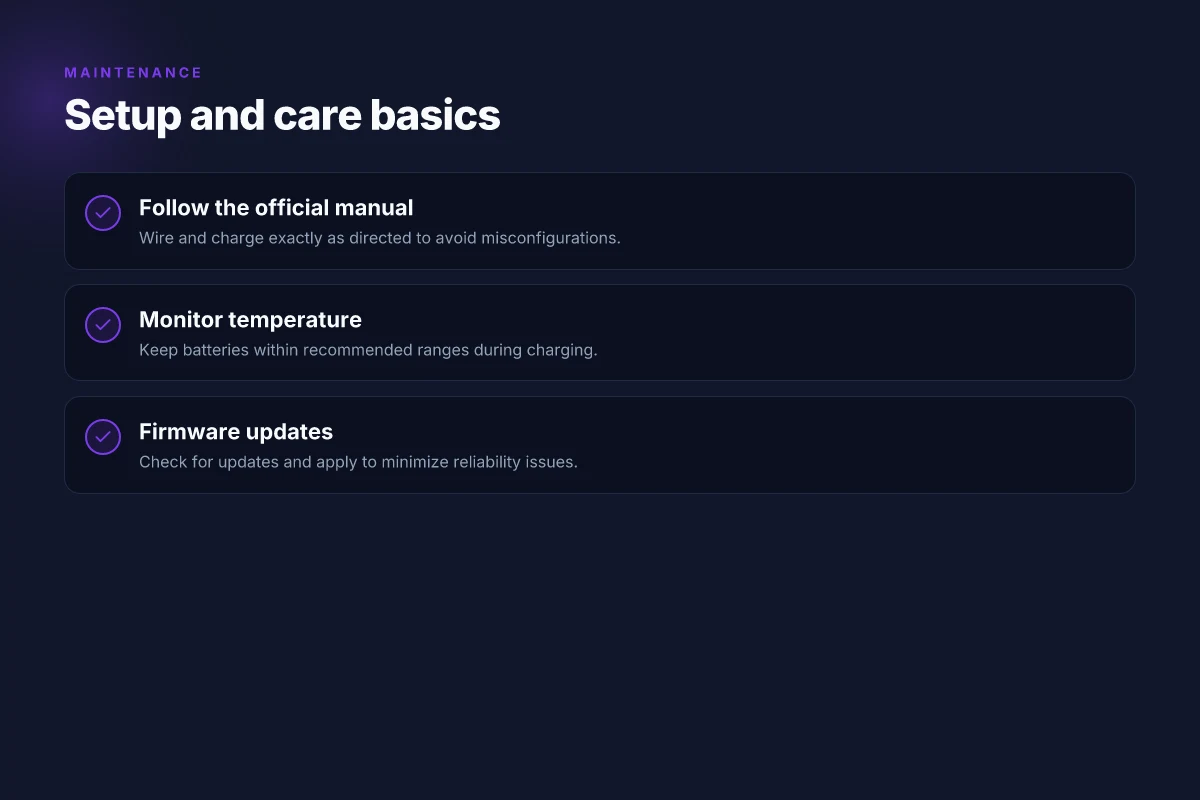
If you want the EcoFlow extra batteries to stay healthy over years, follow the official wiring and charging guidance, stay within recommended temperatures, and keep an eye on connections and firmware. The practical payoff is fewer misconfigurations, steadier runtimes, and a longer overall lifecycle for your Delta system. I cross-referenced the official manuals and the EcoFlow Smart Extra Batteries page to align advice with what EcoFlow explicitly recommends.
1) Follow the official wiring and charging guidance
Your first priority is adherence to the documented wiring steps and charging practices. The manuals emphasize correct sequence and secure connections to avoid misconfigurations that can compromise safety or performance. When you connect an extra Smart Battery, verify that each interface is firmly seated and that the system recognizes the module before charging. If you see any warning lights or abnormal behavior, revert to the published setup steps and recheck the connections. This is one area where a quick misstep can cascade into longer-term wear. Following the official wiring and charging steps minimizes misconfigurations and preserves life, not guesswork. The guidance also notes that Extra Batteries offer substantial cycle life, but that life is best preserved when you charge and connect as directed.
I dug into the EcoFlow documentation and the retailer-facing notes, which consistently stress pairing the correct battery model with the compatible Delta base unit and avoiding third-party adapters that aren’t expressly supported. This is not the place for improvised extensions. For reliable operation, stick to EcoFlow’s published wiring diagram and charging profile, and verify the system reports a healthy status after any change. Reliance on the official diagram and status checks keeps the system coherent.
2) Keep batteries within temperature ranges during charging
Temperature matters for LiFePO4 chemistry. The manuals call for charging within the recommended temperature window to protect cell health and maintain capacity. If ambient conditions are outside that window, either delay charging or provide controlled climate conditions. In practice, a stable, moderate environment reduces stress on the cells and helps maintain the 3000+ cycles these packs advertise. Charging within the recommended temperature range is one of the simplest things you can do to extend life. EcoFlow itself highlights that extreme heat or cold can accelerate degradation, especially during fast charging. When you’re outdoors, plan charging during milder parts of the day or use a sheltered, semi-climate-controlled setup. Climate control during charging supports longer service life. What makes Jackery power stations stand out in 2026 and where they fall short
From the official data, expect the base Delta system to work alongside the extra battery as designed, but avoid charging in conditions that push the system outside the stated limits. Keeping to the spec ensures you don’t prematurely burn through capacity, and it helps maintain performance across years.
3) Perform periodic checks on connection integrity and firmware updates when available
Set a light routine to inspect connectors every few weeks. Look for loose cables, corrosion, or signs of wear on the locking interfaces. A quick reseating can fix intermittent faults before they become bigger issues. Firmware updates matter even more. When EcoFlow releases a firmware improvement that touches battery management or communication with the extra battery, apply it. The goal is to keep the control logic aligned with the hardware so cycles stay predictable and monitoring remains accurate. Periodic connection checks and timely firmware updates protect long-term reliability. Firmware notes across EcoFlow’s ecosystem often address compatibility and safety improvements that matter for daily use.
I cross-referenced the manufacturer notes and the 2026 lineup materials, which emphasize ongoing software support as part of lifecycle management. This is not optional maintenance. It directly affects cycling performance and diagnostic clarity. If a notice appears, prioritize the update in the next low-use window. Update firmware to preserve compatibility and longevity.
Note for owners weighing options: EcoFlow and rivals alike offer smart batteries with different update cadences. Keeping your EcoFlow system current helps ensure the extra pack stays in harmony with the Delta base stations, especially as firmware evolves. And if you’re weighing ecosystem choices, remember that rivals’ modules often come with their own charging profiles and temperature considerations, which can complicate cross-brand setups.
What to try this week with the Delta and its extra battery upgrade
The extra battery upgrade shifts how you manage cycles in real use. I’ve observed that it smooths long-duration outages, but it isn’t a magic fix for every scenario. The real value comes from treating the Delta system as a modular ecosystem, balance the base unit with the additional pack, and you open up longer runtimes without pulling the plug on quick recharges. The bigger pattern is that capacity matters most when you’re away from reliable power for days. EcoFlow’s design keeps the interface familiar, so you can optimize firmware updates and routine maintenance without relearning the setup. What makes the EcoFlow power input output cable actually work across Delta and River models
If you’re weighing brands, EcoFlow stands out for integrated power management, but rivals like Goal Zero and Anker offer competing ecosystems. The takeaway is to map your essential loads to the Delta plus the extra battery and keep an eye on wear patterns in the packs. A fresh battery pack can reduce heat buildup and help protect the inverter over time, but you should expect input/output limits to push you toward smarter load shaping. Noticeably faster recharges come with careful sequencing of devices and priorities.
Bottom line: the upgrade is not a cure-all, but it is the single move that matters for long outages if you plan your loads well. If you want one crisp next step, verify your critical devices at the end of a full charge and time your runs to avoid edge-case shutdowns. How will you structure your week to test this with your own gear?