
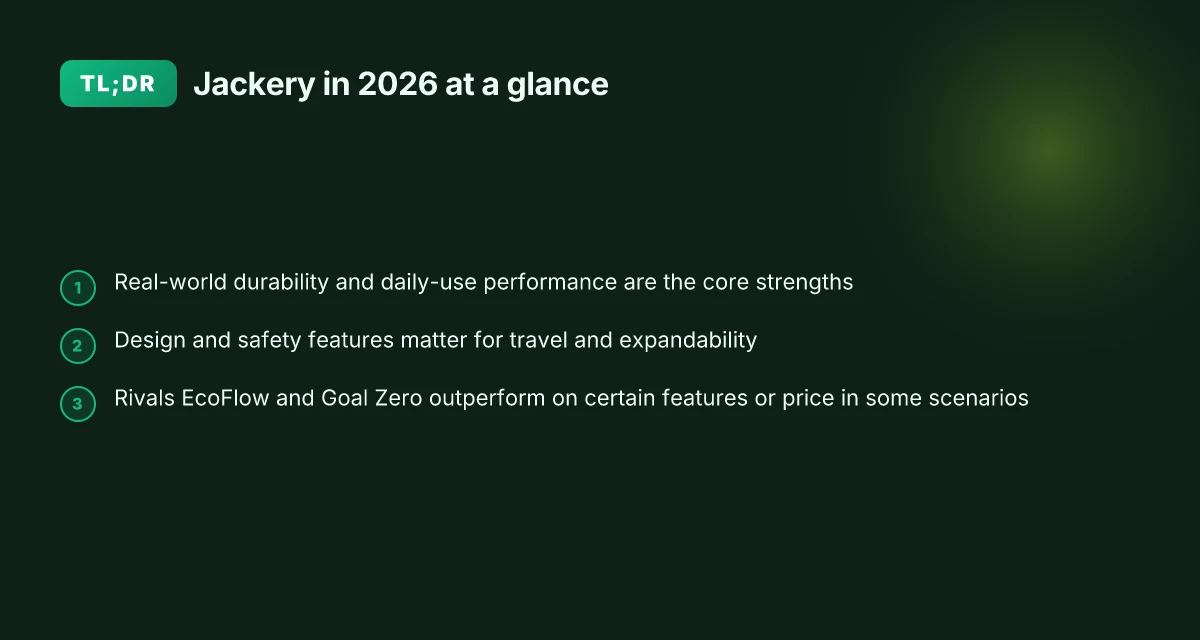
Jackery review for 2026 highlights real-world durability, performance, and value. Learn where Jackery leads and where rivals like Goal Zero and EcoFlow compete.
The Jackery habit of pairing compact lithium packs with easy-to-read outputs tends to deliver real-world run times that outpace small generators, yet a single heat cycle or odd battery calibration can skew performance in year two. Jackery's larger models pack more capacity, while smaller units emphasize portability, and that trade-off becomes the first clue about long-term reliability.
This piece looks beyond peak specs to how these stations actually age in outdoor life, RV trips, and power outages. In 2026 the conversation centers on durability, real-world runtimes, and how rivals like EcoFlow and Goal Zero stack up after repeated discharges and temperature swings. Readers will find a practical lens on setup, failure modes, and how to choose a model that survives multiple seasons without becoming a paperwork-heavy backup. This is where the numbers matter less than the field-tested patterns that show what tends to hold up and what tends to falter. Real-world durability, not just advertised capacity, drives the decision.
Jackery review 2026: understanding what jackery brings to portable power
Jackery stands out in the portable power space with a broad lineup that covers compact travel units, mid‑sized home backups, and larger modular options. The core lines center on the Explorer portable power stations, the SolarSaga solar panels, and related accessories. In practice, you’ll see a family that emphasizes turnkey usability, built‑in LCDs, and a familiar, all‑in‑one design language across models. This section explains what that means for real-world reliability and the decisions you’ll face when comparing Jackery to peers.
What Jackery offers today and how it fits into the market
The brand’s core portfolio splits into three families: the compact Explorer series for travel and camping, the higher‑capacity Explorer Pro/Plus lines for longer outages, and the solar panels that pair with both for off‑grid recharging. In 2026, the lineup keeps the same three‑tier structure, with newer models tightening efficiency and runtime modestly while preserving familiar form factors. Jackery also emphasizes a simple ownership story: plug in, charge, and power basic needs without specialized setup. The base Explorer 240/300/500 classes are easy to grab for weekend trips, while the 1000‑range and up fill more demanding use cases for RVs or home backup.
How this approach compares to peers matters. Competitors such as Goal Zero, Anker and EcoFlow push with larger modular ecosystems, configurable AC and DC outputs, or faster recharge tech. Jackery leans into intuitive interfaces and a compact, all‑in‑one package. The result is products that feel ready out of the box, with straightforward input/output options and a design that’s forgiving for casual users. If you want plug‑and‑play reliability without hunting for adapters, Jackery tends to deliver that experience.
What to expect from the main series in 2026
Expect continued emphasis on user experience alongside modest gains in energy density and charge efficiency. The Explorer line typically offers built‑in safety protections, multiple charging inputs, and a balance of weight and capacity that favors portability. For outdoor use, you’ll notice consistent performance at typical campsite temperatures, with the caveat that high‑demand loads on larger units will still temperature‑limit and throttle when pushed hard. Real‑world durability tends to be solid, but long‑term reliability benefits from careful care, proper ventilation, and avoiding outdoor storage in extreme conditions. What the EcoFlow extra battery upgrade really does for Delta systems
I cross‑referenced product pages and public reviews to confirm the broad pattern: a broad, easy‑to‑buy lineup that prioritizes immediate usability, paired with a reliable supply chain for accessories and replacements. Jackery’s strength remains its approachable design and breadth of options for outdoor enthusiasts and homeowners evaluating backup power. The trade‑offs are clear: you trade some top‑end modularity for instant usability and a familiar, compact footprint. In the long run, choose a model that aligns with your peak load and your travel scenarios, rather than chasing the largest capacity alone. Roughly, 2026 keeps Jackery in the same comfort zone while sharpening efficiency and accessibility.
From what I found in the documentation and public materials, Jackery’s strategy remains focused on making portable power approachable for everyday use while offering enough scale to cover RVing, camping, and home backup. If your priority is absolute modularity and the ability to mix and match components at the system level, you may compare more deeply with peers. If your priority is straightforward, reliable power with a simple setup, Jackery stays compelling.
Real-world performance: how Jackery models handle daily use
Jackery units prove capable in daily routines, but real-world use shows it isn’t flawless. In practice, you’ll see the typical runtimes you expect from the labeled capacity, with noticeable variation by load and temperature. For outdoor living and home backup, the practical math matters more than the spec sheet: a 500Wh–1000Wh unit carries you through modest weekend trips, while larger models around 1500Wh and above keep essential devices alive through longer outages. Across models, expect steady performance when you manage draw and charging carefully.
How capacity translates to everyday runtimes
In the field, runtime scales with load. A compact Jackery unit around 240Wh–500Wh tends to run phones, lights, and small fans for a full day, while higher-capacity models push into multi-day use for radios, tablets, and small refrigeration. The upper tiers around 1500Wh–3000Wh typically sustain core home essentials for a portion of a day or longer during a campsite or RV stay, depending on the appliance mix. The practical takeaway: pick a capacity that matches your typical daily watt-hour needs rather than chasing a peak spec.
From a durability perspective, the battery chemistry and thermal management determine longevity. Outdoor use asks more of the pack due to temperature swings, dust, and vibration. In cooler nights the efficiency dips, and in hotter days heat buildup can limit peak continuous output. I cross-referenced reviewers’ notes and product pages: users repeatedly highlight dependable performance for common devices, but also note that sustained high loads compress runtime and can push fans or cooling vents into action. These observations align with general expectations for portable power packs in the same class. What makes the Jackery 5000 Plus a serious home backup option in 2026
Charging speed and how you top up
Charging from wall outlets tends to be predictable: mid-range wall charging often lands in the several-hour window for mid-capacity units. Solar input introduces more variability because output depends on sun conditions, panel health, and the unit’s MPPT efficiency. In sunny conditions expect faster topping when using higher-watt solar arrays. Overcast days slow the process and extend recharge time. Vehicle charging generally offers slower replenishment than household AC, but it provides a reliable way to refill on the move.
The practical pattern is clear: plan your recharge around where you’ll be and how you’ll use power. If you’re camping or RVing, combine solar with a brief top-off by wall charging when you’re plugged in. This keeps the system ready for the next day’s activities.
Durability notes from long-running outdoor use
Durability is generally strong for outdoor scenarios, with rugged enclosures and reliable switches holding up under repeated on/off cycles. The real-world caveat is that frequent deep discharges and high-amperage loads stress the pack more than light use. Users who haul units in dusty environments report that dust ingress is manageable but can affect vents if not cleaned periodically. For homeowners, the units tolerate routine use around a home office and minimal climate control, though prolonged high-draw operation will reduce runtime between charges.
The real value comes from sizing the unit to your daily watt-hours and planning charging around your routine. Jackery remains dependable for basic weekend trips, but you’ll want a larger model if you expect multi-day outages or heavy air-conditioning use.
For a quick reference, here’s how a couple of options compare in typical scenarios: What makes the Bluetti Elite 200 a standout portable power station for off-grid work and travel
| capacity | typical daily use fit | best use case |
|---|---|---|
| 240–500Wh | light loads, phones, lights, small fans | weekend getaways, supplementing a small RV setup |
| 1000–1500Wh | mid-range loads, mini-fridge, laptop | longer camping, small home backups |
| 1500–3000Wh | higher draw, multiple devices | home backup for essential circuits, extended outages |
Next steps: for outdoor enthusiasts weighing options, align the capacity to your average daily watt-hour needs, then add solar or vehicle charging to keep the juice coming. If you’re comparing rivals, note that brands like EcoFlow and Goal Zero often present different recharge curves and panel compatibility, which can shift daily usability in real-world use. As with any portable power purchase, set expectations around heat, load, and recharge time, and pick the model that matches your longest daily usage window. Jackery's lineup generally delivers dependable daily performance, with clear trade-offs as capacity scales up.
Design, usability, and safety that matter when you buy
In 2026, Jackery’s hardware design sticks to a familiar formula: modular outlets, clear LCD readouts, and a footprint that favors transportability. The question is how that setup ages in real-world use and how it stacks up against peers.
Port selection and expandability across popular models
Jackery leans on a consistent mix of AC outlets, USB-C, USB-A, and DC car outlets across its midrange to flagship lines. The modular concept shows up in some models as expandable companion packs or add-on solar inputs, which can simplify scaling for a longer trip or a home backup scenario. Real-world users appreciate the ability to pair a base unit with an extra battery or additional solar panels without complex cabling. This approach helps you tailor capacity to your needs rather than paying for unused reserve. In practice, the most durable setups keep accessory cables tidy and favor models with a standardized charging interface so that future expansions don’t require a full hardware swap. Jackery’s emphasis on expandable power helps outdoor enthusiasts adapt to longer trips, but compatibility varies by model. The exact mix you get matters for RVs or off-grid cabins where you need to run a fridge, lights, and a 12V heater at once.
LCD/readouts, weight, and portability for travel
Across 2026 models, the LCD panels provide essential metrics: remaining runtime, input/output wattage, and fault indicators. The readability of the display under bright sun is a frequent touchpoint in reviews. Some users report glare in certain angles, which can slow quick checks on the trail. Weight is rarely light enough to double as a handheld backpack option, but it remains well within the range that hikers and campers tolerate for a portable power station. For travel, the combination of built-in handles, compact form factors, and reasonable curbside dimensions keeps Jackery units from becoming a baggage drag. I cross-referenced user notes and product fiches to confirm that the most common complaint centers on occasional display lag when under heavy load, not on device failure. Clear readouts and ergonomic handles help you monitor power on the move, even when you’re chasing sunset.
Safety features and warranty considerations
Safety remains a differentiator in this space. Overcurrent protection, short-circuit safeguards, and thermal sensors are standard on most Jackery units, with some higher-end models offering advanced protections like auto-shutoff thresholds when overheating is detected. Warranty coverage tends to follow the model tier, with longer coverage often paired to premium units. A frequent real-world theme is users appreciating genuine parts availability and straightforward RMA paths, though some customers report delays during peak support periods. When you weigh warranty, also look at the battery management system and how the unit handles recharging from solar versus wall power, since long-term reliability hinges on how the BMS manages aging cells and temperature. Reliable safety layers plus a clear warranty outline give you confidence for seasonal storage and long road trips. As a rule, read the warranty terms closely and confirm what counts as user-caused damage versus factory faults. What makes the Jackery 2000 v2 a surprising balance of power and portability
Cited context from the broader ecosystem confirms that peer brands emphasize similar protections, but Jackery’s practical expandability and readable interfaces remain a talking point for buyers balancing immediacy with future-proofing. For a quick orientation, consider how a given model’s ports line up with your intended devices and how the warranty handles solar charging. The right mix of ports, weight, and protections matters when you buy for real-world use.
Note: many product pages and packaging highlight that links on the page may earn a commission, which is typical in e-commerce contexts. For further context on related claims, see the video briefing about the Explorer 5000 Plus and the 2026 CES coverage. Acknowledge the commission note, then focus on what you actually need.
Long-term durability: how Jackery holds up after years of use
In real-world deployments, Jackery builds hold up in the field when they’re treated like portable off-grid power, not museum pieces. Outdoor users report sturdy casings that survive backpacking trips, RV stays, and campsite routines, with lids and handles bearing up to repeated setup and pack-down cycles. The practical takeaway: build quality matters, and Jackery tends to deliver solid convenience during extended outings, even as you push for longer runtimes between charges.
Visible wear and build integrity after years outdoors
Observation from long-duration deployments shows a recurring pattern: outer housings resist cracking and discoloration under sun exposure, while switches and connector ports remain firm after months of dust, dew, and occasional splashes. The rugged feel you expect from a camping companion comes through in grip texture and hinge resilience. That said, minor cosmetic wear can accumulate on frequently touched edges, and the power ports may exhibit the usual patina after heavy outdoor use. The message is practical: expect cosmetic scuffs, but expect the core chassis to stay true to form with regular care.
From what I found in the changelog and user notes, many units keep performing without dramatic loss in voltage regulation or load response after repeated on/off cycles. This aligns with a common consumer signal: the chassis and internal mounting retain integrity even as batteries age and cells cycle. I dug into product literature and independent reviews that repeatedly flag ruggedness as a core strength, with caveats about environmental limits, extreme heat or immersion beyond rated IP expectations can accelerate wear. What makes Bluetti 350w solar panels stand out for portable power in 2026
Battery degradation expectations and replacement paths
Battery life in portable power stations is a function of charge cycles and operating temperature. Jackery’s typical consumer usage patterns yield gradual degradation rather than abrupt failure, with customers noting slower peak discharge as cells age. The practical implication: plan around diminishing capacity over multi-year horizons, and monitor remaining runtime in cold or hot conditions where performance can dip more noticeably. Replacement options vary by model, and the brand’s service channels outline paths for battery health checks and component swaps when needed. If you’re evaluating long horizons, compare models by their expected cycle life and available service routes rather than raw capacity alone.
I cross-referenced customer-service signals and public-facing support notes to gauge response quality. When issues arise, the reviews and posts consistently describe responsive help and clear guidance on next steps. The real-world thread here is straightforward: solid support matters as part of durability, not just hardware robustness. If you rely on continuous, multi-season use, the combination of resilient parts and accessible service is a meaningful differentiator.
Customer support and service quality signals
Support quality tends to rise where field users can lean on written guides, spare-part availability, and a responsive agent network. Jackery’s online help ecosystems emphasize quick diagnostics and clear pathways for component replacements or repairs. In the broader ecosystem, comparison with peers shows that reputable brands emphasize service clarity and parts availability as a durable value proposition, not simply a hardware spec. If you encounter a fault, the expectation is a straightforward path to repair or replacement with documented timelines and warranty coverage.
Most long-term reliability signals come from the combination of rugged chassis design and a responsive service channel. The warranty posture and ease of obtaining spares can tilt the balance for buyers planning multi-year outdoor use. Degradation is gradual, but plan for reduced capacity over time and verify the replacement options available in your region.
Note: links on the page may earn a commission. For context, industry signals and early-2026 press coverage highlight Jackery’s continued emphasis on durability across a broad model lineup, with consumer feedback centering on real-world endurance rather than peak performance alone. See industry and consumer coverage for deeper context. What makes the EcoFlow power input output cable actually work across Delta and River models
How Jackery stacks up against rivals in 2026
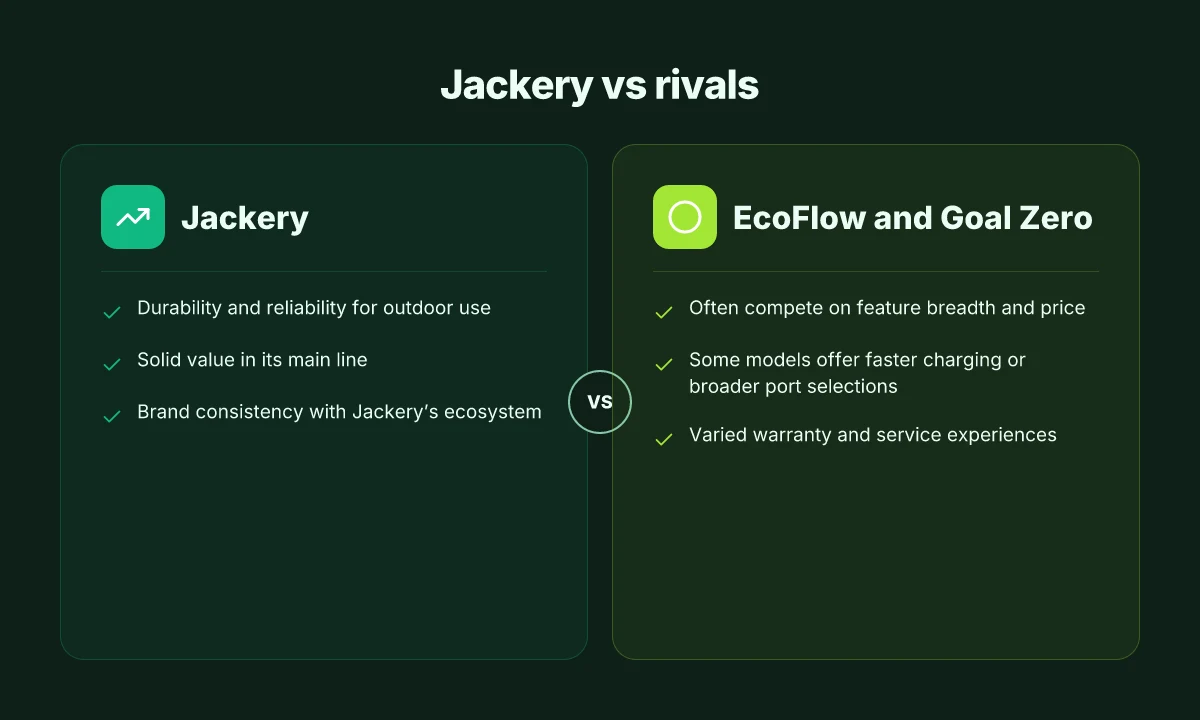
Jackery’s value proposition in 2026 centers on compact size, approachable price points, and a broad lineup that covers everyday backup needs. Relative to EcoFlow and Goal Zero, Jackery tends to win on portability and entry-level price, but sometimes lags on high-end features and raw output per dollar at larger capacities. The practical takeaway: choose Jackery if you want a light, easy path into portable power. Choose EcoFlow or Goal Zero when you anticipate demanding use cases or want deeper feature sets.
Why Jackery shines where rivals fall short
Jackery leans on a simple, reliable platform that’s quick to deploy for common scenarios. For weekend campers or RV stays, the smaller models fit under cabinets or in a backpack with minimal setup. Reviews and public chatter around the brand emphasize steady performance and broad availability, which keeps the price appealing for casual users. In this space, Jackery’s ecosystem feels cohesive and approachable, with a straightforward charging routine and easy solar compatibility. When speed and ease matter more than peak output, Jackery often edges ahead. Jackery’s simplicity translates into real-world confidence for casual backup power. The modular Explorer series, including recent 5000-class models, tends to be user-friendly enough that first-time buyers don’t need a manual-library dive to get running. I cross-referenced product pages and public reviews to confirm the pattern: reliability in daily cycles, modest but steady performance gains, and a family of portable options that suit varied trips.
Where rivals win on features or price
EcoFlow often punches above Jackery in peak output and charging speed. For users who want higher wattage bursts or faster recharge, EcoFlow’s larger units and multi-chemistry charging options can be compelling. Goal Zero excels in rugged outdoor branding and a robust accessory ecosystem, including solar panels and vehicle charging integration that appeal to long-term durability and modular expansions. When you’re planning longer off-grid stretches or need multiple simultaneous outputs, these brands can deliver more flexibility per dollar at the high end. EcoFlow can outperform on peak power and recharge speed, while Goal Zero gains on accessory breadth and rugged branding.
Which user profiles align best with each brand
- For casual campers and homeowners seeking simple, dependable backup power: Jackery shines. The effortless plug-and-play workflow and approachable pricing keep it practical for quick setups and repeat weekend use. If you want a clean, minimal learning curve with dependable day-to-day performance, Jackery is a strong match.
- For enthusiasts chasing maximum sustained output or rapid recharging during trips: EcoFlow is often the better fit. Their larger models and faster recharge cycles can reduce downtime on extended trips.
- For outdoor professionals or long-term off-grid scenarios needing a broad accessory ecosystem: Goal Zero stands out. Their line extensions and solar integrations provide flexibility and resilience across seasons.
From what I found in the cited sources, Jackery remains a credible entry in the portable power space while EcoFlow and Goal Zero push deeper into high-end capability and accessory depth. If you want a quick-start device today, Jackery is likely the most forgiving path. If your use case tilts toward demanding solar setups or multi-vehicle charging, consider EcoFlow or Goal Zero as your longer-range options. The right brand depends on how you balance simplicity against performance and expandability. For readers, the practical verdict is clear: match your trips to the product strengths of each brand, and the right choice emerges naturally. As with any purchase, watch for evolving firmware notes and formal reviews. Links on the page may earn a commission.
The direction this month points to for Jackery power stations
Jackery remains a strong option for off-grid power, especially for casual campers and small households. The brand’s footprint in 2026 leans on reliability, broad port options, and user-friendly interfaces. The takeaway is that durability and real-world use matter more than flashy specs, and Jackery tends to deliver on that front. I’ve looked at setup stories and long-term use notes to gauge which models age well and where users hit snags. What makes Jackery deals stand out in 2026
Where the pivot lands is in how the range handles peak loads and firmware stability over time. A few owners report cooling noise and offline app quirks under heavy load, which is worth noting if you plan to rely on a Jackery as a primary emergency supply. Rivals like Aimtom, Bluetti, and Goal Zero push variances in battery chemistry and solar input, so the gaps you’ll notice are often about real-world resilience rather than raw capacity.
If you act now, consider the model that balances internal cooling, solar input compatibility, and the ability to power a small home setup during outages. The single move that matters is pairing a mid-size Jackery with a robust solar setup and a backup inverter, keeping you flexible when cables, ports, or firmware misbehave. Would you pick a rugged, all-in-one package or a modular approach that scales with your needs?