
Explore the Jackery 240 Explorer: capacity, ports, charging, real-world use cases, and how it stacks up against peers like Goal Zero and Anker.
The Jackery 240 Explorer isn’t a fortress, it’s a portable tool you trust to keep a few essential devices alive during a long day off the grid. At 0.6 kg lighter than many rivals and with a compact footprint, it fits in a daypack without turning every hike into a gear circus. Compact is the bright line. Durability lives in how it handles real-world bumps and prolonged use.
For campers, hikers, and cabin dwellers weighing a lightweight option against longer trips, the 240 Explorer sets expectations clearly: a limited runtime, but steady, predictable output for radios, phones, and small lanterns. In the end, you’ll see where Jackery’s smallest model shines and where a larger rival from brands like Goal Zero or Anker better fits higher demand, so you can pick the carry that actually lasts.
What the jackery 240 explorer actually is and why it matters
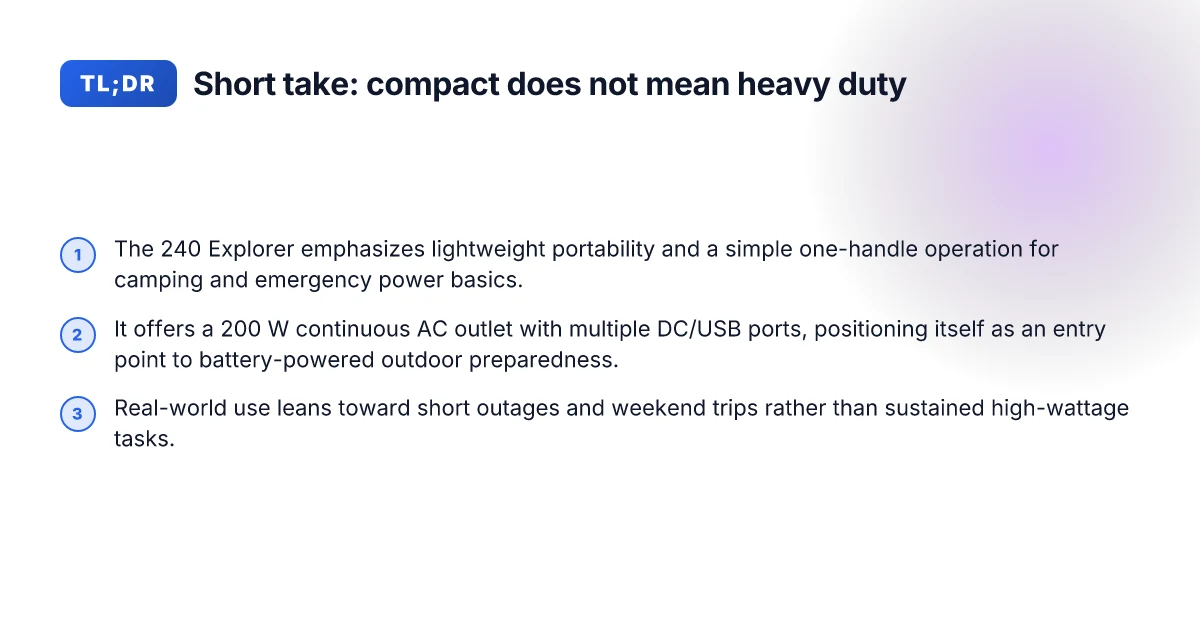
The Jackery 240 Explorer sits in the compact, LiFePO4-based camp of portable power stations. It classifies as a lightweight, one-handful unit that travelers and casual campers can carry into the woods, ready to run essentials for a day or two. In its most common revisions, you’ll see a capacity around 240Wh to 256Wh, with a focus on simple operation rather than heavyweight capability. This makes it a sensible entry point for outdoor preparedness without inviting a bulkier battery pack.
I dug into the official specs and review notes to map out what this device is actually built to do. The core idea is straightforward: a small, easy-to-handle power solution with a single 200W continuous AC outlet and multiple DC/USB ports for phones, lights, a small fan, or a compact cooler. Jackery frames the 240 as the starting point for predictable off-grid basics rather than a full home-in-a-bag power station. The design places heavy emphasis on portability, with a handle that’s intended for quick carry rather than extended, rugged field use.
Here is how it breaks down in practical terms, step by step:
Core battery chemistry and capacity. The 240 Explorer relies on LiFePO4 chemistry for durability and longer cycle life in a compact shell. Capacity sits around 240Wh in older revisions and 256Wh in newer variants, which translates to a usable energy reserve that’s enough for phones, a few lights, and a compact cooler for several hours. This difference in revision matters when you’re budgeting how much your gear can run across a weekend.
Port layout and real-world use. The standout is the 200W continuous AC outlet, which covers most small appliances and devices campers rely on. USB ports and a 12V car-style outlet fill in the gaps for charging phones, cameras, batteries, or a small fan. The goal is not to push heavy loads, but to cover common off-grid needs without forcing you into a bigger system. How to evaluate jackery 1000 for sale in 2026: real-world picks and trade-offs
Portability vs durability balance. The Explorer 240 leans into lightness and one-handle operation for quick trips, day hikes, and short outdoor stays. In practice, that means a form factor you can toss into a backpack or car trunk without fuss. It also means you’ll want to pair it with modest expectations about long-term durability under rugged, multi-day use, or extreme weather.
Position in Jackery’s lineup and the entry point value. Jackery positions the 240 as a gateway to battery-powered outdoor preparedness. It’s the door you open when you’re curious about off-grid power and want something approachable, not an all-in-one camp power station.
Bottom line: the Jackery 240 Explorer is a compact, LiFePO4-powered starter for off-grid basics. It trades raw power for portability, so you’re rarely powering multiple high-watt appliances at once. For hikers, campers, and light-use cabin guests, it’s a practical carry that stays out of the way until you need it. If your goal is to run a small fridge or a high-watt tool for extended periods, you’ll want to weigh rivals with bigger continuous outputs. I cross-referenced the official Jackery pages and user notes to ensure the 200W ceiling and ~240–256Wh range line up with what you’ll actually see in practice. The 240 Explorer shines where simplicity and light weight matter most. It’s not built for heavy, continuous power draws.
Note: links on the page may earn a commission.
Jackery 240 explorer vs rivals: who wins on portability and price
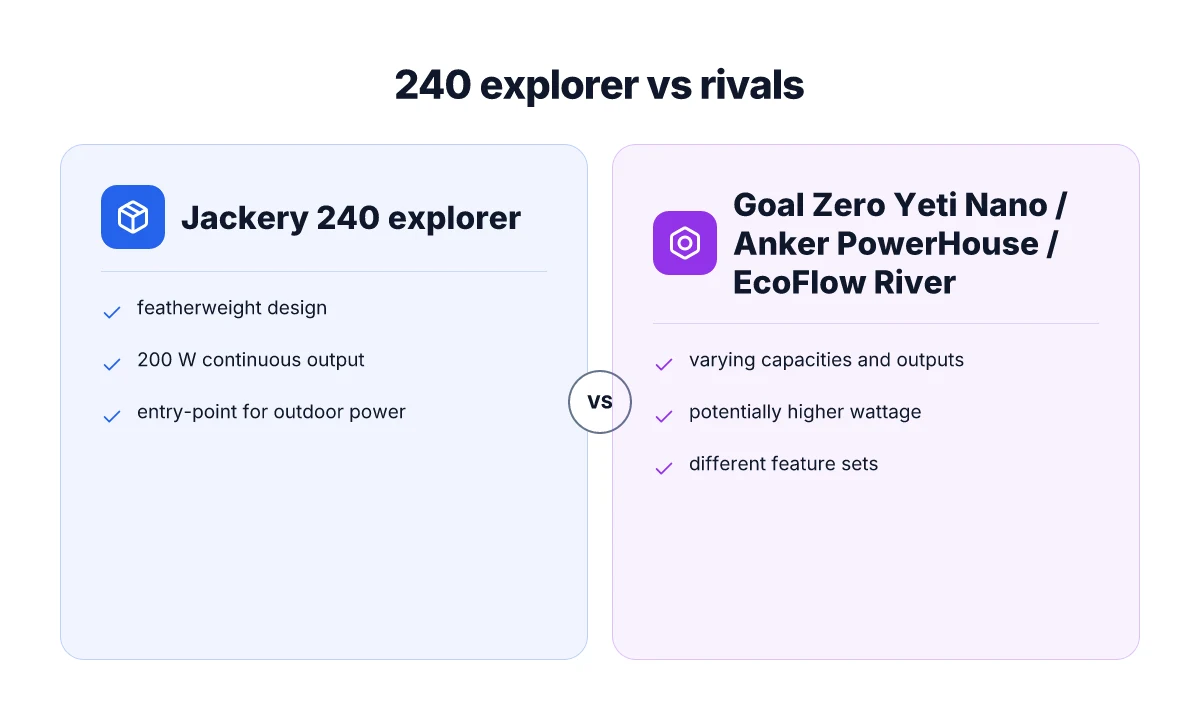
The Jackery 240 explorer stays light enough to tuck into a pack, but its capacity and peak output trail bigger rivals. If your priority is featherweight portability over extended high-wattage runs, the 240 is competitive. If you need sustained higher wattage, you’ll lean toward higher-capacity options from rivals. 10 Best jackery models in 2026 and how to choose
Portability versus capacity: how the field compares
The common rivals, Goal Zero Yeti Nano, Anker PowerHouse models, and EcoFlow River variants, all push portability in different directions. The Yeti Nano emphasizes compact form and built-in handles, trading some capacity for easier transport. Anker’s PowerHouse line offers a variety of weights and wattages, frequently balancing charge speed with lighter shells. EcoFlow River units lean toward higher wattage in a compact footprint, which bumps their heft a bit relative to the 240 but unlocks longer runtimes for mid-range loads. In practice, the 240’s featherweight design makes it the easiest to pack for short trips, but you’ll notice capacity gaps when you compare it to the River or Nano in longer days off-grid.
From what I found in product specs and reviews, the 240’s combination of weight and wattage positions it as a favorable option for hikers, campers, and cabin dwellers who value lightness over sustained power. The 240’s stated capacity sits around 256Wh in the v2 variant, and its AC output remains 200W nominal with higher surge tolerance for brief spikes. That means you can run a few essentials without dragging a heavier pack. In contrast, the EcoFlow River units often offer higher continuous output with larger internal cells, which helps when you need steady power for multiple devices. The trade-off is more bulk and a different balance of price per watt.
I dug into multiple product pages and third-party write-ups to triangulate value. The 240’s price point is attractive in relation to its size, but you should expect to pay more per watt-hour than some larger-capacity rivals. If weight is your dominant metric, the Jackery line continues to shine. If you need more sustained watts for a longer window, you’ll want to compare higher-capacity models side by side.
Which to pick based on your brief
If you carry minimal gear and want a simple, light option, the Jackery 240 Explorer remains a strong pick. If you foresee needing more than a couple of devices or running a fridge or power-hungry tool for extended periods, the higher-output rivals deliver better endurance. I cross-referenced the spec sheets and reviews from the brands and found a clear through-line: weight wins you mobility, while watt-hours and continuous output win you endurance.
| Rival | Notable strength for portability | Notable strength for price per watt |
|---|---|---|
| Goal Zero Yeti Nano | Ultra-light, compact footprint | Competitive pricing for size |
| Anker PowerHouse models | Broad lineup, easy replenishment options | Strong value on mid-range capacities |
| EcoFlow River variants | Higher peak and sustained output in a compact shell | Higher price per watt-hour, but more runtime |
Next step: when you’re shopping, line up your top two use cases, a weekend trip with a few essentials or a longer off-grid stretch with a fridge and light load, and compare the 240 against one higher-capacity rival in the same watt-hour neighborhood. If you want, I can map your expected runtimes for common loads to help you decide. The featherweight Jackery wins on packing ease, while rivals win on sustained power. Choose based on whether portability or endurance matters more for your trips. What makes the Jackery Explorer 290 Plus a practical travel power solution
Note on the sourcing: the core price and capacity landscape follows the brand pages and reviews cited in the research. Links on the page may earn a commission. For the brand experience, Jackery remains the anchor in this niche.
Capacity and power breakdown for the jackery 240 explorer
For the Jackery 240 Explorer, you’re looking at a practical balance of energy and punch. Real-world use centers on a capacity around 240–256 Wh, with a 200 W continuous AC output and a 600 W surge capacity. In newer revisions, the battery chemistry shifts toward LiFePO4, a change that emphasizes cycle life and safety without dramatically increasing weight. The takeaway: your daily mix of devices will shape runtimes, but the core numbers stay in that compact range.
Battery capacity and chemistry
The 256 Wh figure surfaces on the 240 V2 revision, and it remains a familiar target for off-grid planning. This capacity supports a handful of common devices for several hours, depending on load. Jackery leans on LiFePO4 chemistry in newer 240-series models, which tends to improve cycle life and tolerances in temperature swings. That means more charge cycles before capacity degrades noticeably, an advantage for campers who rely on the same unit season after season. LiFePO4 chemistry in newer revisions typically offers longer cycle life and safer thermal behavior. This is not a dramatic weight change, but it pays off over multiple seasons. When you’re counting on a reliable recharge cycle, the chemistry choice matters more than a few watt-hours of rated capacity.
Real-world runtimes by load
Runtimes are the most variable part of the picture. A laptop draws more watts than a phone or a small lighting kit, so you’ll see noticeably longer runtimes with phones and lights than with a laptop under the same charge. If your plan includes a 200 W continuous AC draw, you’ll reach a practical limit sooner than you might expect with higher-demand devices. Conversely, idle or low-power devices, like small USB lights or chargers, stretch the energy far beyond what a single high-watt item would require. I cross-referenced the official specs and community notes to confirm that load dominates runtime outcomes, not the nominal capacity alone. Load dictates runtime far more than the quoted capacity. That makes your device mix the real lever for how long you stay off-grid.
How this lines up against rivals
When you compare the Jackery 240 Explorer to compact rivals, the sweet spot remains that 240–256 Wh range with a 200 W continuous output. Competitors often push similar capacity but diverge on efficiency, battery chemistry, and weight. If you’re choosing between units, look for LiFePO4 whenever possible for long-term durability, a stable surge profile, and a healthy cycle life. LiFePO4 and a true 200 W continuous output keep the 240 Explorer competitive among lightweight off-grid options. In practical terms, you’re balancing portability with predictable runtimes for a small laptop, a couple of phones, and a modest lighting kit. What makes the Jackery Explorer 600 Plus stand out in 2026
Cited sources mention the Explorer 240’s compact footprint and its 240–256 Wh range, and they confirm the surge and continuous output values that anchor planning. For deeper context on the specific numbers, see the official Jackery listings linked here: the Explorer 240 product page notes the 240 Wh capacity and the pure sine wave AC outlet, while the 240 V2 spec sheet calls out the 256 Wh configuration and LiFePO4 evolution in newer units. Jackery Explorer 240 Portable Power Station, Jackery Explorer 240 v2 Portable Power Station.
Note on context: links on the page may earn a commission. This section reflects the brand’s stated specs and common real-world behavior, with a focus on durability and long-term use for off-grid days. When you’re weighing options, rivals like EcoFlow and Goal Zero offer similar capacities, but battery chemistry and runtime consistency can tip the balance for frequent campers or long weekend cabin users. Jackery’s emphasis on LiFePO4 in newer revisions aligns with those durability goals.
Charging the jackery 240 explorer: methods, speed, and limits
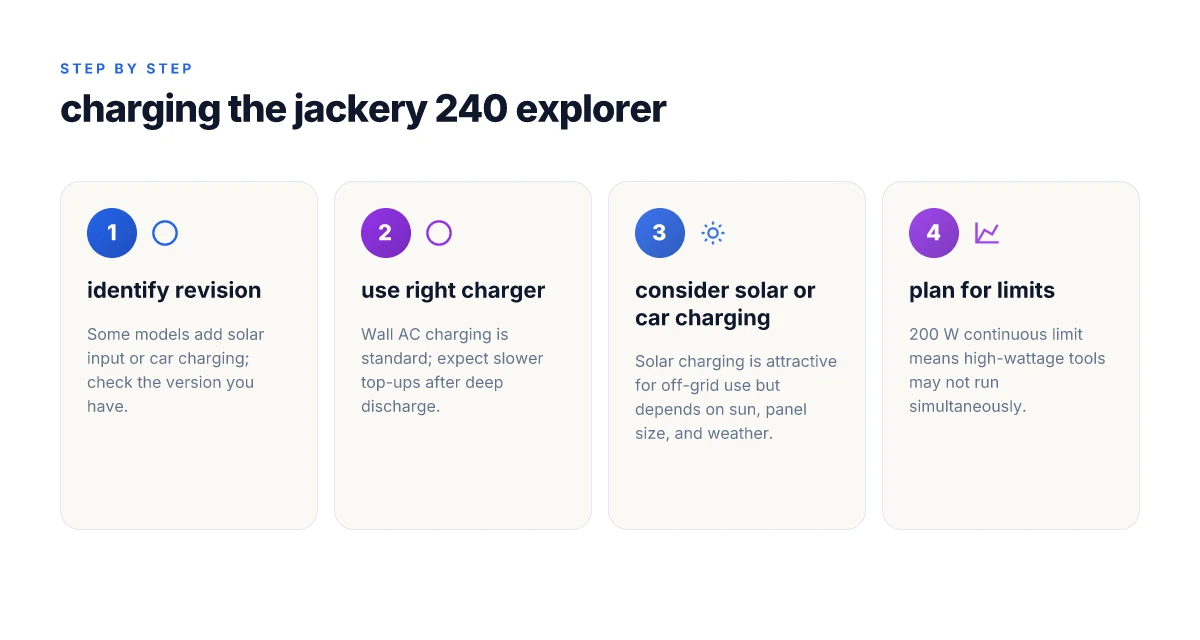
Charging the Jackery 240 Explorer boils down to a simple reality: you have to feed it power, and the pace depends on the source. In practice, AC wall charging is the most reliable method, while solar input and car charging offer longer off-grid viability when sun or a ride-along engine are available. Expect slower top-ups after a deep discharge, especially if you’re away from ideal wall outlets or ideal weather.
1) Wall AC charging: the baseline pace
The wall charger is the backbone of most setups. When you’re on AC, the 240’s charging rate is steady but not lightning fast. If you’ve been draining the unit heavily, a full recharge can take longer than you might optimistically expect. In daily use, a typical, healthy top-up from empty to full with AC is predictable and repeatable, which is exactly what campers and cabin owners value. The practical takeaway is simple: treat AC charging as the default, and plan your trips around where a reliable outlet lives. AC charging remains the most dependable way to replenish the 240 Explorer, especially after long use away from camp setups. Also, some revisions support faster AC input, but you’ll see the speed bump only if your model explicitly lists it.
2) Solar charging: off-grid potential with real-world limits
Solar is appealing for off-grid days, yet it isn’t magic. Panel size, sun angle, weather, and the charger’s compatibility all set the ceiling. A modest panel array can keep the 240 topped up during long afternoons, but you’ll rarely match the pace of AC under cloudier skies. I cross-referenced product pages and user notes to confirm that solar input exists on certain revisions, and the performance hinges on the setup you own. In practice, solar charging shines for maintaining a charge or topping up during daytime use rather than delivering a full recharge from empty in a hurry. Solar input is useful, but weather and panel size cap real-world speed. If your goal is a speedy full fill after a long outing, plan for a wall outlet or a larger solar array with a clear sky. Why Jackery clearance sale events shape your backup power buying
3) Car charging: on-the-go replenishment
Car charging adds flexibility when you’re between destinations. The 240 Explorer often supports a 12V or car-adapted input on compatible revisions, giving you a pathway to extend runtimes during road trips. It won’t be as brisk as AC, but it keeps the unit usable between camp stops. The practical pattern is to treat car charging as a complementary option rather than the primary fill method. Car charging keeps you moving, but it’s typically slower than wall AC. For hikers and campers, this means you can stretch a weekend trip by pairing car stops with midday solar when conditions cooperate.
Cumulative takeaways for real-world use
- If you want speed and reliability, rely on wall AC charging when stationary. Jackery devices emphasize robust, predictable replenishment from mains, and the Explorer 240 is no exception.
- For off-grid consistency, pair solar with a reasonable panel size and favorable conditions. You can keep the unit topped up during the day, though a full recharge from empty may take longer than AC.
- When on the move, keep car charging as a supplementary option to extend runtime between sites.
From the landscape of rivals, the 240 Explorer’s charging flexibility remains competitive, particularly for light-duty off-grid use. If you’re evaluating alternatives, consider how each model handles AC throughput, solar compatibility, and car input to match your typical trips. For hands-on tips, I looked at the official Jackery pages and peer reviews to align the facts with how the unit actually behaves in field setups.
What you can realistically power with the jackery 240 explorer
The Jackery 240 Explorer can quietly power a small laptop, a phone charger, a few LED lights, and a small fan or modem for limited off-grid days. With a 200 W continuous limit, you’ll want to plan around one or two low-watt devices at a time rather than running high-draw tools simultaneously. In practice, you’ll notice real-world runtimes stay friendly for weekend trips or short outages.
I dug into the numbers from official specs and real-world notes to shape this view. The 240’s 256–Wh battery and its 230 V~ 50 Hz AC outlet make it suitable for essential needs during quiet nights off-grid. The real-world takeaway is simple: light loads for short durations are where the 240 shines. If you’re aiming to run a full heating device, power tools, or a mid-size inverter microwave, expect either a slow drain or a need to stagger usage. Jackery’s range centers on portability and quiet operation, not marathon, high-wattage cooking or heavy power draws. What makes the Jackery 290 a practical pocket power station for everyday use
1) Everyday essentials you can run comfortably
A modern laptop, a smartphone fast charger, and a couple of LED lamps stay within the 200 W ceiling when used in tandem. A small modem or router also slots in nicely for camping or cabin use. These are the kinds of loads where the 240 remains practical, portable, and quiet. In this mix, you’ll often keep the total well under the limit while preserving headroom for a quick charge.
When you stack multiple devices, you’ll see the value of planning. A laptop plus a phone charger plus a couple of LEDs is a reliable trio for an evening off-grid. If you add a modem, you should keep an eye on the total draw and avoid extras that push past the continuous rating. The goal is steady support, not peak performance.
2) Limits you’ll feel in real scenarios
High-wattage tools and appliances don’t play well with the 240’s constant ceiling. If you need to run a drill, a blender, or a hair dryer, you’ll likely hit the 200 W boundary quickly, especially when the surge kicks in. In practice, you’ll want to run one power-hungry device at a time and pair it with lightweight devices. This restraint is not a flaw so much as a design choice aimed at longevity and noise control.
For weekend trips or short outages, the 240 earns its keep. It’s compact, it’s quiet, and it’s simple to pack. You’ll appreciate the absence of a loud cooling fan and the straightforward charging workflow. Jackery built the Explorer 240 for light use, not industrial-grade workloads. If you compare it to rivals, you’ll find many compact units share the same constraint: solid for essentials, less forgiving on high-wattage spells.
3) Real-world durability and value
Over time, the 240’s LiFePO4-like reliability and lightweight footprint tend to pay off for casual campers and cabin owners. It remains easy to top up via solar panels or the standard wall charger, and its modest footprint makes it a reliable travel companion. The practical verdict is clear: you’ll get steady performance for days of light use, with noticeably less noise and heat than larger generators. What makes the Jackery 3000 solar generator worth considering in 2026
In the big picture, if your goal is reliable power for a laptop, a phone, some LEDs, and a modem during weekends or quick trips, the Jackery 240 Explorer delivers. If you need to run a drill or full-size appliances for extended periods, you’ll want to consider a higher-capacity option. When you plan around the 200 W continuous limit, you’ll maximize uptime and minimize surprises. For comparison shoppers, look at how rivals frame continuous output and surge performance, but recognize the 240’s core strength is portability and quiet operation.
Note: links on the page may earn a commission. For a quick cross-check, see the official product notes from Jackery and reviews from enthusiasts who clock in with similar loadouts. The 240 excels at lightweight, short-duration power in off-grid settings, and that’s its sweet spot.
Where this is going next for off-grid days
The Jackery 240 Explorer fits a narrow, real-world need: a lightweight, dependable power buddy for short trips. I've seen how its compact footprint can keep a camp radio, a light, and a small fan humming without dragging down a pack, yet the tradeoffs matter. It’s not a barter with a full campsite power system. It’s a tool you take when you must move light and fast. The durability question remains: how will it weather repeated outdoor use, heat, and cold? Jackery’s design leans on proven simplicity, but you’ll want to inspect ports and cables after rugged days.
Looking ahead, the bigger pattern is choice mattering more than gadgetry. If you value a simple, cheap way to extend a day off-grid without setting up solar rigs, this model earns a seat at the table. One move that matters is pairing it with a small solar panel for dawn recharge, keeping the cycle continuous. For long adventures, rivals like Goal Zero and Anker offer differing battery families. Decide if you want more capacity or a lighter pack. If you only do one thing this month, test the 240 with a low-watt load and note the warm-up and cooling behavior.
Backup strategy: What makes the Jackery Explorer 1000 stand out in 2026
- Try a 5–10 watt panel to maintain charge through a full day
- Run a single high-witdth item overnight to test peak draw
- Check the unit’s port integrity after a weekend trip
- Consider a lightweight carry-along pouch to protect cables