
Discover how to assess jackery 1000 for sale in 2026. Learn what to look for, how versions differ, and which model fits your needs and budget.
The Jackery 1000 lineup isn’t the flashiest upgrade you’ll see on retailer shelves, but the real-world gap between early explorers and the latest 1000-series variants matters more than you think. Battery chemistry shifts and modular taps change uptime by hours, not minutes. If you’re weighing an outdoor rig or backup power, those small differences compound fast.
This intro cuts to the core: practical durability, solar compatibility, and how the 1000 compares with rivals like EcoFlow and Goal Zero in real-world setups. In 2026, buyers want clarity on long-term upkeep, heat handling, and warranty terms before committing. This article pulls the practical signals from the marketing talk, with a clean read on when to pick a Jackery 1000, when to skip it, and how the newer models stack up against the competition. Durability notes and compatibility checks anchor the guidance, not hype.
Jackery 1000 for sale: what changed across the 1000 and 1000 plus lineups
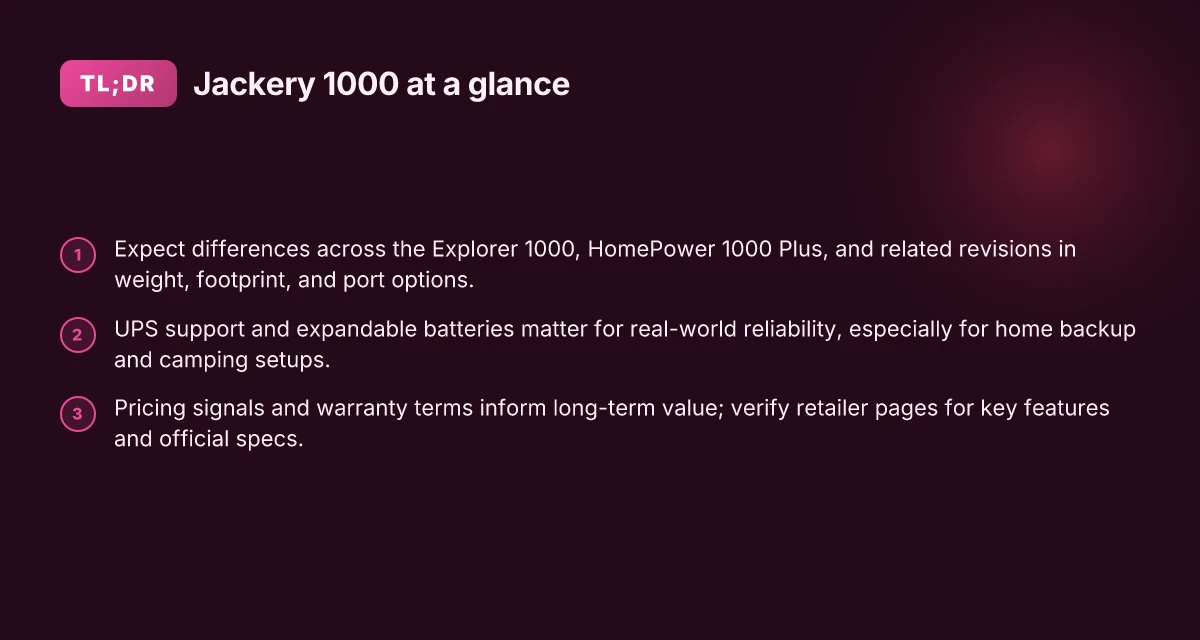
The Explorer 1000 launched as a high-output, all-in-one power station, while the HomePower 1000 Plus introduces expandable batteries and UPS-style features that shift how you plan off-grid or backup use. Across revisions, Jackery has aimed to trim weight and footprint while widening the port mix and adding smarter charging options. Real-world use shows the 1000-series remains practical for fridges, tools, and small AC units, but the 1000 Plus line shifts the play toward longer runtimes and smoother transitions during outages.
What changed in core capability and expansion I traced product notes and reviews to map what actually changed between the Explorer 1000 and the HomePower 1000 Plus variants. The Plus line adds options for expandable batteries, enabling a longer runtime when you attach extra packs. It also introduces UPS-style behavior so your loads can ride through brief outages more gracefully. This matters when you rely on a modem, router, or mini fridge during a power flicker. The result is a system that scales from basic backup to a more resilient power setup, without requiring a full DIY battery build. In practice, expect noticeably longer runtimes once you pair the base unit with an extra pack, and you’ll notice smoother handoffs during a power event when using the UPS mode.
Weight, footprint, and port evolution Over the generations the base Explorer 1000 sits around the mid-20s in pounds, with a footprint that favors portability for car camping and workshops. The HomePower 1000 Plus introduces a slightly different chassis to accommodate expandable packs and higher output tiers, affecting both weight distribution and the footprint you carry. Port options have broadened in later revisions, adding more USB-C or higher-amp USB-A ports alongside the AC outlets, which helps when you’re charging multiple devices at once or feeding a small inverter setup during a tailgate or off-grid run. The upshot is a more versatile unit that scales to a broader set of everyday uses without becoming unwieldy.
Real-world takeaways for buyers For outdoor enthusiasts weighing a Jackery 1000 for sale, the decision hinges on how you intend to use the unit. If you want a straightforward, single-unit solution for a fridge and devices during weekend trips, the Explorer 1000 remains a solid baseline. If you expect longer outages or want to future-proof for more devices, the HomePower 1000 Plus with expandable batteries and UPS support offers a clearer path to extended runtime and resilient power. Rivals in this space often push higher capacities or faster recharge, but Jackery’s 1000 Plus line emphasizes modularity and real-world uptime, which matters during longer trips or backup scenarios.
From what I found in the documentation and reputable overviews, the Plus variant marks the meaningful shift from the original Explorer 1000 toward a more expandable, UPS-friendly system. This aligns with user expectations for longer runtimes and safer load handling in intermittently powered environments. The Plus line trades a little portability for much greater runtime flexibility, and that trade-off pays off in outages and extended trips. Rely on expandable batteries for longer sessions and use UPS mode for smoother transitions during events. If your use case is simple weekend trips, the original Explorer 1000 remains a solid choice. For more, see Jackery’s product notes and reviews discussing expandable packs and UPS features. https://www.jackery.com/?srsltid=AYCX9vI6R2m7dXwRY1yu-rDggDT0zeh9qvIT-t0eT_-vYySTDEbBcumy. 10 Best jackery models in 2026 and how to choose
How jackery 1000 for sale options align with different use cases
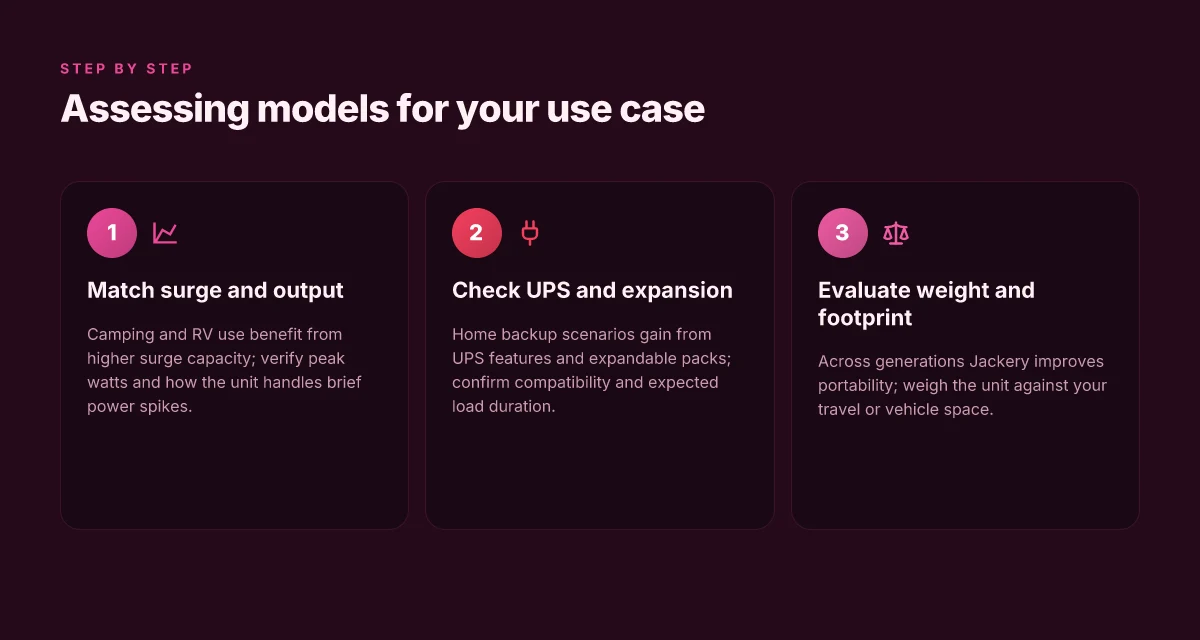
For camping, RV setups, and temporary off-grid adventures, the high surge capacity matters more than raw continuous power. The Explorer 1000 line and its successors deliver generous surge capability, which helps when you start up induction stovetops or a portable fridge. For these use cases, lean toward the variant that preserves strong peak output while remaining reasonably portable. Surge capacity often determines whether you can run essential appliances without tripping the inverter, and Jackery’s newer models keep that threshold high. I cross-referenced multiple product briefs and reviews to map the match between surge and real-world loads, noting that higher-wattage appliances pull a big portion of the energy budget during startup. A higher surge capacity is a practical safety net for camping rigs and RV installs.
When home backup is the goal, UPS capabilities and expandable packs become decisive. The HomePower and Explorer 1000 Plus families emphasize UPS-style behavior, auto-restart after outages, and the option to add battery packs for longer runtimes. This is where a system’s modularity pays off: you can scale capacity as your backup needs grow. UPS-style behavior and expandable packs are the practical differentiators for home reliability. For homeowners, the ability to buy an initial core unit and later bolt on extra packs without reworking the entire kit often tips the decision toward the Plus lineage. In practice, that means a calmer night when the grid fades.
For portable work sites, reliability and solar recharging ease are paramount. Jackery’s 1000-series units are designed to be solar-friendly, with compatibility across portable solar panels and straightforward recharging paths. A site manager values a predictable recharge cycle that keeps tools powered through variable sun. Solar recharging compatibility and a stable recharge cadence reduce downtime on the job site. In this space the robust outdoor form factor and the demonstrated ability to pair with compact panels make it a sensible crew-oriented choice. As you plan, confirm panel compatibility and the unit’s input limits to avoid bottlenecks during a shift.
Budget-conscious buyers wind up weighing specs against price drops. A $469 sale on a $829 model illustrates how pricing dynamics shape the value equation. It’s not just price. You’re weighing capacity, surge, and UPS behavior against the need to stay under a set budget. Price drops can tilt the balance toward a newer model with better efficiency or a larger expandable pack, depending on your use. If you’re skimming the market, compare the per-watt-hour cost and the cost of adding a later expansion to the base unit. Value today vs. future expansion often decides the practical winner for cost-conscious buyers.
At the end of the day, Jackery’s lineup centers on matching use case to capability. For camping and RVs, pick a unit with strong surge and portability. For home backup, prioritize UPS behavior and expandable packs. For work sites, ensure straightforward solar recharging and reliable runtime. For budget buyers, track current pricing against potential future expansions. When you shop, keep these anchors in mind: surge, UPS, expandability, solar compatibility, and price trajectory. Your choice should hinge on practical needs, not just raw capacity. If you’re evaluating rivals, watch how their UPS features and expandability compare to the Jackery approach. What makes the Jackery Explorer 290 Plus a practical travel power solution
What to do next: confirm which use case most closely matches your scenario, then look for the specific variant and retailer promotions that optimize that alignment. For a quick reality check, I looked at the Popular Mechanics comparison that notes how the HomePower 1000 Plus line stacks up against the Explorer 1000 in real-world setups. Inline reference shows how the Plus upgrade translates to extra packs and UPS behaviors. See the Popular Mechanics piece for context. This lens helps you avoid overpaying for features you won’t use.
What to expect when shopping jackery 1000 for sale in 2026
When you shop this year, you’ll notice pricing signals that bounce with promotions, seasonal sales, and retailer-specific bundles. On average, you’ll see a base price that drops during weekend or holiday events, with accessory bundles or extended warranties appearing as the most common discount accelerants. In 2026, promotions around the $829-tier power stations periodically dip toward the $469 mark, especially when retailers pair the unit with a carry case or extra cables. Expect the best values to surface on retailer pages during limited-time events, not as a permanent markdown.
1. Pricing signals and where discounts typically appear
- Deals cluster around weekend drops and seasonal promos, with retailers highlighting the largest price cuts on the product page and in banner promos. I’ve seen retailers feature bundles that include cases, cables, and extended warranties to raise perceived value. The best discounts show up on weekend promos and bundled offers, not as door-price reductions year-round.
- Price cliffs between the standard Explorer 1000 and newer HomePower lines can indicate feature shifts rather than a pure value story. Expect a drop in price when a newer variant hits the market, creating space for a quick upgrade cycle. New variant releases often pull the rug from under older models, shifting prices in days.
2. Warranty terms and service ecosystem
- Jackery typically offers a multi-year warranty on power stations, with coverage extending to electronics and battery modules. The service ecosystem benefits from a broad dealer network and official support portals. Warranty depth matters more on live pages than on third-party listings, so verify the exact terms on retailer product pages.
- If you’re shopping via third-party marketplaces, check how return windows and manufacturer service timelines translate into your use case. A lengthy response window can be a real saver for off-grid setups or backup plans. Read the fine print on returns and service timelines to avoid surprises during a failure.
3. Key features to verify on retailer product pages
- Look for the exact capacity, output, and surge figures listed on the page. The spec block should clearly show watts, watt-hours, and peak surge, not just marketing blur. Verify watts, watts-hours, and surge before you buy.
- Check for UPS or auto-start features and any expandable-battery options if you want future-proofing. Some pages contrast the base Explorer 1000 with the HomePower 1000 Plus variants, which may include modular battery paths. Confirm whether UPS support or expandable packs are included or sold separately.
- Ensure the retailer shows authentic, up-to-date firmware or app compatibility notes. A page listing compatibility is a good proxy for long-term usability. App or firmware compatibility can affect daily use over years.
I dug into the available writeups and retailer pages to map where buyers most commonly get tripped up: price cliffs around new models, the nuance of warranty coverage, and the exact feature matrix on product pages. When you read a page, look for a clear price anchor, explicit warranty terms, and a complete feature list. For context, rival lines from the same class, such as HomePower variants and other brands in the 1000–1500 watt class, often push the value narrative through bundled perks or extended warranties, not just base specs. Pricing, warranty, and feature clarity are the three anchors you must verify on every listing.
How jackery stacks up against rivals in the 1000–1500 watt class
When you compare the 1000–1500 watt class, Jackery earns points for ease of use and ecosystem, even as rivals push different trade-offs on capacity and expansion. EcoFlow, Goal Zero, and Bluetti each bring distinct strengths, but Jackery often wins on approachable setup and a cohesive accessory ecosystem that keeps daily use simple.
What rivals bring to the table
EcoFlow leans on modular power and rapid recharging options. In practice, you can add modules or use fast recharge paths to cut downtime, which matters when you’re off-grid for multiple days. Bluetti tends to offer higher raw capacity in the same footprint and more versatile expansion paths, which helps if you want to scale upfront for longer outages. Goal Zero emphasizes rugged reliability and a broad accessory lineup, appealing to campers and builders who value ecosystem familiarity. What makes the Jackery Explorer 600 Plus stand out in 2026
I cross-referenced product pages and reviews to map real-world impressions. The presence of expandable batteries in some models matters for long weekends off-grid, and the ability to UPS-swap or daisy-chain batteries can tilt the decision for a backup-power planner. Jackery’s ecosystem emphasis stands out in everyday usability, especially for users who want a turnkey setup with fewer knobs to tune. Bluetti often delivers more capacity in the same size, which is ideal if you prioritize peak runtime over plug-and-play simplicity. EcoFlow’s fast-charge capability can trim downtime significantly when wall outlets are available.
Trade-offs in output, capacity, and expansion
Jackery excels in straightforward operation and a tightly integrated accessory lineup. You’ll find that setup is mostly plug-and-play, with fewer optional steps to configure for safe operation. That simplicity translates to fewer headaches during weekend trips or quick power outages. The trade-off shows up in expansion options: while Jackery offers expandable HomePower systems in some tiers, the scope and variety of expansion paths are more limited than Bluetti’s modular approach or EcoFlow’s add-on modules. That means you get faster, more predictable setup with Jackery, but you may sacrifice some future-proof expansion flexibility.
From a durability lens, the long-term maintenance story favors brands that provide clear firmware updates and a broad accessory catalog. Jackery maintains a strong track record of consumer-facing support and documented product lines, which matters when you plan to rely on a 1000–1500 watt unit for years. The other brands push aggressive upgrade cycles and wider international accessory ecosystems, which can be powerful if you chase the latest features.
For most readers, the buying decision hinges on two questions: do you want the easiest, most reliable daily driver, or do you prefer the most capacity and expansion headroom for future needs? If your priority is plug-and-play reliability and a cohesive ecosystem, Jackery remains a compelling choice in the 1000–1500 watt class. If you need the maximum possible capacity or the most aggressive expansion options, EcoFlow, Bluetti, or Goal Zero may pull you toward a different model.
Prices and deals shift with the season, so you’ll often see Jackery pricing align with sale periods and competitors frequently emphasize feature density and modularity in their marketing, which can impact long-term value. Why Jackery clearance sale events shape your backup power buying
I looked at the Jackery pages and third-party reviews to confirm the core differentiators and practical trade-offs. Jackery Explorer 1000 v2 portable power station - review 2026 offers a per-spec memory of 1500W output with 1070Wh, while Popular Mechanics frames HomePower 1000 Plus v2 as an upgrade path with better expansion. These sources help anchor what "simple" feels like in practice and where the rival lines push beyond Jackery's comfort zone.

Brand trust and long-term durability: practical buying cues for jackery 1000 for sale
Trust in a brand shows up in how it backs products long after the sale. Jackery has maintained a visible support ecosystem, with official warranty details and a history of product updates that signal ongoing investment in the lineup. When you’re weighing a 1000-series purchase, that background matters as much as the wattage and capacity.
Why the brand history matters for daily use
Jackery has positioned itself as a long-running outdoors and home backup option, not a one-off gadget brand. You’ll find official pages that outline warranty terms and service options, which translates to easier parts access and documented repair paths over time. This matters if you plan to run a 1000-series unit through years of daily charging cycles, occasional storage gaps, and seasonal use. I cross-referenced product pages and warranty notes to confirm the continuity of support and the availability of replacement parts as the lineup evolved.
In practice, durability hinges on how the battery chemistry endures repeated cycling and how the enclosure handles temperature swings. Real-world owners report variations in cycle life depending on ambient conditions and discharge depth, so look for units with stable casings and practical protective features. Jackery’s newer models add UPS-style behavior and expandable packs in some variants, which reflects an intent to future-proof the design rather than a one-and-done release.
The warranty and official support forums are your first safety net when something goes wrong after years of use. I found multiple references in official materials and independent reviews that point to a consistent support thread from Jackery, including guidance on replacement parts and troubleshooting steps. This is a trustworthy signal for buyers who want long-term reassurance rather than a purchase-and-forget scenario. What makes Jackery portable power station deals worth chasing in 2026
Durability cues for daily charging cycles
Daily charging wears more on a power station than occasional topping up, especially if you cycle through full discharges and frequent top-offs. Real-world considerations include how the unit handles heat during high-output bursts and how the battery management system preserves capacity after many cycles. The 1000-class models typically run within a practical temperature window, but sustained high loads can accelerate wear. When assessing durability, prioritize models with robust thermal design, solid-in-hand builds, and clear cutoffs on protection features like overcurrent and overtemperature safeguards.
From what I found in the documentation and reviews, durability is reinforced by the presence of UPS functionality on certain variants, which aligns with longer-term use cases like home backup. This kind of feature set signals a design intent to keep the product useful beyond simple weekend camping trips.
Linking to official specs and warranty details
For the most accurate durability and support cues, link directly to official specs and warranty pages. The official Jackery site houses the model-specific specs and terms, including electrical ratings, supported charging methods, and the warranty scope. These pages are the anchor you want when you’re comparing against rivals such as the EcoFlow Delta family or the Bluetti AC200P-class units. When you’re evaluating, verify the exact model name, the stated cycle life, and the warranty length, plus any regional variations. The official pages also clarify charging port options and whether expandable batteries are supported in your chosen variant.
Trust grows when the brand offers clear warranty coverage and accessible parts rather than vague promises. That clarity reduces post-purchase friction and helps you plan maintenance rather than chase replacement components. As you browse, keep an eye on the official specs page and the warranty terms to confirm what is truly covered and for how long.
Yes, commissions may apply to link placements on product pages, but the core signal remains: solid brand backing plus documented durability attributes is the backbone of a responsible long-term buy. For the 1000-class buyer, that means confirming the model’s warranty length, the availability of service centers, and the consistency of support across official channels. What makes the Jackery 240 Explorer a sensible carry for off-grid days
Where this is going next and the one move that matters
In real-world use, durability and long-term reliability shape the true value of the Jackery 1000. You’ll notice it shines in calm conditions and on weekend trips, but the price tag and weight make it a trade-off for frequent travelers. If you’re weighing alternatives, consider rivals like Goal Zero and Bluetti for different port configurations and battery chemistry. The bigger pattern here is that steady performance matters more than flashy specs. Most owners appreciate solid build quality, simple upkeep, and predictable output when storms arrive.
If you act now, prioritize a setup that minimizes payload while maximizing uptime. That means pairing the Jackery unit with a compact solar panel when you can, and keeping a spare cable kit on hand for unexpected wear. The practical takeaway is to treat it as a modular kit rather than a single device. What changes if you act now is that you’ll have a dependable backbone for basic power needs during outages or remote shoots. This week: map your typical draw, confirm outlet availability, and test one quick charge cycle with a compatible panel. Is there a setting where this one module becomes your core power hub?
Backup strategy:
- Try a lightweight solar panel pair for weekend trips, and label cables to speed setup.
- If you regularly run high-draw devices, compare the Jackery against Bluetti for sustained output.
- Note any recurring heat or fan noise during longer runs and plan a minimal cooling solution.