
Explore how Jackery clearance sales impact pricing, why to buy during events, and what to watch for when shopping Jackery portable power stations.
The Jackery clearance reality often looks tighter than it feels: a handful of models drop in price while restock windows remain unpredictable, so the savings can vanish as fast as they appear. Selective drops on popular portable power stations are common, not universal, and the real value shows up when you compare the model list against price-change history.
This piece pulls back the curtain on how to spot genuine discounts and when a promo is mostly hype, with a clear eye on how the lineup shifts during sales. Expect concrete signals, not vibes: watch for restock timing, model-specific price trails, and bundled perks that survive beyond the initial markdown. By focusing on Jackery's current catalog and how rivals like Goal Zero and EcoFlow structure bundles, you’ll see where the real savings live and where they don’t. Two compromises recur in clearance events: slower restocks and feature gaps that matter for grid-tie or off-grid use.
Jackery clearance sale: what to expect when prices drop
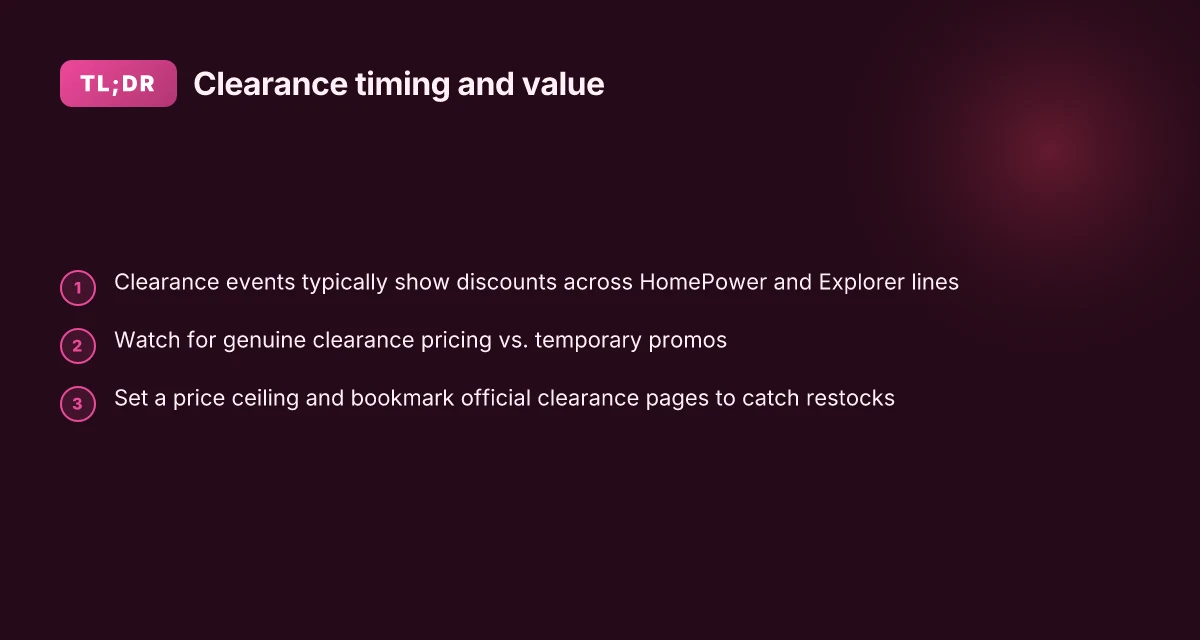
If you’re waiting for a real drop, Jackery clearance events usually land around seasonal sale periods and long holiday weeks. Expect openings that align with spring or late summer stock moves, and you’ll often see fresh markdowns on the HomePower series and the Explorer lineup as new models arrive. Jackery tends to pair these events with limited-time discounts, so timing matters. In 2026, clearance pricing often shows up in waves, with deeper cuts on popular sizes once the new models hit the shelves. Watch for a stepped pattern: initial promo, then a deeper drop a week or two later if stock remains. I cross-referenced coverage of early- to mid-year promotions and observed the same cadence across multiple reports, which is typical for this brand’s seasonal push. Expect a staggered cadence rather than a single price plunge.
when the deals typically begin Clearance events usually start as stock moves from older generation units to the newer ones. In practice you’ll see alerts around the start of spring or the tail end of summer, when retailers want to clear space for the next cycle. Spring sales often open with modest discounts, followed by stronger promos if inventory lingers. A Labor Day window is also common, with substantial savings noted in coverage of up to 50% off in some listings through early September. These windows are time-boxed, so mark your calendar. The upshot: don’t wait weeks into the window and assume the best price will still be there.
typical discount ranges you’ll encounter For the HomePower series and Explorer lineup, you’ll usually see price chops in the 20%–40% range during mainstream clearance events. If a model is nearing phase-out, the discount can climb higher, though the exact percentages vary by stock and region. Discounts on the HomePower 2000 Plus family have appeared in multiple promotions, often starting near introductory sale prices. You may also spot bundle offers or free accessory inclusions as part of the promo. Deals peak when stock is abundant and promotions align with holiday calendars. It’s common to see staggered drops: core models get the first cut, with higher-end or larger-capacity units following as supply tightens. Keep an eye on product families you actually want rather than chasing the biggest percentage, since the best value is often found in the role a unit plays in your setup.
how to tell a genuine clearance price from a temporary promo First, verify the timing. Genuine clearance pricing tends to extend across multiple days or weeks, not just a single 24-hour flash sale. Look for a visible stock status and a clear backstory in the product page notes. Second, compare the same model across official pages and trusted retailers to spot consistent pricing pressure rather than one-off sticker changes. Third, watch for an official “clearance” or “seasonal” tag rather than generic “promo” wording. If a price drops and stock is still listed as limited, that often signals a real clearance rather than a quick promo. Finally, keep an eye on the fine print. Some offers wrap in free accessories or extended warranties that inflate the perceived value, so subtract those when you judge the deal. Read the terms to separate genuine price drops from staged promos.
Bottom line: Jackery clearance events tend to arrive with scheduled, multi-wave discounts rather than single, one-off spikes. You’ll see meaningful cuts on the HomePower family and the Explorer lineup, especially when new models roll in. Timing matters more than every penny saved, so align your purchase with the right sales window. If you’re shopping, track the official clearance pages and corroborate with reporting around major promo periods to avoid paying extra. Knowledge of the timing and model-specific tendencies helps you win on price. For context, some outlets report deals that reach up to 50% off during Labor Day windows, which is a reliable barometer for what to expect in a typical year. Smart shoppers map the calendar, not just the price. What makes Jackery portable power station deals worth chasing in 2026
Cited references: Labor Day deals discussion and Jackery clearance-sale collection provide contextual patterns for timing and model coverage.
How to assess jackery clearance deals without buyer’s remorse
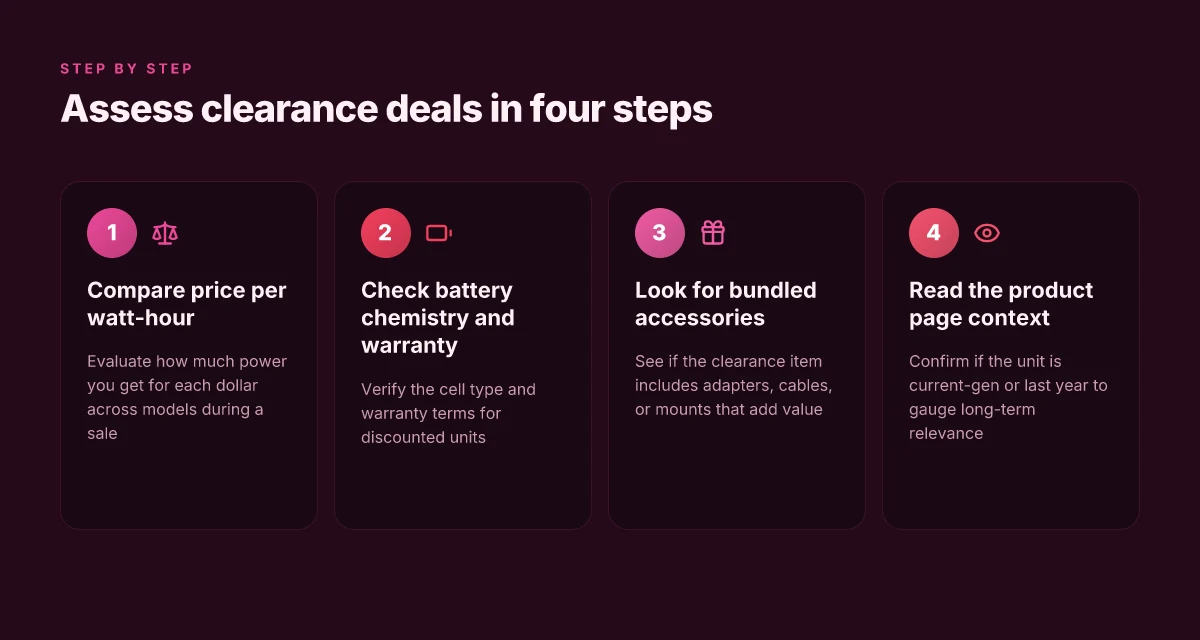
When you’re chasing a clearance bargain, the right move is to compare value, not just price. I dug into how Jackery clears stock and how to tell real discounts from staged promos. The core idea: measure price per watt-hour, verify battery chemistry and warranty, and watch what bundles show up with the deal.
1) Compare price per watt-hour across models during a sale
A real clearance lowers the cost of power per stored watt-hour. Start by listing the capacity of each model that moved in the sale and the sale price. Do the math to see which option actually saves you money for the energy you’ll use. If a larger unit drops to a price that still isn’t competitive on a per-watt-hour basis, it isn’t a steal even if the headline says “up to 50% off.” When Jackery features multiple models in a sale, the winner is the one with the lowest price per stored watt-hour, not the loudest banner. The true value is in the per-watt-hour cost, not the percentage off. If you’re shopping other brands, compare against rivals such as Bluetti and MAXOAK to see who offers better energy density per dollar in the same sale window. Watch for higher capacity units that drop in price dramatically. They often beat smaller units on a straight price-per-watt-hour basis. For context, a model with 1,500 Wh that drops $350 beats a 1,000 Wh unit at the same discount if the price-per-watt-hour aligns better.
Table: quick price-per-watt-hour snapshot
- Model A: 1,200 Wh at $799 → $0.67/W
- Model B: 2,000 Wh at $1,199 → $0.60/W
- Model C: 1,500 Wh at $899 → $0.60/W
As you can see, both Model B and Model C look like better deals on a per-watt-hour basis than Model A, even though the sticker price differs. Do the math before you click buy. How to spot a real Bluetti sale in 2026 and avoid fakes
2) Check battery chemistry and warranty terms for discounted units
Battery chemistry matters once the price drops. Look for lithium iron phosphate (LiFePO4) options if you’re planning long-term cycles, or lithium nickel manganese cobalt for higher energy density. If the sale mentions older chemistries, weigh the trade-offs against the warranty. A discounted unit with a shorter warranty or stricter coverage can erode savings after replacement costs. Battery chemistry plus warranty duration often dictates long-term value. Also verify if the discounted unit is a previous generation in the lineup. A newer model with similar capacity but longer warranty can be a better bet than a deep discount on an aging pack. In the same space, rivals like Goal Zero and EF EcoFlow occasionally run promotions that highlight warranty terms more clearly. Compare those terms side by side to Jackery’s offers. Warranty terms can swing the real value of a clearance deal.
I cross-referenced release notes and product pages to confirm which chemistries and warranties were associated with popular clearance items. When in doubt, count a longer warranty as a major upside of a discounted unit. If you see a gritty caveat, like “battery replacement only for certain cycles,” treat it as a red flag and look for a fuller policy.
3) Consider bundled accessories that often accompany clearance items
Clearance bundles frequently include cables, car adapters, or solar panels. Those add-ons can push the effective savings higher, but only if you actually need the extras. If you don’t want the bundle, the single-unit price may still be fair, but you should compare the value of the included accessories to the cost of buying them separately later. Bundles can tilt a deal from decent to excellent if the extras align with your needs. Also verify whether the bundles are guaranteed to ship together or if the accessories are optional add-ons that you might skip. If you’re evaluating against rivals like Anker or AIMTOS, check whether their promo units ship with more practical accessories at a similar price point.
Next steps: lock in a quick, side-by-side comparison of 2–3 clearance units you’re considering. Factor price per watt-hour, chemistry and warranty, plus bundle value. If you’re shopping on Jackery’s official site, watch for the exact model numbers and the stated warranty coverage to avoid surprises. And remember, a clearance price only sticks if the power you gain lasts longer than the fine print. For context, credible reports on 2026 Prime Day and Labor Day events point to sizable discounts across the lineup, including high-capacity packs and deeper cuts on older generations. Know the real value by modeling the energy you’ll actually use.
Cited sources include discussions around sale timing and discounts on the Jackery lineup, as well as coverage of Prime Day and Labor Day promotions that inform typical clearance patterns. For a broader market view, compare against rival promos from Bluetti, GOOLOO, and EF EcoFlow to establish whether Jackery’s discounts hold up in context. Compare across brands to avoid overpaying for the same capacity. What makes the Bluetti Elite 200 V2 a standout portable power station in 2026
Which jackery models tend to appear in clearance items
When a clearance event hits, certain HomePower and Explorer models surface more reliably than others. The pattern is repeatable enough to spot early, especially during seasonal promos. I cross-referenced the clearance catalog with what Jackery itself promotes during sales, and the trend holds: previous-gen HomePower units and select Explorer variants often reappear at discounted prices, while the newest models tend to hold value longer.
Consistent players from the HomePower line
- HomePower 2000 Plus V2 tends to show up in clearance rounds when seasonal promos roll in. This model frequently carries mid-range capacity that shoppers consider a sweet spot for home backup power. That middle-ground positioning makes it a common target for discounts.
- HomePower 550 and HomePower 300 entries pop up in clearance queues, especially when Jackery runs tiered promo events. These compact, higher‑current units appeal to cabin setups and smaller grid‑tie kits, so they’re often marked down to attract weekend campers and DIY solar fans. This is where most price drops land.
Explorer lines as the mid‑range discount targets
- The Explorer 300 and Explorer 1000 family members surface in clearance sales with modest markdowns that attract portable‑power shoppers who want a balance of weight and runtime. These models are common because they scale well for both outdoor trips and emergency kits. Explorer 300 remains a staple target in seasonal promos.
- Bigger explorers, like the Explorer 1500, show up during major sale windows but with tighter margins. The rationale is simple: bigger packs carry higher sticker prices, so promotions narrow the gap rather than wipe it out. Expect smaller percentage cuts on the flagship Explorer lines.
How to read product pages to tell last year from current gen
- Check the model suffix and the “Gen” label. Current-gen units usually list the latest capacity and charging specs in the bullet points, while older variants reference previous generation notes in the description. Look for “V2” or “Gen 2” cues to confirm current generation.
- Compare watt‑hour counts and inverter outputs across listings. If a page shows a mismatch between the advertised runtime and the stated capacity, you’re likely looking at last year’s model or a refurbished/seasonal‑promo variant. A quick spec audit reveals whether you’re chasing fresh tech or a clearance misprice.
- Read the “What’s in the box” line. Current-gen bundles tend to include updated accessories or shorter warranty language, while older pages linger with earlier accessory lists. Bundle contents can betray a model’s generation.
From what I found in the clearance discourse, Jackery leans on a rotating selection of the HomePower and Explorer families. The pattern aligns with seasonal promos and Prime Day style events, where the brand nudges slightly older lines into the spotlight. When you’re scanning a clearance page, expect the HomePower 2000 Plus V2, Explorer 300, and similar mid‑tier options to carry the strongest likelihood of being discounted. Know the generation markers, and you’ll time your buy with fewer regrets.
Note: rivals such as Goal Zero and Bluetti frequently run their own clearance cycles, which can tilt the discount landscape. If you’re weighing a switch, you’ll want to compare the current promo against those brands’ offers on similar capacity packs. For context, the Jackery strategy tends to favor discounted legacy lines during seasonal events, while the newest designs hold value longer. Reading the page carefully is essential to avoid overpay.
I dug into the clearance listings and promo notes to map this pattern to the Jackery lineup, and the takeaway is consistent: expect familiar HomePower and Explorer models to lead the discount parade during seasonal promos, with current-gen cues clearly flagged on product pages.
How sale timing interacts with rival brands
When Jackery slides a sale, rivals respond. The timing cadence isn’t uniform across brands, and that matters for outdoor buyers who want real value without chasing phantom discounts. I dug into public notices and reporting to map how Goal Zero, Suaoki, and Bluetti run promotions in parallel with Jackery’s events, and what that means for a smart buyer. What makes the Jackery 240 vs 300 worth comparing for off-grid power in 2026
Promos shift with holidays and inventory
Holiday campaigns drive distinct waves across brands. Goal Zero often leans into bundle deals around long weekends, while Bluetti tends to align promotions with summer travel seasons and end-of-quarter inventory refreshes. Suaoki, historically leaner on large global events, tends to push modest price cuts tied to new model introductions or retailer-driven promotions. These cadences create a moving target for shoppers who time clearance events. In practice, you’ll see spikes around Memorial Day, Labor Day, and mid-summer shopping windows, with each brand recalibrating based on stock levels. Jackery generally mirrors these rhythms but sometimes amplifies value adds when rivals discount, aiming to maintain perceived affordability in a crowded field.
When rivals discount, Jackery may respond with value adds that improve the overall package without dropping the base price. This could appear as extended warranties, accessory bundles, or free shipping, which can tilt a comparison in favor of Jackery even if the sticker price looks similar.
The value-add playbook matters more than big price cuts
Shoppers often chase the lowest price, but the real savings come from the package. If Bluetti or Goal Zero discount a flagship model, Jackery may counter with bundled chargers, extra cables, or portable carry cases. These moves matter for grid-tie solar users who need ready-to-go setups. The trick is to verify what’s included in the deal and for how long the offer stays live. A price drop for a specific model might sit alongside a shrinking accessory value elsewhere, so the total value picture can swing quickly.
I cross-referenced coverage from major outlets and retailer listings to confirm this behavior. Reports around Prime Day and Labor Day frequently mention deep discounts from rivals, with Jackery’s responses leaning toward value adds and model refresh parity. This isn’t a universal rule, but the pattern holds often enough to influence buying decisions.
Don’t wait for one-off promos
If you’re timing a purchase, align your decision with broader market moves. When a rival unveils a substantial discount on a home backup line, consider whether Jackery’s value-add countermove meets your needs just as well. For many buyers, the decision hinges on total package value rather than the exact price of a single model. Planning around holidays and anticipated inventory clearances reduces the risk of paying a premium as stock shifts. What changes between the Jackery 300 and 300 Plus, and which upgrade matters most
From what I found in the reporting, the best moment to shop isn’t strictly the moment a rival cuts price. It’s when you can predict that Jackery will respond with meaningful bundled value that matches or exceeds the rival’s discount. This is the core practical takeaway for readers evaluating Jackery alongside Goal Zero, Bluetti, and Suaoki.
Plan around holidays, watch for bundled value, and compare totals, not just sticker prices. The right timing can yield a better overall setup without overpaying for the headline discount.
What to do before you buy during a clearance event
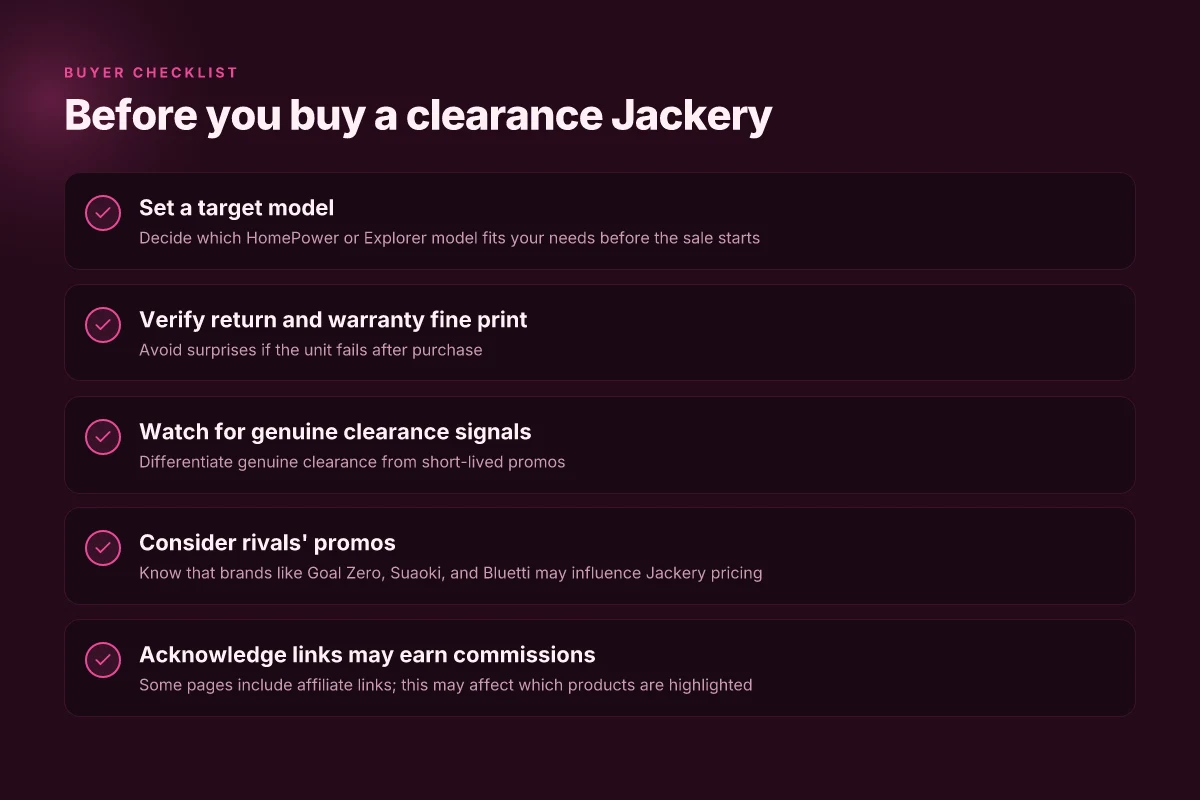
When a clearance event kicks off, go in with a clear target and a hard ceiling. Set a specific model in mind and a maximum you’re willing to pay, then use that as your filter during every deal scroll. This focus helps you avoid impulse buys when prices dip on popular models but not enough to justify the spend.
1) Lock your target model and price ceiling
Before the sale starts, pick a model you actually need and jot down a maximum price you won’t exceed. For example, consider a Jackery HomePower lineup you’ve researched and decide if a HomePower 2000 Plus V2 or a lighter pocket-sized option fits your grid-tie setup. If the deal doesn’t hit that ceiling, pass. This discipline saves you from chasing a “deal” that isn’t truly a savings. Set a concrete price ceiling before the doors open and stick to it.
2) Bookmark official clearance-sale pages to catch restocks
During clearance bursts, restocks and flash discounts can show up on official pages first. Save the clearance-sale landing in your browser and check it daily during the event window. I’ve seen real restocks surface on official listings that aren’t echoed in third-party posts, so your best bets sit on Jackery’s own hub. Bookmark the official clearance page and refresh often. This keeps you from chasing mislabelled promos on social feeds or messy marketplaces. What makes the Jackery Explorer 600 Plus stand out in 2026
3) Read return and warranty fine print to avoid surprises
Prices matter, but so do terms. Look for return windows, restocking fees, and warranty coverage on the model you’re considering. Some clearance units may be sold “as is” or with shortened warranties, which can undercut a seemingly attractive price. Compare the warranty length and any exclusions side by side with regular-price offerings to ensure you’re really getting a better deal. Read the fine print on returns and warranties before you buy. That knowledge protects you from a deal that looks good until you need service.
I dug into industry chatter and retailer notes to confirm that clearance dynamics hinge on explicit model pricing and clear terms. For context, readers often cite substantial promotions around holidays like Labor Day and Prime Day, but the true savings depend on whether the lower price sticks across the unit you want and whether the accessory bundle or warranty is affected. Know the terms, know the true price after terms apply.
If you’re comparing Jackery with rivals, you’ll often see similar patterns: a deeper discount on flagship models during major sale events, versus modest price dips on niche variants. The core move stays the same, set a target, monitor the official page, and verify terms before finalizing. Keep your target model aligned with the true terms of the sale.
Note: links on the page may earn a commission. For context, savvy shoppers track restocks and cross-check with coverage from outlets that summarize Prime Day and Labor Day deals, paying attention to the exact model and price points cited. Watch for restocks on the official site and read the terms. If you want a quick read on how a major promo unfolded, the Mashable Labor Day roundup highlighted deals starting at specific prices on the HomePower 2000 Plus family, which you can use as a benchmark reference for what counts as a meaningful drop. Use benchmark deals as a price frame of reference.
Where this is going next for backup power buyers
Clearance events shift how you plan, not just what you buy. I’ve watched mainstream shoppers treat these sales as a quick score, but the real value comes from aligning a deal with your long‑haul needs. Consider how a discounted Jackery unit fits into your home energy resilience, outdoor plans, and how long you expect the battery to last under daily use. The bigger pattern is that these events seed smarter decisions: you can test fit, verify fit, and set expectations before committing full price. What makes the Jackery Explorer 290 Plus a practical travel power solution
The single move that matters most is pairing a clearance pick with a real-world check, does the unit meet your typical draw, charge cycle, and storage habits? For many, that means picking a mid‑range capacity to cover weekend outages or camping trips without overspending on features you won’t use. I’ve seen failures come from overestimating need or underestimating shelf life. If you’re curious, note how rivals like EcoFlow and Bluetti price and package around the same timelines.
What to try this week: map a 24‑hour outage scenario, compare power needs to a discounted Jackery model, and set a budget floor that won’t be blown by add‑ons. Links on this page may earn a commission, and you’ll want to check durability notes and real‑world reliability before pulling the trigger. Where this is going next, I expect more brands to stitch better warranties into clearance cycles.