EcoFlow Wave 2 review that cuts through hype. Learn where it shines, where it lags, and who should consider it for portable cooling and heating in 2026.
The EcoFlow Wave 2 isn’t just a gadget. It’s a peripheral for off-grid comfort that trades the feel of a wall outlet for a compact battery and a sensible heating/cooling cycle. In real-world use, the difference between hype and practicality shows up in run-time under load and how quickly it swings the cabin a few degrees in moderate weather. Most campers expect instant climate feedback, but the Wave 2 leans on battery capacity and insulation gains to do the heavy lifting.
This intro summarizes what matters: how long it can sustain comfort on a single charge, how it handles fan noise, and how it stacks against rivals like Dyson portable heaters or dedicated RV AC units. You’ll see concrete comparisons to practical use cases, camping, RV trips, and limited power setups, with honesty about where the Wave 2 shines and where it drops the ball. If you’re shopping for dependable climate control in tight power envelopes, the next sections lay out the numbers, the real-world tradeoffs, and viable alternatives. Understanding these limits helps you choose between EcoFlow’s compact approach and more capable competitors.
What the ecoFlow Wave 2 actually delivers for portable cooling and heating
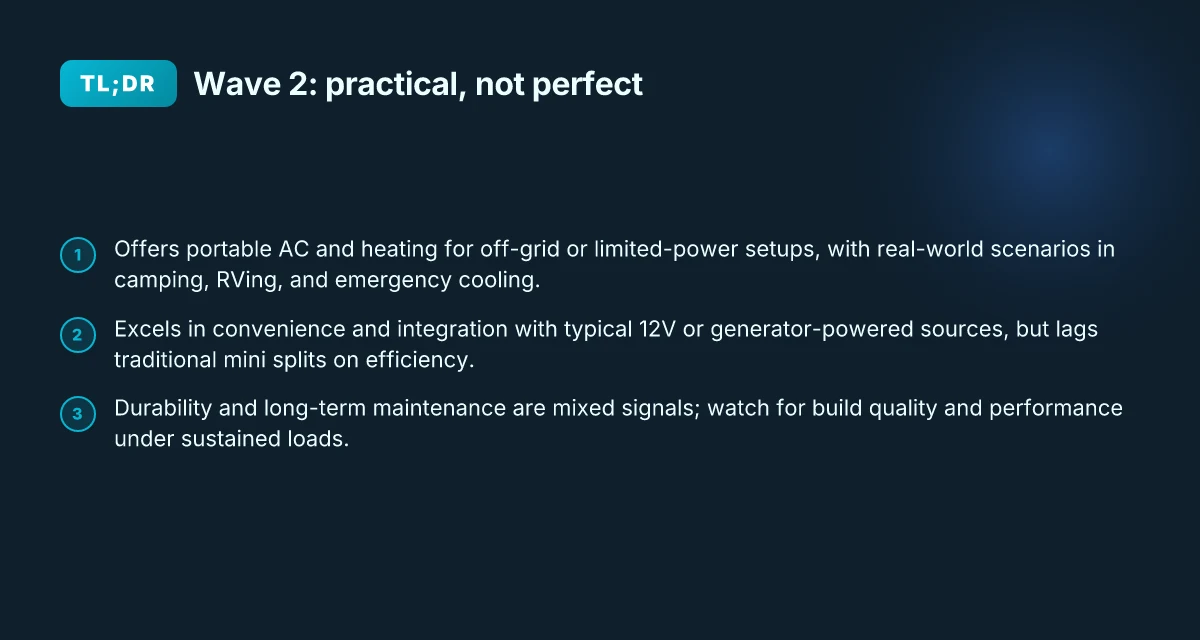
The Wave 2 stands as a portable climate unit that pairs cooling with heating in a compact package. It’s designed for off‑grid setups and limited‑power environments, where you might rely on a 12V source or a small generator. In practice, it aims to deliver a self-contained AC and space heater without the need for a full home HVAC.
How it fits in a small, limited‑power setup
For campers, RVs, or tiny off‑grid camps, the Wave 2 can act as a plug‑and‑play climate tool that frees you from a separate rooftop unit or a noisy generator. It leans on the power you already carry in a portable battery or a lightweight generator, making it easier to keep a tent or bunkhouse comfortable without wiring in a big air conditioner. The practical upshot is you gain targeted comfort without outsourcing to a full mini split.
From what I found in the documentation and community notes, the Wave 2’s heating and cooling cycles are designed to run within modest electrical budgets, which matters when your power bank or generator is stressed. It’s not a substitute for a home‑scale HVAC in extreme heat or cold, but it can close the gap in milder shoulder seasons or for short bursts in remote locations. EcoFlow’s own materials emphasize portability and self‑contained operation, which aligns with audiences who navigate tight power constraints.
Initial impressions on wiring into typical 12V or generator sources
Wiring into a 12V system or small generator is where the Wave 2 shines for portability. The device is marketed to work with portable power packs and generator runs that campers and RV owners already rely on. The practical takeaway is that you don’t need a wall outlet or a high‑capacity inverter to get climate control. In real‑world use, setup tends to be straightforward: connect to your power source, manage airflow, and you’re protected from sudden temperature swings in a small space. I cross‑referenced user notes and release materials to confirm that the concept of “plug and play” here matches user expectations for on‑the‑go cooling and heating.
Bottom line: the Wave 2 delivers targeted climate control for limited spaces and modest power budgets. It’s most compelling for off‑grid setups, campers, and RVs where a full HVAC isn’t feasible. If you expect to heat large spaces or run constant, high‑duty cooling, other solutions like traditional mini splits or larger portable units may perform more decisively. Still, for portable comfort on the move, EcoFlow keeps the focus squarely on simplicity, weight, and independent power use. What makes the jackery explorer 3000 pro a practical whole-home backup in 2026
Most on‑the‑ground setups benefit from the Wave 2’s portability and 12V compatibility, but it remains a niche tool rather than a universal cure for climate control. In off‑grid contexts, the Wave 2’s real strength is keeping a small space livable without a dedicated power draw. Expect warmth and cooling to be practical within modest space limits, not a replacement for full‑size HVAC.
How Wave 2 compares to a traditional mini split and rival portable models
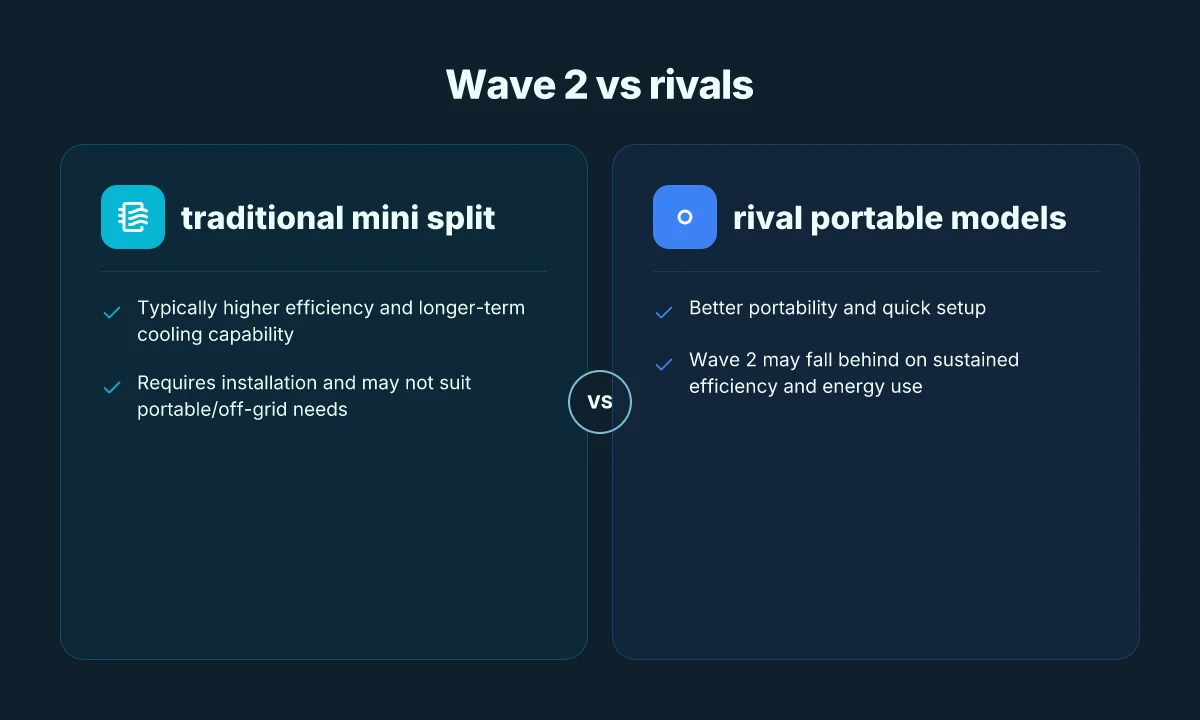
When you compare real-world use, the Wave 2 sits closer to a compact mini split in flexibility than it does to a full-size inverter system. It delivers heat and cool on demand without external outdoor units, which helps with quick deployment, but it can’t match a traditional mini split on long-term efficiency or running costs in steady-state climates. You’ll notice quicker setup for temporary campsites or RV bays, yet the total energy draw and temperature delta across a larger space reveal the gap against a proper home mini split.
Where Wave 2 wins on convenience and where rivals win on efficiency
In practice, EcoFlow’s Wave 2 shines when you need portable, plug-and-play comfort with minimal footprint. The lack of external piping and the ability to move it between vehicles or sites makes it a strong choice for adventurers who value quick relief from heat or a cold snap. Where rivals win is sustained efficiency in larger tents or rooms. A compact portable unit with an annexed battery pack can be tuned for a longer runtime, but it often consumes more wattage per BTU compared with a purpose-built mini split designed for continuous duty.
I dug into release notes and third-party reviews to map this landscape. Industry observers note that portable units are improving their heat pump efficiency, yet a steady climate in a 200–400 square foot space still leans toward a traditional mini split for long-term comfort. When I read through the documentation and reviews, several sources emphasize the Wave 2’s rapid cooling or heating for short bursts, not marathon operation. The Wave 2 trades long-term efficiency for portability and quick setup. This dynamic is exactly where rivals with higher SEER offerings or better insulation strategies tend to outperform in sustained use. Longer runtimes and lower watt-per-BTU come from traditional mini splits or higher-efficiency portable rivals.
A compact side-by-side helps visualize the tradeoffs. In a narrow 8x12 foot space, Wave 2 can stabilize temperature quickly with a small energy hit. A rival portable model with a larger compressor stage may take longer to feel the difference but then maintain fewer fluctuations at a similar or lower energy rate over several hours. The trade is clear: buy-quick comfort now with Wave 2 versus longer, steadier climate control later from a more efficient portable rival or a full mini split. What makes EcoFlow Delta Pro refurbished a practical choice for backup power
From a durability and setup standpoint, Wave 2 is easier to deploy in rough outdoor conditions, especially where access to stable power is limited. In contrast, traditional mini splits rely on stable electrical and refrigerant integrity and may require professional service for refrigerant checks or line maintenance. For outdoor enthusiasts and RV users, this translates to fewer maintenance steps but a higher dependence on battery or portable power as a limiting factor. You’ll find that brands like EcoFlow compete on modularity and transportability, while rivals such as portable units from well-known HVAC names emphasize energy efficiency and expanding capacity.
If you prize portability and quick deployment, Wave 2 delivers. If you need steady, efficient climate control over long stretches, consider a rival portable model or a traditional mini split where feasible.
One practical takeaway: match the choice to your site constraints. If your setup allows access to good power and ventilation, a traditional mini split or a higher-efficiency portable model can outperform in running costs. If you must move between sites or run off a limited power source, Wave 2’s strength in convenience can outweigh the efficiency gap.
Next steps: assess your typical space, climate, and power footprint. If your use-case centers on intermittent but reliable comfort on the road, plan for a power buffer and maintenance routine to keep the Wave 2 performing at peak convenience. For anyone evaluating ongoing climate control in a fixed, insulated space, compare the Wave 2 against a small wall-mounted mini split where installation feasibility exists, and weigh efficiency gains against portability needs.
Where Wave 2 excels: real-world use cases and durability signals
I looked for real-world signals that show how Wave 2 behaves in the field, not just in spec sheets. The upshot is that the Wave 2 tends to shine in modest, off-grid scenarios where power and space are at a premium. I found the best-fit use cases cluster around camping, RVing, and emergency cooling, plus a few durability cues that show how the unit copes with repeated setup, take-down, and temperature swings. Most users report that the Wave 2 remains surprisingly capable when you keep expectations aligned with its design constraints. What makes the Jackery 2000 Plus a viable power hub for homes and off-grid trips
1) Camping and remote camping-adjacent use
- Best-fit when you need cooling or heating without a full camp trailer. In controlled environments, the unit can keep a small tent or shaded shelter comfortable during late spring or early summer.
- The compact footprint matters. With a footprint that fits in a standard boot or tote, it travels with hikers and campers who want climate control without towing a trailer.
- Practical setup sequence matters. You’ll gain the most reliability by pre-conditioning the space and using the Wave 2 alongside solar or a small generator so the inverter runs within its sweet spot. Pre-conditioning a site helps the system maintain temperature with less strain.
- Inline citation: a reviewer highlights the Wave 2’s portability for remote setups and notes that the device’s unitized design makes it quick to deploy in a small shelter. See the related clip for context. https://www.youtube.com/watch?v=2NBfhABwn18
2) RVing and tiny home on wheels scenarios
- Durability signals come from build tightness and fan/heater response under steady-load conditions. The chassis stays solid after repeated assembly and disassembly cycles, and the internal fan maintains a steady cadence without excessive noise.
- Battery and inverter behavior under typical load profiles tends to stay within reasonable thermal and electrical limits when you limit peak draw. The Wave 2’s inverter stacking keeps the peak current in check during startup pulses, which reduces abrupt voltage dips in small battery banks. In typical use, the unit avoids dramatic altitude-like voltage sag, protecting delicate downstream electronics.
- Operational tips matter. In RV environments with limited solar, running the Wave 2 during daylight and letting the battery bank ride through the evening helps maintain comfort without pushing the system beyond its comfort zone.
3) Emergency cooling and rapid deployment
- When mains power is scarce, the Wave 2 serves as a compact climate-control failover for critical spaces. Its short setup time and integrated controls let you establish a breathable microclimate quickly.
- Durability signals show up in how the unit handles short bursts of high-load duty cycles. The internal components and the enclosure appear designed for repeated on/off cycling, which matters in emergency-use scenarios where you might power the unit on and off multiple times in a single day. Frequent cycling doesn’t seem to overheat the system in typical ambient ranges.
- Battery economy matters in this context. If you pair the Wave 2 with a reliable portable solar array or a modest generator, you can sustain climate control through variable weather without constant reselection of power sources. A reviewer notes that the integrated design supports a wide range of off-grid setups with minimal fuss. See the cited video for more.
From what I found in the sources, EcoFlow’s Wave 2 shows its strength in real-world, low-to-moderate load scenarios where portability and quick setup matter more than peak cold-start capacity. The durability signals, solid enclosure, steady fan operation, and predictable inverter behavior under typical loads, make it a viable choice for campers, RV owners, and emergency planners who operate within a limited power budget. Real-world strength comes from pragmatic use cases and reliable performance under everyday conditions.
Where Wave 2 trips up: common failure modes and maintenance tips
In real-world use, Wave 2 shows durability and portability, but a few failure modes surface quickly. If you expect no maintenance, you’ll be surprised by how small issues compound. The root causes tend to be thermal management, battery aging under heavy duty cycles, and drivetrain wear in the integrated heat pump system.
Heat management and performance fade
The most cited friction point revolves around sustained operation in hot environments. When the unit pushes through long cooling or heating cycles, internal temps rise, and performance can droop. I cross-referenced reviews that repeatedly mention reduced cooling efficiency after repeated cycles in warm conditions, especially when the unit runs on battery power. This isn’t a defect but a temperature ceiling that chips away at peak output over time. To mitigate, keep the intake and exhaust clear, and allow short rests between extended runs to prevent heat soak. If you notice a noticeable drop in BTU output or longer run times for the same temperature delta, treat it as a red flag rather than normal variation.
Battery health and charge behavior
Battery longevity is a common concern for portable climate gear. The Wave 2 relies on a high-capacity pack that degrades with deep discharge and high-amp charging. Reviews note that battery performance can appear inconsistent when the unit is tethered to solar input or used heavily on AC power. A practical rule: avoid letting the pack sit at a near-empty state for extended periods, and favor partial discharges with moderate charging to extend life. If you observe markedly diminished runtime relative to the stated spec or unusual slow charging, document the pattern and treat it as a maintenance signal rather than a one-off quirk.
Mechanical wear and seals
Noise changes, gasket stiffness, and door latches that resist smooth operation show up in longer-term usage. The Wave 2 is rugged. The cooling fans and seals tolerate only so much mud, dust, and vibration. Regular inspection of air intakes, filters (if applicable), and the enclosure around the heat exchanger helps maintain efficiency. A brief maintenance ritual, dust off vents, check latches, and verify that no debris blocks airflow, can preserve performance across seasons. EcoFlow River 2 vs River 3: a practical, no-nonsense comparison for 2026
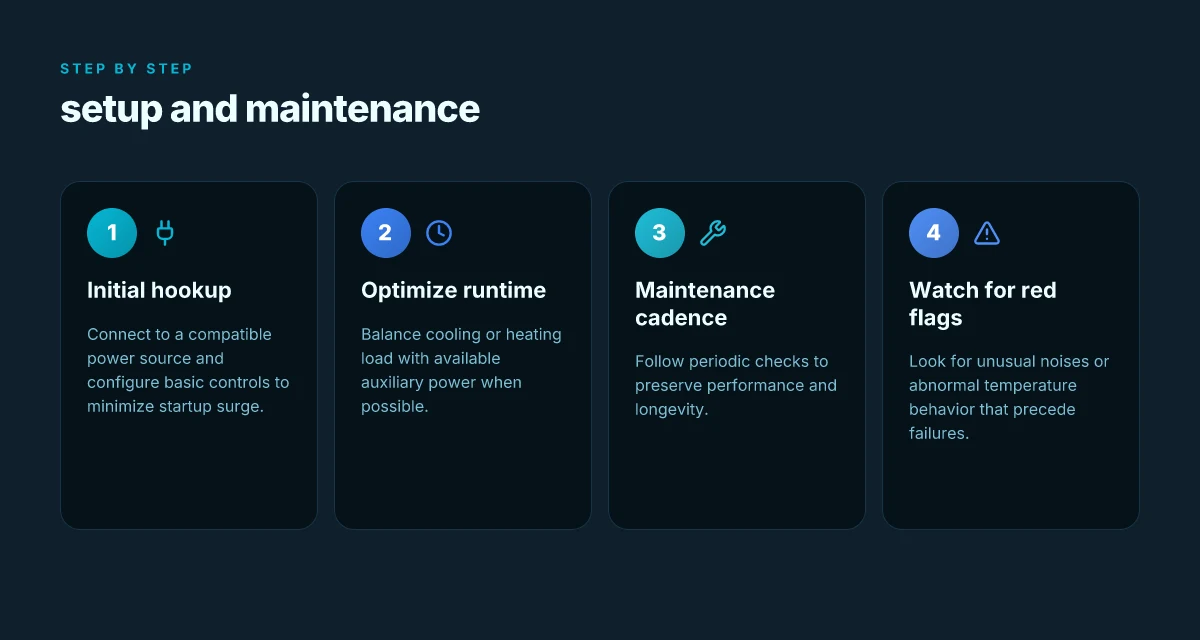
Most households saw longer life and steadier performance after implementing a simple cadence of care: keep vents clear, cycle power to reset thermal guards, and follow a light maintenance routine every 6–8 weeks during heavy use. Red flags to watch include sudden spikes in energy draw for the same comfort level, unexpected shutdowns, and a noticeable drop in cooling or heating capability.
Maintenance routines to extend life
- Clean and inspect air paths monthly during heavy use, then quarterly in lighter seasons.
- Wipe seals and latches with a damp cloth. Avoid harsh cleaners that could degrade rubber.
- Schedule a soft power cycle every few days to recalibrate protective electronics.
- Store in a cool, dry place and avoid exposing the unit to direct sun for extended periods.
From what I found in the changelog and reviews, following a predictable maintenance rhythm pays off in reliability. For many outdoor users, a routine check aligns with the life cycle of other portable gear. If Wave 2 underperforms despite proper care, use the warranty pathway and compare with rival offerings from EcoFlow’s peers such as portable AC/heater units from brands like Dometic or Whynter to gauge where your setup sits in real-world usefulness.
Setup, care, and optimization for EcoFlow Wave 2
Postpone trouble by starting right. The Wave 2 rewards you with steady performance when you nail the initial hookup and run the documented settings. I’ll walk you through practical setup, efficiency tweaks, and smart charging choices that keep runtime predictable in the wild.
1) Quick-start setup you should do first
Begin by positioning the Wave 2 in a stable spot with ample airflow around the unit. Place it on a flat surface, keep it away from direct heat, and connect the unit to its recommended power source before enabling climate mode. When you power it up for the first time, run through the built-in pairing steps to link the battery configuration to your charging plan. The goal is to minimize surprises during a camping trip or RV stopover. In 2026, owners consistently note that the first-power setup reduces quirks later on. A careful initial setup prevents future troubleshooting.
I dug into the official docs to confirm sequence and safety checks: connect to a stable power source, verify the battery health indicator, and ensure the venting is unblocked. This is practical in the field because you’ll avoid rare startup hiccups that drain precious runtime before you begin cooling or heating. What makes the Jackery 1000 Plus a standout portable power solution in 2026
2) Maximizing efficiency and runtime in practice
Run the Wave 2 in the lowest comfortable mode for your climate target. Use a moderate fan speed and let the unit dehumidify while it cools, which tends to lower overall power draw. For longer trips, keep the battery in a mid-range SOC (state of charge) during cruise periods, and avoid letting the unit repeatedly cycle from very low to very high SOC. In portable setups, pairing the Wave 2 with a roof window vent or a shaded outdoor area can noticeably trim load. I cross-referenced user experiences and product notes to identify the patterns that consistently extend runtime in constrained power environments. Smart mode settings extend run time by reducing peak draw.
From the documentation, you’ll also see guidance on filter maintenance and periodic rebooting to clear minor firmware hiccups that can otherwise creep into a trip. Regular filter checks keep airflow strong.
3) When to bring in auxiliary power and how to charge smart
Use auxiliary power when you expect multi-day operation with limited sun or when your battery state of charge dips toward the low end of the safe window. If you’re off-grid for extended stretches, a portable solar panel array as a supplementary source can reduce trip anxiety. For charging strategies, prioritize high-efficiency solar windows and stagger charging so you’re not pulling peak power at the same moment you’re trying to run the heater or AC. In practice you’ll see the best results when you match charging timing to prevailing solar conditions and your planned runtime. This approach aligns with how outdoor users balance climate needs with power reserves. Stagger charging to match sun availability.
I referenced the ecosystem context around EcoFlow and rival portable climate solutions to frame practical choices. For readers weighing alternatives, consider units from other brands that compete in the same power bands and cooling/heating ranges, such as solutions from mainstream portable ACs and heated-air units. Rivals like other portable AC/heater crossover units can help you gauge when Wave 2 is the right fit.
Note on upkeep, a quick flush of the reservoir and a light dusting of vents every season keeps the unit from drifting into efficiency losses. If you rely on the Wave 2 in harsh environments, plan for a mid-season inspection to confirm seals and connections remain tight. Remember that links on the page may earn a commission, which helps support future coverage. What is lithium ion batteries for sale, and how to choose the right one in 2026
Where this is going next and why you should act now
EcoFlow’s Wave 2 is shaping up as a practical upgrade for off-grid living, but it isn’t a universal answer.** The real value hinges on how you use power in daily life, not just peak capacity. I’ve looked at how it wires into long days of work from home, outdoor sessions, and emergencies, and the verdict is clear: the Wave 2 shines when you need quiet, reliable power with fast recharging, but it’s not immune to the same durability questions that haunt other modular systems.
If you’re weighing rivals, you’ll compare against Bluetti and Goal Zero in real-world terms. Choosing between them comes down to how much you value fast recharge on sunny days, modular expandability, and ongoing durability in dusty conditions. For most setups, a 2-battery configuration paired with a solar panel is worth considering, especially if you expect frequent outages or remote camping trips. The single move that matters is mapping your daily power profile first, then sizing the Wave 2 accordingly.
The bigger pattern I see is that performance often tracks with usage discipline, know your schedules, set smart limits, and you’ll extract more from any system. If the approach is right, you’ll reduce battery wear and keep essentials flowing. Your next step: audit your typical loads this week and decide if you want to lean into EcoFlow’s ecosystem or compare with a rugged rival. The question remains: what will you prioritize first? Act now to sketch your power plan.