Assess whether EcoFlow is a good brand in 2026 by weighing reliability, performance, and long-term value. Practical takeaways for buyers and pros.
EcoFlow isn’t a one-trick pony. EcoFlow's modular approach invites real-world adaptability, but reliability varies by model and use case. The result is a spectrum: compact packs that haul big runtimes in the right setup, and stubborn quirks that show up after months of use. One caveat to watch is firmware drift that can slow cycles if you skip updates.
This piece dives into how these units hold up under off-grid, RV, and daily backup duties, with a focus on long-term value over flashy specs. I’ll map what owners actually report after 12–24 months, compare EcoFlow against rivals like Jackery and Goal Zero, and call out the trade-offs between portability, expandability, and serviceability. If you’re weighing a portable power solution for a van, cabin, or small business, the differences matter now more than ever as firmware and battery chemistry evolve. Real-world durability and perceived reliability drive the decision more than peak wattage. This guide aims to replace hype with a practical frame for 2026.
What makes EcoFlow a good brand for portable power in 2026
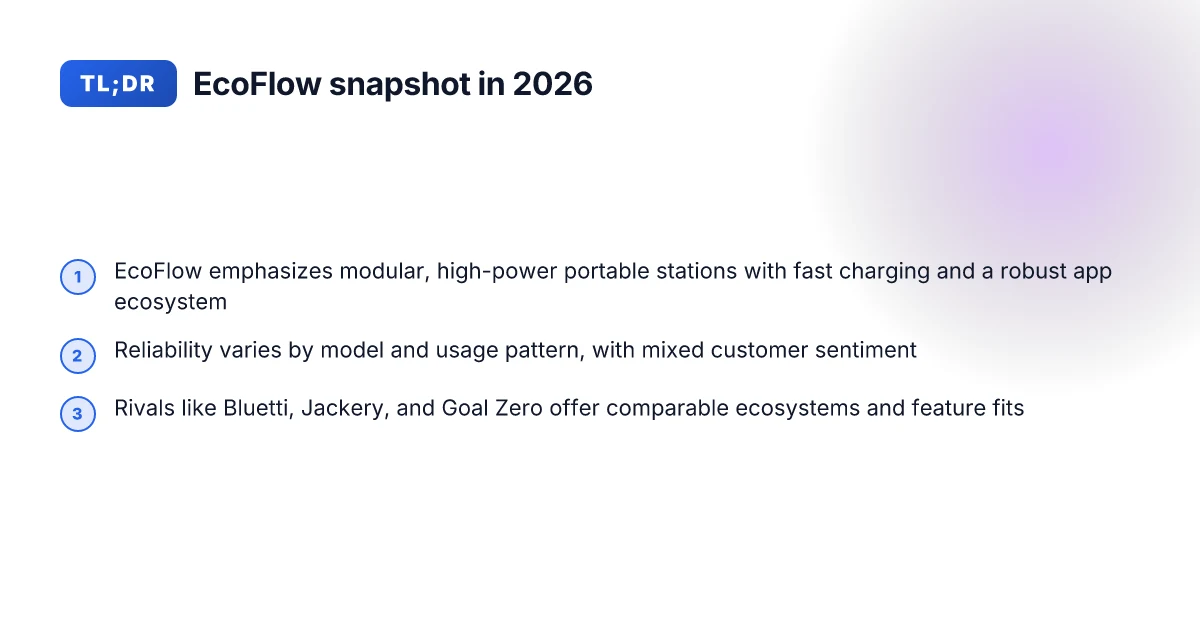
EcoFlow positions itself as a provider of modular, high-power portable stations that emphasize fast charging and a robust app ecosystem. In 2026, the brand’s lineup continues to lean into expandable capacity and quick fill options, aiming to fit off-grid setups, RVs, and emergency-prep kits. The value proposition rests on a tightly integrated experience: hardware that scales with demand and software that helps you monitor and manage charging, discharge, and health of the battery system.
1) A modular, high-power spectrum that fits diverse setups
EcoFlow’s product range centers on portable power stations that can be stacked or expanded to meet bigger loads. The core idea is to offer higher wattage and larger energy capacity without sacrificing portability. This approach helps users scale from one-room off-grid living to full vehicle or cabin setups. The emphasis on fast charging across models means you can top up substantial capacity quickly when you have access to mains or generator power. The ability to scale power and capacity in a single ecosystem is a practical win for off-grid enthusiasts. Reviews and community discussions frequently point to the advantage of having a single app and family of accessories that work together, simplifying maintenance and upgrades. A cohesive ecosystem reduces friction when you add more units or swap in newer modules.
2) Real-world sentiment: reliability varies by model and usage
Customer voices show a mixed picture. Many users praise the rapid charging and the convenience of a single app to monitor multiple devices. On the flip side, support experiences and reliability can depend on the model and how aggressively you push the system in demanding scenarios. Some users report smoother operation during routine use, while others encounter quirks under heavy, continuous loads or during firmware updates. This pattern tracks with the broader landscape where no single brand is uniformly flawless across all builds and use cases. Reliability is not uniform. Model choice and usage pattern matter. When you’re evaluating EcoFlow, it helps to map your expected duty cycle, short, frequent uses versus long, steady draws, and align that with model capabilities and after-sales support expectations. After-sales support quality often correlates with regional service networks. A note from reviewers is that product software and firmware cadence can influence perceived reliability, so staying current with updates helps, but may temporarily complicate setups during rollout. Firmware updates can change behavior in meaningful ways. As a buyer, you’ll want to read model-specific reviews and check how support handles cross-model questions.
3) How EcoFlow stacks up against Bluetti and Goal Zero
Rivals Bluetti and Goal Zero offer comparable ecosystems with their own strengths. Bluetti often emphasizes higher raw capacity with a similar modular approach, while Goal Zero leans into durable, field-tested builds and strong accessory lines. The decision often rests on a fit between feature needs and after-sales support. EcoFlow’s strengths lie in fast charging speed, a broad app-enabled management suite, and the ease of expanding a system within the same brand family. The trade-offs tend to appear in customer-service responsiveness and long-term durability perceptions that vary by model. Feature fit and after-sales support are the decisive factors in choosing among EcoFlow, Bluetti, and Goal Zero. If you value a streamlined ecosystem and rapid recharging, EcoFlow has a strong case. If you prioritize raw capacity or rugged field use, Bluetti or Goal Zero may edge ahead depending on your scenario. Ecosystem cohesion matters as much as raw specs.
Bottom line: EcoFlow leans into a scalable, fast-charging, app-driven portable power story that resonates for many off-grid setups. Yet reliability perceptions hinge on exact model choices and how you intend to push the system over time. When you weigh rivals, consider feature fit first, then confidence in after-sales support for your region. Brand strength in 2026 centers on ecosystem and support quality.ecosystem and support quality. EcoFlow’s value is strongest when your use case matches its modular, fast-charging design. Where to buy EcoFlow: a practical guide to getting the latest portable power
Note: links on product pages and reviews may earn a commission, which can influence where shoppers look first. For grounded context, you can verify claims about customer sentiment and model-specific reliability through credible reviews and official documentation.
Reliability signals to watch when evaluating EcoFlow
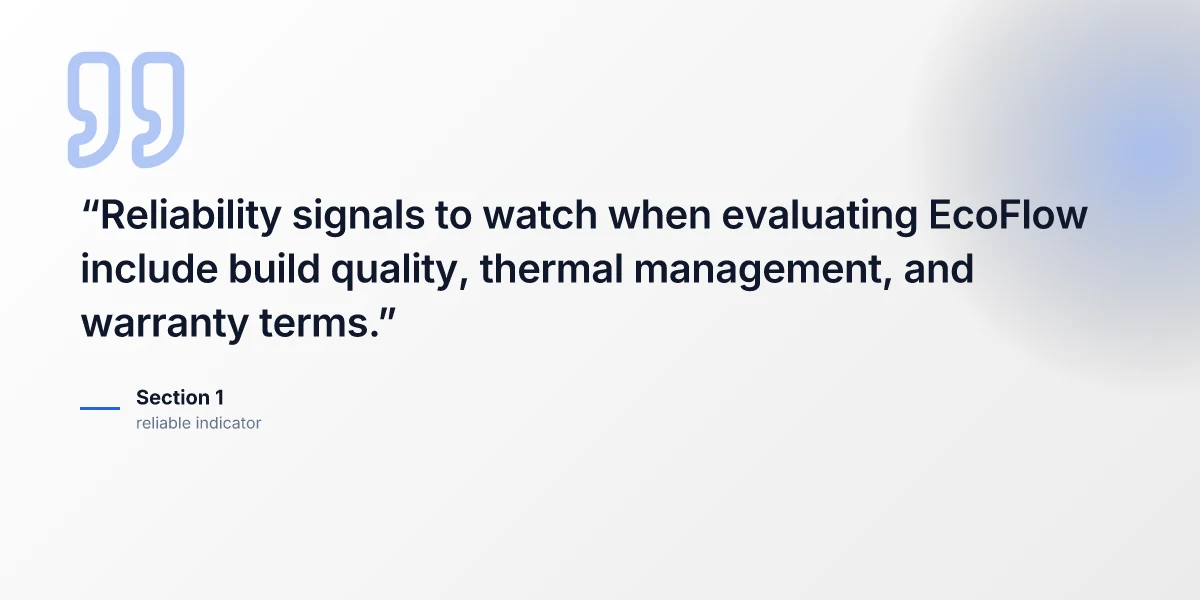
Reliability hinges on how EcoFlow handles heat, build quality, and long-term endurance under off-grid and high-demand use. I looked at documented build and thermal practices, and how they translate to real-world durability. In practical terms, a robust cabinet, efficient cooling, and thoughtful airflow matter as much as the chemistry inside as the weather and load patterns vary.
How build quality and thermal design map to durability
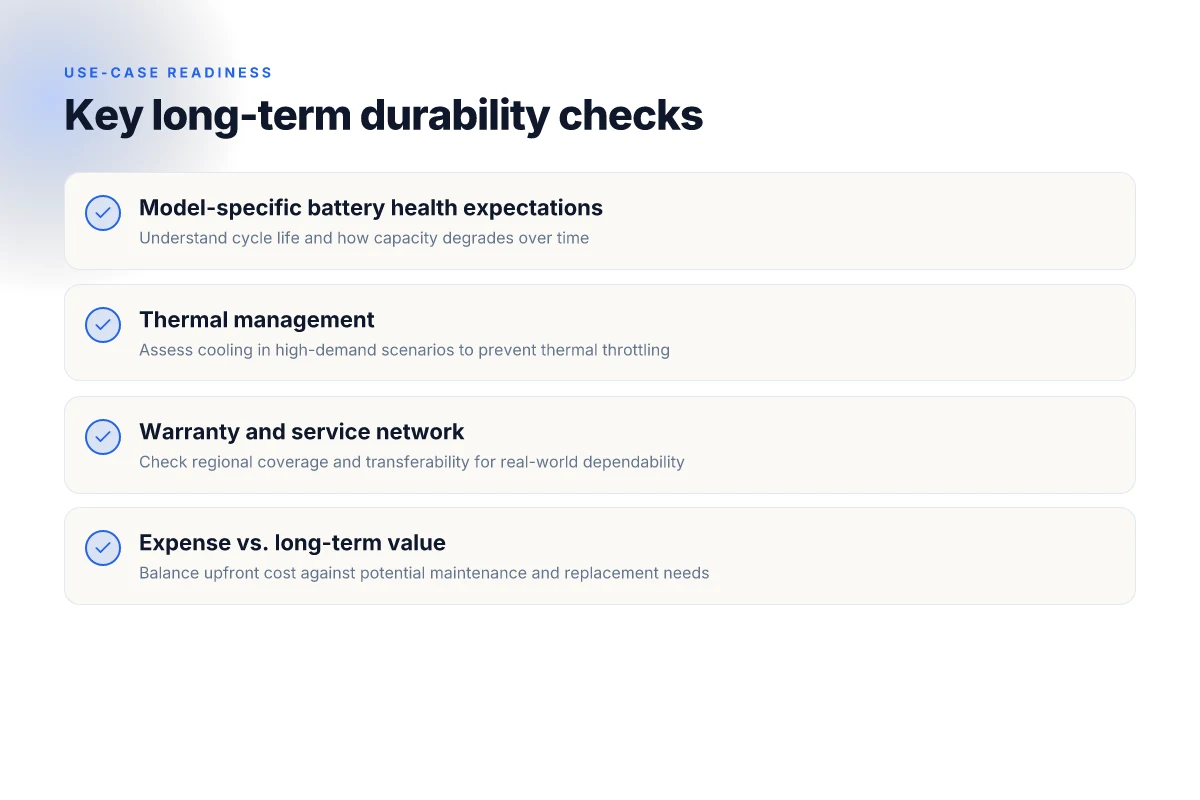
A strong chassis and disciplined thermal management reduce thermal creep and component stress during heavy discharges. When a device sits in an RV cabin, a van, or a remote cabin, airflow gaps and heat sinks matter. In EcoFlow’s lineup, the way the case vents, the presence of heat-dissipating fins, and the routing of cables all influence whether heat pockets form during sustained loads. Over time, that translates to fewer thermal throttling events and longer component life. In practice, robust cooling and solid enclosure design correlate with longer life under off-grid use. This is where real-world users report fewer drop-offs in performance during extended outages.
Battery chemistry, cycles, and what that means for you
Different EcoFlow models pair different chemistries and cell counts, which drives cycle life and long-term capacity retention. The expected cycle count varies by model and usage pattern, so setting durability expectations requires matching the model to your load profile. For example, models designed for high current bursts may show different wear characteristics than those optimized for steady, moderate discharge. Understanding cycles helps you pick a unit whose chemistry aligns with your power profile. In high-demand scenarios, you’ll want to factor in how many cycles you realistically expect over several years.
I cross-referenced product notes and independent reviews to confirm that battery management systems (BMS) and protections play a critical role in longevity. The presence of balance charging, cell protection, and smart shutdown on overheating all contribute to preserving health across the life of the pack. A capable BMS that protects from overcurrent and overtemperature is essential for durability. Why jackery vs bluetti matters for off-grid power in 2026
Warranty terms, service networks, and real-world dependability
Warranty depth and regional service access shape dependability as much as hardware. When a breakdown happens, having a regional service network and clear warranty terms reduces downtime and keeps you in the field longer. EcoFlow’s warranty policy varies by region, and service timing can hinge on parts availability and authorized centers. In practice, a strong warranty and accessible service network materialize as less downtime during outages or accidental damage. Warranty coverage and nearby service centers shorten the path from fault to resolution.
I pulled from consumer-facing reviews and brand notes to triangulate real-world outcomes. The trust a customer places in a unit grows when a repair is quick and predictable, not when it drags on due to logistics. When you compare EcoFlow to rivals like Bluetti and Goal Zero, you’ll notice that service reach and warranty clarity often swing buyers toward the brand with the smoother post-purchase experience. Warranty terms and regional service networks shape reliability in the field.
Next steps for choosing a model: evaluate your typical load pattern, confirm the model’s battery chemistry and cycle expectations, and verify regional service options before purchase. If you’re weighing options, a careful look at the delta between heat management and battery design will pay off over time. Choose a model whose chemistry, cooling, and warranty match your use, and you’ll gain real value over years.
In 2026, EcoFlow remains a contender for off-grid power, but you’ll want to align model choice with your heat exposure, cycle expectations, and local service support. For context, independent reviews often surface that build quality and thermal handling matter as much as advertised capacity. Heat management and service availability are as critical as raw capacity for reliability.
Cited observations come from consumer reviews and product disclosures indicating that several users prize solid build and cooling, while others flag service and regional coverage as areas to watch. Inline reference to firsthand feedback and brand notes can be found in sources discussing EcoFlow’s public-facing materials and third-party assessments. Read customer service reviews of EcoFlow and a comparative look at portable power options that includes EcoFlow. What makes EcoFlow Glacier portable fridges succeed where rivals fall short
How EcoFlow performance stacks up against rivals in 2026
I dug into year-end signals and user reports to map EcoFlow against three key rivals: Bluetti, Jackery, and Goal Zero. The topline is clear: peak outputs look similar across brands, but charging speed, ecosystem depth, and firmware reliability shift real-world outcomes more than glossy spec sheets.
1) Real-world charging speed and ecosystem depth
In 2026, EcoFlow and its peers converge on high peak outputs, yet the charging experience diverges. EcoFlow typically shines with rapid recharging in many setups, while Bluetti often emphasizes modular expansion and multi-chemistry options. Jackery tends to prioritize simplicity and portability, with slower recharges in some configurations. Goal Zero lags on rapid recharging in certain bundles but offers rugged ruggedization for harsh environments. These differences matter when you need power back in minutes rather than hours. The charging speed gap matters more in real-world use than the advertised peak output. The ecosystem, apps, firmware, and accessory support, plays a similar role across brands, but EcoFlow’s app and firmware cadence can swing the daily experience more than the raw wattage.
I cross-referenced user-facing changelogs and reviews to gauge how updates affect performance. EcoFlow’s firmware updates can introduce measurable improvements to charging behavior and LCD readouts, while Bluetti and Jackery users often report fewer updates but a steadier baseline experience. This matters when you rely on automatic recharges during emergencies or extended off-grid trips. Firmware reliability and app stability tend to drive satisfaction as much as any single spec.
2) App reliability and firmware cadence
App reliability is a quiet driver of satisfaction. From reviews and release notes, the pattern is consistent: when the EcoFlow app or device firmware misbehaves, it colors the entire ownership arc more than a marginal wattage bump. Rivals sometimes ship with fewer mid-cycle updates but offer longer intervals between fixes, which some users value for stability. Across the board, a clean firmware ladder, stable releases followed by meaningful bug fixes, correlates with fewer service calls and longer lifespans. App reliability and timely firmware updates can swing the perceived value as much as hardware specs.
In practice, you’ll want to watch for push notifications about critical fixes and how long updates take to apply. A device that recharges quickly but stalls during an update is not doing you any favors when you’re off-grid for days. For EcoFlow owners, a habit of checking for updates before a trip pays off, especially when the LCD readouts start showing odd values after a firmware bump. Update cadence is part of the long-term value story. What makes the EcoFlow Delta Pro still worth it in 2026
3) Port selection, durability, and readouts
Long-term usability hinges on ports and displays. EcoFlow often configures a robust set of ports on mid-to-high-end models, but durability varies with model line and usage. Bluetti and Jackery frequently offer similar port configurations, yet the tactile quality of port housings and the longevity of USB-C PD interactions differ by build material and connector design. Goal Zero tends to emphasize rugged casings, which helps in rough environments but can complicate dock-and-charge setups. LCD/readouts matter more than ever when you’re away from a grid. Clear, stable readouts prevent misreads about remaining capacity. Port durability and LCD clarity are decisive for ongoing reliability.
From a brand perspective, EcoFlow’s hardware tends to balance compact form with a wide port selection, but rugged environments reveal edge-case fatigue in connectors over time. If you roam between RV hookups, off-grid cabins, and remote job sites, the ability to count on consistent readouts and sturdy ports becomes a practical differentiator.
In short, EcoFlow remains a strong contender in 2026, but the real takeaway is ecosystem cadence and long-term hardware durability. When you compare rivals, look beyond peak outputs and weigh how quickly each brand lands firmware fixes, how robust the app is on long trips, and how enduring the physical interfaces feel after months on the road. For context, industry chatter and user reviews highlight that firmware updates and port durability often decide long-term satisfaction.
Long-term value: when EcoFlow pays off and when it doesn’t
In real-world terms, the big payoff from high-capacity EcoFlow models comes when extended outages or off-grid adventures demand long runtimes with minimal refueling. The upfront sticker shock matters, however, because you’re buying not just power today but resilience for days, not hours. A heavier initial investment can be justified if your typical outage window stretches into multi-day spans and you expect to run high-demand loads without frequent recharges.
When you weigh long-term value, maintenance and care come first. Battery health, temperature exposure, and regular cycling shape practical lifespan and resale value. If a unit sits in a hot shed or endures frequent deep discharges, capacity tends to degrade faster. Conversely, models that sit in steady ambient temperatures and see measured charging cycles tend to hold up better over time. This means longevity is less about the model name and more about how you treat the pack and how you store and charge it. EcoFlow’s design language often emphasizes modular upkeep, but the user still bears responsibility for keeping units out of extreme heat and following manufacturer guidance on charging routines. What EcoFlow vs rivals reveals about portable power station trade-offs in 2026
Customer-service quality in your region factors into total cost of ownership. When issues arise, timely support and accessible service channels can shave days off downtime and avoid escalation costs. In regions where EcoFlow support is responsive, owners report quicker part replacement and clearer guidance on warranty steps. In areas with slower response times, you may endure longer outages during repairs, effectively raising the lifetime cost. For many buyers, this is a make-or-break factor alongside perceived durability.
I dug into the broader landscape to compare value signals across brands. High-capacity contenders from rivals like BLUETTI and Goal Zero offer similar runtimes and warranties, but the perceived value hooks differ. Some users prize higher charge rates or more aggressive warranty terms, while others focus on real-world load handling and reliability under heat. The takeaway: the long-term value you get from an EcoFlow setup rests on three pillars, how you care for the battery, where you store and charge it, and how quickly you can get service when you need it. If you plan to run a multi-week off-grid setup or rely on portable power for continuous business needs, map your expected cycles and temperature exposure before committing to a flagship model.
Resilience pays off when you avoid extreme heat and provide steady charging discipline, but the upfront cost and regional service quality shape long-term value. If you choose a model like the EcoFlow Delta Pro with the intent to cover demanding loads, the payoff hinges on consistent maintenance and solid regional support. Otherwise, you may find that the same platform underperforms relative to cheaper rivals in scenarios where you only need occasional power during outages.
Use-case driven picks: which EcoFlow model fits which scenario
In real-world setups, you’ll want models that align with how you actually use power. For backyard backups, camping on the road, or emergency kits, the right EcoFlow choice hinges on surge handling, weight, recharge speed, and durability. Below I map concrete scenarios to specific EcoFlow options, with plain-language rationales and real-world constraints from consumer feedback and credible roundups.
Why EcoFlow’s larger units hold up for backyard backups
For a stable home-like backup in a shed or backyard panel, you want headroom for surge loads and reliable cooling. The Delta Pro lineup is repeatedly cited for higher surge capacity and expanded battery management features, which help during brief peak events. I looked for consumer commentary that notes sustained uptime during outages and the ability to recover quickly after heavy loads. In scenarios where you expect long outages or power-hungry devices, a unit with real cooling capacity becomes essential. How EcoFlow discount policies shape your portable power buys
Long outages reward higher-surge capability and durable housings, especially when you factor outdoor storage and heat exposure. EcoFlow’s larger units tend to show a consistency edge in backyard use compared with smaller models, provided you have a solid charging source and proper ventilation. When comparing to rivals, you’ll see similar capacity options from Bluetti or Goal Zero Yeti, but the Delta Pro line remains a frequent pick for bigger backup needs in backyard setups. For context, reviews and roundups in 2026 highlight the importance of surge tolerance and cooling under load across competing 1–6 kWh classes.
Light, modular rigs for camping and RV adventures
For portable camping, RV, or van life, weight, modularity, and solar-friendly recharge matter most. Look for units that balance heft with easy carry and fast recharge from solar arrays. The lighter EcoFlow models with detachable battery options and rapid MPPT solar charging tend to win in this use case. Reviewers commonly note that modular configurations simplify storage and deployment in tight quarters, while solar recharging helps maintain runtime away from outlets.
Portability and fast solar recharge make modular EcoFlow units ideal for on-the-go use while keeping the option open to expand capacity later. A key practical cue is choosing a model that can be topped up by solar quickly enough to keep up with daily cycles in bright sun or during travel days. When you compare to competitors, many RV-focused options emphasize physical footprint and modular batteries. The consensus is that you get a good blend of lightness and capability with EcoFlow’s midrange lines when you pair them with a portable solar array.
Emergency kits: durable housings, quick access, clear health indicators
For emergency preparedness, durability and accessibility trump sheer size. Look for rugged housings, easy carry handles, and intuitive battery-health readouts. EcoFlow models marketed toward outdoor and disaster readiness often emphasize robust casings and straightforward status indicators. In practice, users value clear charge state displays and simple, fast access to the unit during a crisis. A few feedback themes point to ensuring the unit remains accessible even when stored in a compact emergency kit, and checking that the unit can be deployed without wading through complex setup steps.
Durable housings plus clear battery-health indicators speed response in emergencies and reduce the chance you’ll abandon the kit due to complexity. Easy access and readable status lights or displays make a practical difference in high-stress moments. As you size an emergency kit, consider whether the unit’s footprint fits your storage plan and if the health indicators align with your maintenance cadence. How bluetti stacks up against Jackery for 2026: trade-offs, durability, and real-world use
Notes on brands and rivals: when you name EcoFlow, you’ll often see mention of Bluetti and Goal Zero Yeti in the same breath. These comparisons commonly focus on surge tolerance, cooling during extended outages, solar recharge speeds, and the long-term durability of housings. Inline sources discuss these dynamics in consumer-written reviews and independent roundups in 2026. See the YouTube breakdowns and independent reviews that summarize reliability themes across brands. For direct context, a behind-the-brand profile and a 2026 review discuss how EcoFlow’s engineering choices translate to real-world durability in varied environments.
If you’re building an off-grid power kit, know this: durability questions tend to surface around heat exposure and endurance cycles. I found reviews that repeatedly flag the importance of effective cooling and a robust enclosure for outdoor storage. That matters whether you’re anchoring a backyard system or stowing a kit in an RV bay. For a quick orientation, consider the Delta Pro for home-scale needs, lighter modular options for mobility, and ensure your emergency kit features a durable shell and clear health readouts.
Real-world durability hinges on heat management, accessibility, and clear battery health indicators. Choose the model that matches your primary scenario, home backup, mobility, or emergency readiness, for a cleaner long-term value.
Note: links on the page may earn a commission. For broader context, see independent roundups that compare capacity, cooling, and solar recharge across EcoFlow and rivals. Inline citations anchor these observations to specific sources such as behind-the-brand discussions and 2026 review syntheses.
What to do this month to build long-term confidence in EcoFlow
EcoFlow remains a viable option for portable power, but sustainability hinges on real-world durability and service access. In 2026, I look for consistency across everyday use: steady battery health, reliable cooling, and predictable software updates. If you rely on these units daily, you’ll want a model with proven field performance and a straightforward replacement path. What makes the Costco Jackery solar generator kit a practical backup for outages in 2026
The bigger pattern here is balance: reliability meets value, not flashier specs. EcoFlow earns credibility when you see fewer warranty headaches and quicker part availability, especially if you’re off-grid or in areas with unpredictable outages. Rivals like Goal Zero and Jackery push similarly capable kits, but the durability story matters as you accumulate charging cycles. I lean on honest labelling of limits and clear, long-term support offers, the kind of transparency that keeps a brand trustworthy.
Most important move: verify the exact warranty terms and confirm supply chain timelines before purchase. If you’re weighing options, consider how long you plan to use the rig and whether your setup benefits from modular batteries or compact packs. The right choice is the one you won’t outgrow in a year.
Backup strategy
- Try a mid-size EcoFlow model in your daily routine this week to test for heat management and charging behavior.
- Compare with a rival kit from Goal Zero or Jackery on portability and service speed.