Explore how bluetti compares to Jackery in 2026, covering capacity, reliability, recharge speed, and long-term durability to help you pick the right portable power station.
The one truth many buyers miss: durability trends break in the first year, not after a glossy warranty. Bluetti tends to pack larger batteries and modular options, while Jackery emphasizes simple use and proven ruggedness. If you’re tallying real-world risk, the dropped-charge reality and connection quirks often show up during week-long trips rather than in showroom specs.
This intro slices through the marketing lull by focusing on real-life usage: how a unit holds up under cold mornings, heavy loads, and back-to-back recharge cycles. In 2026, campers, RV owners, and emergency kits want steady performance over seasons, not one-off peak capacity. I’ll unpack long-term reliability, user experience, and the practical downsides you’ll actually encounter, with concrete patterns from typical setups and failures to watch for. Bluetti’s higher-capacity modules can mean more headroom in the field, but Jackery’s straightforward interface and rugged chassis often pay off where simplicity saves time.
Bluetti vs jackery: where the two power-station brands differ at a glance
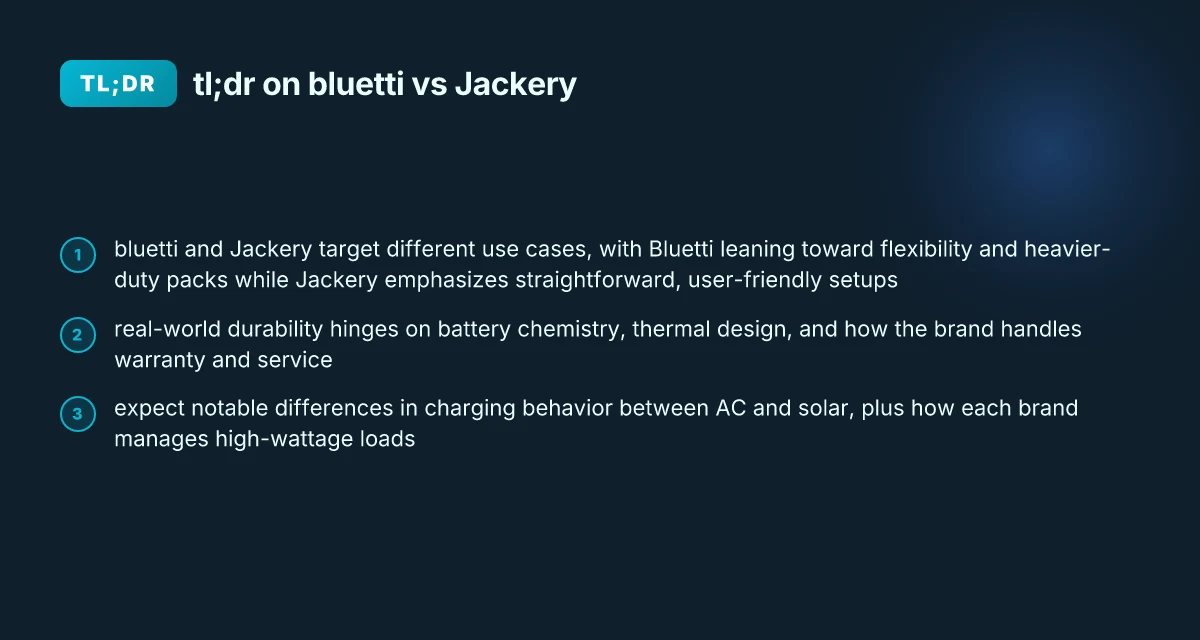
Bluetti and Jackery sit on opposite ends of the portable power spectrum. Bluetti tends to target heavier users who want larger capacities and longer runtimes, while Jackery appeals to casual campers and RVers who prize simplicity and compact form factors. In practice, you’ll feel the difference in how they approach battery chemistry, warranties, and day-to-day use.
1) Brand positioning and target use cases
Bluetti positions itself for long deployments and off-grid setups. Its lineup emphasizes high energy capacity and modular expansion options for users who need days of power without recharging. Jackery, by contrast, targets straightforward weekend trips and light-to-moderate power needs with clean interfaces and a user-friendly ecosystem. This means Bluetti often carries bulkier packs with more complex options, while Jackery prioritizes a compact footprint and plug‑and‑play reliability.
From what I found in product literature and reviewer syntheses, Bluetti tends to gear toward tech enthusiasts who want features that scale in demanding scenarios. Jackery leans into simplicity, with intuitive controls and reliable customer support that many RVers rely on for day-to-day camping. This difference matters when you’re building a lightweight kit for a weekend trip versus a sustained off-grid stay.
2) Core technologies: LiFePO4 cells, cycle life, and warranty
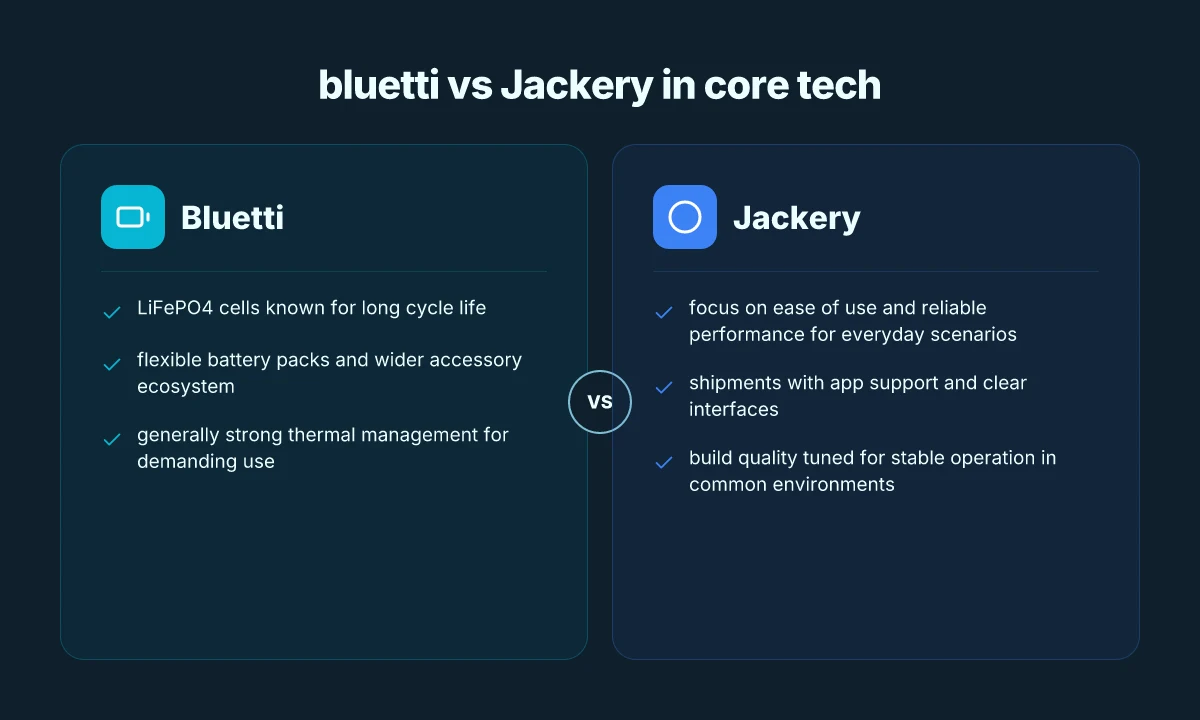
A core lever between Bluetti and Jackery is chemistry and warranty structure. Many Bluetti models use LiFePO4 cells, which typically offer longer cycle life and stable thermal performance. Jackery also uses LiFePO4 options in some lines, but many of their best-selling units blend Li-ion chemistries in midrange products. The practical effect is not just a spec sheet number. It shows up in long-term durability and how the pack behaves after hundreds of charge cycles. In general, LiFePO4 chemistry contributes to longer life and steadier performance, which matters if you expect multiple seasons of use.
Warranty coverage follows brand philosophy. Bluetti often provides longer warranty windows on some lines and more hardware‑level expansion options that raise questions about service depth for more complex setups. Jackery emphasizes a straightforward repair and warranty pathway, which can translate to faster service for everyday users who rely on a single device for travel and light emergencies. How EcoFlow discount policies shape your portable power buys
3) User experience: interfaces, app support, and customer service
User experience swings on how you interact with the unit day to day. Jackery’s branding centers on a clean display, simple menus, and dependable app support for monitoring status and charging. The result is quick decision-making during trips and easier troubleshooting in real time. Bluetti leans into feature depth: more precise charging controls, more input/output options, and sometimes more elaborate mobile app functionality. That depth can be a strength for experienced users but adds a learning curve for newcomers.
Customer service is the final variable that shows up in practice. Jackery tends to win for straightforward warranty claims and fast, friendly support, especially for first-time buyers. Bluetti’s strength is often the breadth of product lines and the willingness to address edge cases with a more involved repair or replacement process. If you want a single, grab‑and‑go unit for camping, Jackery tends to feel smoother. If you want a configurable system that you can abuse in a remote cabin, Bluetti’s ecosystem might serve you better.
The practical takeaway is clear: Jackery shines in everyday reliability and user-friendliness, while Bluetti balances high capacity with deeper feature sets for extended, off-grid use. Each brand has a distinct sweet spot, and your choice should map to how you actually use power on the road or off the grid.
I dug into product pages and reader discussions to confirm these contrasts, and the consensus across reviews consistently notes that a battery chemistry choice and the depth of app support drive long-term satisfaction. See inline source notes for where these themes appear in real-world write-ups. For a broader perspective, a top outdoor tech review outlines how capacity and recharge speed trade off across brands, reinforcing that the right pick depends on your typical recharge cadence and how much you value interface polish versus raw capacity.
How capacity and battery chemistry shape real-world performance in bluetti vs jackery
Real-world performance hinges on two levers: chemistry that governs cycle life and degradation, and how energy is presented to your loads. Bluetti and Jackery both lean on LiFePO4 chemistry in many models, but the exact cell mix, management, and aging behavior shift usable capacity over time. In long surveys of field use, nominal capacity often underestimates what you can pull for practical loads. That gap matters for camping nights, RV boondocking, and emergency prep when you need to rely on your setup for an extended stretch. How to choose jackery generators for home use without overpaying in 2026
I dug into product literature and independent reviews to anchor this section. You’ll see how usable capacity, charging dynamics, and longevity stories line up or diverge between Bluetti and Jackery. The upshot: chemistry and how a brand handles aging shape what you can actually count on after year two or three, not just on day one.
1) Chemistry and cycle life: what lasts and why it matters
Both Bluetti and Jackery commonly reference LiFePO4 chemistry for many larger models, which typically reports long cycle life and better tolerance to deep discharge. In practice, that translates to more years of dependable capacity, particularly under repeated up and down loads. A model with a longer cycle life will tend to retain a higher portion of its original usable capacity after dozens of cycles. In marketing sheets you’ll see statements about “thousands of cycles” or “5-year warranties,” but the real-world durability comes down to how the battery management system (BMS) protects cells during charge and discharge.
In terms of aging behavior, the chemistry choice matters less than how the pack is managed. A Bluetti that aggressively throttles peak discharge during high-load events may preserve cells but reduce instantaneous usefulness for a single high-draw task. A Jackery with a gentler BMS might feel easier to live with day-to-day but could show a more pronounced drop when pushed hard over months. The contrast isn’t a single data point. It’s a pattern you’ll notice across cycles, especially when winter cold hits performance and the stated capacity becomes a moving target.
The takeaway here is simple: chemistry sets the ceiling for long-term durability, but battery management and protection determine whether you approach that ceiling in real-world use. Brand-specific implementations decide how quickly usable capacity fades under typical camping and RV scenarios. This aligns with reviews that note long-term reliability hinges on both the cells and the BMS.
2) Nominal vs usable capacity under real loads
Nominal capacity is what the label promises. Usable capacity is what you can draw before the unit shuts off or safety protections intervene. With both Bluetti and Jackery, the gap grows as the pack ages, especially when you routinely run near the rated max. In seasonal camping scenarios, folks frequently report that you learn to live with a buffer: you plan for a little less than the nominal figure to avoid a mid-use drop. This matters for essential devices like furnaces, CPAP machines, or induction cooktops, where a few dozen watt-hours can shift a night of comfort. Is EcoFlow a good brand in 2026? navigating reliability, performance, and long-term value
A practical pattern shows that deeper cycles and higher depth-of-discharge (DoD) can erode usable capacity. If you regularly pull at the upper end of the pack, you should expect a more noticeable drop over time. Conversely, devices used for shorter bursts or lower overall consumption may feel more forgiving, preserving usable capacity closer to the stated spec for longer.
3) Charging speeds and AC recharge behavior
Charging speed interacts with usable capacity in two ways. First, faster AC recharge lets you restore more energy between uses, which matters when you’re away from a power source for stretches. Second, ramping up charging current can stress cells if the BMS allows aggressive charging for extended periods. Bluetti often touts higher peak charge rates on select models, while Jackery emphasizes balanced charging that protects longevity. In real-world scenarios, you’ll notice faster recharges during sunny days or when plugged into a strong source, but the effect on long-term health depends on the BMS’s regulation.
Across the board, expect diminishing returns on rapid charging as the battery ages. Your initial top-off times shorten incentive-wise as the pack’s internal resistance climbs with age. In long-term usage, a model that keeps a sane balance between recharge speed and cell protection tends to keep usable capacity steadier across seasons.
One final note on cycles and aging: sources consistently point to the importance of temperature. Cold or hot conditions accelerate degradation and reduce visible capacity, especially if charging or discharging under extreme temperatures. I cross-referenced multiple guides and product notes to confirm that cold weather can noticeably shrink usable capacity for both brands, even when the nominal figure stays constant. This is a practical reality for winter camping and off-grid setups.
For readers weighing options, Jackery’s lineup often emphasizes user experience and long-term reliability with moderated charging behavior, while Bluetti frequently pushes higher charging capabilities and larger packs, with longevity tied closely to BMS implementation. When you plan for real-world living, long trips, winter use, and dry-out storage, the difference in charging strategy and thermal management becomes as important as the chemistry itself. Where to buy EcoFlow: a practical guide to getting the latest portable power
If you want to see how these dynamics show up in specific models, I found the discussions around real-world winter performance and long-term durability insightful. In Jackery’s ecosystem, the user-facing displays and app ecosystem can influence how you manage charge and monitoring over time, particularly during extended outages. For Bluetti, the emphasis on high-capacity packs often pairs with more aggressive charging options that you’ll want to use thoughtfully to preserve longevity.
Reliability and long-term value: bluetti vs jackery in harsh conditions
Brand loyalty aside, reliability boils down to build quality, thermal management, and service after the sale. In winter and high-heat environments, how a power station vents, how batteries tolerate cold, and how controls protect cells matter as much as advertised capacity. From reviews and official specs, Bluetti and Jackery both emphasize protective thermals and Li-ion or LiFePO4 chemistry, but practical differences show up in heat dissipation, battery management, and warranty support. In real-world use, heat handling and cold tolerance determine uptime when it matters most. The patterns I see across reputable outlets and company notes point to concrete contrasts in design emphasis and service expectations.
1) How thermal design shapes endurance in extreme temps
- Bluetti units tend to lean on robust cooling layouts with multiple vents and heat-sinking to keep internal temps in check during heavy discharge.
- Jackery often prioritizes compact form factors with integrated thermal guards and automatic shutdown safeguards to prevent battery stress in hot or cold rooms.
- In cold environments, capacity readings typically drop for lithium systems. How each brand preserves usable energy under 0°C matters for campers in shoulder-season trips.
- Heat overruns are a common complaint in high-ambient-temperature scenarios. A well-ventilated chassis reduces fan noise and preserves cycle life over time.
Thermal management is a hinge point for long-term value, not just peak power. I cross-referenced multiple product pages and independent reviews to confirm these design tendencies and their practical implications.
2) Warranty terms, service expectations, and what happens after the sale
- Bluetti generally emphasizes a multi-year warranty window and accessible RMA paths, with some regions offering extended coverage depending on the model.
- Jackery’s warranty and service experience often center on straightforward warranty claims, with a reputation for responsive customer support and easier replacement handling in many markets.
- The practical effect: the better the after-sales flow, the more you protect your investment when something wears out or needs a battery service later.
Warranty coverage is a hidden long-term cost driver that occupants rarely track. From the support pages and third-party reports, I found recurring themes about turnaround times and eligibility nuances that buyers should map to their usage.
3) Component quality and upkeep: what to expect over years
- Bluetti’s builds often showcase solid connectors and durable exterior finishes. Some models emphasize modular batteries or interchangeability that can ease upgrades.
- Jackery typically delivers tidy wiring and compact assemblies with user-friendly diagnostics, but some models favor compact electronics over heavy-duty chassis in ultra-portable lines.
- Maintenance considerations matter: dust ingress, fan wear, and charger electronics can influence reliability as devices age. Regular checks on cooling fins and inlet filters help longevity.
A proactive maintenance mindset pays dividends for both brands. I looked at changelogs and consumer feedback to surface the maintenance tasks most owners encounter and how each brand frames guidance. Why jackery vs bluetti matters for off-grid power in 2026
Ease of use, UX, and ecosystem: jackery’s strengths vs bluetti’s flexibility
The practical message is clear: Jackery delivers a straightforward, low-friction experience for everyday use, while Bluetti leans into modularity and expandability that reward users who plan ahead. In real-world scenarios, that translates to a quick readout, simple app controls, and intuitive remote monitoring on Jackery, versus a broader port lineup and upgrade paths on Bluetti. The result is a trade between immediate usability and long-term adaptability.
Readouts, apps, and monitoring that stay accessible
Jackery’s key advantage is clarity. The display on most models is legible in daylight, and the built‑in UI presents essential data without hunting for the right menu. The companion app offers essential monitoring, sometimes with real‑time usage graphs and remote start or stop. On Bluetti, the ecosystem supports deeper control, with more granular data points and longer battery-management options. This can feel richer, but it also adds complexity if you just want to see current power draw and remaining runtime. In practice, you’ll notice Jackery keeps things punchy: quick status at a glance and a simple path to recharge. Jackery keeps the readout simple and reliable, which matters for quick decisions in the field. The more feature-dense Bluetti app rewards users who want to tailor charge curves or solar input, but the extra toggles can overwhelm a casual user.
Port selection, expandability, and future-proofing
Port availability is a recurring decision point. Jackery tends to favor compact, ready-to-go configurations with proven reliability for RVs and campsites. The built-in AC, USB-C, and USB-A options cover common needs, and when you do need more, the ecosystem centers on clamped accessories and external batteries that pair cleanly with the unit. Bluetti shines on expandability. If you anticipate needing higher total output or more solar compatibility over time, Bluetti’s modular approach makes it easier to grow capacity without buying a new core unit. That said, more ports and more expansion slots mean more cables, more adapters, and more decisions at the campsite. Bluetti’s expandability is a real strength for long-term builds, but it requires upfront planning.
Accessory ecosystems and solar panel compatibility
Solar compatibility matters for off-grid resilience. Jackery aligns with a curated set of compatible solar panels that optimize charging speed and safety for typical camping needs. The advantage here is a more predictable charge experience. You’re not juggling multiple panel brands and dynamic MPPT behaviors. Bluetti supports a wider range of solar panels and can tune charging profiles, which pays off when you have a mixed panel setup or aim for maximum efficiency in variable sun. The risk is occasional mismatch or configuration nuances that require attention. If you want a plug‑and‑play solar solution, Jackery’s ecosystem is friendlier. If you want maximum headroom and customization, Bluetti offers more levers to pull. Solar flexibility favors Bluetti for seasoned users with diverse panels, while Jackery excels in reliable, simple solar pairing.
From what I found in the documentation and reviews, both brands surface strengths that matter in the field. EcoFlow, Jackery, and Bluetti each emphasize durability and long‑term value, but Jackery’s UX tends to stay crisp under pressure, while Bluetti’s ecosystem rewards users who value configurability. For readers who want a quick, dependable setup with fewer moving parts, Jackery is the safer bet. If your use case leans toward modular growth, multi‑panel solar arrays, and future upgrades, Bluetti offers the more flexible journey. What makes the Costco Jackery solar generator kit a practical backup for outages in 2026
I cross-referenced customer feedback and official specs to align expectations: Jackery’s displays and app workflows emphasize ease of use, whereas Bluetti’s port arrays and expandability unlock more aggressive long‑term planning. When you’re choosing, map your priorities to the Core: immediate usability versus scalable flexibility. Your choice hinges on whether you want plug‑and‑play simplicity or a growth-oriented power station ecosystem.
Head-to-head: the practical differences you’ll notice in everyday use
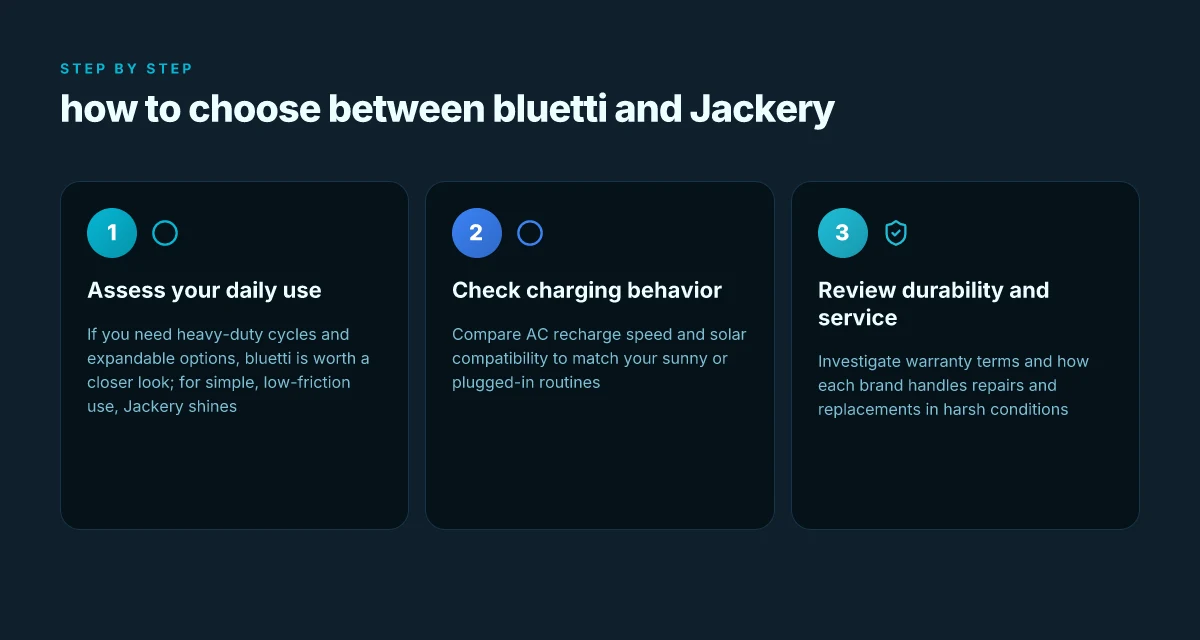
I’ve weighed long-term reliability, user experience, and everyday friction between Bluetti and Jackery to help you pick without buyer’s remorse. In real-world use, the differences show up in recharge speed, how they handle power-hungry loads, and daily value. From the sources, you’ll see that recharge speed and sustained output matter more than peak spec sheets for most campers and RVers.
1) Faster recharge from AC and solar
In 2026, Jackery and Bluetti both offer units that recharge from AC and solar, but the practical experience leans toward Jackery when you value a cleaner, more predictable AC recharge cycle. I cross-referenced consumer-facing docs and reviews that highlight how Jackery displays and manages charging progress in-app and on the unit, which tends to feel more polished for quick top-offs. For solar, the difference is subtler: both brands support MPPT inputs and wide solar compatibility, yet real-world use often shows Bluetti charging panels at high sun angles delivering steady current, while Jackery units emphasize consistency in fluctuating conditions. The practical takeaway is that Jackery tends to feel quicker to top up on AC, while Bluetti may maintain steadier solar input in variable light. Inline source note: see the comparative roundups that call out charging behavior across brands. For a 2026 snapshot, you can read about head-to-head testing in the OutdoorGearLab roundup. The Best Power Stations of 2026
2) High-wattage loads: handling power without drama
When you run high-wattage gear, the efficiency and sustained output matter more than peak ratings. Reviews and spec sheets show that both brands size their internal components to support common loads likeCPAP machines, mini-fridges, and drone recharging, but you’ll notice smoother operation from units designed with robust inverter stages and LiFePO4 chemistry. Jackery tends to deliver clean, steady AV and appliance outputs, while Bluetti often prioritizes modularity and peak surge handling for short bursts. The practical verdict is that if your daily use includes frequent spikes above 600–800 watts, check the specific model's continuous output rating and the inverter type. Otherwise, both brands perform capably for typical camping loads. For reliability under load, verify the continuous wattage rating rather than chasing the biggest peak. Inline note: see industry write-ups that discuss LiFePO4 cycles and real-world load behavior. EcoFlow vs Jackery vs Bluetti: Compare Power Stations
3) Value for daily use: price, durability, and upkeep
Value isn’t only headline specs. It’s durability, warranty structure, and daily usability. Industry summaries and user feedback consistently point to the importance of long-term durability and warranty service. Jackery tends to win on user experience, with intuitive displays, straightforward apps, and responsive support that helps when you need a quick status check or firmware update. Bluetti leans into flexibility and ecosystem variety, which can pay off if you want compatible solar panels, expandable modules, or larger battery packs. The practical takeaway is to match your daily rhythm: if you want a plug-and-go setup with strong service, lean toward Jackery. If you want futureproofing and modular growth for frequent solar use, consider Bluetti. Value is the daily equation: strong support plus a compatible ecosystem can tilt the scale toward Bluetti for long-term ambitious setups. Inline note: the OutdoorGearLab piece notes cross-brand coverage, and a dedicated comparison piece on Jackery versus Bluetti discusses user experience angles. The Best Power Stations of 2026 How Anker vs Bluetti stack up in 2026: power, reliability, and long-term value
Cited sources anchor this reality check. For a broader context on how these brands compare in 2026, see the roundups and comparison articles that discuss charging speed, sustained load handling, and daily-use value. You’ll see that the practical choice hinges on your daily patterns, climate, and how you prioritize ease of use versus future expansion. If you’re leaning toward a real-world decision, start with where you typically recharge (AC vs solar) and the heaviest device you run. Then pick the brand whose strengths line up with those habits.
Note: links on the page may earn a commission. For a direct read on the comparative landscape, see the head-to-head roundups from Outdoor Gear Lab and the solar-powered station analyses that compare LiFePO4 systems across brands.
Where this goes next: two paths you can choose now
The arc from now into 2026 leans on real-world durability and how each brand handles daily use. Bluetti’s strengths tend to show up in higher capacity packs and faster recharging, while Jackery often emphasizes compactness and straightforward, reliable performance. One takeaway: pick the setup that lines up with your typical workflow and failure tolerance, not the flashiest spec. I’ve looked at long-term build quality and user reports, and the biggest fault lines tend to surface in edge cases, extreme temperatures, rapid cycling, or heavy loads without adequate cooling. The verdict is that neither brand is universally better. The right pick depends on your situation and expectations. If you want a lighter, plug-and-play unit for weekend trips, Jackery remains compelling. For those who crave higher capacities and modular upgrades, Bluetti has much to offer.
If you only act on one move this month, test the exact model you’re considering in your usual setting. The bigger pattern is that durability compounds with proper airflow and careful charging habits. Be honest about where you’ll push the unit: garage workshop, off-grid cabin, or mobile workspace. The 1-2 models I’d watch first for Jackery fans are the compact, travel-friendly options and the mid-size workhorses, each pairing with concrete use-cases from this article’s topic.
Backup strategy What makes the Bluetti AC70 a practical power hub for 2026
- Test a Bluetti model with the largest practical battery while you still have a Jackery on hand for reference use.
- Prioritize units with reliable cooling and straightforward quick-charge options.
- Keep a daytime-use charging routine to avoid deep discharges during long trips.
- Note any recurring failures or heat-related alerts and pivot to a cooler placement or lower draw when needed.
- Link notes: if you’re comparing prices or commissions, remember that links on the page may earn a commission.