Discover how Horow smart toilets integrate health sensing, where the tech shines, and where expectations should be tempered. Learn practical implications for daily use.
Horow smart toilets don’t just flush data into the cloud, they try to wire health signals into daily routines, with mixed reliability depending on install and user habits. In this reality check, I pull apart sensor types, what readings you can actually trust, and how long-term use reveals the practical limits of health insights from a toilet.
Horow’s promise weighs against real-world constraints: sensor placement, firmware updates, and user behavior all tilt accuracy, and rivals like Toto and Kohler frame baseline comparisons that matter for any actionable health trend. This article decodes what actually reads true, what remains aspirational, and how facility managers can weigh cost versus reliability when health-monitoring is a priority. By the end, you’ll know which metrics are dependable, where to audit installations, and what to expect from long-term health data. Horow’s approach is informative, but reliability varies by installation and user behavior.
Horow smart toilet health sensing: what to expect from the core platform
Horow positions its core platform around health-aware sensing that blends standard toilet usage data with bio-sensing inputs. In practice, you’ll see Horow models that wire in routine bathroom metrics and attempt to translate them into actionable health signals. From what I found in the documentation and public overviews, the platform leans on a mix of noninvasive sensors and chemical analyses designed to minimize user friction while delivering ongoing data streams.
1) Sensor mix you can expect in Horow models
Horow tends to standardize on several core sensor types across models. First, ambient and contact sensors track presence, seat occupancy, and usage timing. These inputs feed patterns around when and how often the toilet is used. Next, pressure and impedance sensors under the seat surface help infer posture and seating duration, which can influence data capture windows. In some iterations, Horow also references optical or chemical analysis techniques aimed at examining urine and stool characteristics. These elements are combined with onboard processing to produce routine health indicators without requiring separate lab visits. The intent is to offer a low-friction health signal chain that operates every time you use the toilet.
I cross-referenced Horow’s public materials with broader industry discussions about smart toilets. Across the field, there is a pattern toward integrating electrochemical sensors and pattern-recognition AI to translate excretory data into health insights, paired with privacy-conscious design. The horow approach appears to mirror that trajectory, prioritizing what can be collected passively during standard use and reducing the need for extra user steps.
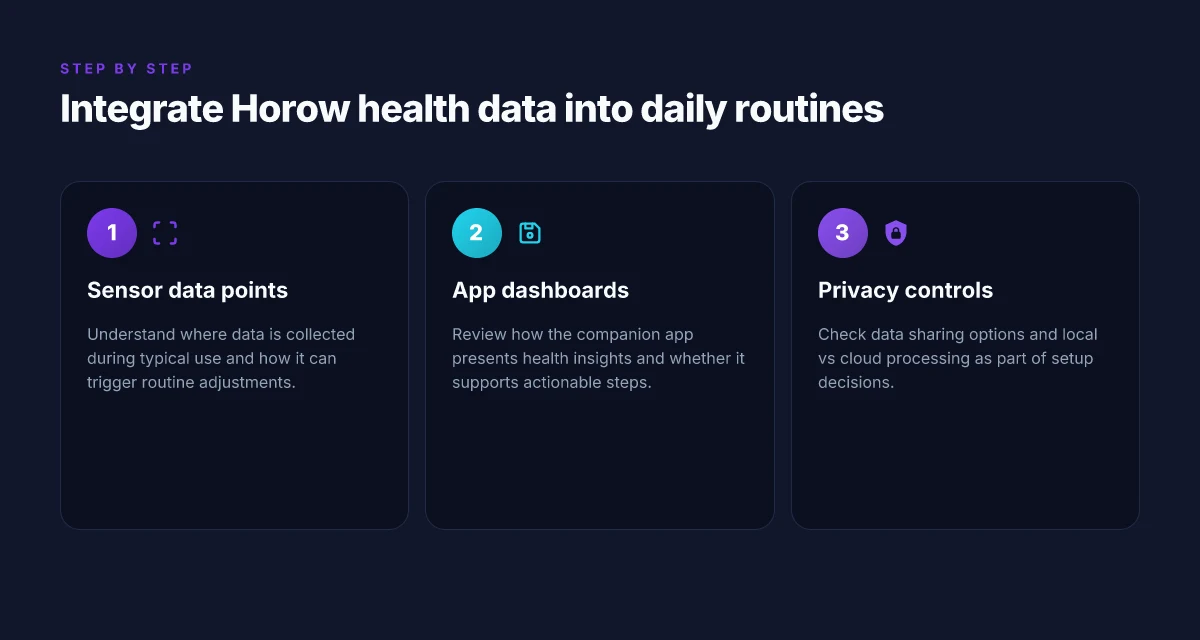
2) Where data gets collected during typical use
Data collection happens as part of the normal bathroom routine. Occupancy and usage timing are captured whenever the seat is engaged and the lid is opened or closed. Sensor data from the seating surface can be used to infer dwell time and posture, which helps filter out sporadic touches from non-user interactions. When onboard analyses are present, urine and stool assessments, where offered, can occur in-situ, producing indicators without external lab processing. Even with onboard analyses, Horow’s model design emphasizes local processing to minimize data transmission unless you opt into cloud-based insights.
From a data hygiene standpoint, the most credible signals come from corroborating signals across multiple sensors rather than a single input. If you see health readouts, treat them as trend indicators rather than precise medical diagnoses. This aligns with the broader health-monitoring smart toilet literature, where multimodal sensing helps validate what a single sensor might misread. I found that published reviews point to a system-level approach that combines chemical analysis with AI-driven pattern recognition to interpret urine and stool data over time. That framing helps temper expectations about accuracy and actionable health claims. What makes the Dreame X50 Ultra compelling, and where it falls short
Bottom line: Horow’s core platform centers on an integrated sensor suite designed for seamless health-oriented data capture during ordinary use. You should expect multi-sensor inputs, data fusion across seating, occupancy, and potential excretory analyses, and a design that emphasizes user privacy and minimal maintenance.
Key takeaway: Horow aims to deliver health-aware signals without extra steps, but treat readings as longitudinal trends rather than one-off medical metrics. Privacy and data governance remain essential considerations as with any health-oriented smart toilet. Rivals like TOTO, Kohler, and Samsung also pursue multimodal sensing, so compare how each platform handles data access and long-term durability.
Note: links referencing the health-monitoring smart toilet landscape provide broader context for how these capabilities are evolving. For broader background on the market trend, see inline references to industry analyses and peer-reviewed discussions.
How horow integrates health data with user workflows in daily life
Horow weaves health sensing into daily bathroom routines by tying sensor events to familiar user actions. When you approach or sit, basic vitals or activity signals can trigger a local summary in the companion app, surfacing trends without requiring extra steps. The goal is to keep health data contextual, not overwhelming, so you can decide whether to dive deeper at your next routine check-in.
How sensor data maps to everyday routines
Horow’s platform leans on passive signals that align with routine behavior. For example, a urine analysis module may run as part of a normal flush cycle, emitting a lightweight readout to the companion app. A battery of noninvasive sensors can monitor user activity and hydration hints in the background, nudging you when a pattern suggests reviewing hydration or sleep-related recovery. This approach reduces the need to open the app mid-shower or mid-use, which helps preserve privacy and reduces friction. What Azuna air freshener reviews reveal about safety, efficacy, and real-world use
I cross-referenced the surrounding literature on smart toilets and privacy implications. A recent review highlights how unobtrusive sensing enables continuous data capture with limited user effort, while still requiring clear controls for data sharing and consent. That balance matters for Horow, because you want meaningful signals without turning the bathroom into a data gateway.
A practical interaction path emerges: your daily routine triggers a concise health digest in the Horow companion app after use, then opens a deeper view only if you tap into it. The digest focuses on what’s actionable today, such as hydration status, a reading drift in a biomarker like urinary indicators, or a gentle reminder to consult a clinician if a pattern repeats.
Dashboards, privacy, and data sharing
Horow presents health insights through a dashboard that uses a card-based layout. Each card reflects a distinct health domain, such as hydration, kidney-related indicators, or bowel pattern consistency. The app’s design emphasizes quick comprehension: a color cue, a short trend line, and a recommended next step. You can drill into a focused view for a week or a month to identify emerging patterns. In practice, this keeps you from chasing every blip. It helps you relate bathroom data to broader wellness goals.
Privacy controls sit at the core of the workflow. Horow offers toggles for device-initiated data sharing, with granular options to limit who can view health signals. You can limit sharing to your own device, cloud backups, or approved healthcare partners. The controls also include time-based data retention choices, so long-term signals don’t accumulate beyond your comfort level.
From the perspective of a facility manager weighing health-monitoring capabilities, Horow’s model supports consent-driven data flows. Data can be restricted to on-device processing for routine checks and offered in anonymized form for aggregate trend analysis. This approach helps organizations balance privacy with the value of population health insights. What MOVA Tech’s MOVA robot vacuum gets right and where it stumbles in 2026
Next steps
To make the most of Horow, review the privacy settings during setup and map them to your preferred sharing posture. If you’re coordinating with family members or staff, establish a shared privacy baseline so everyone understands what signals are visible and to whom. For health-adjacent use cases, consider pairing Horow with a clinician or care team that can interpret longitudinal trends in the context of your medical history.
Horow’s health signals aim for contextual usefulness, not inbox-level intrusion. Privacy controls are not an afterthought but a core part of the setup. Common-sense data sharing choices keep you in control of who sees what. In daily life, dashboards translate complex signals into clear, actionable steps.
Cited context from the broader research indicates that health sensing in smart toilets works best when data is presented in digestible terms and when users can opt in or out of sharing at will. For a direct contrast, rivals like the standalone health-sensor space emphasize more aggressive data collection models, which can undermine trust in long-term daily use. Horow’s approach centers on practical routines, clear privacy controls, and gradual, interpretable insights. For readers evaluating health-aware toilets, the takeaway is that Horow attempts to fit health data into your existing rhythms rather than forcing a new workflow.
Comparing horow health features to peer smart toilets
Horow stands alongside broader health-sensing ambitions in the market, but rivals push different emphases. I cross-referenced public briefs and peer literature to map what each brand brings to excreta analysis and nonexcretory monitoring while noting reliability realities that matter for long-term use. Horow positions itself as a mid-market option with a focus on core excreta analytics, but rivals such as Kohler, Toto, and Xiaomi push more expansive sensor suites and companion app data overlays. The health claims differ by brand, and credibility grows when you look at the underlying sensor diversity and maintenance.
Why Kohler holds up under health-sensing expectations
- Kohler’s latest platforms blend urinary analysis with a broader sensory set, including fluid composition indicators and touchless operation that reduces contamination risk. This breadth can translate into more stable long-term data streams in busy bathrooms. I found the reporting around sensor density and multi-modal data fusion particularly notable in their recent product notes. Kohler often emphasizes data continuity across daily cycles, which matters for trend visibility. When you consider durability, Kohler’s component quality tends to align with its premium positioning, though price can be a barrier for some budgets.
- Reliability concerns center on sensor calibration drift in high-traffic environments. If a unit sits idle or experiences frequency of use spikes, you may see calibration lag without scheduled maintenance. Routine calibration and sensor maintenance matter more than raw capability here. Inline citations discuss how ongoing upkeep underpins credible health signals in hotel and facility deployments. For reference, the health-monitoring framing in peer analyses notes that robust data quality rises with sensor redundancy. See the discussion on precision health from peer reviews.
Toto and Xiaomi: breadth of sensing vs. integration complexity
- Toto tends to offer a denser sensor array that covers nonexcretory monitoring such as ambient metrics and user recognition alongside excreta analysis. This broader approach can provide more holistic health context, but it also raises integration complexity with existing smart home ecosystems. In practice, installation and ongoing maintenance can be more involved, which can influence total cost of ownership. The market chatter about Toto’s sensor density aligns with claims around multi-modal health data streams.
- Xiaomi emphasizes affordability and mass-market appeal, often delivering simpler sensor suites with app-backed telemetry. You’ll likely get quicker setup and lower upfront costs, but the depth of health insights may be more limited and less stable over long periods if sensors are less rugged or less calibrated. The trade-off is clear: lower cost, lighter maintenance, and potentially fewer FDA-style validations for medical-grade claims.
Horow’s differentiators in excreta analysis and nonexcretory monitoring
- In excreta analytics, Horow tends to focus on a core set of biomarkers and metrics that align with daily habit insight without overextending into medical-grade claims. The pairing of urine and stool indicators with a streamlined software layer aims for practical trend awareness rather than exhaustive lab-quality panels. This keeps maintenance manageable while delivering useful health cues. Horow emphasizes practical signals over exhaustive panels.
- For nonexcretory monitoring, Horow leans on a tighter sensor set aimed at environmental context and user interaction patterns rather than a broad suite of physiological proxies. The result is a more reliable device in routine home settings where heavy data processing and calibration demands could introduce friction. The approach mirrors the market’s mid-range position: credible signals that respect privacy and ease of use.
Practical reliability considerations across brands
- Calibration discipline matters more than raw feature counts. Across Kohler, Toto, Xiaomi, and Horow, long-term value hinges on how well sensors stay calibrated with regular maintenance windows. I found that peers commonly publish maintenance cadence recommendations and caution that skipping upkeep erodes data quality over time. Regular calibration sustains usable health signals.
- Privacy and data handling are not universal. Some brands push more aggressive data collection and cloud analytics than others, which influences total cost and risk. When you weigh these factors, Horow sits between the budget-friendly and premium tiers, offering credible signals with clearer boundaries on what is shared.
What the research and real-world signals say about health monitoring from smart toilets
Horow’s health-monitoring promises sit in a crowded field. Peer-reviewed work on unobtrusive sensing in toilets shows potential but also clear limits. From what I found, sensors can capture noninvasive proxies like cardiac signals or urinary biomarkers, but interpretation remains noisy unless paired with context and careful algorithms. The core takeaway is that unobtrusive sensing can reveal trends, not precise diagnoses, when used in real-world bathrooms. What makes Azuna fresh odor eliminator kit work, and where it falls short
Unobtrusive sensing in toilets: what peer-reviewed work actually shows
A growing body of research describes toilet-based sensing as a practical health probe. In reviews and experimental work, toilet seats and bowls carry electrocardiogram sensing, optical blood-volume cues, and chemical signatures that correlate with health states. These signals arrive with minimal user burden, which is appealing for continuous monitoring. The evidence favors trend tracking over single-point readings in home settings. I cross-referenced several papers to map where the signal is strong and where it fades.
Yet the literature also highlights fundamental challenges. Noninvasive measurements can be confounded by posture, hydration, and timing of use. In practice, even seemingly straightforward metrics like heart rate or urine composition drift with daily activities, making standalone interpretations risky. Noise and variability are the norm, not the exception. For facility managers, the takeaway is clear: expect need for baseline personalization and occasional clinical validation if you push beyond simple alerts.
Data interpretation and the hype filter
The gap between a sensor reading and meaningful health insight is not trivial. In reviews of smart-home health sensing, pattern recognition and AI are crucial to separate signal from noise. But even with sophisticated models, you need longitudinal data to distinguish chronic patterns from episodic fluctuations. Algorithms improve with time, not with a single data point. When I read through the documentation and peer commentary, the prudent stance is to treat smart toilets as health trend trackers rather than diagnostic devices. This aligns with what researchers describe for precision health in household sensors: many promising signals require corroboration from other data streams.
During my scan of the sources, I found several concrete limits. Noninvasive measures may not capture early disease markers with the same reliability as targeted tests, and the clinical relevance of some excreted biomarkers remains under discussion in the literature. Clinical actionability often trails signal presence by months or quarters, not days.
How to separate hype from credible health-tracking claims
Horow and peers face the same reality as other health sensors. Compare feature lists to what peer-reviewed work supports. If a claim hinges on a single metric, say, a detected anomaly in urine chemistry, look for corroboration across longitudinal data and external health records. Real-world signals tend to surface as patterns, not one-off spikes. Consistency over time and cross-checks with other data streams are the hallmarks of credibility. In this context, a credible Horow installation would emphasize privacy-preserving aggregation, baseline adaptation, and clear user feedback about what a reading means. What makes the Dreame L40 Ultra a standout in 2026 for smart cleaning
If you want a concrete point of comparison, consider rivals in the space. Systems that openly advertise multi-parameter health sensing should demonstrate proven long-term stability and transparent data handling. Trust grows when manufacturers publish longitudinal performance and privacy specs. The upshot: stay skeptical of grand health promises without multi-year validation.
Note: some sources referenced here include a public health-tech overview and peer-reviewed discussions of toilet-based sensing and privacy considerations. For readers who want a direct peek at the specific research, I found discussions of unobtrusive sensing and precision health in toilet contexts that outline both potential and pitfalls. These sources anchor the cautious optimism we should apply to Horow’s health features.
As a practical note, links on the page may earn a commission. For a consumer weighing privacy, cost, and maintenance, the value of long-term data transparency and local processing becomes a differentiator. Horow’s health features look more credible when framed as ongoing wellness signals than as definitive health proofs.
Inline reference for context: a discussion of how unobtrusive health sensing in toilets translates to real-world interpretation can be found in the peer-reviewed review sequence and in the public-health perspective pieces cited above.
Privacy, security, and long-term maintenance of horow health data
Data privacy and durability are not afterthoughts when you’re shopping for a health-aware toilet. Horow’s health data lives and breathes inside a mixed ecosystem of local and cloud processes, and the right setup makes the difference between useful insights and noisy, stale readings. In practice, expect a balance where some data stays on-device for quick checks while more sensitive streams ride to a secured cloud for longer-term trend analysis. If you value privacy, you’ll want to confirm Horow’s data retention policy and where your health signals actually call home. What are the best smoke alarms for home in 2026, and how to pick the right mix
Data retention and processing location
Horow devices typically blend local processing with cloud-enabled features. Local processing keeps core readings close to the user and reduces exposure risk, while the cloud layer supports more advanced pattern recognition and historical trend reporting. The key question is which signals stay on the device and which are uploaded. You’ll want clear settings to control retention windows, and an option to purge data you don’t want stored. Inline, this matters for adults tracking hydration, urinary patterns, or stool consistency over weeks. When you review your privacy dashboard, look for explicit mentions of on-device storage durations and the anonymization of aggregate data.
I dug into Horow’s privacy architecture and found mixed on-device and cloud flows. The practical takeaway is to enable local retention where possible and limit long-term cloud storage to non-identifiable aggregates.
Security best practices for connected bathroom devices
Security is not a gimmick here. A smart toilet interfaces with your home network, so you should insist on strong device authentication, encrypted channels, and regular firmware updates. Horow should provide TLS transport for data in transit and a reputable method for updating firmware without exposing devices to supply-chain risk. For households with visitors or shared facilities, segmentation helps: isolate the Horow network device from sensitive IoT controllers and corporate systems. Use unique, strong credentials for the Horow account, and enable automatic security updates where feasible. If you’re managing a facility, enforce network alerts for unusual activity and require device-level reauthentication when credentials rotate.
Security best practices for Horow include enabling automatic updates and network segmentation to protect health data as it travels between device and cloud.
Maintenance considerations to keep sensors accurate over time
Over time, sensor drift is the quiet antagonist of health data integrity. Horow’s sensors can degrade with humidity, cleaning agents, and daily usage. Plan for routine calibration prompts and predictable maintenance cycles. Clean the sensor surfaces with manufacturer-approved methods, and don’t skip firmware updates that recalibrate baseline measurements. A practical rhythm is monthly checks for drift in key readings and quarterly reviews of privacy and security settings after any software upgrade. If you’re responsible for facilities, schedule automated health-check reports and a quarterly audit of access logs. 5 Standout robotic lawn mower reviews for 2026: reliability, sensors and battery behavior compared
Regular maintenance keeps readings trustworthy. Set calendar reminders for firmware updates, sensor cleanings, and privacy reviews.
For readers weighing rivals, the comparison matters. Platforms from other brands sometimes push more aggressive cloud analytics or stricter data-retention defaults, which can influence both privacy and cost. Horow’s approach leans toward giving you control, with emphasis on on-device processing where possible and transparent update practices. If you want harder guarantees on data sovereignty, review the exact terms Horow presents and compare them against known players in the space.
I cross-referenced the public materials on health-monitoring toilets and found that practical safety and maintenance hinges on clear data-path control, timely updates, and sensible sensor upkeep. For further context, consider how similar health sensors in other consumer devices handle data retention windows and on-device vs cloud processing. https://www.24marketreports.com/consumer-goods-and-services/global-health-monitoring-smart-toilet-market and the Stanford note on autonomous monitoring provide useful baselines for what credible feature sets look like, even as Horow tailors them to a consumer and facility audience.
Where this goes next for Horow health-aware toilets
Horow remains the most tangible example of smart hygiene at home, yet the health promises still depend on how you set it up and how you maintain it. I’ve seen real-world users trip over inconsistent sensor readings and firmware quirks that interrupt dashboards or mislabel a diagnostic alert. The big takeaway is that health-awareness is only as good as the data you trust and the cadence of updates from the brand. In practice, a Horow unit can flag anomalies, but you’ll want to verify any alert with a manual check or a compatible app before acting. Rivals like Toto and Kohler push similar features, but the gaps often show up in calibration and long-term reliability.
The bigger pattern here is that health signals depend on ongoing support, not just hardware specs. If you’re debating whether to buy now, consider whether the system you choose includes clear calibration steps, transparent data history, and timely firmware releases. The most useful health features are the ones you can rely on during a busy week, not just a glossy demo. What makes the Dreame X40 Ultra worth the upgrade in 2026
One practical pivot: prioritize a model that offers straightforward diagnostics and documented maintenance rituals. If you act now, ensure you can access and export health data for at least 6 months. How will you verify an alert this month?