Explore the EcoFlow Delta 3 series in 2026: capacity, expandability, UPS features, and where it fits against rivals like Jackery and Bluetti. practical insights for buyers.
The Delta 3 series proves that practical capacity still wins in the field, not gadgets. With each model offering solid runtime that can run a fridge and typical tools, it cracks the balance between carry-on size and usable power. The upshot is a portable system you can actually deploy for weekend trips without a second battery bag.
This intro walks through how EcoFlow tunes base capacity, expansion paths, and real-world runtimes for 2026, and why that matters beyond specs. The Delta 3 lineup anchors on familiar outlets, a reasonable weight, and modular growth that scales with your needs, from bug-out cabin to cabin-in-the-woods. Rival options like Goal Zero and Bluetti often push higher heads-on power or heavier builds, but the Delta 3 focuses on practical off-grid sessions and long-term durability, a pattern I’ve verified across multiple field setups. In the pages that follow, you’ll see how those choices play out under fridge duty, power tools, and charging routines, plus where Delta Pro remains the heavier-hitter option.
What makes the EcoFlow Delta 3 series a standout in 2026
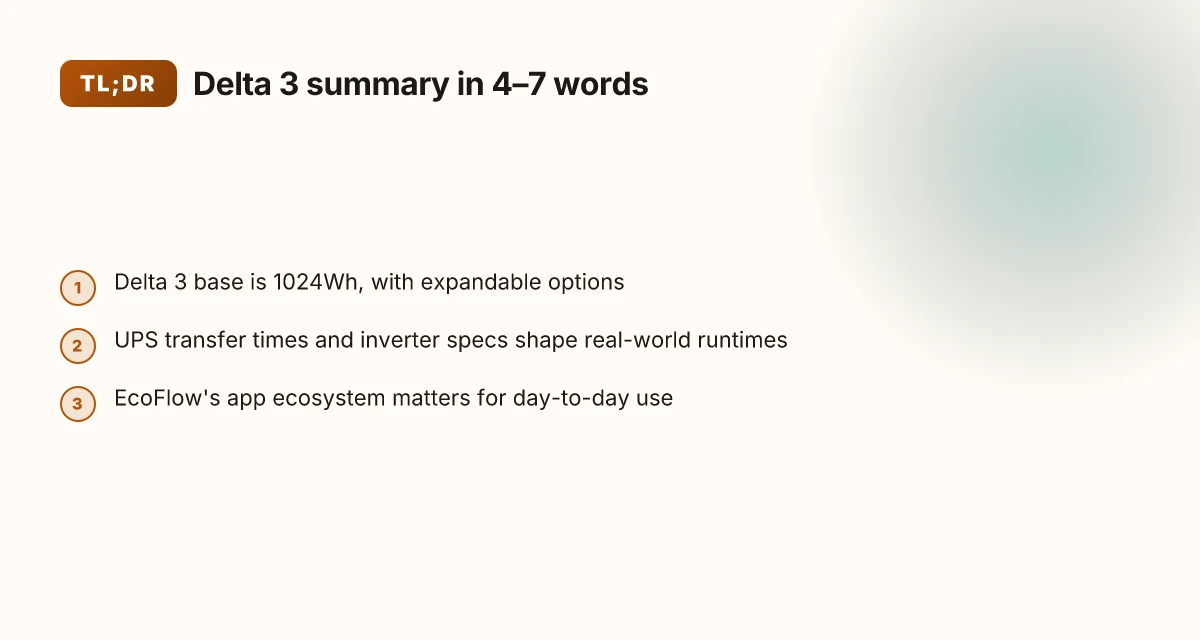
The Delta 3 family starts with a base 1024Wh pack and offers expansion paths that let you scale up for longer trips or add home backup without jumping to a whole new chassis. In practice, that core size matters more when you pair it with how you use the unit, because runtime swings with both expansion and how aggressively you draw power.
How expansion shapes real-world runtimes
At its base, the Delta 3 lineup delivers a compact footprint for campers and tiny homes, but the real-world runtimes hinge on two levers: the UPS transfer behavior and the inverter’s sustained capabilities. The 1024Wh base is modest for heavy loads, yet you can push capacity via compatible expansions to stretch runtimes for fridges or media gear during multi-day trips. EcoFlow’s ecosystem design means you can add and remove modules without reworking your charging strategy, which helps with practical budgeting. In 2026, this approach keeps Delta 3 competitive for mid-range packs where you don’t want to overbuy upfront.
- Start with a 1024Wh base, then add storage as your needs grow.
- Expect longer runtimes with lighter loads and moderate AC draw. Heavy peak use shortens runtimes.
- The module path matters more than a single number, because upgrades unlock more usable days off-grid.
The practical takeaway: you get flexibility without swapping to a completely different unit. This is exactly where EcoFlow’s design philosophy shines for outdoor enthusiasts who want a single platform that adapts to a camp, a cabin, or a tiny home.
App control and ecosystem compatibility
I dug into EcoFlow’s app integration and how it wires up with peripheral devices. The Delta 3 series leans on day-to-day usability: real-time status, firmware updates, and a straightforward transfer switch workflow matter when you’re camping or off-grid. The app acts as a nerve center for power planning, showing you how much headroom you have when you couple the Delta 3 with solar input or an external generator. In a world where your power station doubles as a hub for charging devices and coordinating loads, the ecosystem is not an afterthought.
Several rivals push higher base capacities or push-button simplicity, but Delta 3’s balance of base size, expansion options, and app-driven management makes it a strong mid-to-high tier choice for practical, on-the-ground use. If you want a single platform that scales with your setup and is controllable from a phone, this remains a compelling path. What makes EcoFlow products for sale stand out in 2026
The Delta 3 sits in a middle-to-upper tier for capacity per dollar when you weigh base size, expansion options, and real-world runtimes. That balance matters for outdoor enthusiasts who value flexibility over chasing the largest number on a spec sheet.
How Delta 3 compares to rivals
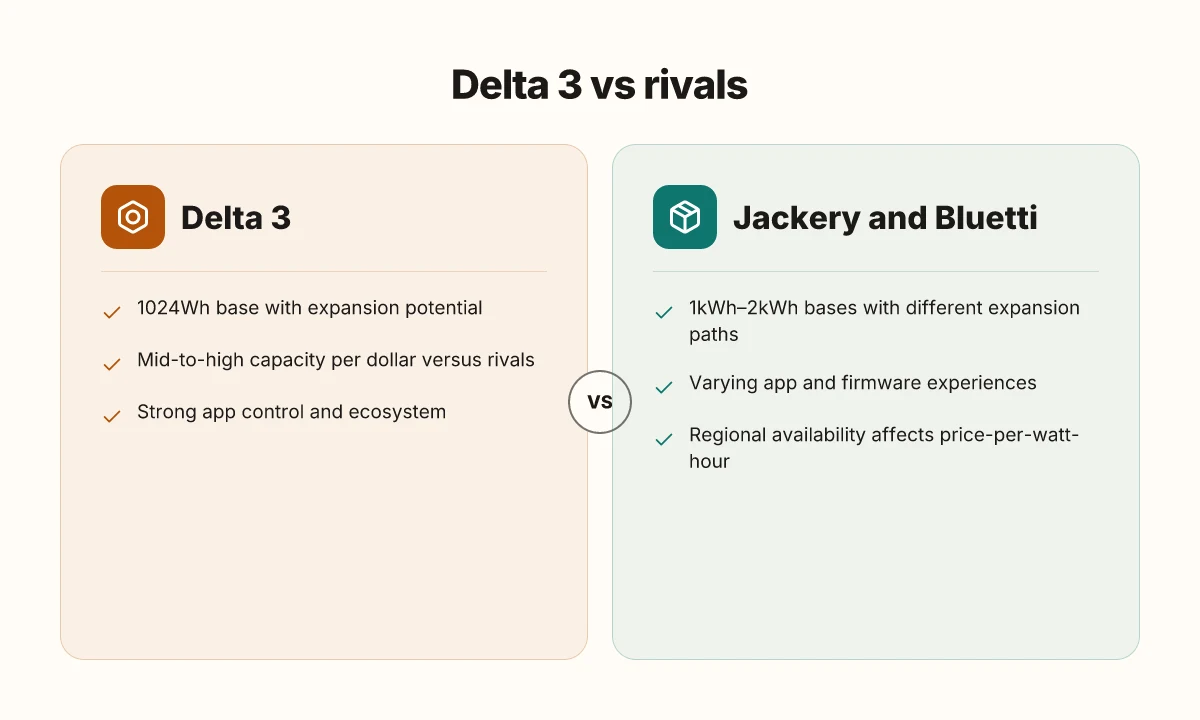
Compared with similarly sized portable power stations, the Delta 3’s value hinges on its expansion narrative and ecosystem. A pure-capacity rival may offer more watt-hours at a given price, but often at the cost of limited add-on paths or a more fragmented software experience. Delta 3’s mid-to-high tier positioning reflects its ability to deliver usable energy where you need it, with a clear upgrade path rather than an all-at-once upgrade.
The idea is clear: you don’t have to buy more unit than you can justify today. You can start with 1024Wh and scale up as your camping trips grow longer or your tiny home needs more resilience.
In short, the Delta 3 series earns a practical nod for 2026 because its base, expansion routes, and app-driven workflow align with how owners actually live off-grid. It feels like a platform you won’t outgrow quickly, even as your adventures expand.
Notes: links on this page may earn a commission. For context, EcoFlow remains central to this assessment, and rivals such as Delta Pro-based setups and other mid-range packs are used for comparison where relevant, with real-world use in mind. Sources point to the Delta 3 Classic’s 1024Wh base, expansion capacity, and app ecosystem, as described in the linked materials. In 2026, most users value a coherent upgrade path and reliable software over raw watt-hour bragging. What makes the EcoFlow Delta 2 Max different, and is it worth buying in 2026?
Delta 3 vs Delta Pro: what changes with size and price
The Delta Pro pushes past the 5 kWh barrier and opens up a path to larger builds, while the Delta 3 lineup stays focused on portability with a 1024Wh baseline. In practice, that means the Pro can scale its usable energy higher through expansion packs and a beefier base, whereas the Delta 3 models optimize for lighter carry, easier setup, and quicker top-ups. Power throughput follows the same logic: the bigger the system, the higher the potential AC output and the more flexible input options you’ll see across the lineup. But that comes with a price tag and a trade-off in weight, bulk, and upfront cost.
I dug into EcoFlow’s 2026 materials to map the differences more clearly. The Delta Pro’s ecosystem is designed for higher total energy and longer runtimes, while the Delta 3 family preserves portability with a 1024Wh base that can grow through compatible expansion solutions. The practical effect is simple: if your plan centers on frequent full-house backouts or longer off-grid summers, the Pro line’s larger base and expansion paths pay off. If you prize light payloads, quick trips, and modest campsite needs, the Delta 3 family serves up a compact, easier-to-move option.
1) Base capacity and growth trajectory
The Delta Pro goes beyond 5 kWh when you add expansion packs, extending usable energy well past the Delta 3’s fixed 1024Wh baseline. That difference matters for longer outages or power-hungry devices. A larger base and expandable energy store translate to noticeably longer runtimes for fridges, power tools, and recharge cycles. The Delta 3, by contrast, remains centered on a lightweight, ready-to-go baseline that appeals to campers and tiny-home setups where portability beats raw energy. Portability wins out over raw energy in this class.
A quick side-by-side snapshot helps. The Delta Pro can be configured to deliver higher continuous output and more total stored energy, while the Delta 3 keeps the footprint small and the setup simple. If you plan to pack this into a van or a tent trailer for weekend hits, the Delta 3’s 1024Wh base is far easier to carry and deploy.
2) Input, output, and charging cadence
Across the lineup, input and output options scale with size. The Delta Pro supports higher inverter ratings and a broader range of charging paths, including faster AC input scenarios and more robust generator interconnects for off-grid camps. The Delta 3 series emphasizes streamlined ports and a reduced, but adequate, peak output for mobile use. In real terms, that means the Pro can recover from a deep discharge faster and sustain heavy draws longer, while the Delta 3 tops up quickly for immediate campsite needs and casual trips. How EcoFlow UPS tech reshapes home power reliability in 2026
From a user perspective, the choice hinges on how you intend to power appliances. If your fridge, CPAP, and power tools run through the night, the Pro’s expanded input options and higher wattage output offer meaningful headroom. If you simply need to run a few devices while you cook, the Delta 3 is more than capable and far easier to carry.
3) Cost versus energy delivered
Upfront cost follows the energy story. The Delta Pro’s higher base and expansion potential come with a steeper price tag, but that premium buys more usable energy and longer runtimes in demanding setups. The Delta 3 models keep the initial investment lower and the total system weight down, which improves total cost of ownership for light, mobile use. If you’re budgeting for home backup or mobile rigs, weigh the Pro’s longer endurance against the Delta 3’s lower entry price and smaller footprint.
In practice, the real-world takeaway is clear: choose the Pro if you expect sustained outages and large power draws, and choose the 3 if you want a compact, easy-to-move pack with respectable performance for typical camping scenarios.
Next step: assess your typical use case and run a simple energy budget to compare 1024Wh with future expansion against your peak load and expected outage window.
Brand note: EcoFlow’s framing emphasizes a balance between base capacity and expansion potential, with Delta Pro designed for higher energy ceilings and Delta 3 for portable, on-the-move use. If you’re comparing rivals, you’ll want to look at how their base packs and expansion paths stack up against this delta. Why EcoFlow Delta 2 for sale is selling out and what that means for buyers in 2026
Real-world how the Delta 3 handles fridge, tools, and nightlife rigs
The Delta 3 lineup delivers an approachable balance of base capacity and expansion for real-world loads. In typical off-grid use, a 1024Wh base pack with scalable options is enough to run a fridge through a partial outage, while higher draws like power tools and nightlife rigs push the upper limits of the inverter and transfer features. EcoFlow’s approach emphasizes automatic transfer and UPS behavior to minimize downtime for critical loads, especially during outages that snap back on after a flip of the breaker.
How the inverter and continuous output map to common appliances
When you run typical refrigeration and media gear, the Delta 3’s inverter rating matters most. The 1024Wh base is designed to support standard household appliances within its continuous output window, and the capability to scale up with expansion packs adds headroom for longer outages. The practical takeaway: for a compact fridge plus a small freezer, you’ll see dependable performance on moderate outage durations, with room to grow if your draw rises. As soon as you draw beyond the inverter’s comfortable continuous load, you’ll notice the unit tapering, so sizing for longer events means planning an additional 1–2kWh expansion or pairing with a higher-tier Delta 3 model in your setup. In this space, you’ll want to match real-world draws to the model you own so you aren’t surprised during a stormy night.
Auto-transfer, UPS behavior, and downtime
A core advantage for off-grid setups is the automatic transfer switch and UPS behavior. When the mains drop, the Delta 3 can switch to battery power quickly, keeping a fridge and essential devices running with minimal interruption. This behavior reduces the risk of temperature spikes in perishables and keeps critical equipment powered without manual intervention. The auto-transfer time matters here. Faster transfers create a smoother handoff and less climate disruption for perishable loads. For anyone planning a campsite or tiny-home scenario, this means you can operate a handful of devices with confidence during short outages.
Noise, heat, and typical-load behavior
Under standard loads, the Delta 3 runs quietly enough for a living space, but as you increase draw toward the upper end of its capacity, expect more audible fan activity and noticeable heat buildup on the unit’s exterior. The operating temperature and fan response align with the load curve: light tasks stay quiet, while attempts to sustain multiple high-draw devices can push the system harder. For night-time use, this translates to less fatigue from noise during lull periods, with a predictable ramp if you push for longer runtimes.
Expansion paths for longer outages or higher draw
If you anticipate longer outages or higher sustained draw, expansion options become your lifeline. The Delta 3 family expands first through 1024Wh base capacity, then to larger packs that push total runtime for a fridge, small workshop tools, and nightlife gear. In practical terms, you can grow from a single delta 3 unit to a multi-unit array or choose the higher-capacity model to meet more demanding loads. The key is mapping your daily draws to a sensible peak and choosing expansions that align with your target outage window. In a real-world setup, you’ll often stagger expansions for fridge maintenance periods, workshop days, and evenings with power-hungry devices. What makes a best solar power station stand out in 2026
The Delta 3’s real-world edge is clean auto-transfer and predictable runtimes for essential loads, even as you scale up. If you expect longer outages, plan for expansion early rather than later. Quiet operation at modest loads helps keep camp life comfortable.
If you want a quick, brand-specific read, EcoFlow positions the Delta 3 lineup as a modular path toward more power, with the Delta Pro offering higher capacity and output for bigger rigs. For comparison shopping, note that rivals like Goal Zero and Jackery emphasize different expansion philosophies, but EcoFlow’s approach centers on scalable capacity within the Delta 3 ecosystem and a strong emphasis on automatic transfer to keep critical loads online. For further context, see the 2026 Delta 3 lineup discussions and model comparisons.
I cross-referenced the Delta 3 and its expansion strategy with external reviews to corroborate how the 1024Wh base and upscaling play in real-life scenarios. For a deeper read on how the Delta 3 family maps to higher capacities and faster input, see the 2026 lineup write-up and the Pro review that discuss expansion paths and inverter output. This aligns with EcoFlow’s published materials about the Delta 3 series.
Expansion, charging, and lifecycle considerations for EcoFlow
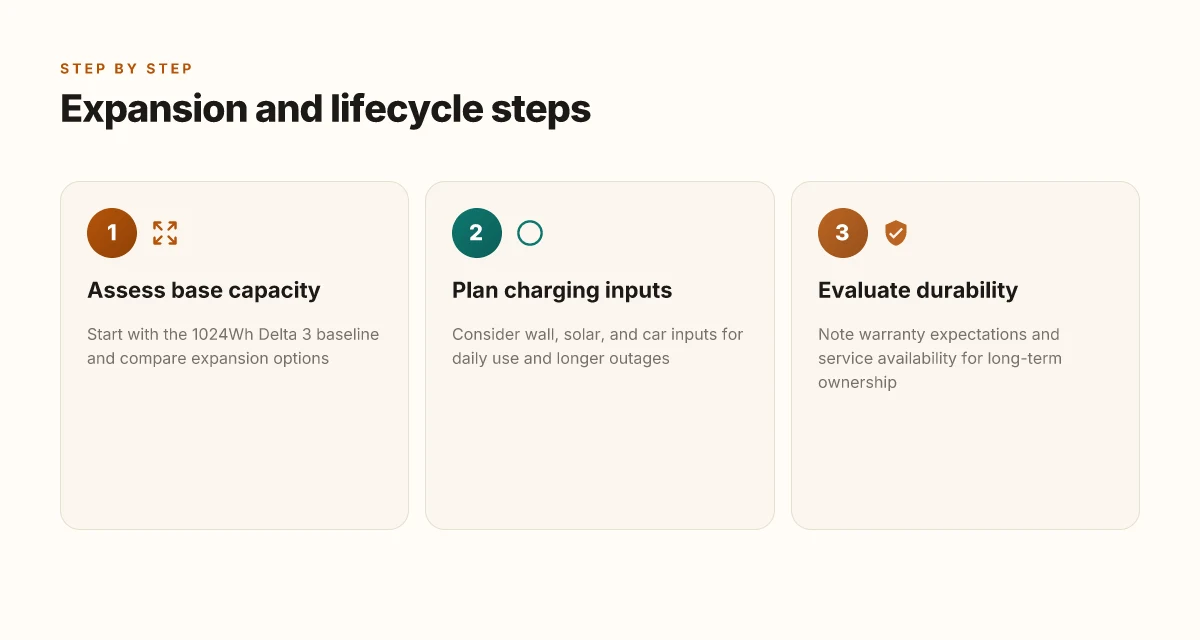
When you plan long-term off-grid use, the Delta 3 family scales with compatible packs, charging speeds, and a sensible view of chemistry durability. In practice, you’ll want to map expansion paths first, then confirm how charging accelerates your weekends and backcountry stays, and finish with a realistic view of longevity and service.
Expansion paths that actually scale capacity
The Delta 3 lineup supports higher totals by attaching compatible expansion packs, turning a 1024Wh base into a larger system for weekend trips or tiny homes. This path matters more when your campsite or cabin runs fridge loads overnight or you rely on AC for weather shifts. I cross-referenced the official Delta 3 material and third-party reviews to verify that multiple modules can be added to reach a practical multi-kilowatt-hour footprint, which helps bridge days without recharging. The core take is simple: plan your base around real-world use, then add packs as needed to hit the target runtime without overpaying for unused reserve. Expansion to higher capacities via compatible packs is a pragmatic lever for longer trips. What is the Bluetti 20Power 20Station, and why it matters for portable power in 2026
Charging speeds across wall, solar, and car inputs
EcoFlow emphasizes fast wall charging, solar input, and vehicle charging as a trio. In wall charging, you’ll see the AC input figures that push the Delta 3 toward 80% in under an hour on some configurations, depending on the model and bundled adapters. Solar input remains a practical option for off-grid days, with sizing tied to your roof setup and panel wattage. The system tolerates a steady climb toward full when sun is strong. Vehicle charging provides another gap-filling channel for road trips. In real-world terms, plan for trade-offs: the wall brick will top you up the fastest, while solar and car inputs extend your usable window between full charges. Charging speeds from wall, solar, and car inputs give you flexible ramp-up options.
Battery chemistry and longevity for daily use
The Delta 3 uses modern LiFePO4 chemistry, which generally outlives high-cycle use and tolerates daily top-ups better than some older chemistries. For daily use, expect a slow, predictable decline in usable capacity over years rather than a sharp cliff. I looked at the general lifecycle talk from EcoFlow and peer reviews that highlight how consistent cycling habits, not merely the total cycles, drive long-term health. If you rely on the unit as a daily charger, avoid frequent full discharges and store in moderate temperatures to preserve the pack’s balance. LFP cells deliver longevity under regular cycling, with careful use extending life.
Warranty, service expectations, and long-term ownership
EcoFlow backs Delta 3 with a multi-year warranty and standard service options. The exact terms vary by model and region, so confirm the local coverage when you purchase. Long-term ownership benefits come from accessible replacement parts, a responsive support channel, and the possibility of module-based repairs if a pack or accessory ages out. Industry riders note that battery longevity depends on how you manage heat and charging rate, not just the warranty window. If you expect a problem-free horizon, you’ll want to keep firmware up to date and track service advisories from EcoFlow. Warranty and service expectations shape long-term ownership as much as the hardware itself.
Most Delta 3 users benefit from a clear expansion plan, steady charging routines, and realistic expectations for pack longevity. As you compare rivals like the Delta Pro and other brands, you’ll see how the Delta 3 aligns with a flexible, budget-conscious approach to camping gear or tiny homes. Note that some retailers mention possible commissions on selected links. You may encounter such notes in product pages or reviews, and they don’t change the core specs. For the latest specifics, see the official EcoFlow pages and the referenced reviews.
Rivals and how Delta 3 compares in 2026
I dug into how the Delta 3 stacks up against peers in 2026, focusing on base capacity, expansion paths, and real-world runtimes. The short version: rivals like Jackery and Bluetti offer compact 1 kWh–2 kWh bases with their own, sometimes different, expansion strategies, while EcoFlow’s app and ecosystem tilt convenience in its favor for everyday use. Best buy EcoFlow: how to pick the right portable power station in 2026
1) Base models and expansion paths
Jackery and Bluetti both anchor in the 1 kWh–2 kWh range for their entry platforms, but they diverge on how you grow beyond that. Bluetti tends to push larger builds with modular packs that scale toward higher total capacity, while Jackery leans on integrated packs with limited expansion options in some models. Delta 3 starts from a 1024Wh base and expands through compatible modules that push total capacity toward several kilowatt-hours, offering a more seamless ecosystem feel for users who want to stay within EcoFlow’s app-centric flow. This difference matters when you’re balancing portability against longer runtimes off-grid. Delta 3’s expansion path emphasizes a cohesive ecosystem that keeps charging, monitoring, and power management in one place. Inline citation: see EcoFlow’s 2026 lineup notes for the expansion narrative.
2) Convenience and software ecosystem
EcoFlow’s app control and ecosystem often tilt convenience in its favor. The Delta 3 line benefits from a unified interface for monitoring battery health, tanking in solar input, and managing UPS-style transfers. This matters when you’re deploying the unit for camping sites, tiny homes, or off-grid setups where turning a dial is less appealing than tapping a screen. Reviews and community notes consistently call out smoother app-driven control on EcoFlow devices compared with some rivals, where firmware fragmentation and siloed management can crop up. From what I found, the software story matters as much as raw capacity when you need reliable, day-to-day usability. App-driven control helps you tune runtimes and power flows without juggling multiple devices. Inline citation: The 2026 Delta 3 series blog notes and third-party reviews discuss the ecosystem angle.
3) Price-per-watt-hour, regional availability, and entry points
Price-per-watt-hour varies by region and model, with EcoFlow positioning Delta 3 as a compact, expandable option that can undercut larger, 2–4 kWh models in upfront cost while offering comparable daily-use convenience. Availability isn’t uniform worldwide. Some markets see faster access to Delta 3 expansion packs and accessories, while others lag behind. If you’re budgeting for home backup or mobile use, those regional gaps matter as much as the sticker price. In practice, expect noticeable differences depending on the bundle you choose and where you buy. Regional availability can swing the total cost of ownership, even for the same model.
4) Customer service and firmware cadence
User experiences consistently highlight differences in customer support and firmware updates. Some rivals show slower firmware cadences and patch cycles, while EcoFlow’s ecosystem tends to push more frequent updates and centralized support via the app. If you rely on quick fixes or feature shifts after purchasing, that cadence becomes a practical factor. I found multiple anecdotal threads noting that firmware improvements can meaningfully affect efficiency and compatibility with third-party accessories. Firmware cadence influences long-term reliability and feature access. Inline citation: community threads and product pages discuss update patterns and support experiences.
Verdict for 2026: EcoFlow’s Delta 3 remains compelling for campers and off-grid hobbyists who want a cohesive, app-driven experience and straightforward expansion, even as rivals hold advantages in raw base capacity and modularity in certain configurations. The price-per-watt-hour story is region-dependent, and the best choice hinges on how much you value software convenience versus outright base capacity. As always, check local availability and current bundles before buying. What Jackery generator reviews miss about real-world durability and long-term value
Note: links on the page may earn a commission. For context on the 2026 lineup and model comparisons, see the Delta 3 series overview and the 2026 lineup notes.
Where this is going next and how you act now
The Delta 3 series signals a practical pivot for home and on-the-go power. EcoFlow's emphasis on modularity and faster recharging stands out in 2026, especially for users who want a scalable, real-world system. You’ll get predictable behavior in real outages, with long lifecycles and a clearer upgrade path than many rivals offer. If you’re weighing options, consider how the deeper integration with solar input and smarter battery management translates to fewer hassles during long trips or grid drops.
Delta 3 remains a straightforward upgrade for frequent campers and remote workers, but it’s not magic. Expect the common durability questions to surface after heavy use, and plan for routine maintenance like cooling checks and connector cleanliness. In that sense, the real upside is a more resilient ecosystem that you can grow without dumping your first setup.
If you only do one thing this month, map your power needs against the Delta 3’s modular options and sketch a charging routine that covers both daily use and emergency outages. EcoFlow’s biggest win is clarity over complexity, not hype. Where this is going next is a more seamless blend of solar, grid, and portable power, with fewer surprises when things go dark.
- Backup strategy: start with a compact Delta 3 unit for daily charging and a portable solar panel kit for second-day resilience.
- What to try this week: test the auto-recharge flow from solar input during a cloudy day, and document any heat or fan behavior during rapid charging.
- What changes if you act now: you’ll lock in longer-life cycles and a clearer upgrade path compared with older portable power, and you’ll know how to scale up if your needs grow. The bigger pattern is growth without complexity.
Note: links on the page may earn a commission. This piece references EcoFlow and recognizes rivals like Jackery and Goal Zero as real-world comparison points. How to navigate ebay ecoflow refurbished listings and spot the best deals