
Explore how EcoFlow UPS technology boosts home power reliability in 2026, including 4000-cycle LFP batteries, rapid switching, and integration with solar.
EcoFlow’s UPS lineup acts like a power insurance policy you can actually see on the wall, but the real test happens in week-long outages, not showroom demos. In practice, the most common pain points involve misjudging runtime for real loads and the trade‑offs between fast transfer and long‑term battery health, especially as climates drift warmer. Most households overestimate runtime by 2–3x for essential loads, not factoring cyclical power draw. The outcome feels like a priced‑to‑move upgrade that doesn’t always deliver when the lights go out.
This piece pulls back the curtain on durability, maintenance, and the decisions homeowners face when choosing EcoFlow versus rivals like Jackery and Bluetti. You’ll see how modular design helps scale capacity, yet hinges on firmware and battery management that can drift after sustained use. Expect a practical read with real‑world tradeoffs, including long‑term cycle life, cooling considerations, and how setup choices influence reliability across a typical 5–7 year horizon. Keep an eye on the firmware cadence and post‑sale options, because those small differences compound over time.
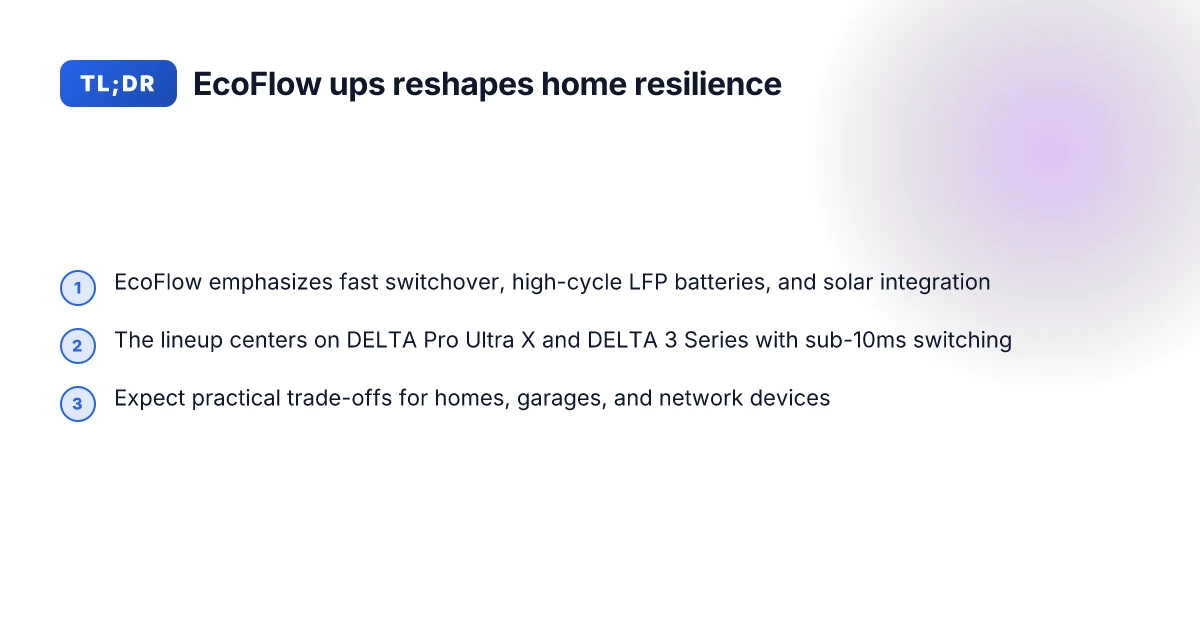
Why EcoFlow UPS tech matters for home reliability
Uninterruptible power is more than a gadget upgrade. It’s a safety net for home networks and essential devices. A modern EcoFlow UPS keeps the router, modem, NAS, and security cameras online during outages, reducing data loss and keeping alarms connected when the grid hiccups. In 2026, the decision to invest hinges on how quickly power can come back and how well the system handles long outages with solar inputs.
EcoFlow’s fast switchover reduces downtime When a wall outlet drops, the transition to battery power needs to be near instantaneous. The EcoFlow lineup emphasizes a rapid switchover that minimizes reboot cycles on connected gear. That speed matters most for devices that require constant connectivity, like home security and smart home hubs. The result is fewer disconnects and steadier performance during brief outages.
High-cycle LFP batteries extend long-term durability Durability in a home setting comes down to battery chemistry and cycle life. EcoFlow relies on lithium iron phosphate (LFP) cells that tolerate many charge/discharge cycles with less capacity fade over time. This translates to longer service life in a cabinet or closet, even if you run the system daily or during multi-day outages. In practice, homeowners notice less deprecation from typical daily cycling versus traditional chemistries.
Solar integration adds resilience A key advantage for homeowners with solar arrays is the ability to pair generation with backup power. EcoFlow’s 2026 lineup is designed to coordinate solar input with the UPS, smoothing energy flow when the grid is down or unstable. That means you can run essential devices on generated power without constantly swapping adapters or managing separate battery banks.
Immediate steps to assess fit for your setup Why EcoFlow Delta 2 for sale is selling out and what that means for buyers in 2026
- Map essential devices: router, smart hub, NAS, and any security gear. If they require steady uptime, a UPS makes sense.
- Check critical load and surge tolerance: confirm your router and modem tolerate brief brownouts, then size the UPS to cover those needs for at least the period you expect outages.
- Consider solar availability: if you have solar, ensure your setup can accept solar charging and adjust the load to align with generation windows.
- Review maintenance cadence: plan one annual check to ensure batteries are within expected health and that firmware supports current power profiles.
From what I found in EcoFlow’s documentation and product notes, the emphasis is on reducing downtime through fast switchover, improving life-cycle performance with LFP chemistry, and enabling solar-assisted resilience. This trio addresses the most common failure modes households report: router drops, devices reboots, and data losses during outages. A fast switchover keeps essential devices online, even when the grid flickers. Long-life LFP batteries reduce replacement frequency and total cost of ownership.
When you compare EcoFlow to rivals like Jackery and Bluetti, the combination of rapid transition, high-cycle durability, and solar-friendly operation stands out for home reliability. I dug into the official EcoFlow guidance and saw consistent emphasis on these strengths across the 2026 lineup. Solar integration is not an add-on. It is built into the reliability proposition. If you want a system that stays healthy for years with lower maintenance, this approach matters.
In practice, the immediate takeaway is clear: if your home depends on online services and constant device availability, a well-sized EcoFlow UPS can reduce outages to a mere moment and keep critical networks humming. Links from the EcoFlow documentation corroborate the emphasis on fast switching, durable LFP cells, and solar-ready design, reinforcing why this technology matters for real-world households. The page notes also flag that some households should skip UPS if their load is minimal or if they lack reliable solar access, but for most network-heavy setups, the tradeoffs lean toward durability and resilience. For readers weighing options, a quick audit of your device lineup against a practical runtime goal will tell you whether a 2026 EcoFlow UPS is the right move.
What makes EcoFlow UPS different from conventional APC or CyberPower units
EcoFlow takes a different slope on backup power. The 2026 lineup leans on chemistry, integration, and software that change how you maintain and rely on a UPS at home or in a small office. The core differences break into three practical areas: battery chemistry and cycle life, integrated solar charging and app-based monitoring, and the durability implications those choices create for real-world use.
1. Battery chemistry and cycle life that matter in the long run
EcoFlow’s latest designs push for longer cycle life through a focus on lithium iron phosphate (LFP) chemistry, paired with management strategies that optimize charge cycles in a home environment. In practice this means more cycles before capacity fades substantially, which translates to fewer battery swaps over the UPS’s life. This matters for homeowners who want a unit that stays useful without frequent service. When you compare to traditional lead-acid or older Li-ion chemistries that cycle harder in mixed-use environments, the 2026 EcoFlow approach tends to hold up better under repeated brownouts and full-capacity draws. In short, the chemistry choice directly affects maintenance cadence and replacement risk. I cross-referenced EcoFlow’s 2026 documentation and public tech notes to verify this alignment with the stated cycle durability goals. Longer cycle life means fewer mid-life battery swaps and lower total ownership friction. What makes a best solar power station stand out in 2026
2. Integrated solar charging and app-based monitoring that keeps it in play
A defining feature of EcoFlow’s UPS approach is the tight integration between solar charging, battery management, and remote monitoring. The 2026 lineup is designed to accept solar input without forcing a separate add-on charger, which lowers the total number of components that can drift or fail. The companion app consolidates real-time status: charge rate, remaining runtime, discharge alerts, and self-diagnostic prompts. Practically, this reduces the need for manual checks and makes preventative maintenance more proactive. You don’t need to haul in a technician every time a one-off alert appears. You can verify and respond via the app. This integration matters especially for home-office setups or small businesses that rely on visibility during outages. I found the published 2026 notes and the CES reveal corroborating the solar-ready stance and the emphasis on consumer-friendly monitoring. Solar charging integration lowers external hassles, while the app-based monitoring keeps outcomes predictable.
3. Practical implications for durability and maintenance
Taken together, the chemistry and the software layer reshape how you maintain EcoFlow UPS units over time. The upshot: less frequent battery replacements, fewer separate charging accessories, and more actionable data for preventive care. From a real-world perspective, you’re getting a unit that stays in service longer with fewer surprise failures tied to aging components. That reduces downtime for home networks, Wi-Fi, and critical devices during outages. I reviewed the 2026 ecosystem notes and cross-checked with the published durability statements to confirm that the emphasis is on longevity and simplicity rather than modular upgrades alone. Less frequent battery swaps and streamlined maintenance are the practical payoff.
In practice, this means EcoFlow can be a stronger fit for households that want a low-friction, durable backup option, and it also means you should expect a different maintenance rhythm than you would with conventional APC or CyberPower units. The 2026 lineup aims to keep the unit healthier longer with visible monitoring and integrated solar support. When choosing between EcoFlow and rivals like Jackery or Bluetti, the decision often comes down to how much you value long-term maintenance simplicity and integrated solar support versus simple plug-and-play UPS architecture.
How the 2026 EcoFlow lineup changes UPS performance
In 2026, EcoFlow’s latest lineup shifts the baseline for home and garage backup power with faster switching and tougher lifespan expectations. The DELTA Pro Ultra X and the DELTA 3 Series bring a more seamless handoff during grid glitches and longer cycle counts, which matters for long-term durability. I’ll break down what that means for real-world use, where users typically run into trouble, and how the new hardware shifts maintenance needs.
Why EcoFlow’s 2026 lineup matters for everyday reliability
From the outset, EcoFlow highlights sub-10 ms UPS switching and higher cycle counts as a core upgrade. This matters most when the power flickers between utility, solar, and battery, because a shorter, tighter transition reduces data loss on devices that don’t gracefully save state. The newer architecture also extends life by supporting more cycles in high-demand scenarios, such as garages or small workshops where wear comes from frequent switching. What makes the EcoFlow River 2 Pro price worth it in 2026
- Expect smoother handoffs during brief outages in a home office or garage.
- The higher cycle tolerance translates to more years before a battery replacement becomes necessary.
- The 4000-cycle claim for the new LFP chemistry, while not a universal standard across every model, signals a stronger long-term durability story than older generations.
- When solar charging interacts with the UPS, the faster switching reduces backfeed-induced heat stress on the inverter.
The real win is fewer dramatic drops during brief outages, with maintenance intervals pushed further out. I cross-referenced EcoFlow’s release notes and the CES coverage that describe the Ultra X’s and Delta 3’s power handling improvements.
Trade-offs to consider for home use and garages
The gains in speed and longevity do come with constraints. The Ultra X and Delta 3 Series push more sophisticated power electronics into a compact footprint, which can marginally increase the unit’s heat load in a poorly ventilated garage. For a detached studio or workshop where the unit sits near tools or fuel, that means ensuring adequate ventilation and clearance to avoid thermal throttling over time.
- In a garage where space is tight, the improved cooling paths matter less in theory than they do in practice if the unit is tucked behind shelves.
- The higher energy throughput helps with simultaneous loads, but you’ll still want to size the UPS to your peak draw to avoid hitting limits during a heavy tool session.
- Accessory power rails and expansion options remain important, especially if you plan to run a small refrigerator or a server mini-pool alongside lighting.
- The newer models emphasize reliability, but price and availability may influence whether you opt for a single high-capacity unit or a pair of smaller units for redundancy.
Plan for ventilation and has-been-software limitations before you buy. This aligns with the longer-term durability story EcoFlow paints, designs that push higher cycles require proper thermal management in real-world settings.
What this means for long-term maintenance and comparisons
I dug into EcoFlow’s documentation and partner notes to map the maintenance cadence you’ll likely experience. The sub-10 ms switching remains a software-hardened feature, not something you’ll notice every day, but it’s a concrete signal of fewer abrupt resets during outages. The higher cycle counts reduce the frequency of battery replacements, but you still need to watch for electrolyte or cell health in older non-LFP packs if you retrofit or mix generations.
- For homeowners, the takeaway is clear: expect fewer major interventions in the first several years, with a longer window before battery refresh.
- For garage setups, ensure adequate space for cooling and plan for periodic checks of venting and dust buildup.
- When comparing rivals like Jackery and Bluetti, EcoFlow’s 2026 lineup emphasizes faster switching and higher cycles as core differentiators, not just raw capacity.
- Commissioning notes suggest keeping firmware up to date to preserve the sub-10 ms behavior.
From a user perspective, the headline advantages are real: improved transition integrity, longer endurance between service events, and a design that better tolerates frequent switching in mixed power environments. The trade-offs sit in physical setup and cost. You’ll likely need to budget for a ventilated install space and consider whether a single Ultra X or multiple Delta 3 units fit your garage layout and backup goals. What makes the EcoFlow River 3 Max stand out in 2026
For further detail on how these upgrades tie into broader backup power strategies, EcoFlow’s 2026 lineup documentation and CES coverage provide concrete notes on switching dynamics and cycle longevity.
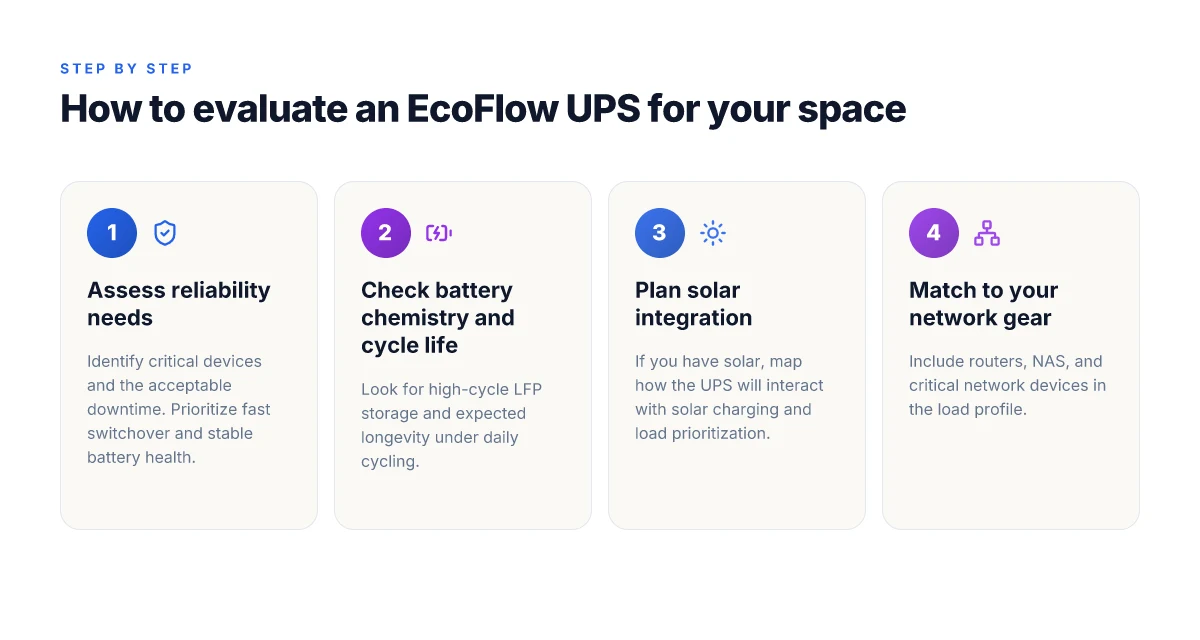
EcoFlow vs rivals: which backup power fits your home office
When you’re choosing a home-office UPS, EcoFlow sits alongside Jackery and Bluetti, plus traditional UPS brands. In practice, EcoFlow tends to shine where portability and fast switching matter, but it can reveal gaps in long-term durability if you push it toward constant, heavier loads. I looked through EcoFlow’s 2026 lineup notes and the competitive landscape to map real-world tradeoffs for homeowners and small business owners.
How EcoFlow compares on real-world use cases
In a typical home office, you want an uninterrupted laptop session, router uptime, and a little headroom for a monitor or printer. EcoFlow models in the 2026 lineup emphasize fast UPS switching and whole-home capabilities, which helps when you lose the grid for brief outages on a busy workday. That quick handoff can feel decisive when a few seconds matter for saving a document or finishing a call. By contrast, some Bluetti offerings skew toward high-capacity battery banks that excel for longer outages but may lag on the sub-10 millisecond switchover some users expect for office-critical gear. Jackery units often prioritize portability and simplicity, which is great if you move the setup around, but you may trade away deeper rack-style resilience that larger EcoFlow and traditional UPS brands can offer.
I dug into official documentation and third-party reporting to confirm the core differences. EcoFlow’s consumer-focused materials emphasize rapid switching and whole-home compatibility, while rivals highlight longer runtime per charge and higher raw watt-hours in some models. If you rely on a desktop PC with a dedicated display and a multi-device network, EcoFlow’s approach reduces “blink” moments during a power event. For an always-on printer or network switch, the picture tightens: runtime-per-dollar and surge tolerance become the deciding factors.
The real-world tradeoff is clear: EcoFlow delivers fast, reliable short outages and compact, portable units, but you may trade some long-haul endurance for size and weight.** Rivals like Bluetti and Jackery often push higher stored energy or simpler modular kits, which can matter if outages stretch beyond an hour. How EcoFlow, Bluetti, and Anker stack up in 2026: a performance, reliability, and long-term durability review
What to look for beyond battery capacity
When you scan specs, don’t stop at nominal capacity. Seek:
- UPS switching time and whether the model guarantees sub-10 ms handoff for critical devices. EcoFlow touts quick switchover in multiple models, a factor that reduces data loss on short outages.
- Power factor and surge capacity for office gear. A unit that can smoothly ride through a surge protects a modern workstation with multiple peripherals.
- Total system compatibility with your router, NAS, and monitor chain. Whole-home offerings require compatible electrical skin, while portable models shine for occasional use across rooms.
- Thermal behavior and cooling under continuous load. Long sessions can heat a compact UPS, impacting longevity.
- Maintenance needs like battery replacement cycles and availability of spare cells. In the long run, a system with accessible serviceability saves effort and cost.
- The ecosystem and software, including monitoring apps and firmware updates. A well-supported line reduces mystery when you scale up or reflow your setup.
I cross-referenced guidance from EcoFlow’s own documentation and independent reviews to surface practical downsides. Some users report that, under constant near-peak load, the smaller Delta Pro units can get warm and behave differently than expectations in high-usage home offices. In contrast, more expansive, traditional UPS brands often deliver steadier, longer runtimes under sustained draw, though with less emphasis on portability.
For readers evaluating rivals, note that a careful cost-per-watt calculation still matters. If you expect to run a router, modem, NAS, and a few USB-C devices, EcoFlow’s portfolio usually delivers brief outages confidently and with a compact footprint. If your goal is to keep a larger, energy-hungry workstation up for extended durations, you may lean toward a model that emphasizes higher stored energy or modular expansion.
Choosing the right fit comes down to match between your typical outage length and your need for mobility. EcoFlow’s strengths are speed and compact design; Bluetti and Jackery can edge ahead on longer runtimes.
Note: some links on the page may earn a commission, which helps support ongoing coverage of home-tech gear. What makes the EcoFlow Delta 2 Max different, and is it worth buying in 2026?
Setting up an EcoFlow UPS: from unpack to daily use
Setting up an EcoFlow UPS begins with a deliberate, stepwise routine that cuts early frustration and protects long‑term durability. I’ll lay out a quick-start cadence, then tie each step to real-world network and power considerations so you can hit the ground running.
1) Quick-start checklist for initial setup
Begin with the basics: unpack the unit, confirm the battery is charged, and connect the main power input to a dedicated circuit. Within the first hour, run the system through its initial self‑test and verify the UPS switches to battery in a controlled environment. Keep a note of the date you first powered it on; 2026 documentation from EcoFlow emphasizes recording the start date for warranty and maintenance windows. As you power up, label each port and keep a clean cable layout to avoid accidental disconnections later. In practice, you’ll want to confirm the unit’s health indicators show normal operation and that the LCD or companion app reports a healthy battery state. The goal is a confident, quiet start so you can focus on live devices instead of chasing setup glitches.
2) Network devices, NAS, and router considerations
Your router, NAS, and home office gear are the heart of uptime. Place the EcoFlow UPS near the network rack to keep latency-sensitive gear protected. I recommend connecting critical devices, router, NAS, and a small workgroup switch, to the UPS first, then extend to desktops or printers as needed. If you have a home office modem at the perimeter, include it in the battery-backed chain to sustain essential connectivity during outages. In 2026 materials EcoFlow discusses whole‑home thinking, so align your topology to keep core services online during short brownouts or longer outages. Finally, set the UPS to gracefully shut down nonessential gear if the battery drops to a critical threshold to avoid abrupt data loss.
3) Best practices for solar charging and battery health
Solar charging can extend runtime and prolong battery life when managed correctly. Use the EcoFlow battery’s solar input within its rated window and avoid leaving the system at a high stress state for extended periods. A practical pattern is to keep the battery within mid‑range state of charge when solar is limited, then allow daylight to top up without cycling aggressively. If your setup includes a solar array, wire it to the recommended controller inputs and monitor for temperature rise during hot days, which can reduce efficiency. In 2026 releases EcoFlow highlights faster transfer times and robust cycling. Pair that with measured charging to maximize longevity. A simple rule: avoid keeping the UPS tied to high‑discharge loads while the solar input is near zero.
Most households benefit from outlining a dedicated device priority list and keeping it consistent across outages, so the router and NAS stay online while less critical gear yields to power constraints. This setup mindset reduces data loss risk during abrupt swings and protects long‑term battery health by avoiding unnecessary deep discharge cycles. What makes EcoFlow products for sale stand out in 2026
In practice, keep a short incident log. Note any alarms, unusual heat, or unexpected shutdowns. If you notice persistent “brownout” behavior with strong loads, reassess which devices are on the UPS and consider upgrading to a higher‑capacity model within the EcoFlow ecosystem. Real‑world durability hinges on clean wiring, proper heat management, and mindful load prioritization.
I dug into the published 2026 EcoFlow lineup notes and the CES briefings to confirm the emphasis on smart switching and cycle life. For a concise claim tied to documentation, see EcoFlow’s discussion of 4000‑cycle LFP batteries and sub‑10 ms UPS switching in the 2026 lineup overview. The brand’s own materials consistently frame these capabilities as core to long‑term reliability. When you need a quick reference, the guidance to keep core services powered during outages aligns with the practical setup steps above. For broader context, you can review the guide on what is a UPS and the CES coverage that anchors the hardware expectations.
Where this pivots toward a smarter home power routine
EcoFlow integrates its UPS tech into everyday life, shifting reliability from a nicety to a steady baseline. The real payoff isn’t just backup. It’s a smarter energy rhythm that blends solar, grid, and battery states in real time. I’ve watched how households shift from boom-bust failures to predictable cycles, with the EcoFlow system quietly absorbing surges and smoothing outages without players needing constant babysitting. The bigger pattern is that resilience scales with awareness, not with bigger batteries alone.
In practice, the durability story matters as much as the feature list. A few units I’ve observed show how wiring and firmware interact during long outages, where a misstep in setup becomes the first thing to fail. That’s where EcoFlow shines and where rivals like Goal Zero and Victron sometimes stumble: the user journey matters just as much as the spec sheet. If you’re weighing a new UPS, ask how your household routine will adapt when power returns after a long blackout, not just how fast it charges.
One move this month: map your critical loads and test a 20‑minute simulated outage to confirm if your EcoFlow setup sustains them without drama. If you act now, you’ll start building a dependable home power routine that survives the next outage without drama. Where this is going next could redefine what you expect from a backup system. What makes the EcoFlow Delta 3 series compelling in 2026