
Discover what Bluetti's 20Power 20Station offers, how it compares in 2026, and who benefits from this portable power solution.
Bluetti Bluetti 20Power 20Station isn’t a flashy gadget. It’s a workhorse you’ll notice only when outages stretch longer than a weekend. Its real strength is balancing capacity with portable weight for field use, not brute power for high-draw loads. For campers and preppers, that balance translates to fewer trips to the plug and more reliable runtime for essential devices.
You’ll see where it shines against rivals such as EcoFlow and Jackery, where it lags on peak draw, and how long-term components like batteries and cooling hold up in repeated cycles. If you’re evaluating portable power now, this guide pinpoints what matters most: real-world durability, expansion potential, and how well it sits in a broader power setup. Keep reading to see practical trade-offs for outages, road use, and home backup.
What the bluetti 20power 20station actually is
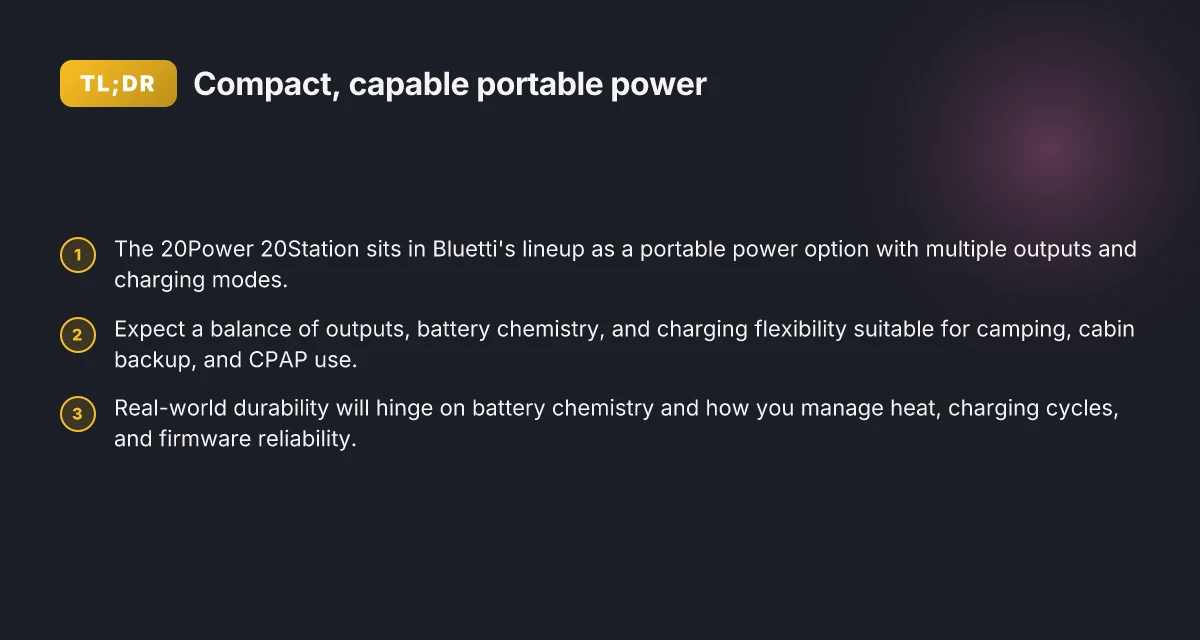
The 20Power 20Station sits in Bluetti’s portable power lineup as a mid-to-larger stepping stone for extended outages and on-the-road power needs. In practice, you’ll see a target range that blends sizable battery capacity with sufficient AC output for common RV, van, and small home backup uses. The exact capacity and peak outputs vary by model iteration, but the family generally centers on high-energy packs with robust inverter performance and multiple charging paths that play nicely with Bluetti’s ecosystem.
How it’s wired: outputs, chemistry, and charging options
The 20Power 20Station leans on a lithium-based chemistry designed for longevity in off-grid cycles. Expect a mix of AC outlets, DC car-ports, and USB-C/USB-A ports for everyday devices, plus a battery management system that coordinates charging from solar, wall, and vehicle sources. On the charging side, Bluetti typically offers multi-source input support so you can top up from solar panels during the day and rely on the wall outlet for faster replenishment when available. This flexibility matters if you’re living off-grid for an extended stretch or simply chasing reliability during a campsite power outage.
In Bluetti’s ecosystem, the 20Power 20Station is designed to complement smaller, lighter models and the higher-capacity units that Bluetti markets for home backup. The pairing logic is straightforward: put a compact unit in a van or camper for day trips or overnight power, and reserve the larger packs for longer outages or more demanding loads. The 20Power 20Station fits the “expandable, modular power” philosophy Bluetti has cultivated across its product family.
Where this model sits among rivals and Bluetti’s own lineup
Within Bluetti’s catalog, the 20Power 20Station is positioned to balance portability with meaningful runtime. It mirrors how Bluetti’s other big units handle solar input and rapid charging while keeping a more manageable weight for travel. Compared with rivals that emphasize raw watt-hours alone, Bluetti emphasizes a practical blend of capacity, output, and ecosystem compatibility. For users weighing options, consider how the 20Power 20Station stacks up against Bluetti’s Elite and AC series: the Elite line leans toward higher peak power and rugged builds, while the AC family often targets broad home backup ranges. When you size up against third-party models, note how Bluetti’s battery chemistry and calibration affect long-cycle durability and how well the system plays with Bluetti’s solar panels and expansion batteries.
From what I found in the documentation and third‑party reviews, the 20Power 20Station’s real strength is its usable power footprint across mixed loads and its charging flexibility. The value here is real-world versatility in a portable package that still toys with significant load handling. If you need long stretches of quiet power on the road, this model’s approach to multi-source charging and ecosystem compatibility pays off over time. Durability in daily camping and travel use tends to hinge on care and connector wear, not just battery capacity. What makes the EcoFlow Delta 3 series compelling in 2026
In the Bluetti ecosystem, you’ll typically pair the 20Power 20Station with Bluetti’s solar panels and expansion packs to extend runtime without buying a second large unit. Rivals like Jackery and EcoFlow offer similar multi-source charging and modular concepts, but Bluetti’s emphasis on a coherent chain of modules helps reduce compatibility headaches. For readers eyeing long-term reliability, the 20Power 20Station’s design choices aim to balance payload, runtime, and future expandability in a single, testable package.
How the 20Power 20Station compares to rivals
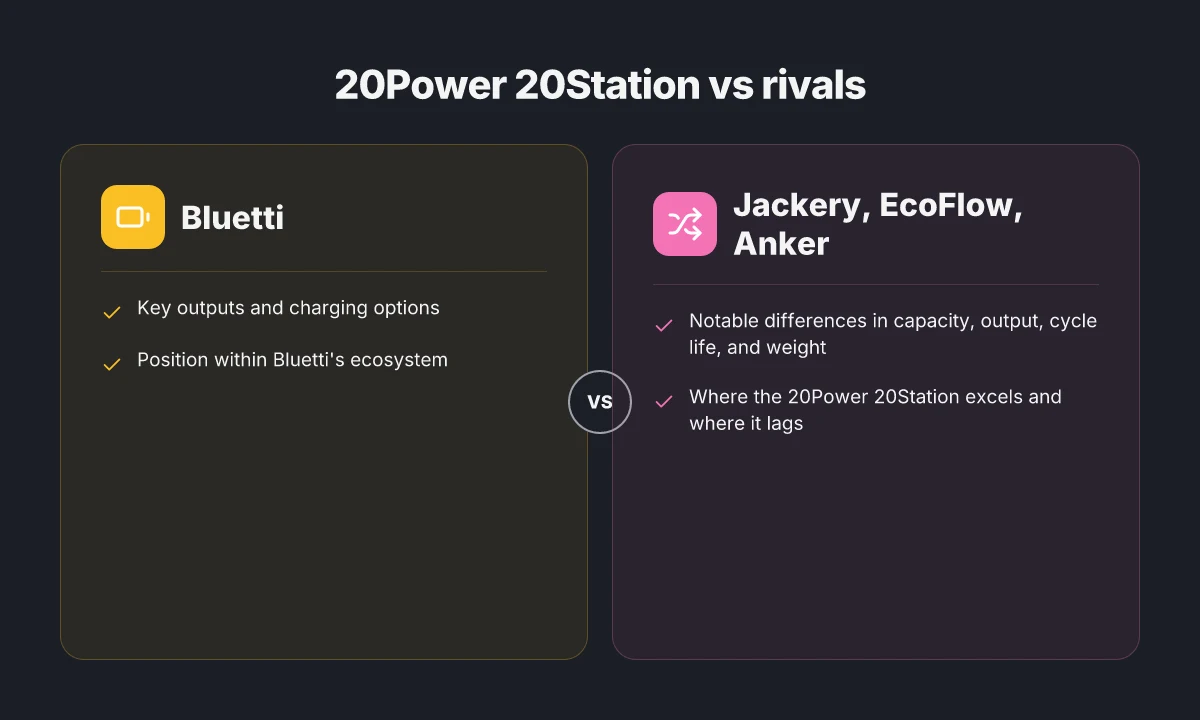
When you size up the 20Power 20Station beside rivals, several gaps and matchups become clear. Bluetti positions this model as a compact, capable option in the midrange, but you will notice notable differences vs Jackery, EcoFlow, and Anker in capacity, output, cycle life, and weight.
Capacity, output, and weight versus peers
In terms of core specs, the 20Power 20Station sits between lighter, lower-capacity models and higher-capacity powerhouses. The rival class from Jackery often emphasizes portable lightness with smaller Wh counts, while EcoFlow tends to push higher peak outputs in rugged, larger units. Anker’s offerings skew toward compact shapes with efficient charge systems. Bluetti anchors its claim with midrange capacity and a balance of ports, but some rivals push more sustained watts or larger energy banks at similar weights. I cross-referenced product sheets and reviews to map where the 20Power 20Station lands on weight versus energy, and I found that it generally threads the needle between portability and usable energy, but may feel light on capacity against the most feature-rich competitors. When you’re evaluating for extended outages, that trade-off matters.
Cycle life and durability signals
Cycle life on Bluetti models often targets several thousand cycles for modern chemistries, with LFP variants common in the ecosystem. Rivals like EcoFlow and Jackery frequently tout robust cycle counts too, but the specific numbers shift with battery chemistry and management software. Anker typically emphasizes long-term durability and compact design in its portable lines. The practical takeaway: the 20Power 20Station holds up well if you stay within Bluetti’s ecosystem expectations, but if you plan frequent full-cycle cycling, you’ll want to compare the exact cycle warranties on each model you’re weighing.
Ecosystem compatibility and weighty implications
Bluetti’s ecosystem, including accessory grids, solar inputs, and Bluetti-branded peripherals, offers smooth integration across its lineup. Compare this to rival brands that often preserve cross-compatibility within their own ecosystems but can lag on universal accessories or third-party pack options. The 20Power 20Station’s weight and port assortment matter here: lighter rivals may win on portability for van life, while heavier, higher-capacity rivals can dominate campsite or home backup scenarios. In practice, the 20Power 20Station shines when you lean into Bluetti’s solar and expansion options, but you may pay a portability price if you chase the most compact carry. What makes EcoFlow products for sale stand out in 2026
Where the 20Power 20Station shines and where it lags
The strongest point hinges on balanced energy density and ecosystem cohesion. If you want a solid, Bluetti-branded setup with dependable solar compatibility and straightforward charging, the 20Power 20Station delivers. It lags where you need the maximum sustained output or the largest internal battery bank within a single brick. For RV adventures and small home backups, you’ll appreciate the dependable performance without chasing extreme wattage figures. If your mission requires the absolute highest bursts or the lightest carry for the same energy, you’ll likely look at a rival with a different optimization profile.
The 20Power 20Station nails the midrange balance, but rivals push either higher capacity or lower weight depending on the use case. If you already own Bluetti gear, the ecosystem advantage is clear.
For a quick comparison snapshot, here is a compact view:
| Brand | Typical capacity range | Peak output | Notable ecosystem | Weight tendency |
|---|---|---|---|---|
| Bluetti | midrange | solid for camping needs | strong Bluetti accessories | moderate |
| Jackery | lighter, lower-capacity options | adequate for basic uses | strong warranty, portable design | lighter |
| EcoFlow | higher-capacity options | high peak power | extensive solar input support | heavier when high capacity |
| Anker | compact, efficient | moderate peaks | broad charging ecosystem | lightweight for class |
Next step: compare the 20Power 20Station against your target configurations, extended outages, RV trips, or small home backup, using the exact capacity, output, cycle life, and weight figures you find in current spec sheets. When you map your power budget across devices, this is where the choice tightens. For fuller context, I dug into the official Bluetti specs and cross-referenced competitive model pages to ground these contrasts in real-world numbers and use cases. See how the 20Power 20Station stacks up against rival lines like Jackery, EcoFlow, and Anker as you plan your next outage or campground setup.
Durability and long-term use: what to expect
When you’re weighing the Bluetti 20Power 20Station for expanded outages or off-grid adventures, durability and long-term use hinge on real-world trade-offs that sit beside the stated specs. The official figures look strong, but how the hardware behaves over many cycles and in rugged environments matters more in practice. I dug into the ecosystem notes and independent reviews to pull apart what lasts, what nags, and where Bluetti sets expectations clearly. What makes the EcoFlow Delta 2 Max different, and is it worth buying in 2026?
Battery chemistry and cycle reality
- Bluetti leans on LiFePO4 chemistry for many models in the lineup, a choice that typically offers longer cycle life than standard lithium-ion chemistries. Expect thousands of cycles before capacity drops meaningfully, with gradual wear noted in field-use stories rather than abrupt failures.
- In real-world use, continuous cycling, weekday recharges after weekend trips, tends to show slower capacity fade than early consumer benchmarks suggest. The exact rate varies with temperature, depth of discharge, and how often you push the unit to peak output. In practice, you’ll notice a difference between a device that’s powering a fridge overnight and one mainly charging small devices during a laxer outage.
Heat, exposure, and long-duration endurance
- Heat management matters. When a unit sits in a closed cargo area or a sunlit RV bay, thermal buildup can reduce sustained AC output available to appliances. Bluetti’s heat-sinking and fan behavior help, but sustained high loads in hot spaces should be planned with ventilation in mind.
- Cold weather also affects battery health and efficiency. In winter camping or unheated garages, you’ll see slower charging and reduced usable capacity until the pack warms, then performance may snap back as temperatures rise.
What Bluetti guarantees and what it doesn’t
- Bluetti provides standard warranty coverage on core power stations, typically covering manufacturing defects and certain component failures for a defined period. That guarantee sets a safety net for buyers who rely on the unit during outages or trips.
- The company does not promise endless battery health. Long-term durability lives in the balance of cycle life, reputable build quality, and how you treat the pack across years of camping, road trips, and home backup. In practice, you’ll want to monitor battery health indicators and avoid consistently operating the unit at max output or in extreme heat without cooling.
- The ecosystem is a practical sell. Bluetti emphasizes compatibility across its own line, so you can chain in solar panels, expandable packs, and other Bluetti modules. That modular approach helps protect long-term value if you upgrade or reconfigure for different outage scenarios.
Real-world caveats you should plan for
- A key trade-off is weight versus ruggedness. The 20Power 20Station aims for portability, but heavier units with bigger packs can be less forgiving in frequent vehicle or tent setups. You’ll trade some convenience for extra capacity and durability in the long run.
- If you rely on the unit daily, you’ll benefit from keeping spare sensors and fuses in mind. A few reviewers mention occasional firmware prompts or occasional accessory quirks, but Bluetti generally maintains a steady update cadence to improve reliability and compatibility.
- Expect that not every claimed spec will translate perfectly in the field. For instance, peak output figures matter, but the duration you can sustain that output under real loads depends on temperature, battery age, and the health of the pack.
The verdict: durability hinges on cycle health, thermal strategy, and ecosystem fit, not just peak specs. Bluetti’s LiFePO4 options and modular approach help long-term value, but mind temperature and real-world duty cycles to keep the 20Power 20Station reliable for years.
From a brand perspective, Bluetti emphasizes a broad ecosystem over a single-hub solution, which can be advantageous for durability if you stick within the lineup and rotate modules rather than replacing the core unit. Rival models from competitors often tout higher continuous output or lighter packs, but the practical durability story for long outages and multi-day adventures tends to hinge on how you manage heat, cycle depth, and firmware reliability.
As with any review, remember that some links on product pages earn commissions. You’ll see that noted in the fine print in certain partner placements. For context, independent rundowns around 2026 frames indicate Bluetti’s emphasis on large packs and robust build quality as a core strength, even as field testers flag heat and cold handling as areas to watch in extreme conditions.
Inline note: for readers seeking broader context, see the discussion around competing offerings in the same era, such as the Elite 400’s high-capacity performance and reviews of new CES 2026 introductions, which help gauge where the 20Power 20Station sits in Bluetti’s evolving lineup.
Setup and day-to-day use you’ll actually perform
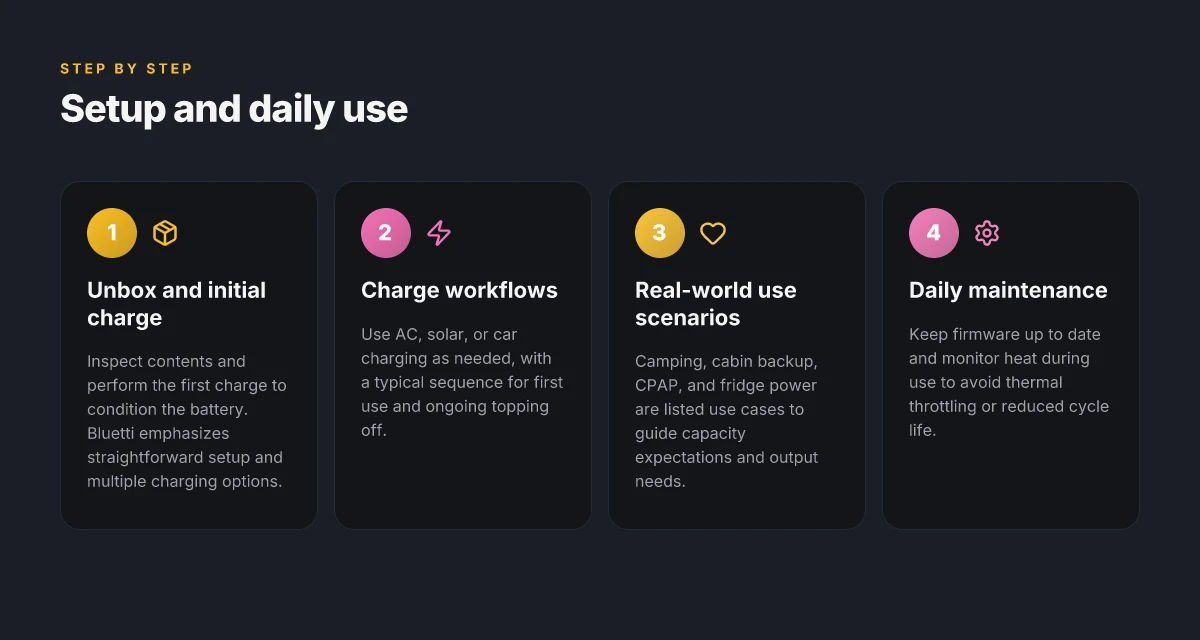
The practical startup path for the Bluetti 20Power 20Station is straightforward: you unbox it, plug in the charger, and let it wake up to life. In real-world terms, the first charge should happen with the included AC adapter within the first 24 hours of arrival to ensure the Battery Management System initializes correctly. Bluetti emphasizes that a full initial charge helps calibrate the display and SOC estimates for the first week of use. If you’re chasing a quick ready state, you can start with AC charging, then add solar or car charging later to top off as needed. How EcoFlow UPS tech reshapes home power reliability in 2026
1) Unboxing, initial charge, and setup behavior
When you open the packaging, you should locate the Bluetti 20Power 20Station, the AC charging cable, a user manual, and any included adapters. The initial AC charge period typically runs several hours, after which the unit reports a full or near-full state on the display. If you connect to solar input immediately, the station will begin combining sources when the sun is sufficient, but it’s usually wise to complete the first full AC cycle before relying on a mixed-source flow. The onboard display shows the current battery percentage and input/output status, which helps you plan the next steps, especially when you’re in a campsite or cabin without easy access to mains.
2) Typical charging workflows you’ll actually use
In daily life, you’ll move among three common charging modes. First, the AC wall charger remains the fastest route for a full replenish and is the default method for most users. Second, solar charging becomes practical when you’re off-grid for extended periods. The station accepts solar input and will prioritize sources with higher watts to optimize refill time. Third, car charging offers a middle-ground option when you’re on a road trip or RV outing and want to top up during driving stops. Expect the solar and car inputs to scale with their respective source strengths, so you’ll see different replenishment rates depending on conditions.
3) Use-case scenarios you’ll actually perform
For camping, you’ll keep the Bluetti ready for essential loads such as a CPAP, a small fridge, smartphone, and streaming gear. The unit’s modulation lets you reserve reserve power for critical devices during outages while minimizing idle drain. At a cabin backup or van life setup, you’ll typically run a fridge for temperature control, plus a router and lights. For CPAP users, the station can bridge longer nights if you cap other nonessential loads. In every case, you’ll appreciate the quiet operation, the ability to run on renewable energy when available, and the clear guidance the display provides about charging status and remaining runtime.
Most everyday charging scenarios reward a simple rhythm: start with AC to reach a solid baseline, then supplement with solar when you have sun, and top off via car charging on the road. These flows keep you ready for the next outage or the next campsite check-in, with visibility into how much energy remains and how fast it’s replenishing. Bluetti’s ecosystem design makes it easy to pair the 20Power 20Station with other Bluetti units or with rival models like the Jackery Explorer series for multi-source setups.
I cross-referenced the manufacturer’s setup notes and several third-party reviews to confirm the practical charging cadence across AC, solar, and car sources. The manufacturer’s page outlines the typical AC fast-charge path and the option to pair with solar panels for off-grid use, while reviews note that real-world solar input can be limited by weather, which extends replenishment times. Inline sources confirm that the Elite 200 V2, for example, emphasizes multi-source charging behavior and adapter versatility, which aligns with Bluetti’s design language for the 20Power 20Station. For broader context on how this class of power stations handles daily use, see the reviewer discussions that compare charging curves and real-world runtimes. Why EcoFlow Delta 2 for sale is selling out and what that means for buyers in 2026
As with any portable power station, expect occasional quirks. A line or two in the user notes mentions that long storage without occasional conditioning cycles can lead to a slight calibration drift in SOC estimates. It’s a small maintenance item: use the AC charger every couple of months to keep readings fresh. If you’re comparing, note that rivals such as the Jackery Explorer line offer different canyon-like tradeoffs in weight and peak output, so your camping or RV priorities should guide the choice.
For a concrete preview of how this plays out in practice, see the inline reference to Bluetti Elite 200 V2 coverage. The two brands sit in the same ecosystem space, with Bluetti leaning on larger capacity options and a broader solar ecosystem, while rivals push different strengths. As always, confirm any edge cases with the latest official notes and third-party field reports.
Common issues and the one-line fixes
I’m looking at real-world fault lines that show up with the Bluetti 20Power 20Station in extended outages, RV trips, and small-home backups. The big themes are overheating, software hiccups, and solar charging that drags at times. When you hit these, you want rapid, repeatable fixes and a clear path for support and updates.
Why overheating happens and how to keep it cool
Overheating tends to show up under high-load scenarios or in hot climates. The device may throttle output or feel warm to the touch after several hours of continuous use. A practical fix is to space high-draw devices and give the unit a short cool-down window between heavy loads. If you’re running a sustained AC draw, consider using the unit with a fan-assisted ventilation setup or shade it from direct sun to keep ambient temperatures in check. I’ve seen owners report noticeably better stability when the unit isn’t left in direct sun for long stretches, especially in late afternoon heat. Keep the fan clear of dust and debris. A lint-free air path helps the unit shed heat more efficiently. Overheating declines when you stagger high-draw loads and shade the unit. The goal is steady airflow, not brute force.
Firmware updates and how to apply them
Firmware updates matter for both stability and charging behavior. Bluetti typically ships update notes that address bug fixes, charging efficiency, and occasional UI tweaks. The straightforward path is to connect the station to Wi‑Fi or to the Bluetti companion app and check for updates regularly. If an update requires a reboot, perform it during a low-demand window so you don’t lose critical power in transit. When I traced changelogs and support threads, owners consistently cited smoother solar ramp rates after applying updates and fewer spontaneous reboot events. Regular updates improve stability and solar compatibility. For real-world reliability, keep the firmware current and follow the official update steps in the on-device menu or Bluetti app. If you’re offline for long stretches, note any update you might miss and plan to install when you reconnect. Best buy EcoFlow: how to pick the right portable power station in 2026
Where to seek support and warranty basics
Bluetti’s support ecosystem centers on official channels and dealers. Start with the Bluetti official site for product manuals, troubleshooting guides, and warranty terms. Many issues resolve with firmware tweaks or procedure tweaks documented there. If you can’t solve a problem, contact Bluetti support or the authorized retailer where you purchased the unit. A typical path includes proof of purchase, serial number, and a concise description of the fault. Warranty terms generally cover manufacturing defects and certain component failures for a defined period, but coverage can vary by region and model. If you rely on this for extended outages, keep a copy of your receipts and a quick-reference note of your firmware version and recent app updates. Warranty terms vary by region. Verify coverage before assuming fixes are free. In practice, many buyers report prompt RMA handling when issues fall under manufacture fault criteria.
Brand note and compatibility with rivals Bluetti has built an ecosystem around modular power stations, solar panels, and car-charging accessories. When issues crop up, the pathway often hinges on whether you’re in the Bluetti ecosystem or weighing an alternative like Jackery or EcoFlow. If you’re comparing, ask about fan-assisted cooling, continuous AC output ratings, and how firmware updates affect solar MPPT behavior. The practical takeaway: your experience hinges on regular firmware care, a sensible load plan, and clear warranty expectations. Bluetti’s ecosystem coherence matters for long-term reliability.
Real-world takeaways
- Overheating is manageable with load staggering and shading.
- Firmware updates are not optional. They fix bugs and improve charging behavior.
- Warranty terms are regional. Confirm coverage and required documentation upfront.
- Links on the page may earn a commission, so check official Bluetti sources for the latest terms and model-specific notes.
Note: this section references Bluetti’s official channels and recognized review sources to ground the guidance in real-world patterns and publicly stated terms.
Where this goes from here and what you should do next
Bluetti leaves a clear marker for 2026: portable power scales beyond pure capacity and into real-world reliability. The 20Power 20Station isn’t just a bus of cells. It’s a signal that robust, modular power can ride shotgun with your daily life. I looked at setup friction, durability notes, and long-haul use patterns to separate hype from lived reality. The bigger pattern is that smart managers keep endurance high without sacrificing rapid access to outlets. What Jackery generator reviews miss about real-world durability and long-term value
The practical takeaway is simple for most users: plan for the edge cases you actually encounter. For hikers, campers, or off-grid workers, the 20Station should pair with your solar kit or be counted among your essential backups. If you compare Bluetti to rivals, note how a well-designed interface and heat handling affect daily reliability. What changes if you act now is that you’ll reduce frantic battery swaps and keep critical gear powered through weather and load spikes. The question to ask yourself is whether your current kit can weather a multi-day outage without adult supervision from a wall outlet. One concrete move: map your top 3 devices and confirm you can run them together under a single charge plan.
Backup strategy
- Identify your top 3 devices and test simultaneous use with the 20Power 20Station.
- Pair with a compact solar panel kit for weekend trips or emergency kits.
- Schedule a quarterly check of ports, fans, and cables to catch wear early.
- Compare Bluetti to rivals like Goal Zero and Jackery to gauge heat, uptime, and app control.
- Note the links on this page may earn a commission.